
Medium Super CA Glue Kit
4.7Editor score
Two large adhesive bottles
Multiple precision microtips
Broad multi-material compatibility
This 3D Printer Super Glue guide compares ten formulas for bonding PLA, ABS, PETG, TPU, and resin prints with confidence and precision.
3D printer super glue can turn separate printed pieces into a durable model, prototype, repair, or functional assembly. A useful adhesive must bond effectively to common filaments, cure without leaving distracting residue, and flow precisely enough for small seams, figures, and multipart projects.
The products in this guide were compared using their published specifications, material compatibility, applicator design, viscosity, cure-time information, container format, and intended uses. The list covers thin and gel formulas, kits with extra tips, and options for both delicate models and repeated workshop repairs.
Each review explains the strongest reason to choose that adhesive, along with its practical limitations. The top picks highlight the most balanced options for general makers, detailed work, and demanding repairs, while product availability and prices can change at any time.
4.7Editor score

4.7Editor score

4.6Editor score
This side-by-side comparison organizes the ten adhesives by formula, supported materials, application system, container size, and practical maker use, making it easier to identify the right option for assembly or repair.




This 3D Printing Super Glue Gel carries a 4.7 rating and stands out as the most balanced option in the guide. It is formulated around the realities of printed assemblies: uneven layer lines, imperfect contact surfaces, vertical parts, and joints that need more than a simple drop of conventional household adhesive. Its no-drip gel format gives makers more control without requiring a complicated dispensing system.
We may earn a commission when you buy through this link, at no additional cost to you.
Compatibility is one of its main strengths. The published specifications identify PLA, ABS, PETG, TPU, ASA, and nylon as supported materials, covering most popular desktop-printing filaments. The gel remains in the intended contact area, which is especially useful on vertical seams, complex joints, and support structures. A precision needle and anti-clogging design support repeatable placement, while the large tube is better suited to frequent repairs than a tiny disposable container.
The product also claims resistance to temperatures up to 110°C and exposure to humidity. Those characteristics make it relevant for RC components, mechanical fits, and outdoor-printed parts, although actual performance depends on geometry, surface preparation, and loading conditions. As with all cyanoacrylate-style products, the thick formula can be less forgiving than a thin liquid when the two mating surfaces do not make close contact.
This is the recommendation for makers who want one dependable adhesive for many common filaments and several kinds of projects. It is particularly suitable for layer repairs, post-processing, functional parts, and assemblies where keeping glue on the joint matters. Choose it over the thinnest options when wicking, running, or visible squeeze-out would be undesirable.
The no-drip gel is designed to remain where applied instead of traveling rapidly down a vertical surface. That behavior gives a maker time to align a part, supports small or uneven joints, and reduces cleanup around model details.
The stated material range covers PLA, ABS, PETG, TPU, ASA, and nylon. This makes the tube a practical single-product option for mixed-filament workshops, although every new material combination should be tested on a small sacrificial print.
We may earn a commission when you buy through this link, at no additional cost to you.
This 3D Print Glue has a 4.5 rating and focuses on a problem common to printed models: joints that are not perfectly flush. Warped edges, layer lines, and slight dimensional differences can leave large areas of a joint unsupported. The high-viscosity formula is intended to stay in that contact region and bridge small gaps rather than disappearing into a poorly fitting seam.
We may earn a commission when you buy through this link, at no additional cost to you.
Its controlled flow is useful for models, props, prototypes, and display repairs. The listed material support includes PLA, ABS, PETG, TPU, and resin, making it one of the more versatile choices in the roundup. Three precision applicator tips provide some control when placing beads along figure limbs, base sections, angled joints, or the edges of prototype housings.
The adhesive positions in approximately 45 seconds and reaches full cure in 24 hours. That distinction matters because a fast initial set is not the same as maximum final strength. The finished bond is described as suitable for normal display use and minor bumps, but the manufacturer specifically advises against using it on hinges or joints that are repeatedly flexed.
This glue is a sensible choice when cosmetic continuity matters as much as adhesion. It can help reduce dark, bulky seam lines and preserve the appearance of collectibles, miniatures, architectural models, and presentation samples. Buy it for static assemblies and repair work, but select a more flexible or specialized solution for moving mechanisms.
The thick formula is especially useful when mating surfaces are not perfectly flat. By remaining near the seam, it can create a fuller connection than a runny adhesive while keeping the joint visually restrained.
A clear bond line and controlled beads help protect panel lines, surface texture, and nearby decorative details. This is advantageous for collectibles and miniatures where a conspicuous repair line can undermine the finished appearance.
We may earn a commission when you buy through this link, at no additional cost to you.
This CAMALEAO kit has a 4.4 rating and presents a compact but unusually complete adhesive package. The set combines a 1 oz medium-viscosity bottle, an additional 1 g aluminum tube, extra anti-clogging caps, and six precision microtips. It is an attractive choice for a home maker who wants portability, quick curing, and several application options without maintaining a large inventory.
We may earn a commission when you buy through this link, at no additional cost to you.
The medium formula is described as comparable to syrup, offering a balance between flow and control. It is advertised at 2610 PSI with a cure time of 5–30 seconds and a permeability of 0.008 inches. The intended bonding applications include PLA, ABS, PETG, and TPU, particularly where layer lines need to be joined into a structurally coherent prototype. The manufacturer also lists compatibility with metals, leather, wood, ceramics, and pottery.
A built-in steel pin in the cap helps keep the nozzle open, while the additional aluminum tube makes the kit convenient to carry or keep in a separate toolkit. The quick cure is a major benefit when repairing a broken print and needing to move directly to the next assembly step. The trade-off is limited working time: a maker who needs to reposition a part after touching the adhesive may find five seconds too short.
The set is best for detailed bench work, quick repairs, and users who appreciate having backup tips and caps. It also suits projects that mix printed parts with other materials. Test the adhesive on the specific filament and joint geometry before committing a valuable model, particularly where appearance or long-term flexing matters.
The extra tube, caps, and microtips make this more than a single bottle. It provides useful backup components for a workshop where nozzles can clog, tips can wear, or a compact travel kit is desirable.
The syrup-like formula is intended to penetrate small layer-line gaps without behaving like the thinnest possible CA liquid. That middle ground can be helpful across prototypes, miniatures, and models made from several materials.
We may earn a commission when you buy through this link, at no additional cost to you.
This 3D Printer Glue earns a 4.6 rating and stands out as a value-oriented choice with two complementary applicators. A brush can distribute a smooth layer over broad mating surfaces, while the small dropper targets seams, cracks, corners, and fine details. That flexibility makes the 50g bottle useful for both model assembly and repeat repair work.
We may earn a commission when you buy through this link, at no additional cost to you.
The stated filament support includes PLA, ABS, PETG, TPU, and resin, so it fits a broad range of models, miniatures, prototypes, and functional builds. The initial set occurs in about 30 seconds, allowing makers to align parts quickly. Maximum bond strength is expected after 24 hours, an important qualification for anyone planning to load or flex a repair immediately.
The built-in steel pin in the cap helps seal the nozzle and reduce dried glue between uses. A large bottle can also be more practical for a workshop that regularly assembles multipart prints, but a wider opening may expose the adhesive to more moisture than a narrow container. The brush applicator is excellent for broad joints but requires restraint around tiny features.
This is the best-value recommendation for general makers who want more than a tiny tube and appreciate having both a brush and precision dropper. It handles common printed materials and straightforward household or hobby repairs. Use the brush for larger contact zones and the dropper for controlled lines, keeping both applications thin and deliberate.
A broad joint and a tiny model detail do not require the same dispensing method. The included brush and dropper let a maker spread or place adhesive without transferring glue between tools and workpieces.
The 50g capacity is practical for multipart assemblies, crack repairs, and recurring projects. It reduces the need to replace a small tube frequently, although the cap should still be secured promptly after use.
We may earn a commission when you buy through this link, at no additional cost to you.
This All-Purpose Super Glue Gel holds a 4.6 rating and is built more for general repair work than for a narrowly defined filament list. Its 50g container and gel format position it as a substantial bench supply for household fixes, crafts, industrial tasks, and 3D-printed parts that need an instant adhesive.
We may earn a commission when you buy through this link, at no additional cost to you.
The formula is described as rapid drying, reaching maximum handling durability in seconds, while maintaining a crystal-clear finish. That combination can appeal to users repairing decorative items, models, or assemblies where a visible adhesive line would be distracting. The airtight precision tip and anti-clogging safety cap are designed to support consistent flow and reduce drying during storage.
The product does not publish a specific list of compatible 3D printing filaments. That makes it a less straightforward choice than products explicitly formulated for PLA, ABS, PETG, TPU, or resin. Makers should not assume compatibility merely because many plastics can be bonded by cyanoacrylate adhesives. Printed surfaces, plasticizers, and the chemistry of each filament can affect performance.
This glue is best for a general-purpose repair kit or for a maker who values a clear finish and a large gel supply. It is particularly suitable when a print has broken and needs a rapid cosmetic fix rather than a heavily engineered joint. Test it on a scrap piece first, and use only a small amount to avoid squeeze-out or a raised seam.
The invisible finish is the main cosmetic advantage. It can be useful for decorative items and printed models where the repaired area should blend into a smooth or lightly textured surface.
The large gel container is suited to frequent household and craft repairs. It also avoids the constant replacement cycle associated with very small adhesive tubes, making it convenient to keep beside a general tool collection.
We may earn a commission when you buy through this link, at no additional cost to you.
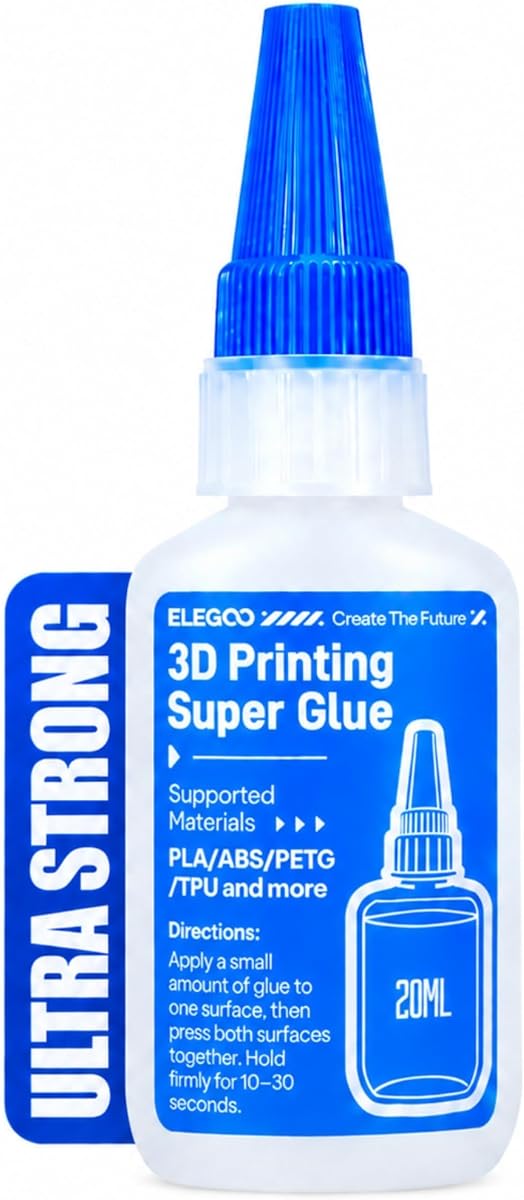
The ELEGOO 3D Printer Super Glue has a 4.5 rating and places appearance and precise application at the center of its design. It is explicitly intended for printed models rather than ordinary household repair, with compatibility listed for PLA, ABS, PETG, TPU, ASA, resin, and other materials.
We may earn a commission when you buy through this link, at no additional cost to you.
Its low-bloom, clear finish is particularly useful when the repaired part will be displayed. Whitening around a joint can make an otherwise strong repair immediately visible, especially on dark or highly detailed prints. The fine-tip applicator lets the user place a small amount on small components and complex assemblies with less risk of flooding nearby details.
Initial bonding is stated at 10–30 seconds at room temperature, followed by full strength development within 24 hours. This rapid set supports an efficient workflow for model assembly and small post-processing repairs. However, quick alignment is still essential: once the adhesive grabs, forcing a misaligned part can damage fine geometry or leave a permanent offset.
The 20ml container is modest, so this is primarily a dedicated detail adhesive rather than a bulk workshop supply. It is a strong recommendation for people building display models, miniatures, or cosmetic resin and filament assemblies where low bloom and controlled placement matter most.
Reducing visible whitening helps a repair blend into the original print. That advantage is most valuable on display pieces, finished miniatures, and any part whose surface quality is part of the finished presentation.
A narrow applicator is valuable around delicate panel lines, narrow seams, and small joints. It helps the maker limit excess adhesive, although the bottle should still be handled carefully to prevent overflow.
We may earn a commission when you buy through this link, at no additional cost to you.
This 3D Printing Super Glue carries a 4.3 rating and is the fastest-setting option highlighted in the guide. Its thin cyanoacrylate formula can set in as little as 10 seconds, making it attractive for emergency repairs where a broken print must be reassembled quickly. It is formulated for PLA, ABS, PETG, and TPU.
We may earn a commission when you buy through this link, at no additional cost to you.
The advantage of a thin liquid is penetration. It can flow into tiny seams and micro-gaps between layers, creating a connection without the bulky ridge sometimes left by a gel. It also dries transparent, which helps maintain the visual quality of display pieces, miniatures, prototypes, and precision prints. Four additional precision nozzles are included for detailed work and future replacements.
The cured bond is described as impact resistant, water resistant, and capable of handling temperatures up to 110°C. Those claims extend its relevance to RC models, drone parts, electronics, and outdoor components. The main caution is inherent to thin CA glue: it can wick across a surface, race down a vertical model, stain a finished area, or lock adjacent features before a maker can correct alignment.
This product suits users who prioritize speed and deep gap penetration over generous working time. It is especially useful for tiny cracks and layer splits that accept a minimal amount of adhesive. For larger, uneven, or appearance-sensitive joints, one of the gel options will usually provide more control.
The thin formula is designed to reach small spaces between printed layers and along tight seams. It can create a strong connection with less visible bulk, provided the user controls the amount placed on the part.
A ten-second initial set can save a broken model that would otherwise require a reprint. The user should prepare the mating surfaces and align the components before opening the bottle for the best result.
We may earn a commission when you buy through this link, at no additional cost to you.
This 3D Printer Glue has a 4.4 rating and provides a compact, clear gel formula for assembly and repair. It is specifically presented for printed models, miniatures, and prototypes, with listed support for PLA, ABS, PETG, TPU, ASA, and nylon. That broad filament coverage makes it a useful option for mixed-material hobby work.
We may earn a commission when you buy through this link, at no additional cost to you.
The gel texture is the defining feature. It helps the adhesive remain in seams, corners, and small contact points instead of quickly spreading across a surface. A precision dropper tip gives additional control around narrow details, while the clear formula is intended to maintain a discreet bond line after curing.
An anti-clog cap is designed to reduce blockage between uses, and the 30g size fits comfortably on a craft table, model station, or near a 3D printer. The compact format is more approachable than a large tube for occasional repairs, while still offering enough product for a series of assembly tasks. No detailed heat-resistance or cure-time figures are provided in the product information.
This adhesive is a sensible choice for hobbyists who want gel control in a smaller package. It works well for loose joints, broken figures, RC parts, prototypes, and small plastic accessories. Users should keep the cap secure and avoid unnecessary exposure to moisture, as with any fast-setting CA adhesive.
The controlled texture is useful on small contact points and uneven assemblies where a runny adhesive could travel beyond the intended area. It offers a practical middle ground between a thin liquid and a very thick paste.
The 30g bottle is easy to position beside a model kit, craft tools, or printer accessories. It provides more capacity than a travel-sized sample while remaining compact enough for a crowded workspace.
We may earn a commission when you buy through this link, at no additional cost to you.
This Plastic Glue has a 4.4 rating and is aimed at rigid plastic assembly and repair. Its 100g container is the largest single-bottle capacity in the guide, while the listed applications include PLA prints, model cars, miniatures, crafts, and broken plastic household components.
We may earn a commission when you buy through this link, at no additional cost to you.
The product is described as a heavy-duty, fast-setting adhesive for rigid plastics. It specifically identifies PLA, ABS, PVC, and acrylic as suitable materials, making it especially relevant to detailed plastic models and small-part repairs. The quick-setting formula is useful when a split, cracked, or separated component needs to be restored quickly.
Six precision microtips are included to help with tight gaps, corners, and detailed bonding areas. These are particularly valuable for miniature work, where too much adhesive can obscure texture or interfere with adjacent pieces. The large bottle is better suited to repeated workshop or household use than to a small travel kit, although the broad opening may require especially careful closure and storage.
This glue is a good option for rigid plastic models and everyday broken parts. It is not the strongest match for PETG, TPU, or resin projects because those materials are not included in the stated compatibility list. Makers working across mixed materials should keep a dedicated filament-compatible adhesive on hand.
The product is built around strong bonding and quick repair of rigid components. It is a practical pick for model cars, miniatures, and household plastics that have cracked or separated.
Six microtips provide options for changing flow and reaching confined areas. They are useful around fine features and tight corners where a single wide applicator would be difficult to control.
We may earn a commission when you buy through this link, at no additional cost to you.
This Medium Super CA Glue Kit has a 4.7 rating and is the most extensive package in the roundup. It includes two 2.3 oz bottles, four extra anti-clogging caps, 24 precision microtips, and a user manual. The generous components make it a premium option for active makers who perform repeated repairs across different materials.
We may earn a commission when you buy through this link, at no additional cost to you.
The medium-viscosity formula is specified at 750 CPS and compared to syrup for its balance of control and flow. It is advertised at 2610 PSI strength with a cure time of 15–30 seconds. The stated compatibility includes plastics, metal, leather, wood, ceramics, and pottery, while the product information specifically identifies PLA, ABS, and PETG for 3D-printing work.
The easy-squeeze bottles are designed for comfortable handling, and the built-in steel pins help prevent nozzle clogging. With 24 microtips, users can preserve the original tips or select different sizes for broad seams, narrow joints, and intricate assemblies. A 24-month shelf life is stated when the adhesive is stored in a cool, dry, dark environment between 35–45°F.
This kit is best for serious hobbyists, model builders, and repair benches that value a complete supply of accessories. Its large total volume and broad material compatibility justify a premium choice for frequent use. As with other fast-setting CA products, users should prepare and align parts before application, and they should not rely on the initial set for a joint that will immediately bear heavy load.
Two bottles, replacement caps, and 24 microtips cover both capacity and maintenance. The kit is designed to remain useful as the original nozzle wears or as different repair tasks require different levels of precision.
The stated compatibility extends beyond 3D printing into metal, leather, wood, ceramics, and pottery. This broad range is useful for display bases, scenic elements, hobby components, and prototypes that combine printed and non-printed parts.
We may earn a commission when you buy through this link, at no additional cost to you.
The right 3D printer super glue depends on the filament, joint geometry, cosmetic requirements, working time, and frequency of use. These factors help narrow the field before you consider brand, bottle size, or included accessories.
Begin with the materials you actually print. The products in this guide list support for combinations of PLA, ABS, PETG, TPU, ASA, nylon, and resin, while a few are described more generally. A label that explicitly names the filament you use is more useful than a broad promise that simply says it bonds plastic. Printed polymers can contain pigments, additives, and plasticizers that influence adhesion, so compatibility should be verified on a small offcut or failed print.
Choose an adhesive that explicitly supports the relevant filament whenever possible. If you regularly alternate between rigid and flexible materials, look for a formula covering both, or keep separate products for very different surfaces.
Thin CA glue flows into micro-gaps and reaches small layer-line irregularities, making it effective for hairline cracks and tight seams. Gel formulas stay closer to the application point, which is useful for vertical walls, uneven edges, and broader contact areas. Medium-viscosity formulas offer a compromise between penetration and control. The most important consideration is whether the two parts make good contact without requiring a large amount of glue to fill the gap.
Use thin glue for narrow, precise repairs and gel for controlled placement. For large mismatched gaps, neither viscosity is a substitute for improving the fit mechanically.
Fast-setting adhesives save time but leave little opportunity to correct alignment. Products in this guide claim initial set times ranging from approximately 10 seconds to 45 seconds, with full cure generally taking much longer. Before opening the bottle, inspect the joint, confirm the mating surfaces are clean, and decide exactly where the adhesive will go. A slower-working product is generally easier for beginners, while a fast product suits experienced users who prepare in advance.
Treat the advertised set time as handling time, not proof of full structural strength. Allow the stated full-cure period before loading, flexing, or testing a repaired joint.
A clear, low-bloom finish can make a repair much less noticeable. Some formulas claim near-zero whitening, while others offer a clear bond line but do not specifically address bloom. On dark, translucent, or highly textured prints, cosmetic performance may matter as much as adhesion. Gel and controlled-flow products are generally easier to keep tidy, whereas thin liquids can wick into adjacent texture or leave a visible ridge.
For display models, prioritize a clear or low-bloom formula and apply the smallest effective amount. For functional parts hidden inside a housing, faster placement and gap penetration may be the more valuable traits.
Applicators influence speed as much as the formula itself. Precision needles suit narrow seams and small details, droppers offer controlled placement, and brushes can distribute adhesive evenly across larger mating surfaces. Anti-clog caps and built-in steel pins help preserve the opening between uses. Multiple replacement tips are valuable if the original becomes blocked or if different joint sizes require different flow rates.
Choose the applicator that matches your typical work rather than the most complicated system. A fine tip is useful for figures, while a brush can be faster and more even on broad, flat panels.
Container size should reflect how often you expect to use the adhesive. A 20ml or 30g bottle may be ideal for occasional detail work, while 50g to 100g containers suit regular model building or general repair. Multi-bottle kits make sense when the user wants backup supplies and multiple applicators. Larger packaging is convenient, but it does not replace proper storage: fast-curing adhesives benefit from tightly closed caps and protection from humidity.
Avoid buying a large package for a single tiny repair. Conversely, repeated users will appreciate enough capacity to avoid frequently replacing a small tube.
Not every successful bond is suitable for every application. Static display models, rough prototypes, RC parts, and repeatedly flexed joints create very different demands. Some products are explicitly intended for normal display use and minor bumps but not hinges. Others emphasize heat, water, or impact resistance. Determine whether the joint will carry weight, experience vibration, remain outdoors, or move repeatedly before making a final choice.
For critical loads, use appropriate design methods such as mechanical fasteners or compatible joining methods rather than relying on adhesive strength alone. The glue should support a sound design, not conceal a weak one.
Even a strong adhesive performs best on clean, dry mating surfaces. Printed parts may carry oils from handling, dust from sanding, or a layer of uncured coating that prevents direct contact. Wipe the bonding area, lightly prepare it when appropriate, and allow the parts to dry fully. Avoid flooding a joint because excess adhesive can create squeeze-out, obscure panel lines, or make an otherwise straight assembly misaligned.
Always test a new product on a sacrificial part with the same filament and surface texture. This small step reveals curing behavior, residue, and bond quality before a valuable model is at risk.
Begin by cleaning and drying both mating surfaces, then test-fit the parts without adhesive. Remove any dust, oils, or loose sanding debris that could create a gap. For important repairs, make a small test on an unused print with the same material so you can confirm compatibility and observe how the joint fits before committing to the final model.
Secure the bottle, open it only when ready, and apply a small amount to one mating surface. Gel formulas work best as a short bead; thin formulas require even less material. Bring the parts together immediately, align them carefully, and hold them in the intended position until the initial set. Do not squeeze the joint afterward, and allow the advertised full-cure period before adding weight, flexing the part, or exposing it to moisture.
After use, close the cap immediately and store the bottle upright in a cool, dry, dark place away from children and pets. Do not wipe hardened glue from the nozzle with a hard tool that could damage it. Follow the cap and pin design provided with the product, and replace precision tips when they become blocked or worn.
No. Adhesive compatibility depends on the exact polymer, additives, pigments, and printed surface, so a general super glue is not automatically suitable for every filament. Look for products that explicitly list the material you use, and verify the result on a small test print. Always confirm that the joint is not intended to flex repeatedly unless the adhesive is specifically approved for that use.
Thin glue is useful when adhesive must penetrate tiny gaps, cracks, or layer-line irregularities. Gel stays closer to the application point and is usually easier to control on vertical parts, visible models, and broad seams. The better choice depends on the joint and how much room the maker has to align the pieces, not simply on the viscosity label.
Handle the part only as much as necessary after the initial set, which can range from about 10 to 45 seconds among these products. Wait for the stated full-cure period, generally around 24 hours, before placing the repaired print under load or repeatedly flexing it. Faster handling strength is not the same as maximum final bond strength.
Several products in this guide explicitly list resin compatibility, including the 3D Print Glue 30g, the 3D Printer Glue 50g, the ELEGOO adhesive, and the 3D Printing Super Glue Gel. Even with stated compatibility, resin formulations and surface finishes vary, so test on a spare piece and allow the full cure before stressing the joint.
Close the bottle immediately after use and keep the cap or built-in steel pin clean. Several products include anti-clog designs and replacement microtips, which can be swapped when residue accumulates. Store the adhesive in a cool, dry, dark place, since moisture and prolonged exposure are common causes of CA glue hardening inside the opening.
The two surfaces that will touch should be clean, dry, and free of oil, dust, loose sanding particles, and incompatible coatings. Printed parts handled frequently may have fingerprints or skin oils, so wipe them before assembly. If light surface preparation is appropriate for the material, do it carefully and remove the debris before applying adhesive.
Use caution because a rigid cyanoacrylate bond can crack or fail under repeated movement. One product in the guide specifically states that its finished bond should not be used on hinges or repeatedly flexed joints. For articulated models, remote-control components, and mechanisms, use a repair method approved for flexible movement and test the assembly through several cycles.
No. Excess adhesive can run beyond the seam, create squeeze-out, obscure details, and make parts misalign. A thin, continuous bead is usually sufficient for a close-fitting joint. If significant adhesive is needed to fill a gap, the parts may need better mechanical alignment, trimming, or additional support rather than a larger quantity of glue.
The 3D Printing Super Glue Gel is the strongest all-around recommendation because it combines broad filament support with controlled gel placement, useful environmental resistance, and a large tube. The Medium Super CA Glue Kit earns the premium position for its two-bottle supply, 24 precision tips, and compatibility across printed and non-printed materials, while the 3D Printer Glue 50g stands out as the best-value option with both brush and dropper application.
For most makers, prioritize explicit compatibility with the filament, then choose the viscosity and working time that suit the joint. Use thin glue for tiny gaps and rapid penetration, medium formulas for balanced work, and gel for vertical surfaces, uneven seams, and visible assemblies. The right applicator and a small test print can prevent most disappointing results.
Product details, ratings, availability, and prices can change, so confirm the current listing before purchasing. Also check the applicator instructions, storage guidance, and full-cure time for the selected product. With those factors in mind, you can choose a 3D printer super glue that fits both the material and the quality of finish your project requires.