
White OF-990 Slimline Wall-Mountable Basic Corded Telephone
4.0Editor score
No AC power required
Desk or wall mounting
Redial, pause, and mute
Our Cheap Landline Phone guide compares ten affordable corded and cordless models, covering call quality, features, setup, and ease of use.
A reliable landline phone can be a practical addition to a home, office, workshop, or senior living space, especially where dependable call handling matters more than advanced smart features. The best options pair straightforward operation with useful functions such as caller ID, redial, speakerphone, answering systems, call blocking, and wall mounting.
This guide compares ten inexpensive landline phones selected from the available range of corded and cordless designs. We considered the features supplied for each model, including its rating, power requirements, installation method, call-management tools, accessibility features, storage capacity, answering-machine functionality, and suitability for shared spaces.
The list includes a compact basic phone for the smallest spaces, dependable corded models for straightforward use, cordless systems for mobility, and feature-rich packages for homes that want message recording and call filtering. Product ratings and availability can change, and current prices should be checked before making a final purchase.
4.0Editor score
4.3Editor score

4.3Editor score
The comparison below highlights each phone's format, core call-handling features, and installation requirements, helping shoppers distinguish simple corded models from cordless systems and answering-machine packages.


The White OF-990 is a straightforward corded telephone built around the idea that a dependable phone should be easy to connect and uncomplicated to operate. Its 4.0 rating reflects a generally practical proposition, and the supplied details show a device designed for homes, offices, bedrooms, and other spaces where a basic line is enough. It does not rely on AC power, reducing the number of connections required.
We may earn a commission when you buy through this link, at no additional cost to you.
Its strongest benefit is installation flexibility. The phone can sit on a desk or be mounted to a wall using holes spaced 3.15 inches apart, although buyers should verify whether that spacing matches their existing plate. A simple setup involves connecting the line cord to the phone jack and network, then attaching the handset through its coiled cord. Redial, pause, and mute are included for essential call control, but the feature set remains intentionally limited.
The main limitation is the inability to adjust the ringtone volume. The stated loud setting is intended to make incoming calls difficult to miss, but it may not suit a bedroom, shared office, or quiet room. There is also no display for identifying callers, so people who regularly screen unknown calls may need to use the traditional pickup-and-listen method or consider a model with caller ID.
This is a sensible choice for anyone seeking a low-cost, no-fuss telephone that works without batteries or an AC adapter. Its practical controls, flexible placement, and simple line-powered operation make it a particularly strong fit for secondary rooms, offices, shops, and households that already know which callers matter most. It is our budget selection because it focuses on dependable essentials without adding features that increase complexity.
Because the phone requires no AC power, it avoids dependence on a wall adapter and remains closely associated with the telephone line service. That makes it a convenient option for a guest room, garage, office, or other secondary location where a simple phone is sufficient.
Desk placement keeps the compact phone close at hand, while wall mounting can save surface space in busy rooms. Check the stated 3.15-inch hole spacing before ordering because the mounting design may not fit every pre-existing wall plate.
We may earn a commission when you buy through this link, at no additional cost to you.
The AT&T 210 is a basic trimline corded phone with a 4.2 rating and a clear emphasis on familiar, uncomplicated operation. It is designed for people who want speed dialing, a lit keypad, and basic call controls without a display, answering machine, or complicated setup. Its line-powered design also removes the need for an AC adapter.
We may earn a commission when you buy through this link, at no additional cost to you.
Thirteen numbers can be stored for speed dialing, giving regular callers a quicker way to reach frequently contacted people. The illuminated keypad helps with dialing in dim conditions, while receiver volume control gives the user some flexibility during conversations. Flash, redial, a seven-foot line cord, and hearing aid compatibility round out a practical set of features for home or office use.
Those who need caller identification should look elsewhere, since the AT&T 210 has no screen or stored caller log. The wall-mountable format is useful for spaces where a desk is unavailable, although buyers should consider how comfortable a wall-mounted handset is for their preferred calling position. The product is also deliberately basic, with no speakerphone, answering system, or call-blocking system.
It is a good choice for someone who values a traditional corded telephone, visible controls, and quick access to a personal speed-dial list. The lack of AC power makes setup convenient, and the hearing aid compatibility adds meaningful accessibility. For a guest room, small office, kitchen, or second phone location, it offers a balanced mix of useful conveniences without the complexity of a digital cordless system.
The 13-number memory turns frequently used contacts into one-touch or short-sequence dialing. This is especially helpful for people who make the same calls every day and prefer not to enter a complete number each time.
A lighted keypad makes the dial buttons easier to identify in dim rooms. Combined with hearing aid compatibility and receiver volume control, it creates a more accessible everyday calling experience.
We may earn a commission when you buy through this link, at no additional cost to you.
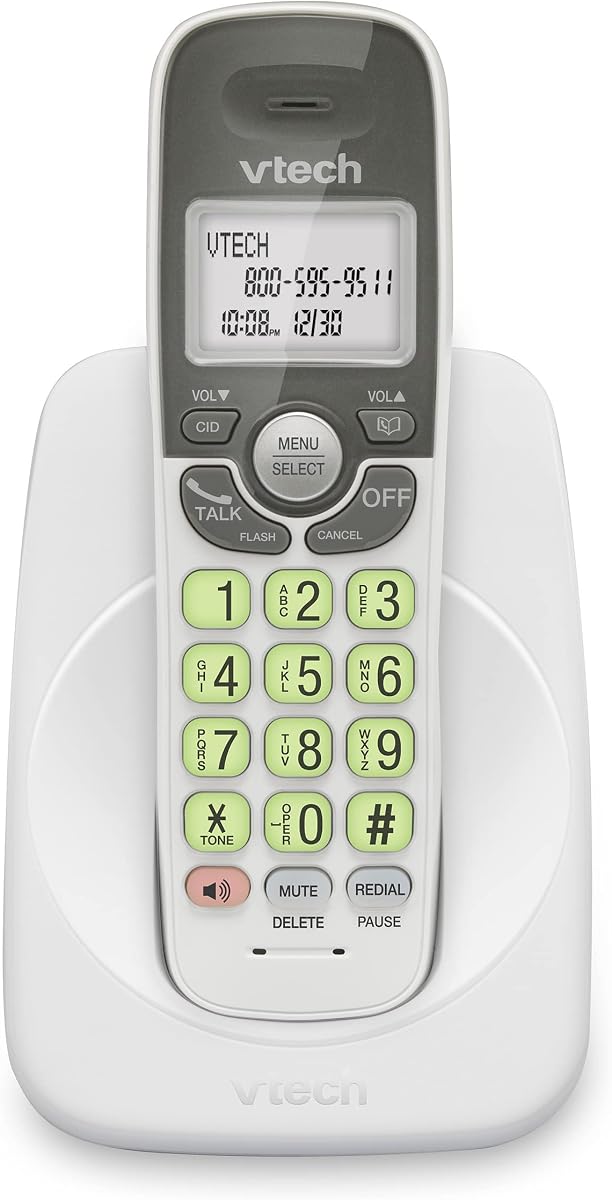
The VTech VG131 is a well-rounded cordless landline phone with a 4.3 rating and a broader feature set than most basic models. It combines DECT 6.0 technology, a full-duplex speakerphone, illuminated controls, caller ID, call waiting, and a sizable contact directory. It is a natural choice for households that want to move around while talking without giving up a conventional home phone.
We may earn a commission when you buy through this link, at no additional cost to you.
The supplied specifications describe a stable operating range of up to 1,000 feet outdoors, making the cordless format more flexible than a tethered handset. A full-duplex speakerphone allows both parties to talk and be heard simultaneously, which is useful for group conversations. The blue-white backlit display and green illuminated keypad improve visibility in darker conditions, while one-touch volume and mute controls reduce menu navigation.
Contact and call-history storage is another major advantage. The phonebook holds 30 names and numbers, the caller ID log retains 20 entries, and the call history records five recently called numbers. English, Spanish, and French language settings are supported. The base is designed to mount on standard wall plates without an extra bracket, making it flexible for both a central table and a mounted location.
The main omission is an answering machine. That means the VG131 is better for homes that use a separate voicemail service, want to answer promptly, or do not require physical message recording. It also needs a powered base even though the handset is cordless. Despite that limitation, the combination of mobility, clear controls, useful storage, and accessible lighting makes it our overall cordless recommendation and the most versatile model in this guide.
DECT 6.0 allows the handset to be carried away from the base, which is useful in larger homes, workshops, and offices. The stated outdoor range reaches up to 1,000 feet, although interior walls, furniture, and other environmental factors can affect practical reception.
The display presents caller names, numbers, time, and date, while separate directories retain contacts and recent call records. This gives the phone more day-to-day utility than a purely basic model without requiring a complex setup.
We may earn a commission when you buy through this link, at no additional cost to you.
The TelPal FSK/DTMF telephone combines a traditional corded design with a small LCD caller ID display. Its 3.9 rating places it among the more modestly rated selections, but the supplied feature list gives it a useful purpose: identifying incoming callers and retaining call information in a compact desk or wall-mounted format.
We may earn a commission when you buy through this link, at no additional cost to you.
The display shows the incoming number along with the real time and date. Storage extends to 50 groups of incoming calls and 16 groups of outgoing calls, which is unusually generous for a basic corded phone. Hold and redial controls add everyday convenience, and the product is powered by the telephone line rather than batteries, eliminating routine battery maintenance.
Its clear-voice description suggests a focus on stable, intelligible conversations for home or office use. The simple design also avoids learning a more advanced interface. That makes it a reasonable option for someone who wants caller ID and history but has no need for a cordless handset, speakerphone, answering machine, or extensive call-blocking features.
The lower rating and relatively basic specification set are the main considerations. Buyers who require advanced call filtering or message recording will need one of the cordless multi-handset systems. For a small office, reception area, bedroom, or other location where a compact corded phone and visible caller information are the priorities, however, this model provides a focused and practical solution.
Fifty incoming and 16 outgoing call entries provide a broad record of recent activity. That can be useful when a user needs to compare several numbers or return a missed call without relying on handwritten notes.
The tethered handset and line-powered operation remove wireless range and battery concerns. Its small desk format and wall-mount option also make it adaptable to compact rooms, reception areas, and home offices.
We may earn a commission when you buy through this link, at no additional cost to you.
The AT&T BL102-2 is a two-handset DECT 6.0 cordless system designed as a more complete home telephone solution. Its 4.2 rating is supported by an extensive feature set: a digital answering machine, automated robocall blocking, caller ID announcement, Audio Assist, intercom, full-duplex speakerphone, and a large high-contrast display.
We may earn a commission when you buy through this link, at no additional cost to you.
The answering system can record up to 22 minutes of incoming messages, outgoing announcements, and memos, with a voice guide intended to simplify setup. Call filtering is a major strength. Robocalls can be automatically blocked before they ring, announced callers can be screened, and the dedicated call-block key provides one-touch access to a directory that holds as many as 1,000 name and number entries.
Accessibility receives particular attention. The handset has a two-inch screen with large high-contrast text, an enlarged illuminated keypad, and Audio Assist. A full-duplex speakerphone supports natural conversation with both sides talking and listening simultaneously, while the intercom allows communication between the included handsets. The antenna design and noise filtering are intended to improve range and clarity.
This is the premium pick for households that need two locations, physical message recording, and detailed call screening. It is less suitable for a user who only needs one handset in a small room, and the system involves more controls than a basic corded phone. Even so, the combination of answering-machine capacity, a large block directory, accessible display, and two-handset convenience gives it the strongest all-around feature package among the more elaborate options.
The digital answering system records up to 22 minutes and can also store an outgoing announcement or memo. This makes the system useful for households that do not want to depend entirely on a carrier voicemail service.
Automatic robocall blocking, announced caller screening, and a 1,000-entry block directory give users several ways to reduce interruptions. The caller ID announcer can also identify who is calling before the user decides whether to answer.
We may earn a commission when you buy through this link, at no additional cost to you.
The AT&T TR1909 gives users the familiar trimline corded format with a more useful information display than a purely basic telephone. It carries a 4.1 rating and includes caller ID, call waiting, an 80-name and number history, 13-number memory, display dialing, and standard call controls.
We may earn a commission when you buy through this link, at no additional cost to you.
The generous caller ID history is one of the most useful parts of the specification. Instead of losing incoming contact details after a short list is filled, users can revisit names, numbers, and timing information over a much broader record. Display dialing also allows a stored number to be called without manually entering every digit.
Everyday controls include mute, flash, last-number redial, and ringer volume adjustment. The phone can be placed on a desk or mounted on a wall, which gives users flexibility based on the room. It keeps the operation model of a traditional corded phone, so there is no wireless pairing, roaming handset, or charging routine to manage.
The tethered design is the central trade-off. Users cannot carry the phone far from the base, and a separate voicemail or answering-machine service may be needed for unattended messages. Even so, the TR1909 is an effective middle ground for someone who wants the reliability and familiarity of a corded phone but also needs visible caller information and a substantial call log.
An 80-entry caller ID history preserves substantially more incoming information than many simple corded phones. This makes it easier to identify a missed call, recover a contact number, or recognize a returning caller.
Mute, flash, redial, and ringer volume controls are available directly on the phone. There is no need to manage a cordless handset battery or pair the device with a base for everyday calling.
We may earn a commission when you buy through this link, at no additional cost to you.
The Panasonic two-handset cordless system combines an answering machine, extensive call blocking, and scam awareness in a package built for home use. Its 4.3 rating and feature set make it one of the strongest choices for shoppers who want more than a single basic handset without moving to a complex business system.
We may earn a commission when you buy through this link, at no additional cost to you.
Advanced call blocking is the defining feature. Automated Call Block pre-blocks robocalls, Telemarketing Call Block handles announced marketing calls, and a dedicated one-touch button lets users add up to 1,000 more blocked numbers. The one-ring scam alert presents a confirmation screen when a missed one-ring call is returned, providing a safeguard against a common deceptive calling pattern.
Telephone conversations can be recorded and replayed using the system's two-way recording feature, while an announcement that recording has started is intended to deter suspicious callers. The illuminated keypad uses large characters for easier operation, speed dialing provides quick access to frequent contacts, and the wall-mountable design keeps the phones available in convenient locations.
This system is a strong fit for households seeking two cordless extension points, message capture, and active control over unwanted calls. It asks more of the buyer than a simple corded model because each handset must be charged and kept near its base. For users who value convenience and call management over a minimal interface, though, the added functionality is the central reason to choose it.
The combination of automated robocall blocking, announced telemarketing screening, and a large one-touch block directory gives users several levels of control. The one-ring confirmation screen adds an extra check before returning a suspicious missed call.
Two handsets make it possible to keep a phone in separate rooms without buying two complete systems. The wall-mountable design also helps conserve space and keeps frequently used devices within reach.
We may earn a commission when you buy through this link, at no additional cost to you.
The VTech CD1113 is a corded phone designed specifically for a home office, with caller ID, call waiting, dedicated speed-dial keys, and flexible wall mounting. Its 4.0 rating reflects a solid balance of traditional operation and useful call-history tools, making it appropriate for users who do not need cordless mobility.
We may earn a commission when you buy through this link, at no additional cost to you.
The speed-dial arrangement includes three dedicated one-touch memory keys and 10 additional numbers available through two-touch dialing. Caller ID records can hold 80 entries, and numbers from the log can be dialed directly from the display. Last-number redial, adjustable ringer and handset volume, flash, and mute are also included.
The line-power mode is a practical advantage because the telephone can operate without an AC adapter. The stated standby and talk times are framed around line-powered use, and the phone indicates when backup batteries are low. For full caller ID operation, three alkaline AA batteries are needed, but they are not included with the product.
This model is a good option for a dedicated desk, reception area, or home office where a stationary telephone is preferred. It has more information and memory than a basic phone but avoids cordless pairing, charging, and roaming. The battery requirement for full caller ID functionality and the fixed handset are the main compromises for buyers who prioritize setup simplicity or mobility.
Three one-touch keys can be assigned to regularly used numbers, while ten more are available through the keypad. This gives the phone enough memory to support a busy daily calling routine without storing every contact as a full one-touch button.
The 80-entry caller ID log preserves names, numbers, times, and dates when the required AA batteries are installed. Users can also dial a listed number directly from the display rather than re-entering it.
We may earn a commission when you buy through this link, at no additional cost to you.
The Black OF-990 is an extremely compact basic corded telephone designed for locations where surface space is at a premium. Its 4.1 rating and narrow 6-centimeter width make it appealing for a bedside table, small workbench, reception counter, hallway, or other tightly arranged area.
We may earn a commission when you buy through this link, at no additional cost to you.
Installation requires only a telephone line connection, with no batteries to install or recharge. The phone can be placed on a desk or mounted to a wall. Its stated ringtone reaches up to 90 decibels, and the manufacturer says the phone is suitable for noisy places, larger spaces, or homes where calls need to carry across multiple rooms.
The fixed ringtone is the decisive limitation. It cannot be lowered, which may make the model unpleasant in a bedroom, quiet office, or shared living area despite its compact size. There is also no caller ID screen or detailed call history in the supplied specifications, keeping the phone focused on basic receiving, placing, and redialing needs.
Buyers who require a loud, hard-to-miss ring in a workshop, garage, shop, or spacious home may find this model especially suitable. It is less attractive for shared sleeping quarters or anyone sensitive to ringing volume. Its strongest benefit is focused simplicity: a small footprint, a wired connection, and no battery routine.
The phone's stated width of only 6 centimeters makes it easy to place where a full-size corded telephone would be inconvenient. Wall mounting provides an alternative when keeping the surface completely clear is more important.
A ringtone stated to reach up to 90 decibels is useful in noisy workspaces or larger rooms where a quieter traditional phone may be difficult to hear. Since the volume is fixed, buyers should consider whether that level suits the intended location.
We may earn a commission when you buy through this link, at no additional cost to you.
The HD Sound Corded Phone is a basic home-and-office telephone designed with large buttons and a straightforward interface. Its 3.8 rating is the lowest among the ten selections, so buyers should weigh its accessibility-focused construction against the more extensive features offered by several alternatives.
We may earn a commission when you buy through this link, at no additional cost to you.
The large polycarbonate buttons are intended to make the phone easier for seniors and people with limited vision or dexterity. The simple layout avoids unnecessary complexity, while the corded construction provides a stable connection and reduces the chance of a handset being misplaced. The product is described as suitable for homes, hotels, offices, and call centers.
The most important limitation is the absence of volume control. That matters when hearing comfort varies between callers or when a shared environment calls for a lower listening level. The product title references HD sound, but the supplied information does not provide detailed technical specifications for that claim, so it should be evaluated primarily as a basic accessible handset rather than an advanced audio system.
This phone makes the most sense for a gift for an older adult, a straightforward office extension, or a location where a user benefits from oversized keys and a simple corded design. It is not the strongest option for a caller ID, call history, speakerphone, or advanced call screening. Its basic construction is understandable, but the low rating and missing volume control narrow the situations in which it is the right choice.
The large buttons and uncomplicated interface are intended to reduce difficulty for seniors and users with limited vision or dexterity. Straightforward labeling and familiar corded operation can also make the phone less intimidating to new users.
Because the handset remains connected to the base, users do not need to charge it or manage a wireless link. That makes the phone dependable for a fixed desk, guest room, office, hotel, or call-center station where mobility is unnecessary.
We may earn a commission when you buy through this link, at no additional cost to you.
The right inexpensive landline depends on where it will live, how it will be used, and which calling features matter. Comparing corded versus cordless construction, power needs, sound controls, call management, accessibility, and installation constraints helps narrow the options before purchase.
Choose corded for simplicity and fixed use, or cordless when movement and multiple extension points matter most.
Check whether the phone needs an outlet, handset charging, or batteries before choosing a location.
Prioritize visible caller information and sufficient history if screening and returning missed calls are common.
Choose advanced filtering when unwanted calls are frequent, and a simple model when fewer controls are preferable.
Include message recording in the decision only if it adds value beyond the voicemail already available.
Prioritize illumination, legible text, large controls, hearing compatibility, and simple navigation when accessibility matters.
Match mute, redial, speakerphone, and volume controls to how you normally manage calls.
Measure the area, confirm wall-plate spacing, and verify access to line and power connections.
Begin by identifying the telephone service connection and checking whether the chosen model requires AC power, a rechargeable handset, or backup batteries. Corded line-powered models generally need only the included line cord, while cordless systems require their base to connect to both a telephone jack and an electrical outlet. Before mounting a phone, compare its mounting holes with the existing plate and place the unit where the handset can be reached comfortably.
Read the supplied manual before changing ringer, volume, language, call-blocking, or answering-machine settings. Test the basic functions immediately by placing a call, checking the handset or speakerphone sound, adjusting the ringer, using redial, and confirming that the display shows the expected date and time. For cordless models, keep each handset charged and return it to its base after use. For caller ID systems, install the required batteries before expecting the full memory and display features to operate.
Treat the phone as a durable household device but avoid exposing it to moisture, excessive heat, or liquid spills. Clean the handset, keypad, and base with a soft, dry or lightly damp cloth, and do not spray cleaner directly onto the unit. Check cords for damage, keep the line connection secure, and review blocked numbers, stored contacts, and recorded messages periodically. For a cordless phone, testing the handset away from the base can also reveal whether coverage is adequate in the rooms where it will be used.
No. Several basic corded models in this guide operate from the telephone line and require no AC power, while the cordless systems need their bases connected to an outlet for charging and operation. Some corded display phones also use AA batteries for specific features, so check the product requirements before installation.
The best choice depends on the user's vision, hearing, dexterity, and ability to manage charging. Large buttons, hearing aid compatibility, illuminated keypads, Audio Assist, and high-contrast displays can make operation easier. A simple corded model may be preferable for someone who wants fewer functions, while a cordless model adds convenience if charging is manageable.
Cordless phones can be highly practical for home use because they allow the handset to move between rooms. Their effectiveness depends on the technology, base placement, building materials, and interference in the home. DECT 6.0 models offer dedicated cordless operation, while the AT&T system also provides noise filtering and an antenna design intended to improve range and clarity.
It depends on whether the household uses carrier voicemail. A built-in answering machine provides a physical way to record and replay messages and may be useful if the line has no voicemail service. If voicemail is already dependable and the user prefers a simpler phone, a model without a recording system can provide plenty of everyday utility.
Caller ID memory records information about incoming calls, while a phonebook stores numbers and names selected by the user for outgoing calls. A phone with both can identify recent callers while also providing one-touch access to important contacts. Storage capacity varies substantially among the models reviewed.
Yes, but only certain models in this list include dedicated call-blocking features. The AT&T BL102-2 and Panasonic two-handset system offer automated robocall blocking, announced telemarketing screening, one-touch block controls, and large block directories. Basic corded models generally do not offer equivalent filtering tools.
Many of the reviewed phones are designed for straightforward wall mounting, but plate compatibility should be checked first. The white OF-990 specifies 3.15-inch hole spacing, while the VTech VG131 is described as fitting standard wall plates without an additional bracket. Confirm the required spacing and ensure the handset is easy to reach after installation.
A basic line-powered corded model is usually the simplest choice because it avoids charging, wireless pairing, and complicated menus. The white OF-990, AT&T 210, and black OF-990 all provide traditional handset operation. The right choice among them depends on whether you prioritize a lit keypad, speed dialing, compact size, or a loud fixed ringtone.
The white OF-990 stands out as the most economical and compact traditional option, while the VTech VG131 is the most versatile overall pick for users who want cordless mobility, a display, a full-duplex speakerphone, and generous contact storage. The AT&T BL102-2 and Panasonic two-handset system take the premium end of the list by adding answering machines and sophisticated call blocking.
Prioritize the features that match the intended room. A basic corded phone is ideal for straightforward calling, a caller ID model helps with screening, a cordless system supports movement, and a multi-handset package serves shared homes. Also consider power needs, mounting space, display visibility, hearing compatibility, and whether the home already has voicemail before making a final decision.
Ratings and product availability can change over time, and current prices should be checked before ordering. Comparing the latest listing, included accessories, and installation requirements with the needs identified in this guide will help ensure that the selected cheap landline phone provides dependable service in the place where it will be used.
