
Portable CO2 Meter Handheld
4.4Editor score
Wide 9,999-ppm range
Manual sensor calibration
Temperature and humidity readings
This Portable CO2 Meter guide compares ten monitors for accuracy, sensor type, alerts, portability, data access, and indoor air use.
A portable CO2 meter helps reveal how much carbon dioxide has accumulated in a room, office, classroom, vehicle, or other enclosed space. A useful model combines reliable sensing, clear readings, understandable alerts, practical power options, and enough portability for checking more than one location.
This guide compares ten products using the supplied specifications, with attention to measurement range, sensor technology, carbon dioxide coverage, temperature and humidity readings, alarms, display design, power requirements, and intended applications. It also identifies two carbon monoxide detectors that are useful safety tools but do not measure CO2.
Each review explains the strongest benefits, practical limitations, and likely buyer, helping distinguish dedicated CO2 instruments from broader indoor air monitors. Product ratings and availability can change, and current prices should always be checked before purchasing.
4.4Editor score

4.7Editor score

4.8Editor score
The table below compares all ten products by sensor capability, displayed measurements, alerts, and portability, while clearly identifying the two units that detect carbon monoxide rather than carbon dioxide.



The Temtop CO2 Monitor is a compact indoor instrument designed to track carbon dioxide, temperature, and relative humidity. It carries a 4.3 rating and stands out for its stated NDIR performance, one-ppm resolution, and refresh cycle of approximately five seconds. Those specifications make it useful for quickly seeing whether ventilation changes the concentration in a room.
We may earn a commission when you buy through this link, at no additional cost to you.
Its measurement range extends from 400 to 5,000 ppm, with stated accuracy of ±40 ppm plus 5% of the reading across the critical 400–2,500 ppm range. The display can be silenced, and the audio alerts can be disabled, making the monitor practical for bedrooms, nurseries, offices, and classrooms where alarms could otherwise be disruptive.
The product also includes mounting hardware and a USB cable. Its 70-day figure applies to standby rather than necessarily continuous real-time monitoring, so buyers who need always-current readings should plan to keep it plugged in. Most importantly, the unit detects CO2, not carbon monoxide, and should never be treated as a CO safety alarm.
This is a strong choice for households and small workplaces that want more frequent readings and adjustable alerts than a basic display provides. It is less suitable for demanding professional surveys, where the wider range, manual calibration, and broader environmental measurements of dedicated handheld meters may be more valuable.
The five-second refresh rate gives the monitor a practical advantage when a door is opened or several people enter a room. It makes it easier to observe a rising or falling trend rather than relying only on occasional spot checks.
Disabling sound and backlighting helps prevent unnecessary disturbance during sleep or focused work. The result is a monitor that can remain in a private room without making every alert visually and audibly demanding.
We may earn a commission when you buy through this link, at no additional cost to you.
This handheld CO2 meter is built for users who need to inspect several locations and evaluate readings in context. It has a 4.4 rating, a 0–9,999 ppm CO2 range, and a stable NDIR sensor. The handle-based format makes it more suitable for surveys of offices, classrooms, hotels, factories, and hospitals than a small stationary display.
We may earn a commission when you buy through this link, at no additional cost to you.
It goes beyond CO2 with temperature, relative humidity, dew point, and wet-bulb measurements. Stated CO2 accuracy is ±50 ppm or ±5% of the reading through 2,000 ppm, then ±10% of the reading from 2,000 to 9,999 ppm. Manual calibration for CO2 and humidity adds a useful layer of control for regular professional use.
The included battery provides flexibility when traveling or checking remote rooms. A 9V adaptor can be used for continuous operation, although it is not included, and the battery is automatically disconnected when the adaptor is connected. That arrangement adds convenience without making the meter dependent on wall power.
Choose this model if a portable instrument, manual calibration, and comprehensive environmental readings matter more than compactness. It is less convenient for a permanent bedroom display, where a smaller monitor with quiet controls and a long standby claim may fit better.
The combination of a handle, broad measurement range, and five environmental readings supports room-to-room assessments. A user can move the instrument between spaces and record a more complete picture of the indoor environment.
Manual CO2 and humidity calibration is valuable for periodic professional checks. It provides an active way to maintain measurement consistency rather than treating the meter as an unattended novelty.
We may earn a commission when you buy through this link, at no additional cost to you.
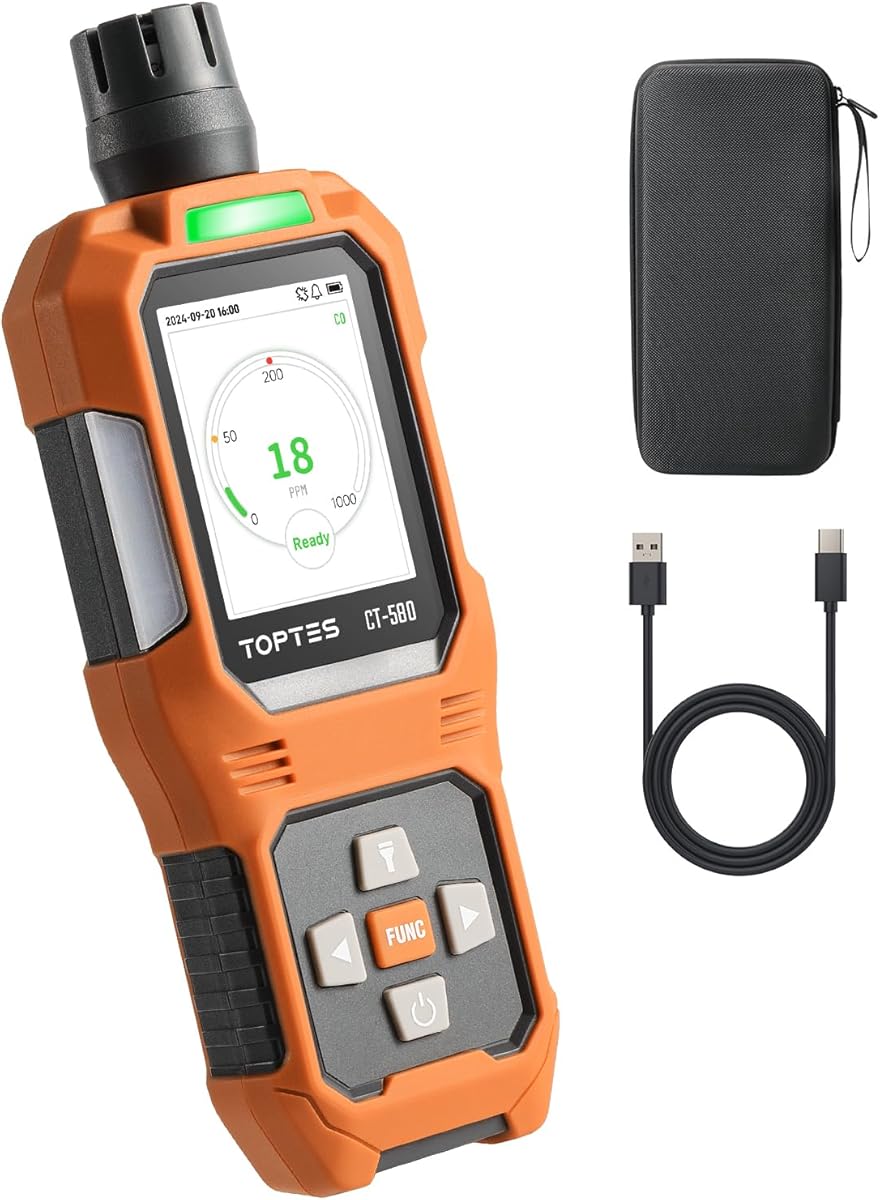
The TOPTES CT-580 is not a CO2 meter; it is a portable carbon monoxide detector. It has a 4.5 rating and monitors carbon monoxide from 0 to 1,000 ppm using a DDS sensor. It belongs in this roundup because portable gas safety devices are frequently confused with indoor air-quality monitors, but it should never be used to infer CO2 levels.
We may earn a commission when you buy through this link, at no additional cost to you.
The main strength is a layered warning system. When a threshold is reached, an indicator light, audible alarm, and vibration activate together. That combination can be useful around camping equipment, travel, industrial work, and other locations where sound alone may be missed.
A color TFT display presents readings clearly, while adjustable brightness, automatic screen shutdown, a built-in flashlight, and USB-C charging support field use. The package includes a protective case, charging cable, and manual, and the menu offers alarm history along with zero and standard-gas calibration settings.
This device is appropriate for someone who specifically needs portable carbon monoxide detection. It is not the right purchase for measuring ventilation, indoor CO2 buildup, or general air quality. Even for CO applications, a portable inspection instrument should not replace properly installed residential carbon monoxide alarms.
The simultaneous light, sound, and vibration response covers different situations. A user can notice a warning even when visual attention, hearing conditions, or ambient noise limits reliance on a single alert method.
USB-C charging, a protective case, adjustable display brightness, and an integrated flashlight make the unit more practical away from a desk. These features support travel, camping, and industrial inspection use.
We may earn a commission when you buy through this link, at no additional cost to you.
The Klein Tools ET110 is a dedicated carbon monoxide meter rather than a CO2 monitor. It holds a 4.6 rating, the highest among the products in this guide, and displays CO readings from 0 to 1,000 ppm alongside temperature in Fahrenheit and Celsius. Its primary purpose is personal safety during inspection tasks.
We may earn a commission when you buy through this link, at no additional cost to you.
Two alarm levels provide practical warning thresholds. The stated low alarm is 35 ppm, while the high alarm is 200 ppm, and both are delivered through audible and visual signals. A built-in short-term exposure limit alarm adds another layer for users who need to monitor exposure over time.
The backlit display improves readability in dim conditions, while automatic shutdown after 20 minutes of inactivity helps preserve battery life. A carrying pouch and four AAA batteries are included, so the meter is ready to carry between jobs without a separate accessory purchase.
Select the ET110 for compact carbon monoxide inspection and exposure awareness. Do not select it to measure carbon dioxide, assess particulate pollution, or track indoor ventilation. As with other portable gas meters, it complements rather than replaces fixed residential CO alarms and site-specific safety procedures.
Separate low and high alarms make it easier to distinguish a developing concern from a more serious reading. Audible and visual outputs provide useful redundancy when the display is not the user's primary focus.
The included pouch and batteries simplify transport between work locations. Automatic power-off also reduces the likelihood of draining the batteries when the meter is left unattended between readings.
We may earn a commission when you buy through this link, at no additional cost to you.
The 10-in-1 portable smart air quality monitor combines CO2 with HCHO, TVOC, AQI, PM2.5, PM1.0, PM10, temperature, and humidity. Its 4.8 rating is the highest listed here, and the variety of measurements makes it an appealing all-around indoor monitor for users who want more than a single CO2 number.
We may earn a commission when you buy through this link, at no additional cost to you.
A high-definition color screen visualizes readings in real time, while the display changes color when conditions exceed safety thresholds. That makes the unit useful at a glance in homes, offices, bedrooms, vehicles, schools, hotels, basements, restaurants, grow rooms, and other indoor spaces.
The stated sensor arrangement combines intelligent CO2 detection with electrochemical HCHO and TVOC sensors and includes smart calibration for stable output. One limitation is that the supplied specifications do not itemize measurement ranges or numerical accuracy for each individual pollutant, so it should be viewed as a broad visual monitoring tool rather than a calibrated laboratory instrument.
This is the best budget-oriented choice for shoppers who want a versatile indoor air display at an accessible market position. It is particularly useful for checking several common air-quality concerns at once. Buyers whose only requirement is a highly precise, dedicated CO2 survey should instead favor a product with explicit CO2 accuracy and calibration specifications.
The combination of CO2, VOCs, formaldehyde, particulates, temperature, and humidity reduces the need for several dedicated gadgets. It provides a convenient overview of conditions that can change together in an enclosed room.
The three-color display system communicates air-quality status quickly and from a distance. Users can check the room without interpreting every number, which is particularly helpful in a busy home or workplace.
We may earn a commission when you buy through this link, at no additional cost to you.
The Aranet4 is the most balanced dedicated CO2 meter in this group. It has a 4.7 rating and uses a nondispersive infrared sensor to measure CO2, temperature, relative humidity, and atmospheric pressure in real time. The device was made in the European Union and emphasizes dependable indoor readings rather than a large collection of approximate pollutant sensors.
We may earn a commission when you buy through this link, at no additional cost to you.
Its most impressive convenience feature is the cable-free design. The power-efficient e-ink display is claimed to support a battery life of up to four years, allowing users to place it in a room without a nearby outlet. A prominent CO2 number, color coding, and an optional buzzer make the basic operation straightforward.
The companion smartphone application adds substantial value by storing and graphing up to 90 days of historical data. This turns the monitor from a momentary display into a tool for seeing how occupancy, weather, and ventilation affect the room over time. A drawback is that it remains focused on a relatively small set of core measurements.
For most people seeking a dependable portable CO2 meter, the Aranet4 offers the best combination of measurement credibility, long battery life, readable design, and data history. It is ideal for a bedroom, home office, classroom, or meeting room where the user wants one clear environmental signal rather than a crowded multi-sensor dashboard.
Ninety days of app history and interactive graphs make it possible to distinguish a temporary spike from a recurring ventilation problem. That long-term perspective is more informative than a single instantaneous reading.
The claimed four-year e-ink battery life removes much of the inconvenience of continuous placement. Without a cable to route, the monitor is easy to position on a shelf, desk, or table where occupants will naturally see it.
We may earn a commission when you buy through this link, at no additional cost to you.
This AK3-style 8-in-1 monitor is designed for people who need to check air quality in different rooms or while traveling. It has a 4.5 rating, weighs 4.8 ounces, and reports CO2, HCHO, TVOC, AQI, temperature, humidity, time, and overall air-quality status on one screen.
We may earn a commission when you buy through this link, at no additional cost to you.
A 30-second automatic self-test runs at startup to check and stabilize the sensors before normal monitoring. The device then tracks conditions in real time. Its rechargeable battery supports wireless use, while Type-C power can sustain continuous operation, and the compact size makes it easy to move from a bedroom to a car or hotel room.
The strongest household feature is Silent Mode, activated with a double-click of the power button. An audible alert is available when quality reaches a warning level, but users can suppress it in bedrooms, nurseries, meetings, or at night. A one-button Celsius and Fahrenheit toggle adds straightforward temperature unit switching.
Choose this model for lightweight, flexible room checks and a broad collection of indoor readings. It is less suitable for professional measurement programs because the supplied information does not provide specific accuracy figures, calibration procedures, or individual pollutant ranges. It is better viewed as a convenient awareness and screening device.
The 30-second automatic self-test gives the sensors time to stabilize before the readings are used. That startup process helps reduce inconsistencies caused by changing room conditions immediately after the device is turned on.
At 4.8 ounces, the monitor is light enough to carry between a home, office, car, and hotel room. The internal rechargeable battery allows checks in locations where reaching an outlet would be inconvenient.
We may earn a commission when you buy through this link, at no additional cost to you.
The INKBIRDPLUS PTH-10C is a small dedicated CO2 monitor with a 3.7 rating, the lowest listed in this roundup. It nevertheless offers the core features most home users seek: NDIR sensing, a 400–5,000 ppm range, a color LCD, audible alerts, and simple green, yellow, and red concentration indicators.
We may earn a commission when you buy through this link, at no additional cost to you.
The indicator lights divide the range into good, medium, and danger bands. An audible alarm also sounds above 1,500 ppm, and the alarm value can be customized. A full-color LCD keeps the numerical display readable, while a five-minute inactivity period activates energy-saving ECO mode.
Portability is handled with a small enclosure, included lanyard, and built-in 1,000mAh lithium battery. The stated battery life is about 72 hours, and a full charge takes approximately three hours. Those figures make it more practical for short trips and room changes than for continuous multiweek surveillance.
This monitor is best for a user who values a compact screen and straightforward visual warnings over advanced history or multi-pollutant data. The lower rating suggests buyers should pay particular attention to calibration, accuracy documentation, and real-world consistency. It does not measure CO, formaldehyde, VOCs, particulates, temperature, or humidity.
The green, yellow, and red lights make it simple to judge CO2 conditions without focusing on the exact number. This is useful for everyday household awareness and quick checks after a room becomes crowded.
A stated 72-hour runtime supports travel and portable checking across several locations. The included lanyard also makes the compact monitor easier to carry without placing it in a pocket.
We may earn a commission when you buy through this link, at no additional cost to you.
This digital CO2 meter offers a broad 0–9,999 ppm range and combines CO2 with temperature and humidity. It has a 4.3 rating and uses an NDIR sensor, making it a more focused environmental instrument than general-purpose air-quality monitors. The supplied specifications support use in homes, offices, and grow rooms.
We may earn a commission when you buy through this link, at no additional cost to you.
Its large backlit LCD displays CO2, temperature, and humidity together, reducing the need to switch between screens. Audible and visual alarms activate when CO2 exceeds a user-selected threshold, allowing the alert level to match the room and intended use rather than relying on a single fixed setting.
Accuracy is stated as ±50 ppm or ±5% of the reading through 2,000 ppm, followed by ±10% of the reading up to 9,999 ppm. Humidity accuracy is listed as ±3% RH. The instrument also calculates dew point and wet-bulb values, adding environmental context without requiring separate meters.
Choose it for straightforward, simultaneous readings and adjustable alerts. It is less attractive for users seeking graphs, phone connectivity, or automatic historical analysis. Compared with the Aranet4, it offers a larger display and broader range but lacks a comparable app-based history feature.
Showing CO2, temperature, and humidity simultaneously helps users judge whether a stuffy feeling is accompanied by other environmental changes. A backlit display also keeps the information legible in dim conditions.
A user-selected alarm point supports different environments, from a home office to a grow room. The alert can provide a prompt to check ventilation without requiring the user to remember a fixed concentration.
We may earn a commission when you buy through this link, at no additional cost to you.
The compact 8-in-1 indoor monitor tracks CO2, HCHO, TVOC, temperature, and humidity in real time. Its 4.5 rating and bright color LCD make it a practical general-purpose option for users who want a quick overview of common indoor air concerns across bedrooms, offices, vehicles, schools, hotels, and grow rooms.
We may earn a commission when you buy through this link, at no additional cost to you.
Color-coded air-quality levels and built-in indicator reminders simplify interpretation. When readings reach preset levels, the device provides an alert so the user can decide whether additional ventilation is needed. The display presents the key measurements together rather than requiring separate screens for each pollutant.
A 1,200mAh rechargeable battery and convenient Type-C charging support extended portable use. The lightweight enclosure makes it easy to move between rooms or take while traveling. Unlike dedicated CO2 meters, it does not concentrate exclusively on one ventilation variable, which is useful for a broad environmental check but less precise for professional surveying.
This monitor is best for households and general users who want multiple indoor air readings in one affordable device. Its lack of detailed numerical accuracy specifications means it should not be the primary choice for regulated work or scientific analysis. For those needs, choose a dedicated instrument with documented sensor performance.
CO2, formaldehyde, TVOC, temperature, and humidity can all influence comfort and perceived air quality. Showing them together gives users a more complete snapshot of conditions in a closed room.
The 1,200mAh battery removes the need for disposable cells during portable use. Type-C charging offers a familiar connection, while the compact body simplifies moving the monitor to wherever a check is needed.
We may earn a commission when you buy through this link, at no additional cost to you.
The right portable CO2 meter depends on whether you need occasional awareness, continuous room monitoring, professional surveys, or a broader indoor air-quality display. Sensor technology, accuracy documentation, power, alerts, and portability deserve the most attention.
Confirm the gas before comparing features. A CO2 instrument may use NDIR, photoacoustic, or another sensing approach, whereas a portable CO alarm may use a metal-oxide or electrochemical detector.
Prioritize a recognized CO2 sensing method. Multi-pollutant capability is useful, but it should complement rather than obscure the quality of the primary CO2 measurement.
Choose documented accuracy for professional work and general specifications for casual awareness. Confirm that the range covers the conditions expected in your intended space.
Match the form factor to the task. Choose continuous placement for trends and a handheld design for repeated room checks.
Consider where the monitor will live. Use quiet or disabled alerts in bedrooms and nurseries, but retain visual or audible warnings in settings where timely action matters.
Favor long battery life for unattended rooms and rechargeable convenience for travel. Include a suitable adaptor when continuous operation is required.
Prioritize a large, legible number and useful alerts. Add data history when you need to evaluate patterns rather than only current conditions.
Avoid choosing features that make the device too cumbersome for your routine. Portability means fitting naturally into the places and movement pattern of the intended user.
Place the monitor in the breathing zone of the room, away from windows, supply vents, direct sunlight, and obvious CO2 sources such as an open doorway. Turn it on, allow the sensor to stabilize according to the manufacturer's instructions, and compare the reading with outdoor conditions when possible. A rising concentration after occupancy or a falling reading after ventilation are often more informative than one number.
Use the alarm threshold to prompt a response rather than treating it as a diagnosis. If the reading climbs, confirm that the monitor has stabilized, open a window or door, increase mechanical ventilation, and reduce unnecessary occupancy when practical. Recheck after the room has ventilated. A portable monitor supports decisions, but it does not replace professional building diagnosis or required safety equipment.
Keep the sensor opening clean and unobstructed, and follow the supplied instructions for charging, calibration, firmware or app updates, and storage. Avoid exposing the device to moisture, extreme heat, or impact. For photoacoustic, electrochemical, and NDIR-based models alike, periodic comparison against a known reference and adherence to the manufacturer's calibration schedule are the best ways to preserve measurement confidence.
Outdoor air is often near 400 ppm, so a sustained indoor reading well above that baseline can indicate inadequate fresh-air supply. The level at which action becomes necessary depends on the building, occupancy, and user goal, but many indoor-air guides treat roughly 1,000 ppm as a point for checking ventilation. A portable meter is most useful when its trend is compared with outdoor conditions and changes in room occupancy.
No. A CO2 meter measures carbon dioxide, while a carbon monoxide meter detects CO. The TOPTES CT-580 and Klein Tools ET110 in this roundup are portable CO detectors and are useful for that separate safety purpose, but they do not provide CO2 readings. Never use either type of instrument as a substitute for the other.
NDIR is a widely established method for portable indoor CO2 monitoring because it directly measures carbon dioxide through infrared absorption. Photoacoustic sensing can also be effective and may support low-power designs. The best choice depends on the intended environment, power availability, measurement range, and whether documented accuracy and calibration support are important.
Place it where occupants breathe and where it can observe the air affected by occupancy, not directly beside a window, air supply, heater, or CO2 source. If checking a specific room, keep the location consistent. For professional surveys, taking measurements at several heights and locations can reveal layering or ventilation differences that one stationary reading may miss.
Readings can differ because of sensor technology, stated accuracy, calibration state, room position, airflow, occupancy, and the time allowed for stabilization. Small handheld and electrochemical multi-sensor devices may also be less consistent than calibrated NDIR instruments. For important decisions, compare devices under similar conditions, follow the startup procedure, and prioritize a model with explicit accuracy specifications.
An app is helpful when you want historical trends, graphs, or remote awareness across multiple rooms. It is less essential for a simple check after sleeping in a bedroom or entering a meeting room. A dedicated display with clear alerts may be sufficient, while an app-based model offers better context for identifying recurring ventilation patterns.
Calibration frequency should follow the manufacturer's instructions and how the device is used. A model that explicitly supports manual calibration is particularly suitable for recurring professional surveys. Keep the sensor exposed to clean, stable air when directed to perform a zero or reference check, and avoid expecting a multi-sensor consumer display to match laboratory-grade reference equipment.
A CO2 meter primarily helps assess ventilation and carbon dioxide levels. Some listed products also estimate HCHO, TVOC, or particulates, but those readings do not by themselves diagnose mold, identify a specific source, or establish whether a space is safe. More specialized inspection and testing may be necessary when a suspected hazard requires confirmation.
The Aranet4 is the strongest all-around dedicated choice because it combines NDIR sensing, a clear display, exceptional stated battery life, and ninety days of app history. The handheld meter earns the premium position for professional movement between locations, broad range, manual calibration, and additional environmental calculations, while the 10-in-1 smart monitor is the best budget-oriented option for broad pollutant awareness.
Prioritize the intended use before comparing extra features. A bedroom or office benefits from quiet alerts and long-term placement, a professional survey benefits from manual calibration and a wide range, and a traveler benefits from low weight and rechargeable power. Choose a dedicated CO2 instrument for ventilation, and treat the CT-580 and ET110 strictly as portable carbon monoxide safety tools.
Finally, verify current product specifications, ratings, availability, and prices at the time of purchase. Sensor technology and manufacturer details can change, and a listing alone may not reveal every operating condition. Comparing the monitor's range, accuracy, power method, alert behavior, and data features against your own routine will lead to the most useful purchase.