
Portable UHF/VHF Frequency Counter
4.1Editor score
Covers common VHF and UHF
Includes CTCSS and DCS decoding
Pocket-sized nine-volt design
Our Frequency Counter for Ham Radio guide compares 10 portable and precision RF counters for range, accuracy, decoding, power options, and field usability.
A frequency counter for ham radio helps operators identify operating frequencies, check transmitters, inspect two-way radio signals, and support calibration or tuning work. A useful model balances broad frequency coverage with accurate readings, dependable controls, suitable antenna options, and enough portability for a bench, vehicle, or field installation.
The products in this guide range from simple handheld counters and exposed circuit boards to sophisticated spectrum analyzers and GPS-disciplined instruments. We compared the published frequency ranges, operating modes, CTCSS and DCS support, time-base information, display design, power arrangements, accessories, and intended applications to identify the strongest choice for different needs.
The first three selections represent an approachable dedicated counter, a versatile spectrum-analysis option, and a high-precision premium instrument. Later reviews cover narrower-band handheld meters, radio-service counters, and bare-board kits. Ratings reflect the supplied customer feedback, while specifications and availability should be confirmed at purchase because product details and market conditions can change.
4.1Editor score

4.4Editor score

5.0Editor score
The table below compares all ten instruments by frequency coverage, measurement or analysis capabilities, portability, decoding support, and practical role in a ham radio setup.



The Mcbazel Surecom SF401 Plus is a portable frequency counter and signal meter designed around common two-way radio frequencies. It covers 27MHz through 3000MHz, includes CTCSS and DCS decoding, and has a customer rating of 4.1. Its standout appeal is the combination of broad coverage, multiple selectable ranges, and a genuinely portable format rather than a bare circuit board.
We may earn a commission when you buy through this link, at no additional cost to you.
The package is thoughtfully arranged for radio work. It includes a VHF 144/430MHz antenna, a UHF 400-470MHz antenna, an AC power adapter, an 11.8-inch USB cable, and a user manual. A signal-strength indicator adds context to the frequency reading, while the temperature-compensated crystal oscillator is specified at approximately plus or minus 2 to plus or minus 4ppm accuracy over minus 45 to 65 degrees Celsius.
There are important limits. The stated purpose is to count continuous carrier signals from walkie-talkies, and the manufacturer specifically says it is not suitable for wideband signals. That makes the instrument appropriate for testing conventional two-way radio transmissions, but not a general-purpose analyzer for complex or wideband activity. The rating is also below the strongest options in the list, although the published feature set remains capable.
This is a good choice for an operator who wants one portable meter for VHF, UHF, and higher-frequency two-way radio work without moving to an exposed module. It is especially suitable for setting frequencies, checking a handheld radio, and identifying CTCSS or DCS tones. For those tasks, the supplied antennas and compact controls make it more approachable than a kit requiring separate enclosure and external accessories.
The 27MHz to 3000MHz range covers many common handheld-radio bands, while the included antennas provide a practical starting point for 144/430MHz and 400-470MHz operation. The selectable ranges make it easier to work within a relevant portion of the spectrum rather than searching the entire span for every reading.
A TCXO time base is valuable when readings need to remain consistent across changing ambient temperatures. The specified plus or minus 2 to plus or minus 4ppm performance gives the instrument a more technical foundation than an uncomplicated display-only counter.
We may earn a commission when you buy through this link, at no additional cost to you.
This Surecom SF401 Plus listing provides a portable way to measure continuous carrier signals from two-way radios across 27MHz to 3000MHz. It carries a 4.3 customer rating, supports CTCSS and DCS decoding, and adds a signal-strength indicator. Compared with the first Surecom listing, it has the same central measurement concept but a slightly stronger published customer score.
We may earn a commission when you buy through this link, at no additional cost to you.
The instrument is designed for quick field-oriented work rather than laboratory complexity. Four buttons control the device, and its small body makes it straightforward to carry between a radio bench, a vehicle, or an antenna location. Selectable ranges cover much of the frequency territory used by common two-way radios, helping users concentrate on the portion of the spectrum relevant to their equipment.
The TCXO-based time base is specified to maintain accuracy of approximately plus or minus 2 to plus or minus 4ppm from minus 45 to 65 degrees Celsius. That specification makes the counter more appropriate for repeatable comparisons across temperature than a simple uncompensated module. Nevertheless, the design remains focused on continuous carriers and does not offer spectrum visualization or advanced signal analysis.
Choose this model when your regular work involves checking handheld-radio frequencies, confirming CTCSS or DCS settings, or comparing signal strength. It is less suitable for an operator seeking a wideband analyzer or a precision time and frequency standard. Within its defined purpose, the combination of coverage, portability, and simple operation is difficult to overlook.
A four-button layout reduces the learning curve for users who need to check a radio quickly. The emphasis is on direct frequency measurement and tone decoding rather than complex signal characterization, which fits maintenance benches and on-site troubleshooting.
The stated TCXO performance provides a more consistent reference than many basic hobby counters. It is particularly useful when a radio may be tested in a vehicle, outdoor setup, or unheated service area rather than in a temperature-controlled room.
We may earn a commission when you buy through this link, at no additional cost to you.
The FC-2800M is a compact frequency counter built around two selectable measurement ranges: 2MHz to 200MHz and 27MHz to 2800MHz. It measures continuous carrier signals, includes a signal-strength indicator, supports DMR radio use, and provides CTCSS and DCS decoding. Its 4.4 rating makes it one of the strongest customer-rated dedicated counters in this guide.
We may earn a commission when you buy through this link, at no additional cost to you.
The low-PPM crystal time base is an important part of the specification because accurate counting depends on a stable reference. Dual range selection also makes the instrument practical across 2-meter, VHF, UHF, CB, and other two-way radio contexts. Four-button operation keeps the controls manageable, while the compact enclosure supports use wherever a radio is being tested.
The device remains a counter rather than a spectrum analyzer. It does not display a sweep of signal activity across a band, isolate multiple carriers visually, or provide the deeper analysis tools of the TinySA or TinyGTC. Users who primarily need to identify one continuous transmission and confirm its frequency or tone scheme will find that focus beneficial rather than limiting.
This is the most well-rounded dedicated counter for many ham radio operators. It works for CB, amateur VHF and UHF, DMR-equipped systems, and conventional two-way radios without asking the user to navigate a complex interface. The two-year warranty adds reassurance, and the combination of range selection, decoding, and a favorable rating makes it our editor's choice for the category.
Two broad selections cover 2MHz to 200MHz and 27MHz to 2800MHz. That arrangement is useful for moving between low-band and high-band equipment while keeping operation centered on the portion of the spectrum being investigated.
The built-in CTCSS and DCS decoder adds context beyond a raw frequency value. For users identifying repeater, handheld, or commercial-radio signals, tone information can be as valuable as the carrier frequency itself.
We may earn a commission when you buy through this link, at no additional cost to you.
The SEESII TinySA is a portable spectrum analyzer with frequency coverage from 100kHz through 960MHz. It can examine MF, HF, VHF, and UHF signals, and its color touchscreen can show up to 290 scan points. With a 4.4 rating, it stands out as a broader diagnostic instrument than the dedicated handheld counters in this roundup.
We may earn a commission when you buy through this link, at no additional cost to you.
Its dual-range design measures 0.1-350MHz and 240-960MHz signals, with selectable resolution bandwidth from 2.6kHz to 640kHz. A built-in signal generator offers a 0.1-350MHz sine-wave output and a 240-960MHz square-wave output, while an internal calibration source supports self-testing and low-input calibration. These features extend its value beyond simply locating a carrier.
The 2.8-inch touchscreen, rechargeable battery, USB CDC connection, and serial-command access make it suitable for both a workbench and a portable troubleshooting kit. Windows and Linux users can control measurements and settings from a computer. The included package is extensive, with RF cables, USB cable, SMA adapters, telescopic antenna, connector, and touchscreen pen.
Choose the TinySA when seeing surrounding spectrum activity matters more than obtaining a simple counter reading. It is particularly useful for ham station antenna checks, signal troubleshooting, and general RF exploration. It does not cover the upper UHF range offered by several dedicated counters, and its wider feature set introduces a modest learning curve, but for visual analysis it is one of the most capable options here.
A color spectrum view reveals how a signal sits within its surroundings, which can make interference and tuning work easier to understand. The display and scan-point capability give this instrument a different role from a straightforward numerical counter.
USB control through Windows or Linux allows measurements, adjustments, and serial commands to be handled from a computer. The internal calibration source and included RF accessories also reduce the need for a separate kit during many routine checks.
We may earn a commission when you buy through this link, at no additional cost to you.
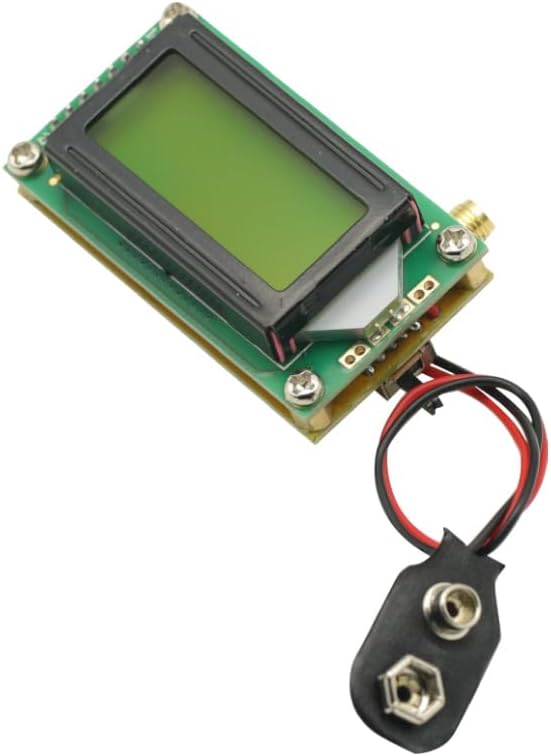
The Portable UHF 400-470MHz and VHF 136-174MHz Frequency Counter is a straightforward meter for common two-way radio work. It provides a 4.1 rating, includes CTCSS and DCS decoding, and uses one-button control. Its strongest selling point is focused simplicity rather than advanced analysis.
We may earn a commission when you buy through this link, at no additional cost to you.
The two covered ranges correspond to 136-174MHz VHF and 400-470MHz UHF. A 9V battery and antenna are included, and the stated measurement range is within one meter. This makes the unit practical for checking a nearby handheld radio or another nearby transmitting device without a large collection of accessories.
Its 9 by 5.5 by 2cm size makes it easy to carry in a pocket, tool pouch, or radio case. A long press turns the unit on or off, and a normal press proceeds through testing. That minimalist design is approachable, although operators who need broader coverage, stronger documentation, or advanced signal information may find it too limited.
This is a sensible budget selection for users whose needs stay within the common VHF and UHF two-way radio bands. It can be particularly useful for quickly checking frequency and tone information on a nearby transmitter. If your work includes HF, 2-meter frequencies outside the stated VHF span, or frequencies above 470MHz, choose a broader instrument instead.
Long-pressing the button controls power, while pressing it advances through the test sequence. This uncomplicated layout is useful for quick checks, especially for users who do not want to configure a larger meter before every measurement.
At 9 by 5.5 by 2cm, the counter is small enough to remain on a bench or fit into a compact field kit. The battery-powered design removes the need to remain near a mains outlet during nearby radio testing.
We may earn a commission when you buy through this link, at no additional cost to you.
The Anysecu SF-103 is a portable counter for continuous carrier signals from 2MHz to 2.8GHz. It includes a signal-strength indicator, selectable ranges, four-button operation, and DMR signal counting support. Its 4.2 rating reflects a well-liked middle ground in frequency coverage and portability.
We may earn a commission when you buy through this link, at no additional cost to you.
The device is positioned for maintenance personnel and wireless enthusiasts who need to test frequency and signal strength. A broad 2MHz lower limit brings the 2-meter amateur band into the instrument's coverage, while the 2.8GHz upper limit covers the majority of common VHF and UHF two-way radio equipment. The small enclosure makes it easier to move around than a bench-only counter.
As with the other dedicated continuous-carrier counters, it does not offer the graphical spectrum inspection available from the TinySA. It also lacks the phase, interval, and long-term stability tools of the GPS-disciplined TinyGTC. Its value lies in a relatively direct instrument that can answer a basic question quickly: what frequency is this nearby radio transmitting on?
The SF-103 is a good fit for amateur operators, installers, and service technicians who regularly work with conventional two-way radios. It can also serve as a compact bench tool for frequency identification. Those needing a visual analysis of complex signals should look toward a spectrum analyzer, while those requiring laboratory-grade stability should consider a precision counter.
Starting at 2MHz brings important amateur radio territory into the same instrument used for VHF and UHF checks. That broader lower reach can be more valuable for ham work than a counter limited strictly to commercial handheld bands.
A signal-strength indicator supplements the frequency display, giving maintenance users an additional indication of received level. Combined with compact controls, it supports quick checks during radio servicing and equipment setup.
We may earn a commission when you buy through this link, at no additional cost to you.
The Mcbazel Surecom SF-103 is a handheld frequency counter for continuous carrier signals across 2MHz to 2.8GHz. It carries a 4.3 rating, includes a signal-strength indicator, and uses a TCXO reference. Its stated ±2 to ±4ppm performance from minus 45 to 65 degrees Celsius makes it a technically stronger option for temperature-sensitive field work.
We may earn a commission when you buy through this link, at no additional cost to you.
The frequency coverage is particularly relevant to ham radio because it includes the 2-meter band, all VHF, and UHF. DMR signals can also be counted, while four-button operation and the compact body keep the device practical for radio maintenance and wireless testing. Users can choose from several ranges rather than searching the entire span.
Safety is a significant consideration. The maximum direct input is specified as 5Vp-p, and the manufacturer explicitly prohibits direct connection to a radio antenna output because doing so can damage the frequency counter. A suitable attenuator or other interface may therefore be required for transmitter testing. Like the SF401 models, it is not designed for wideband signals.
This counter is a strong choice for a serious two-way radio user who wants broad coverage and temperature-compensated stability. The published warning should be read carefully before testing any transmitter or high-power output. With appropriate signal conditioning, it offers a portable and repeatable way to identify frequency and signal strength.
The TCXO specification is the key technical distinction in this listing. Its stated accuracy range provides a consistent reference across a broad temperature span, useful for field work and repeated comparisons between radios.
Direct antenna-output connection is prohibited, and the maximum direct input is only 5Vp-p. Before working with a transmitter, select a suitable interface or attenuation method and follow the device's safety guidance to avoid damage.
We may earn a commission when you buy through this link, at no additional cost to you.
The Acxico 1-500MHz Frequency Counter is a single RF meter module with an integrated 0802 digital LCD. It offers a 1MHz to 500MHz range and a customer rating of 3.1. Unlike the finished handheld products, it is presented as a bare PCB-and-FR4 module intended for builders and budget-conscious experimenters.
We may earn a commission when you buy through this link, at no additional cost to you.
The main attraction is accessibility. A user assembling a homebrew frequency-measurement device can incorporate a ready-made counter and display rather than designing the circuit from the beginning. The package contains one module, and the supplier invites customers to provide photographs and more information if a problem occurs.
The published specifications are limited, so this option demands more caution than the fully documented counters. The listing notes that accuracy can be adjusted only to the second digit after the decimal point and describes this as less than one-tenth of the precision. It does not provide the time-base, input-protection, or accessory details found with the higher-ranked portable instruments.
This board is best for a maker who wants a basic display for a project and is comfortable handling bare electronics. It may be useful for checking transmissions in covered HF through UHF portions, but the 3.1 rating and limited documentation make it less attractive as a first professional tool. Complete the project with an appropriate enclosure, antenna, and input protection.
The integrated display and single-board format simplify the first stages of a homebrew counter. A maker can focus on enclosure, antenna, and input-interface design instead of constructing the measurement and readout circuitry from scratch.
The stated adjustment limitation means the module should not be treated like a precision laboratory reference. It is better suited to practical frequency identification and project work where the exact resolution and stability requirements are understood in advance.
We may earn a commission when you buy through this link, at no additional cost to you.
The 1MHz to 500MHz Frequency Counter Meter Board is a minimal kit for ham radio builders. It includes a counter board with an LCD display, operates across 1MHz to 500MHz, and has a 3.6 customer rating. Its low-power consumption and integrated readout make it a straightforward option for embedding in a custom project.
We may earn a commission when you buy through this link, at no additional cost to you.
Unlike a finished counter, this product does not present itself as a complete field instrument. The package description focuses on one board with an LCD, and there is no mention of an enclosure, antenna, controls, or input protection. Those omissions are not necessarily flaws for a maker, but they define the work required before the board becomes a finished tool.
Available information is sparse, so the board should be selected primarily on its stated 1MHz to 500MHz range, integrated display, and low-power design. It offers less documented guidance about time-base stability, accuracy, and maximum input level than the dedicated portable counters. Those details should be verified before connecting it to valuable equipment.
This board is most appropriate for a ham radio enthusiast creating a custom frequency display or educational project. It can add a convenient readout within a 1MHz-to-500MHz installation. For a ready-to-carry counter with antennas, documented controls, and built-in radio decoding, select one of the higher-ranked handheld models instead.
Low power consumption is valuable when the board will operate from a small supply or remain installed in a compact station setup. It can help a builder create a dedicated readout without continuously powering a more elaborate instrument.
A board, LCD, and specified frequency range are not a complete portable counter. Consider the enclosure, antenna, signal path, input limits, and operating controls before building around the module, especially for transmitter testing.
We may earn a commission when you buy through this link, at no additional cost to you.
The AURSINC TinyGTC is a portable, high-precision dual-channel frequency counter and timer with an integrated GPS-disciplined oscillator. It measures frequency, phase, counts, and time intervals at up to 40ps resolution and carries a 5.0 customer rating. Channel A covers 0.1Hz to 7GHz, while Channel B covers 0.1Hz to 350MHz.
We may earn a commission when you buy through this link, at no additional cost to you.
Its TCXO-based GPSDO is designed to lock to GPS and deliver an approximate Allan deviation of 1e-10 at averaging times from 1 to 100 seconds. This creates a much more stable long-term reference than a simple crystal counter. An external 10MHz reference can also be used to calibrate SDR boards, signal generators, and radio equipment, extending its relevance beyond ordinary frequency identification.
The device supports real-time charting, histograms, ADEV, FFT, FM deviation analysis, USB data logging, SD card storage, and SCPI remote control. A 4-inch touchscreen provides primary control, while a backup jog wheel supports operation in difficult conditions. The rechargeable 4000mAh battery and compact form factor allow the instrument to be carried to an outdoor installation.
This is the premium choice for operators who need more than a quick carrier-frequency check. It is particularly compelling for ham radio calibration, SDR tuning, homebrew oscillator work, time-interval measurement, and professional RF analysis. The advanced feature set and specialized precision position it at the opposite end of the roundup from a simple board, but for a suitably equipped station it offers the deepest measurement capability.
The integrated GPSDO disciplines the internal oscillator against satellite timing references, supporting repeatable long-term measurements. Users can also provide an external 10MHz reference when calibrating SDR, signal generators, or other station equipment.
Real-time charts, histograms, ADEV, FFT, and FM deviation tools turn the TinyGTC into a compact analysis platform. Data logging, SD storage, SCPI control, and compatibility with TimeLab expand its usefulness for extended and automated measurement sessions.
The 4000mAh rechargeable battery, touchscreen, and backup jog wheel support both bench and field use. Its measurement precision makes it useful for on-site antenna tuning, radio adjustment, and reference verification without relying on a mains-powered bench setup.
We may earn a commission when you buy through this link, at no additional cost to you.
The right frequency counter depends on the bands you work, the signals you need to measure, the accuracy your projects demand, and whether the instrument must travel between locations. Consider the following factors before choosing a dedicated counter, spectrum analyzer, or builder module.
Begin with the bands and equipment you actually use rather than selecting the widest advertised range by default. A counter covering 27MHz to 3000MHz suits many handheld and commercial radios, while the SF103 models extend down to 2MHz for 2-meter amateur work. Bare modules in this guide cover 1MHz to 500MHz, and the TinyGTC reaches 7GHz on Channel A. The TinySA extends from 100kHz to 960MHz but stops below the upper UHF reach of several dedicated counters. Match the lower and upper limits to your stations, repeaters, radios, and planned projects.
A conventional counter is optimized to present the frequency of a carrier, often with signal strength and tone information. A spectrum analyzer shows how energy is distributed around a frequency, making it more useful for visual troubleshooting, interference checks, and antenna-related work. The TinySA belongs in the analyzer category, while the FC-2800M, SF401, SF103, and compact handheld units focus on direct counting. The TinyGTC bridges both ideas with frequency, phase, interval, FFT, and deviation analysis, but at a much higher level of complexity.
Accuracy determines how closely the displayed frequency matches the incoming signal, while stability describes how consistently the instrument maintains that reference over time. The Surecom products specify a TCXO with approximately plus or minus 2 to plus or minus 4ppm accuracy across minus 45 to 65 degrees Celsius. The FC-2800M uses a low-PPM crystal time base, while the TinyGTC adds GPS discipline and a premium TCXO for much stronger long-term stability. A simple module may be adequate for basic identification, but calibration, SDR reference work, and precision comparisons justify a more stable reference.
A frequency alone does not always tell the full story of a two-way transmission. CTCSS and DCS decoding can reveal the tone or digital signaling scheme used by a radio, which is valuable when identifying channels, comparing equipment, or checking repeater settings. The Surecom SF401 models, FC-2800M, and compact VHF/UHF meter include this type of decoding. The SF103 listings identify DMR signal counting support, while the TinySA and TinyGTC take a broader analysis approach. Confirm that the signaling format matches the equipment you intend to test.
Never connect an unknown or powerful transmitter output directly to a sensitive counter. The Mcbazel SF-103 states a maximum direct input of 5Vp-p and explicitly warns against direct antenna-output access. Other products focus on continuous carrier signals and are not intended for wideband transmissions. Review input limits, use appropriate attenuation or an interface where required, and use the correct antenna for the band being checked. Safe signal conditioning protects both the instrument and the equipment connected to it.
Field use calls for a compact instrument, manageable controls, and a practical power source. The 136-174MHz and 400-470MHz handheld meter is only 9 by 5.5 by 2cm and uses a 9V battery, making it highly portable. The TinySA combines a rechargeable battery with a color touchscreen, while the TinyGTC adds a much larger 4000mAh battery for field precision work. The Surecom units are compact and include mains or USB power options. Choose according to the space available, expected battery life, and whether color screens or larger data displays are worthwhile.
A four-button counter can be ideal for routine service work because the operating sequence remains short and predictable. The single-button handheld is even more focused but covers fewer bands. The TinySA's 2.8-inch touchscreen reveals considerably more information, while the TinyGTC's 4-inch display supports graphing, histograms, FFT, and other analysis. More controls do not automatically make an instrument better, but they can make a more complicated instrument easier to use once properly configured.
A complete counter that includes antennas, power leads, and a manual is easier to deploy than a bare board. The Surecom SF401 and TinySA packages include extensive accessory sets, while the two low-cost boards require the builder to supply an enclosure, antenna, input path, and possibly controls. If the device will be embedded in a permanent installation, examine voltage, power consumption, display readability, and connection options. If it must work immediately in the field, bundled accessories are often more valuable than a broad specification sheet.
Begin by selecting the measurement range that contains the expected signal, installing the correct supplied antenna, and allowing the instrument to stabilize according to its manual. For a dedicated counter, keep the test radio and receiving antenna within the device's stated working distance. For a spectrum analyzer, choose a resolution bandwidth that reveals the signal without unnecessary sweep time, and use the internal calibration source when performing a self-test.
Transmitter measurements require particular care. Never connect a radio's antenna output directly unless the manufacturer explicitly permits it and the signal remains within the documented input limits. Use suitable attenuation or an interface to bring the signal into range, watch for overload indications, and disconnect the setup before changing antennas or cabling. The SF103's stated 5Vp-p maximum direct input and warning against antenna-output access are especially important to follow.
To maintain accuracy, protect the device from moisture, impact, and extreme heat, and keep connectors clean. Store bare modules in an anti-static environment and avoid powering an unfinished board without confirming its supply voltage and input arrangement. For precision instruments, allow the GPSDO to acquire a stable reference before taking long-accuracy measurements, protect the included GPS antenna, and use the external 10MHz reference only with a correctly configured setup.
A counter is useful when you need to confirm the operating frequency of a radio, identify a nearby transmission, compare equipment settings, or support calibration work. It is not essential for every station, but it becomes valuable for repeater control, commercial-radio interfaces, homebrew projects, and troubleshooting. A spectrum analyzer offers extra context when signals are complex or interference is the main concern.
Choose a counter that covers the bands and equipment you use most. A 27MHz-to-3000MHz model serves many VHF and UHF handheld radios, while a model beginning at 2MHz includes the 2-meter band. A 1MHz-to-500MHz board can cover substantial HF and UHF ground, and a 7GHz instrument is useful for microwave and advanced RF work. Always verify both the lower and upper limits.
Yes, but only with a safe and suitable signal path. Many listed counters are designed for continuous carrier signals, and connecting a transmitter directly can damage the input or produce an inaccurate result. Use an appropriate attenuator or interface, respect the documented maximum input, and never ignore a warning against direct antenna-output connection.
A frequency counter normally emphasizes a direct numerical reading for a carrier, sometimes adding signal-strength and CTCSS or DCS information. A spectrum analyzer displays signal energy across a range of frequencies, making it easier to identify nearby activity, inspect interference, and observe band conditions. The TinySA is the analyzer in this guide, while most other selections are dedicated counters.
A GPS-disciplined oscillator uses satellite timing references to improve the counter's long-term stability. That can make repeated measurements and calibration comparisons more consistent than an ordinary crystal reference. The AURSINC TinyGTC also supports an external 10MHz reference, making it useful for checking SDR boards, signal generators, and radio equipment.
It depends on the radios you work with. CTCSS and DCS decoding can identify the tone scheme associated with a transmission, which is useful for repeater, commercial, and handheld-radio work. If your equipment primarily uses conventional voice without tone signaling, the feature may add little. It is particularly valuable for technicians and operators who frequently identify channels.
They can be, but only if the project includes the necessary enclosure, antenna, power arrangement, input protection, and connections. Boards such as the Acxico module and the 1-500MHz LCD board are more approachable for a maker comfortable with electronics than for someone wanting an immediate field tool. Their published specifications are also less detailed than those of the finished counters.
Start with the stated frequency accuracy and time-base type, then examine how performance changes with temperature. TCXO compensation offers more consistency over changing conditions, while GPSDO provides even stronger long-term stability. Accuracy specifications alone do not guarantee useful performance if the input is overloaded, the wrong antenna is used, or the signal is outside the instrument's supported type.
The FC-2800M stands out as the most balanced dedicated counter, combining two selectable ranges, DMR support, CTCSS and DCS decoding, a low-PPM time base, and simple controls. The Portable UHF/VHF Frequency Counter is the budget choice for common two-way radio bands, while the AURSINC TinyGTC is the clear premium option for GPS-disciplined precision, dual-channel measurement, and sophisticated analysis.
Prioritize the measurement task before the specification count. Choose a compact meter for nearby two-way radio checks, a counter beginning near 2MHz when 2-meter work matters, a spectrum analyzer when seeing the surrounding band is important, and a GPS-disciplined instrument for calibration, SDR references, or time-interval work. Always account for input limits, supported signal types, antennas, and power requirements.
Ratings and product information can change as customer feedback accumulates and sellers update listings. Check the current specifications, package contents, warranty terms, and availability before purchasing, and compare current market prices at the time of purchase. The right instrument is the one that covers your bands, protects your equipment, and provides the level of accuracy your actual projects require.

