
5-Pack Step Down/Step Up Converter
5.0Editor score
1.8V–5V input range
Fixed 3.3V output
100mA maximum current
Discover the best 5V to 3V voltage regulators by comparing input ranges, output current, module size, protection, and construction.
A 5V to 3V voltage regulator is a compact power-conversion module that lets 3.3V microcontrollers, sensors, and development boards operate from a 5V supply. The right choice depends on input range, available current, board dimensions, and whether a linear or switching design best fits the project.
The products in this guide were compared using their stated voltage ranges, maximum output ratings, regulation specifications, physical dimensions, protection features, and intended applications. The list includes AMS1117 linear modules, compact buck converters, and a low-voltage step-down or step-up converter for projects requiring more flexibility.
The first three picks show the strongest combinations of versatility, value, and useful capacity, while the remaining reviews explain where narrower modules may be easier to use. Product configurations and availability can change, and prices fluctuate, so verify the current listing and electrical requirements before purchasing.
5.0Editor score

4.6Editor score

5.0Editor score
The table below compares all ten modules by input flexibility, rated output, regulation approach, and physical format, making it easier to identify the right regulator for a 5V-powered circuit.


This switching buck module offers the most balanced specification set in the group, combining a 4.5V–24V input range with a fixed 3.3V output of up to 1.8A. Its 4.6 rating reflects a generally favorable reception, while the 17.5 × 12 × 4.5mm dimensions make it practical for tightly packed DIY, embedded, and portable builds.
We may earn a commission when you buy through this link, at no additional cost to you.
The wide input compatibility is its defining advantage. It can accept common 5V, 9V, 12V, and 24V supplies without requiring a different regulator for each source. A stated ripple below 30mV and a switching frequency of 1MHz–1.5MHz make it a sensible option for powering microcontrollers, sensors, and similar 3.3V electronics with a relatively clean supply.
There are limits to consider. This is a fixed 3.3V module rather than an adjustable converter, so it will not suit a project that needs other output levels. The seller also specifically advises adding a diode and capacitor when operating motors, servos, or other inductive loads. That requirement adds assembly work but can reduce the risk of voltage spikes or fluctuations affecting downstream circuitry.
It is a strong general recommendation for makers who want more current and input flexibility than a basic AMS1117 board offers. Choose it when the source may be 12V or 24V, the load needs more than the 800mA class, or board space is limited. For uncomplicated 5V-to-3.3V projects, it remains a capable and adaptable option.
Supporting sources from 4.5V through 24V means one module can cover several common power systems. That makes it especially useful when a prototype moves between USB-derived 5V, a 9V source, or a 12V battery supply.
The stated 1.8A maximum output is more generous than the 800mA and 100mA alternatives here. Verify that the connected load, cooling conditions, wiring, and source can support the intended operating level.
We may earn a commission when you buy through this link, at no additional cost to you.
This ten-pack of AMS1117-3.3 modules is designed for straightforward development-board work, with a 4.75V–12V input range and a regulated 3.3V output rated up to 800mA. Its 4.1 rating places it below the leading switching modules, but the simple connection format and broad compatibility make it relevant for both beginners and experienced makers.
We may earn a commission when you buy through this link, at no additional cost to you.
The three-pin arrangement provides separate input, output, and ground connections, making it easy to add a stable 3.3V rail to Arduino UNO and Mega2560 projects, MSP430 boards, STM32 systems, ARM-based circuits, and FPGA or CPLD projects. The stated overheat shutdown adds a basic safeguard, and the pack contains enough boards for parallel projects or classroom use.
The main limitation is its linear-regulator design. AMS1117 modules generally convert unused voltage into heat, so the larger the difference between input and output, the more thermal demand the component creates. Its 800mA figure is also well below the 1.5A–1.8A claims of the compact buck converters. Users should not interpret the stated current as a guarantee that every board can sustain full output without appropriate thermal conditions.
This product is best for conventional low-power development boards, especially when straightforward three-pin wiring matters more than maximum efficiency or extremely compact dimensions. It is less attractive for battery-powered systems, space-constrained wearables, or loads that may approach 800mA. For those situations, one of the switching modules offers a more appropriate thermal and current profile.
The three-pin layout simplifies connection to microcontrollers and prototyping boards. It is especially useful when a project already relies on standard AMS1117-style wiring and component spacing.
Because this is a linear regulator, heat generation depends on the input-to-output voltage difference. Keep the source voltage reasonably close to 3.3V and provide ventilation when the module operates near its stated current limit.
We may earn a commission when you buy through this link, at no additional cost to you.
This module stands apart because it can operate from 1.8V to 5V and still provide a fixed 3.3V output. Its step-down/step-up design means it can either reduce a 5V source or raise a lower source such as 1.8V, 3V, 3.7V, or 5V. The listed rating is 5.0, making it one of the strongest-rated selections in the guide.
We may earn a commission when you buy through this link, at no additional cost to you.
The defining benefit is unusual source flexibility. Most 5V-to-3.3V modules need an input above the target output, but this one can also generate 3.3V from a lower source. That makes it a practical candidate for single-cell battery experiments, low-voltage energy-harvesting circuits, small sensors, wearable prototypes, and microcontroller boards that tolerate a very light load.
Its 100mA maximum current is the decisive constraint. This is not a general-purpose regulator for motors, high-power radio equipment, LED lighting, or a development board with several attached peripherals. It is better viewed as a small signal-conditioning module. Buyers should also confirm board dimensions and pin labeling against their own circuit because the supplied information does not list exact measurements.
The module is a compelling budget choice when the source can fall below 3.3V and the load remains modest. It is less useful for a conventional project that always begins with a steady 5V supply and demands hundreds of milliamperes. In that situation, the switching converters in this list offer much more current headroom.
The boost capability allows a sub-3.3V source to supply a 3.3V rail. This is valuable for low-energy prototypes where the available battery voltage can dip below the required logic level.
The 100mA limit makes this converter appropriate for small sensors and low-power logic rather than motors or other demanding peripherals. Calculate the expected peak load before committing to it.
We may earn a commission when you buy through this link, at no additional cost to you.
This Mini360-style buck module combines a 4.5V–24V input range with a fixed 3.3V output and substantial current capability. Its stated maximum is 1.8A, with output around 3.2V at 1.3A, while the dimensions are only 17.5 × 12.3 × 4.3mm. A 5.0 rating makes it one of the most appealing compact options.
We may earn a commission when you buy through this link, at no additional cost to you.
Compared with a standard AMS1117 board, this switching module offers a better fit for projects that need more current or draw power from a higher-voltage source. The stated ripple is below 30mV, and the switching frequency ranges from approximately 1MHz up to 1.5MHz. These characteristics are useful for microcontrollers, sensors, and compact embedded systems where a stable 3.3V rail is required.
The listing is clear that output voltage falls as current rises, reaching approximately 3.2V at 1.3A. That distinction matters because a headline maximum-current figure does not mean the module will hold exactly 3.3V at every load. Motor and servo applications can also generate large ripple, and the seller recommends adding a Zener and capacitor for downstream protection.
This is a premium pick for builders who prioritize size, current headroom, and source flexibility together. It works especially well in tightly packed projects with 12V or 24V sources. Buyers should not use it for inductive loads without the recommended protection, and they should account for the slight voltage drop when designing 3.3V-sensitive logic at high current.
Delivering up to 1.8A from a board smaller than many common regulator packages makes this module useful when space and load capacity both matter. The practical current target should remain below the point where output voltage drops noticeably.
A switching architecture can be more efficient than a linear AMS1117 when the input is well above 3.3V. Lower heat generation helps in enclosed builds where thermal headroom is limited.
We may earn a commission when you buy through this link, at no additional cost to you.
This seven-pack of Dorhea AMS1117-3.3 boards offers a familiar route to a stable 3.3V supply from 4.75V to 12V. Each module is a positive step-down regulator with a stated output current of 800mA. Its 4.2 rating suggests broad practical appeal, especially among users familiar with the standard three-pin regulator format.
We may earn a commission when you buy through this link, at no additional cost to you.
The three-pin configuration makes the modules straightforward to incorporate into microcontroller development boards and embedded experiments. Published applications include MSP430, ARM7, ARM9, ARM11, and STM32 systems, as well as low-power MCUs and FPGA or CPLD projects. The included overheat shutdown provides a basic safeguard, while the fixed 3.3V output reduces setup ambiguity.
The seller explicitly warns that the module supports only a 3.3V, 800mA output, so the load current should not exceed that figure. Like other linear modules, it will dissipate more heat as the difference between input and output grows. A 12V source feeding a 3.3V load is therefore a demanding thermal arrangement compared with feeding it from 5V.
This pack is a sensible choice for educators, hobbyists, and teams working on several small 3.3V projects at once. It works particularly well when development-board compatibility and recognizable AMS1117 wiring are the priorities. For compact projects, higher-current loads, or runs from 12V and 24V supplies, a switching buck module is generally the more efficient alternative.
The multi-board pack provides useful inventory for classroom exercises, parallel prototypes, and projects that may branch into several regulated circuits. It reduces the need to source identical modules repeatedly.
The standard three-pin arrangement is easy for electronics learners to understand. The VIN, output, and ground connections provide a familiar path from an input supply to a fixed 3.3V rail.
We may earn a commission when you buy through this link, at no additional cost to you.
This 15-piece AMS1117-3.3 set is built for users who want a substantial inventory of standard fixed-output regulator modules. It accepts 4.75V–12V DC, provides 3.3V with a stated ±2% accuracy, and is rated up to 800mA. The 5.0 rating makes it one of the most favorably reviewed products in this comparison.
We may earn a commission when you buy through this link, at no additional cost to you.
Its stated accuracy is useful when a circuit needs dependable logic-level voltage rather than a merely present output. The three-pin VIN, OUT, and GND design allows direct connection to Arduino UNO and Mega2560 boards, STM32 systems, MSP430 platforms, and other embedded equipment. The operating-temperature range is listed as -40°C to 125°C, with overheat and overcurrent protection highlighted.
This remains a linear regulator, so the input-output voltage difference affects heat and efficiency. The stated minimum difference can be as low as 1V, and the documentation notes no more than 1.3V at full load. That makes a 5V input a sensible pairing for a 3.3V load, while higher inputs should be considered with careful attention to cooling.
The large quantity makes this set attractive for classroom environments, repair inventories, and makers who expect to need many identical modules. It is less appropriate for a single compact prototype or a load that exceeds 800mA. For most one-off 5V-powered electronics projects, a smaller pack would be less wasteful, but this option maximizes readiness for repeated builds.
The stated ±2% output accuracy provides a clearer quality target than a module that lists only a nominal 3.3V output. It is a useful reference for circuits with defined logic-level tolerances.
Overheat and overcurrent protection can help limit stress during abnormal operating conditions. These safeguards do not replace correct wiring, current planning, or adequate ventilation.
We may earn a commission when you buy through this link, at no additional cost to you.
This compact buck module accepts a 5V–30V input and provides a fixed 3.3V output with a stated maximum current of 1.8A. Its small board measures approximately 0.67 × 0.24 × 0.16 inches, and the seller lists output ripple below 30mV. The 3.4 rating is the lowest among the ten products and deserves careful consideration.
We may earn a commission when you buy through this link, at no additional cost to you.
The module's broad input range makes it relevant to 12V and 24V systems, as well as projects near a 30V upper boundary. A reverse-polarity mark is printed on the PCB, which can help installers identify orientation, although a marking alone does not guarantee complete reverse-polarity protection. The pack includes five modules for repeated prototypes or multiple regulated branches.
The main concern appears in the product's load specification. The listing states that at 1.5A the output voltage is 4.6V, which conflicts with the fixed 3.3V description and suggests a possible transcription or listing error. Because the published information is internally inconsistent, this module should be selected only after confirming the actual output behavior and pinout with the seller or through a controlled bench check.
It may still be attractive for a maker who specifically needs its compact format, wide input acceptance, and high-current architecture. However, the lower rating and ambiguous voltage statement make it a less confident recommendation than the other Mini360-style modules in this guide. Confirm the circuit requirements and module behavior before using it where exact 3.3V regulation is critical.
A range extending to 30V gives the module more flexibility than typical 12V AMS1117 boards. It can suit higher-voltage projects when the load and wiring are appropriately rated.
The stated 4.6V output at 1.5A is inconsistent with the advertised 3.3V function. Confirm the board's actual regulation, connector labels, and pinout before connecting sensitive electronics.
We may earn a commission when you buy through this link, at no additional cost to you.
This five-pack of 3.3V buck converters is positioned for compact electronics powered from 5V through 30V sources. It provides a fixed 3.3V output with a stated peak current of 1.8A, output ripple below 30mV, and dimensions of 17.5 × 12.3 × 4.3mm. No customer rating is supplied, so the product's reception is less clear than that of the rated alternatives.
We may earn a commission when you buy through this link, at no additional cost to you.
Its broad input support covers common 12V and 24V batteries, solar-panel arrangements, and vehicle power. The product information also names Arduino, Raspberry Pi, ESP32, STM32, and 5V LED strips as intended applications, making the module accessible to a broad range of hobbyists. The compact size also supports wearables, drones, and IoT devices where every millimeter matters.
The distinction between peak and continuous current is important. A stated peak of 1.8A does not guarantee that the module can maintain that output indefinitely without appropriate heat dissipation, source capability, and wiring. The supplied information also does not state a sustained-current figure, so designers should leave margin and avoid planning around the peak number for a continuously loaded circuit.
This product is a promising option for portable and embedded projects that may encounter changing source voltages. It is especially attractive when a maker wants a single module for both 5V bench work and higher-voltage battery systems. The lack of a customer rating warrants additional care: confirm the pinout, test the output under the expected load, and purchase only if the board and connector arrangement meet the project design.
The 4.5V–30V range makes the converter useful across USB-derived supplies, battery packs, solar systems, and vehicle circuits. Confirm that the upstream source remains within the limit under load.
A footprint of 17.5 × 12.3mm fits many small electronics without occupying the space of a larger breakout board. Soldered connections make it particularly useful for permanent embedded installations.
We may earn a commission when you buy through this link, at no additional cost to you.
This ten-pack of AMS1117-style modules is tailored to the common task of converting a near-5V DC source into a fixed 3.3V rail. It accepts 4.5V–7V input, delivers 3.3V, and is rated up to 800mA. Its 5.0 rating indicates strong customer feedback, although actual suitability depends on the source and the load attached.
We may earn a commission when you buy through this link, at no additional cost to you.
The restricted input window makes the module appropriate for USB supplies, 5V batteries, and other regulated 5V-class sources. The listing warns that the input must remain more than one volt above the output, which the stated range satisfies. A ten-module quantity is useful for schools, repair kits, and makers who regularly need identical fixed-voltage regulators.
The product title contains wording about adjustable boost and start-limit behavior, but the supplied specifications describe a fixed 3.3V step-down module with a limited 800mA output. Buyers should treat the clear electrical specifications as the controlling details and verify the board markings if they intend to adjust anything. Exceeding the operating voltage can damage the module, as the listing explicitly cautions.
This is a good straightforward choice for one or several 5V-powered microcontroller projects, particularly when the source never exceeds 7V and the load stays below 800mA. It is less appropriate for 12V or 24V sources, where a compact switching buck converter provides more efficiency, current headroom, and operating margin.
The 4.5V–7V input range is closely aligned with common regulated 5V supplies. It avoids the extra conversion stress of feeding a much higher battery voltage into a linear regulator.
A ten-piece pack supports multiple projects, classroom exercises, or maintenance inventories. It is particularly practical when identical fixed 3.3V modules are needed repeatedly.
We may earn a commission when you buy through this link, at no additional cost to you.
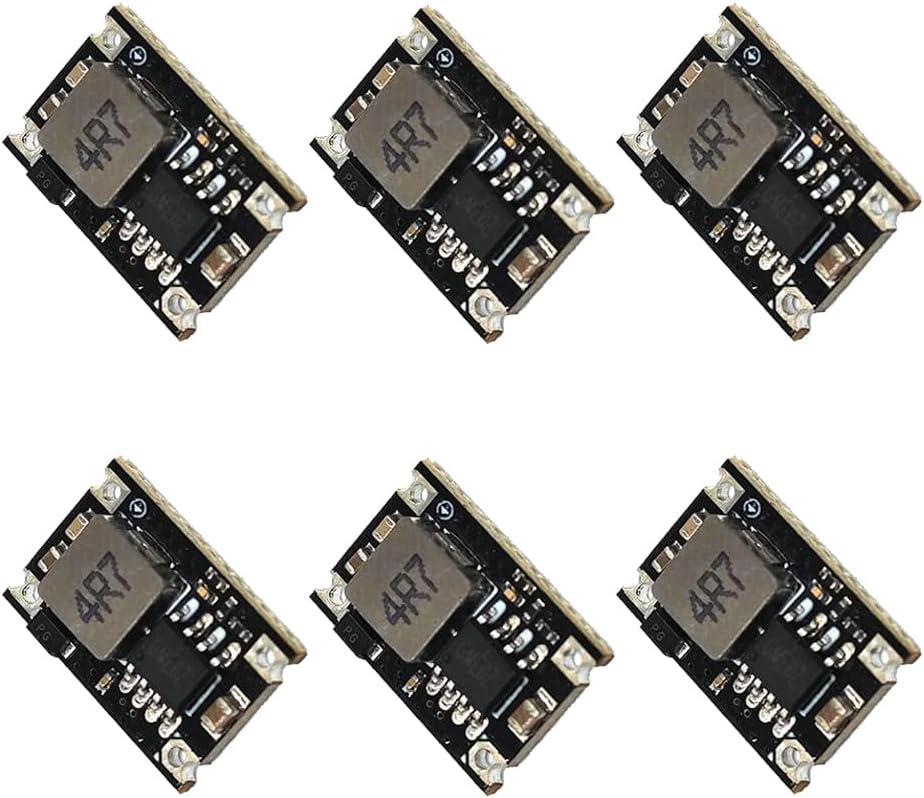
This six-pack of Mini360-style modules targets compact 3.3V systems, including model and aircraft-related electronics. The board measures 17 × 11 × 3.6mm, accepts 4.5V–24V input, and supplies a fixed 3.3V output with a stated maximum current of 1.8A. Its 4.9 rating is among the strongest in the guide.
We may earn a commission when you buy through this link, at no additional cost to you.
The tiny footprint is a major advantage for model aircraft, drones, and other tightly packed electronics. At 1.5A, however, the stated output falls to 3V, so the module does not maintain exactly 3.3V across its full current range. The listed ripple remains below 30mV, and the switching frequency reaches 1.5MHz at its highest level.
The seller specifically warns about inductive loads. Motors and servos can generate substantial ripple that may affect chips in later stages of a circuit, so a Zener and capacitor are recommended for protection. This makes the module better suited to regulated logic and sensor rails than to directly driving noisy electromechanical devices without additional filtering.
For aircraft-model builders and other makers working under severe size constraints, this is a strong option with a useful six-module quantity. It also suits any portable project needing more current than an AMS1117 can provide. Account for the voltage drop at heavy load and include the recommended protection when an inductive component shares the supply.
At 17 × 11mm, the module offers a useful board area for model aircraft, drones, and compact embedded devices. Its small dimensions can also reduce routing space in a permanent prototype.
The output reaching approximately 3V at 1.5A matters for sensors with narrow tolerance limits. Keep heavy loads modest or provide additional regulation if a precise 3.3V rail is required.
We may earn a commission when you buy through this link, at no additional cost to you.
A suitable regulator must match both the voltage source and the load. Input range, current requirements, electrical efficiency, board size, and protection needs should be evaluated before choosing a module.
Choose a module whose range comfortably contains the expected source voltage. For a 5V-only design, an AMS1117 board is simple; for 12V and 24V systems, a switching buck converter is generally more suitable.
Keep expected continuous load comfortably below the stated limit and allow additional headroom. The 100mA module suits sensors and small logic, while 800mA boards suit typical development setups and higher-current buck modules handle more demanding loads.
Use a linear module for straightforward, low-power 5V projects. Use a switching buck module when efficiency, thermal margin, physical size, or a broader input range is more important.
Check the output specification under the load you expect. Low ripple is helpful, but the complete load curve and any stated voltage drop matter more than a single nominal figure.
Compare dimensions with the actual available footprint rather than relying on the word mini. Confirm the pinout before soldering, especially for modules whose supplied specifications do not identify every terminal clearly.
Do not treat a regulator module alone as complete motor-driver protection. Add the specified flyback and filtering components or separate the noisy load onto another appropriately protected supply branch.
Treat the stated current limit as a maximum, not a target. Conservative load planning and adequate cooling provide more reliable operation than operating continuously at the advertised ceiling.
Choose the smallest quantity that covers the immediate build, prototypes, and likely spares. For a one-off project, avoid paying for inventory that will remain unused.
Before wiring, disconnect the power source and identify the module's input, output, and ground terminals. Confirm that the source voltage falls inside the module's specified range and that the load is designed for 3.3V. Use common ground wiring between the source, regulator, and load, and check polarity before applying power for the first time.
Connect the regulator to the load with wiring rated for the expected current. For a compact board, solder the leads securely and insulate exposed joints. If the circuit includes a motor, servo, relay, or other inductive component, add the diode, capacitor, or Zener protection recommended by the module seller. Avoid presenting a directly connected motor's noisy current draw as a normal logic load.
Power the circuit gradually and measure the 3.3V output at the module and at the load. Check the voltage under both normal and peak conditions, look for unexpected heating, and confirm that the current remains below the module's limit. Store unused modules in a dry, static-safe place, and keep soldering residue or conductive debris away from their exposed contacts.
Yes, provided the regulator's specified input range includes 5V and the load requires no more current than the module can supply. Most AMS1117 boards and all listed compact buck modules accept 5V. A linear AMS1117 is convenient at this input, while a switching module can be preferable when the load is larger.
An AMS1117 is a linear regulator that reduces excess voltage into heat, while a buck converter uses switching components to reduce voltage more efficiently. Linear boards are simple and familiar, but their heat rises as the input-output voltage difference increases. Buck modules are generally better for wider input ranges, compact builds, and loads approaching or exceeding 800mA.
It depends on the module. The products here range from 100mA for the step-down/step-up unit to modules advertising 1.8A, with several AMS1117 boards rated at 800mA. Peak, maximum, and continuous ratings are not interchangeable, so check the detailed listing and allow thermal headroom.
A converter may develop more voltage drop as current increases, especially near its rated limit. Some products in this guide state approximately 3.2V at 1.3A or 3V at 1.5A. If the connected circuit requires a precise 3.3V rail, measure the output under load and consider a module with a specified regulation curve or additional post-regulation.
It is strongly advisable. Motors, servos, and relays can generate back EMF and ripple that may disturb sensitive downstream electronics. The relevant product information recommends a diode, capacitor, or Zener arrangement for inductive loads, so follow those instructions and separate noisy power branches when possible.
Most modules in this guide are fixed at 3.3V, even if a title contains broader wording. The exception is the step-down/step-up module, which can accept lower and higher sources but is still described as providing a 3.3V output. Do not assume a fixed 3.3V module is adjustable without a clearly documented control and resistor configuration.
No. A wider range adds flexibility but should be matched to a source that genuinely needs it. A regulated 5V supply paired with a simple AMS1117 may be easier to use, while a 12V or 24V system generally benefits from a switching buck converter. Wider compatibility is most valuable in prototypes that may use several source types.
Add the normal and peak current of every connected device, including startup requirements. The 100mA module is intended for low-power sensors and small logic, while an 800mA or higher-rated module is appropriate for development boards and more demanding loads. Choose the lower-capacity module only when the calculated demand remains safely below its limit.
The wide-input 1.8A buck module is the strongest all-around option for projects that need source flexibility, compact dimensions, and useful current headroom. The 100mA step-down/step-up converter stands out for unusual low-voltage sources, while the Mini360-style module offers a strong combination of size, low ripple, and higher output capacity.
For conventional 5V development boards, an AMS1117 module remains simple and appropriate, provided the current stays within its 800mA rating and heat is controlled. Before buying any module, identify the source voltage, calculate normal and peak load, verify the pinout and dimensions, and determine whether motor or servo protection is necessary.
Ratings, module designs, and product availability can change, and prices also fluctuate. Check the current listing, final electrical specifications, and included components before purchasing so the selected regulator matches the actual circuit rather than relying only on its headline output rating.