
CENMATE 3 Bay USB 3.0 Enclosure
4.3Editor score
Three SATA drive bays
Five-Gbps USB interface
Tool-free hot swapping
2.5-inch and 3.5-inch support
A 3 bay hard drive enclosure gives you a convenient way to connect multiple SATA hard drives or SSDs to one computer without installing each drive inside the case. The right enclosure should balance usable speed, effective cooling, reliable construction, flexible connections, and simple maintenance while fitting the way you actually store and access data.
We compared these ten products by drive compatibility, interface speed, hot-swap behavior, cooling design, capacity support, expansion options, operating-system compatibility, and installation convenience. The list covers external consumer enclosures, direct-attached storage, hot-swap backplanes, and internal drive cages so readers can compare different approaches rather than just similar-looking boxes.
Each review explains the product's strongest advantages, practical limitations, and ideal user. Award labels on the top selections identify the best budget, editor's choice, and premium options, while every comparison entry remains eligible on its own merits. Product listings, ratings, features, and availability can change, so verify current details before buying.
4.3Editor score

4.3Editor score

4.1Editor score
As an Amazon Associate we earn from qualifying purchases.
The table below compares all ten enclosures by their core design, drive support, connection approach, and most important practical feature. It includes external USB models, internal SAS/SATA cages, hot-swap backplanes, and a hybrid HDD/NVMe enclosure so the differences are easy to understand.


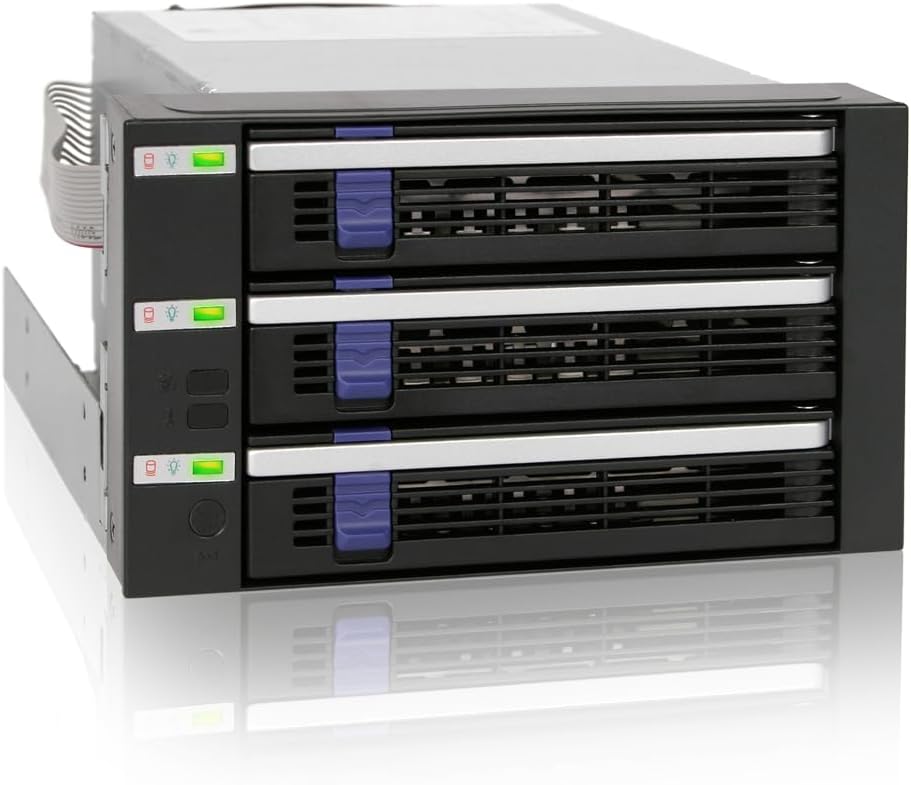


The CENMATE Aluminum 3 Bay Hard Drive Enclosure combines a roomy three-bay layout with a USB 3.0 interface, active cooling, and maintenance-friendly tool-free trays. Its 4.3 rating reflects a broadly capable design for users who want one enclosure to handle several SATA hard drives or SSDs, move large archives, and add more storage later without changing the basic setup.
We may earn a commission when you buy through this link, at no additional cost to you.
The enclosure accepts both 2.5-inch and 3.5-inch SATA drives, with a stated maximum capacity of 20TB per hard drive. An aluminum-alloy body and built-in 2.7-inch fan help manage heat, while hot swapping lets you replace a drive without powering off the unit. Its USB A/C 3.0 connection supports up to 5Gbps and includes both cable styles for compatibility with newer and older systems.
Expansion is another strength. A dedicated USB host port allows daisy chaining with up to three devices, producing a stated maximum expansion capacity of 180TB. The trade-off is that this is direct-attached storage rather than a RAID or NAS system, and the fan operates at a stated noise level of roughly 40–50 decibels. It is therefore better suited to a desk or equipment area than a silent listening room.
This is an adaptable choice for creative professionals, small offices, and home users who need flexible external storage. It works particularly well when you want simple installation, tool-free drive changes, active cooling, and the ability to expand without moving every drive to a larger enclosure. It remains the strongest all-around recommendation here because it covers the most common enclosure needs without requiring a NAS.
The aluminum housing and continuous cooling fan are valuable when several drives operate together, particularly during large transfers. The stated noise output may be noticeable, so placement near your workstation deserves consideration, but active cooling offers a more deliberate thermal-management approach than a completely passive metal box.
Including USB-A and USB-C cables helps reduce connection friction across different computers. The host port also makes it possible to daisy-chain several units, so users who begin with three bays can add capacity incrementally rather than replacing the entire enclosure.
We may earn a commission when you buy through this link, at no additional cost to you.
The CENMATE 3 Bay Hard Drive Enclosure is a straightforward external storage solution for users who want three SATA drive positions, a five-Gbps USB connection, and easy maintenance without a complex network configuration. Its 4.3 rating places it among the strongest choices in this group, and the tool-free, hot-swappable design keeps routine drive changes uncomplicated.
We may earn a commission when you buy through this link, at no additional cost to you.
Both 2.5-inch and 3.5-inch SATA hard drives and SSDs are supported, with a maximum listed capacity of 20TB for each drive. The unit uses a USB 3.0 interface, includes USB-A and USB-C 3.0 cables, and works with Windows 7 and later, Mac 9.1 and later, and Linux. For transfers involving 1GB files, the manufacturer states a typical transfer time of three to five seconds when conditions support the interface speed.
The main omission is an explicitly listed cooling fan. That makes the enclosure appealing for simpler desks and setups where users prefer a less mechanically complex enclosure, but sustained multi-drive workloads deserve closer attention to airflow and drive temperature. Unlike the first CENMATE model in this guide, it does not list a dedicated host port for daisy chaining, so expansion requires a different connection strategy.
Choose this model if you want the essential benefits of a three-bay enclosure without paying for active cooling or a hybrid NVMe design. It is a practical fit for archiving media, consolidating files, creating a portable work drive, or giving a computer access to multiple SATA SSDs. It also works well as a general-purpose enclosure that can be moved between compatible systems.
Tool-free trays and hot swapping reduce the effort involved in adding or replacing storage. You can keep the enclosure's overall workflow simple while moving individual drives between the enclosure and a computer as your archive or working set changes.
Support for both compact SSDs and full-size 3.5-inch hard drives makes the three bays more useful. The included USB-A and USB-C cables also reduce the chance that a connection method will prevent use with a current computer.
We may earn a commission when you buy through this link, at no additional cost to you.
The CENMATE Aluminum 3 Bay 10Gbps enclosure is aimed at users who want more interface headroom than a conventional USB 3.0 model provides. It combines three SATA drive bays with USB 3.2 Gen 2 connectivity, an aluminum body, a 2.7-inch cooling fan, hot swapping, and daisy-chain expansion. Its 4.1 rating remains solid despite this ambitious combination of features.
We may earn a commission when you buy through this link, at no additional cost to you.
The stated interface rate reaches 10Gbps, and the listed performance includes up to 510MB/s read and write speed with one SSD. Two hard drives are listed at a combined total read and write speed of 500MB/s. Those figures remain dependent on the storage devices, computer, and connection involved, so enclosure bandwidth alone does not guarantee identical results in every working environment.
Capacity reaches 20TB per drive, and daisy chaining can expand the setup to as many as three devices with a stated maximum of 180TB. USB Type-C is compatible with USB 3.0, 3.1, 3.2, Thunderbolt 3, and Thunderbolt 4 interfaces. The trade-offs are the same ones associated with the enclosure's active cooling: the fan produces a stated 40–50 decibels, and the interface is still subject to host-device limitations.
This enclosure makes sense for users moving large SSD libraries, maintaining multi-drive archives, or pairing modern computers with fast external storage. It is not a NAS, RAID appliance, or guaranteed replacement for internal performance, but it offers a useful combination of capacity, flexibility, and faster transport in a desktop enclosure.
The ten-Gbps interface is especially relevant when the enclosure contains fast SATA SSDs rather than rotational hard drives. One SSD is listed at up to 510MB/s, although users should judge the result by their computer, cable, file type, and thermal conditions.
The USB host port allows the enclosure to participate in a daisy chain with up to three devices. This creates a path for gradual expansion while preserving a direct-attached, plug-and-play workflow.
We may earn a commission when you buy through this link, at no additional cost to you.
The CENMATE Aluminum 3 Bay enclosure stands out for offering USB 3.0 and eSATA connections, and its 4.6 rating is the highest among the ten products reviewed. The aluminum chassis, 2.7-inch fan, tool-free installation, and support for 2.5-inch or 3.5-inch SATA drives make it suitable for storage users who need more than one connection option.
We may earn a commission when you buy through this link, at no additional cost to you.
Its eSATA feature requires careful attention. The manufacturer explicitly states that the port cannot be used with a computer's SATA-to-eSATA adapter, and the computer's own eSATA port must support RAID functionality to access multiple drive bays through that connection. Otherwise, only one bay can be accessed. Hot swapping is also not supported with this model, even though drive installation remains tool-free.
For normal USB use, the enclosure provides up to 5Gbps and includes USB-A, USB-C, and eSATA cables. The product supports Windows 7 and above, Mac 9.1 and above, and Linux, while the cooling fan is described as operating around 40–50 decibels. As a direct-attached enclosure, it does not itself provide RAID or NAS functions.
This model is best for someone who specifically values eSATA compatibility, perhaps as part of a mixed workstation setup, and who understands the stated multi-bay limitation. Users who prioritize hot swapping or a simpler connection should favor the other USB-focused CENMATE enclosure. For compatible eSATA systems, however, the combination of cooling and connection flexibility is compelling.
eSATA can be convenient when a computer has a native port, but this enclosure's multi-bay access depends on that port supporting RAID functionality. Confirm your computer's specifications and test the intended connection method before relying on eSATA for a multi-drive workflow.
Active fan cooling helps protect sustained drive operation, while the tool-free tray design simplifies initial setup. The lack of hot swapping means drive changes should follow a safe shutdown and power-off procedure rather than an online replacement.
We may earn a commission when you buy through this link, at no additional cost to you.
The TerraMaster D4-320 is included as a near-category alternative because it brings a four-bay layout, USB 3.2 Gen 2, and high stated throughput to the same buying decision. It is a diskless direct-attached storage enclosure rather than a NAS, and its 4.2 rating reflects a capable external design for users who want more drive positions than a strict three-bay model.
We may earn a commission when you buy through this link, at no additional cost to you.
The enclosure supports 3.5-inch SATA hard drives, 2.5-inch SATA hard drives, and 2.5-inch SATA SSDs. A single HDD is listed at up to 30TB, with total capacity reaching 120TB. With four 8TB SATA III hard drives, the manufacturer states a combined read and write rate of up to 1,016MB/s; with a single 1TB SATA III SSD, read speed is listed at up to 510MB/s.
Its Push-lock tray automatically secures a drive after insertion, and the tool-free design makes installation and removal straightforward. Hot swapping is supported. Cooling uses an intelligent temperature-controlled fan, while sound-absorbing panels and vibration damping reduce noise. Standby noise is listed below 21dB(A), making it potentially quieter during idle periods than enclosures with continuously running fans.
Choose the D4-320 when one additional bay is beneficial and you want a polished four-drive external platform. It is ideal for high-capacity archives, media workflows, and multi-drive direct-attached storage. The lack of built-in RAID means it cannot replace a dedicated RAID enclosure, but its drive security, cooling, and broad compatibility make it a persuasive alternative for the right user.
The stated four-drive performance illustrates the value of a ten-Gbps host interface. Although actual results vary with the drives and host, this enclosure is oriented toward users who intend to use all of its bays for high-capacity storage rather than treating it as a single-disk dock.
Push-lock retention helps keep each drive seated, which is useful during frequent transport or removal. The temperature-controlled fan and low listed standby noise also make this a considerate option for a shared workspace when the system is not actively transferring files.
We may earn a commission when you buy through this link, at no additional cost to you.
The StarTech.com HSB3SATSASBA is an internal three-bay backplane rather than a desktop USB box. It converts two 5.25-inch chassis spaces into hot-swappable interfaces for up to three 3.5-inch SATA or SAS hard drives. With a 4.3 rating and a trayless design, it targets builders and IT professionals who need serviceable storage inside a compatible computer or server chassis.
We may earn a commission when you buy through this link, at no additional cost to you.
The backplane supports SATA I, SATA II, SATA III, SAS I, and SAS II drives, with a stated interface rate of 6Gbps. Individual ejection levers make drive removal and installation more controlled, while a key-lock design provides optional physical security and includes two keys. Power and status indicators for each bay help technicians identify drive activity and presence.
Thermal management is handled by a vented aluminum enclosure and a built-in fan with speed control. Unlike a consumer external enclosure, however, this is not a complete standalone storage product. It must be installed in a suitable chassis with appropriate data and power connections, and the system configuration must support the chosen SATA or SAS drives.
This model is a strong recommendation for system builders, workstation operators, and IT teams that value hot swapping and internal integration over plug-and-play portability. Its trayless construction and clear bay indicators support maintenance workflows. If you want a self-contained enclosure that connects directly to a laptop with USB, this is the wrong form factor, but for a compatible server or desktop it delivers the right maintenance-oriented design.
Trayless ejection levers and per-bay indicators help simplify replacement and status checks. These features are especially valuable in a server or professional workstation where frequent service and clear drive identification matter more than portability.
The vented aluminum body works with a speed-controlled fan to dissipate heat. Because it sits inside a chassis, adequate case airflow and correct installation remain important even when the backplane includes its own cooling hardware.
We may earn a commission when you buy through this link, at no additional cost to you.
The CENMATE Hybrid 3 Bay enclosure is the most specialized product in the guide because it combines three SATA HDD or SSD positions with three M.2 NVMe positions. Its 4.1 rating reflects a design that can combine high-capacity rotating storage with low-latency flash storage in one unit, making it the premium pick for users who want more than a conventional three-drive box.
We may earn a commission when you buy through this link, at no additional cost to you.
The SATA section accepts 2.5-inch and 3.5-inch HDDs or SSDs with up to 22TB per drive. The NVMe section supports 2230, 2242, 2260, 2280, and 22110 M.2 SSDs with up to 8TB each. The manufacturer states a maximum combined capacity of 90TB based on three 22TB hard drives and three 8TB SSDs, giving users an unusually flexible arrangement of capacity and performance.
USB 3.2 Gen 2 provides a nominal 10Gbps interface, while the listed full-load read rate is 200–300MB/s. That figure indicates that the enclosure is not attempting to turn its combined six-drive design into a single ultra-high-speed array. Instead, the benefit is selective flexibility: capacity-oriented SATA drives can coexist with fast NVMe SSDs used for active files and applications.
The aluminum-alloy body uses two-inch silent fans that continuously run for cooling and do not sleep. That can be noticeable in a quiet room, but it provides consistent thermal management for mixed drive types. This enclosure is best for editors, developers, and advanced users who deliberately want both HDD bulk storage and NVMe scratch performance; general users can achieve the same three-drive goal more simply.
Three SATA bays and three NVMe bays let you keep large project files or backups on hard drives while placing frequently accessed active data on SSDs. This mixed approach is more versatile than filling every bay with one drive type.
The stated 90TB maximum combines large hard drives with roomy M.2 SSDs. The enclosure is especially useful for creators who want high-capacity media close to faster working storage, although its full-load speed reflects the limits of sharing a host interface across multiple drives.
We may earn a commission when you buy through this link, at no additional cost to you.
The ICY DOCK FatCage MB153SP-B is a three-drive internal hot-swap backplane designed to fit into two 5.25-inch chassis bays. Its 4.5 rating is among the strongest in this guide, and its support for both SATA and SAS media makes it appealing to experienced users building storage-focused workstations or compact servers.
We may earn a commission when you buy through this link, at no additional cost to you.
The enclosure holds three 3.5-inch SATA I, SATA II, or SATA III hard drives and states support for SATA up to 6Gbps and SAS up to 12Gbps. Its full-metal body is intended to dissipate heat, and the listed cooling provisions include an 80mm fan and a large 92mm fan in different descriptions of the product. The emphasis is therefore on a robust internal chassis rather than a portable desktop accessory.
SATA hot swapping is supported, making the unit attractive for maintenance-sensitive storage configurations. SATA 15-pin power connections are used for compatibility with suitable power supplies. Because this is a backplane, it does not include a USB controller or act as a self-contained external device; the host system needs compatible connections and must support the relevant drive technology.
Buy the FatCage when you want to integrate three hot-swappable drives into a compatible chassis and value SAS flexibility. It is less suitable for someone seeking a plug-and-play laptop accessory, but for a workstation with suitable bays and cabling, it provides a serviceable bridge between removable storage and internal system integration.
Supporting both SATA and SAS lets the backplane adapt to different server and workstation drive inventories. The host platform must still provide the appropriate controller and cabling, so compatibility checking is an essential part of planning the installation.
Hot-swappable drive positions make replacement more convenient in systems maintained by IT personnel. The full-metal enclosure helps conduct heat away from the drives while the installed fans provide active cooling inside the chassis.
We may earn a commission when you buy through this link, at no additional cost to you.
The SilverStone SST-FS305-12G expands three 5.25-inch chassis spaces into five hot-swappable 3.5-inch drive positions. Although it does not fit the literal three-bay form, it is a useful alternative when bay density and future storage headroom matter. Its 3.9 rating is the lowest in this group, so buyers should validate their chassis and controller requirements carefully.
We may earn a commission when you buy through this link, at no additional cost to you.
The all-aluminum cage supports SAS drives at up to 12Gbit/s and SATA drives at up to 6Gbit/s. Its trayless, screwless installation reduces assembly time, and each drive position has an individual metal key lock for added physical security. Adjustable drive-status LEDs and a fan-control system are included to help operators monitor activity and manage cooling.
As an internal cage, the SST-FS305-12G requires a compatible chassis with three available 5.25-inch spaces, appropriate data connections, and sufficient power. The host system also needs to support the chosen SATA or SAS media. It is not a portable USB device and does not include an external controller, so the intended buyer should already be building or upgrading a system.
This model makes the most sense for a workstation or server owner who wants to fit five removable drives into the space normally occupied by three optical-drive cages. It provides strong drive density and secure, screwless serviceability. Those benefits make it a specialized alternative rather than the first recommendation for a typical user searching for a simple desktop three-bay enclosure.
Converting three 5.25-inch spaces into five 3.5-inch positions is valuable where every chassis bay matters. This cage gives system builders more removable storage capacity without requiring a separate external desktop box.
Individual metal key locks help protect drives in shared or controlled environments. Trayless, screwless carriers also support faster maintenance compared with cages that require a separate tool for every drive.
We may earn a commission when you buy through this link, at no additional cost to you.
The Chenbro SK32303T3 is a compact internal three-bay backplane for 3.5-inch hard drives. It fits into two 5.25-inch chassis spaces and supports SAS and SATA connections with a listed SAS rate of 12GB/s. Its 5.0 rating is the highest in the comparison, although the available product information is less extensive than for the consumer enclosures.
We may earn a commission when you buy through this link, at no additional cost to you.
Each hot-swap drive carrier includes failure and activity indicators, helping users identify the state of individual drives. A rear-mounted 60mm fan supplies cooling for the enclosure. The package weight is listed as 1.754 kilograms, reflecting the practical construction of a metal drive cage rather than a lightweight portable accessory.
This product does not function as a standalone USB or eSATA device. Installation depends on a compatible internal chassis, the correct data connections, and suitable power. Users must also verify that their controller and operating system support the selected drives. Its strongest selling point is a clean three-bay hot-swap layout in a relatively space-conscious internal format.
The Chenbro is a compelling option for a builder who wants exactly three hot-swappable 3.5-inch positions and values the reported customer satisfaction more than a broad accessory ecosystem. It works particularly well in a compatible workstation or server. For a typical laptop or desktop user seeking immediate plug-and-play storage, a USB enclosure from the first half of this guide would be easier to integrate.
Failure and activity indicators make it easier to identify the condition of each installed drive. That visibility is valuable in a system where storage reliability and quick troubleshooting matter.
Using two 5.25-inch spaces for three 3.5-inch hot-swap carriers balances capacity with internal chassis constraints. The design is tailored to builders rather than users who want to carry a compact enclosure between computers.
We may earn a commission when you buy through this link, at no additional cost to you.
The right enclosure depends on whether you want portable external storage, a hot-swap system for a server, or a specialized combination of HDD and NVMe capacity. Compare physical form, drive interfaces, cooling, expansion, and the level of computer configuration you are prepared to handle.
External USB enclosures are the easiest way to connect multiple drives to a laptop or desktop without opening the computer. They are portable, plug-and-play, and appropriate for archives, transfers, and shared direct-attached storage. Internal backplanes and cages are better for server, workstation, and enthusiast builds because they integrate with chassis power, data connections, cooling, and drive controls. They are not interchangeable: an internal backplane does not include a USB controller, and an external enclosure usually cannot be installed into two 5.25-inch chassis spaces.
Most three-bay external enclosures accept both 2.5-inch SATA SSDs and 3.5-inch SATA hard drives. The CENMATE Hybrid model goes further by adding three M.2 NVMe positions, allowing capacity-heavy hard drives and fast flash storage to coexist. Internal products may support SAS as well as SATA, but your controller, cables, and operating system must support the chosen drive type. Check the physical connector and protocol before buying, because a physical bay that looks compatible does not guarantee controller support.
USB 3.0 offers a nominal 5Gbps interface, while USB 3.2 Gen 2 provides 10Gbps. Faster interfaces can reduce bottlenecks when working with fast SATA SSDs, although the host computer, cable, drive type, file size, and number of active drives all influence results. A ten-Gbps enclosure does not make a rotational hard drive faster than the drive itself can sustain. For large archives, capacity and reliability matter more; for active SSD projects, interface headroom becomes more valuable.
Hot swapping allows a drive to be removed or replaced without powering down the entire enclosure. It is valuable for maintenance-sensitive servers and for users who move between cold and warm storage sets. Not every enclosure supports it: the CENMATE USB and eSATA model explicitly does not, while several other products do. Internal backplanes often include retention locks, status indicators, and ejection mechanisms designed for maintenance. Always follow the manufacturer's procedure and confirm that the host software can safely handle a drive disappearance.
Multiple operating hard drives produce heat, and SSD performance can also suffer when temperatures climb. Aluminum housings help conduct heat away from drives, while active fans improve cooling under sustained workloads. Fan noise is a separate consideration: CENMATE models with continuously running fans are described as producing roughly 40–50 decibels, which may be distracting in a quiet room. Temperature-controlled or quieter designs can be preferable for offices, living spaces, and audio-sensitive environments.
Three bays let you balance capacity and performance by combining large hard drives with faster SSDs. Most CENMATE models list a 20TB maximum per SATA hard drive, while the hybrid design lists 22TB per HDD and 8TB per M.2 SSD, for a stated aggregate maximum of 90TB. Daisy chaining adds another layer of scalability, but it requires compatible ports and careful data-management practices. Before expanding, consider the host connection, total dataset size, and whether a larger enclosure or network storage would simplify your workflow.
A USB host port lets one enclosure connect to another, increasing the number of drives available from a single computer. The CENMATE Aluminum models list support for as many as three devices and a maximum expansion capacity of 180TB. Not every enclosure includes this feature, and chained storage does not automatically behave as a RAID array. Individual drive contents and fault isolation should be planned before relying on a chain for critical data.
The consumer USB enclosures in this guide list plug-and-play compatibility with Windows, Mac, and Linux. Internal SAS/SATA products require more careful validation because the chassis, data controller, power connections, and operating system must work together. eSATA has additional restrictions: the CENMATE model that includes it requires a native eSATA connection with RAID support to access multiple bays and does not support hot swapping. Read the full compatibility notes rather than assuming every interface behaves identically.
Before inserting a drive, power the enclosure off and consult its instructions for the proper installation sequence. For SATA models, align each HDD or SSD with the tray or connector, secure it with the locking mechanism, and ensure the carrier sits fully in place. Tool-free trays should be removed and reinstalled by their handles rather than by pulling on the drive itself. Keep the enclosure on a stable surface with its vents unobstructed, and provide clearance around any installed fan.
Connect the enclosure with the appropriate cable and power it on before accessing its contents. Give a new drive time to initialize, then format it according to the file system required by your computers and workflow. When using hot swapping, follow the enclosure manufacturer's removal sequence and allow the host to recognize the change before inserting a replacement. If a drive contains important information, confirm that the data is copied and readable before relying on it as the sole copy.
For long-term care, keep the enclosure away from moisture, unstable surfaces, and excessive heat. Periodically check that the enclosure and drives remain responsive, especially during large transfers. Back up irreplaceable data to another system or drive; an enclosure improves access and storage organization, but it does not replace backups. If a drive reports a failure, stop repeated write attempts, protect any remaining readable data, and replace or service the failed device promptly.
No. A three-bay enclosure generally provides direct attached storage, meaning the connected computer controls the individual drives. It does not automatically combine them into a RAID array, provide shared network access, or create user accounts like a NAS. Some NAS products use three bays, but their software features and network capabilities are fundamentally different from the external enclosures featured here.
Most models support both 2.5-inch SATA SSDs and 3.5-inch SATA hard drives, provided the drive fits the carrier and the enclosure's specifications are followed. The CENMATE Hybrid model goes further by adding three M.2 NVMe positions alongside three SATA bays. In every case, check whether the enclosure manages mixed capacities or drive types as one logical volume before creating a shared pool.
No. TenGbps describes the interface's theoretical capability, not the speed of every file transfer. The host port, cable, drive type, file size, operating system, and number of active drives all affect results. Rotational hard drives may be limited by their mechanical speed, while fast SATA SSDs can better utilize a higher-bandwidth connection.
It depends on the role you want the storage to play. A NAS provides shared network access, centralized management, and often RAID features, while an external enclosure offers a direct connection to one computer and simple plug-and-play operation. A local enclosure can be useful for fast local copies, offline archives, or temporarily connecting a set of drives before moving them into a NAS.
An external USB enclosure can reduce the need for internal storage bays, but it occupies desk space and depends on a free USB connection. It may also add cable and power requirements. Some computers support USB boot, while others require additional setup or a different boot arrangement, so check startup requirements if the enclosure will contain a system drive.
No. Hot swapping must be supported by the enclosure, its controller, and the operating system's storage stack. The CENMATE USB and eSATA model specifically does not support it, while several other products do. Even when supported, follow the documented procedure, confirm the drive has gone offline safely, and use a new filesystem or properly reconnect the replacement.
It depends on drive count, workload, and the enclosure's built-in thermal design. Aluminum helps dissipate heat, but sustained multi-drive use may benefit from active airflow. Check whether the enclosure already contains a temperature-controlled fan and monitor drive temperatures during long transfers. Adding a loose external fan can obstruct vents and may not improve airflow if it is poorly positioned.
Not by themselves. Daisy chaining provides more connected storage and may offer access to multiple drives, but it does not automatically distribute data, mirror files, or recover from a drive failure. If redundancy, automated backups, or shared access is important, use a NAS or dedicated RAID system and follow its configuration guidance.
The CENMATE Aluminum 3 Bay USB 3.0 enclosure is the most balanced overall choice because it combines three SATA positions, active cooling, tool-free hot swapping, USB-A and USB-C connections, and daisy-chain expansion. The CENMATE 3 Bay USB 3.0 model is the best budget-oriented option for users who value a simpler enclosure, while the CENMATE Hybrid NVMe design earns the premium recommendation for its unusual combination of three SATA and three M.2 positions.
Your priorities should determine the right alternative. Choose a 10Gbps model when fast SATA SSDs are central to the workload, a four-bay design when another drive position is useful, and an internal hot-swap backplane when system integration and serviceability matter more than portability. Verify SAS or eSATA requirements carefully, since those interfaces introduce compatibility constraints that USB does not share.
Finally, confirm the enclosure's drive size, capacity limits, noise level, expansion method, and operating-system support before ordering. Product specifications, ratings, and availability can change over time, so check the current listing for the latest details. Most importantly, use any enclosure as part of a sound backup strategy rather than treating a collection of connected drives as protection against data loss.