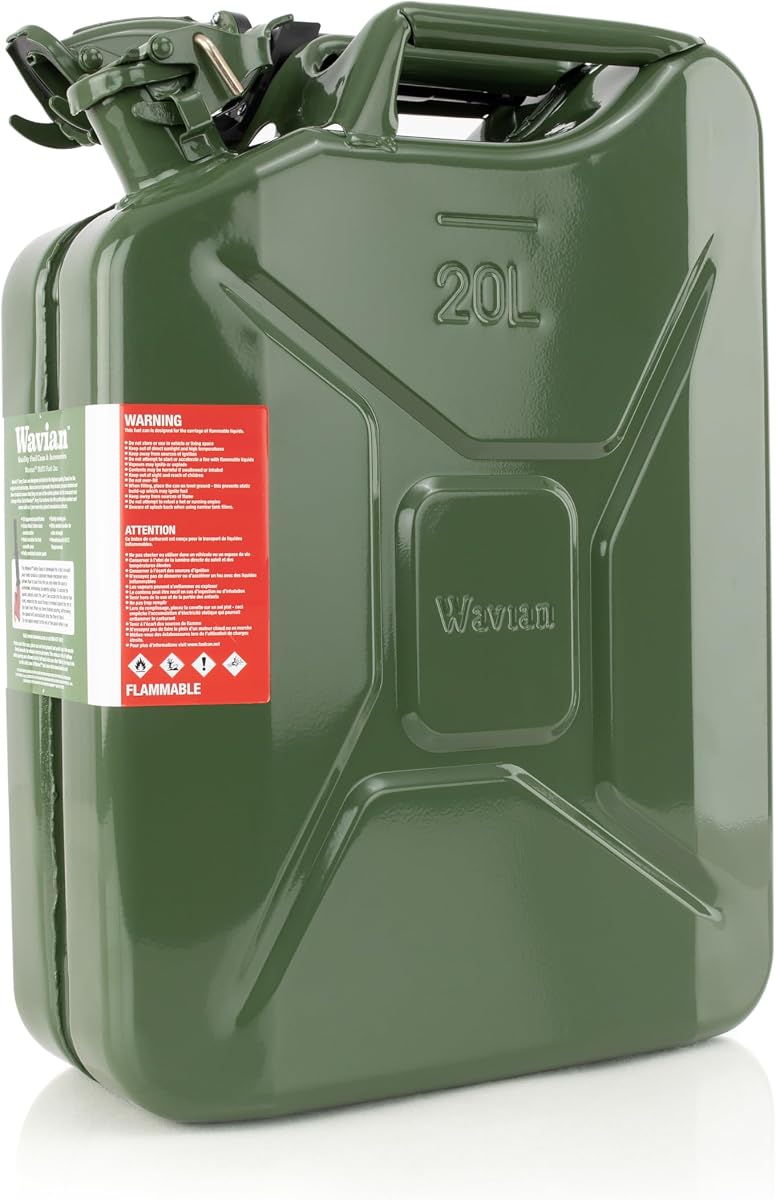
Wavian USA Authentic NATO Jerry Can and Spout System
4.4Editor score
Authentic NATO-style system
North American compliance
Bayonet locking spout
Our All Metal Jerry Can guide compares 10 durable, compliant steel fuel containers for safe storage, transport, and dispensing of gasoline, diesel, and
An all metal jerry can is more than a rugged alternative to plastic: it is a purpose-built container for storing and transferring flammable liquids safely. The strongest choices combine corrosion-resistant steel, secure closures, flame protection, balanced handling, and recognized safety certifications for the fuel they are intended to carry.
This guide compares ten metal jerry cans across useful categories, including Type I safety cans, Type II dispensing cans, military-style containers, and general-purpose steel fuel cans. We compared stated capacity, construction, closure systems, dispensing features, certification details, and intended fuel type, with particular attention to the differences between gasoline, diesel, and kerosene containers.
Each review explains who the container is best suited for, what makes it stand apart, and where its design creates trade-offs. The ranking reflects the supplied product information rather than personal hands-on testing, and availability, certification details, and pricing can change, so readers should verify current product information before purchasing.
4.4Editor score

4.7Editor score

4.5Editor score
The table below compares all ten containers by capacity, intended fuel, closure system, and principal safety or dispensing features, making it easier to identify the right metal jerry can for each use.


The Wavian USA Authentic NATO Jerry Can and Spout System earns the top position for buyers who want a military-style all metal jerry can with a thoughtfully engineered closure. It carries a 4.4 rating and holds five gallons, equivalent to the stated 20-litre capacity. Its green finish and familiar rectangular profile give it the recognizable appearance associated with rugged outdoor and emergency-preparedness equipment.
We may earn a commission when you buy through this link, at no additional cost to you.
Construction is based on 0.9mm cold-rolled steel with an anti-corrosive coating, providing the substantial feel and environmental durability expected from a serious fuel container. The spout uses a bayonet-style quick-release connection and a safety lock, creating a more involved securement system than a simple screw cap. The product information also states EPA and CARB compliance, along with specific regulatory numbers for use across North America.
Its main trade-off is that the published specifications emphasize military styling, corrosion resistance, and regulatory compliance rather than the extensive third-party approval language found on several Type I safety cans. Buyers whose workplace requires FM, UL, or ULC approval may need documentation beyond the stated EPA and CARB compliance. It is also a more specialized purchase when the priority is simply inexpensive bulk fuel storage.
This is the recommendation for campers, overlanders, rural property owners, and preparedness buyers who value a recognizable NATO-style container, robust steel construction, and a secure locking spout. It is especially attractive when legal North American fuel transport and a substantial capacity are the central requirements. For regulated workplaces, confirm current approval and labeling requirements before using it as a formal safety can.
The bayonet-style quick-release nozzle and safety lock provide a reassuringly secure way to cap the container. That design suits users who expect the can to move through vehicles, outdoor gear, or busy workshops without relying on a loosely fitted lid.
The rectangular five-gallon form provides useful bulk capacity while preserving a familiar field-container profile. Its stated 0.9mm cold-rolled steel shell and anti-corrosive coating make it a compelling choice for long-term fuel storage.
We may earn a commission when you buy through this link, at no additional cost to you.
The 5.3 Gallon Metal Jerry Can, 20L Steel Fuel Can for Trucks SUV is built around high capacity and rugged vehicle use. It has a 4.0 rating and an army green finish, with a classic rectangular body intended to fit truck beds, SUV trunks, and off-road mounting racks. The supplied information describes a five-point-three-gallon and twenty-litre design, making it one of the more substantial containers in this roundup.
We may earn a commission when you buy through this link, at no additional cost to you.
The body uses high-grade cold-rolled steel with a rust-resistant coating, while the locking cap and heavy-duty gasket are intended to limit leaks and vapor escape. An integrated handle supports carrying and pouring, and the product is described as compatible with most standard transfer accessories. That versatility makes it useful for tractors, generators, mowers, outdoor trips, and emergency fuel reserves.
One concern is the limited certification information in the product listing. Unlike the Eagle and Justrite models, this can does not have a supplied description naming OSHA, NFPA, FM, UL, ULC, or TÜV approvals. Buyers handling fuel in regulated workplaces should therefore verify its legal safety-can status and confirm whether the stated five-point-three-gallon capacity corresponds to a marketed five-gallon configuration.
The Festisoul is best for truck, SUV, farm, and off-road users who prioritize capacity, recognizable military styling, and a simple steel container with a gasketed lock. It is a sensible general-purpose option when a certified Type I can is not required. For commercial facilities, however, documented safety approval should take priority over capacity and appearance.
The large stated capacity reduces the need for repeated refills when maintaining generators, tractors, or mowers. Its rectangular shape is also practical for arranging fuel storage in truck beds and trunks.
A precision-sealed locking cap and heavy-duty gasket are intended to keep the container closed against bumps and vibration. The design is well matched to mobile use, provided the cap is fully tightened after each use.
We may earn a commission when you buy through this link, at no additional cost to you.
The Eagle 5 Gallon Type I Red Safety Gas Can for Gasoline is the strongest all-around choice for buyers who need a clearly safety-focused metal fuel can. It has a 4.7 rating, a familiar five-gallon capacity, and a Type I design centered on a single opening for filling and dispensing. The red finish provides a visible indication that this model is intended for gasoline.
We may earn a commission when you buy through this link, at no additional cost to you.
Its supplied safety details are extensive. The can meets OSHA Standard 1910.106 and NFPA Code 30 requirements and is listed as FM, UL, and ULC approved. A self-closing gasketed spout cap helps prevent leakage while automatically venting internal vapors, and the included funnel assists with controlled filling and pouring. A non-sparking flame arrestor helps reduce ignition risks, while the double-interlock, no-weld bottom seam strengthens the lower closure area.
The construction is hot-dipped 24-gauge galvanized steel with a baked-on powder-coat finish intended to resist rust, dents, scratches, chipping, and fading. That combination creates a can that looks ready for repeated workshop or garage use. The trade-off is that Type I cans use a relatively straightforward spout rather than the flexible hose found on higher-end Type II dispensing designs, and color coding limits fuel flexibility.
This Eagle can is the recommendation for home mechanics, facilities managers, emergency-preparation buyers, and anyone who values recognized safety approvals without needing a dispensing hose. It is a particularly sensible choice for gasoline storage where OSHA or NFPA compliance matters. The included funnel and automatic vapor venting make routine handling more convenient while preserving a compact, familiar design.
The self-closing gasketed spout cap, automatic vapor venting, and non-sparking flame arrestor work together to support controlled handling. These details make the can more than a metal vessel with a screw lid.
Stated OSHA and NFPA compliance plus FM, UL, and ULC approval make this a reassuring choice for workshops and industrial environments. Buyers should still observe local storage rules and keep the can in a suitable location.
We may earn a commission when you buy through this link, at no additional cost to you.
The Justrite Type II Gasoline Safety Can, Red Galvanized Steel, FM Approved is the option to consider when controlled dispensing matters more than the simplicity of a conventional spout. It carries a 4.6 rating and uses galvanized steel with a chemical-resistant powder-coat finish, providing a durable body for repeated commercial and industrial use.
We may earn a commission when you buy through this link, at no additional cost to you.
The defining feature is its patented manifold and Safe-Squeeze trigger. Together they are designed to produce smoother, glug-free dispensing with improved flow control, which can reduce splashing and make it easier to transfer fuel accurately. A flexible metal hose directs the stream into smaller openings, and the ergonomic lift lever supports faster, more convenient refilling. These are meaningful advantages when the can is used around equipment with restricted fill ports.
Fire protection comes from a stainless steel flame arrester, while the self-closing, leak-tight lid supports safer storage between uses. The product is listed as FM Approved, UL/ULC Listed, and TÜV Certified, with its design supporting OSHA and NFPA requirements. The trade-off is greater mechanical complexity, and the larger Type II arrangement may be less convenient for users who only need occasional top-ups from a standard fuel opening.
This Justrite can is best for workshops, maintenance departments, industrial facilities, and experienced users who repeatedly dispense gasoline into small openings. The controlled hose and trigger system justify the more specialized format for high-frequency use. For simple transport or emergency reserves where compactness is more important, a Type I can is usually the simpler option.
The flexible hose and Safe-Squeeze trigger are particularly useful for narrow or awkward openings. Better flow control can also reduce splashing during repeated transfers into tanks, mowers, and portable equipment.
Galvanized steel, a chemical-resistant finish, and pressure-tested construction support demanding use. Recognized FM, UL/ULC, and TÜV certifications add confidence for professional buyers.
We may earn a commission when you buy through this link, at no additional cost to you.
The Eagle 5 Gallon Type I Yellow Safety Gas Can for Diesel is a strong choice for owners of diesel-powered equipment who value certified fuel handling. It has a 4.6 rating, a five-gallon capacity, and a Type I single-opening configuration. Its yellow finish clearly distinguishes it from the red gasoline version in the same product family.
We may earn a commission when you buy through this link, at no additional cost to you.
Like the gasoline model, it includes a funnel, a gasketed self-closing spout cap, and a cap assembly that automatically vents internal vapors. The fixed handle and double-interlock, no-weld bottom seam support stable handling, while a non-sparking flame arrestor helps guard against ignition during flammable-liquid handling. The supplied information also states compliance with OSHA Standard 1910.106 and NFPA Code 30, along with FM, UL, and ULC approval.
The body is made in America from hot-dipped 24-gauge galvanized steel and receives a baked-on powder-coat finish designed to resist scratches, chipping, fading, and other wear. This is a familiar and proven construction approach for a durable safety can. As a trade-off, the Type I opening is less flexible than a hose-equipped Type II can, and the yellow designation means it should be reserved for diesel rather than used interchangeably with gasoline.
Choose this Eagle can for farm equipment, diesel generators, compact tractors, or home workshops that regularly handle diesel. Its recognized certifications and automatic venting make it a safer, more professional option than a general-purpose steel fuel container. It is less suited to buyers who need a flexible discharge hose or a smaller capacity for easy one-handed transport.
The yellow finish makes fuel identification immediate around a busy workshop. That helps prevent the cross-contamination that can occur when red and yellow containers look too similar in poor lighting.
The gasketed cap, vapor venting, flame arrester, and galvanized steel shell combine into a well-documented safety design. The stated approvals make this especially appropriate for regulated diesel-storage applications.
We may earn a commission when you buy through this link, at no additional cost to you.
The Justrite Type I Gasoline Safety Can, Red Galvanized Steel, Made in the USA is a well-balanced metal jerry can for routine gasoline storage and dispensing. Its 4.6 rating reflects a strong overall showing, while the familiar Type I layout keeps the product direct and easy to understand.
We may earn a commission when you buy through this link, at no additional cost to you.
Its counterbalanced swinging handle and integrated bottom lip are designed to improve balance during carrying, filling, and dispensing. The self-closing lid includes automatic positive-pressure relief to help reduce vapor release and minimize pressure buildup, while a stainless steel flame arrester helps reduce flashback ignition risk. Those closure details make it more than a basic container with a removable cap.
The body uses 24-gauge galvanized steel with a chemical-resistant powder-coat finish, and the supplied information describes the can as leak tested and made in the USA. It is FM Approved, UL/ULC Listed, and TÜV Certified, with the design supporting OSHA and NFPA requirements. The limitation is the same inherent tradeoff found in Type I designs: without a flexible hose, the spout must align reasonably well with the receiving opening.
This Justrite model suits maintenance professionals, homeowners, and workshop operators who want certified gasoline storage with a comfortable handling system. It is a sensible alternative to the Eagle Type I cans for buyers who prefer a swinging handle and automatic pressure relief. Users who need to reach deeply recessed fill ports should consider the Type II model instead.
The counterbalanced handle and bottom lip help manage the shifting weight of a full can. These ergonomic details are especially noticeable when moving a five-gallon container between a storage area and a vehicle.
Automatic positive-pressure relief works with the self-closing lid to manage internal pressure. A stainless steel flame arrester adds another layer of protection during routine flammable-liquid handling.
We may earn a commission when you buy through this link, at no additional cost to you.
The Eagle 2 Gallon Type I Red Safety Gas Can for Gasoline is the compact choice in this lineup. It provides the same Type I safety-can concept and certification language as the larger Eagle models, but its two-gallon capacity makes it easier to carry and store. It holds a 4.6 rating and uses the familiar red color associated with gasoline.
We may earn a commission when you buy through this link, at no additional cost to you.
The included funnel assists with filling and pouring, while the gasketed spout cap self-closes to help prevent leaks and spills. The cap assembly automatically vents internal vapors, and the fixed handle gives the user a stable grip. A double-interlock, no-weld bottom seam and a non-sparking flame arrestor support dependable flammable-liquid handling.
The construction is hot-dipped 24-gauge galvanized steel with a baked-on powder-coat finish. According to the supplied information, it meets OSHA Standard 1910.106 and NFPA Code 30 requirements and carries FM, UL, and ULC approval. The main compromise is capacity: two gallons may require more frequent refills for vehicles or larger equipment, and the can is less suitable for minimizing the number of containers in a vehicle.
The smaller capacity is the central benefit for users who find a full five-gallon can awkward to lift. It is well suited to short-distance transport and controlled amounts of gasoline.
Despite its smaller size, the product retains the gasketed closure, automatic venting, flame arrestor, and stated professional approvals. Compact does not have to mean under-specified in a safety can.
We may earn a commission when you buy through this link, at no additional cost to you.
The Justrite Type I Kerosene Safety Can, Blue Galvanized Steel, Made in the USA is a purpose-built option for users who need to store and dispense kerosene rather than gasoline or diesel. It has a 4.7 rating and a blue finish that provides clear fuel identification, helping separate it from red and yellow containers in a shared storage area.
We may earn a commission when you buy through this link, at no additional cost to you.
The can uses 24-gauge galvanized steel with a chemical-resistant powder-coat finish, and the supplied information describes it as leak tested. A counterbalanced swinging handle and integrated bottom lip support controlled carrying and pouring. The self-closing lid incorporates automatic positive-pressure relief to reduce vapor release and pressure buildup, while a stainless steel flame arrester helps reduce flashback ignition risk.
The product is FM Approved, UL/ULC Listed, and TÜV Certified, with its design supporting OSHA and NFPA requirements for flammable-liquid handling. The trade-off is that it is specialized for kerosene and uses a Type I opening rather than a flexible hose. Buyers who handle several fuels should keep this blue container clearly separate and avoid assuming it is suitable for every fluid.
The blue finish helps identify the contents at a glance. That is valuable in homes, workshops, and facilities that keep kerosene alongside other flammable liquids.
The swinging handle, bottom lip, positive-pressure relief, and flame arrester provide a practical combination of handling and safety. It is a focused choice for kerosene rather than a general-purpose fuel can.
We may earn a commission when you buy through this link, at no additional cost to you.
The Eagle 5 Gallon Type I Yellow Safety Gas Can for Diesel is a straightforward five-gallon diesel container with a strong 4.7 rating. Its yellow finish and Type I configuration make it immediately recognizable for users who store diesel for generators, tractors, or other diesel-powered equipment.
We may earn a commission when you buy through this link, at no additional cost to you.
The gasketed spout cap self-closes to help prevent leaks and spills, and the cap assembly automatically vents internal vapors during use. A fixed handle supports transport, while the double-interlock, no-weld bottom seam and non-sparking flame arrester contribute to safe handling. The supplied information states compliance with OSHA Standard 1910.106 and NFPA Code 30 and notes FM, UL, and ULC approval.
The body is made in America from hot-dipped 24-gauge galvanized steel, with a baked-on powder-coat finish intended to resist scratches, chipping, fading, and other wear. Unlike another Eagle diesel model in the supplied data, this listing does not mention an included funnel, so buyers may need a separate filling aid. It also retains the normal Type I placement limitation rather than offering a flexible hose.
Choose this can for straightforward diesel storage where certified safety features and color coding are the priorities. It offers a compelling balance of capacity, recognizable construction, and a strong rating. Users pouring into difficult-to-reach tanks may want a Type II dispensing can, while frequent buyers should confirm whether a funnel is included with the specific package.
The self-closing cap, vapor venting, and flame arrester keep the core Type I safety features intact. This makes the can practical without adding a complex dispensing assembly.
Hot-dipped galvanized steel and a powder-coated finish are intended to resist corrosion and everyday marking. The rectangular five-gallon form also provides useful capacity without becoming excessively bulky.
We may earn a commission when you buy through this link, at no additional cost to you.
The VEVOR Metal containers with Spout and Handle, Yellow 20 L is the simplest and most budget-oriented option in this guide. It has a 4.5 rating, a metal body, a dedicated spout, an integrated handle, and a stated twenty-litre capacity. That makes it a practical basic container for users who want a metal alternative to plastic without a large collection of premium features.
We may earn a commission when you buy through this link, at no additional cost to you.
Its yellow color gives it the familiar appearance associated with many standard metal fuel containers. The handle supports portability, while the spout provides a more controlled destination for fuel than pouring from an open rim. The simple configuration also means fewer moving parts that can wear, making it straightforward to inspect and maintain.
The important limitation is that the supplied product information gives no specific certification or compliance claims. Buyers who need an OSHA- or NFPA-compliant safety can, workplace documentation, or a certified flame-arrestor system should choose a model that explicitly provides those details. As with any fuel container, the can should be used only for compatible liquids and stored and transported in accordance with applicable safety guidance.
This VEVOR container is best for cost-conscious buyers seeking a metal can with a useful twenty-litre capacity and straightforward spout-and-handle design. It may suit equipment refills, farm use, or general fuel organization where formal certified safety-can status is not required. For professional fuel handling, the reduced documentation makes a certified Type I or Type II model the wiser investment.
The dedicated spout and integrated handle cover the two basic needs of a useful fuel container: controlled pouring and manageable transport. The straightforward format also makes the can easier to inspect for wear.
A twenty-litre steel container provides a solid alternative to plastic for compatible fuel-storage needs. Its appeal comes from simplicity, while buyers needing formal safety documentation should look elsewhere.
We may earn a commission when you buy through this link, at no additional cost to you.
The right all metal jerry can depends less on appearance alone than on fuel type, capacity, closure design, environmental resistance, and the safety documentation required for the intended setting. The following factors help narrow the field before purchase.
Type I safety cans use a single opening for both filling and dispensing, usually with a gasketed, self-closing spout. They tend to be simpler and highly recognizable, making them appropriate for routine storage and top-ups. Type II cans add a separate dispensing arrangement, often a flexible hose and controlled trigger, so fuel can be directed accurately into smaller or less accessible openings. The choice depends on frequency of use, receiving-container geometry, and whether precise flow control justifies a more complex design.
Color coding is a useful warning system: red commonly indicates gasoline, yellow indicates diesel, and blue commonly identifies kerosene. The listing should always be checked rather than relying on color alone. Some general-purpose containers are described only as fuel cans, while certified models may be explicitly approved for a particular flammable liquid. Matching the can to the intended fuel helps reduce misidentification and prevents a container intended for one liquid from being used casually with another.
Professional or regulated users should look for clear references to OSHA Standard 1910.106, NFPA Code 30, FM approval, UL or ULC listing, and TÜV certification. These claims indicate that a manufacturer has provided the can for recognized safety evaluation, although buyers should still follow local workplace and fire-code requirements. A general steel container may be durable and useful without carrying the same documented safety status as a certified safety can.
A five-gallon container is convenient for reducing refill trips and stocking equipment, but a full can is heavy and less convenient to lift. A two-gallon model is easier to carry and store but requires more frequent refills. Twenty-litre military-style containers sit between common passenger-car fuel limits and large bulk tanks, so buyers should consider how the can will be lifted, secured, and positioned in a truck bed or storage area.
A quality closure should seat fully, maintain a gasket seal, and resist accidental opening. Self-closing spout caps help contain liquid, while automatic venting can manage internal pressure during use. For difficult fill ports, a flexible hose and trigger-controlled flow offer a major convenience advantage. For straightforward work, a fixed spout with a funnel may be sufficient and easier to maintain because it has fewer components.
Steel construction provides a rigid body that tolerates impacts and temperature changes better than many plastic alternatives, but the stated gauge and coating help distinguish quality options. The Eagle models use 24-gauge hot-dipped galvanized steel, while the Wavian model uses 0.9mm cold-rolled steel with an anti-corrosive coating. Coatings, seams, and surface condition all influence how well a can resists rust, dents, and finish wear over time.
A flame arrester is an important feature in a fuel can because it helps reduce the chance that a flame ignites internal vapors. Self-closing lids limit liquid escape, while positive-pressure relief and automatic venting help manage pressure as temperatures and liquid levels change. These features are especially valuable for gasoline and kerosene, although the specific fuel and workplace rules should determine which safety can is appropriate.
Consider where the can will live between uses. A fixed handle is simple and durable, a counterbalanced swinging handle improves balance, and an integrated military-style handle suits vehicle and outdoor kits. Workshops may benefit most from certified models and precise dispensing, while emergency-preparedness buyers may prioritize a recognizable NATO-style container. Truck and SUV users should plan how the can will be restrained against movement during travel.
Before filling, verify that the can is approved or intended for the specific fuel, inspect the body and seams, and check the cap, gasket, spout, hose, and flame-arrestor components. Clean and fully dry any filling funnel or transfer accessory before introducing fuel. Place the can on a level surface in a ventilated area, keep it away from ignition sources, and tighten the closure completely after filling.
When dispensing, set the receiving container in a stable position and align the spout or hose before opening the flow. Pour slowly to prevent splashing, and avoid overfilling the receiving vessel. For Type II cans, use the trigger gradually so that the controlled flow and flexible hose can reduce glugging and improve placement. Never leave a safety can open during unattended use, and always return the lid or spout to its secured position.
Store the container upright with the closure fully engaged, away from heat, sparks, open flames, and direct sun, and follow local fuel-storage rules. Inspect periodically for rust, dents, leakage, damaged threads, worn gaskets, and corrosion around seams. Empty and clean the can before changing fuel types, allow it to dry fully, and use only compatible cleaning methods. Retire a container if the body, seam, closure, flame arrester, or hose shows damage that could compromise safe operation.
A Type I safety can has one opening for filling and dispensing, usually through a self-closing spout. A Type II can separates the filling opening from a controlled dispensing outlet, often using a flexible hose and trigger. Type I models are usually simpler and more compact, while Type II models are better suited to frequent transfers into small or awkward openings.
No. A container may be made of metal without carrying the certifications required for a formal safety can. The Eagle and Justrite options in this guide include specific OSHA, NFPA, FM, UL, ULC, and TÜV claims, while the Wavian listing emphasizes EPA and CARB compliance, and the VEVOR listing provides limited safety information. Check the product documentation and local rules for professional use.
It is best not to improvise with fuel color coding. Yellow containers in this guide are specifically described for diesel, while red containers are intended for gasoline and the blue container is for kerosene. Using the correctly identified container reduces the chance of a dangerous mix-up and ensures that the product is being used within its stated design and certification.
A flame arrester helps reduce the chance that external flames ignite flammable vapors inside the container. It is particularly important for gasoline, diesel, and kerosene storage because these liquids can produce vapor that becomes flammable under suitable conditions. A flame arrester complements, but does not replace, proper ventilation, secure closure, careful handling, and distance from ignition sources.
A five-gallon container is substantial and may be awkward for some users, especially when lifting it into a vehicle. Fixed handles, counterbalanced swinging handles, and integrated handles can make the difference. A two-gallon can offers a smaller load, while a larger twenty-litre military-style can is useful when minimizing refill trips is more important than low lifting weight.
Store the can upright, fully closed, and away from heat, sparks, flames, and direct sunlight. Use a suitable ventilated storage area and observe applicable local fire and workplace regulations. For vehicle transport, secure the container so it cannot tip, slide, or strike other equipment, and never leave it unattended with its dispensing system open.
Look for rust, dents, pinholes, loose seams, damaged threads, worn gaskets, and signs of leakage. Check that the cap or spout closes completely and that any hose, trigger, flame arrester, and pressure-relief components are intact and free of obstruction. Do not use a damaged safety can, and clean the can thoroughly before changing from one fuel to another.
That depends on the exact product and the applicable rules. The Wavian model in this guide emphasizes an authentic NATO-style design, rust-resistant steel, a locking spout, and stated EPA and CARB compliance. A facility may additionally require a safety can with FM, UL, ULC, or other listed approval, so buyers should confirm the documentation and local requirements before putting it into regulated service.
The Eagle 5 Gallon Type I Red Safety Gas Can for Gasoline is the most balanced overall choice because it combines a high rating, five-gallon capacity, a self-closing spout, automatic venting, flame protection, and extensive stated approvals. The Wavian USA NATO-style system stands out for military appearance and a secure bayonet spout, while the VEVOR container offers the most straightforward metal-and-spout format for buyers focused on basic utility.
Your priorities should guide the final selection. Choose a certified Type I can for familiar, controlled storage; choose a Type II can when precise dispensing into small openings is a regular task; select a smaller two-gallon model for easier carrying; and choose the military-style container when visual profile, bulk capacity, and a locking nozzle are the deciding factors. Fuel compatibility and workplace requirements should come before appearance or minor convenience features.
Before purchasing, verify the latest listing details, approval documents, included accessories, dimensions, and fuel compatibility. Product availability and pricing can change, and safety requirements vary by location and application. Readers should also follow local fuel-handling rules, inspect the container before use, and select the model best matched to the fuel and environment where it will be used.