
GL.iNet GL-X2000 Spitz Plus
4.3Editor score
Wi-Fi 6 at 3000M
4G LTE Category 12
Dual-SIM failover
Four external SMA ports
Discover the best router with SIM card slot options by comparing 4G, 5G, Wi-Fi speed, failover, antennas, portability, and carrier support.
A router with SIM card slot can turn a cellular connection into a private Wi-Fi network for a home, office, vehicle, cabin, or temporary worksite. The right model balances network generation, wireless speed, antenna performance, wired connectivity, security, portability, and dependable carrier compatibility.
We compared ten routers using the supplied specifications, focusing on 4G or 5G support, Wi-Fi standards, Ethernet ports, failover features, VPN tools, antennas, device capacity, battery life, and regional limitations. The list includes fixed routers, travel hotspots, and portable models for different needs.
Each pick reveals which shopper it suits, from budget-conscious users seeking straightforward 4G service to advanced buyers wanting 5G, Wi-Fi 6, multi-WAN control, or cellular redundancy. Product availability and prices can change, so confirm current carrier support, plan terms, and costs before buying.
4.3Editor score

4.0Editor score

4.7Editor score
The comparison below highlights each router's network type, Wi-Fi performance, physical connectivity, and defining features, making it easier to identify the most suitable model for home backup, travel, or business continuity.


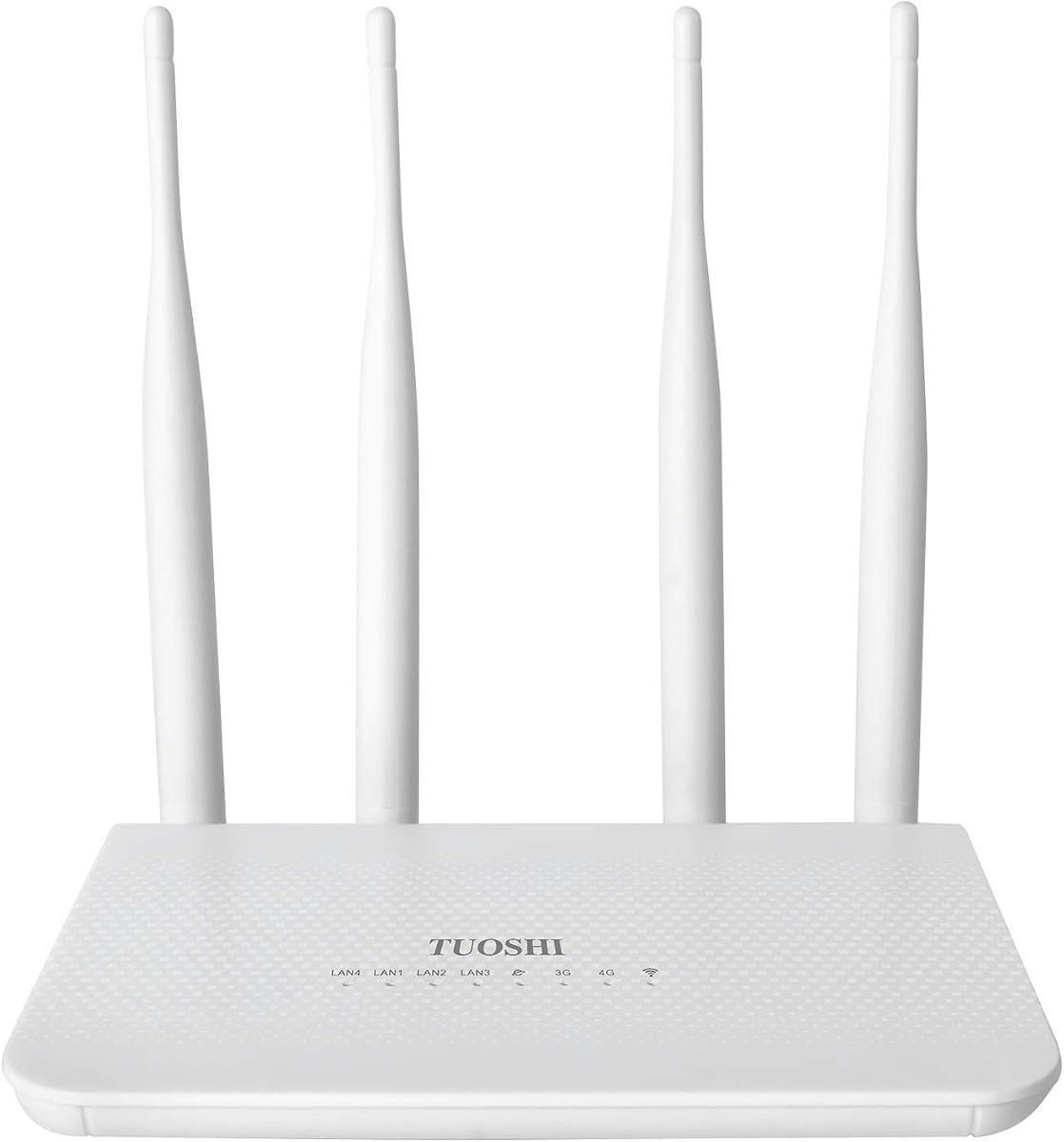


The Cudy 4G AC1200 is a fixed 4G router designed to provide dependable cellular internet in homes, small offices, kiosks, and other locations without a cable connection. It carries a 4.3 rating and combines a nano SIM slot, four external antennas, dual-band Wi-Fi 5, and four fast Ethernet ports in a compact enclosure.
We may earn a commission when you buy through this link, at no additional cost to you.
Its most valuable feature is automatic WAN failover. When a primary broadband connection disappears, the router can switch to cellular service, helping keep essential devices online. It also includes WireGuard, OpenVPN, and IPsec support in both server and client roles, making it more versatile than a basic hotspot for remote-access and privacy-conscious users.
Cellular performance uses 4G LTE Category 4, with the supplied information listing downloads up to 150 Mbps and uploads up to 300 Mbps in one description while elsewhere identifying 150 Mbps download. The local network offers 867 Mbps on the 5 GHz band and 300 Mbps on 2.4 GHz. That distinction matters because actual Internet performance depends on the carrier, signal, congestion, and plan.
This is a compelling option for a rural cabin, temporary event site, small retail operation, or home backup connection. Buyers who want Wi-Fi 6 or 5G may need a more advanced model, but those seeking an easy transition from broadband to cellular will find the wired ports, failover behavior, and VPN support particularly practical.
Automatic failover turns the Cudy into more than an ordinary cellular hotspot. It is especially useful for security systems, point-of-sale equipment, VoIP phones, and remote workers that cannot tolerate a prolonged fixed-line outage.
Four fast Ethernet ports let computers, cameras, and other network equipment connect without adding a separate switch. Dual-band Wi-Fi serves phones and less demanding wireless clients around the same time.
We may earn a commission when you buy through this link, at no additional cost to you.
The Premium 4G LTE Portable Mobile Router is a compact hotspot for travelers, renters, remote workers, and anyone who needs cellular Internet without carrying a separate Wi-Fi stick. It has a 4.0 rating, a SIM card slot, 4×4 MIMO antenna hardware, dual-band Wi-Fi, and a built-in 2100mAh battery.
We may earn a commission when you buy through this link, at no additional cost to you.
The 4G modem can support speeds up to 300 Mbps, although real results depend heavily on the local provider's tower coverage. Multiple devices can connect for general work, video calls, entertainment, and other online activity. A smart LED display shows battery level, network strength, and the number of connected devices, reducing the need to log into an administration page for basic status checks.
Its rechargeable battery is listed for up to 12 hours of use, and USB-C charging works with a wall adapter, power bank, or laptop. That makes the router suitable for planes, trains, campsites, temporary rentals, and moving offices. WPA2 encryption provides a private network for connected clients, while a SIM from a major Americas carrier is required.
It is best for mobile users who value simplicity and battery life more than wired Ethernet or advanced failover controls. Users needing a fixed installation, broad regional band support, or eSIM flexibility should consider a desktop-style alternative.
The small footprint and rechargeable 2100mAh battery make this router convenient for a pocket, backpack, or carry-on. USB-C charging also reduces the need to carry a proprietary power supply.
The LED screen is a practical addition for travel. It provides quick feedback about battery life, cellular signal, and connected-device count without interrupting a mobile work session.
We may earn a commission when you buy through this link, at no additional cost to you.
The Dual Band 4G LTE Router stands out as the strongest all-around value in this comparison. Its 4.7 rating is the highest listed, and the router combines simple SIM-based setup, 2.4 and 5 GHz Wi-Fi, five Ethernet ports, automatic 4G failover, and six antennas in one straightforward package.
We may earn a commission when you buy through this link, at no additional cost to you.
The 5 GHz network can provide up to 900 Mbps and the 2.4 GHz network up to 300 Mbps, allowing compatible clients to move between less crowded and faster bands. Up to 32 devices can be connected simultaneously, which is sufficient for a family home, small office, or travel group with mixed connected devices.
Its networking layout is unusually flexible. One RJ45 port is designated as a WAN connection to an existing modem, while four additional RJ45 ports support wired clients or a network switch. If the broadband link fails, the router automatically moves to 4G, providing a practical continuity layer for a home or small business.
Carrier compatibility is the important limitation: the supplied data identifies AT&T and T-Mobile support and states that it does not work with Verizon or Sprint. It is a good fit for users in those supported markets, particularly when affordability, simple setup, and useful port count matter more than 5G or Wi-Fi 6.
The 2.4 GHz band is suited to routine browsing, messaging, and basic connected-device traffic, while the 5 GHz band offers more bandwidth for gaming, HD video, and other latency-sensitive activity.
With one WAN port and four LAN ports, the router can bridge an existing broadband modem and wired equipment. It also offers a convenient route to add a switch when more wired connections are required.
We may earn a commission when you buy through this link, at no additional cost to you.
The Hitron D60 5G is a premium cellular router for households, small offices, and advanced users who want more than basic 4G connectivity. It supports 5G non-standalone and standalone networks, remains compatible with 4G LTE, and offers AX3000 Wi-Fi 6 with mesh functionality.
We may earn a commission when you buy through this link, at no additional cost to you.
The supplied specifications state that the router can reach download speeds of up to 3.4 Gbps on 5G NSA. Its 4×4 5 GHz MIMO radios are described as delivering up to 5.4 Gbps of wireless performance, allowing compatible clients to use substantial bandwidth while the cellular modem supplies the Internet connection.
Dual failover is its central resilience feature. With both a nano SIM slot and eSIM capability, the router can maintain cellular continuity if one connection path fails. It is certified with T-Mobile, AT&T, and US Cellular, giving buyers more carrier choice than products limited to two providers, though a compatible activated nano SIM is required.
The D60 makes the most sense for users in strong 5G coverage areas, high-capacity households, and critical connectivity environments. Its more advanced networking, future-oriented wireless standard, and multi-carrier design justify consideration over a basic 4G router, provided the available cellular plan and local coverage deliver the needed performance.
Support for both NSA and SA 5G increases compatibility with different network deployments. Backward-compatible 4G operation means the router can remain useful where full 5G service is unavailable.
The combination of nano SIM and eSIM enables dual cellular failover, a useful feature for home offices and small businesses where a second active pathway is more useful than a single connection that can fail.
We may earn a commission when you buy through this link, at no additional cost to you.
The GL.iNet GL-X2000 Spitz Plus is a technically advanced 4G router built around 4G LTE Category 12, Wi-Fi 6, dual-SIM management, and multi-WAN operation. It is a strong alternative for users who need control over multiple Internet paths rather than simply choosing between Wi-Fi and cellular service.
We may earn a commission when you buy through this link, at no additional cost to you.
Wireless performance is specified at 574 Mbps on 2.4 GHz and 2,402 Mbps on 5 GHz. The cellular side uses Category 12 download carrier aggregation across three carriers, designed to improve bandwidth availability, coverage, and reliability compared with a simpler Category 4 modem.
Multi-WAN functionality can combine Ethernet, repeater, cellular, and tethering connections. Users may set failover priorities or distribute bandwidth among connection methods by custom proportion, which is particularly useful for a resilient office, mobile command center, or home with more than one access option.
Four interchangeable SMA connectors allow external antennas to be added for better positioning or directional coverage. OpenVPN and WireGuard are preinstalled, with the supplied data listing 30-plus supported VPN services. Because the product is designated for North America and has modem restrictions in several countries, buyers outside supported regions should verify compatibility before ordering.
Multi-WAN is the Spitz Plus's defining feature. It can maintain cellular, wired, repeater, or tethering options and choose among them according to the configuration, giving administrators more control over resilience.
Four SMA connectors make it possible to integrate suitable external antennas and optimize placement. That can be valuable inside metal cabinets, vehicles, remote sites, or buildings where an internal router antenna is a weak point.
We may earn a commission when you buy through this link, at no additional cost to you.
The CPE C600C is a fixed 4G router with a SIM card slot and dual-band Wi-Fi. Its combination of cellular service, four LAN ports, and portable use cases makes it suitable for holiday cabins, remote cameras, offices, recreational vehicles, and trucks where conventional cable service is unavailable.
We may earn a commission when you buy through this link, at no additional cost to you.
Using an activated nano SIM from AT&T or T-Mobile, the router can provide Category 4 cellular service with downloads up to 150 Mbps and uploads up to 50 Mbps. The description also notes that the chosen operator must support hotspot service, an important qualification because not every mobile data plan permits router use.
Setup is designed to be approachable. The supplied information describes a three-step process, local administration at 192.168.1.1, and a physical WPS button for quick wireless linking. It can support up to 32 devices, while its mobile-router design allows it to serve as a traveling hotspot as well as a stationary network hub.
The absence of a listed customer rating means buyers have less visible review history to assess. Nevertheless, the C600C is a practical option for users who need one device to work across a cabin, temporary office, and vehicle without requiring a separate Wi-Fi hotspot.
The C600C's portability does not prevent it from functioning as a wired network center. It can travel between locations while retaining access to cellular and Ethernet connectivity.
A basic installation sequence and web-based management keep setup approachable. The WPS button offers a quick path for joining compatible devices without manually entering every network setting.
We may earn a commission when you buy through this link, at no additional cost to you.
The C910 4G LTE is an unlocked wireless router that converts cellular service into a 300 Mbps Wi-Fi hotspot. It supports numerous North American LTE bands and can connect up to 32 devices, making it a broad-fit option for users in the United States, Canada, and Mexico who use compatible AT&T or T-Mobile service.
We may earn a commission when you buy through this link, at no additional cost to you.
Four high-performance external antennas, two LAN ports, one WAN port, and a SIM slot give it a useful mix of wireless and wired connectivity. Cellular download speed is listed at up to 150 Mbps and upload at up to 50 Mbps, while the local wireless network supports up to 300 Mbps.
Operating-mode flexibility is one of its strongest practical features. It can act as a cellular router, access point, or repeater, allowing an existing wired or wireless network to be extended. Setup may require APN configuration and disabling a SIM PIN code for certain combinations, and the product does not support roaming, virtual SIM cards, or IoT SIM cards.
The C910 fits households, offices, IPTV setups, gaming devices, and connected-home equipment where a broad selection of LTE bands is helpful. It is less attractive for travelers who depend on roaming or international eSIM services, but within its stated North American scope, it is capable and adaptable.
Router, access-point, and repeater modes make the C910 useful beyond a standard cellular hotspot. It can share LTE directly, turn a wired connection into Wi-Fi, or extend an existing wireless network.
Support for B2, B4, B5, B12, B13, B17, B18, B25, and B26 bands improves the chance of compatibility across supported North American markets. Buyers should still confirm their carrier's exact network and plan.
We may earn a commission when you buy through this link, at no additional cost to you.
The N300 WiFi Unlocked 4G LTE Modem Router is aimed at buyers who need a straightforward cellular connection for a cabin, vacation home, remote office, vehicle, or backup to an unreliable broadband service. It offers Category 4 LTE, N300 dual-band Wi-Fi, four fast Ethernet ports, and support for up to 32 connected devices.
We may earn a commission when you buy through this link, at no additional cost to you.
The router supports a broad collection of LTE and WCDMA bands. AT&T and T-Mobile are identified as major compatible providers, while the supplied information also notes that Verizon may require a specific TTL setting depending on the data plan. That qualification makes plan and carrier verification essential before purchase.
Security is a notable strength. WPA3 encryption, L2TP, PPTP, and OpenVPN support give the router tools for private access and encrypted traffic. Mesh capability allows it to participate in a broader roaming network, which can be helpful in a larger home or small office where one access point does not provide enough coverage.
Its 3.8 rating is the lowest numerical score in the list, so buyers should weigh the strong feature set against limited visible customer feedback. It remains a compelling option for a basic but secure cellular network, especially when wired connections and mesh expansion are priorities.
WPA3 and built-in VPN protocols make the router more appropriate for a private home-office network than an open public hotspot. These protections are especially helpful when connecting over public cellular service.
The extensive frequency list includes LTE bands B2, B3, B4, B5, B7, B8, B12, B13, B17, B25, B26, B66, and B41. Users should still confirm that both the SIM and its data plan are compatible with the router.
We may earn a commission when you buy through this link, at no additional cost to you.
The 4G LTE Asia Router is a regional cellular hotspot designed around LTE bands B1, B3, B5, B8, B38, B40, and B41. It is intended for buyers operating in Asian cellular markets rather than users shopping primarily for North American AT&T or T-Mobile service.
We may earn a commission when you buy through this link, at no additional cost to you.
Four non-removable 5 dBi antennas are included to improve sensitivity and help establish a wireless connection over a greater distance. The router converts LTE service into a 300 Mbps Wi-Fi network, with cellular downloads listed at up to 150 Mbps and uploads at up to 50 Mbps.
The device can serve approximately 10 to 20 simultaneous clients, which is appropriate for a small traveling group or individual mobile office. Its power input accepts 100 to 240 volts, and installation is centered on inserting a compatible SIM and powering the unit on. Some SIMs may require the PIN to be disabled and the APN changed through the interface at 192.168.100.1.
This router is a sensible choice when the selected carrier and physical location match its Asian band support. It would be a poor substitute for a similarly priced model carrying broader regional compatibility or more Ethernet ports, so buyers should verify their carrier's bands and data-plan rules first.
The four 5 dBi antennas are intended to improve sensitivity and support longer-distance Wi-Fi coverage. Their value is greatest where the router is placed near a window, above a work surface, or in a location with a clearer cellular path.
Band support is the decisive consideration for this model. Confirm the exact LTE bands and APN requirements of the intended local carrier before purchasing to avoid an otherwise simple router being unable to connect.
We may earn a commission when you buy through this link, at no additional cost to you.
The GL.iNet GL-E750V2 Mudi is a portable travel router combining 4G LTE Category 6, dual-band Wi-Fi, a 7000mAh battery, and an easy-to-carry enclosure. It targets travelers, remote workers, and international users who want a private network beyond the reach of a public hotspot.
We may earn a commission when you buy through this link, at no additional cost to you.
It measures 5.7 by 3.1 by 0.9 inches and weighs 285 grams, making it practical for a carry-on or backpack. The battery is specified for up to eight hours of use, while the router also includes an Ethernet port and USB 2.0 port for more flexible connections than a basic mobile hotspot.
Privacy-oriented features include built-in OpenVPN and WireGuard support, customized DNS, and compatibility with more than 30 VPN servers. The supplied data lists maximum VPN speeds of 50 Mbps with WireGuard and 10 Mbps with OpenVPN under the stated test conditions, making it suitable for browsing, streaming, and secure remote access.
The Mudi supports GL.iNet physical eSIM cards, which must be purchased separately, in addition to its standard SIM approach. Modem restrictions limit cellular use in Russia, Belarus, Cuba, Iran, North Korea, Syria, and the Crimean Peninsula. It is best for travelers who value VPN tools, battery capacity, and compact construction over multi-gigabit local Wi-Fi.
The 7000mAh battery is larger than those in many compact travel routers and is rated for up to eight hours. That makes the Mudi practical for full workdays, long flights, and road trips where consistent charging is not guaranteed.
OpenVPN, WireGuard, and customized DNS support make it easier to protect traffic on public cellular links. The physical eSIM option also allows compatible travelers to manage operator profiles without relying exclusively on a conventional nano SIM.
We may earn a commission when you buy through this link, at no additional cost to you.
Choosing a cellular router means balancing cellular network support, local Wi-Fi capability, wired connectivity, portability, and resilience. The following factors help narrow the field before checking current plan and device availability.
A 4G LTE router is generally the simpler option for browsing, video calls, streaming, and standard home or office use. Category 4 and Category 6 modems are common, while Category 12 can aggregate multiple carriers for better throughput. A 5G router such as the Hitron D60 supports both NSA and SA 5G and falls back to 4G, making it better positioned for future coverage and higher-capacity connections.
In practice, a newer modem only helps when the local tower, carrier plan, and signal environment support it. Choose 4G for broad 4G coverage and simpler use, or 5G for locations with strong 5G service and demanding data requirements.
A SIM card slot is only useful with a compatible carrier, SIM format, data plan, and LTE or 5G band. Several products in this list are limited to AT&T and T-Mobile, the C910 targets North American bands, and the 4G LTE Asia Router is explicitly designed around Asian frequencies. Some models also exclude roaming, virtual SIM cards, or IoT SIM cards.
Check the exact bands, hotspot permission, plan limits, and roaming policy of your provider before ordering. The best router is useless if the active SIM cannot connect to its modem.
Cellular download speed and Wi-Fi speed are separate limits. The modem may receive data at 150 Mbps while the local 5 GHz network provides a higher or lower rated speed depending on the router's hardware. AC1200 models divide bandwidth between 2.4 and 5 GHz, while Wi-Fi 6 models such as the D60 and GL-X2000 target newer clients and denser networks.
Match Wi-Fi performance to the devices you will connect. AC1200 is practical for many homes and offices, while Wi-Fi 6 offers more headroom for modern phones, computers, and high-use wireless networks.
LAN ports are important for desktop computers, cameras, IPTV boxes, game consoles, and other wired equipment. Routers with four or five Ethernet ports can serve as a complete small-network hub. WAN support may also allow the router to share an existing broadband connection.
Cellular failover adds another layer. The Cudy LT500, Dual Band 4G LTE Router, and Hitron D60 can switch to cellular when a primary path fails. For business-critical use, dual-SIM or eSIM options provide more redundancy than a single removable SIM.
Travel users should consider size, weight, battery capacity, charging method, and the number of devices that must share the connection. The Premium 4G LTE Portable provides up to 12 hours from a 2100mAh battery, while the Mudi offers up to eight hours from a substantially larger 7000mAh cell. The CPE C600C and GL-X2000 suit mobile installations but rely more heavily on external power.
Choose a pocket router for personal travel, a larger battery for extended mobile work, or a mains-powered model for a vehicle, cabin, or fixed temporary site.
External or high-gain antennas can improve reception when a router's internal antennas sit behind walls, inside vehicles, or in low-signal locations. The GL-X2000 has four interchangeable SMA connectors, the Cudy includes external antennas, and the C910 and Asia Router use four external antennas. Multiple antennas alone do not guarantee a stronger signal, but they provide useful flexibility.
Position the router near a window or higher surface when possible, and use external antennas that match the cellular and Wi-Fi functions. Confirm connector type and supported frequency before adding third-party hardware.
A cellular router can expose every connected device to the same public connection, making private Wi-Fi and VPN support important. The GL-X2000 and Mudi include OpenVPN and WireGuard, while the Cudy offers WireGuard, OpenVPN, and IPsec server and client functions. Other considerations include WPA2 or WPA3 encryption, customizable DNS, remote management, and easy APN configuration.
Prioritize models that make security controls understandable. The best options make it easy to establish an encrypted private network without turning routine access into a technical project.
Advertised device counts indicate an approximate upper limit rather than guaranteed performance for every client. The Cudy, Dual Band 4G LTE Router, CPE C600C, and C910 list support for as many as 32 devices, while the Asia Router is intended for 10 to 20. The 5G and Wi-Fi 6 models target higher-capacity or faster environments.
Count only active clients and consider how they use the network. Video, gaming, cloud work, security cameras, and smart-home devices place different demands on throughput and capacity.
Start by confirming that the router supports your carrier, SIM size, LTE or 5G bands, hotspot permission, and data plan. Insert the activated SIM, connect the correct power adapter, and allow the modem time to register. If the device does not appear online, check for a SIM PIN prompt, verify the APN, and confirm that the account has not restricted hotspot use.
After connecting, change the default administrator credentials, update the router's firmware, and set a strong Wi-Fi password. Select the 5 GHz band for nearby high-bandwidth devices and allow 2.4 GHz for longer range and compatible smart-home equipment. Configure VPN protection, DNS settings, and automatic cellular failover if the device supports them.
For best reception, place the router in an open, elevated location rather than inside a cabinet or behind metal. Keep the device ventilated, use the specified power supply, and avoid exposing it to moisture or extreme heat. Update software periodically, review connected clients, and compare cellular performance at different times because tower load and signal conditions can change.
Most models require an activated SIM with mobile data and a plan that permits hotspot or router use. A regular phone plan may support the SIM physically but restrict router traffic, so confirm hotspot permission with the carrier. Some products include a SIM slot without a SIM, while physical eSIM support on compatible models may require a separate eSIM card.
It can when cellular coverage and the selected data plan provide sufficient speed, reliability, and data allowance. A 4G router is suitable for normal browsing, streaming, and many office tasks, while 5G can better serve crowded or demanding networks. Fixed installations should also consider monthly data limits, carrier throttling, and the availability of a backup connection.
The fastest network depends on location, carrier, plan, tower load, and device compatibility. A router with 5G support may deliver the highest potential speed where 5G coverage is strong, but 4G Category 12 with three-carrier aggregation can perform well in other areas. Check coverage maps and local carrier performance rather than relying only on the router's maximum rating.
Dual SIM is useful when cellular continuity matters because it allows two carrier lines or profiles to provide redundancy. A router with a single SIM and automatic WAN failover can still protect against a fixed broadband outage, but it cannot switch to another cellular carrier if the inserted SIM loses service. The Hitron D60 and GL-X2000 are the strongest options here for cellular redundancy.
Cellular speed describes the connection from the carrier's network to the router. Wi-Fi speed describes the connection from the router to nearby wireless clients. A router may advertise a fast local Wi-Fi standard while its cellular modem provides a lower Internet rate, and the slower of the two links usually limits end-to-end performance.
Only with a SIM, eSIM, or roaming plan that is compatible with the router's supported bands and regional restrictions. Several models are designed for North America, one targets Asian networks, and some cellular modems are restricted in specified countries. Check both the router's region and the carrier's roaming terms before departing.
The listed maximum varies from approximately 10 to 20 devices on the Asia Router to as many as 32 on several 4G models. The practical limit also depends on cellular bandwidth, client activity, signal quality, and device processing. Counting active clients gives a better estimate than relying on the advertised maximum.
Common causes include an inactive SIM, a PIN lock, an incorrect APN, carrier hotspot restrictions, unsupported bands, or a coverage gap. Confirm that the SIM works in a phone, disable its PIN if the router requires that, and check the APN settings in the router interface. If the issue continues, verify plan activation and the carrier's permitted use of the device.
The Dual Band 4G LTE Router is the strongest general choice for most supported AT&T and T-Mobile households, offering a high customer rating, AC1200 dual-band Wi-Fi, five Ethernet ports, 32-device capacity, and automatic cellular failover. The Hitron D60 5G is the premium option for users who need 5G, Wi-Fi 6, eSIM, and dual cellular paths.
The GL.iNet GL-X2000 Spitz Plus stands out for advanced multi-WAN control, Category 12 cellular aggregation, Wi-Fi 6, and external antenna options. Portable buyers can instead consider the Premium 4G LTE Portable for its rechargeable 2100mAh battery or the GL.iNet Mudi for a larger 7000mAh battery, built-in VPN tools, and travel-oriented design.
Prioritize carrier compatibility, local signal quality, the required device count, wired connections, and failover needs before comparing features. Then check current prices, data-plan charges, SIM requirements, and product availability, since all can change over time and are separate from the hardware itself.