
TADA 200g/0.2g Mechanical Balance
3.8Editor score
Compact 200g capacity
0.2g stated precision
Included classroom weight set
Portable lightweight design
Explore the best Mechanical Balance options for labs and classrooms, comparing 10 models by capacity, readability, damping, platforms, construction, and
A mechanical balance remains a useful, battery-free instrument for teaching mass measurement, performing classroom demonstrations, and handling routine laboratory or kitchen weighing. A worthwhile model combines a stable frame, readable beam markings, effective damping, and enough capacity for the materials being measured. Capacity, readability, included weights, and ease of zeroing deserve careful attention before purchase.
This guide compares ten mechanical balances, with most of the selection centered on triple beam designs and one option built for medical weighing. The review considers maximum capacity, stated readability, platform construction, damping, adjustment mechanisms, supplied weights, portability, and intended environments. Products with unavailable customer ratings are identified accordingly, and specifications are limited to information supplied with each listing.
Each pick demonstrates a different balance of practical priorities, from compact classroom teaching to expanded analytical capacity and clinical durability. The featured products include the TADA for elementary-style instruction, the QWORK and Ohaus models for established laboratory capability, and the Health o meter for professional medical environments. Retail listings and product configurations can change over time, so confirm specifications before ordering.
3.8Editor score

4.4Editor score

4.3Editor score
The comparison below places all ten balances side by side, emphasizing capacity, readability, construction, damping, portability, and the environments each model is designed to serve.

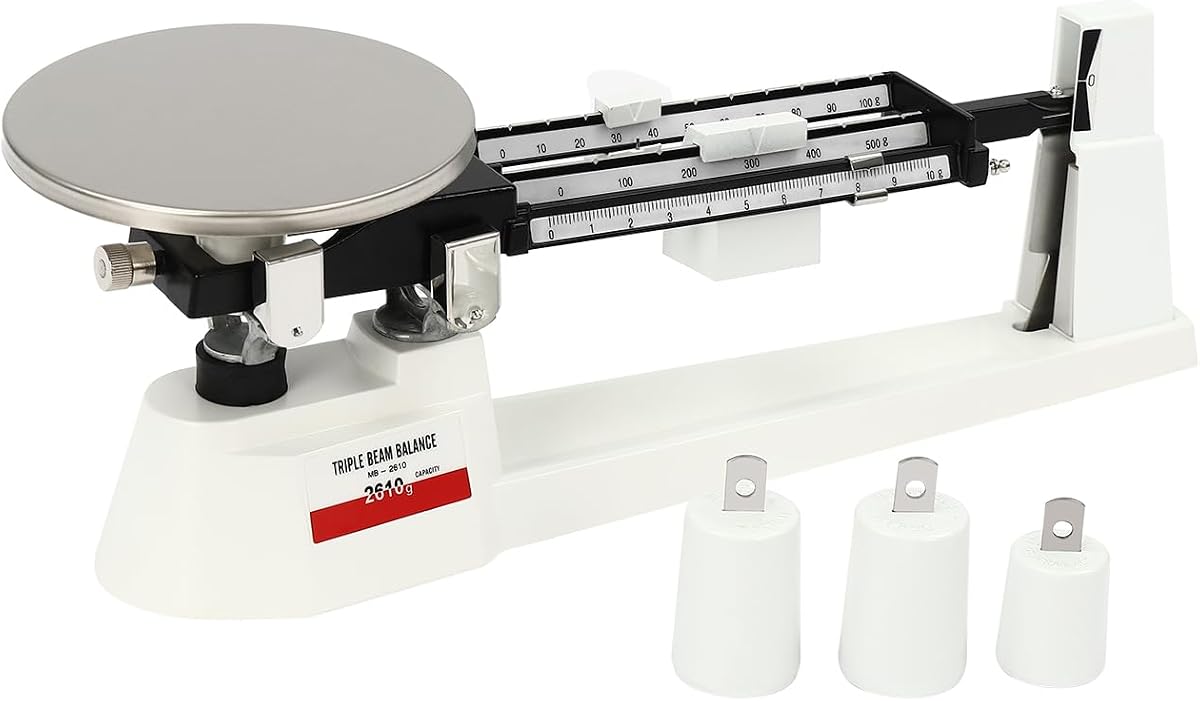


The QWORK Triple Beam Mechanical Balance is a battery-free scale designed for classroom, university, laboratory, and kitchen weighing. It has a customer rating of 3.7, and its defining advantage is the combination of a stated 2610g maximum capacity with 0.1g accuracy. That combination allows it to handle objects beyond the range of a compact teaching balance without relying on an electronic power source.
We may earn a commission when you buy through this link, at no additional cost to you.
The scale includes two 1000g weights and one 500g weight, increasing the usable capacity from 610g to 2610g. A rider on the beam supports direct reading, while the zero adjustment knob helps reduce systematic error before a measurement. Magnetic damping is intended to stabilize the pointer quickly, and the six-inch platform provides a practical surface for placing small containers, ingredients, or other classroom materials.
An important consideration is transportation. The listing states that although the balance is professionally calibrated, movement during shipping can disturb the zero setting. The user may therefore need to follow the included image instructions or video to re-zero it. This is a normal consideration for a sensitive beam mechanism, but it adds an extra setup step and is the main reason the product does not lead every category in this guide.
This model is best for buyers who need more capacity than a small classroom balance but do not require a permanently installed analytical workstation. It is particularly useful when the balance will move between rooms or be stored after demonstrations. Buyers should check the calibration instructions before first use and expect to verify zero whenever the instrument has been moved or exposed to substantial handling.
The included 1000g and 500g weights raise the listed range to 2610g, allowing the balance to serve larger samples than a standard 610g triple beam design. It remains suitable for multiple laboratory, classroom, and cooking demonstrations without electronic displays or batteries.
Built-in magnetic damping reduces pointer swing after the riders are adjusted. This makes repeated classroom measurements feel more settled while preserving the direct, hands-on nature of a mechanical beam balance.
We may earn a commission when you buy through this link, at no additional cost to you.
The TADA 200g/0.2g Mechanical Balance Scale is a compact teaching tool for science classrooms and instructional demonstrations. Its customer rating is 3.8, and the design focuses on portability, simple operation, and enough precision for common lesson exercises rather than extended analytical workloads. The listed maximum capacity is 200g, making it most appropriate for small samples and lightweight classroom objects.
We may earn a commission when you buy through this link, at no additional cost to you.
The scale comes with 5g, 10g, two 20g, 50g, and 100g weights, giving an instructor a useful starter set for demonstrating mass comparison and reading balance weights. Its compact size and low weight make it easier to store in a laboratory cabinet or carry between classrooms. High-grade materials are specified for regular educational use, while the straightforward format keeps the instrument approachable for students.
The 0.2g precision is adequate for many introductory activities but does not match the 0.1g readability of the 610g and 2610g triple beam options. Capacity is the more important limitation: objects above 200g cannot be handled without additional, compatible weights and verification of the instrument's design. Consequently, the model is less versatile for laboratories that regularly weigh larger samples.
Choose the TADA when the priority is a straightforward, portable balance for teaching measurement principles. It is especially useful for instructors who need an instrument that can be put away easily and carried between lessons. For serious analytical work or samples approaching several hundred grams, one of the higher-capacity triple beam balances will provide more headroom and finer stated readability.
A lightweight, compact body allows the balance to move between storage cabinets, teaching benches, and demonstration areas. That portability makes the instrument more practical for teachers who do not have a dedicated laboratory station.
The included assortment provides several useful mass values for lessons. It reduces the need to source a basic collection separately when setting up introductory mass-measurement activities.
We may earn a commission when you buy through this link, at no additional cost to you.
The MB2610 Triple Beam Mechanical Balance Scale combines 2610g maximum capacity with a stated 0.1g resolution, making it the strongest all-around choice in this guide. It carries a customer rating of 4.4 and is positioned for laboratory analysis, school instruction, and other settings where a traditional beam display is useful. Its three-beam design lets operators combine larger masses with a smaller rider increment in a single reading.
We may earn a commission when you buy through this link, at no additional cost to you.
Two 1000g weights and one 500g weight are included, and the balance supports two attached weights at the same time. The sliding beam weights are 10g, 500g, and 100g, while a rider provides fine adjustment. Built-in magnetic damping stabilizes the pointer after movement, improving the experience of taking repeated readings. The clear, fast-read display is particularly relevant in classrooms where students need to understand how each beam contributes to the final mass.
As with many mechanical balances, careful handling matters. The platform and beam must remain stable, the sample must be placed centrally, and the instrument should be leveled before use. The model is larger and more involved than the 200g TADA scale, but that extra bulk is what enables the greater capacity and finer resolution. It also offers a more advanced demonstration of beam-balance principles than a simple single-pan balance.
This is the recommended model for most laboratories, universities, and serious classroom programs that want a traditional mechanical instrument without giving up useful capacity. It suits buyers who want 0.1g stated resolution and a 2610g working range. Those needing a more established manufacturer or a steel plate may prefer the Ohaus, but the MB2610 offers the most balanced specification set for general use.
Offset beam levels and sliding weights let the operator work through a large measurement range without constantly changing weights. This makes the scale intuitive for teaching and efficient for routine laboratory checks.
Magnetic damping shortens the pointer's settling time after the riders move. The result is a smoother workflow for repeated weighings and less waiting between classroom measurements.
We may earn a commission when you buy through this link, at no additional cost to you.
This Triple Beam Scale combines a stated 2610g capacity and 0.1g accuracy with a six-inch stainless steel platform. It is designed for laboratories, classrooms, universities, kitchens, agriculture, and industrial weighing, and it works without batteries. No customer rating is currently supplied for the listing, so the product's assessment here rests on its documented features rather than a measured consensus score.
We may earn a commission when you buy through this link, at no additional cost to you.
Its construction combines stainless steel, aluminum alloy, zinc alloy, and plastic. The listed dimensions of 18 by 6.7 by 7 inches make it relatively compact for its capacity, while a recessed base provides a place to store three weights. Clearly marked weighing ranges aid operation, and the threaded zero adjustment knob is designed to resist finger slippage while the user centers the pointer.
The balance also uses magnetic damping to reduce rider stabilization time. That detail improves workflow when several objects are weighed in succession. Its platform is easy to clean and corrosion resistant, which is advantageous in kitchens, agricultural settings, and busy teaching spaces where spills and regular wiping are likely. The number markings on the reading rod are described as durable and easy to read.
The principal tradeoff is that a customer rating is unavailable, making it harder to judge long-term user satisfaction from the provided data. The feature set is nevertheless thorough for a general-purpose instrument. Choose it when a threaded zero knob, recessed weight storage, and stainless platform are priorities, particularly if the balance will move among several work areas.
The threaded adjustment knob is intended to provide a stable grip during zeroing. Fine adjustments become easier when the mechanism does not slip under the fingertips.
A recessed area holds three weights close to the instrument. This reduces clutter and helps prevent small components from being misplaced after demonstrations or repeated measurements.
We may earn a commission when you buy through this link, at no additional cost to you.
The Health o meter Professional 400KL is a mechanical beam scale built for clinics, hospitals, and other patient-weighing environments. It has a customer rating of 4.4, an alloy steel frame, and a listed capacity of 390lb or 177kg. Unlike the compact classroom and laboratory balances in this guide, its priorities are patient comfort, stability, mobility, and long-term institutional use.
We may earn a commission when you buy through this link, at no additional cost to you.
The platform is fitted with a non-slip black mat designed to improve stability and comfort during weighing. A powder-coated finish covers the inside and outside of the scale, providing rust protection in high-use areas. Optional wheels, identified as Item #55000, can make the unit easier to move, while optional counterweights, identified as Item #55090, increase capacity to 490lb or 210kg.
Readability is listed in quarter-pound or 100g graduations, so this is not a substitute for a laboratory balance with 0.1g readability. Its larger-scale measurement interval is appropriate for tracking patient mass, where a broad, readable indication and safe platform are more important than fine mass resolution. The optional additions also mean buyers should check their facility's mobility and capacity requirements before finalizing the setup.
The standout advantage is the ten-year limited warranty, which adds institutional confidence beyond the product specifications alone. This model is the premium choice for medical offices, clinics, and comparable settings. It is less relevant to precision laboratory work, but for patient weighing, its steel construction, non-slip mat, high capacity, and warranty provide a more specialized and durable package.
The non-slip platform mat supports steadier positioning and improves comfort during a routine weighing. These patient-facing details matter more here than fine analytical resolution.
Powder-coated alloy steel is designed to resist wear and rust in demanding clinical environments. The ten-year limited warranty further supports long-term institutional ownership.
We may earn a commission when you buy through this link, at no additional cost to you.
The Ohaus 80000012 is a mechanical triple beam balance with a 610g capacity and 0.1g readability. Its customer rating is 4.3, and it targets classroom and laboratory settings where a fine stated increment, durable construction, and repeatable readings are important. The instrument uses a stainless steel weighing plate along with a metal base and beams.
We may earn a commission when you buy through this link, at no additional cost to you.
Three sliding weights, notched beams, and tiered beam levels support accurate and repeatable results. The design also provides a spring-loaded zero compensator for fine modifications, giving the operator more control when aligning the pointer before use. Built-in magnetic damping speeds settling, which is valuable during repetitive weighing and helps the balance feel more efficient than an undamped classroom model.
The main limitation is capacity. At 610g, the Ohaus covers many common laboratory and teaching samples but does not offer the expanded 2610g range of the MB2610 designs. That means additional mass requires a different instrument rather than simply adding the larger included weights used by several competitors. Buyers should base the decision on whether fine readability at moderate capacity is more important than maximum range.
This is a compelling choice for established classrooms and laboratories that want a recognizable specialist balance with a steel plate, metal frame, and precise 0.1g readability. It is also a strong alternative to the MB2610 when a 610g working range is sufficient. For larger samples, choose one of the 2610g models; for fine readings within 610g, the Ohaus remains highly practical.
The spring-loaded zero compensator permits small corrections while preserving a stable operating position. This is particularly useful when the instrument must be aligned carefully before each teaching session.
Notched and tiered beams help the operator interpret each scale position. Combined with three sliding weights, the layout makes the weighing process visible and teachable.
We may earn a commission when you buy through this link, at no additional cost to you.
The MB2610 Multi-Industry Mechanical Balance is built for school laboratories, classrooms, universities, kitchens, and several industrial or agricultural tasks. No customer rating is available in the supplied listing information. Its documented 2610g capacity and 0.1g accuracy nevertheless place it among the more capable general-purpose options in this selection.
We may earn a commission when you buy through this link, at no additional cost to you.
The balance includes two 1kg weights and one 500g weight and can support two attached weights simultaneously. It works without batteries, has a zero adjustment knob, and uses a six-inch weighing tray. Magnetic damping reduces rider stabilization time, while clear weight-range markings on the base help the operator understand the instrument's operating range.
Construction combines stainless steel, aluminum alloy, zinc alloy, and plastic. This mixed-material design is intended to provide stable performance and durability, while the relatively compact platform and tray make the scale easier to move than a large institutional beam balance. The listing also identifies electronics, agriculture, textiles, food, medicine, and scientific research as possible application areas.
Those broad applications should still be matched to the actual task. A 0.1g stated accuracy may be suitable for many routine checks, but specialized analytical or regulated procedures may require validated performance beyond the listing. This model is best for flexible institutional use where one instrument must cover demonstrations, sample checks, and light production weighing without relying on electrical power.
The 2610g range accommodates small components as well as larger classroom or kitchen samples. That flexibility reduces the need to move between separate instruments for routine weighing tasks.
A purely mechanical design can be valuable in teaching rooms, agricultural settings, and other locations where convenience or battery life is not the priority. The balance remains usable as a direct beam-reading instrument.
We may earn a commission when you buy through this link, at no additional cost to you.
The Lightweight MB2610 Balance has a customer rating of 5.0, the highest listed rating among the available reviews in this guide. It offers a 2610g maximum capacity, 0.1g stated accuracy, and a stainless steel weighing platter. The balance is positioned for education and practical weighing across food, medicine, agriculture, textiles, electronics, and research settings.
We may earn a commission when you buy through this link, at no additional cost to you.
Two 1kg weights and one 500g weight are included, allowing the working range to expand from 610g to 2610g. A zero adjustment knob supports careful alignment before each measurement, while magnetic damping reduces the time required for riders to stabilize. Its clear weight-range markings and six-inch platter make the operating layout relatively easy to understand.
The body is made from stainless steel, aluminum alloy, zinc alloy, and plastic, and its listed size is 18 by 6.7 by 7 inches. This makes it relatively easy to place on a teacher's desk, a kitchen counter, or a compact laboratory bench. The platform is easy to clean, while the overall form remains portable enough to move between work areas.
The 5.0 rating is encouraging, but it is based on a limited customer-review history rather than a deep pool of feedback. The product is best recommended for buyers who need high stated capacity, 0.1g accuracy, and a broad set of documented applications in one compact instrument. It offers an especially strong combination for general teaching and routine weighing where no single application dominates.
The 2610g range is unusually generous for an 18-inch listing, and the footprint remains small enough for ordinary desks. That balance makes the scale practical where bench space is limited.
The stainless steel platter is easy to wipe clean after food, medicine, or classroom use. Lightweight construction also makes the instrument simpler to reposition when work areas change.
We may earn a commission when you buy through this link, at no additional cost to you.
The EISCO Triple Beam Mechanical Balance is a single-pan instrument intended to help students determine an object's mass through direct, tactile experience. No customer rating is included in the supplied data. Its educational focus is reinforced by an unobstructed vertical view of the scales, created by offsetting the three beams from one another.
We may earn a commission when you buy through this link, at no additional cost to you.
Spring-loaded zero adjustment, magnetic damping, and calibrated resting notches support stable and accurate readings. The stainless steel pan is designed for durability and routine laboratory use, while the frame uses a coated, corrosion-resistant aluminum construction. These materials give the balance a practical mix of rigidity and manageable weight.
The instrument is listed for professional laboratories, science classrooms, households, and shops. That range reflects the appeal of a familiar beam balance: it can demonstrate measurement principles, perform routine checks, and support low-volume weighing without an electronic display. The 610g capacity makes it appropriate for many small samples, although it is not designed to cover the 2610g range offered by several MB2610 models.
The EISCO is most compelling for education, where the visible beam mechanism is itself part of the lesson. It is also a sensible choice for users who appreciate direct readings and a single-pan layout. Buyers who need finer practical resolution specifications beyond the supplied information, greater maximum capacity, or a larger weight set should look to the more explicitly specified 0.1g models.
Offset beams provide a clear vertical view of the scales, making it easier for students to follow how the weights affect the pointer. The instrument teaches the process rather than hiding it behind a display.
Calibrated resting notches give the moving parts a repeatable position when the balance is not in use. This complements the zero adjustment and magnetic damping during active use.
We may earn a commission when you buy through this link, at no additional cost to you.
The Triple Beam Mechanical Balance with Weights provides a 2610g working range and 0.1g stated precision. It has a customer rating of 4.0 and is marketed for school laboratories, universities, kitchens, and industrial environments. The product's main appeal is a straightforward combination of substantial capacity, a cleanable platform, and included weights.
We may earn a commission when you buy through this link, at no additional cost to you.
Two 1000g weights and one 500g weight support the expanded range. The six-inch stainless steel platform resists corrosion and can be wiped clean, making it practical for powders, liquids, food materials, and other samples. Magnetic damping stabilizes the pointer after adjustments, while a clear scale supports direct interpretation of each measurement.
A built-in zero adjustment knob is intended to reduce errors by allowing the operator to zero before weighing. The instrument needs no batteries or other power source, which simplifies placement in classrooms, teaching laboratories, kitchens, and work areas. The balance can accommodate solids, liquids, and powders within the stated operating range, though exact suitability depends on the vessel and sample being weighed.
This is a practical general-purpose option, particularly for buyers who want the large capacity, stainless platform, and three-piece weight set in one package. Its 4.0 rating trails the best-rated general models, and the compact product description gives fewer construction details than some alternatives. Even so, the documented feature set supports it as a straightforward choice for teaching and routine weighing.
Corrosion-resistant stainless steel makes the six-inch platform easier to maintain after liquids, powders, or food residue. A smooth, cleanable weighing surface also supports efficient turnover between tasks.
The scale combines a zero knob, magnetic damping, and a clear beam display without requiring a battery. This keeps operation simple in permanent classrooms and mobile teaching environments.
We may earn a commission when you buy through this link, at no additional cost to you.
Selecting a mechanical balance starts with the sample size and required readability, then narrows to construction, adjustment, damping, portability, and the environment in which the instrument will be used.
Match capacity to the workload, not just the individual object. A 200g model suits small lesson samples, a 610g balance covers many routine laboratory tasks, and a 2610g instrument offers more room for larger classroom or industrial materials. The medical model serves a completely different requirement centered on patients and high-capacity platforms.
For classroom demonstrations, either 0.1g or 0.2g may be sufficient. For laboratory measurements, a 0.1g specification is the more suitable target. Check the intended task before paying attention to decimal places, since a long display of decimals is less useful than a stable, properly zeroed instrument.
Verify the number and denomination of included weights, and confirm whether they can be attached in the positions required by the selected model. A complete starter set is convenient for schools and new laboratory spaces, while users who already own compatible weights may prioritize beam design or platform construction instead.
Choose a damped model when speed and readable settling are priorities. For a single demonstration, damping may be less noticeable, but for frequent classroom use it is a meaningful convenience. The EISCO listing also identifies magnetic damping as part of its stable-reading design.
Look for a zero control that is easy to reach, provides enough sensitivity, and resists accidental movement. Keep the balance on a level, stable surface, allow it to settle, and check zero before each teaching session or series of measurements. Recalibration guidance should be retained with the product documentation.
For general laboratory or kitchen use, a smooth, corrosion-resistant platform is practical. For medical environments, a non-slip mat is more important. For classrooms, ensure the platform is large enough for the sample and container, but not so large that the instrument becomes difficult to store or transport.
Consider storage space, doorways, and the distance between the teaching bench and storage cabinet. Confirm the listed dimensions rather than estimating from images. A balance that must be transported frequently should also be checked for zeroing needs after movement, because mechanical instruments can be affected by vibration and handling.
Avoid choosing solely by decimal precision. Consider who will use the instrument, what materials will be handled, how often it will move, and whether the surrounding surface can support it. Specialized clinical equipment and general teaching balances serve different purposes, and their specifications should not be compared as if they were interchangeable.
Place the balance on a firm, level surface away from vibration, drafts, direct sunlight, and heat. Before adding a sample, allow the instrument to settle and check that the pointer reads zero with the pan empty. If it does not, use the zero adjustment control according to the product instructions. Keep the pan clean and center every object or container so its weight is distributed evenly.
Add the appropriate beam weights and move the rider in small, controlled steps. Allow the pointer to stabilize before reading, and approach zero rather than forcing the final adjustment. Record the direct beam reading and return the riders to their resting positions after each measurement. For the QWORK model in particular, repeat the zeroing process after transport because the listing notes that movement may disturb the calibration.
For care, use a soft, dry or slightly damp cloth to wipe the platform, beams, and reading rod. Do not immerse the balance, direct heavy liquid into the mechanism, or use harsh chemicals that could damage the finish, markings, or internal components. Store the instrument in a dry location, protect loose weights from loss, and check the zero and damping operation periodically. A protective cover can reduce dust exposure when the balance is not in use.
A mechanical balance uses sliding masses and a moving pointer to display weight, while an electronic scale converts force into a numerical reading. Mechanical balances require no batteries and make the measurement process visible, which is valuable in teaching. Electronic models can offer more compact displays and automated features, but the products reviewed here are mechanical instruments.
The options in this guide include 610g models and expanded 2610g versions. A 610g balance works well for many classroom and laboratory samples, while the larger models include heavier weights for broader workloads. Always account for the weight of the sample container as well as the material being measured.
No. A stated readability or accuracy is a specification, not a guarantee of perfect performance in every environment. Level placement, proper zeroing, vibration, clean components, careful rider movement, and appropriate sample size all affect the final result. The instrument should also be used within its stated operating conditions.
Mechanical balances can be disturbed during shipping, storage, and movement. A shifted beam, rider, platform, or internal mechanism may prevent the pointer from reading zero when empty. The QWORK listing explicitly notes this possibility and points buyers to the included instructions or video for recalibration.
Yes, provided the capacity and readability match the task. Several 2610g models are listed for kitchen, classroom, university, laboratory, agricultural, and industrial weighing. A compact 200g model is better suited to small teaching samples, while the medical balance is designed for patient weighing rather than culinary precision.
Keep the weights together in a labeled container or use the recessed storage area provided by models that include one. Smaller pieces can be easy to misplace, and missing weights may limit use of the balance's full advertised range. Store them away from moisture and direct impact to preserve their condition.
Yes. Every product in this guide is a mechanical instrument and therefore does not depend on electronic power. The beam, riders, weights, pointer, and damping mechanism perform the measurement directly. Battery-free operation is especially useful in classrooms and locations where charging or replacing power sources would be inconvenient.
Check the zero frequently, particularly after moving, storing, or transporting the balance. If the pointer cannot be centered through the normal zero adjustment, follow the manufacturer's instructions and have the instrument inspected if readings remain unreliable. The appropriate recalibration interval depends on the working environment and how often the balance is handled.
The TADA 200g/0.2g balance is the straightforward budget pick for compact classroom teaching, while the MB2610 is the strongest general recommendation for buyers who want 2610g capacity and 0.1g stated resolution. The Ohaus 80000012 stands out for its 610g capacity, stainless plate, metal construction, and fine readability, making it a refined laboratory alternative.
Prioritize maximum capacity, required readability, included weights, and the working environment before choosing a model. A fine increment is useful only when the balance is stable and properly zeroed, and a large range is unnecessary if all samples are small. Battery-free operation, magnetic damping, and a cleanable platform can add convenience, but they should support rather than replace the core capacity decision.
Finally, verify the current specifications and listing details before ordering, since retailer information and product configurations can change over time. Check included weights, dimensions, calibration guidance, and warranty terms for the selected balance. Those final checks will help ensure that the chosen mechanical balance fits both the samples and the space in which it will be used.