
iulock Keypad & Key Smart Door Lock
4.3Editor score
Up to 50 customizable codes
IP65 weather resistance
USB-C emergency power backup
This guide compares the best coded lock for doors, evaluating security, code capacity, auto-locking, installation, battery life, and connected features.
A coded lock for doors replaces the inconvenience of physical keys with secure numeric entry, programmable access, and useful locking controls. The best models suit everything from single-family entrances and rental properties to offices and connected smart-home setups, but their security features, installation requirements, and daily convenience vary considerably.
This guide compares ten keypad and smart door locks using the information supplied for each product. We examine lock construction, code limits, temporary-code support, auto-lock behavior, physical-key backups, weather resistance, power options, connected features, and installation compatibility, covering both standalone models and Wi-Fi-enabled locks.
Each review identifies the strongest use case and important trade-offs for that model. Ratings reflect the supplied customer feedback, while availability, features, and pricing can change, so readers should confirm current specifications and compare current prices before making a final purchase.
4.3Editor score

4.5Editor score
4.3Editor score
This side-by-side comparison highlights each lock's access methods, code capacity, locking behavior, installation profile, and standout security features to help readers find the most suitable model for their door.


The Schlage Electronic Keypad Lock pairs a familiar lever handle with a dependable standalone keypad system, making it an especially balanced option for households seeking a coded entry without app complexity. Its supplied rating is 4.5, and the principal strengths are its Grade 2/AAA security rating, automatic five-second re-locking, and straightforward installation.
We may earn a commission when you buy through this link, at no additional cost to you.
Security is supported by high-quality metal construction and a deadbolt designed for residential or light-commercial applications. The lock accepts multiple programmed codes, illuminates its silicone-coated numbers when pressed, and includes a dedicated low-battery indicator. Battery operation can last up to two years with typical use, reducing routine maintenance compared with shorter-lived power sources.
Its main limitation is that it operates as a local keypad rather than a connected smart lock. There is no remote app control, access history, fingerprint reader, or voice-assistant integration. The fixed five-second delay may also feel shorter than the adjustable 10-to-99-second timing offered by several other models in this guide.
This is the strongest general recommendation for someone replacing an existing lever who values established mechanical construction, recognizable security standards, and uncomplicated daily operation. It is less suitable for renters who need remotely revocable temporary codes or smart-home users who want real-time monitoring through a phone.
The Grade 2/AAA rating and metal construction support confidence in a lock designed for everyday entrances. It focuses on physical security and dependable keypad entry instead of requiring a router, smartphone, or cloud account.
Automatic locking begins five seconds after a code is entered, reducing the chance of leaving the entrance unsecured. An illuminated keypad also makes nighttime entry easier without adding another control to learn.
We may earn a commission when you buy through this link, at no additional cost to you.
The Yamiry Keyless Entry Digital Lock is a flexible keypad door knob aimed at homes, offices, and rental properties where fast, code-based access matters. It has a supplied rating of 4.4, with useful code controls, an adjustable auto-lock timer, physical-key access, and weather-resistant construction.
We may earn a commission when you buy through this link, at no additional cost to you.
Users can program 4–8 digit codes for family members and create one-time codes for visitors. Its auto-lock interval can be set anywhere from five to 99 seconds or disabled when passage-style access is needed. The backlit keypad, low-battery indicator, anti-prying user-code protection, and aluminum alloy body provide a practical mix of convenience and security.
The product supports only 20 programmed codes, which may be limiting for large offices or busy short-term rentals. Unlike the premium Philips models, it has no wireless connection, fingerprint reader, remote control, or digital access log. Battery life is not quantified in the supplied specifications, so prospective buyers should consider the likely replacement interval.
It is best for a homeowner or small property manager who wants a replaceable knob-style lock with adjustable timing and a physical-key fallback. Avoid it if biometric access, remote administration, or a large volume of simultaneous users is essential.
Permanent family codes and temporary guest access coexist without requiring connected software. The short code length keeps everyday entry simple, while physical-key access provides a fallback if batteries are depleted.
The unusually broad five-to-99-second range lets owners choose immediate re-locking or allow a brief window for passage. Disabling the timer provides useful flexibility for moving days or frequently accessed doors.
We may earn a commission when you buy through this link, at no additional cost to you.
The TEEHO TE001 is a compact keyless deadbolt built around dependable PIN access and temporary-code convenience. Its supplied rating is 4.5, and it stands out for long stated battery life, one-time guest PINs, anti-peeping protection, and the ability to lock automatically or with one long keypad press.
We may earn a commission when you buy through this link, at no additional cost to you.
The deadbolt holds up to 20 access codes for family use, while a single-use code automatically deletes after entry. The locking timer can be adjusted from 10 to 99 seconds, although it is off by default. Four AA batteries are claimed to last up to 365 days, and a red indicator warns when the level falls below 15 percent.
Fit is the clearest limitation. The lock is designed for a 2-1/8-inch, or 54mm, door hole and is not compatible with 38mm holes. It must also be reset before first use so it detects the door direction and adapts to left- or right-handed installation. Those steps add complexity relative to a model that simply handles either orientation automatically.
The TE001 is a good match for owners seeking a traditional deadbolt with no app requirement and exceptionally long stated battery life. Measure the bore carefully before buying, and follow the reset instructions before attempting to program or operate the lock.
A one-time PIN is useful for a single visitor, cleaner, or delivery because it deletes after being used. This reduces the need to remember a temporary credential or change the main code afterward.
The stated battery duration of up to 365 days stands apart from many competing models. The low-battery warning provides advance notice, helping owners replace power before an inconvenient lockout.
We may earn a commission when you buy through this link, at no additional cost to you.
The iulock Keypad Smart Door Lock stands out as the most capable standalone value in this group. It supports as many as 50 customizable codes, combines a keypad with two physical keys, and offers passage mode, silent mode, and USB-C backup power in a knob-style design.
We may earn a commission when you buy through this link, at no additional cost to you.
Its illuminated numbers make the lock usable day or night, while a low-battery alarm and emergency USB-C connection reduce the likelihood of being stranded by depleted batteries. Four AAA batteries are stated to last up to 18 months. The lock also includes a detachable silicone grip and is advertised for wooden, metal, screen, residential, commercial, and interior doors.
Its IP65 weather resistance and stated operation from -22F to 176F make it suitable for demanding exterior conditions, although readers should still verify the actual exposure of their installation. It does not offer Wi-Fi, Bluetooth, an app, or fingerprint access. A lock with 50-code capacity also creates more credential-management responsibility than a typical family model.
This is a compelling choice for a shared house, small office, garage, workshop, or other location serving many users without requiring connected infrastructure. It offers the broadest standalone code allowance in the guide, while physical keys and backup power preserve practical ways to enter.
Fifty programmable one-to-15-digit codes separate access among residents, employees, guests, or service providers. Individual credentials are easier to revoke than repeatedly changing one shared code.
The USB-C backup connection offers an additional way to power the lock when its batteries are exhausted. This complements the included mechanical keys and low-battery alarm, making the design more forgiving.
We may earn a commission when you buy through this link, at no additional cost to you.
The TEEHO TE004 combines a keypad with a practical interior thumb turn, making it especially well suited to privacy, shared-space, and everyday entrance use. Its supplied rating is 4.2, and its standout features include anti-peeping entry, a temporary lockout after repeated failures, ANSI Grade 3 certification, and separate privacy and passage modes.
We may earn a commission when you buy through this link, at no additional cost to you.
The lock supports up to 20 PIN codes, one-time visitor credentials, and two backup keys. A one-touch operation locks the door after holding a keypad button for two seconds, while automatic locking can be adjusted from 10 to 99 seconds. The anti-peeping function accepts random digits before or after the genuine code, making shoulder-surfing more difficult.
After ten consecutive failed PIN attempts, the keypad shuts down for three minutes. This is a meaningful deterrent, although it also means a legitimate user could be delayed after repeated errors. The lock uses four AA batteries, which are not included, and is rated for up to one year of operation. It provides no app, remote access, or digital access history.
Choose the TE004 when physical privacy controls matter as much as coded entry. It is well suited to bedrooms, apartments, offices, basements, and storage rooms, provided the door dimensions and standard 2-1/8-inch bore match its installation requirements.
The interior thumb turn provides direct manual control, while passage mode prevents automatic locking during periods of frequent traffic. These choices make the lock adaptable without requiring a connected app.
A three-minute shutdown after ten failed attempts discourages rapid trial-and-error entry. The anti-peeping function adds a separate layer by allowing extra digits around the correct PIN.
We may earn a commission when you buy through this link, at no additional cost to you.
The Schlage Keypad Lever Lock is a premium standalone lever option with a stronger feature set than the similarly styled Schlage model at rank one. Its supplied rating is 4.5, and it combines a Grade 2/AAA security rating with up to 19 codes, flexible interior locking modes, and a three-year electronics warranty.
We may earn a commission when you buy through this link, at no additional cost to you.
Two codes are pre-programmed for easier initial setup, while additional codes can be assigned to trusted friends and family. An interior switch lets users alternate between unlocked and automatic re-locking modes. The illuminated, silicone-coated keypad supports easy code entry, and the included 9V battery has a stated life of up to two years with typical use.
Like other local keypad locks, it cannot be controlled through an app or linked to voice assistants. The design requires replacing an existing lever or knob, so unusual spindle, bore, or door measurements should be checked before ordering. The limited-lifetime mechanical and finish warranty provides reassurance but does not change the need for proper installation.
This model is a strong fit for homeowners who prefer a substantial lever format, a high security rating, and flexible interior controls. It suits a traditional entrance rather than a user seeking remote access, detailed activity logs, or fingerprint entry.
The Grade 2/AAA rating and metal construction target residential and light-commercial use. That makes this lever appealing where a substantial, established lock design is preferred over a connected device.
The interior switch can move between unlocked and automatic re-locking modes. This flexibility is useful for households that sometimes want passage access and sometimes want the door secured immediately.
We may earn a commission when you buy through this link, at no additional cost to you.
The NICE DIGI Keypad Door Lock with Handle is a straightforward lever-style option for homes and rentals. It has a supplied rating of 4.4, and it prioritizes easy installation, temporary codes, reversible handles, and familiar lever operation rather than wireless control.
We may earn a commission when you buy through this link, at no additional cost to you.
Up to 20 personalized four-to-eight-digit codes can be assigned, including temporary credentials for guests or service providers. The auto-lock timer spans five to 99 seconds, and passage mode can keep the door unlocked during moving days, parties, or busy business hours. A backlit keypad and two physical keys improve everyday usability and backup access.
The lock claims to fit 99 percent of standard United States and Canadian wooden doors and is reversible for left- or right-handed installation. Installation reportedly takes about 15 minutes with a screwdriver. Its aluminum alloy body has IP54 weather resistance, and four AA batteries are stated to provide approximately eight to 12 months of operation.
It is a good rental-oriented choice because individual codes can be removed without changing a shared key. However, landlords who need an electronic record of entries, remote revocation, or smartphone notifications will need a connected model. As with all keypad locks, standard bore, backset, and door thickness should be confirmed.
Temporary codes and the ability to add or delete up to 20 credentials make turnover more manageable. Physical keys remain useful for emergency or contractor access.
The handle can be installed on left- or right-handed doors, reducing orientation-related shopping errors. Its screwdriver-only process is approachable for first-time lock installers.
We may earn a commission when you buy through this link, at no additional cost to you.
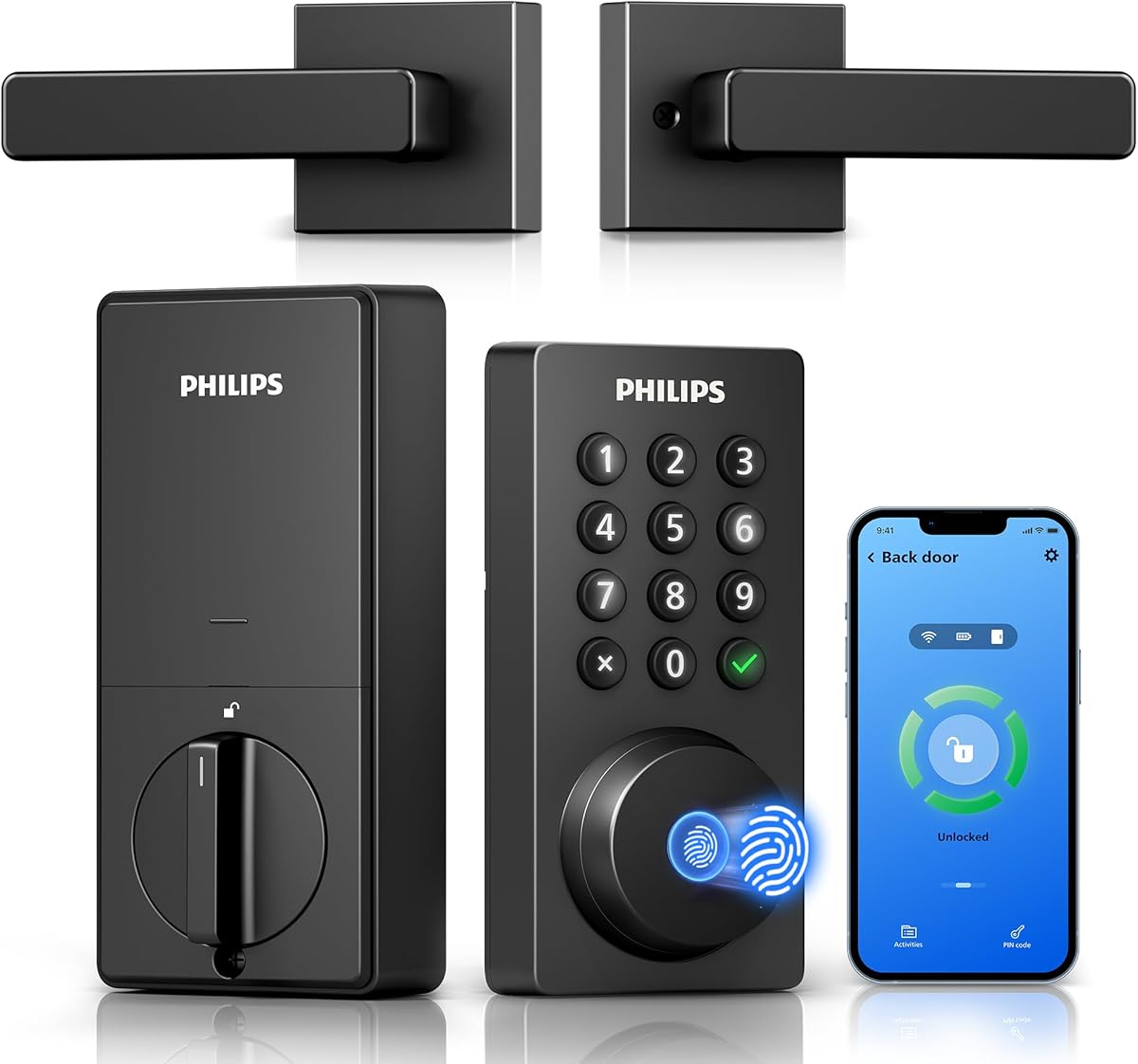
The Philips WiFi Keypad Deadbolt with Handle is the most complete connected entry package in the guide. Its supplied rating is 4.3, and it combines built-in 2.4GHz Wi-Fi, app-based remote control, fingerprint access, a keypad, and a matching handle set without requiring a separate hub.
We may earn a commission when you buy through this link, at no additional cost to you.
Through the Philips Home Access app, users can lock or unlock the door, manage PIN codes and fingerprints, check lock status, and view real-time access history. The lock supports permanent, one-time, periodic, and recurring PINs, which is particularly useful for visitors, housekeepers, and Airbnb access. Alexa and Google Assistant compatibility add another control option.
Auto-lock can be configured from zero to 180 seconds, although it is off by default and must be enabled in the app. The lock must remain within 33 feet of the router for the stated connection, and walls or metal can weaken the signal. Fingerprint access is advertised as taking 0.3 seconds, while the included batteries are not supplied and should be standard 1.5V alkaline batteries.
This is the best option for a connected household or rental where remote administration and access records justify the added complexity. The matching handle reduces the need to buy additional exterior hardware, but left-opening doors require resetting the direction. Installation also demands attention to wire placement and screw tension.
Built-in Wi-Fi allows owners to check and control the entrance through the app, while access history records activity. This is useful for monitoring deliveries, contractors, or guests without relying on physical keys.
Permanent, temporary, scheduled, recurring, and fingerprint credentials cover different access patterns. The result is a more adaptable system than a basic standalone keypad.
We may earn a commission when you buy through this link, at no additional cost to you.
The Philips Wi-Fi Smart Deadbolt is a feature-rich connected lock aimed at users who need flexible remote access and detailed visitor management. Its supplied rating is 4.2, with app control, Wi-Fi connectivity, fingerprint access, physical-key access, voice-assistant support, and a capacity for as many as 100 custom passcodes.
We may earn a commission when you buy through this link, at no additional cost to you.
Users can share unlimited one-time or scheduled codes through the app, making the lock suitable for guests, cleaners, deliveries, and short-term rentals. Real-time notifications and access history show when the door opens or locks, while Away Mode disables all unlock methods except the master code during extended absences.
The lock connects directly to a 2.4GHz network without a hub, but the manufacturer recommends keeping the router and lock within 65 feet for more reliable remote operation. It does not include a door sensor. Auto-lock can be adjusted from 10 to 180 seconds, and standard AA alkaline batteries are required for proper operation.
Choose this model when remote guest management and access visibility are central priorities. It is less attractive for users who want a matching interior handle included, for locations where the lock cannot remain reasonably close to the router, or for anyone seeking a simple keypad with no network configuration.
The app supports one-time and scheduled codes, which makes it suitable for short-term stays and recurring service visits. Sharing access does not require physically handing over a key.
Away Mode leaves the master code as the only enabled unlock method. This creates a useful temporary security state for vacations or extended travel without changing the underlying access system.
We may earn a commission when you buy through this link, at no additional cost to you.
The Veise KS01B has the highest supplied rating in this group at 4.6 and arrives as a complete dual-lever set. It combines 20 permanent codes, one-time guest passwords, two physical keys, auto-locking, and a security-focused set of privacy and away-from-home controls.
We may earn a commission when you buy through this link, at no additional cost to you.
Its two ergonomic lever handles create a coordinated entrance package, while the keypad supports temporary passwords that expire after use. The lock can re-lock in 10 to 99 seconds or respond to a two-second press on any keypad button. Anti-peeping protection accepts dummy digits around the actual code, and ten failed attempts trigger a three-minute shutdown.
Vacation Mode disables every code except the master code and sounds an alarm if the interior thumb turn unlocks the door. Silent Mode suppresses ordinary keypad beeps while retaining low-battery and security warnings. The lock has ANSI Grade 3 and BHMA testing, IP54 water and dust resistance, and a zinc alloy cylinder backed by stated cycle testing.
The Veise is best for buyers who want both interior and exterior levers in one package and prefer local controls over cloud connectivity. Its four AA/LR6 alkaline batteries are not included, and the stated battery duration of over a year depends on operating conditions. Liquids should be kept away from the keyhole, and prolonged direct sunlight should be avoided.
The matching interior and exterior levers simplify a full entrance upgrade and avoid sourcing separate handles. Their shape suits both traditional and contemporary interiors.
Anti-peeping entry, failed-attempt shutdown, one-time guest codes, and Vacation Mode address several distinct access risks. Silent Mode preserves important alerts while reducing ordinary keypad noise.
We may earn a commission when you buy through this link, at no additional cost to you.
The right coded lock depends on door fit, the number of people who need access, local versus remote administration, and the security controls that matter most. Review the following factors before ordering.
Start with door thickness, bore diameter, backset, spindle configuration, and the direction in which the door opens. Products in this guide generally support common interior doors, but several deadbolts specify a 2-1/8-inch bore, while other models accept standard 2-1/8-inch holes with stated door-thickness ranges. Lever and knob sets may use adjustable latches, and some connected locks are designed for right-opening doors by default.
Measure before removing the existing lock, and compare the supplied installation specifications with the physical dimensions of your door. Also consider whether the frame, strike plate, and interior hardware can be replaced without altering the door.
Standalone locks in this guide accommodate roughly 19 or 20 programmed users, while the iulock supports up to 50 codes and the connected Philips deadbolt supports as many as 100 custom passcodes. Individual codes are easier to manage and revoke than a single shared PIN. Households should allow capacity for family members, tenants, cleaners, contractors, and temporary visitors.
Choose enough capacity for realistic daily use without creating an unnecessarily complicated credential list. For high turnover or multiple properties, a connected model with app-based sharing may be easier to administer.
A keypad is the common feature, but some models also retain a physical key, support fingerprint scanning, or work with voice assistants. Physical keys are valuable as a backup when batteries fail, while fingerprint access can be faster for regular household members. Connected locks may also provide app-based control.
More entry methods add convenience but also increase setup and security considerations. Decide whether fingerprints, remote control, or voice commands solve a real household need rather than choosing solely because a feature sounds advanced.
Auto-lock reduces the chance that an open door will be left unsecured. Timers range from five seconds on the Schlage model to as much as 180 seconds in the connected Philips lock. Some systems allow auto-lock to be disabled or provide passage mode for moving days, offices, parties, and other periods of frequent traffic.
Choose a delay that matches how the door is used. A shorter timer improves security but can cause the lock to catch while the user is still handling packages, while a longer timer provides more passage time at the cost of a wider unsecured window.
Look beyond code entry and consider certifications, lock-cylinder construction, anti-peeping functions, failed-attempt lockouts, and metal construction. The Schlage lever locks carry a Grade 2/AAA rating, the TEEHO TE004 and Veise KS01B have ANSI Grade 3 certification, and several products use weather-resistant aluminum or zinc alloy bodies.
Treat temporary-code deletion, physical backups, and away or vacation modes as part of the security system. The best model balances meaningful deterrents with features that remain understandable to everyone who uses the door.
Most locks use AA or AAA alkaline batteries, while the Schlage models use an included 9V battery. Stated operating time varies from about one year to as much as 365 days, and some products clearly specify alkaline batteries while excluding rechargeable or lithium alternatives. Low-battery indicators are widely supported.
For frequent or exposed doors, consider a lock with USB emergency power or included physical keys. Regardless of the stated interval, establish a routine for checking the indicator rather than assuming a battery will last exactly as long as the manufacturer estimate.
An exterior entrance lock should have an appropriate weather-resistance rating. Models here include IP54 ratings for rain and cold exposure, IP65 for stronger water and dust protection, and one product states an operating range of -22F to 176F. Installation location, direct sunlight, and standing water can affect real-world conditions.
For an exposed exterior door, favor a model with a stated weather rating and weather-resistant keypad. For sheltered or interior doors, fit and code management may matter more than a higher ingress-protection number.
Standalone keypad locks work without an app, hub, or network and are often the simplest choice for one property. Connected Philips models provide remote locking, access histories, notifications, scheduled codes, and voice-assistant integration, but they depend on stable 2.4GHz Wi-Fi and appropriate router proximity.
Choose connectivity when remote access or digital oversight delivers meaningful value. Choose a standalone lock when reliability, straightforward programming, and independence from network infrastructure are the priorities.
Install the lock only after confirming door dimensions and handing direction. Follow the manufacturer's instructions, keep wiring or the tailpiece correctly positioned, and avoid overtightening screws that could interfere with the spindle or latch. Test the handle, keypad, key override, auto-lock, and passage mode several times before discarding the old hardware.
Program a master code first, then create separate credentials for regular users and temporary visitors. Avoid birthdays, sequential numbers, and other easily guessed PINs. When someone leaves, delete their code immediately, disable scheduled access if applicable, and review the app's activity history for connected locks. Never share a master credential with someone who only needs a temporary code.
Check the low-battery indicator routinely and replace batteries with the specified type when prompted. Keep the keypad free of dirt and moisture, and use a soft, dry cloth rather than harsh chemicals. For connected models, update the app and lock firmware when prompted, maintain reliable Wi-Fi coverage, and replace the batteries promptly to avoid unexpected lockouts.
A keypad lock can be safer in practical use because access can be changed without replacing physical keys. It also allows temporary codes and automatic locking, which reduce key-copying risks and forgotten access credentials. Its actual security still depends on construction, code management, anti-guessing features, installation quality, and the owner's ability to keep codes confidential.
Many models in this guide are designed for screwdriver-only installation and can replace an existing lock without hardwiring. However, compatibility depends on bore size, backset, door thickness, spindle shape, and handing direction. Connected locks may also involve wires or cable routing. Measure carefully and review the manual before removing working hardware.
Low-battery warnings are common, but a depleted lock may prevent electronic entry. Some products include physical backup keys, while the iulock supports USB-C backup power. Owners should keep a tested physical key accessible in a separate secure location if their model provides one, and should replace batteries promptly when the warning appears.
Most households need one code per regular user plus temporary codes for visitors and service providers. Capacity above 20 is useful for shared houses, offices, or rentals, although managing many codes can become inconvenient. Connected models are often easier to administer because credentials can be shared and revoked through an app.
The two connected Philips models in this guide state that they connect directly to a 2.4GHz home network without an extra hub. Reliable placement still matters because walls, metal objects, and distance can weaken the connection. The products use different stated router-distance recommendations, so buyers should follow the instructions for the exact model.
Temporary codes are safer than handing someone a permanent key when the credential expires automatically after use. Their security still depends on choosing a strong PIN, sharing it only with the intended guest, and promptly deleting any scheduled code that is no longer required. Avoid using the same PIN as a household master code.
Auto-lock is generally preferable for security because it reduces the chance of leaving the entrance open. Choose a delay that provides enough time to enter items without leaving the door unattended. Use passage mode only during periods when the door is intentionally being held open, and remember to restore automatic locking afterward.
Yes, when the lock has an appropriate weather-resistance rating and the manufacturer's installation conditions are followed. IP54 models are designed for outdoor exposure, while IP65 offers stronger protection against water and dust. The keypad and interior components should also be protected from direct rain, standing water, and prolonged sunlight where specified.
The Schlage Electronic Keypad Lock is the strongest all-around choice for its security rating, dependable five-second re-locking, long stated battery life, and simple installation. The iulock is the best value-oriented option for users who need many standalone codes, flexible modes, weather resistance, and emergency power, while the Philips WiFi Keypad Deadbolt earns the premium position for app control, fingerprint access, remote management, and a complete handle set.
Before ordering, prioritize correct door fit, the number of people who need credentials, and the access methods you will actually use. Choose a standalone model for simplicity and reliability, or a connected lock when remote control, recurring schedules, and access history justify dependence on Wi-Fi. Temporary-code support, failed-attempt protection, and physical backups are worthwhile priorities even for a single household.
Features, ratings, availability, and pricing can change, so verify the current product listing and manufacturer specifications before purchasing. Compare the final configuration with your door measurements and compare current prices across the models most closely matched to your security and convenience needs.
