
Handheld Anemometer
4.2Editor score
Five wind measurement units
Current maximum average modes
Pocket-friendly fifty-three gram weight
Five-second illuminated display
Discover the best Pocket Weather Meter options, comparing wind speed, temperature, humidity, pressure, portability, and specialized features for outdoor use.
A pocket weather meter turns a handheld reading into useful information about wind, temperature, humidity, pressure, and the conditions around you. The right device depends on whether you are planning a hike, checking HVAC airflow, monitoring outdoor work, or tracking ballistic conditions, so the most useful features matter more than a long specification list.
This guide compares ten pocket weather meters using the supplied product information, including supported measurements, display design, portability, power source, weather resistance, and specialized functions. It covers general-purpose meters, lightweight wind gauges, home weather stations, heat-stress instruments, and a premium ballistic weather meter without treating every product as suitable for the same task.
Each review explains the strongest reasons to choose the product, along with its limitations and ideal user. Ratings and specifications reflect the listed data, while prices can change at any time, so compare the current listing, included accessories, warranty details, and functions before making a final purchase.
4.2Editor score

4.5Editor score

5.0Editor score
The table below highlights each product's core capabilities, portability, power approach, and ideal application. It is a quick comparison of ten distinct options rather than a ranking of identical products, because some specialize in wind, heat stress, forecasting, or ballistics.



The TopTes TS-301 is a versatile handheld anemometer with a 4.5 rating and an unusually readable 2.26-inch backlit screen. It combines wind speed, temperature, and relative humidity in one compact instrument, making it more useful than a basic wind-only gauge for trips where changing conditions matter.
We may earn a commission when you buy through this link, at no additional cost to you.
Its standout strength is the balance of features and simplicity. The rotatable impeller measures wind velocity in feet per minute, feet per second, miles per hour, knots, kilometers per hour, and meters per second. Temperature and humidity readings expand its usefulness for hiking, sailing, boating, drone flying, kite flying, golf, shooting, and HVAC checks without complicating the basic operation.
The trade-offs are practical rather than dramatic. Temperature and humidity sensors may require at least 30 minutes to adjust after moving to a new environment, so immediate readings should not be treated as fully settled. The unit uses three AAA batteries and shuts down after ten minutes of inactivity, meaning it is convenient to carry but not designed around continuous monitoring.
This is the strongest general-purpose choice for someone who wants more than wind speed, an easy-to-read display, and broad outdoor utility without moving into specialized equipment. It is especially suitable for recreational users and light professionals who want dependable measurements in a pocketable format.
The large backlit LCD makes the TS-301 easier to read than a compact display with no illumination, particularly during dawn, dusk, or shaded work. The screen presents wind and environmental information together, reducing the need to switch between separate instruments.
Six wind units support different activities, from sailing and boating to HVAC work and drone preparation. The temperature and humidity sensors add context, helping users judge whether a wind reading is pleasant, hazardous, or relevant to equipment performance.
We may earn a commission when you buy through this link, at no additional cost to you.
The Vortex Ace earns a 5.0 rating and stands apart from conventional pocket meters through its integrated GeoBallistics solver. It is designed to produce custom wind and drop solutions using current conditions, making it most relevant to precision shooting, long-range shooting, and platform-specific ballistic planning.
We may earn a commission when you buy through this link, at no additional cost to you.
The Ace includes ten common default ballistic profiles that can be used directly or customized for a particular platform. Its wind impeller, compass, and inclinometer capture wind speed, target direction, wind direction, and angle. Temperature, pressure, and humidity sensors add broader environmental context, while a large full-color display makes the information comparatively accessible.
This level of specialization comes with obvious limits. Someone looking only for a simple hiking or HVAC wind gauge may find the ballistic tools unnecessary and the device more elaborate than required. It works as a standalone instrument, but compatibility with Vortex Relay expands its value when users want to share real-time ballistic, environmental, and platform-specific information across connected devices.
The Ace is the right recommendation for a shooter who values a dedicated solution over a general-purpose anemometer. Its waterproof and shockproof design, environmental sensors, customization, and transferable lifetime warranty reinforce its position as a specialized premium instrument rather than a casual gadget.
The built-in solver uses real-time atmospheric conditions to develop custom wind and drop information. Customizable profiles make it possible to adapt the device to a particular platform instead of relying only on a generic calculation.
Waterproof and shockproof construction suits outdoor shooting environments where an ordinary consumer gauge may be vulnerable. The full-color screen, multiple directional sensors, and optional Relay connectivity support a more advanced field workflow.
We may earn a commission when you buy through this link, at no additional cost to you.
The AP-816B handheld anemometer is built around portability, weighing only 53 grams with its battery and lanyard. Its 4.2 rating reflects a capable, no-frills wind meter for hikers, travelers, technicians, and anyone who wants a useful reading without carrying a larger instrument.
We may earn a commission when you buy through this link, at no additional cost to you.
It detects wind from a 0.1 meter-per-second threshold up to 30 meters per second, approximately 67 miles per hour, with a stated accuracy of 5%. Five units, current, maximum, and average modes, and real-time temperature cover many common needs. Any button activates the five-second backlight, while an automatic wind-chill symbol appears when the temperature falls below freezing.
Its limitations center on scope rather than apparent quality. It does not provide the broader environmental suite offered by the TS-301 or HoldPeak, and its screen may be less accommodating for users who want several readings visible simultaneously. The included CR2032 battery and low power consumption help offset the need to carry spare cells.
For users seeking the lightest practical wind meter in this group, the AP-816B is an excellent recommendation. It is particularly effective for outdoor activities where portability matters, while its glove-friendly controls and automatic readings reduce friction during quick field checks.
At 53 grams, the AP-816B is easy to carry during a hike, run, or travel day. Despite its small size, it retains multiple units, maximum and average modes, temperature, and an illuminated display for outdoor use.
Low power consumption of approximately 3 milliamps supports extended use from the included CR2032 cell. A low-battery indicator and automatic or manual power-off functions help conserve energy when readings are not continuous.
We may earn a commission when you buy through this link, at no additional cost to you.
The Ambient Weather WM-5 is a 4.4-rated handheld weather meter that emphasizes durability and simple carry. Its pocket-knife-style enclosure protects the instrument when it is not in use, while the soft carrying case and neck lanyard make it practical for outdoor routines where equipment may be frequently packed and removed.
We may earn a commission when you buy through this link, at no additional cost to you.
The defining feature is that it is water resistant and floats. That makes it appealing for boating, fishing, hiking, and wet-weather travel, where a conventional exposed meter could be more easily lost or damaged. The enclosed design also communicates that the instrument is intended to travel rather than remain on a desk.
The supplied information provides less detail about sensors and measurement ranges than many other listings in this guide. Buyers should therefore review the current product page to understand display functions, dimensions, battery requirements, and included readings. Its value proposition is clear, but informed comparison requires more attention to the full listing.
Choose the WM-5 when portability, flotation, and physical protection are the main priorities. It is a particularly sensible option for boaters and outdoor users who want a meter that can accompany them without the exposed form of a typical handheld anemometer.
The pocket-knife design helps shield the instrument while it is carried in a pocket or bag. It is a practical alternative to a loose meter with exposed fan blades, especially for users who transport sensitive equipment regularly.
Water resistance and flotation add confidence around water. Those traits make the WM-5 more suitable for boating and fishing trips than a meter without any stated moisture protection.
We may earn a commission when you buy through this link, at no additional cost to you.
The HoldPeak 866B-WM combines wind speed, temperature, humidity, dew point, altitude, barometric pressure, and wind chill in a single handheld instrument. Its 4.2 rating makes it a strong option for users who want more environmental data than a simple anemometer provides.
We may earn a commission when you buy through this link, at no additional cost to you.
The device supports wind units of meters per second, kilometers per hour, feet per minute, knots, and miles per hour. Temperature, altitude, and pressure units can also be changed. Maximum, minimum, and average wind readings, battery status, auto-off, and a backlight improve everyday handling, while 16 stored barometric pressure sets create a basic history for trend awareness.
Altitude is calculated from barometric pressure, so manual pressure correction is available before measurement when greater accuracy is needed. That distinction matters for hikers, pilots, shooters, and survey users because an uncorrected calculated altitude can reflect changing environmental conditions rather than true elevation.
The tripod hole and hand strap improve handling during sustained measurements, while sensitivity to low airflow supports HVAC and duct work. This is a good recommendation for outdoor users, HVAC technicians, and weather enthusiasts who value data breadth and hands-free flexibility.
Dew point, pressure, altitude, wind chill, temperature, and humidity provide useful context beyond wind speed. That breadth makes the 866B-WM suitable for comparing conditions over time or assessing how weather may affect a planned activity.
The ability to store 16 pressure records helps users observe changes, while manual pressure correction supports more accurate altitude calculations. This is especially useful in changing weather or at elevations where a default pressure setting would distort results.
We may earn a commission when you buy through this link, at no additional cost to you.
This rechargeable handheld anemometer is designed for airflow checks in HVAC systems as well as outdoor wind measurements. Its 4.2 rating reflects a practical combination of sensitive airflow detection, a three-function display, and a rechargeable power system that suits repeated work without disposable cells.
We may earn a commission when you buy through this link, at no additional cost to you.
The eight-blade impeller detects airflow starting at 0.3 meters per second, and wind speed is offered in meters per second, kilometers per hour, feet per minute, knots, and miles per hour. The stated wind range extends from 1 to 65 miles per hour. Temperature readings cover 14 to 113 degrees Fahrenheit, while humidity is measured from 0 to 99 percent relative humidity.
Current, maximum, and minimum wind values are supported, and Data Hold keeps an important reading on screen. A backlit LCD and built-in flashlight help during dim inspections. Auto power-off can be disabled for continuous monitoring, and the bottom tripod mount allows hands-free placement.
The principal trade-off is the rechargeable battery system: the cover must be opened and the battery connected before first use, and a depleted meter is less convenient in remote settings than one using disposable batteries. For HVAC professionals and regular outdoor users, the Type-C charging convenience makes it a strong recommendation.
The rechargeable 3.7-volt battery removes the need to keep replacing disposable cells. Data Hold, MAX and MIN modes, and the flashlight support inspections where recording a result or seeing the screen in poor light is important.
The eight-blade impeller starts detecting at 0.3 meters per second, which is useful for gentle airflow around vents and registers. The broad selection of wind units also makes it practical for outdoor preparation and HVAC measurements.
We may earn a commission when you buy through this link, at no additional cost to you.
The Kestrel 5400 WBGT is a pocket-sized heat-stress tracker rated 3.8, designed primarily for workplace, athletic, and military heat monitoring. Its defining feature is waterless WBGT calculation, which estimates natural wet bulb temperature from onboard sensors without requiring distilled water, wicks, or field setup.
We may earn a commission when you buy through this link, at no additional cost to you.
A loud buzzer, bright LED beacon, and flag warnings provide multiple ways to communicate dangerous conditions. Built-in guidelines include ACGIH, UIL, athletic regional zones, and military options, while custom thresholds can be entered for specialized environments. The screen also supports 15 measurement categories, including heat index, globe temperature, wet bulb, wind, humidity, dew point, pressure, altitude, and wind chill.
Onboard logging stores more than 10,000 time-stamped readings, which is valuable for safety programs and detailed record keeping. One important limitation is that the device does not connect to an app, so data must be managed directly on the unit rather than through a phone workflow.
Despite its more specialized purpose, the 5400 is a strong recommendation for athletic trainers, industrial safety teams, military users, and anyone responsible for heat decisions. Its IP67 waterproof rating, five-year warranty, U.S. manufacture, and setup-free WBGT method support dependable field use.
The waterless WBGT approach eliminates distilled water, wicks, and periodic preparation. That makes the meter easier to deploy repeatedly across athletes, crews, or work areas where reliable monitoring is needed.
Multiple audible and visual warnings make hazards noticeable in noisy or bright environments. Built-in guidelines and custom thresholds support established heat-stress protocols, while extensive logging preserves a defensible history of conditions.
We may earn a commission when you buy through this link, at no additional cost to you.
The Kestrel 3000 Pocket Wind Meter is a focused handheld instrument for users who primarily need wind speed, gust information, temperature, and wind chill. Its pocket format and specialized measurement set distinguish it from broader multifunction devices that add pressure, humidity, altitude, or other environmental data.
We may earn a commission when you buy through this link, at no additional cost to you.
Current wind speed, maximum wind gust, and average wind speed provide a clear view of both steady and changing conditions. Air, water, and snow temperature readings add relevant context for cold-weather activities, while wind chill offers an immediate interpretation of the combined effects of wind and temperature.
The supplied listing does not provide a numerical customer rating, so this review does not imply one. It also does not enumerate a full set of specifications such as unit ranges or power details, meaning prospective buyers should consult the current listing for those specifics. The straightforward function set is both an advantage and a limitation.
This is the right choice for someone who wants a dedicated pocket wind meter and does not need barometric pressure, humidity, or altitude readings. Its core measurements remain useful for hiking, boating, recreation, and jobs where understanding wind is the primary objective.
Current, maximum gust, and average readings let users compare a momentary value with broader conditions. That makes the 3000 useful when deciding whether wind is increasing or merely feels strong because of temperature.
Support for air, water, and snow temperature broadens its value for cold-weather use. The wind-chill function gives a more complete cold-weather reading than wind speed alone.
We may earn a commission when you buy through this link, at no additional cost to you.
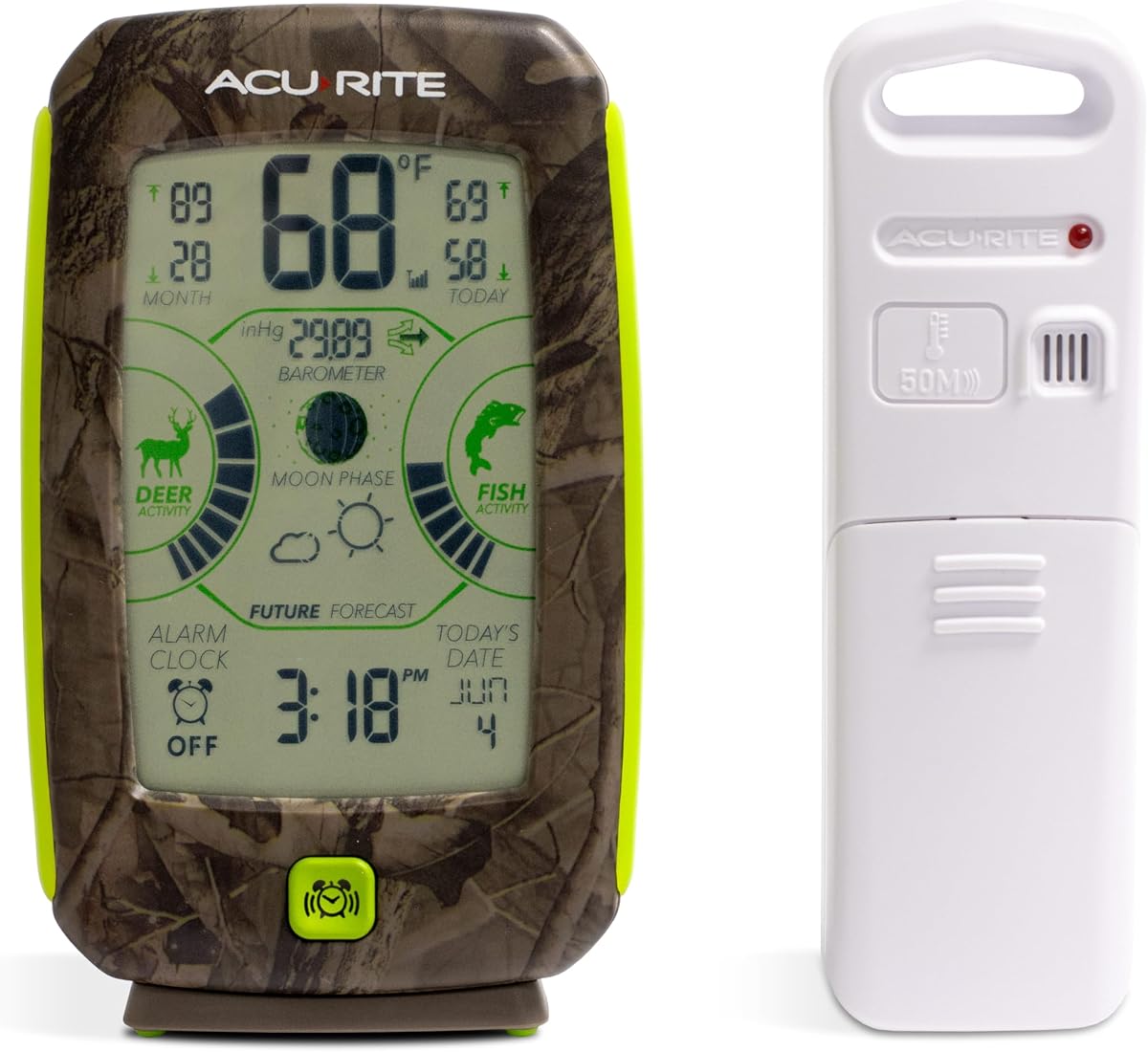
The AcuRite 00249 Sportsman's Weather Station is a 4.5-rated display designed around hunting and fishing conditions. Rather than functioning as a small handheld anemometer, it combines an indoor display with a remote outdoor temperature sensor to provide environmental information and a more personal forecast.
We may earn a commission when you buy through this link, at no additional cost to you.
Its patented self-calibrating forecasting uses the in-display barometer and remote sensor to generate a hyperlocal 12-hour forecast. Users can review real-time outdoor temperature, barometric pressure, moon phase, high and low records, and forecast icons. These features are intended to help indicate favorable wildlife activity conditions.
This station trades pocket portability for a more informative always-visible display. The remote sensor must be positioned outside, and the listing focuses on temperature, pressure, and moon phase rather than detailed wind-speed measurements. Those distinctions make it less appropriate for users shopping primarily for a handheld airflow gauge.
It is a good recommendation for anglers and hunters who value forecasts, temperature history, and lunar information in one readable unit. The self-setting clock and automatic daylight-saving adjustments also reduce ongoing setup after battery replacement.
The self-calibrating forecast uses barometric readings and the remote temperature sensor to provide a personalized 12-hour outlook. This offers more planning context than a single current-temperature reading.
Moon phase displays, pressure readings, and high and low records are presented for quick interpretation. The design aligns better with hunting and fishing routines than with users seeking continuous airflow or barometric data logging.
We may earn a commission when you buy through this link, at no additional cost to you.
The AcuRite Notos 01604A2 is a home-oriented weather station with a 4.5 rating and a color digital display. A wireless three-in-one sensor measures temperature, humidity, and wind speed, providing a more complete view of conditions than a single-purpose pocket meter.
We may earn a commission when you buy through this link, at no additional cost to you.
Current, average, and peak wind readings are tracked and updated every 18 seconds. Daily and all-time high and low temperature records add useful history, while the illuminated full-color display includes an adjustable dimmer for different viewing conditions. The display is electric-powered and can use batteries as backup.
Setup is designed to be approachable, with sensor mounting hardware included. The remote sensor should be positioned thoughtfully because placement affects temperature and wind readings. Unlike the products ranked above it, the Notos is not intended to fit in a pocket, so it serves a stationary home or workspace role instead.
The Notos is the best recommendation for users who want an always-on home weather display and wireless remote sensing. Its regular wind updates, long stated battery life, attractive display, and record keeping make it a convenient alternative to constantly checking a handheld meter.
Wind data refreshes every 18 seconds, allowing the display to show changing conditions without manual retrieval. Separate current, average, and peak values help distinguish steady wind from short-lived gusts.
The adjustable illuminated color screen is suited to a desk, shelf, or wall-mounted location. Optional battery backup helps preserve operation during an electrical interruption, while the included hardware simplifies sensor installation.
We may earn a commission when you buy through this link, at no additional cost to you.
Start by identifying the measurements and environment that matter most, then compare display visibility, power needs, protection, and special functions. A meter with more features is not automatically more useful, especially when basic wind accuracy and readable output are the priorities.
A basic wind meter is usually sufficient for checking a beach, trail, HVAC vent, or kite-launch area, but wider environmental readings can make decisions easier. The TS-301 adds temperature and humidity, the HoldPeak adds dew point, pressure, altitude, and wind chill, and the Kestrel 5400 extends into a full heat-stress package. Match the sensors to the task rather than selecting the longest feature list.
Choose a compact wind meter for focused outdoor checks and a multifunction model for broader situational awareness.
A large screen with adjustable or automatic illumination is valuable outdoors, in HVAC spaces, and during dawn or dusk. The TS-301 has a 2.26-inch backlit LCD, while the Ace offers a large full-color display. Smaller screens can still work well if the essential information remains legible and the device is operated mainly in good light.
Look for a backlight, readable number size, and simple controls that work with gloves or one hand.
Detection threshold matters when measuring gentle ventilation rather than strong outdoor wind. The AP-816B begins at 0.1 meter per second, while the rechargeable eight-blade model begins at 0.3 meter per second. The rechargeable model also lists a 1-to-65-mile-per-hour range and a stated wind-speed accuracy of plus or minus 5 percent.
For HVAC inspection, favor a low threshold; for sailing or drones, consider the full measurement range.
Different activities often call for different units. Knots and meters per second are useful for marine and scientific work, feet per minute can help with ventilation, and miles per hour is familiar for general outdoor use. Most wind-focused choices offer several formats, but the HoldPeak also provides unit switching for temperature, altitude, and pressure.
Confirm that the required unit is supported before purchasing, especially for technical work.
Disposable batteries are simple for occasional use because a spare cell solves most power problems. The TS-301 includes three AAA batteries, while the AP-816B uses a low-power CR2032 cell. The rechargeable handheld model uses a 3.7-volt, 400mAh lithium battery with Type-C charging, which is convenient for routine HVAC or outdoor work.
Choose disposable batteries for remote convenience or rechargeable power for frequent use and easier routine charging.
Water resistance and flotation should influence any meter used near lakes, rivers, or wet work areas. The Ambient Weather WM-5 is water resistant and floats, while the Kestrel 5400 has an IP67 waterproof rating. The Vortex Ace is described as waterproof and shockproof for demanding shooting environments. Accessories such as lanyards, straps, pouches, and protective cases also reduce drops and loss.
Match protection to the environment, and include a lanyard or wrist strap whenever accidental loss would be costly.
Some products are designed around a very specific decision. The Vortex Ace focuses on ballistic wind and drop solutions, the Kestrel 5400 supports heat-stress safety programs, and the AcuRite Sportsman's Station prioritizes hunting and fishing forecasts. General outdoor users may not use those specialized features enough to justify them.
Pay for a specialty function only when it supports a regular task; otherwise, a general-purpose meter offers better value.
The way readings are used determines which control features matter. MAX, MIN, and average modes help compare gusts with steady conditions, while Data Hold keeps a result visible during HVAC work. The HoldPeak records 16 sets of barometric data, and the Kestrel 5400 stores more than 10,000 timestamped readings for formal safety records.
Choose logging and hold features for repeated work, but avoid extra complexity if you only need an immediate reading.
Before first use, install or connect the specified battery, verify that the screen powers on, and confirm the displayed units and time. For models with environmental sensors, allow readings to stabilize after moving between very different conditions. The TS-301 may require at least 30 minutes for its temperature and humidity sensors to adjust fully, so early readings should be treated as provisional.
When measuring wind, hold the meter in open air away from walls, vehicles, trees, vents, and other obstructions. Keep the impeller unobstructed and hold the device steadily rather than walking with it. For HVAC work, position the sensor at the vent or duct location being inspected, wait for the reading to stabilize, and use Data Hold or MAX and MIN modes when recording results.
Protect the instrument by storing it in its pouch or case, securing the lanyard during outdoor use, and keeping the charging cover closed on rechargeable models. Remove batteries from a long-unused device if the manufacturer permits, clean debris from fan blades gently, and check seals or covers before exposing the meter to water. Always consult the manual for model-specific calibration, storage, and battery guidance.
It depends on how you will use the readings. Wind speed is enough for many brief outdoor checks, while humidity and temperature help explain comfort, condensation risk, and changing conditions. The TS-301 combines all three in a portable format, making it a flexible choice for general recreational and light professional use.
A handheld meter can provide useful wind information before a flight, especially when it offers current, maximum, and average readings. It should be used in an open location because walls and trees can distort the air movement around the operator. Aircraft-specific guidance and onboard wind information should still guide the final decision.
A pocket anemometer is portable, often handheld, and intended for immediate measurements at a particular location. A home weather station uses a fixed remote sensor and display to provide continuous observations and records. The AcuRite Notos and Sportsman's Station are therefore more appropriate for stationary use than pocket travel.
Several models can, provided their wind detection range suits the airflow being measured. The HoldPeak is sensitive to low air movement and supports HVAC applications, while the rechargeable eight-blade model offers a 0.3-meter-per-second starting point. For accurate duct calculations, also measure the duct dimensions and consider how placement affects airflow.
Altitude is often calculated from barometric pressure, which changes with weather and atmospheric conditions rather than elevation alone. The HoldPeak allows manual barometric-pressure correction before measuring altitude, which can improve the result. Even with correction, handheld estimates should not replace survey-grade equipment when legal or safety-critical precision is required.
The Kestrel 5400 WBGT is specifically designed for heat-stress monitoring. It calculates WBGT without wet-bulb setup and provides audible and visual alerts, built-in guidelines, and extensive onboard logging. It is a better fit for athletic, workplace, and military safety programs than a general-purpose consumer anemometer.
Rechargeable models reduce battery replacement inconvenience during frequent use, but they require access to charging equipment. Disposable-battery meters can be more convenient in remote settings when spare cells are already carried. Consider not only the battery format but also runtime, available charging power, and the frequency with which you will use the meter.
A backlit display is the primary feature to look for because it improves visibility without requiring a bright flashlight. The rechargeable handheld model adds a built-in flashlight, while several other devices activate their backlight through a button for a short period. Display size and automatic illumination can be especially useful during outdoor dawn or dusk conditions.
The TopTes TS-301 is the strongest general recommendation because it combines wind, temperature, and humidity with a large backlit display and six units. The AP-816B is the lightest focused wind option, while the Vortex Ace is the specialized premium choice for users who need integrated ballistic calculations and directional data.
Prioritize the features tied to your actual activity: low airflow sensitivity for HVAC work, water resistance for wet environments, dedicated heat alerts for safety programs, or ballistic solutions for precision shooting. A simpler meter can be more dependable and easier to use than a feature-rich model whose advanced functions never get used.
Finally, check current prices, included accessories, warranty coverage, and the latest specifications before purchasing, since availability and pricing can change. The right pocket weather meter is the one that gives you reliable, readable information in the environments and situations where you will actually use it.