
LEKATO Guitar Looper Pedal
4.6Editor score
Forty-minute total recording
Built-in high-sensitivity tuner
WAV import and export
This guide compares the best live looper pedal for musicians across recording capacity, controls, connectivity, audio features, and ease of use at home.
A live looper pedal lets musicians build arrangements in real time, practice independently, add rhythmic support, and turn a single instrument into a fuller performance. The best models balance generous recording capacity with fast foot control, dependable audio, and enough connectivity to move comfortably between home practice, rehearsal, and the stage.
This guide compares ten loopers using the specifications and feature details supplied for each product. It examines loop time, overdubbing, built-in tuner or rhythm tools, stereo operation, memory, USB transfer, MIDI, microphone support, display clarity, and pedalboard practicality without suggesting that every musician needs the same level of complexity.
Each pick highlights a different path into live looping, from compact beginner-friendly units to feature-rich loop stations designed for demanding performances. Ratings provide a useful snapshot of customer reception, while product details reveal which pedal best fits a particular routine. Current prices and availability can change, so shoppers should confirm current details before buying.
4.6Editor score

4.6Editor score

4.7Editor score
The table below compares the ten pedals by their most useful practical distinctions, including loop capacity, memory, control style, and connection options. It is designed to help narrow the field before considering the detailed reviews.




The BOSS RC-1 Loop Station Pedal is the most balanced overall choice in this guide, combining an approachable design with a respectable 4.6 customer rating. Its 12 minutes of stereo recording time may look modest beside units offering several hours, but the focus is on creating a repeatable performance rather than accumulating hours of unused material.
We may earn a commission when you buy through this link, at no additional cost to you.
The RC-1 supports recording, playback, overdubbing, and undo or redo functions, giving musicians enough range to build layered arrangements while performing. A clearly defined loop indicator displays Record, Overdub, and Play modes, which is particularly valuable when a performer cannot easily look down at the pedal. Stereo inputs and outputs also make it practical for instruments with more than one output and for users who want a wider signal path.
The most useful compromise is its balance between portability and permanence. It can operate from a single 9-volt alkaline battery for approximately 4.5 hours, although an optional PSA-series adaptor can be used for longer sessions. Recorded phrases remain in memory after the unit is turned off, reducing the risk of losing a carefully constructed loop. A five-year BOSS warranty adds confidence for a pedal intended to become part of a regular practice or performance setup.
The RC-1 is best for guitarists, bassists, keyboard players, and singer-songwriters who want a dependable live looper without navigating a dense control system. It is less suited to someone whose main goal is storing complete songs, arranging extensive phrase libraries, or building a full backing-track workflow. Even so, its uncomplicated controls, stereo operation, and retained loops make it the most broadly practical recommendation here.
Overdubbing and undo or redo functions let a musician layer phrases and correct a take without restarting the entire performance. The visible mode indicator reduces uncertainty while the instrument is in hand.
Phrase memory retention preserves recorded material when the pedal is switched off. That makes the RC-1 useful for turning a rehearsal-room idea into a repeatable song setup for the next session.
We may earn a commission when you buy through this link, at no additional cost to you.
The LEKATO Looper Guitar Pedal is an appealing value choice for musicians who want more than basic repeat-and-layer functions. Its 4.4 rating reflects a strong customer reception, while the combination of nine loops, 40 minutes of total recording, a tuner, and USB transfer makes it unusually complete for an entry-oriented pedal.
We may earn a commission when you buy through this link, at no additional cost to you.
Audio is captured at 48 kHz and 24-bit resolution in an uncompressed format, with an Analog-Dry-Through design intended to preserve the player’s direct sound. A single loop can run as long as 10 minutes, and unlimited overdubbing gives performers room to develop arrangements. The built-in high-sensitivity tuner can be accessed continuously without the disruptive interruption described for less integrated tuner systems.
USB connectivity allows WAV loops to be imported from or exported to a computer, an important feature for musicians who want to move material between a pedal, a DAW, or a practice system. Control remains straightforward: record, stop, erase, undo, and redo are assigned to different foot commands of one button, while a single knob sets loop playback volume. This makes the pedal approachable without stripping away essential loop functions.
This LEKATO model makes sense for electric guitarists and bassists who want a practical home-practice looper, a tuner in the same enclosure, and convenient file handling. It may not provide the advanced connectivity or storage structure found in premium loop stations, but its combination of useful features and straightforward operation gives it strong value for beginners and intermediate players.
WAV import and export through USB helps a musician capture useful ideas on the pedal and continue working with them in a computer-based setup. It also supports loading prepared material for rehearsal or performance.
The integrated high-sensitivity tuner is a practical addition for guitarists who want one compact pedal to handle both pitch reference and looping. Continuous operation is designed to avoid unnecessary interruption.
We may earn a commission when you buy through this link, at no additional cost to you.
The NUX Loop Core Stereo stands out for musicians who want to store far more than a short, single-use performance. It supports up to six hours of recording across 99 memory slots, and its 4.4 rating indicates generally favorable reception among users who value both capacity and visual control.
We may earn a commission when you buy through this link, at no additional cost to you.
A large HD color LCD provides a clear view of parameters and supports a more responsive editing experience than a minimal LED-only unit. The value of that display becomes apparent when a musician has dozens of stored phrases to navigate. Built-in access to 50 rhythm patterns gives performers an accompaniment source without requiring a separate drum machine, while stereo audio suits players who want a fuller sound.
External MIDI control expands the ways the pedal can be operated, including control over tap tempo, recording, playback, and other parameters. The included MIDI-to-1/8-inch cable makes the feature easier to introduce to an existing setup. Users can also personalize the startup screen with a GIF, a minor extra that gives the device a more individual character.
The Loop Core is best for a guitarist or other instrumentalist who records songs, experiments with arrangements, and wants a large phrase library with future MIDI integration. It is overkill for someone who only needs a short drum-style loop, but it offers an unusually generous toolkit for study, composition, rehearsal, and live layering.
With 99 slots and six hours of total recording, the pedal can separate verses, choruses, intros, and complete practice arrangements. That organization is more useful than a single shared buffer for musicians managing multiple pieces.
External MIDI control can streamline operations such as starting, stopping, recording, and setting tempo. A compatible controller or DAW setup can reduce reliance on repeated foot commands during complex workflows.
We may earn a commission when you buy through this link, at no additional cost to you.
The TC Electronic DITTO 2 LOOPER is positioned specifically for guitarists and live performances. It carries a 4.1 rating, placing it below the higher-rated picks, but the focused product concept can still make it a serious option for musicians who want a looper dedicated to stage use.
We may earn a commission when you buy through this link, at no additional cost to you.
The supplied product information identifies it as the second-generation DITTO looper and emphasizes its live-performance role. That targeting suggests a practical stompbox intended to fit into a guitar signal chain without introducing the broad complexity of a full-featured loop station. For players who repeatedly use the same looping workflow, a specialized tool may feel more direct than a device loaded with rhythm, MIDI, and editing options.
One important limitation of this review is that the supplied listing includes a title and a brief performance-oriented description but not a detailed set of specifications. It would be misleading to assume a particular recording time, bypass design, audio format, or memory count for this model. Buyers should check the manufacturer’s current documentation and the live retail listing for those technical details before making a decision.
The DITTO 2 is best considered by guitarists who specifically want a compact performance looper and recognize the established DITTO product line. Those who need verified long recording time, USB transfer, multiple memory slots, or extensive rhythm support may prefer a model whose specifications are clearly documented in the supplied information.
The product is explicitly presented for live performances, giving it a clear purpose for guitarists who need looping directly in a gigging setup. A focused instrument can be easier to integrate than a broad workstation.
Because the provided information does not detail this model’s recording capacity or connection options, shoppers should consult the current manufacturer information. Confirming those details prevents assumptions from shaping the purchase.
We may earn a commission when you buy through this link, at no additional cost to you.
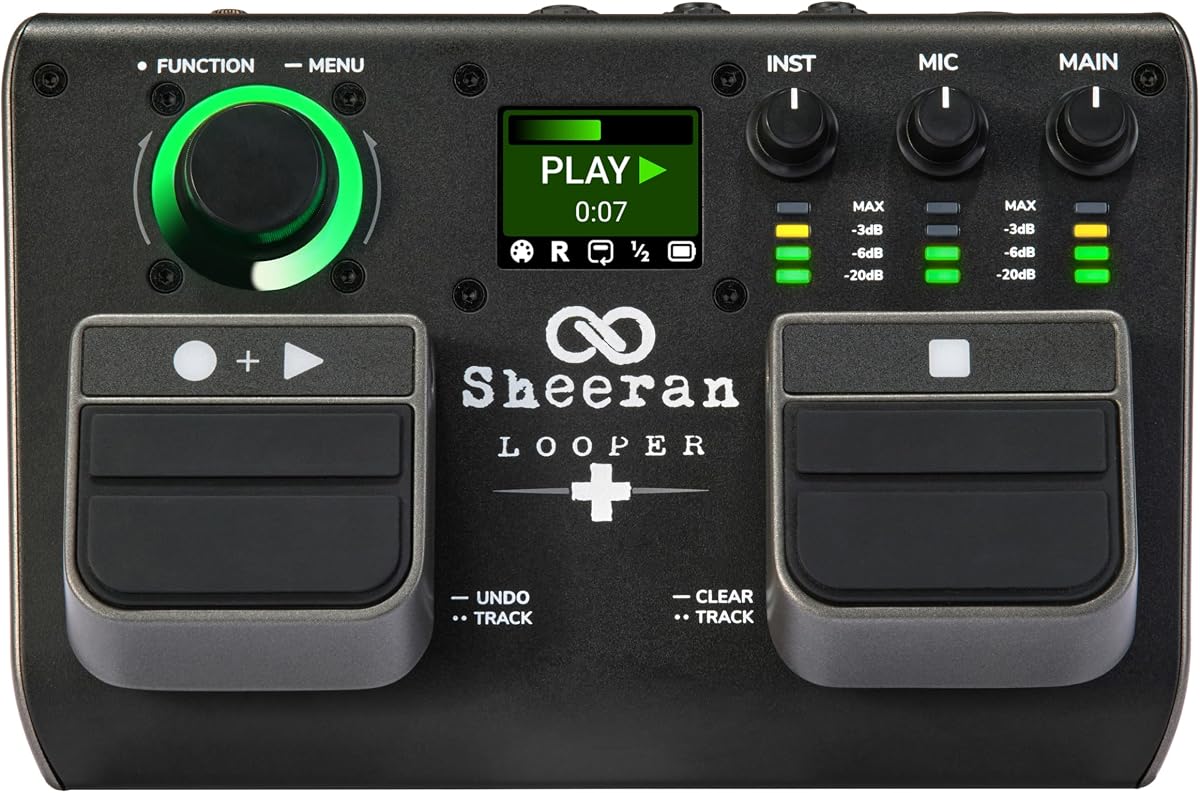
The Sheeran Looper + is the most performance-oriented dual-track design in this roundup. Built around an Ed Sheeran-inspired workflow, it offers single, multi, sync, and song modes, a full-color display, an RGB loop-status ring, and custom DSP from HeadRush. Its 4.0 rating suggests that buyers should examine feature fit carefully rather than rely on rating alone.
We may earn a commission when you buy through this link, at no additional cost to you.
The pedal supports 32-bit audio and unlimited layering, with storage for as many as 128 loops and more than three hours of total audio. The drag-and-drop transfer system allows loops to move to a Mac or PC without requiring separate transfer software. When connected to a computer, the unit also functions as a two-in, two-out USB audio interface for recording to a DAW or setting up a live stream.
Its connection set is extensive, including microphone input, stereo instrument inputs, stereo main outputs, single or dual footswitch input, MIDI input, and USB-B for audio, MIDI, and file transfer. A durable steel chassis and more than six hours of typical battery life on four AA batteries support touring and street-performance use. The included connection breadth means it can serve as the center of a complete looping setup.
This is a strong choice for a solo performer who wants separate track control, computer recording, streaming, and a large library of prepared loops. Its dual-pedal construction may demand more pedalboard space, and the 4.0 rating is not the strongest in the group. Nevertheless, musicians who value a complete, flexible performance system may find that its specialized workflow outweighs those concerns.
Single-track and dual-track modes let performers choose between a focused layered workflow and greater control over separate musical parts. The status ring and color display provide visual confirmation during a live set.
USB file transfer, MIDI, and two-in/two-out audio operation create a bridge between live looping and computer-based recording. The same pedal can support rehearsal, capture, and streaming rather than remaining isolated on the board.
We may earn a commission when you buy through this link, at no additional cost to you.
The LEKATO Guitar Looper Pedal with Tuner Function is a well-equipped option for musicians building a home practice system. Its 4.6 rating matches the BOSS RC-1 among the highest customer ratings in the group, and the included tuner, USB cable, and 9V power supply make it convenient to start using.
We may earn a commission when you buy through this link, at no additional cost to you.
Nine loops and 40 minutes of total recording provide practical room for song parts and practice ideas, while a single loop can record for up to 10 minutes. The pedal uses 48 kHz, 24-bit uncompressed recording and includes a visual time indicator. A high-sensitivity tuner is integrated, and the supplied description says it can switch continuously without a discordant interruption in the phrase.
The one-button control scheme assigns record, stop, erase, undo, and redo to distinct foot commands, which keeps live operation relatively direct. A single knob controls loop playback volume, and USB allows WAV files to be imported from or exported to a computer. The bundle also includes a 9V 0.6A pedal power adapter, reducing the need for a separate purchase for the listed setup.
This LEKATO pedal is best for electric guitarists and bassists who want a tuner, looper, file-transfer capability, and basic power in one package. It is less compelling for someone requiring documented stereo operation or extensive memory, but for practice, songwriting, and portable layering, it offers a notably complete set of tools at a 4.6-rated level of customer reception.
Combining the tuner and looper reduces the number of separate devices needed for a focused practice setup. It also makes the pedal attractive to musicians who want to tune, record a phrase, and immediately build on it.
The included USB cable and 9V power adapter address two practical needs at the outset. Users can exchange WAV files and power the pedal without treating accessories as separate shopping priorities.
We may earn a commission when you buy through this link, at no additional cost to you.
The original TC Electronic DITTO Looper is a focused choice for players who want a straightforward pedal rather than a complete recording workstation. Its 4.5 rating and designer-led concept make it one of the most approachable options here, while true bypass and analog dry-through offer important signal-chain advantages.
We may earn a commission when you buy through this link, at no additional cost to you.
The pedal provides five minutes of looping time with unlimited overdubs and undo or redo functionality. That is enough for many guitar riffs, bass figures, short melodic patterns, and compact practice arrangements. Analog dry-through allows the direct instrument signal to continue through the pedal while looping is engaged, which can help a player maintain the familiar response of an analog signal path.
True bypass is useful when a musician wants the looper removed from the audible circuit while the pedal remains connected. It also makes the DITTO easier to combine with other effects in a conventional pedalboard. The design was created by guitarists for guitarists, and the five-minute limit creates a defined creative boundary that many players may find easier to manage than an open-ended recording canvas.
A 9V power supply providing at least 100 mA is required, and the supply is not included. That is the main practical drawback for someone starting from scratch. Within that consideration, the DITTO is best for guitarists who prioritize intuitive controls, familiar signal behavior, and quick looping over large storage, USB workflows, or extensive editing features.
Analog dry-through maintains the instrument’s direct route while the looper is active. Musicians can add layers without losing the response they expect from the pedal.
The pedal needs a 9V source capable of supplying 100 mA or more, and that adapter is not included. A suitable power supply should be included in the setup budget and kept consistent with the requirements of the other pedals.
We may earn a commission when you buy through this link, at no additional cost to you.
The BOSS RC-5 is the clear premium recommendation and earns the highest customer rating in the comparison at 4.7. It is designed for musicians who want extensive recording capacity, dependable phrase organization, rhythms, and deep connectivity without moving to the multi-pedal scale of a full advanced loop station.
We may earn a commission when you buy through this link, at no additional cost to you.
Its most impressive specifications are the 13 hours of stereo recording time and 99 onboard phrase memories. Thirty-two-bit AD/DA conversion and 32-bit floating-point processing support high-quality capture and playback, while the multi-color backlit LCD makes loop status and parameters easier to read under different lighting conditions. A reverse function adds an experimental tool for reversing phrases and creating changed textures.
The rhythm section includes 57 patterns, each with A and B variations, and seven selectable drum kits. That library makes the RC-5 useful for solo practice and live performance without requiring a separate beat source. USB, full MIDI I/O through mini TRS jacks, external footswitch support, and expression-pedal control create multiple paths for integrating the loop station with a larger system.
The RC-5 operates from 9V battery power or an optional PSA adapter, and its compact design is intended to preserve pedalboard space. It is best for serious performers, composers, and practice-focused musicians who value storage and control more than minimalism. A beginner may find its feature set imposing, but the reward is a pedal capable of supporting both quick live layers and deeply organized music projects.
Thirteen hours of stereo capacity and 99 phrase memories make it practical to store many distinct parts rather than overwrite one loop. Guitarists can keep intros, sections, and complete arrangements together for quick recall.
Fifty-seven rhythms, A/B variations, and seven drum kits add musical support without another device. A reverse function further expands the creative palette for ambient, textural, or experimental music.
We may earn a commission when you buy through this link, at no additional cost to you.
The Boss RC-600 Loop Station is built for musicians who need more than a single looping layer and want the pedal to function as a central part of a performance system. Its 4.4 rating reflects solid customer reception, while six stereo phrase tracks, multiple input types, and microphone support separate it from simpler single-track designs.
We may earn a commission when you buy through this link, at no additional cost to you.
Two XLR microphone inputs with phantom power make the RC-600 relevant to vocalists, acoustic performers, and instrumentalists who want to loop live sound. The supplied specifications also list two stereo instrument or line input pairs. That flexibility allows microphones, instruments, and line-level sources to enter the looping system, potentially creating a fuller arrangement than a guitar-only pedal can capture.
Ninety-nine phrase presets support organized storage of songs, sections, and recurring ideas. A rhythm guide is included, giving performers an internal timing source. The combination of multiple phrase tracks and a rhythm tool is especially useful for a solo musician who wants to establish a repeating structure and then vary the layers around it.
The RC-600 is best for serious performers who loop vocals and instruments, rehearse complex arrangements, or use a pedalboard as the center of a live show. It is not the natural first choice for a beginner who only wants to practice a short riff, since the six-track workflow and microphone routing demand more setup. For the right user, however, its routing and recording flexibility justify the larger investment.
Two XLR microphone inputs with phantom power allow compatible microphones to enter the system. Instrument and line-level pairs add further routing options for performers working with several sound sources.
Six stereo phrase tracks offer more structural control than a conventional single-track looper. They can support layered sections, recurring patterns, and more developed live arrangements.
We may earn a commission when you buy through this link, at no additional cost to you.
The FLAMMA FF20 is an unusually ambitious practice and performance pedal, combining 300 minutes of stereo recording, 100 memory slots, a built-in drum machine, and a 2-inch color display. Its 4.1 rating is among the lower scores here, but the supplied feature set makes it particularly relevant to guitarists, bassists, and buskers who want more internal tools.
We may earn a commission when you buy through this link, at no additional cost to you.
Dual footswitches provide direct control over recording, overdubbing, playback, stopping, and loop switching. A built-in drum machine supplies 220 grooves across 11 styles, including rock, blues, funk, and pop. This allows a solo player to create a stronger rhythmic foundation without adding a separate drum pedal, particularly useful for practice, street performance, and casual jamming.
Time stretch adjusts playback speed without changing pitch, while auto record starts with the player’s first note. One-Shot mode, fade-out, and tap tempo add further performance options. The color screen presents loop status, recording time, BPM, drum patterns, and menus, while USB file transfer and a headphone output support quieter practice and computer-based editing.
The FF20 is best for a musician who wants a self-contained practice station, a loop library with a drum machine, and the ability to transfer WAV files. It may be more complicated than a basic looper, and the 4.1 rating warrants attention to current user feedback. Even so, its capacity and performance tools offer a distinctive combination for players who regularly practice alone.
The 220 drum grooves give a guitarist or bassist an internal rhythmic foundation. Combining that with 100 loop slots supports a practice system capable of handling both accompaniment and layered ideas.
Time stretching changes playback speed without affecting pitch, making it possible to practice or perform recorded phrases at different tempos. Auto Record and tap tempo can streamline preparation and performance.
We may earn a commission when you buy through this link, at no additional cost to you.
The right live looper depends on the kind of music you make, the complexity of your arrangements, and how you perform. Recording capacity, control layout, connectivity, and signal behavior should be weighed against one another rather than treating the largest specification as the only measure of quality.
Recording capacity determines how much music can be captured without erasing earlier material. The BOSS RC-1 provides 12 minutes of stereo recording, the original DITTO offers five minutes, the LEKATO pedals provide 40 minutes across nine loops, the NUX Loop Core supports six hours across 99 slots, and the FLAMMA FF20 lists 300 minutes across 100 slots. Larger capacity is useful for full arrangements, while a shorter buffer can encourage focused, repeatable phrases. Memory organization matters as much as total time because a musician needs to locate the correct loop quickly during a live set.
A looper must remain easy to operate while the musician is playing. Single-button models can be learned quickly, while dual footswitches may provide more direct separation between functions. The BOSS RC-1 includes an indicator that displays Record, Overdub, and Play modes, and the FLAMMA FF20 uses a 2-inch color screen to show status, time, tempo, and menu information. Consider whether you need a bright display, simple lights, or a color interface, and test the button spacing mentally against your pedalboard and playing posture.
Stereo support can preserve instrument width and provide more flexibility when connecting to amps, mixers, and recording equipment. The RC-1, RC-5, RC-600, and FLAMMA FF20 are documented as stereo-oriented models. Analog dry-through and true bypass are also important in a pedalboard: the original TC Electronic DITTO includes both, helping the direct signal continue through the circuit in a familiar way. Compare the pedal’s routing with the rest of the signal chain, particularly if you use stereo pedals, DI boxes, or a mixer.
Built-in utilities can reduce the need for additional floor pedals. The LEKATO models include a high-sensitivity tuner, the NUX Loop Core supplies 50 rhythm patterns, the BOSS RC-5 includes 57 rhythms with A/B variations and seven drum kits, the RC-600 has a rhythm guide, and the FLAMMA FF20 includes 220 grooves across 11 styles. These tools are especially helpful for solo practice, busking, and learning. They are not automatically better than separate hardware, so consider whether the additional menus and screen complexity remain welcome in live use.
USB and MIDI can extend a pedal beyond live looping. The LEKATO pedals support WAV import and export, the FLAMMA FF20 offers USB file transfer with included editor software, and the Sheeran Looper + provides drag-and-drop transfer plus USB audio, MIDI, and a two-in/two-out interface. The NUX Loop Core supports external MIDI control, while the BOSS RC-5 offers USB, MIDI I/O, footswitch support, and expression-pedal control. Look for the connections that support your actual workflow rather than assuming every format is necessary.
Routing determines whether the looper is limited to an instrument or can capture voices and other sources. The BOSS RC-600 includes two XLR microphone inputs with phantom power, making it a strong choice for vocalists and multi-source performers. The Sheeran Looper + includes microphone input, stereo quarter-inch instrument inputs, and stereo main outputs. Guitar-only pedal users should still verify ordinary instrument compatibility, but a broad input section is worth paying for if the pedal will become a central live system.
Every occupied pedalboard area matters, especially for a touring setup. The BOSS RC-5 emphasizes a compact, pedalboard-friendly design, while the Sheeran Looper + uses a rugged dual-pedal format. Larger screens can improve visibility but alter the space a pedal occupies, and steel construction may suit touring better than a lightweight plastic enclosure. Check the overall width, footswitch accessibility, cable reach, and whether neighboring controls can be used without accidentally changing a loop.
Power requirements affect rehearsal, home use, and touring. The BOSS RC-1 runs from a 9V alkaline battery for approximately 4.5 hours and accepts an optional PSA-series adaptor. The RC-5 also supports 9V battery operation or an optional adapter. The Sheeran Looper + runs for more than six hours on four AA batteries under typical use, while the original DITTO requires a 9V supply delivering at least 100 mA, which is not included. The LEKATO bundle includes a listed 9V power adapter. Select a power method that matches the length and reliability demands of your sessions.
Begin by placing the looper in a clean, stable part of the signal chain and confirming the input, output, and power connections. Set a comfortable playback level before recording, then perform a short test phrase to verify that recording starts and stops as expected. Learn the basic Record, Play, Overdub, Stop, Erase, and Undo commands before attempting a full arrangement.
Build arrangements in controlled layers. Record a stable foundation first, play it back to confirm timing, and then add a new phrase with Overdub. Use a click, metronome, built-in rhythm, or external guide when appropriate, but avoid crowding the loop with unnecessary material. When using USB or MIDI, export files regularly and keep a clear naming system so important parts can be found later.
Protect the pedal with sensible care. Keep liquids away from the enclosure, avoid plugging cables into a powered unit unless the manufacturer permits it, and follow the stated power requirements. Use the recommended adapter where required, replace batteries on a schedule, and keep saved phrases backed up when the model supports file transfer. Clean the enclosure with a dry cloth and inspect connections for strain or corrosion.
The BOSS RC-1 is among the easiest choices because it focuses on recording, playback, overdubbing, undo, and redo without a large menu-driven interface. Its loop indicator also shows the current operating mode at a glance. A beginner should still spend time learning the footswitch commands and practicing transitions before using layered loops in a live performance.
The right amount depends on whether you are layering short riffs, building a full song arrangement, or recording complete practice parts. Five minutes may be sufficient for focused guitar patterns, while 40 minutes or more offers more freedom for structured songs. Consider memory slots and navigation as well, because a large recording buffer is not very useful if stored loops are difficult to find.
Stereo can be useful when a pedal, amplifier, or other part of the signal chain produces a stereo signal, even if the guitar itself is mono. It also gives a looper more flexibility when connected to a mixer or recording interface. If the rest of the chain is entirely mono, a simpler unit may be sufficient, so match the pedal to the actual routing.
A built-in rhythm source can be very useful for solo practice, busking, and learning without another pedal. The NUX Loop Core, BOSS RC-5 and RC-600, and FLAMMA FF20 all provide rhythm tools, although they differ in library size and control style. If you already use a drum machine or backing track, those features may be less important than simpler operation or longer memory.
Yes, provided the pedal has a suitable microphone input and the performer uses compatible microphone routing. The BOSS RC-600 includes two XLR microphone inputs with phantom power, while the Sheeran Looper + includes a microphone input. Check connector type, signal level, and the manufacturer’s routing instructions before connecting a microphone.
Overdubbing is the action of adding new material to an existing loop, while layering describes the resulting musical stack. Some pedals also offer separate tracks, as seen in the six-track BOSS RC-600 and dual-track Sheeran Looper +. A single-track design is often simpler, whereas multiple tracks can provide more control over the arrangement.
They are not required for basic live looping, but they can improve rehearsal, recording, and setup workflows. USB enables file backup or computer audio transfer, while MIDI can control functions or coordinate the looper with other compatible devices. Choose these features if they solve a real need rather than adding complexity for their own sake.
Use the power method specified by the manufacturer, including the required voltage and current. Some models accept a 9V battery, some use four AA batteries, and others require a suitable external adapter. The original TC Electronic DITTO needs a 9V supply providing at least 100 mA, which is not included, while one listed LEKATO package includes a suitable 9V adapter.
The BOSS RC-1 is the strongest overall choice for musicians who value simple operation, stereo recording, memory retention, and dependable layering without an oversized feature set. The LEKATO looper with tuner is the best budget-oriented all-rounder for practice, while the BOSS RC-5 stands as the premium choice for extensive phrase memory, large recording capacity, rhythms, and broad connectivity.
Prioritize the features that match your actual routine. A short loop can be enough for focused riffs, a tuner may be more useful than MIDI, and a large screen is only an advantage if you use its information during performance. Before buying a complex model, make sure you will benefit from its file transfer, drum patterns, microphone routing, or multi-track structure.
Ratings and specifications provide a useful starting point, but the final decision should also account for pedalboard space, power requirements, signal routing, and the number of controls you are comfortable managing. Current prices and product details can change, so verify the latest listing and manufacturer information before purchasing.