
FishPRO 2026 Upgrade
4.6Editor score
Seven-inch full-color IPS display
Up to twenty hours of use
Switchable LED and infrared modes
A camera for kayak fishing must do more than produce attractive footage. It needs to be portable, resistant to water and spray, easy to operate from a seated position, and capable of documenting fish, structure, and underwater behavior. Action cameras excel at recording trips, while underwater fishing cameras help anglers see what is happening below the surface.
The products in this guide were compared using resolution, viewing angle, waterproofing, cable length, battery life, display size, night-vision features, portability, and recording limitations. The list includes two action cameras and eight underwater fishing cameras designed for open water, ice fishing, boat fishing, and kayak use.
Each review explains how the camera fits into a kayak-fishing setup and identifies the compromises that may matter to different anglers. Ratings and specifications reflect the supplied product information, while current availability, features, and prices can change, so readers should verify current listings before purchasing.
4.6Editor score

4.6Editor score

4.2Editor score
As an Amazon Associate we earn from qualifying purchases.
The table below compares the ten cameras by imaging system, screen, underwater reach, lighting, and power, making it easier to separate action-recording options from real-time fishing cameras.


The AKASO EK7000 combines a 4K30 action camera with a durable waterproof housing, making it one of the most flexible choices in this guide. Its 4.4 rating reflects a capable action camera designed to document kayak launches, the shoreline, casting movements, and underwater sequences when correctly enclosed.
We may earn a commission when you buy through this link, at no additional cost to you.
Video can be recorded at 4K30 or 2.7K30, while 20MP still images provide useful photo flexibility. Electronic image stabilization helps smooth footage captured during paddling, casting, or movement around the kayak. A 2.4GHz wrist remote, four-times zoom, external microphone support, and built-in Wi-Fi add practical options for trip documentation.
The waterproof case is rated to 131 feet, although the wrist remote itself is not waterproof and must remain dry. A microSD card is also not included, so buyers need to confirm that a suitable card is already in their kit. These are important setup details rather than shortcomings in the core camera.
Choose this model when recording the entire kayak experience matters more than live underwater viewing. It suits anglers who want scenic video, social-ready clips, still photographs, and waterproof action coverage in one device. It is our top action-camera selection because it balances resolution, stabilization, accessories, and kayak-friendly ruggedness.
Unlike a fishing camera with a fixed underwater cable, this model can document the entire outing. The housing allows the camera to transition between action on the water and submerged sequences when mounting and operating conditions are appropriate.
Electronic image stabilization is especially useful when a kayak rocks, turns, or encounters waves. Combining stabilization with 4K recording creates a more polished record of paddle strokes, casting, strikes, and wildlife encountered during the trip.
We may earn a commission when you buy through this link, at no additional cost to you.
This AKASO EK7000 listing offers the familiar 4K30 action format in a bundle described as a waterproof camera with accessories. Its 4.6 rating places it among the strongest-rated products in the guide, although the supplied details do not explicitly list electronic image stabilization.
We may earn a commission when you buy through this link, at no additional cost to you.
The camera records 4K30 or 2.7K30 video and captures 20MP photographs. A 131-foot waterproof housing protects the camera during wet environments and supports underwater filming, while the 2.4GHz wrist remote provides convenient start, stop, and framing control from outside the housing.
Built-in Wi-Fi connects with the AKASO GO app for editing and sharing. The stated range is up to ten meters, making the camera practical for transferring a short sequence while the angler remains nearby. As with the other AKASO remote, the wrist remote is not waterproof and should be protected from spray.
This is a strong choice for anglers who want a complete action-camera kit for both above-water and underwater footage. It is especially suitable when 4K capture, still photography, wireless control, and broad accessory support matter more than a dedicated live underwater display.
The included accessories and 131-foot housing create a ready-to-pack system for kayaking. It lets anglers capture launch preparation, surface action, and underwater scenes without carrying separate housings for each outing.
The AKASO GO app and ten-meter Wi-Fi range simplify the basic workflow of moving footage to a phone or tablet. That convenience is valuable when an angler wants to edit highlights soon after returning from the water.
We may earn a commission when you buy through this link, at no additional cost to you.
This portable fish finder is a detailed underwater viewing system rather than a conventional action camera. It combines a six-inch 1080P OLED display, a 220-degree wide-angle lens, and a 25-meter cable, giving kayak anglers a flexible way to observe fish and submerged structure.
We may earn a commission when you buy through this link, at no additional cost to you.
The screen reaches a stated maximum brightness of 2000 nits, while a triple-panel foldable sun visor helps control glare. Eight infrared LEDs improve visibility in murky ponds or low-light conditions. Four modes—day, night, murky, and clear water—plus three viewing perspectives help tailor the image to conditions.
The system includes a 10,000mAh battery with up to 12 hours of continuous operation, timed recording in one-to-three-minute segments, zoom and replay functions, and a 32GB memory card. Its IP68 certification and cable load rating support demanding fishing use, although the complete kit requires more packing space than a compact monitor.
Best for kayak anglers who want to record underwater observations, inspect deeper structure, and use a sizable display in bright conditions, this is one of the most versatile underwater systems in the roundup. Its feature set is especially useful for anglers fishing clear lakes, remote water, and varying light conditions.
The six-inch OLED screen gives the monitor a more substantial viewing area than the many 4.3-inch alternatives. High brightness and a foldable visor make it easier to examine fish movement, aquatic plants, and bottom features during a sunny day.
Timed video capture, zoom, replay, and an included memory card extend the system beyond real-time observation. These functions are useful for reviewing structure or checking how fish reacted to bait and nearby movement.
We may earn a commission when you buy through this link, at no additional cost to you.
This underwater fishing camera is designed around real-time observation, with a 4.3-inch IPS display and 1080P imaging. Its 4.1 rating is the lowest in the group, but the specification set offers a practical balance of visibility, cable reach, and screen readability for kayak anglers.
We may earn a commission when you buy through this link, at no additional cost to you.
The 220-degree wide-angle lens provides broad coverage around the camera, helping an angler see fish and underwater terrain without pointing directly downward. Infrared lighting produces a high-contrast black-and-white image in dark or murky water, with stated visibility of approximately 15–20 feet in clear water and 8–12 feet in murky water.
The 50-foot waterproof cable is rated to support 66 pounds, and the camera is waterproof to 50 feet. A 6000mAh battery provides more than eight hours of continuous use with maximum brightness and infrared illumination active. The adjustable mount can attach to a rod or kayak.
Its clearest limitation is that it only functions as a standalone monitor: there is no photo capture, video recording, or phone streaming. For an angler who wants an uncomplicated, always-available underwater view without recording menus, these trade-offs are reasonable. It is a good match for live fish observation in freshwater lakes and ponds.
The IPS panel and included sun visor improve screen visibility during bright conditions. That matters in a kayak because the low seating position and reflective water can make small or dim displays difficult to read quickly.
The lack of recording and streaming features keeps operation focused on real-time underwater information. Anglers can use the camera to identify fish movement and choose where to place bait without managing storage or phone connections.
We may earn a commission when you buy through this link, at no additional cost to you.
The TMACTIME underwater fish finder offers 1080P live viewing on a 4.3-inch LCD and has a 4.2 rating. It is explicitly suitable for ice, lake, boat, and kayak fishing, making its feature set immediately relevant to anglers who want a portable view of fish and underwater structure.
We may earn a commission when you buy through this link, at no additional cost to you.
Six built-in infrared lights help reveal activity in dark or murky water. The underwater camera and cable have IP68 waterproof ratings, work to depths up to 15 meters, and the cable is listed with a 100-kilogram load capacity. These details make the system suitable for repeated deployment from a kayak or small craft.
Its 5000mAh battery is rated for up to ten hours of continuous use. The package includes the monitor, underwater camera and 30-meter cable, stand, charging cable, and manual, while the simple connection process keeps setup approachable for less experienced users.
The product is limited to real-time viewing and does not support recording, so it will not replace an action camera for documenting a catch or the surrounding trip. It is best for anglers who value long operating time, straightforward operation, and dependable underwater observation over saved footage.
The stated ten-hour runtime offers enough capacity for a full day of ordinary use. That makes the camera practical for anglers moving between productive areas without returning to a vehicle or shoreline power source.
The stand, 30-meter cable, and plug-and-play design make deployment straightforward. The monitor can remain at hand while the camera is lowered from the kayak to examine fish activity around bait or submerged structure.
We may earn a commission when you buy through this link, at no additional cost to you.
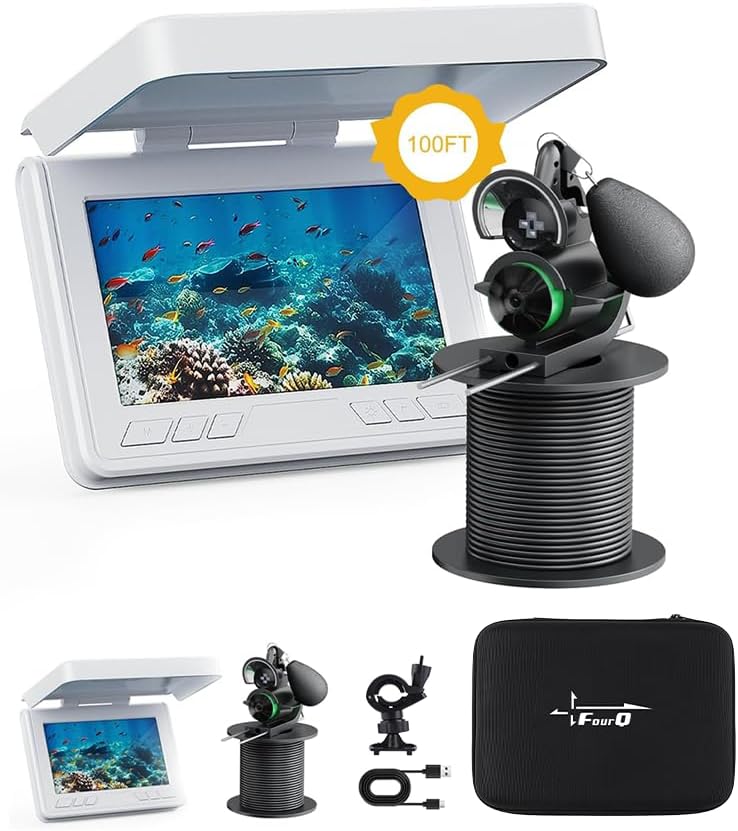
The FishPRO 2026 Upgrade is the most feature-focused premium underwater monitor in the guide. It has a 4.6 rating, a seven-inch full-color IPS screen, true 1080P underwater imaging, and an 82-foot cable, giving it the largest display among the dedicated fishing cameras reviewed.
We may earn a commission when you buy through this link, at no additional cost to you.
Its 10,000mAh battery is listed for up to 20 hours of nonstop use and can be charged through USB-C while operating. A magnetic connection lets the monitor and cable spool be used separately, while standard quarter-inch mounts provide additional mounting flexibility.
The lighting system offers switchable infrared and white LED modes. Infrared produces a monochrome view in dark water, while LED can provide full-color underwater scenes. The monitor also includes a flip-up screen cover that protects the unit and functions as a sunshade, plus a backlight for night use.
The 1.8-millimeter cable uses an aramid-fiber core and is rated for an 88-pound load. A 12-month warranty and stated customer support add reassurance, although the absence of HDMI and recording means it remains a live-view device. It is the premium pick for anglers who value a large, bright display, long runtime, and flexible lighting.
The seven-inch IPS panel is easier to read than a small monitor and maintains useful viewing angles. Its full-color presentation can make species, bait, vegetation, and bottom structure easier to distinguish when conditions are favorable.
Switching between white LED and infrared lets anglers choose a natural-color view or a high-contrast monochrome image. That control is valuable when fishing shaded water, evening spots, or locations where surface light is limited.
We may earn a commission when you buy through this link, at no additional cost to you.
This 4.3-inch LCD underwater camera is a practical budget-oriented option for kayak anglers. Its 4.2 rating, 720P live view, 200-degree wide-angle lens, and 50-foot reinforced cable cover the fundamental needs of an entry-level fishing camera.
We may earn a commission when you buy through this link, at no additional cost to you.
Twelve infrared LEDs illuminate dark or murky water, helping reveal fish movement and submerged terrain at night or below the surface. The camera carries an IP68 waterproof rating, while the cable is described as resistant to pulling, twisting, and abrasion and supports up to 220 pounds of tensile strength.
A rechargeable 5000mAh battery provides up to eight hours of continuous operation. The complete kit includes a carrying case and LED finger lights for nighttime convenience, making it easier to organize the system and handle tasks around a dark shoreline or launch area.
Its main limitation is the lower 720P underwater resolution compared with the 1080P alternatives. The smaller screen also offers less detail than premium models. Even so, it is a credible first underwater camera for anglers who want broad viewing angles, infrared illumination, and a useful cable at a more restrained entry point.
The 200-degree lens gives the camera a wide field of view beneath and around the deployment point. This is useful when fish approach from different angles or when the angler wants to observe more than a single patch of bottom.
The included carrying case helps protect and organize the monitor, camera, and cable. Finger lights add a small but useful layer of convenience when preparing equipment after sunset.
We may earn a commission when you buy through this link, at no additional cost to you.
This five-inch underwater fishing camera combines a medium-size IPS screen with a 100-foot cable, creating a balanced system for lake and kayak fishing. Its 4.4 rating and broad feature set place it among the stronger dedicated live-view options.
We may earn a commission when you buy through this link, at no additional cost to you.
The 220-degree wide-angle lens helps anglers observe fish and terrain around the camera rather than only directly below it. Infrared night vision illuminates fish silhouettes in dark or murky water, while the IPS screen is designed to remain clear and stable during changing viewing conditions.
The underwater camera has an IP68 waterproof rating, and the cable is rated to support 100 kilograms of pull strength. A 6000mAh rechargeable battery supports up to nine hours of continuous operation. The plug-and-play package includes essential accessories and a convenient carrying case.
The model supports real-time viewing only, without photo or video capture, and the fishing rod and pulley are not included. Those limitations keep it from competing with action cameras, but they also make it a focused fish-finding tool. It is a strong recommendation for anglers who want a larger display and deep cable reach without a premium-level setup.
The 100-foot cable gives the camera ample reach from a kayak or shoreline position. It also provides a secure retrieval margin when inspecting a drop-off, vegetation edge, or deeper fishing area.
A five-inch IPS display offers a useful balance between size and packability. Angler can angle the monitor toward themselves while remaining aware of the kayak, paddle, line, and surrounding water.
We may earn a commission when you buy through this link, at no additional cost to you.
This underwater fishing finder camera is an especially balanced choice for a kayak because it combines a bright five-inch IPS display with long battery life and a 220-degree lens. Its 4.6 rating is among the highest in the group, and the product is explicitly listed for sea, lake, boat, and kayak fishing.
We may earn a commission when you buy through this link, at no additional cost to you.
The screen reaches 1500 nits of peak brightness and includes a foldable sunshade for direct sunlight. Underwater, eight infrared LEDs and the 220-degree wide-angle lens support glare-free night viewing and broad observation. Adjustable voltage, backlight, and chroma settings give anglers more control over image clarity in turbid or dark water.
The 8000mAh battery is rated for up to 15 hours of continuous operation, while the USB charging port supports power-bank use. The IP68-rated camera and reinforced 98-foot cable are listed with a 170-pound tensile strength, making the deployment system suitable for cold water, current, and regular handling.
The kit includes the main device, 30-meter cable and camera, adapter, stand, manual, and storage bag. Its 30-meter cable and full monitor package require deliberate packing, but the long operating time reduces the need to recharge during a multi-day trip. It is our editor's choice for the best overall balance of image visibility, endurance, and kayak-relevant features.
The 15-hour stated runtime makes the camera well suited to long lake days and extended trips. USB charging adds flexibility because an angler can use a compatible power bank when the built-in battery is not enough.
Voltage, backlight, and chroma adjustments can help refine the picture when visibility changes. Those controls are especially relevant in stained water, shaded banks, and changing daylight conditions.
We may earn a commission when you buy through this link, at no additional cost to you.
The 100-Foot Underwater Camera is a portable live-view system built around a long cable, 4.3-inch color display, and infrared illumination. Its 4.2 rating matches the more detailed budget category in this guide while offering substantial deployment reach.
We may earn a commission when you buy through this link, at no additional cost to you.
Twelve infrared lights make fish more visible in dark environments, and the color screen is intended to remain useful in bright surroundings. The camera is designed to avoid disturbing fish, allowing the lens to be positioned near bait or structure for a closer view of underwater activity.
The waterproof camera reaches a stated depth of 100 feet, while the cable supports 88 pounds. A 5000mAh rechargeable battery provides more than ten hours of continuous operation, and the included portable box makes the system easier to transport between shoreline, boat, and kayak locations.
Its IPX6 rating should be considered carefully when comparing it with IP68-rated alternatives. The listing also identifies a 1000TVL program chip rather than stating a full HD resolution, so buyers should not assume it matches the 1080P models. It remains a useful long-cable camera for basic fish observation.
The 100-foot cable gives anglers room to investigate deeper water and structure beyond the kayak's immediate reach. It also allows the camera to remain stationary while the angler watches from a stable seated position.
The included portable box keeps the system together during transport. A simple connection process and infrared lighting make the camera approachable for anglers focused on basic underwater fish detection.
We may earn a commission when you buy through this link, at no additional cost to you.
The right kayak fishing camera depends on whether you mainly want to record the outing or inspect fish below the surface. Resolution, display visibility, waterproofing, cable strength, lighting, battery life, and setup requirements should guide the decision.
An action camera is the better choice for recording the complete experience. The two AKASO EK7000 options record 4K30 video, capture 20MP photographs, use waterproof housings, and support remote or wireless control. They are better suited to scenic footage, casting demonstrations, action shots, and documenting fish near the surface than to continuously viewing fish at depth.
An underwater fishing camera is better when the main goal is to see fish, bait, vegetation, and bottom structure before choosing a fishing position. These systems generally use a tethered underwater camera, a display, infrared lighting, and a reel or spool for deployment. Select the camera type that matches the information you need most.
Underwater resolution ranges from 720P in the 4.3-inch LCD model to 1080P in several dedicated systems. Higher resolution can help reveal fine structure, but display size, lighting, water clarity, and camera placement also determine how useful the image appears. The premium FishPRO adds a seven-inch IPS screen, while several lower-cost products use 4.3-inch displays.
Prioritize 1080P when the budget permits, but do not overlook sunlight readability. IPS screens and included sun visors can make a major difference during a bright lake session. Choose a screen size that remains visible from a seated kayak position without taking up excessive deck space.
Kayak fishing exposes equipment to splashes, rain, humidity, and occasional partial submersion. Underwater cameras should have a clearly stated waterproof rating, and action cameras need a reliable waterproof housing. IP68 appears across several dedicated systems, while the 100-foot model in the guide uses IPX6 and therefore warrants closer inspection before purchase.
Treat waterproof ratings as important but not as permission to ignore connectors, seals, and cable strain. After every outing, dry the monitor, inspect seals, and flush freshwater equipment when it has been used in saltwater. Protection depends on correct assembly as much as on the rating.
Cable length determines how far an underwater camera can be placed from the angler. Options in this guide range from 30 meters to 100 feet, with the FishPRO using an 82-foot spool. A longer cable permits deeper and wider searches, but it also takes more space to carry and manage.
Check both reach and tensile strength. Listed capacities range from 66 pounds to 100 kilograms, but the proper figure represents maximum load rather than normal operating pressure. A strong, smooth cable is especially important in a kayak because rocks, weeds, and repeated retrieval can create sudden strain.
Infrared illumination helps the underwater camera reveal fish silhouettes when sunlight is absent or water is dark. Most models include between six and twelve infrared LEDs, and the FishPRO also offers white LED for a full-color view. White light may reveal more color but can also appear much brighter to nearby fish than infrared illumination.
Look for a mode that suits the fishing environment. Infrared is useful at night, under ice, and in shaded water, while LED can help identify fish and structure in darker but clear conditions. The number of LEDs alone does not guarantee visibility, so water clarity and camera distance remain important.
Stated runtimes range from approximately eight hours to twenty hours. Longer battery life is valuable on open-water trips, cold days, and multi-day outings where charging opportunities are limited. The FishPRO and the 8000mAh fishing-finder camera are especially oriented toward extended use, while USB-C charging on some systems allows compatible power-bank support.
Treat published runtime as an operating-range estimate rather than a guarantee. Brightness, infrared lighting, recording, and environmental conditions can affect consumption. For a full-day kayak session, a long-rated battery and a compact power bank provide the most comfortable margin.
A wide lens gives the underwater camera a broader view of fish approaching from multiple directions. Most of the dedicated fishing cameras offer 200- or 220-degree lenses, while the AKASO action cameras list 4X zoom. Wide viewing is particularly useful around bait, structure edges, and shallow drop-offs.
Consider the stated depth or cable reach alongside the lens. A broad field of view does not compensate for placing the camera too deep for available light. The ideal setup keeps the lens near the activity, clear of bottom hazards, and positioned where the angler can react quickly.
Most dedicated underwater fishing cameras in this guide support real-time viewing only. Several explicitly do not record photos or video, and the FishPRO also lacks HDMI and recording. These limitations reduce storage requirements and make operation straightforward, but they also prevent anglers from saving a discovered fish or reviewing a brief underwater event.
If documentation matters, consider an action camera alongside an underwater viewer. The AKASO EK7000 models record 4K video and still images, while the portable fish finder with a six-inch OLED screen includes timed capture and a memory card. Define whether you need evidence, social content, or simply immediate visual information before choosing.
Before launching, charge the battery, install a compatible memory card if the model records, and inspect the housing, seals, cable, and connectors. For an underwater camera, test the monitor and illumination on land, then attach the display securely to the kayak or keep it within easy reach. For an action camera, confirm that the waterproof housing is fully closed before entering the water.
Deploy the underwater camera gradually while keeping the lens away from rocks, shells, vegetation, and the kayak hull. Lower the weighted camera to the desired depth, watch the screen for fish movement, and allow it to settle before interpreting the image. Avoid sharply lifting the cable when fish or structure create resistance, and reel it in slowly to reduce tangling and snagging.
After the trip, disconnect power, wipe the monitor and camera with fresh water, and dry every component fully. Rinse any system exposed to saltwater with fresh water, particularly the cable and connectors. Retract and inspect the cable for kinks, clean the lens gently, check the seals, and store the camera in its case away from direct heat and prolonged sunlight.
Yes, an action camera is excellent for recording scenic footage, casting technique, surface action, and the overall trip. The AKASO EK7000 models record 4K30 video and include 131-foot waterproof housings. They do not provide the same continuous underwater view as a tethered fishing camera, so an underwater viewer may still be useful for locating fish below the surface.
A dedicated underwater fishing camera is better because it uses a long cable, a monitor, and infrared illumination to provide a real-time view beneath the kayak. The action cameras are more versatile for recording and waterproof housing, but they are not designed primarily to display fish and bottom structure at depth.
The necessary length depends on the depth and distance you want to explore. A 50- or 82-foot system covers many lake and drop-off situations, while a 100-foot option offers greater placement flexibility. Longer cables also occupy more storage space and require more careful handling around the kayak.
Most models listed here provide real-time viewing only and do not save photos or video. The portable fish finder with a six-inch OLED screen supports timed video capture and includes a 32GB memory card. If you want continuous footage of a catch, choose an action camera or verify recording support before purchasing an underwater viewer.
Infrared light is generally less conspicuous to many fish than bright white light, although its effectiveness depends on water clarity and distance. The FishPRO offers both infrared and LED modes, allowing anglers to compare a monochrome image with a potentially brighter full-color view. Use the least intrusive mode that still provides useful visibility.
Some listed systems are explicitly suitable for marine fishing, but saltwater requires careful care. Rinse the camera, monitor, connectors, and cable with fresh water after use and allow them to dry completely. Verify the product's stated saltwater compatibility and inspect seals and corrosion before deploying it again.
A five-inch screen is a practical middle ground because it remains visible without occupying excessive space. The seven-inch FishPRO display offers more detail and is useful for extended observation, while compact 4.3-inch models are easier to pack. The best choice depends on balance, available deck space, and how often the monitor will be repositioned.
It is critical because spray, rain, and accidental submersion are common around a kayak. Check both the camera and underwater housing ratings, and make sure every seal and connector is properly seated. A stated waterproof rating is only useful when the equipment is assembled and maintained as intended.
The FishPRO 2026 Upgrade stands out as the premium underwater monitor with a seven-inch IPS display, switchable LED and infrared lighting, an 82-foot cable, and up to 20 hours of stated use. The feature-balanced 220-degree fishing finder offers a bright five-inch screen and 15-hour runtime, while the 4.3-inch LCD model provides a more restrained entry point for live viewing.
For anglers focused on documenting the trip rather than inspecting fish below the surface, either AKASO EK7000 option is compelling. The first listing adds electronic stabilization, while the second has a higher rating and emphasizes its accessory kit. Choose based on the features and accessories you will use, along with whether a tripod, card, or other separately sold item is needed.
Before purchasing, check current listings, included accessories, recording restrictions, battery claims, and compatibility with your existing equipment. Prices and configurations can change, and the most suitable camera is the one that matches your preferred type of fishing, viewing conditions, and need to save or share footage.