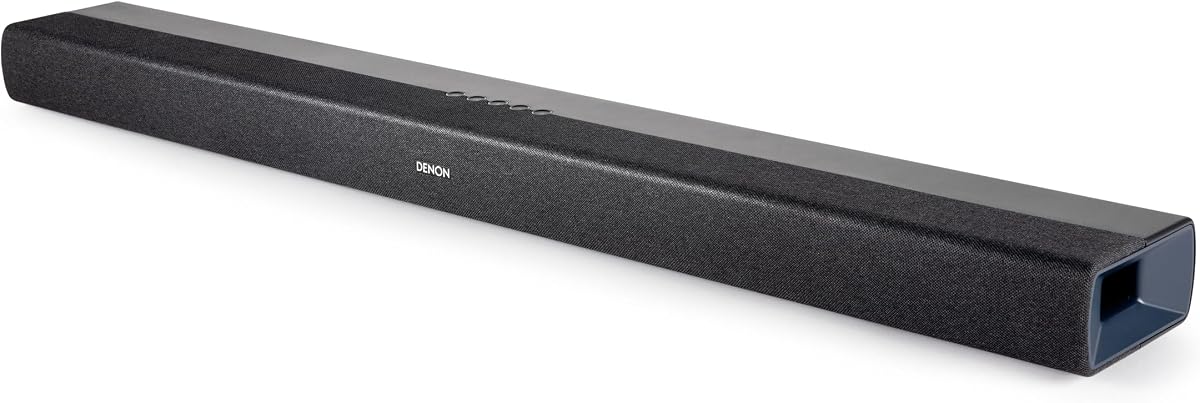
Denon DHT-S218
4.5Editor score
Two down-firing subwoofers
Dolby Atmos support
Dialogue Enhancer
Bluetooth LE multipoint
4K HDMI eARC
Our best soundbar with built in subwoofer guide compares ten models for bass, dialogue, surround sound, connectivity, room fit, and ease of use.
A soundbar with a built-in subwoofer combines dialogue-focused left and right channels with bass reproduction in one housing, reducing cabinet clutter without necessarily sacrificing low-end impact. The strongest models add room-aware processing, virtual surround effects, wireless streaming, and multiple listening modes for movies, shows, sports, music, and games.
This guide compares ten all-in-one soundbars using the information supplied for each model. We consider bass architecture, channel layout, surround and height processing, dialogue enhancement, wired and wireless connections, dimensions, installation requirements, sound modes, and practical extras such as remotes, wall mounting, voice assistants, and room calibration.
The list includes both straightforward 2.0 and 2.1 designs and more elaborate systems that simulate surround sound or integrate with a television. Each review explains the product's strongest benefits, limitations, and ideal setting, helping readers identify the right balance of bass, clarity, connectivity, and physical design for their room.
4.5Editor score

4.4Editor score

4.3Editor score
The comparison below highlights each soundbar's woofer arrangement, surround processing, connectivity, and physical design so buyers can quickly identify a model suited to their television, room, and preferred listening style.


The Samsung HW-B400F is a straightforward 2.0-channel soundbar that places a woofer inside the main cabinet. Its 4.0 rating reflects a simple proposition: clearer television speech, fuller low frequencies than a television speaker, and a wider presentation without requiring a separate subwoofer. It is aimed at viewers who want a cleaner setup rather than a large home theater installation.
We may earn a commission when you buy through this link, at no additional cost to you.
Surround Sound Expansion projects clear audio outward to create a broader listening area, while Voice Enhance mode automatically raises dialogue so voices remain more prominent. The soundbar also supports night-oriented listening by reducing volume and minimizing bass, a useful feature for shared homes or late-night viewing. Its compatibility with a Samsung television remote further reduces the number of controls in the room.
The main limitation is its relatively simple acoustic design. With no stated height channels, advanced room calibration, or wireless surround upgrade in the supplied information, it cannot match the spatial processing offered by more advanced models. The single integrated woofer may also produce less deep or expansive bass than a soundbar with multiple subwoofers or a separate wireless subwoofer.
Despite those limitations, the HW-B400F makes sense for renters, bedroom viewers, and anyone seeking a simple upgrade with fewer cables. It is particularly attractive when the priority is focused speech, modest bass, compact placement, and control through an existing Samsung television remote rather than elaborate surround simulation.
Voice Enhance mode gives the HW-B400F a practical role during news, interviews, and scripted television. Amplifying dialogue can improve intelligibility without requiring listeners to raise the overall volume to the same degree.
Integrating the woofer into the main enclosure keeps the system visually simple. It is a good fit for entertainment centers where a separate floor-standing subwoofer would be inconvenient or visually intrusive.
We may earn a commission when you buy through this link, at no additional cost to you.
The Yamaha SR-B30A is an all-in-one Dolby Atmos soundbar with two built-in subwoofers, and its 4.4 rating reflects a balanced approach to cinematic presentation, music, and television. It offers more spatial ambition than a conventional 2.0 system while preserving the convenience of a single soundbar enclosure.
We may earn a commission when you buy through this link, at no additional cost to you.
Yamaha True Sound works with Dolby Atmos to create a three-dimensional sound field, while Clear Voice technology helps speech remain intelligible beneath music and effects. HDMI eARC or ARC provides a direct television connection and supports uncompressed, high-bitrate audio playback. Bluetooth multipoint also makes it convenient to move between two phones, tablets, or computers for music.
Movie, Stereo, Standard, and Game profiles let listeners choose a suitable starting point for different content. The enclosure can sit on a television console or be mounted using its built-in keyholes. While the SR-B30A cannot offer the rear-speaker expansion possible in some Samsung systems, its virtual surround processing and dual woofers give it a well-rounded feature set for a compact living room.
This is our Editor's Choice because it balances the core qualities most buyers look for: meaningful bass, intelligible dialogue, convincing spatial effects, flexible music performance, and uncomplicated setup. It is especially suitable for anyone who wants a premium single-cabinet sound system but does not need a separate subwoofer or rear-speaker ecosystem.
The dual integrated subwoofers provide a useful foundation for the Yamaha True Sound and Dolby Atmos presentation. This allows the soundbar to convey height and surround cues while remaining visually uncluttered.
Separate Movie, Stereo, Standard, and Game modes make the SR-B30A easy to tailor to different material. Stereo mode in particular offers a more natural starting point for music than a fixed cinematic preset.
We may earn a commission when you buy through this link, at no additional cost to you.
The Bose TV Speaker is a compact all-in-one system designed primarily to make television audio clearer. Its 4.3 rating aligns with a product that emphasizes simplicity, speech intelligibility, and a small footprint rather than large-scale home theater effects. Two angled full-range drivers create a wider presentation than the typical television speaker.
We may earn a commission when you buy through this link, at no additional cost to you.
The enclosure measures just over two inches tall, allowing it to sit in front of a television or fit beneath one in a constrained entertainment area. It can connect through HDMI, optical, or auxiliary input, while Bluetooth allows wireless music and podcast streaming. The included remote provides a dialogue mode and a bass boost for added depth.
Despite the broad search for a soundbar with a built-in subwoofer, this model does not include one. It can be expanded with the Bose Bass Module 500 or 700, but that requires an additional module and the appropriate connection cable. Its spatial effects and channel count are also more modest than those of the Yamaha, Denon, and Samsung models in this guide.
The Bose TV Speaker is a strong choice for a small room, bedroom, or secondary television where dialogue clarity and compact dimensions matter most. It is less appropriate for someone specifically seeking deep integrated bass, height effects, or a cinema-style room-filling presentation.
The angled drivers and dedicated dialogue mode focus on making pronunciation and vocals easier to follow. This makes the speaker useful for viewers who regularly watch news, talk programs, and conventional scripted series.
Although bass is limited at purchase, compatibility with a Bose bass module gives owners an upgrade path. The speaker can therefore serve a smaller space now while remaining adaptable if deeper low-end output is wanted later.
We may earn a commission when you buy through this link, at no additional cost to you.
The TCL S55H 2.1 is a soundbar-and-subwoofer system with a 4.4 rating and a stated power level of up to 220 watts. Unlike the genuinely all-in-one products elsewhere in the guide, it uses a separate wireless subwoofer, allowing bass to be placed independently from the main bar.
We may earn a commission when you buy through this link, at no additional cost to you.
Dolby Atmos and DTS Virtual:X processing create a cinematic presentation, while the wireless subwoofer handles low-frequency effects such as engines, explosions, and music bass. AI Sonic Auto Room Calibration adjusts the output to the layout and listening position through the TCL app. The result is particularly relevant for rooms where freestanding speakers would not be practical.
HDMI eARC and ARC, optical, Bluetooth, and AUX connections give the system broad compatibility with televisions, projectors, phones, and other sources. The low-profile bar is listed at 31.89 inches wide, and the subwoofer is more substantial, measuring 7.68 inches wide by 12.60 inches high and 7.68 inches deep. A remote, HDMI cable, power cord, and wall-mount kit are included.
The separate enclosure gives the S55H stronger low-end potential and more placement flexibility than a built-in woofer, but it also demands more floor space and setup planning. This is a compelling choice for buyers who prioritize bass and room calibration over a completely wire-free-looking single cabinet.
AI Sonic calibration is a meaningful feature in apartments and bedrooms where hard walls or furniture can shape the sound. The one-time setup through the TCL app helps the system account for the room and listening position.
A wireless subwoofer can be moved away from the television cabinet and positioned where low-frequency response is more useful. This flexibility is the principal advantage over a soundbar with a fixed internal woofer.
We may earn a commission when you buy through this link, at no additional cost to you.
The Yamaha SR-B20A is a slim soundbar with two integrated subwoofers and a 4.4 rating. It offers a well-rounded mix of bass, virtual surround processing, dialogue clarity, and convenient Bluetooth operation, making it a logical choice for viewers seeking more capability than a basic 2.0 system without a separate subwoofer.
We may earn a commission when you buy through this link, at no additional cost to you.
DTS Virtual:X gives the system a sense of sound extending around the listener, while Clear Voice enhances dialogue so it remains easier to understand beneath backgrounds and effects. The dual built-in subwoofers add low-frequency weight that should benefit action films, concerts, and gaming. Setup remains approachable through HDMI or optical connections.
Bluetooth supports easy switching between two devices, which is useful for alternating between television content and mobile music. The supplied feature set is more focused than the SR-B30A, however, and the SR-B20A does not list a Dolby Atmos label, room-analysis tools, multiple content presets, or wall-mount provisions in the provided information.
It is best for buyers who want Yamaha's integrated-woofer approach and virtual surround effects in a simple system. Those prioritizing the widest smart integration, explicit height-channel processing, or highly detailed room calibration may find a more advanced model better aligned with their needs.
The SR-B20A combines physically separate subwoofers in one enclosure with DTS Virtual:X processing. That combination helps it produce a fuller low end and a broader sound field than a minimal television upgrade.
HDMI and optical inputs cover common television arrangements, while two-device Bluetooth switching adds everyday flexibility. The included remote reduces the need to navigate every setting through the television itself.
We may earn a commission when you buy through this link, at no additional cost to you.
The Hisense A620 is a 2.1-channel all-in-one soundbar with a visible built-in woofer and a 4.3 rating. Its stated 240-watt output, surround codecs, and broad connection options make it a notably capable entry-level system for viewers who want more features than a basic 2.0 soundbar.
We may earn a commission when you buy through this link, at no additional cost to you.
The integrated 75-by-160-millimeter subwoofer is covered by transparent acrylic, allowing the woofer's vibration to be seen. It supplies low-frequency output without a separate cabinet. Dolby Digital Plus and DTS Virtual:X expand the sound beyond the basic channel layout, while HDMI ARC, AUX, USB, and Bluetooth 5.3 support a variety of entertainment sources.
EzPlay allows the television remote to control the soundbar and can present its settings within the television menu. TV mode is another useful feature, but it depends on a compatible Hisense television decoding Dolby Atmos content and sending that audio to the soundbar. The A620 does not itself claim native Dolby Atmos processing, so understanding that distinction is important.
The result is an attractive option for Hisense television owners and budget-conscious buyers who value visible bass hardware, wireless streaming, physical media access, and easy television integration. It is a particularly well-rounded choice when one cabinet and a modest footprint are priorities.
The transparent window over the woofer gives the A620 a distinctive appearance and makes its bass mechanism visually apparent. More importantly, the integrated design delivers low frequencies without a separate subwoofer taking up floor space.
EzPlay streamlines routine operation by allowing the television remote to handle key soundbar functions. This is particularly useful for Hisense television users who prefer not to manage another remote during everyday viewing.
We may earn a commission when you buy through this link, at no additional cost to you.
The Denon DHT-S218 is a 2.1-channel Dolby Atmos soundbar with two built-in down-firing subwoofers. Its 4.5 rating is the highest among the products supplied, which fits a system that places strong emphasis on cinematic processing, music flexibility, and thoughtful operating modes.
We may earn a commission when you buy through this link, at no additional cost to you.
Dual midrange drivers, tweeters, and down-firing subwoofers form a more elaborate internal array than a basic stereo soundbar. The Denon Dialog Enhancer sharpens speech, while four sound modes—Pure, Movie, Music, and Night—allow the presentation to be adjusted for different content and viewing circumstances. Pure mode disables surround processing and other modifications for a clearer music experience.
Bluetooth LE Audio supports streaming from phones and tablets, and multipoint allows multiple devices to be linked for easier switching. The included cable supports 4K HDMI eARC, which provides a convenient route for television audio and high-resolution sound. The main consideration is that down-firing subwoofers can perform differently depending on cabinet construction and nearby surfaces, so leaving the soundbar on a solid stand is advisable.
This is our Best Premium pick for buyers who want sophisticated audio processing without a separate subwoofer. It is especially well suited to mixed-use households that alternate between movies, music, and daytime television and value equalizer-style flexibility over the most minimal design.
Pure, Movie, Music, and Night modes make the DHT-S218 adaptable rather than locked into one signature tuning. Night mode is useful for shared rooms, while Pure mode gives music a less processed presentation.
Bluetooth LE Audio and multipoint are useful for moving between a phone, tablet, or laptop without repeatedly reconnecting. This adds everyday flexibility to an otherwise television-centered system.
We may earn a commission when you buy through this link, at no additional cost to you.
The Samsung HW-S60D is an ambitious all-in-one soundbar with a five-channel array, built-in subwoofers, Dolby Atmos, and an extensive smart feature set. Its 4.4 rating reflects a system that aims to cover cinema, gaming, streaming, and television integration within one enclosure.
We may earn a commission when you buy through this link, at no additional cost to you.
Its compact internal arrangement uses multiple channels and up-firing speakers to create a broad, elevated presentation. Q-Symphony allows compatible Samsung television speakers to work with the soundbar as a unified system, while SpaceFit Sound Pro analyzes the environment and optimizes the output. Adaptive Sound examines scenes in real time to prioritize important content, and Active Voice Analyzer isolates onscreen voices from room noise.
Wireless Dolby Atmos can reduce cable clutter when used with a compatible television, and built-in Alexa, Chromecast, and AirPlay 2 broaden the system's streaming options. Game Mode Pro automatically activates in sync with a compatible Samsung television and uses the up-firing speakers, acoustic beam, and woofers for a more dimensional gaming presentation.
The trade-off is ecosystem dependence and complexity. Q-Symphony, automatic Game Mode Pro behavior, and some wireless features are most meaningful with compatible Samsung televisions. Buyers outside that ecosystem still gain a capable five-channel system, but should verify the exact television features they plan to use before purchasing.
Adaptive Sound and Active Voice Analyzer work together to emphasize meaningful content. This can make dialogue easier to follow in action-heavy scenes, noisy rooms, and mixed-content viewing.
Game Mode Pro adds sound-field effects and automatic television synchronization, while Alexa, Chromecast, and AirPlay 2 make the S60D useful beyond conventional television audio. Samsung television owners gain the most from the integrated experience.
We may earn a commission when you buy through this link, at no additional cost to you.
The Samsung HW-B550F is a 2.1-channel soundbar with a separate wireless subwoofer and a 4.3 rating. It offers a useful combination of virtual surround effects, automatic sound adaptation, and optional rear-speaker expansion, making it a flexible middle ground for Samsung-oriented home entertainment setups.
We may earn a commission when you buy through this link, at no additional cost to you.
DTS Virtual:X creates a sense of movement around the listener, while the wireless subwoofer supplies bass for music, games, and cinematic effects. A dedicated Bass Boost setting provides additional low-end emphasis, while Adaptive Sound recognizes the content type and adjusts settings to balance clear voices with detailed effects. Voice Enhance mode offers another direct tool for improving speech intelligibility.
The bar can connect wirelessly to optional rear speakers, creating a path toward a more conventional surround configuration. That flexibility distinguishes it from fixed all-in-one designs, although the extra speakers are not part of the standard package. The included wireless subwoofer also requires careful placement to achieve the strongest result in the listening area.
The B550F is a good match for buyers who want the placement freedom of a separate subwoofer but prefer a soundbar-based system. Samsung television users can also benefit from the close integration typical of the brand, while others should confirm compatible television features and accessory requirements.
The optional wireless rear speakers allow the system to grow beyond front-facing and virtual effects. This makes the B550F a practical option for viewers who may want a more physical surround presentation in the future.
Adaptive Sound handles content changes automatically, while Voice Enhance and Bass Boost let listeners make targeted adjustments. Together, these controls offer a balance between convenience and manual control.
We may earn a commission when you buy through this link, at no additional cost to you.
The Samsung HW-C400 is a compact 2.0-channel soundbar that uses two built-in woofers and a sound duct to increase perceived bass impact. Its 4.0 rating makes it a practical choice for viewers who want a clearer and fuller alternative to built-in television speakers without committing to a complex system.
We may earn a commission when you buy through this link, at no additional cost to you.
The sound duct intensifies bass by using air vibration, helping the small enclosure produce a more substantial low end. Dolby Audio and DTS processing create a richer surround impression, even though the underlying configuration remains 2.0. The included remote provides basic control, and the 110-to-240-volt power supply is designed for worldwide use.
Bluetooth supports wireless music streaming, NFC offers a quick connection method with compatible mobile devices, and the integrated USB 2.0 port allows direct playback from a compatible memory device. These features give the HW-C400 more source flexibility than many minimal soundbars, although its options are less advanced than those of the Samsung HW-S60D.
It is most appropriate for a bedroom, office, or compact living room where simple operation and integrated bass are priorities. Listeners seeking extensive height effects, automatic room calibration, rear-speaker expansion, or a very broad soundstage will find other options more suitable.
Two integrated woofers and the sound duct help the HW-C400 deliver more low-frequency presence than a standard television speaker. The design is particularly useful where shelf space is limited and a separate subwoofer is undesirable.
Bluetooth, NFC, and USB playback make the soundbar useful for music as well as television. These options provide convenient ways to stream from compatible devices or play locally stored tracks.
We may earn a commission when you buy through this link, at no additional cost to you.
The right integrated-woofer soundbar depends on room size, television connections, content type, and how much low-end output and spatial processing you actually need. The following factors help narrow the field before comparing individual models.
A built-in woofer can take several forms. Some models use one visible driver, such as the Samsung HW-B400F, while others fit multiple woofers into a wider cabinet, as seen on the Yamaha SR-B30A, Yamaha SR-B20A, Samsung HW-C400, and Denon DHT-S218. Multiple woofers may improve the sense of weight and distribution, although cabinet volume, driver design, and sound processing also influence the final performance. Down-firing drivers need a stable surface beneath the cabinet, while visible side-firing or transparent-covered designs can make their movement more apparent.
Products presented as all-in-one keep the low-frequency drivers within the soundbar enclosure. This is ideal for clean entertainment centers, wall-mounted arrangements, and rooms where a separate subwoofer would be difficult to place. The Samsung HW-B550F and TCL S55H 2.1 fall outside this strict category because their subwoofers are separate, although both use wireless connections and remain visually tidy. A truly integrated design reduces floor space, cable management, and the number of objects competing for attention.
Dialogue enhancement is one of the most useful functions in a modern soundbar. Yamaha Clear Voice, Denon Dialog Enhancer, Samsung Voice Enhance, and the Bose dialogue mode all focus on making speech easier to understand. The effect is especially valuable in films with dense effects, sports broadcasts, news programs, and noisy rooms. Buyers should still consider the underlying speaker design, because processing cannot entirely replace well-balanced left and right channels or proper dialogue-focused tuning.
Virtual surround processing can create the impression of sound extending beyond the cabinet. Yamaha True Sound, DTS Virtual:X, Samsung Surround Sound Expansion, and the Denon's processing all serve this purpose. Dolby Atmos support in the Yamaha SR-B30A, Denon DHT-S218, and Samsung HW-S60D adds a more clearly defined spatial framework. These effects depend on source material and compatible television processing, and they should be viewed as an expansion of the front soundstage rather than a replacement for correctly placed rear speakers.
HDMI eARC or ARC is the preferred connection for modern televisions because it carries compatible digital audio over a single cable and can support advanced formats. Optical is a dependable fallback for older televisions, while auxiliary and Bluetooth provide additional flexibility. The Hisense A620 includes HDMI ARC, AUX, and USB, and the Bose TV Speaker supports HDMI, optical, and auxiliary inputs. Compatibility with the television remote can also simplify operation, although it should not be confused with full HDMI-CEC support.
A compact soundbar is often sufficient for a bedroom, office, or modest living room, while larger cabinets and separate subwoofers can provide greater output in an open-plan area. The Bose TV Speaker is especially compact, whereas the TCL soundbar and its subwoofer require more placement consideration. Down-firing woofers should have an unobstructed, stable surface, and wall-mounted models need enough clearance beneath the cabinet. Placement height and the distance between the soundbar and television also affect perceived dialogue and imaging.
Bluetooth is standard across the list, but Bluetooth multipoint, Bluetooth LE Audio, NFC, Chromecast, and AirPlay 2 add different levels of convenience. Multipoint makes switching between two devices easier, LE Audio is presented as a refined streaming option on the Denon, and Chromecast and AirPlay 2 broaden the Samsung HW-S60D's ecosystem. Built-in voice assistance may be useful for some users, although the supplied information mentions it specifically only for the HW-S60D.
Automatic room calibration can account for furniture, walls, and the listener's position. The TCL S55H 2.1 offers AI Sonic Auto Room Calibration, while the Samsung HW-S60D uses SpaceFit Sound Pro to analyze its environment. Presets such as Yamaha's Movie, Stereo, Standard, and Game profiles and Denon's Pure, Movie, Music, and Night modes make tuning easier. For music listeners, a pure or stereo mode can provide a more natural presentation than a heavily processed cinematic setting.
Begin by identifying the best connection for the television and the room's power outlets. HDMI eARC or ARC is normally the most capable wired option, while optical provides a compatible fallback. If the soundbar supports wireless television audio, use that when cable management is a priority. Place the bar directly below or near the screen, keep the front unobstructed, and allow down-firing subwoofers to rest on a stable surface.
After connecting power and audio, run the manufacturer's recommended setup process. Models with room calibration should be placed in their final positions before calibration begins. Browse the available sound modes, select one appropriate to the current content, and make smaller adjustments to dialogue, bass, and overall level. Avoid repeatedly changing multiple settings, as it becomes difficult to judge which adjustment is responsible for a perceived improvement or problem.
For daily care, remove dust from the cabinet and openings with a soft, dry cloth. Do not use liquid cleaners, solvents, or abrasive materials. Keep the soundbar and subwoofer away from moisture, direct heat, and obstructed ventilation, and avoid placing objects that could press against the drivers. Remote-control batteries should be removed during long periods of nonuse, and all cables should retain enough slack to prevent strain at the connectors.
A built-in subwoofer places its low-frequency drivers inside the soundbar cabinet, creating a single-unit system with less visual clutter. A separate wireless subwoofer gives the bass driver more placement flexibility and may provide a different level of low-end impact. The better choice depends on available space, room acoustics, and whether one compact unit is a priority.
It can create a convincing surround impression, but most such products use processing rather than separate rear speakers. Virtual surround and height effects can place sounds around the listener, though results depend on the content and television processing. A soundbar with optional wireless rear speakers can offer a more physically distributed presentation when needed.
Not necessarily, because dedicated dialogue processing can help even without a separate bass cabinet. The best soundbar for speech should combine clear left and right channels with a dialogue mode, balanced tuning, and sensible volume control. A built-in woofer improves the overall presentation but is not the only factor affecting intelligibility.
HDMI eARC generally offers greater convenience and can support a wider range of high-resolution audio formats, while optical can provide reliable digital audio for compatible televisions. The best choice depends on the soundbar and television ports. If using a separate subwoofer, the audio connection between the bar and television still needs to be checked.
Down-firing drivers should sit on a stable surface with space beneath the cabinet and no immediate obstruction. A solid furniture top is preferable to a hollow shelf because the cabinet can use its resonance. Follow the manufacturer's placement instructions and avoid placing the bar where towels, books, or other objects cover the lower drivers.
Only models that explicitly support wireless rear-speaker expansion can do so. The Samsung HW-S60D and HW-B550F include expansion options in the supplied information, while many other all-in-one models are designed as fixed systems. Compatible rear speakers, power, and any required connection accessories should be confirmed before installation.
A music or stereo mode is usually preferable when the soundbar offers one, because it can reduce the processing designed for films. Yamaha's Stereo profile and Denon's Pure mode are examples of dedicated approaches for music. Hearing preferences vary, so comparing the processed and music-oriented modes is the best way to decide.
Start with the soundbar's dialogue or vocal-enhancement feature, then reduce competing effects and bass if the soundtrack feels crowded. Moderate overall volume is often more effective than excessive volume. For persistent problems, reposition the soundbar nearer the television's screen height and consider adding acoustic treatment to reduce reflections.
The Yamaha SR-B30A is the most balanced choice in this group, combining dual integrated subwoofers, Dolby Atmos, Clear Voice, high-resolution HDMI support, and useful content profiles. The Denon DHT-S218 stands out for refined processing, multiple listening modes, and a high customer rating, while the Hisense A620 delivers the most feature-rich compact alternative for budget-conscious buyers.
Prioritize the qualities you will actually notice. Dialogue-focused listeners should examine vocal enhancement and natural clarity, film viewers should consider surround processing, and bass lovers should compare the number and placement of low-frequency drivers. Room size, television compatibility, and whether you accept a separate subwoofer are equally important to long-term satisfaction.
Before making a final decision, verify the television connections, physical dimensions, included accessories, and expansion options. Product availability and configuration details can change, so checking the current listing ensures that the selected soundbar matches your equipment and available space.