
3-in-1 Hydrogen Inhalation Machine & Hydrogen Water Generator
3.9Editor score
Hydrogen inhalation and infusion
Ultra-pure hydrogen output
Portable vehicle-ready design
Hydrogen water machine guide comparing concentration, capacity, filtration, portability, cycle time, materials, and safety features.
Hydrogen water machines range from compact rechargeable bottles to countertop pitchers and multifunctional generators designed for hydrogen infusion or inhalation. A useful model should do more than create bubbles: it should deliver measurable dissolved hydrogen, operate safely, fit your routine, and be straightforward to clean and maintain.
We compared all ten options by examining stated hydrogen concentration, SPE/PEM technology, water capacity, filtration, cycle times, battery portability, material choices, controls, and maintenance features. The list covers countertop pitchers, personal bottles, an inhalation-and-water generator, and budget-oriented glass models.
Each review identifies the strongest reason to consider the product while noting limitations in its specifications or supplied information. Ratings and specifications can change over time, as can product availability and seller offers, so readers should verify current details before purchasing.
3.9Editor score
4.4Editor score
3.9Editor score
The table below compares the ten featured machines across their format, stated hydrogen output, capacity, and defining technology, making it easier to identify the model that fits your space, mobility needs, and hydration routine.





This 3.6-liter filter pitcher combines hydrogen generation, multi-stage filtration, and UV disinfection in one countertop appliance. It carries a 5.0 rating, the highest listed score in this group, and stands out for people who want more than a portable hydrogen bottle. The combination of a generous reservoir, filtration stages, and cordless operation makes it especially relevant to households and offices.
We may earn a commission when you buy through this link, at no additional cost to you.
Its SPE/PEM system uses dual iridium-platinum membranes and is stated to reach as much as 1300 PPB. The product information also describes filtration for fluoride, chlorine, lead, dirt, harmful metals, odors, microplastics, and PFAS. A UV bulb is included for disinfection, while a 9000mAh battery allows the pitcher to run away from a wall outlet. That makes it more flexible than a conventional plugged-in filter.
The main compromise is its physical size. A 3.6-liter jug needs considerably more counter or refrigerator space than a personal bottle, and its maximum hydrogen concentration is below the figures claimed by several compact models. Its extensive filtration claims also make it important to distinguish the hydrogenation function from contaminant removal, because hydrogen generation does not automatically make unsafe source water safe.
This is the strongest all-around choice for users who prioritize capacity, filtration, and flexible placement. It is less compelling for someone seeking the highest stated concentration or a compact travel format, but it offers the most complete feature combination among the pitchers in this roundup.
Rather than acting only as a hydrogen infuser, this model combines electrolysis, layered filtration, and UV disinfection. That combination makes it useful for families that want one vessel to handle multiple water-preparation tasks throughout the day.
The rechargeable 9000mAh battery allows use in a refrigerator, on an office desk, or around the home without continuous access to an outlet. The large capacity still makes careful placement and regular cleaning important.
We may earn a commission when you buy through this link, at no additional cost to you.
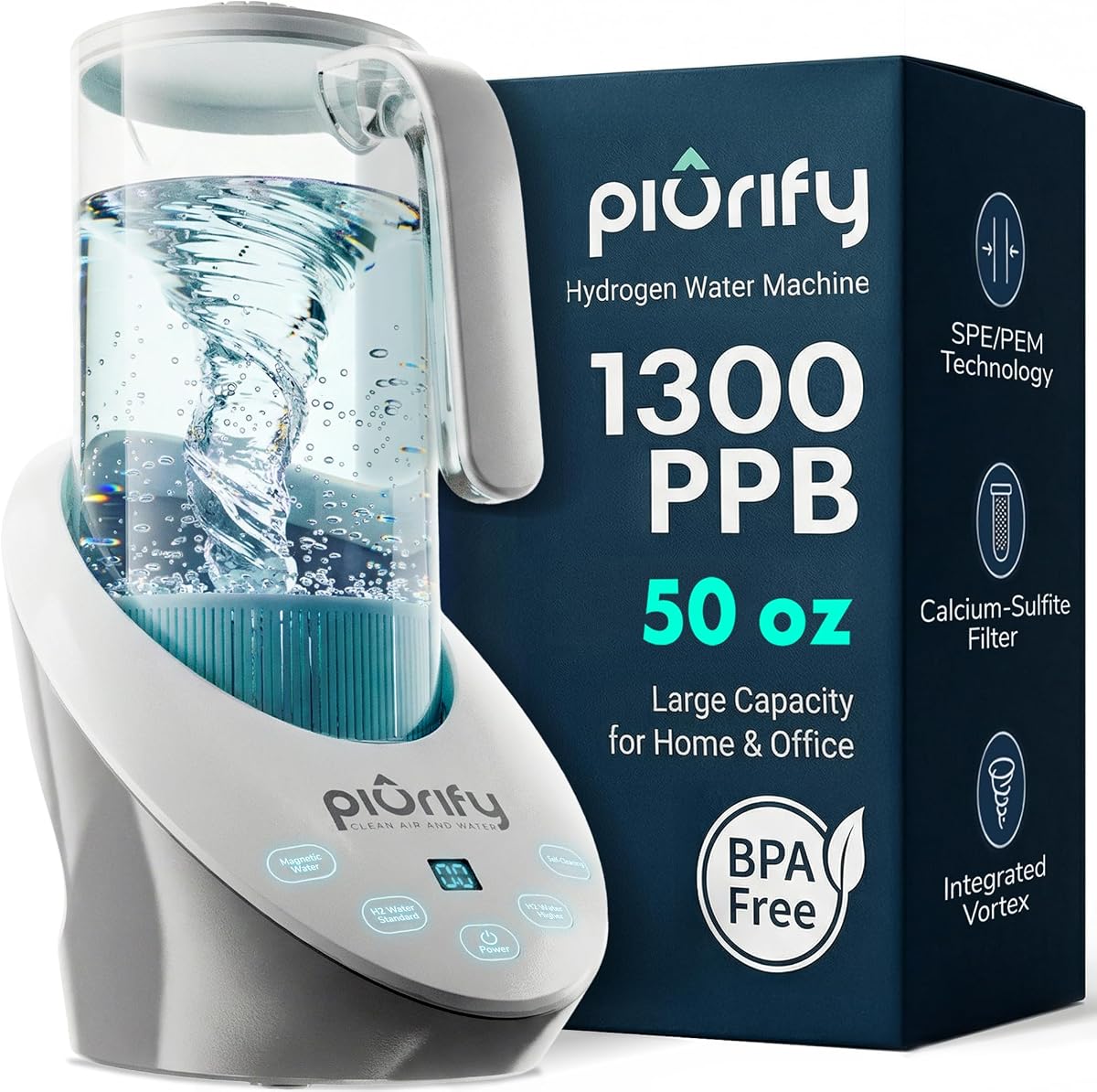
The PIURIFY 3 in 1 is a countertop pitcher that combines hydrogen infusion, a magnetic vortex pre-step, and calcium-sulfite filtration. Its 4.4 rating reflects a strong balance of capacity, control, and specialty features. At 50 ounces, it is smaller than the 3.6-liter pitcher but substantially more practical for a refrigerator door, family table, or shared office space.
We may earn a commission when you buy through this link, at no additional cost to you.
Two hydrogenation cycles offer flexibility. The eight-minute setting is stated to produce 700–900 PPB, while the 13-minute setting reaches 1300 PPB. Hydrogen retention is claimed at up to eight hours. Before electrolysis, the magnetic cycle creates a vortex and routes water through the calcium-sulfite filter, which is intended to reduce chlorine and condition the water for hydrogenation.
It is important to understand the product's intended role. The supplied information explicitly says that it enriches already safe drinking water with dissolved hydrogen and is not a heavy-duty filter. Although it includes calcium-sulfite chlorine filtration, buyers with specific contaminant-removal needs should investigate a dedicated purification system. The maximum cycle also takes longer than the quick modes offered by several personal bottles.
The recommendation is strongest for buyers who want a feature-rich, refrigerator-friendly pitcher rather than the smallest or highest-output device. Its self-cleaning mode, touch controls, quick-swap filter, and stated lifetime warranty improve the ownership proposition, while the three-part design makes it especially interesting to enthusiasts who value the full hydrogenation ritual.
The magnetic vortex, calcium-sulfite filtration, and SPE/PEM electrolysis are designed to work in sequence. This provides a more involved routine than a standard one-button bottle without requiring several separate appliances.
Touch controls, a self-cleaning mode, a replaceable calcium-sulfite filter, and a 50-ounce body make the pitcher practical for offices, families, and anyone who wants to prepare a larger quantity at once.
We may earn a commission when you buy through this link, at no additional cost to you.
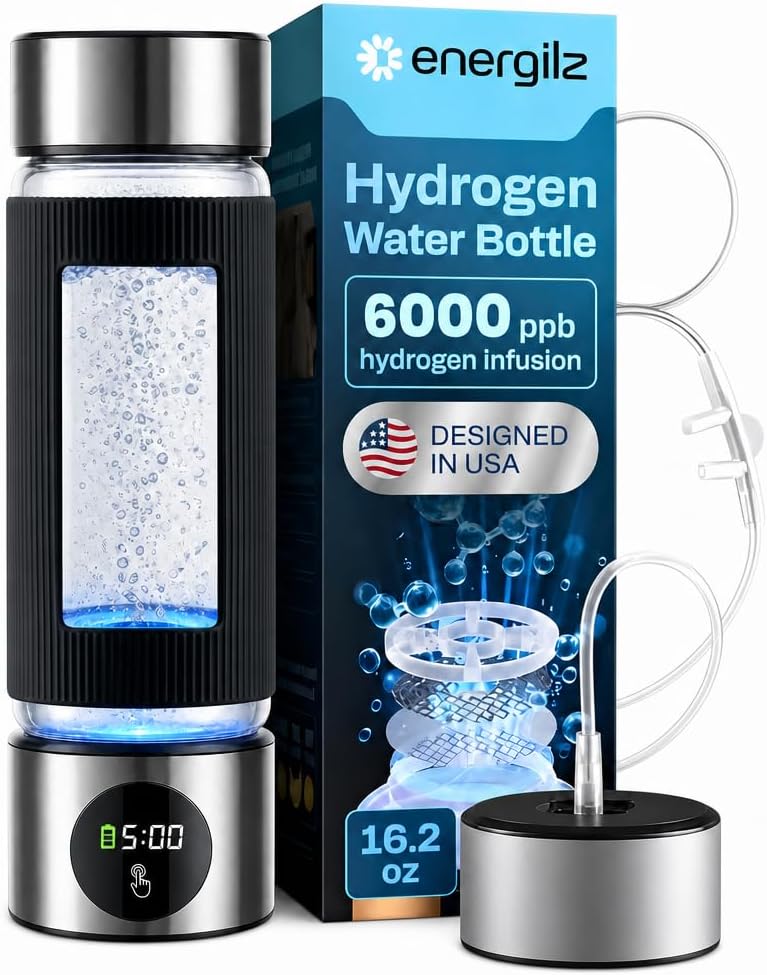
This silver hydrogen bottle combines a 16.2-ounce capacity with a stated output of up to 6000 PPB. Its 4.2 rating places it behind the higher-rated countertop options but ahead of the two models carrying 3.9 ratings. For users who want a relatively compact personal device with a high stated concentration, it remains one of the most relevant picks.
We may earn a commission when you buy through this link, at no additional cost to you.
The machine uses SPE/PEM ionizer technology and is stated to reach 6000 PPB in ten minutes. Its 1200mAh battery supports up to 30 cycles on one charge. A durable silicone cover and dual-sided openings make it suitable for commuting, exercise, and travel, while the bottle format is much easier to carry than the larger pitchers.
There are trade-offs. The 480ml capacity means it cannot generate as much hydrogen-rich water at once as a 50-ounce or 3.6-liter machine. Some of the listing's health and antioxidant comparisons are presented without enough context to evaluate them independently, so the measurable specifications are more useful for comparison. Buyers should also avoid interpreting hydrogen generation as a substitute for safe drinking water.
This bottle is a good fit for people who prioritize portability, a high stated concentration, and simple personal hydration. It is less suitable for households that need to serve multiple people at once. For gym bags, desks, and commutes, however, its rechargeable operation and compact form make it a practical middle ground.
Combining a 6000 PPB stated maximum with a 480ml vessel gives this model a useful balance for people who regularly prepare individual servings away from home.
A battery supporting as many as 30 cycles reduces the need for continuous outlet access. The silicone-covered body should also be kept clean and dry around the charging connection.
We may earn a commission when you buy through this link, at no additional cost to you.
This device combines hydrogen inhalation, water infusion, and hydrogen generation in a portable format. It has a 3.9 rating and is differentiated from every other product here by its 240 mL/min flow rate, Brown's gas option, and stated 99.996% ultra-pure hydrogen output. It is designed for home, travel, and car use, making it the most multifunctional machine in the group.
We may earn a commission when you buy through this link, at no additional cost to you.
Its SPE/PEM system uses DuPont Nafion N117 membranes and platinum electrodes. A nano diffuser rod can infuse hydrogen into water or other liquids at up to 1600 PPB in one to five minutes. The unit also includes a 500ml BPA-free tank, touch display, car adapter, test kits, safety alarms, and a four-hour night mode.
The tradeoff is complexity and responsibility. A machine offering multiple output methods is less like a simple drink bottle and more like equipment that needs correct setup, maintenance, and adherence to its instructions. The supplied information does not describe the complete operating procedure, so prospective users should review the included guides and safety requirements carefully. Its 3.9 rating also suggests less consensus satisfaction than the top-rated models.
Choose this option if inhalation or beverage infusion is central to your interest and you value adaptable output. For ordinary countertop hydration, it offers more capability than most people may need. It earns its place as the specialist, multifunction choice rather than the simplest home pitcher.
The combination of inhalation, water generation, and a nano diffuser gives users more ways to use the machine than conventional bottles. The included test kits and alarms support a more controlled setup.
A car adapter, night mode, touch display, and portable enclosure broaden the intended use environment. Proper ventilation and adherence to the manufacturer's safety guidance remain essential.
We may earn a commission when you buy through this link, at no additional cost to you.
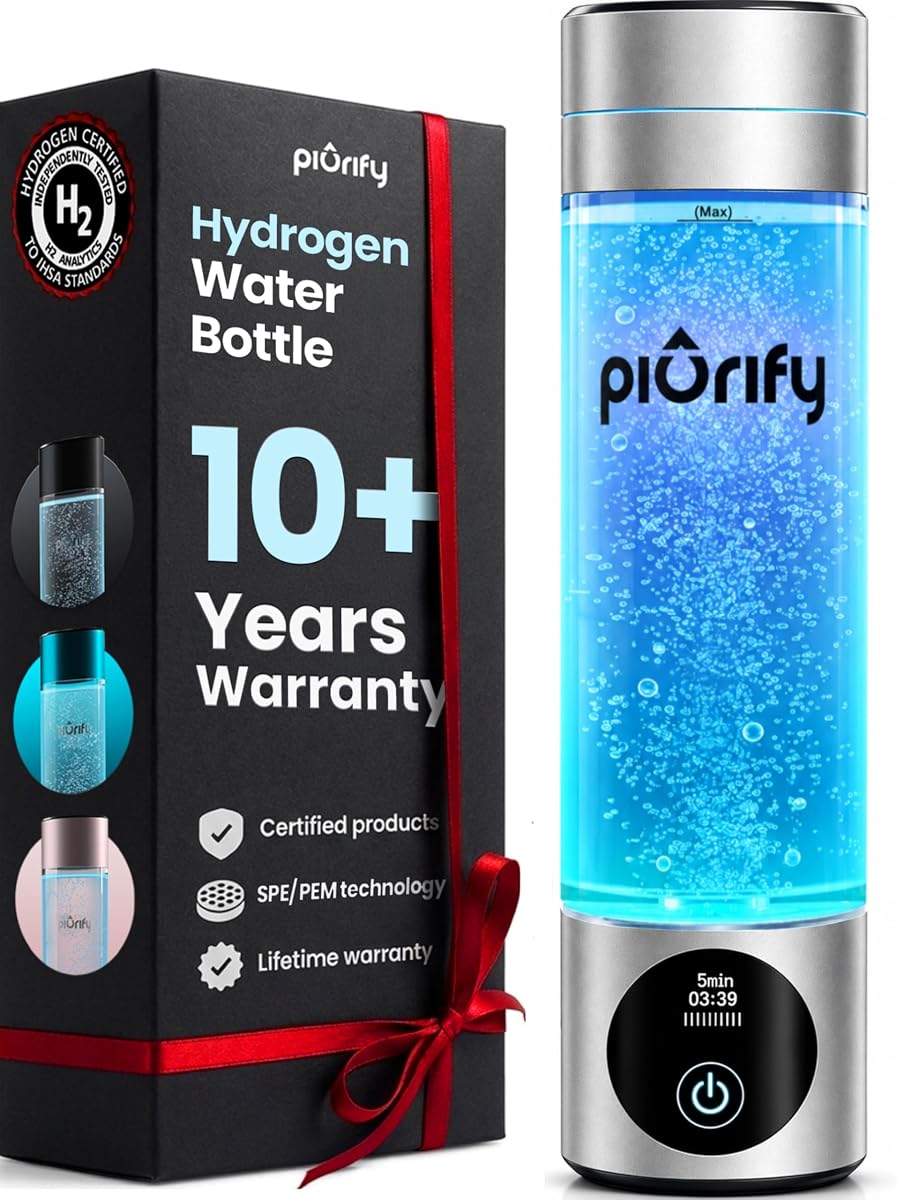
This PIURIFY portable bottle is built around a clear concentration methodology. Its 4.1 rating is supported by details about different cycle lengths and the molecular hydrogen levels associated with each stage. The product information cites third-party certification by H2 Analytics and H2Hubb, making it one of the more transparent listings in the roundup.
We may earn a commission when you buy through this link, at no additional cost to you.
The bottle has five- and 10-minute modes. A five-minute run is stated to reach 2550 PPB, and a 10-minute run is stated to reach 4100+ PPB. Two 10-minute cycles are said to reach 5810 PPB, while three can reach up to 6310 PPB. The listed laboratory-tested range is 2.58–6.30 mg/L dissolved molecular hydrogen.
The body is made from food-grade polycarbonate rather than glass because hydrogen generation creates internal gas and pressure. That is a sensible material choice for a pressurized appliance, though buyers who prefer glass may see it as a drawback. The listing also includes a nasal cannula, although the core product remains a hydrogen water bottle. A visible limitation is that reaching maximum concentration requires repeated longer cycles rather than one short activation.
This is a compelling pick for buyers who prioritize traceable concentration claims, certification references, and a simple fill-and-run routine. It also avoids recurring tablets or chemical refills. The lack of a clearly listed liquid capacity makes it less convenient for direct capacity comparisons, so users should verify that detail before ordering.
The listing breaks concentration down by cycle number and duration, from 2550 PPB in five minutes to as much as 6310 PPB after three ten-minute cycles. That detail helps set realistic expectations.
Citing H2 Analytics and H2Hubb is useful for buyers who want more than a theoretical output claim. Buyers can still confirm the exact certificate details and test conditions in the product documentation.
We may earn a commission when you buy through this link, at no additional cost to you.
The Mirtade 10000+ PPB bottle pairs a 5.0 rating with the highest stated concentration among the portable bottles in this guide. It uses a metal body, an integrated handle, and a 316 stainless steel drinking spout. The result is a rugged-looking personal machine designed for commuting, workouts, camping, and office use.
We may earn a commission when you buy through this link, at no additional cost to you.
Its five-minute mode is stated to reach 7800+ PPB, while the 10-minute mode reaches 10000+ PPB. The SPE/PEM system uses a DuPont membrane and titanium-platinum electrolytic sheet, with claims of zero ozone and zero residual chlorine. An LED screen displays concentration, cycle countdown, and battery status, while a self-cleaning mode is included.
Its most notable compromise is the small 12-ounce volume. Even though concentration is high, users must generate several smaller servings rather than one large jug. The metal construction is also likely less visually lightweight than a glass alternative. As with every hydrogenating appliance, output claims should be considered in the context of the specific test method and actual source water.
This is our pick for a high-output portable bottle, particularly when metal durability and an integrated handle matter. It is less suitable for sharing or for refrigerator pitchers. Buyers who want a portable device with detailed cycle information and a high stated maximum should give this model particular attention.
The stainless steel body and spout distinguish this bottle from plastic-heavy alternatives. The handle and protective spout design support use during travel and exercise.
Live concentration, countdown, and battery information make the machine easier to operate consistently. These displays are particularly useful when comparing short and long generation cycles.
We may earn a commission when you buy through this link, at no additional cost to you.
This PIURIFY listing closely mirrors the brand's other 6300+ PPB portable generators, with a 4.2 rating and clearly stated concentration levels for each cycle. It is especially relevant to buyers who prefer a bottle format and want certification references rather than relying solely on a manufacturer's output figure.
We may earn a commission when you buy through this link, at no additional cost to you.
A five-minute cycle is listed at 2550 PPB and a ten-minute cycle at 4100+ PPB. Repeated ten-minute cycles can raise the stated result to 5810 PPB and then as much as 6310 PPB. The provided laboratory range is 2.58–6.30 mg/L. Its food-grade PC body is designed to tolerate the pressure associated with gas generation more safely than glass.
The main question is how this listing differs from the brand's closely similar models. The supplied information does not identify meaningful differences in capacity, controls, or included accessories, so buyers should compare the current pages carefully for updates. The need to run three cycles for the maximum figure may also be inconvenient when preparing water outside the home.
Choose this version if its current configuration, warranty terms, and availability suit your needs, and if documented concentration matters more than maximum capacity. It is a portable, tablet-free option with a solid 4.2 rating. Those seeking a larger vessel or faster maximum output may be better served by a countertop pitcher or one of the higher-output bottle listings.
The concentration table provides a clear distinction between routine and maximum-output routines. It lets buyers choose a fast personal serving or invest more time when a stronger stated concentration is desired.
Food-grade PC offers a lighter alternative to glass while accommodating internal pressure. The material should still be cleaned according to the manufacturer's instructions.
We may earn a commission when you buy through this link, at no additional cost to you.
This 350ml Tritan bottle is a compact hydrogen generator with an unusually detailed control display. It can reach up to 2000 PPB in three minutes or a stated 12000 PPB in 18 minutes. The product has no listed rating in the supplied data, so it cannot be judged through the same customer-feedback lens as the other nine products.
We may earn a commission when you buy through this link, at no additional cost to you.
Its touchscreen reports live hydrogen concentration in ppb, a countdown timer, and ORP levels. The bottle has a scratch-proof coating, a square sealed lid that can also store small items, and an integrated pressure valve intended to make the lid easier to open. It runs for up to three hours on a charge.
The 18-minute maximum cycle is the main timing drawback, and the instructions specifically warn against repeatedly producing hydrogen without opening the lid. That makes disciplined use important. Its 350ml capacity is also small, and the missing rating leaves buyers with less evidence about long-term customer experiences than they would have with the rated options.
This is an interesting pick for technically minded users who value real-time data and a very high stated maximum concentration. It can produce a quick serving in three minutes, but the impressive headline figure requires a much longer cycle. Verify current instructions and customer feedback before choosing it over a better-reviewed alternative.
Showing concentration, countdown time, and ORP gives users more information than a simple indicator light. These metrics can also make cycle-to-cycle comparisons more transparent.
The three-minute mode is convenient for a quick personal serving, while the 18-minute cycle targets the highest stated output. The pressure valve and lid-opening requirement should be understood before repeated use.
We may earn a commission when you buy through this link, at no additional cost to you.
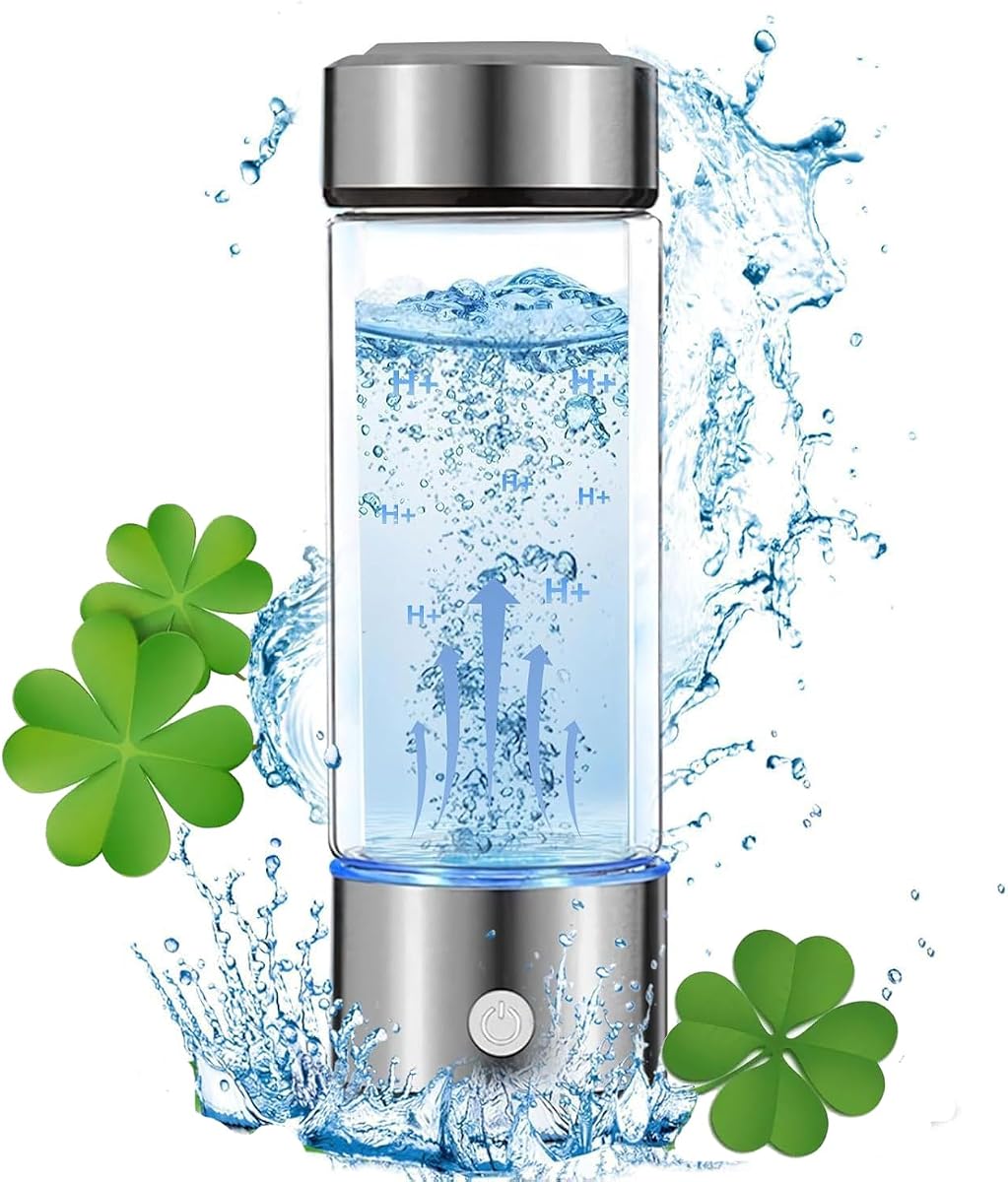
The 420ml borosilicate glass bottle is an approachable hydrogen generator built around uncomplicated operation. Its 3.9 rating ties for the lowest among the rated products, but the feature set makes it a distinct budget option for anyone who values simplicity and a visible drinking vessel over maximum concentration.
We may earn a commission when you buy through this link, at no additional cost to you.
The device uses SPE and PEM ion-membrane technology and is stated to produce 1000–1600 PPB in three minutes. A blue light changes to green when the cycle is complete, after which the bottle shuts off automatically. It has a single-button interface, a non-slip cushion, removable ends, a sealing ring, and an IPX7 waterproof rating.
There are some inconsistencies in the listing. One section says purified and distilled water can be electrolyzed, while a later warm tip says the bottle is not suitable for pure water. It also contains unusually specific performance claims that are not supported by enough context in the supplied data. Buyers should follow the current manual regarding acceptable water and avoid juice, milk, or tea.
This is a practical choice for first-time users, older adults, and anyone who wants uncomplicated one-button operation. Its stated concentration is lower than that of most rechargeable competitors, and glass requires more care around drops and impacts. Within those constraints, it offers a clear, easy-to-follow routine and a compact 420ml capacity.
A single control and automatic shutdown minimize the number of steps. The blue-to-green light provides a clear visual signal when the water is ready.
Removable ends and a sealing ring support routine disassembly and cleaning. Borosilicate glass resists thermal shock better than ordinary glass but remains vulnerable to hard impacts.
We may earn a commission when you buy through this link, at no additional cost to you.
This PIURIFY hydrogen bottle combines a 4.2 rating with a stated maximum concentration of 6310 PPB. Like the brand's closely related bottles in this guide, it emphasizes cycle-by-cycle concentration figures, third-party certification references, and a simple operating sequence. It is designed for use at home, at work, at the gym, or while traveling.
We may earn a commission when you buy through this link, at no additional cost to you.
The five-minute cycle is stated to produce 2550 PPB, and the 10-minute cycle 4100+ PPB. Two ten-minute cycles can reach 5810 PPB, while three can reach up to 6310 PPB. The stated laboratory range is 2.58–6.30 mg/L, and the listing identifies H2 Analytics and H2Hubb as third-party certifiers.
Its food-grade PC construction is designed to handle internal gas and pressure, while the bottle eliminates powders, tablets, and subscription refills. The drawback is that maximum concentration requires several long cycles, and no liquid capacity appears in the supplied information. Since several PIURIFY listings have similar names and features, shoppers should compare the current configuration and included accessories carefully.
This bottle is a good fit for a user who values verifiable concentration details and wants hydrogen water prepared on demand without consumable tablets. It is less suited to buyers seeking a large serving, the very shortest operating time, or a fully specified capacity. Subject to those limitations, it is a solid portable option.
The combination of stated third-party testing and cycle-specific concentrations makes the product easier to evaluate than listings that provide only a headline figure.
The machine prepares hydrogen-rich water directly from suitable drinking water, avoiding recurring tablets or powders. Users should still use safe drinking water and follow cleaning instructions.
We may earn a commission when you buy through this link, at no additional cost to you.
The right hydrogen water machine depends on where you will use it, how much water you need, and how much effort you want to devote to operation. The following factors help narrow the field without treating any single advertised specification as a guarantee of performance.
Choose the format that matches your routine rather than the one with the largest headline number.
Compact and generous models serve fundamentally different needs.
Compare like-for-like cycle conditions and test methods, not just maximum PPB.
Detailed concentration documentation is more useful than a single headline.
SPE/PEM is common, but electrode and membrane details reveal more about the design.
Never substitute hydrogen generation for proper water purification.
Separate hydrogen enrichment from genuine contaminant removal.
Check filter type, replacement needs, and certification for your specific water concerns.
Capacity is useful only when it matches the way you hydrate.
For travel, prioritize size and weight; for households, prioritize serving volume.
Compare expected cycles, not battery capacity alone.
Plan charging around your longest period away from an outlet.
Choose materials based on pressure, portability, and cleaning preferences.
A good seal and easy-to-clean drinking contact surfaces matter every day.
Read the pressure, lid, and cleaning instructions before first use.
A self-cleaning cycle is convenient, but regular manual maintenance remains necessary.
Begin by reading the manual and confirming that the machine is compatible with the water you intend to use. Clean the interior components according to the manufacturer's instructions, remove any maintenance covers where required, and perform an initial rinse if directed. Use safe drinking water, fill only to the marked maximum, and never operate the electrolysis system with an empty chamber. This is especially important for models whose listings explicitly warn against generating hydrogen without liquid.
Secure the lid and sealing ring, connect the charger if necessary, and select the appropriate cycle. Some models use a short mode for routine preparation, while longer or repeated cycles target their highest stated concentration. Watch the indicator lights, countdown, or display rather than interrupting the cycle early. After completion, release pressure as directed and open the lid before starting another cycle. Avoid adding juice, milk, tea, or other substances unless the manufacturer explicitly permits them.
After drinking, empty the remaining water and wash the bottle, lid, spout, filter, and other accessible components with mild dish soap and clean water. Run the self-cleaning cycle where available, but still inspect areas that automated programs may not reach. Allow all parts to dry before reassembly or storage. Store the machine away from heat, inspect seals for damage, and replace filters or wear parts according to the supplied instructions. If a leak, unusual smell, corrosion, display error, or pressure problem appears, stop using the device and contact the manufacturer.
A hydrogen water machine uses electrolysis to introduce molecular hydrogen into water. Most models in this guide use SPE/PEM technology, which separates hydrogen and oxygen during the process. The device may also include filtration, UV disinfection, magnetic vortex preparation, or inhalation functions. Hydrogen water is different from alkaline water: the pH and hydrogen concentration are separate properties, and a machine labeled hydrogen-rich should not automatically be described as a pH-changing appliance.
Not necessarily. A higher stated PPB figure may require a longer cycle or several repeated cycles, and results can depend on the test method and source water. Buyers should compare capacity, cycle duration, retention, ease of cleaning, safety features, and verified concentration data alongside the maximum number. A documented 6000 PPB routine may be more practical for daily use than an unreachable headline figure.
Generally, no. Hydrogen generation enriches water with dissolved molecular hydrogen but does not automatically remove lead, microbes, PFAS, microplastics, or other contaminants. Some featured models include filtration or UV features, but the PIURIFY 3 in 1 explicitly says it is not a heavy-duty filter. Use safe drinking water or pair the machine with a certified purifier appropriate to the contaminants you need to address.
Portable models are designed for travel, provided the lid is secure and the device is protected from impact, heat, and moisture. Do not generate hydrogen without liquid, and do not repeat a cycle without opening the lid when the instructions require it. A padded carrying case and a full battery are helpful for commuters or travelers using a compact model.
A countertop pitcher generally offers the most practical serving volume. The 3.6-liter filter pitcher is the largest model here and includes filtration and UV disinfection, while the 50-ounce PIURIFY 3 in 1 offers hydrogenation, vortex preparation, and chlorine reduction in a more refrigerator-friendly body. Both require enough counter or refrigerator space and regular cleaning.
Clean it after every use or at least before leaving standing water in the chamber, according to the manufacturer's instructions. Rinse the drinking surface and removable components regularly, run a self-cleaning cycle if one is included, and dry everything thoroughly. Filters and wear components should be replaced on the stated schedule, while a full service may be needed if there is residue, odor, leakage, or inconsistent performance.
Hydrogen gradually escapes from water, especially when it is exposed to air, warmth, or agitation. The PIURIFY 3 in 1 states retention of up to eight hours, but real-world retention varies with container design, temperature, and handling. Use clean lids and store containers as directed. If freshness matters, prepare smaller batches and drink them relatively soon after generation.
Glass offers visibility and is easy to inspect, but it is more vulnerable to impacts and may be unsuitable where substantial internal pressure is expected. Polycarbonate is lighter and can be safer for a gas-generation chamber. Stainless steel is durable and easy to clean around a metal spout but may add weight. Choose based on portability, impact risk, cleaning preferences, and the manufacturer's construction guidance rather than material alone.
The PIURIFY 3 in 1 stands out as the most complete countertop option because it combines a 50-ounce pitcher, two hydrogenation cycles, magnetic vortex preparation, calcium-sulfite filtration, touch controls, and a self-cleaning mode. The larger Hydrogen Water Filter Pitcher is the strongest alternative when filtration, UV disinfection, and family-sized capacity matter more than maximum concentration.
Among portable options, the Mirtade model is the standout for its stated 10000+ PPB output, metal construction, LED readouts, and ergonomic handle. The PIURIFY 6300+ PPB bottles are better choices when documented cycle levels and third-party certification references are priorities, while the 420ml glass bottle serves buyers who value one-button simplicity. Prioritize safe operation, manageable cycle time, actual capacity, cleaning convenience, and documented concentration over isolated headline claims.
Ratings, specifications, product configurations, and availability may change, so confirm the current listing and manufacturer instructions before ordering. Compare the selected machine with your source water, the amount you drink, and the spaces where it will be used. Current offers can also change, making it useful to check live retailer details and customer feedback at the time of purchase.