
SUPVAN T50M Pro
4.5Editor score
Phone and tablet app editing
Supports three-quarter-inch media
Free creative design assets
A barcode label printer turns numbers, product names, and shipping information into organized, scannable labels for warehouses, retail counters, home offices, and shipping spaces. The right model balances print width, speed, connectivity, label compatibility, software, and physical design, making it far more useful than a basic printer with a long feature list.
We compared ten barcode label printers using the supplied specifications, focusing on practical factors such as supported media width, thermal print technology, USB or Bluetooth connectivity, app support, template creation, calibration, and intended workload. The list covers compact mobile choices, flexible desktop models, and higher-capacity professional units for more demanding operations.
Each product reveals a different approach to barcode labeling, from broad-width desktop output to portable phone connectivity and app-driven design. Ratings and product details can change over time, as can seller offers and promotions, so readers should verify current specifications, compatibility, and availability before making a purchase.
4.5Editor score

4.3Editor score

4.7Editor score
As an Amazon Associate we earn from qualifying purchases.
The table below compares all ten printers by core format, maximum supported media width, connection method, and standout capability, making it easier to identify the model that matches a particular labeling workflow.




The iDPRT SP310 is a desktop thermal printer aimed at users who need more label width than a conventional two-inch model can provide. Its 4.0 rating reflects a capable package centered on a 25mm to 85mm media range, 203DPI resolution, and a rated print speed of four inches per second. That combination makes it relevant to inventory, fulfillment, office, and small-business labeling tasks.
We may earn a commission when you buy through this link, at no additional cost to you.
The most notable feature is its support for labels up to 3.35 inches wide. It can handle file folders, mailing materials, UPC barcodes, FBA box barcodes, SKU tags, envelopes, and return addresses without restricting users to narrow item labels. An open media system also avoids proprietary microchip roll limitations, giving operators more flexibility when selecting compatible third-party thermal labels.
Its smart sensors can learn label size and gap boundaries after a manual one-touch calibration when media changes. Dedicated drivers support Windows, macOS, Linux, ChromeOS, and Raspberry Pi, while the HereLabel design application supports bulk imports, serialized inventory barcodes, and custom templates without a subscription fee. These are meaningful workflow features, but the fixed USB connection keeps the printer tied to a workstation.
The SP310 is best for businesses that routinely work with medium-to-wide labels and need dependable throughput without moving to a large industrial system. It is less suitable for people seeking a pocketable Bluetooth printer or effortless compatibility without driver installation, yet its width, calibration, and free design tools make it a strong general-purpose desktop choice.
The 3.35-inch maximum width gives this printer useful flexibility for shipping documents, product packaging, file folders, and larger inventory tags. That broader range sets it apart from the many two-inch alternatives in this roundup.
Automatic media learning reduces setup time when changing rolls, while bulk-file import and serialized barcode generation help turn the printer into a repeatable production tool rather than a one-off label device.
We may earn a commission when you buy through this link, at no additional cost to you.
The SUPVAN T50M Pro is a Bluetooth label maker designed around approachable mobile design. Its 4.5 rating is the second highest among the products here, reflecting a favorable balance of creative tools, straightforward operation, and support for labels between three-quarters of an inch and two inches wide. It is especially useful for organizing homes, classrooms, offices, and small retail spaces.
We may earn a commission when you buy through this link, at no additional cost to you.
The companion app allows users to add images from a phone, tablet, or computer and then customize labels using more than 30 fonts, over 50 frames, and more than 660 icons at no additional cost. Automatic label-size recognition further reduces setup friction, while the inkless thermal format keeps the device simple to operate and suitable for frequently changing projects.
Its media compatibility is impressively broad for a compact label maker, covering square, round, address, cable, jewelry, and file labels. The trade-off is that the two-inch maximum width and mobile-first design do not target large shipping-label workflows. Users seeking a dedicated production barcode printer may therefore find a desktop model more appropriate.
For shoppers who want attractive labels without committing to a complex desktop setup, the T50M Pro is an excellent entry point. It combines a substantial free asset library, simple Bluetooth operation, and compatibility with numerous everyday label formats, making it a particularly approachable choice for personal organization and light small-business use.
The app's large selection of fonts, frames, and icons allows users to build more distinctive labels without a paid design tier. It also removes the need to register an account before starting a project.
Support for square, round, address, cable, jewelry, and file labels makes one printer adaptable to many organization systems. This variety is particularly valuable for home inventories, classroom materials, and boutique packaging.
We may earn a commission when you buy through this link, at no additional cost to you.
The CLABEL 221D Bluetooth is a compact two-inch thermal printer intended for small retailers and other businesses that print item-level labels near a counter, shelf, or stockroom. It carries a 4.1 rating and supports both wired Windows workflows and wireless iOS or Android phone workflows, making it a flexible choice for different operating environments.
We may earn a commission when you buy through this link, at no additional cost to you.
Direct thermal printing at 203DPI produces barcodes, QR codes, and address stickers without ink or toner. The open media approach avoids RFID-chip restrictions and brand locks, so users can select compatible universal thermal rolls rather than being tied to one proprietary system. The Clabel trade app includes templates for retail, office, and small-business tasks and allows custom layouts to be saved for repeated jobs.
Connection choice is the model's defining practical feature. USB supports higher-volume back-office work on a Windows PC, while Bluetooth enables label design and printing from a phone at the point of use. The limitations are important: it is intended for item labels rather than four-by-six shipping labels or receipts, and the supplied information explicitly excludes tablet and POS-system compatibility.
This printer suits a small business that wants scannable retail, clothing, jewelry, bakery, gift, or folder labels and values freedom in media selection. Buyers needing full-size shipping labels should choose a wider model, while those who need tablet or point-of-sale integration should verify an alternative's supported platforms before ordering.
USB provides a dependable route for batch printing from a Windows computer, while Bluetooth supports phone-based work away from the desk. This dual approach adapts to both back-office and counter-side labeling habits.
The absence of RFID or brand-authentication restrictions gives users more freedom in roll selection. At 203DPI, the model is suited to crisp barcodes, QR codes, price tags, and other compact item labels.
We may earn a commission when you buy through this link, at no additional cost to you.
The Phomemo M110 is a portable Bluetooth thermal printer whose integrated display gives it a clear identity among conventional app-driven label makers. Its 4.3 rating reflects a versatile design with a 20mm to 50mm width range, mobile templates, custom layout options, Excel batch printing, and optical character recognition.
We may earn a commission when you buy through this link, at no additional cost to you.
The display is especially useful because it gives users immediate visual feedback while labels are being prepared. Bluetooth 4.0 has a stated range of up to 33 feet, and one-click connection is designed to make the printer convenient for moving around a home, school, office, or commercial workspace. It supports clothing, price, cable, jewelry, school, address, and folder labels.
Its app can import spreadsheet data for batch printing and use OCR to recognize text from images in about four seconds, converting photographed wording into editable text. Some templates, icons, and fonts marked with a diamond symbol are exclusive to paid members, although unmarked options are free. The M110 also cannot handle shipping labels or color printing, so buyers should treat it as a specialized item-labeling device.
The M110 is a compelling recommendation for anyone who values portability, quick setup, and more control at the point of label creation. It suits small retailers, teachers, craft sellers, and home organizers who want to move between locations. Buyers who require a broad app library without any paid features may prefer the SUPVAN T50M Pro instead.
The built-in screen is a meaningful convenience in a portable printer, allowing users to check content and layout without relying entirely on a phone display. It also helps the device feel more self-contained during everyday use.
OCR turns photographed text into editable content, which can save time when recreating labels from signs or printed materials. Excel batch printing adds a more efficient path for repetitive product and inventory tasks.
We may earn a commission when you buy through this link, at no additional cost to you.
The DYMO LabelWriter 550 Series focuses on a simple alternative to sheet-label printing: continuous direct thermal labels in dedicated Dymo formats. Its 3.6 rating is the lowest in this group, but the product remains a distinct option for users who value automatic recognition, low waste, and a straightforward relationship between label dimensions and output.
We may earn a commission when you buy through this link, at no additional cost to you.
Automatic recognition helps the printer identify compatible media, while the continuous-label approach eliminates the need to feed individual sheets. As a direct thermal device, it requires no ink or toner. The supplied information notes that the printer works only with authentic Dymo LabelWriter labels, which are described as BPA-free and made from FSC-certified material.
That proprietary media requirement is the central trade-off. Many open-system competitors in this roundup can use standard thermal rolls, giving buyers more freedom to choose supplies. The DYMO system may appeal to users who want fewer configuration decisions and a tightly integrated label format rather than a general-purpose roll-handling platform.
The LabelWriter 550 is best for home offices, small workspaces, and organizations already committed to Dymo supplies who want neat, low-waste labels. Those who can find compatible standard media and prioritize lower ongoing consumable restrictions should look toward an open-system model such as the CLABEL 221D or iDPRT SP310.
Printing exact quantities from continuous media can reduce the unused portions that accumulate with sheet labels. Automatic recognition also makes matching the correct Dymo media format more straightforward.
Authentic Dymo labels provide consistency but remove the ability to use arbitrary third-party rolls. Buyers should include this requirement in their decision rather than comparing only print speed or design features.
We may earn a commission when you buy through this link, at no additional cost to you.
The CLABEL 221D Desktop is a compact two-inch thermal printer aimed at offices, home businesses, inventory tasks, and users who want more application support than a simple mobile label maker. Its 4.0 rating reflects a practical package with a lightweight enclosure, open consumable support, and an app that handles multiple content types.
We may earn a commission when you buy through this link, at no additional cost to you.
Its compact construction does not occupy much desk space, and the manufacturer reports a setup process that takes less than five minutes: download the software, install it, connect the printer, and power it on. The Clabel trade app includes 11 font styles, more than 58 templates, over 300 icons, barcode and QR code support, Excel printing, and options for images, graphics, and tables.
The printer accepts self-adhesive labels from 20mm to 50mm wide and 15mm to 150mm high. Because it can use existing rolls from other brands, owners are not restricted to proprietary media. The trade-off is that the supplied information emphasizes a desktop setup and does not describe wireless phone connectivity for this version.
This is a strong fit for a small business that wants a compact, dependable unit for price tags, product identifiers, inventory records, and office materials. It offers more design flexibility than a basic label maker, although buyers needing mobile flexibility should examine the CLABEL 221B or the Bluetooth 221D instead.
The app's extensive template and icon library makes it suitable for more than plain text labels. Barcode, QR code, spreadsheet, image, and table options give users several ways to build a consistent daily workflow.
Supporting existing thermal rolls from other brands means users can reuse suitable media and avoid proprietary purchasing constraints. The physical design is also small enough to move between workspaces as needs change.
We may earn a commission when you buy through this link, at no additional cost to you.
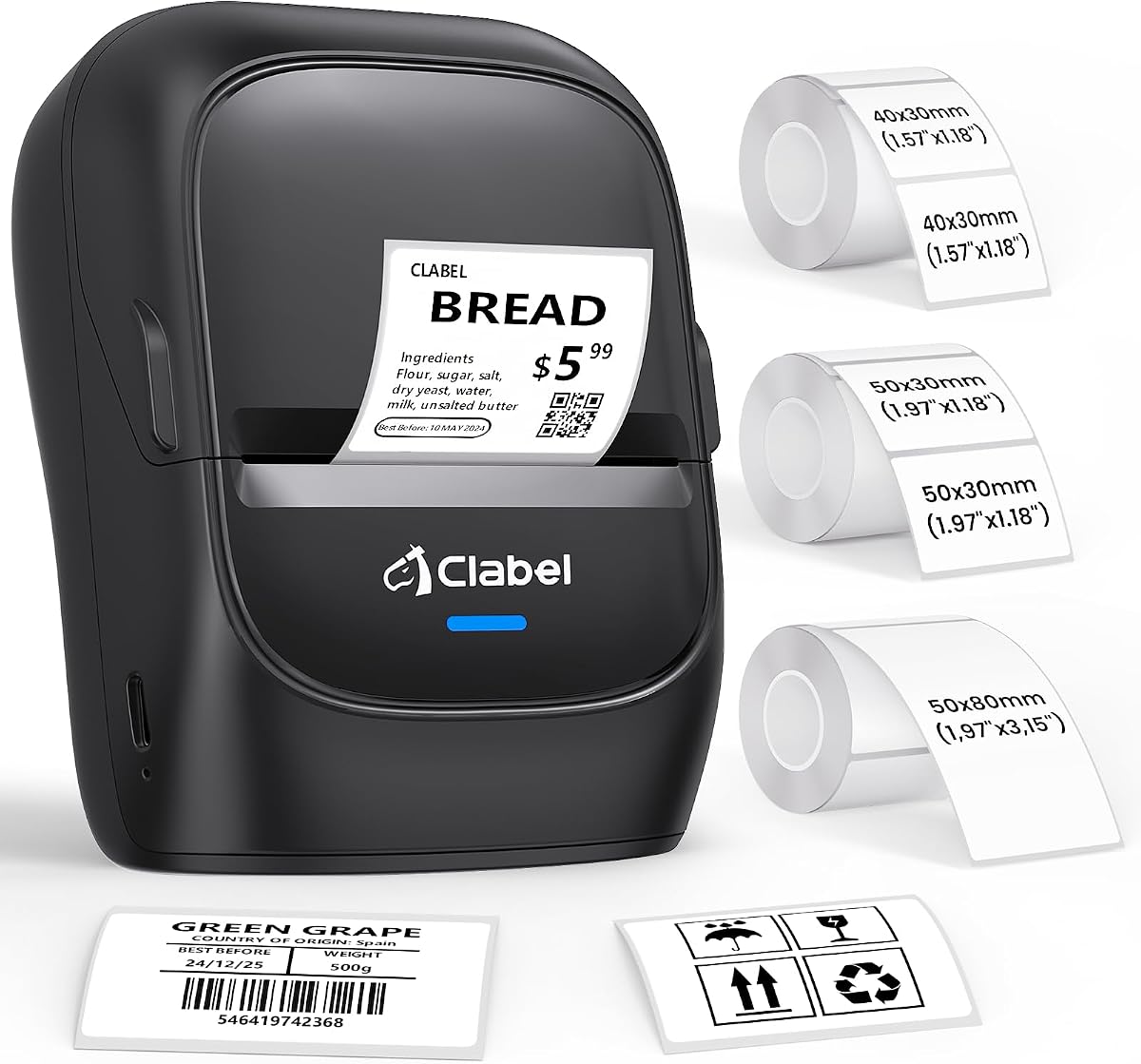
The CLABEL 221B is a two-inch Bluetooth thermal printer designed for people who want to begin labeling quickly. Its 4.3 rating, inclusion of three label rolls, and straightforward open-connect-print setup make it a convenient option for small businesses, retail counters, bakeries, warehouses, offices, and home organization.
We may earn a commission when you buy through this link, at no additional cost to you.
The printer supports standard thermal rolls without RFID chips or brand authentication, so users are not forced into proprietary paper. Through the Clabel trade app, it offers templates, icons, fonts, Excel batch printing, and image-to-text functions. Bluetooth connection to Android and iOS smartphones supports wireless work away from a desk, while USB is available for computer use.
Its supplied labels are described as waterproof, oil-proof, and resistant to friction and scratches, making them suitable for environments such as kitchens and retail shelves. The printer does not support iPad, however, and the two-inch width does not suit oversized shipping labels. These restrictions are manageable when the planned use involves product tags and compact identifiers.
The 221B is a good recommendation for a new small business that wants both a usable starter media package and freedom to buy additional standard rolls later. It is less appropriate for tablet-heavy workflows or organizations that require wide shipping labels, but for item-level wireless labeling it is balanced and approachable.
Three included rolls allow users to print immediately and test different label sizes or formats. Additional standard thermal rolls can be added without facing RFID or brand-lock restrictions.
The matched labels are described as waterproof, oil-proof, and highly resistant to friction and scratches. Those qualities are useful for retail shelves, packaged goods, and food-related environments.
We may earn a commission when you buy through this link, at no additional cost to you.
The ZP450 Zebra is a direct thermal desktop printer with a 4.7 rating, making it the highest-rated model in this roundup. It is built for shipping and receiving areas, offices, retail settings, and other low-volume label-production environments that value reliable wired connectivity and a rugged, compact enclosure.
We may earn a commission when you buy through this link, at no additional cost to you.
It prints at up to five inches per second with 203DPI resolution, providing useful throughput for warehouse receipts, shipping labels, office identifiers, and retail tagging. Parallel, USB, and serial connections give integrators more ways to connect the printer than the USB-only designs in this group. Direct thermal technology eliminates ribbons and toner, while fixed media width supports economical, consistent output.
The double-walled construction is intended to withstand daily work environments without occupying the footprint of a much larger printer. Its label compatibility covers formats such as UPS and FedEx labels. On the other hand, there is no wireless interface, and users focused on phone-based design should look at one of the Bluetooth models instead.
The ZP450 earns the premium recommendation for buyers who want fast output, professional connectivity, and durable construction in a desktop package. It is especially suitable for organizations with existing USB, serial, or parallel infrastructure and a steady need for shipping, receiving, or inventory labels rather than occasional mobile projects.
USB, serial, and parallel interfaces make the printer adaptable to older and newer workstation arrangements. That flexibility is especially relevant in offices and warehouses that already have established equipment.
A rated speed of five inches per second helps reduce waiting during recurring shipping, receiving, and labeling runs. The double-walled housing adds durability without requiring an industrial-scale footprint.
We may earn a commission when you buy through this link, at no additional cost to you.
The CLABEL 2 Inch Desktop is a dual-mode thermal label printer for small businesses that want both batch output from Windows and wireless printing from a phone. Its 4.0 rating accompanies a straightforward set of item-labeling features, including 203DPI output, open media support, templates, saved layouts, and flexible connectivity.
We may earn a commission when you buy through this link, at no additional cost to you.
USB supports high-volume batch work at a desk, while Bluetooth connects with iOS and Android phones for design and printing near a counter, shelf, or stockroom. The Clabel trade app is intended to get users to a first label quickly and provides ready-made templates for common business uses. It also supports editing, saving, and batch printing to reduce repetitive data entry.
The device produces barcodes, QR codes, and address stickers without ink, toner, or cartridges, while the lack of RFID or brand-authentication chips allows use of compatible 25mm to 50mm thermal paper. Limitations include the absence of support for four-by-six shipping labels, receipt rolls, tablets, and POS systems.
This printer is well suited to price tags, clothing hang tags, return addresses, jewelry labels, bakery freshness dates, folders, bins, ingredient tags, gifts, and similar item-level tasks. It is a flexible choice for a business willing to work from a phone or Windows computer, but not for shipping-label specialists or tablet-based retail integration.
The combination of Bluetooth and USB allows the same printer to move between phone-based counter work and computer-based batch jobs. This is useful for teams that do not want separate mobile and desktop devices.
Ready-made layouts and saved custom designs shorten repetitive setup. Users can focus on changing label content rather than rebuilding a layout for every product, bin, package, or shelf.
We may earn a commission when you buy through this link, at no additional cost to you.
The iDPRT iD880 is an entry-level industrial thermal printer that brings wide media support and high print speed to a professional desktop setting. Its 4.1 rating reflects a capable specification set, including labels from one to 4.64 inches wide, 203DPI resolution, and a rated speed of six inches per second.
We may earn a commission when you buy through this link, at no additional cost to you.
It accepts one-inch core media rolls up to five inches in diameter and 4.25 inches wide, allowing it to handle shipping and address labels, barcodes, name tags, wristbands, receipts, and inventory materials. Direct thermal operation avoids ribbons and inks, while the included power adapter, power cord, USB cable, and quick-start guide support a straightforward initial setup.
The removable and reinstallable print head is designed to simplify maintenance and reduce downtime. Memory of 32MB DDR3 RAM and 128MB flash provides room for data-intensive jobs, while drivers can be obtained through a manual QR code or the iDPRT support site for Windows, Mac, and Linux environments. The printer remains wired, so it does not offer the phone mobility of several competitors.
The iD880 suits retailers, offices, small businesses, and professional workgroups that want broad label compatibility and rapid output without moving to a full-size production system. It is a particularly strong fit when shipping, inventory, and varied media formats all need to be handled from one desktop printer.
Support for media up to 4.64 inches wide, combined with a six-inch-per-second rated speed, lets one printer cover several labeling formats. That makes it useful for businesses that do not want a separate device for each media width.
A print head that can be removed and reinstalled simplifies routine service and may help limit downtime. Generous RAM and flash storage also support more complex, data-intensive printing tasks.
We may earn a commission when you buy through this link, at no additional cost to you.
The right barcode label printer depends on media width, label volume, workflow, and connection method. Review these factors before choosing a model so its capabilities align with the labels and devices you actually use.
Begin with the physical size of the labels you expect to print. Compact item-label users may be satisfied with a one-inch or two-inch model, while shipping materials, wide folders, and inventory packaging can require three to nearly five inches of media width. The iDPRT SP310 supports up to 3.35 inches, and the iDPRT iD880 extends to 4.64 inches, giving them an advantage over the many two-inch alternatives.
Choose a width that comfortably fits your media rather than one that merely reaches the limit. A narrow printer may produce excellent labels but force you to split wider information across multiple prints.
Most of the models in this guide use 203DPI direct thermal output, which is appropriate for common barcodes, QR codes, prices, and identification labels. Faster models can improve throughput during large fulfillment or inventory runs. The ZP450 is rated at five inches per second, while the iDPRT iD880 reaches six inches per second; the iDPRT SP310 is rated at four inches per second.
Match speed to the size of your jobs. A high output rate helps with repetitive work, while smaller projects may prioritize portability or design features over maximum throughput.
USB is generally the most consistent option for a fixed workstation and often works naturally with desktop operating systems and business software. Bluetooth allows phone-based design and printing near shelves, counters, or storage areas. The CLABEL 221D Bluetooth, CLABEL 221B, and CLABEL 2 Inch Desktop offer both USB and Bluetooth, while the ZP450 adds serial and parallel options.
Check operating-system and device support carefully. Some Bluetooth models exclude tablets or POS systems, and the Phomemo M110 uses Bluetooth rather than a USB printing connection.
Open media systems let you use compatible standard thermal rolls instead of relying on rolls with RFID chips or brand authentication. That flexibility can simplify sourcing and make the printer easier to adapt to different label formats. The iDPRT SP310, iDPRT iD880, and the featured CLABEL models support third-party media, whereas the DYMO LabelWriter 550 works only with authentic Dymo labels.
Confirm both roll compatibility and the desired label dimensions. A printer that accepts standard rolls is more flexible, but it still needs media with the correct width, gap, and feed configuration.
The best barcode label printer should make it easy to build and repeat a layout. The SUPVAN T50M Pro offers a large free library of fonts, frames, and icons. The Phomemo M110 supports custom templates, Excel batch printing, and OCR. CLABEL models provide saved layouts, reusable business templates, barcode and QR functions, and spreadsheet support. The iDPRT SP310 includes free design software for Windows and macOS.
Look for the features your workflow actually needs. A rich app is less valuable if it lacks the connection method, export format, or spreadsheet integration required by your team.
Occasional home organization calls for a compact model with an approachable app, while a busy counter may benefit from saved layouts, batch printing, and faster media handling. Warehouses, shipping areas, and professional workgroups should pay closer attention to speed, durability, media width, and wired reliability. The ZP450's double-walled housing and the iDPRT iD880's removable print head are particularly relevant to recurring use.
Do not overpay for industrial capacity if your labels are occasional, but do not choose a lightweight mobile model for a high-volume fixed workload. A stable desktop unit usually creates a more efficient long-term workflow.
Automatic or assisted calibration can reduce failed prints when changing media. The iDPRT SP310 includes intelligent label-size and gap detection with a one-touch calibration process. The DYMO LabelWriter 550 provides automatic label recognition. The iDPRT iD880's removable print head simplifies service, while the Phomemo M110 includes a pre-installed test roll for initial setup.
Plan for routine care as well. Keep the print path clean, use the intended media, install current drivers, and confirm that a replacement roll is loaded in the correct orientation.
A printer can offer excellent features and still be unsuitable if it cannot connect to the devices in your workflow. Verify Windows, macOS, Linux, iOS, and Android support where relevant. Several CLABEL products explicitly exclude tablet and POS-system compatibility, while the iDPRT SP310 requires platform-specific drivers even though it supports several major desktop systems. The Phomemo M110 also marks selected app assets for paid members.
Review restrictions before purchasing, especially in stores, warehouses, and offices with established systems. A compatible driver, app, and connection method matter more than an isolated specification.
Start by confirming the printer's supported media width, roll orientation, and connection method. Install the current driver or pairing app, connect the unit, and print a short test label before loading a large job. For thermal models, ensure the roll turns in the correct direction and that the printable surface faces the print head.
Design the label in the supplied or recommended software, then use a template whenever possible. Import data from a spreadsheet for repetitive inventory, SKU, or address tasks, and confirm the barcode or QR code scans before producing the complete batch. Test one label after every media change to verify alignment, spacing, and orientation.
Care for the printer by keeping the print head and media path free of adhesive residue and debris, and by handling thermal paper along the edges. Store unused rolls in a cool, dry environment away from direct heat and sunlight. If output fades, smears, or skips, pause the job and check the media surface, roll position, and calibration before changing settings.
It depends on the media width and intended use. Several two-inch models in this guide are specifically limited to item labels and exclude four-by-six shipping labels or receipts. The iDPRT SP310 and iDPRT iD880 support broader label ranges, while the ZP450 handles various shipping formats. Check the maximum width, core size, and label dimensions before choosing a shipping-focused printer.
No. Direct thermal printing creates images using heat-sensitive media, so the featured models do not require ink, toner, or ribbons. The result can depend on the thermal label's surface quality, storage conditions, and exposure to heat, so compatible media still matters.
No, even when a printer supports an open media system. The roll must match the supported width, gap or continuous-feed configuration, core size, and printable surface orientation. The iDPRT SP310, iDPRT iD880, and CLABEL models are more flexible about brands, while the DYMO LabelWriter 550 explicitly requires authentic Dymo labels.
It depends on where labels are created and printed. USB is often preferable for high-volume batch work from a Windows computer, while Bluetooth helps with phone-based printing near a counter, shelf, or stockroom. Models such as the CLABEL 221D Bluetooth, CLABEL 221B, and CLABEL 2 Inch Desktop support both approaches.
Yes, several models explicitly support QR code printing. The CLABEL 221D Bluetooth, CLABEL 221D Desktop, and CLABEL 2 Inch Desktop list QR functionality, while the iDPRT SP310 and iDPRT iD880 support barcode output for shipping, address, and inventory uses. Always scan a test code before printing a large batch.
Calibration teaches the printer where the media begins, ends, and where gaps appear so it can feed and position labels correctly. It is especially important after changing rolls or label sizes. The iDPRT SP310 offers intelligent size and gap detection, while the DYMO LabelWriter 550 provides automatic label recognition.
Most models in this guide are designed to work with an app for layout creation, barcode generation, images, icons, and saved templates. Some also support desktop drivers, including the iDPRT SP310 and iDPRT iD880 for Windows, macOS, and Linux in appropriate configurations. Check which software and operating systems are included before installation.
For most item-level work, yes. A two-inch printer can handle price tags, clothing labels, jewelry stickers, folder labels, barcodes, and compact return addresses. Wider media is more important for large shipping labels, wide file folders, or oversized packaging, so buyers should compare the physical labels they plan to use before settling on a two-inch model.
The SUPVAN T50M Pro stands out as the most approachable budget choice, with free creative assets, a generous app, and broad everyday label compatibility. The Phomemo M110 adds portability, a useful integrated display, and productivity features such as OCR and Excel batch printing, while the ZP450 Zebra leads the group for fast wired output, professional connectivity, and durable construction.
The right priorities depend on the job. Choose a wide, fast desktop printer for shipping and inventory; a Bluetooth model for phone-based counter work; an open-media system for flexible roll selection; and app features that match recurring layouts. For occasional labeling, simplicity may matter more than maximum throughput, while regular business use rewards saved templates, dependable media handling, and compatible drivers.
Ratings, seller availability, software behavior, and promotional offers can change, so buyers should verify the current product page and latest setup requirements before ordering. The most important final check is that the printer's width, connection method, media rules, and intended workload all align with the labels you expect to create.