
Jin&Bao Garage Door Bottom Rubber Seal 16FT
4.4Editor score
Fits standard 5/16-inch tracks
Includes two extra end plugs
Tool-free sliding installation
A garage door seal creates a barrier between the moving door and the floor, helping limit drafts, rain, snow, dust, leaves, insects, and unwanted noise. The right product depends heavily on your door’s track profile, bottom configuration, opening width, and the surface where it will be installed.
We compared ten seals using the information supplied for each product, focusing on compatibility, sealing design, material, dimensions, installation method, and stated temperature performance. The list covers adhesive threshold strips, rubber weather stripping for standard T-tracks, a single-track option, and a heavier-duty aluminum-track system.
Each pick highlights a different practical advantage, from broad temperature tolerance to simple adhesive installation and noise-reducing dual seals. Ratings reflect the supplied customer feedback, while availability and prices can change, so confirm the dimensions, track type, and current product details before buying.
4.4Editor score

4.6Editor score

4.4Editor score
As an Amazon Associate we earn from qualifying purchases.
The comparison below organizes all ten products by their most important attributes, including length, seal profile, installation approach, and stated operating range. It makes it easier to identify a product that matches your garage door before investigating the fuller reviews.


The Jin&Bao Universal Garage Door Threshold Seal 20FT combines a generous 20-foot length with an adhesive-mounted rubber construction, making it a strong all-around choice for a typical residential garage. Its supplied rating is 4.6 out of 5, reflecting generally favorable customer feedback. The product is intended to keep water, wind-driven rain, snow, dust, dirt, and leaves from entering beneath the door.
We may earn a commission when you buy through this link, at no additional cost to you.
One of its most useful features is versatility. The 3.7-inch-wide, 0.6-inch-high strip can be installed on concrete, asphalt, painted, or treated surfaces. Its serrated grooved base is designed to support adhesion, while the included yellow safety strip makes the threshold easier for people entering and leaving the garage to notice. Anti-slip ridges are also intended to reduce slipping risk.
The stated temperature range of minus 40°F to 284°F is among the broadest in this comparison, and the product description says the material is designed to resist cracking, drying out, breaking, or shifting when properly installed. The strip can be cut to fit shorter openings, and the package includes two tubes of adhesive along with the 20-foot seal. The tradeoff is that this is a threshold-mounted solution rather than a seal designed to slide into an existing T-track.
This is an especially good recommendation for homeowners who want a straightforward repair without changing the door’s track, especially if the floor is reasonably even and clean. Measure the opening before ordering, inspect the floor for moisture or loose material, and follow the included installation guidance carefully. For those seeking a visible, long-lasting threshold barrier, it offers an effective balance of coverage, flexibility, and installation simplicity.
The flexible rubber strip forms a physical barrier against wind-driven rain, snow, dust, and leaves. Its broad base is intended to remain in contact with the floor, helping reduce gaps that commonly form along the bottom edge of a garage door.
The included adhesive and grooved base make this suitable for a do-it-yourself repair on compatible surfaces. The seal can also be trimmed to the opening, which adds flexibility when the floor length is shorter than the full strip.
We may earn a commission when you buy through this link, at no additional cost to you.
The Jin&Bao Garage Door Bottom Rubber Seal 5/16-Inch T-End 16FT is an economical replacement for homeowners whose garage doors use a standard 5/16-inch T-track. It carries a supplied rating of 4.4 out of 5 and uses a U-shaped, O-ring-assisted design intended to create an airtight and watertight barrier. Two extra end plugs are included for closing the strip’s ends.
We may earn a commission when you buy through this link, at no additional cost to you.
Its installation process is refreshingly straightforward. The seal slides into the track without screws or special tools, and the product description recommends soapy water to help the rubber move smoothly. It can be trimmed for a more exact fit, making it useful when the opening does not correspond precisely to a factory-length package. The dual-seal profile also helps limit the movement of wind, rain, dust, dirt, and leaves beneath the door.
A useful secondary benefit is quieter operation. The flexible rubber is designed to absorb vibration and impact during door movement, reducing the noise created when a door closes against the floor. It can also accommodate minor surface unevenness while maintaining contact with the door. The stated working range is minus 40°F to 240°F, and the material includes UV and ozone stabilization intended to limit yellowing, hardening, and heat cracking.
This seal is best for people who want a straightforward replacement strip for a compatible residential or mainstream garage-door track. It is less suitable for single-channel doors, unusual bottom brackets, or tracks that do not accept a 5/16-inch T-end. Check the track cross-section, remove debris from the channel, and use lubrication during installation. For a practical, no-fuss repair, it is an attractive budget-conscious choice.
The U-shape and O-ring construction creates two sealing lines rather than relying on a single flat gasket. Supplied end plugs close the internal channel and help the finished installation present a more complete barrier at the edges.
Because the strip slides into a compatible track, replacing an old seal does not require drilling or permanent fasteners. Cleaning the channel and applying soapy water can make installation smoother and reduce the chance of snagging.
We may earn a commission when you buy through this link, at no additional cost to you.
The Jin&Bao Garage Door Bottom Seal 16FT Heavy Duty Aluminum Track Weatherstrip is the most structurally substantial option in this guide because it combines a 16-foot rubber seal with five aluminum T-track pieces. Its supplied rating is 4.4 out of 5. The system is designed for garage doors with a 5/16-inch T-end and a recommended 3.75-inch width, including many steel and wood roll-up doors.
We may earn a commission when you buy through this link, at no additional cost to you.
The aluminum rails are oxidized to resist rust and discoloration, while their pre-drilled holes simplify attachment to the bottom of the door. Once the rails are secured, the sealing strip installs into the rail assembly. This creates a more substantial repair than a simple sliding weather strip and gives the installer control over the final position of the seal.
The rubber portion uses a U-and-O combination profile intended to block wind-driven rain, snow, dust, dirt, and leaves. Its stated operating range is minus 40°F to 240°F, and the product description describes the components as waterproof and moisture-resistant. The package includes five aluminum T-tracks, one 16-foot universal seal, and 28 screws, so the core hardware needed for the stated installation is supplied.
The primary limitation is compatibility. For steel roll-up doors, the bottom of the garage door must be flat to accommodate this system. It also requires screw installation rather than a simple push-in or adhesive process. Nevertheless, it is a strong premium recommendation for a homeowner who wants a reinforced, adjustable, screw-mounted bottom seal and has a compatible steel or wood door.
The included rails create a more secure mounting structure than a loose rubber strip alone. Their pre-drilled holes and oxidized finish support repeatable installation and help protect the metal from rust and discoloration.
The universal seal can be cut to suit the door width, while the separate rail pieces allow the installation to be adjusted. Confirm that the door has a flat bottom and that its existing T-end dimensions match the stated requirements.
We may earn a commission when you buy through this link, at no additional cost to you.
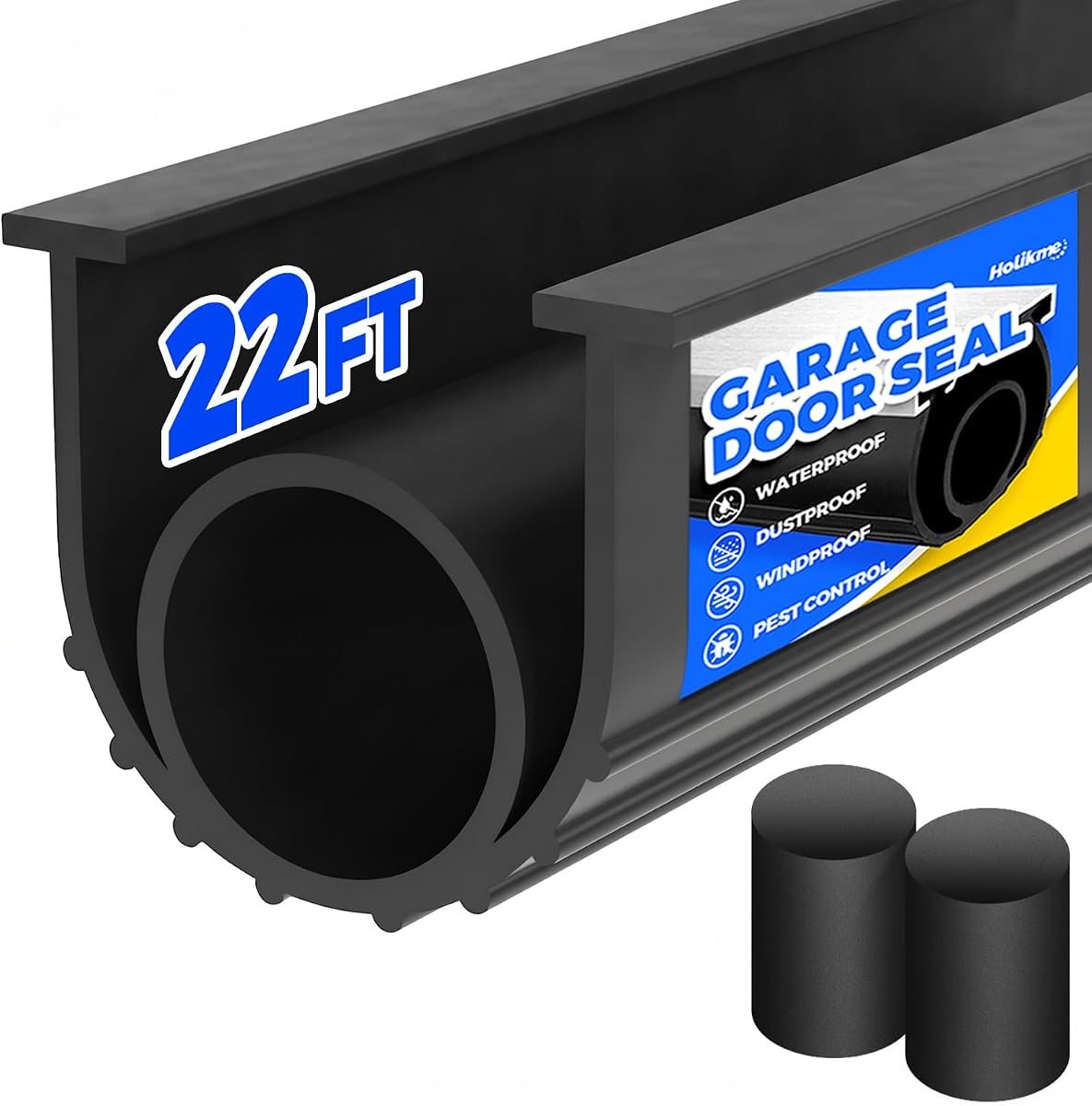
The Holikme Garage Door Bottom Seal 22Ft stands out for its long 22-foot length, making it a practical option for wider garage doors or installations that benefit from extra material for trimming. It has a supplied rating of 4.5 out of 5 and is constructed from high-density EPDM rubber with a 5/16-inch double T-end profile designed for many residential and commercial T-track systems.
We may earn a commission when you buy through this link, at no additional cost to you.
Its U-shaped construction and O-ring create dual layers intended to resist moisture and air movement. Custom-fit rubber end plugs close the center channel and help prevent the strip from shifting in the track. The material is described as resistant to ozone, sunlight, cracking, tearing, and fading, with a stated flexibility range of minus 40°F to 240°F.
Installation uses a standard sliding method rather than permanent fasteners. The product guidance recommends clearing debris from the old track and applying soapy water or silicone spray to reduce friction as the new seal is fed into the channel. It can be measured, trimmed, and cut with scissors or a knife for a custom fit. Importantly, the listing explicitly states that metal tracks are not included.
This product is best for owners of compatible double T-track doors who want extra length and robust EPDM construction. It is not a direct fit for single-channel doors, and the absence of included tracks means buyers should inspect the existing bottom bracket and rail before ordering. With the correct track and some basic care during installation, the 22-foot strip provides ample material and a solid weather barrier.
EPDM rubber is presented as a durable, flexible material that resists cracking, fading, tearing, and ozone exposure. That combination is useful in garages exposed to both strong sunlight and freezing conditions.
At 22 feet, this is the longest seal listed in the comparison. The additional length gives installers room to trim around obstacles and align the strip precisely, although the final cut still needs to match the door and track.
We may earn a commission when you buy through this link, at no additional cost to you.
The Jin&Bao Black Garage Door Threshold Seal 16FT is an adhesive-mounted alternative to track inserts, with a supplied rating of 4.6 out of 5. Its 16-foot length, 3.7-inch width, and 0.6-inch height make it a common-size threshold barrier for residential garage doors. One tube of adhesive is included, and the product description says instructions are provided.
We may earn a commission when you buy through this link, at no additional cost to you.
The flexible rubber is designed to resist cracking, drying out, breaking, and shifting when properly installed. It can be used on concrete, asphalt, painted, or treated surfaces, which broadens the range of garages where it can be used. The design also includes anti-slip ridges and a serrated base intended to promote adhesion to both the door and floor.
Weather protection focuses on water, wind-driven rain, snow, dust, dirt, and leaves. Its flexible profile can help close a small gap beneath a garage door without requiring changes to the track. The stated operating range of minus 40°F to 284°F provides useful reassurance for garages exposed to severe seasonal temperatures, provided the strip is installed as directed.
The principal consideration is that adhesive installation depends heavily on surface preparation. Dust, oil, moisture, and loose flooring can prevent a durable bond, while rough or uneven surfaces may create gaps. This is a good choice for a clean, stable floor and a straightforward threshold repair, but buyers should be prepared to buy additional adhesive if the included tube does not cover the full installation area.
The listed use on concrete, asphalt, painted, and treated surfaces gives this threshold seal flexibility across many garage layouts. The surface still needs to be clean, dry, and structurally sound for the adhesive to perform properly.
Anti-slip ridges are intended to improve footing for people crossing the threshold. The base design also supports sealant adhesion, making the physical shape more important than a simple flat strip.
We may earn a commission when you buy through this link, at no additional cost to you.
The DGSL Garage Door Bottom Seal 16FT is a basic track-mounted option for a 5/16-inch T-channel garage door. It has a supplied rating of 4.2 out of 5 and uses a U-shape combined with an O-ring structure for its weatherproofing design. As with many replacement strips, the main appeal is a simple repair that does not require permanent fasteners.
We may earn a commission when you buy through this link, at no additional cost to you.
The waterproof rubber is flexible enough to trim as needed for a closer fit at the floor threshold. Installation is described as requiring neither screws nor nails, allowing the strip to be worked into the existing track. The dual-rubber design is also presented as a dustproof insulation solution that can reduce noise, while creating a tighter barrier for both interior and exterior garage doors.
Its stated operating range of minus 40°F to 140°F is narrower than that of many EPDM options in this guide. It therefore makes the most sense in climates where the garage and surrounding weather are unlikely to expose the rubber to the upper end of the range. The material is also described simply as flexible and long-lasting, without the same level of detail about UV or ozone stabilization provided for some competitors.
This DGSL strip is a sensible choice for owners seeking a replaceable 5/16-inch T-end seal with a simple installation process. It may be less attractive for hot-weather regions, garages with unusual tracks, or buyers who want a stated temperature range approaching 240°F. Measure the opening, inspect the track, and trim carefully for the best seal.
The product slides into a compatible T-channel and can be trimmed to fit. This makes it useful when the objective is to replace tired weather stripping without modifying the garage door or floor.
The flexible dual-rubber design is intended to soften closing contact and limit the passage of drafts. A complete seal around the opening can also support a quieter, more comfortable garage interior.
We may earn a commission when you buy through this link, at no additional cost to you.
The Jin&Bao Universal Garage Door Threshold Seal Strip 20FT Kit is a complete threshold-focused repair package with a 20-foot rubber strip and two adhesives. Its supplied rating is 4.6 out of 5. The dimensions are listed as 3.7 inches wide and 0.6 inches high, making it directly comparable with the longer adhesive seal in the same range.
We may earn a commission when you buy through this link, at no additional cost to you.
The product is designed to block water, wind-driven rain, snow, dust, dirt, and leaves. Its stated temperature performance extends from minus 40°F to 284°F, while the flexible rubber is described as resistant to cracking, drying out, breaking, or shifting when properly installed. The 20-foot length can be cut to suit the garage opening, and the separate adhesive tubes give the installer more material than a one-adhesive kit.
The physical design includes anti-slip ridges and a serrated grooved base intended to support a secure bond. The product can be used on concrete, asphalt, painted, or treated surfaces, broadening its usefulness for both new installations and replacements. Instructions are included, and the product description emphasizes that installation can be completed without specialized equipment.
Choose this option if you prefer an adhesive threshold seal and want enough adhesive supplied for a larger opening. It is not a substitute for a seal that slides into the bottom T-track, and its performance depends on cleaning and preparing the surface thoroughly. For owners of a compatible door and floor, the kit provides the essential components in one purchase.
The kit includes two adhesive tubes, which can be helpful when the seal spans a broad opening. Extra adhesive also allows the installer to reinforce both ends or address a section that needs additional attention.
The listed minus 40°F to 284°F range is a notable feature of this threshold system. The rubber remains intended to protect against both cold-season snow and warm-weather wind-driven rain without being changed seasonally.
We may earn a commission when you buy through this link, at no additional cost to you.
The 16.5FT Garage Door Seals Bottom Rubber is built specifically for single-channel garage doors. It has a supplied rating of 4.2 out of 5 and uses a triangular EPDM profile with a 0.2-inch endpoint. The product listing clearly warns that it is not suitable for double-channel doors, which makes compatibility verification especially important before purchase.
We may earn a commission when you buy through this link, at no additional cost to you.
The seal is intended to protect against wind, rain, snow, and dust by forming a tight barrier with the door. EPDM rubber is described as resistant to cracking and fading, with a stated temperature range of minus 40°F to 240°F. It can be used on sliding doors, flush doors, wood doors, steel doors, and other garage-door types, provided they use the correct single-track configuration.
Installation normally involves cleaning the track and feeding the seal into its slot without screws or nails. The guidance notes that a warped or uneven seal can be softened with hot water or a hair dryer, and soapy water can be used to lubricate the track. That flexibility can help when a replacement strip has been stored in a compressed shape.
This is a focused recommendation rather than a universal solution. It is appropriate for a single-track door that measures 16.5 feet wide or smaller, and it offers a useful wide temperature range. It should not be considered for double-channel systems, and buyers should compare the triangular shape and endpoint with the old seal before ordering.
The triangular shape is tailored for a single slot and should create a narrow, close-fitting seal. Confirm the door’s track design and the old seal’s cross-section before purchase to avoid a mismatch.
A slightly distorted strip can be warmed in hot water or with a hair dryer before installation. This method is suggested to help the rubber assume a straighter shape as it enters the channel.
We may earn a commission when you buy through this link, at no additional cost to you.
The Jin&Bao Garage Door Bottom Seal 16FT Heavy Duty Aluminum Track Weatherstrip offers a robust solution for owners who want to replace the complete bottom-seal assembly rather than insert a loose strip. It has a supplied rating of 4.4 out of 5 and combines a 16-foot U-and-O rubber seal with an aluminum mounting system.
We may earn a commission when you buy through this link, at no additional cost to you.
The package includes five aluminum T-track pieces, one 16-foot universal seal, and 28 screws. The rails have pre-drilled holes, allowing them to be attached directly to the bottom of the garage door. Once mounted, the flexible seal is fitted into the rails and excess material can be cut to match the door’s length. This creates an adjustable arrangement that can accommodate a range of widths.
The rails are oxidized to help prevent rust and discoloration, while the rubber is described as waterproof and moisture-resistant. The U-and-O design blocks wind-driven rain, snow, dust, dirt, and leaves, and its stated temperature range is minus 40°F to 240°F. The system is recommended for steel or wood roll-up doors with a 5/16-inch T-end and 3.75-inch width.
The key requirement is a flat door bottom, especially on steel roll-up doors. The product cannot accommodate a deeply contoured bottom in the same way some flexible insert seals might. If the door and dimensions match, the reinforced construction makes this a durable option with a more permanent installation method than adhesive or sliding strips.
Pre-drilled aluminum rails give the seal a defined mounting surface and allow precise positioning. The supplied screws and separate rail pieces make the system especially useful for a full bottom-brace replacement.
Oxidized aluminum helps protect the rails from rust, while the rubber strip creates the flexible sealing line. Together they target moisture, airborne debris, and drafts beneath compatible roll-up doors.
We may earn a commission when you buy through this link, at no additional cost to you.
The DGSL Garage Door Bottom Seal 20FT is a longer alternative to its 16-foot sibling. It has a supplied rating of 4.3 out of 5 and is made for a 5/16-inch T-channel. The U-shape and O-ring combination is intended to provide an airtight and watertight barrier while preserving a simple installation process.
We may earn a commission when you buy through this link, at no additional cost to you.
The flexible waterproof rubber can be trimmed to suit the door opening. It slides into the track without screws or nails, making it suitable for replacing an old or damaged seal. Its dual-rubber design is also marketed as a dustproof insulation feature and as a way to reduce noise when the garage door closes.
The product description states an operating range of minus 40°F to 140°F. That range is sufficient for many temperate and cold environments, but it is less generous than several EPDM and high-temperature-rated options elsewhere in the guide. Buyers in hot climates should consider how often and how deeply the exposed bottom of the door reaches the stated upper limit.
This strip is a solid selection for a 5/16-inch T-track door that needs a 20-foot length or extra trimming allowance. It offers the core benefits of a standard replacement weather seal without screws or complicated tools. Confirm the track profile, inspect for debris, and ensure the full opening can be covered with a continuous length.
The longer strip offers flexibility for wide openings and provides a margin for custom cuts. It can be shortened to create a closer fit without changing the basic track-based installation.
The U-shaped section and O-ring work together to limit the passage of drafts and small particles. The flexible material can also soften the sound and impact of the closing door.
We may earn a commission when you buy through this link, at no additional cost to you.
Choosing a garage door seal starts with identifying the bottom seal, track profile, opening dimensions, and installation surface. Those details determine whether an adhesive threshold, sliding weather strip, or screw-mounted aluminum system can create an effective barrier.
Look beneath the garage door and identify whether the bottom bracket uses a standard 5/16-inch T-track, a double T-end, a single channel, or another profile. Several products in this guide fit only standard 5/16-inch tracks, while the triangle seal is explicitly limited to single-channel doors. Placing a different seal into an incompatible groove can create gaps, impede the door, or damage the strip during operation.
Record the full width of the garage door opening, including the space occupied by any existing bottom seal or bracket. A 16-foot seal may fit a nominally 16-foot door with little tolerance, while a 17-foot, 20-foot, or 22-foot product can be trimmed. Also consider uneven sections, center-opening doors, obstructions, and the need for extra material around a raised or irregular threshold.
T-end seals slide into matching channels and combine a U-shaped section with an O-ring. Double T-end products are intended for more robust rail systems, while triangular seals are made for narrow single channels. Adhesive threshold strips sit across the floor and do not need a matching bottom track. Choose the profile based on the existing door structure rather than on appearance alone.
Adhesive threshold seals need a clean, dry, stable surface with good contact along the entire base. Concrete, asphalt, painted, and treated surfaces are listed as compatible for certain Jin&Bao models, but oil, dust, moisture, loose coatings, and uneven patches can undermine adhesion. Track-mounted options avoid floor bonding but depend on clean, correctly sized metal channels.
The stated ranges vary considerably. Several EPDM products and the aluminum-track system are rated to 240°F, while the DGSL strips list a 140°F upper limit. The adhesive Jin&Bao threshold seals list the highest stated maximum at 284°F. Consider the garage’s sunlight exposure, seasonal temperatures, and whether the bottom of the door is exposed to direct heat before selecting a material.
A flexible bottom seal can reduce the clang of metal contacting concrete and soften drafts around the opening. Products with U-and-O or dual-layer structures are particularly oriented toward that combination of sealing and noise control. However, noise performance also depends on the door’s alignment, floor flatness, hinges, rollers, and overall condition, so a seal cannot correct every operational noise issue.
Some track seals include rubber end plugs designed to close the internal channel and reduce movement at the ends. Other products do not list dedicated plugs. This is especially relevant when the seal runs along more than one track, meets at a center post, or sits near an uneven edge where small openings could otherwise allow air and debris through.
Flexible sliding seals can often follow minor unevenness, while the aluminum-track system specifically requires a flat bottom on steel roll-up doors. Before choosing a reinforced rail solution, inspect the closed door from below. A raised, curved, or heavily reinforced bottom may require a different profile or professional modification to achieve a uniform seal.
Begin by closing the garage door and identifying the old seal, track, or threshold area. Measure the opening, compare the new seal’s dimensions and profile with the existing hardware, and remove loose debris, dirt, rust, and old adhesive. For a track seal, clear the channel carefully; for an adhesive seal, make sure the surface is clean, dry, and free of loose material.
Install a track-mounted strip by feeding its profile into the correct channel, working gradually rather than forcing one end. The supplied guidance for several products recommends soapy water to reduce friction, and a hair dryer may help soften a slightly distorted seal. Cut the strip to the required length, add supplied end plugs where applicable, and test the door’s movement before considering the installation complete.
For an adhesive threshold, apply sealant according to the included directions and position the strip evenly along the opening. For a screw-mounted aluminum system, attach the predrilled rails to the door bottom, trim the rubber as needed, and seat it in the rails. Inspect the seal periodically, remove trapped debris, and replace it if it hardens, splits, shifts, or develops a persistent gap.
Measure the bottom track and compare its width and shape with the seal’s stated profile. Standard products generally fit a 5/16-inch T-track, Holikme’s options specify a double T-end, and the triangle seal is only for a single channel. Also check the opening width and whether the door has a flat bottom before purchasing.
No. Adhesive threshold products work best on clean, dry, stable surfaces, and the listed Jin&Bao threshold seals name concrete, asphalt, painted, and treated surfaces as compatible. Oil, moisture, dust, flaking paint, and uneven flooring can reduce adhesion. Track-mounted seals avoid this issue but still require a clean, correctly shaped metal channel.
Most of the sliding rubber seals can be installed without screws or special tools. Clear the track, trim the strip to length, and use soapy water to help it slide. Adhesive threshold strips require more careful surface preparation, while the aluminum-track system uses predrilled holes and supplied screws.
A properly fitted seal can greatly reduce drafts, dust, leaves, rain, and small insects entering around the bottom of the door. Results depend on the gap size, floor levelness, seal profile, and end closure. Seals cannot compensate for a large physical gap or a damaged door, so inspect the whole opening for other sources of leakage.
Replace the seal when it becomes visibly cracked, hardened, torn, flattened, displaced, or unable to close the gap. Inspect it at least seasonally and after severe weather. Cleaning away grit and checking the end plugs can extend useful service, but a brittle or misshapen strip should be replaced rather than forced back into position.
Flexible rubber can soften the sound of the door meeting the floor and reduce vibration transmitted through the structure. Dual-layer U-and-O products are designed with that goal in mind. Persistent noise may also come from worn rollers, loose hinges, an uneven floor, or a misaligned door, which a new seal alone will not correct.
A T-end seal slides into a compatible bottom channel and is typically attached to the moving door. An adhesive threshold strip is fixed to the floor and the lower edge of the door closes against it. The track-based option is useful for standard channels, while an adhesive strip can cover a threshold on a door without a suitable insert profile.
Most listed rubber products can be cut or trimmed to match the opening. The Holikme products specifically mention cutting with scissors or a knife, and the aluminum system allows excess rubber to be cut from the rails. Use clean, even cuts and leave the strip fully seated in its channel or on the threshold.
The Jin&Bao Universal Garage Door Threshold Seal 20FT is the leading all-around choice for its long length, adhesive convenience, visible safety features, and broad stated temperature range. The Jin&Bao 16FT T-End seal is an economical choice for compatible standard tracks, while the Jin&Bao aluminum-track system stands apart for a reinforced, screw-mounted installation.
The most important decision is compatibility. Verify the track profile, opening width, door material, bottom shape, and floor condition before choosing a seal. EPDM and wider-temperature options are attractive for harsh climates, while single-channel owners should avoid standard double T-end products and focus on the dedicated triangle seal.
Finally, check the current product listing for availability, included accessories, and the latest price. Product details and customer ratings can change over time, so confirm that the manufacturer’s stated dimensions still match your garage door before completing the purchase.