
Sirio SY 27-3 3 Elements Yagi Beam CB/10Meter Antenna with 100Ft Coax Cable
4.1Editor score
Three-element directional Yagi
Included 100-foot RG8X cable
Documented SWR performance
A CB beam antenna can improve the clarity, reach, and directional control of 27 MHz radio communication, but the right model depends on whether you need a mounted base-station array, a vertical base antenna, or a mobile whip. Beam antennas focus energy toward a selected direction, while omnidirectional designs spread coverage around the installation.
This guide compares ten antennas listed for CB and 10-meter use, considering frequency range, gain, radiation pattern, power handling, construction, connector type, mounting requirements, and intended application. It includes directional Yagi models, vertical base antennas, and mobile-mounted options, rather than treating every CB antenna as if it serves the same purpose.
Each pick below highlights a distinct way to approach CB antenna selection, from high-gain base-station beams to rugged mobile whips and compact vertical radiators. Product listings, ratings, and availability can change over time, so readers should verify current specifications, connector compatibility, mounting requirements, and price before purchasing.
4.1Editor score

4.6Editor score

5.0Editor score
As an Amazon Associate we earn from qualifying purchases.
This side-by-side overview compares the ten antennas by antenna type, frequency coverage, gain, and practical installation requirements. It is useful for separating true directional beam choices from omnidirectional base stations and mobile antennas that meet the broader CB radio category but serve different communication needs.



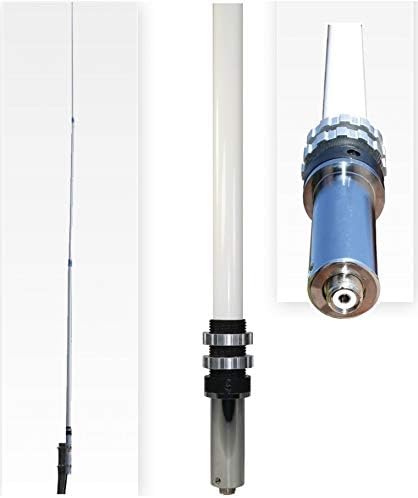


The Sirio SY 27-4 is a four-element Yagi-style base-station antenna for operators who want concentrated, directional coverage across the 26.5–30 MHz range. Its listed 4.6 rating reflects generally favorable buyer feedback, while the technical profile shows why this is the strongest all-around beam choice in the group: meaningful gain, horizontal polarization, continuous power handling, and a construction designed for a permanent outdoor installation.
We may earn a commission when you buy through this link, at no additional cost to you.
The antenna's stated gain is 11 dBd, equivalent to 13.15 dBi in the supplied specifications. That makes it the highest-gain antenna featured here, which is valuable when the objective is to reach a particular region rather than provide equal coverage in every direction. It can handle 1000 watts CW continuously and 3000 watts CW PEP, so it is suitably substantial for demanding base-station operating positions.
Its aluminum alloy construction, waterproof jointing sleeves, and UHF-female SO-239 connector are practical features for an exposed roof or tower installation. The trade-offs are equally important: a directional array does not behave like an omnidirectional antenna, and the approximate dimensions of 5846 by 4030 by 100 millimeters indicate that a substantial mast and turning area may be required. Installation quality and aiming will influence real-world results.
Choose the SY 27-4 when you operate a fixed base station, communicate primarily in one direction, and want the highest stated gain among these selections. It is less suitable for users who need immediate coverage in every direction or who cannot secure a rigid mast. For those priorities, one of the vertical base antennas is a better fit.
With 11 dBd of stated gain, the SY 27-4 concentrates transmitted energy along its main beam. That makes it particularly useful for operators targeting a known direction and potentially able to improve the signal-to-noise ratio received from stations within that sector.
Continuous 1000-watt CW handling provides substantial headroom for high-power base-station use. The stated 3000-watt CW PEP allowance offers additional short-term capacity, although an antenna rating never replaces proper transmission-line, connector, grounding, and equipment setup.
We may earn a commission when you buy through this link, at no additional cost to you.
The Sirio SY 27-3 is a three-element directional antenna that covers 26.5–30 MHz with a stated gain of 8.5 dBd, or 10.65 dBi. It is a logical middle ground between the smaller footprint of a vertical antenna and the additional gain of the four-element SY 27-4. Its 4.3 rating indicates solid buyer feedback without suggesting the same level of consensus as the highest-rated models in the list.
We may earn a commission when you buy through this link, at no additional cost to you.
Directional, high-gain horizontal polarization is the defining feature. Instead of radiating equally around the horizon, the Yagi arrangement favors a selected direction, which can improve the effectiveness of communications with stations in that direction. The antenna can handle 1000 watts CW continuously and 3000 watts CW for short-term use, matching the substantial power capability of the larger Sirio beam.
The primary benefit is a simpler directional array than the four-element model. Fewer elements can translate into a smaller overall installation and potentially easier handling, although the listing does not provide dimensions detailed enough to promise a specific footprint advantage. Buyers also need to account for the directional trade-off and ensure the UHF-female connector matches their transmission line and radio connection.
This model suits fixed operators who want beam performance but do not require the maximum gain listed among these antennas. It may work particularly well for regular contacts in a predictable direction, long-distance work, or a home base where full 360-degree omnidirectional coverage is unnecessary. Users who want the strongest possible front-to-back performance should examine the SY 27-4 instead.
The three-element Yagi provides 8.5 dBd of stated gain while retaining a familiar directional pattern. It is a sensible middle-tier choice for operators who value focused transmission without moving to the larger four-element array.
A 1000-watt CW continuous rating supports robust base-station use, with a stated 3000-watt CW short-time capability. The installation still needs correctly rated coax, secure connectors, and appropriate transmission-line protection.
We may earn a commission when you buy through this link, at no additional cost to you.
The Sirio SY 27-3 Cable Kit combines a three-element CB and 10-meter Yagi beam with a 100-foot RG8X Mini8 coax cable fitted with PL 259 connectors. That bundled cable is the main distinction from the standard SY 27-3 listing and makes this package appealing to operators who want the principal installation components together. Its listed rating is 4.1.
We may earn a commission when you buy through this link, at no additional cost to you.
The antenna supports 26.5–30 MHz operation with a stated SWR of 1.2 or lower at resonance. It offers a bandwidth of at least 1800 kHz at SWR of 2 or below, directional horizontal polarization, and 8.5 dBd, or 10.65 dBi, gain. These figures provide a clearer technical picture of performance across the upper 10-meter band than many general-purpose listings provide.
Construction includes aluminum, steel, and nylon, while the elements use waterproof jointing sleeves. The specifications also list resistance to 120 km/h winds, a turning radius of approximately 3200 millimeters, a 2710-millimeter boom, and mounting for a 35–50 millimeter mast. The included cable is convenient, but its fixed length may not suit every roof, attic, or tower arrangement, and appropriate PL 259-to-radio adapter requirements should be confirmed.
This package is a strong candidate for a new fixed installation that needs both a directional beam and a substantial run of coaxial cable. Its honest drawback is that buyers pay for a premeasured cable whether or not the installation path would use all 100 feet. Operators with a known short cable run may prefer the standard antenna and choose their own cable, while those facing a longer run may find this bundle especially convenient.
The included 100-foot RG8X Mini8 cable with PL 259 connectors removes much of the cable-selection work for a new installation. Buyers should still confirm the route length and the adapter needed at the radio before installation.
The stated bandwidth of at least 1800 kHz at SWR 2 or below and resonance SWR of 1.2 or lower make this one of the most thoroughly specified directional models in the comparison.
We may earn a commission when you buy through this link, at no additional cost to you.
The Wilson T2000 Series is a mobile CB trucker antenna rather than a roof-mounted directional array. It uses a 5-inch shaft and a 49-inch stainless steel whip, making it best suited to vehicle installations where mobility and straightforward mounting matter more than concentrated 360-degree base-station performance. Its 4.7 rating is among the strongest in this group.
We may earn a commission when you buy through this link, at no additional cost to you.
The antenna is listed for 26–30 MHz, covering the CB and upper 10-meter region, and is AM/FM ready according to the supplied information. Its 3500-watt rating provides substantial capability for mobile use, while the larger coil housing is intended to support increased power handling. A chromed brass ferrule with a standard 3/8-inch by 24 thread makes it compatible with many common CB mounts.
As a vertical whip, it provides omnidirectional mobile coverage rather than the directional gain of a Yagi. That is a significant trade-off, but it also means the operator does not have to aim the antenna toward a particular station. The stainless steel whip and mobile-oriented shaft are more useful for vibration, handling, and changing vehicle locations than they are for a permanent directional base station.
Choose the T2000 for truckers, off-road users, or anyone needing a straightforward mobile antenna with a high power rating. It is not the correct selection for a home station that wants maximum gain in one direction. Buyers should verify that their existing mount accepts a 3/8-inch by 24 threaded antenna and plan the coax route carefully to preserve electrical performance and avoid pinching the cable.
The 49-inch whip radiates vertically and avoids the need to rotate a directional pattern while driving. That makes it more practical than a base-station beam for mobile communication across changing directions.
A listed 3500-watt rating and enlarged coil housing provide useful headroom for higher-power mobile installations. Proper mounting, grounding, and coax quality remain essential regardless of the antenna rating.
We may earn a commission when you buy through this link, at no additional cost to you.
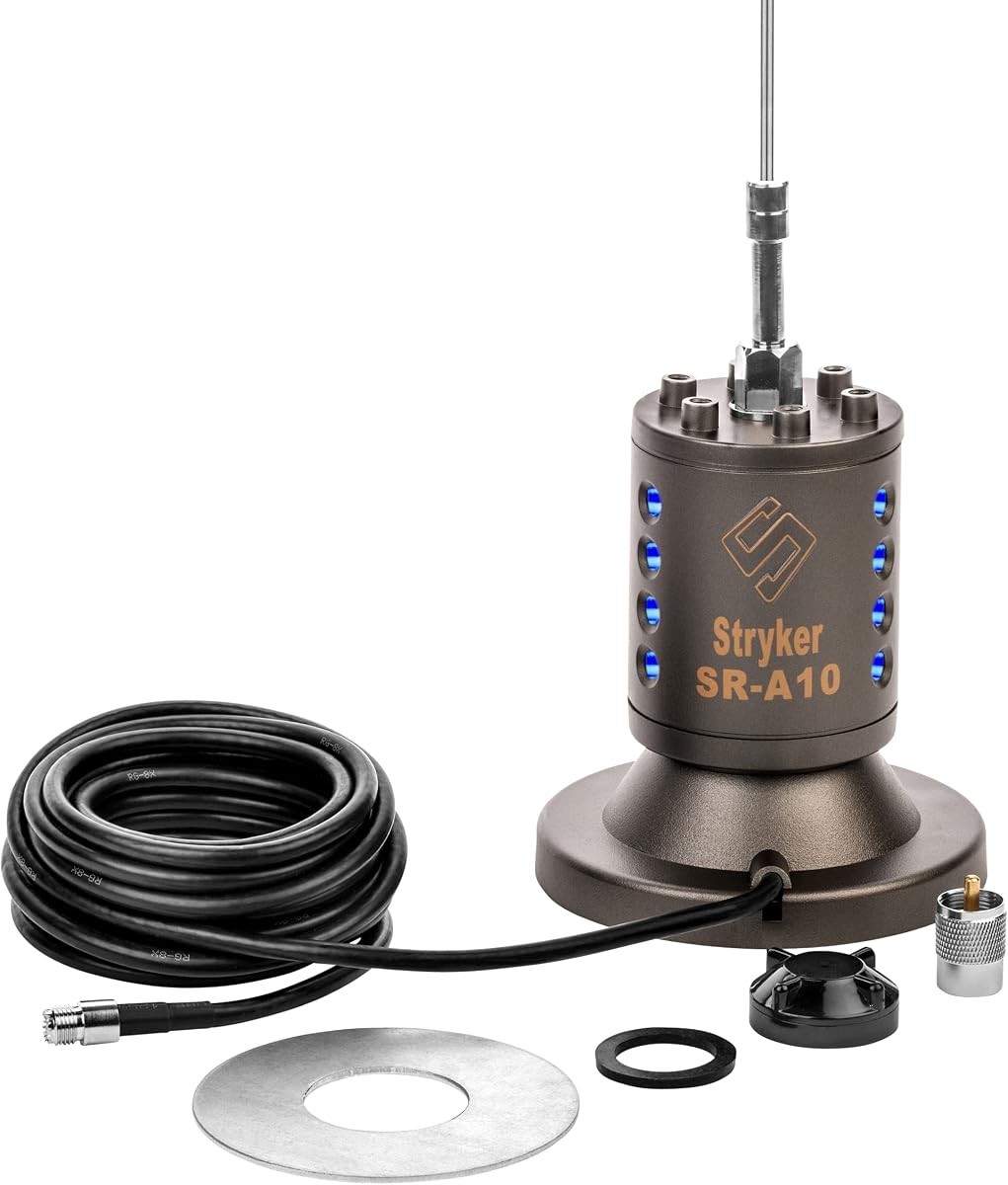
The Stryker SR-A10MM is a high-power magnetic-mount antenna for CB and 10-meter radios. It combines a five-inch magnetic base with a 62-inch stainless steel whip, giving users a portable alternative to drilling a hole or permanently installing a vehicle antenna. Its 4.3 rating reflects favorable but not universally top-tier buyer feedback.
We may earn a commission when you buy through this link, at no additional cost to you.
The listed power-handling capability of 10,000 watts is the headline specification. The antenna also uses a high-Q coil and six-gauge solid copper wire with a 100 percent silver plating, according to the supplied description. A two-year warranty adds reassurance, while the large magnetic base is intended to keep the assembly secure on a compatible vehicle surface.
The benefits come with practical constraints. A magnetic base depends on a broad, clean, relatively flat metal area for consistent coupling, and a long whip can add wind load at higher speeds. The model is also omnidirectional, so it offers no front-to-back rejection like a base-station Yagi. Buyers should inspect the antenna and magnetic mounting surface before travel and verify that the coax can flex without being pinched.
This is a useful choice for operators who move between vehicles, need a quick temporary installation, or want a more substantial mobile whip than a compact mirror mount. It is less appropriate for a permanent home station or anyone who needs directional gain. The massive power specification should be matched with suitable coax, radio output, and grounding rather than treated as the only measure of system performance.
The magnetic base removes the need for permanent drilling and allows the antenna to move between suitable vehicles. Cleanliness and a proper metal contact area are important for reliable attachment.
Six-gauge solid copper, silver plating, and a high-Q coil support the impressive stated power capability. The 62-inch stainless whip provides a vertically oriented mobile radiator.
We may earn a commission when you buy through this link, at no additional cost to you.
The Stryker SRA10 is designed for mounting on or near a vehicle mirror, offering a more compact mobile option than a tall magnetic-base whip. Its listed 4.7 rating is among the best in this roundup, and the low package weight of 1.08 pounds supports the idea of a compact, movable installation.
We may earn a commission when you buy through this link, at no additional cost to you.
Its most notable features are a paper-white daytime backlight, floating waterproof construction with an IPX8/JIS8 designation, and a stated capability of handling 10,000 watts. The illumination improves visibility of the mounted assembly during daylight, while the sealed design is useful for weather exposure. These features make the antenna especially relevant to mobile operators who value a compact footprint.
Mirror mounting introduces practical compromises. The available height and the exact position of the radio and coax vary by vehicle, and a low-mounted antenna may experience greater obstruction from the vehicle body or nearby structures. The listing does not provide a conventional gain figure, so it should not be compared directly with the quantified directional gain of the Sirio Yagis. Its value is convenience and mobile construction rather than concentrated off-axis performance.
Choose the SRA10 if your priority is a compact, illuminated, weather-resistant mobile antenna that can work with a mirror-style installation. It is less suitable for operators seeking a permanent base-station array or a full-height vertical whip. Before purchasing, inspect the mounting bracket and measure the available clearance around the chosen mirror.
The mirror-oriented format reduces the need for a roof or fender-mounted whip. Its 1.08-pound package weight also keeps handling and storage simple.
A white daytime backlight makes the assembly easier to identify, while the stated floating IPX8/JIS8 waterproof construction is designed for outdoor mobile exposure.
We may earn a commission when you buy through this link, at no additional cost to you.
The Sirio GPE 27 5/8 is a tunable 5/8-wave base antenna for 27 MHz and nearby frequencies. It has a perfect 5.0 listed rating, making it the most favorably rated product in the group, although ratings alone do not replace examining antenna pattern, installation, and system requirements. Its low-angle radiation and omnidirectional coverage make it a practical alternative to a true Yagi beam.
We may earn a commission when you buy through this link, at no additional cost to you.
The antenna is tunable from 26.4 to 29.0 MHz by adjusting the whip length. It uses a 50-ohm feed, offers a stated bandwidth of at least 1600 kHz at SWR of 2 or below, and has resonance SWR of 1.3 or lower. Maximum power is listed as 250 watts CW continuously and 750 watts CW for short-term use, substantially less than the high-powered Yagi options.
Static-discharge protection through DC grounding is a meaningful safeguard for an exposed base station. The aluminum, steel, copper, and nylon construction, waterproof jointing sleeve, 130 km/h wind-resistance figure, and protective transparent coil cover support outdoor use. The trade-off is omnidirectional radiation: it offers broad coverage but cannot concentrate the signal as efficiently toward one target as the 11 dBd Sirio Yagis.
Choose the GPE 27 5/8 when you want 360-degree coverage from a compact vertical base antenna without paying for a full directional array. It is a strong budget-oriented option for local and regional communication, especially where many stations are in different directions. Users running substantially higher continuous power should choose one of the models with a higher stated handling rating.
The 5/8-wave ground plane radiates in a 360-degree horizontal pattern with a low radiation angle. That makes it useful when contacts are spread across multiple compass directions.
DC grounding provides a path for static discharge, reducing the chance of damaging sensitive radio equipment during electrical events. A complete system should still include appropriate grounding and surge protection.
We may earn a commission when you buy through this link, at no additional cost to you.
The Taurus CB-18 is an 18-foot, three-section fiberglass base antenna for CB and 10-meter frequencies. It uses a half-wave-over-quarter-wave configuration to provide omnidirectional vertical coverage. With a 4.6 rating and stated 5.75 dBd gain, it offers more gain than basic ground-plane models while retaining coverage in every horizontal direction.
We may earn a commission when you buy through this link, at no additional cost to you.
Its stated frequency range of 26–31 MHz is broad enough to cover the CB allocation and upper 10-meter region. The antenna is rated for 2000 watts, which is useful for higher-power fixed stations that need more handling capacity than the Sirio GPE 27 5/8 provides. A UHF connector and a mounting bracket with stainless steel hardware are included according to the listing.
The tradeoff is physical size and the fact that it is not a directional Yagi. An 18-foot vertical requires a suitable elevated mounting point and can present installation, wind-loading, and clearance considerations. Its three-section construction helps with assembly and transport, but the overall height still determines its effective height above the surrounding environment, which can influence both transmission and reception.
This model is a good fit for base operators who want omnidirectional coverage, a tall installation, and relatively high gain. Choose it over the GPE 27 5/8 when height and stated gain are priorities, or over a Yagi when contacts frequently appear in different directions. It is less appropriate for a restricted rooftop with limited clearance or for an operator who specifically wants a focused beam.
At 18 feet tall, the CB-18 provides substantial physical elevation and a stated 5.75 dBd gain. Its vertical pattern is suited to stations that need broad horizontal coverage without rotating an antenna.
The fiberglass antenna divides into three sections for handling and setup. The included bracket and stainless steel hardware simplify the mounting hardware package, though the mast and roof structure must still be suitable.
We may earn a commission when you buy through this link, at no additional cost to you.
The FMUSER CB100 is an 18-foot outdoor base antenna intended for 27 MHz CB radio systems. Its listing emphasizes straightforward installation, a weatherproof design, and compatibility with a wide range of CB radios. With a 4.1 rating, it provides a practical alternative for operators who want more height and gain than a compact mobile antenna without moving to a multi-element Yagi.
We may earn a commission when you buy through this link, at no additional cost to you.
The stated gain is 4.3 dB, and the description says this helps extend signal reception and transmission range while improving coverage in challenging outdoor environments. A low VSWR is also highlighted as supporting efficient power transfer and reducing reflections. These are useful system-level considerations, but the supplied listing provides fewer detailed radiation, SWR, and power-handling figures than the more fully specified Sirio models.
The weatherproof housing is designed for year-round outdoor placement, while the 18-foot vertical format offers practical height. However, fixed 27 MHz focus may be less accommodating than models tunable across a broader 26–31 MHz span. Operators should also avoid assuming that the stated gain translates directly into stronger reception in every location because nearby objects, ground quality, mounting height, and feed-line losses all influence the installed system.
Choose the CB100 for a general-purpose outdoor CB base installation where broad radio compatibility and weather resistance are priorities. It may appeal to new operators seeking a simpler alternative to a complicated directional array. For users who require precise SWR data, high continuous power ratings, or broad tuning, one of the more thoroughly documented models would offer greater confidence.
The 18-foot vertical design provides height and 360-degree placement without the need to aim a Yagi. It is appropriate for stations with contacts in multiple directions.
The stated weatherproof design is intended to maintain reliable operation in rain and other outdoor conditions. Seal quality and mounting security still deserve attention during installation.
We may earn a commission when you buy through this link, at no additional cost to you.
The Sirio Starduster M400 is a tunable base antenna designed for CB and 10-meter operation. It stands 16.54 feet tall, uses an omnidirectional configuration, and offers a tunable range from 26.5 to 30 MHz. Its 4.7 rating places it among the most favorably reviewed options in this comparison.
We may earn a commission when you buy through this link, at no additional cost to you.
The antenna provides a stated gain of 0 dBd, equivalent to 2.15 dBi, and can handle 1000 watts CW continuously with a stated 3000-watt PEP allowance. A UHF-female SO-239 connector is used for the feed. These specifications make it a credible high-power vertical option, although its gain is lower than that of the Taurus CB-18 and the Sirio Yagi arrays.
Its primary benefit is straightforward omnidirectional coverage with a substantial continuous power rating. The tuning range lets an installer adjust the antenna within the upper 10-meter band rather than confining it to one narrow channel. The vertical form also avoids directional aiming, making it suitable when stations may be located in many different directions. As with all tall base antennas, installation height, roof clearance, and grounding remain important.
Choose the Starduster M400 for a fixed base station that wants a familiar vertical antenna, high continuous power capability, and tuning across 26.5–30 MHz. It is less suitable when maximum gain in one direction is the priority. Buyers should verify the mount height, secure the antenna against wind, and use the specified SO-239 connection with a correctly sized feed line.
The stated 1000-watt continuous handling capability makes the M400 suitable for robust fixed-station use. Appropriate coax, connectors, grounding, and radio-output settings are still necessary for reliable operation.
The 26.5–30 MHz tuning range allows adjustment across the upper 10-meter band. That flexibility is useful for operators who may work across more than a single channel.
We may earn a commission when you buy through this link, at no additional cost to you.
The right CB antenna depends first on the installation environment, then on radiation pattern, gain, frequency coverage, power requirements, connector type, and construction. A mobile whip that works well on a truck may be unsuitable for a rooftop, while a high-gain Yagi becomes an asset only when it can be mounted securely and pointed toward the desired region.
Directional Yagi antennas concentrate energy along one primary beam and are usually the closest match to the term beam antenna. They can improve the signal-to-noise ratio toward stations in the chosen direction while reducing reception from behind, but their coverage becomes less useful when contacts are scattered around the compass. Omnidirectional vertical antennas cover all horizontal directions more evenly and are often easier for new operators to operate because no aiming or rotation is needed. Choose a directional pattern when the communication target is consistent; choose an omnidirectional pattern when the station must hear multiple directions or the location prevents precise aiming.
CB radio operation centers around the 27 MHz allocation, while 10-meter ham use can extend beyond the lower portion of that band. A model tuned from 26.5 to 30 MHz offers useful flexibility, while a 26–31 MHz antenna may cover more of the upper band. A fixed 27 MHz design can be sufficient for straightforward CB use but offers less flexibility if you plan to move across multiple 10-meter frequencies. Always confirm that the antenna covers every frequency your radio may use and that its tuning method is accessible during installation.
Gain describes how strongly an antenna concentrates energy relative to a reference antenna, but more gain is not automatically better for every station. A four-element Sirio Yagi provides 11 dBd, while the three-element versions provide 8.5 dBd, creating useful front-to-back selectivity and potential long-range reach. Vertical options in this guide range from 2.15 dBi to 5.75 dBd and spread more energy around the horizon. Compare the pattern first, then the gain, because a larger number on an incorrectly aimed beam may not suit the communication plan.
The antenna must tolerate the output of the radio connected to it, including continuous operation rather than only short transmissions. The Sirio Yagis and Starduster M400 list 1000 watts CW continuous capacity, the Taurus lists 2000 watts, and the Wilson lists 3500 watts. The Stryker models state 10,000-watt capability. These figures establish antenna limits, not recommended operating levels. Also check the ratings of the coax, connectors, mounting hardware, and any intervening accessories, because a weak component elsewhere in the system can become the actual failure point.
A Yagi needs a rigid boom and a mast that can support its length, turning area, and exposure to wind. The larger Sirio models provide dimensions and wind figures, allowing prospective buyers to compare them against available space. Mobile antennas require a different plan: magnetic bases need broad clean metal, while mirror mounts need adequate clearance and a secure bracket. Tall verticals demand safe access during assembly and a roof or tower structure capable of supporting their height. Never attach a large antenna to a vehicle or structure without confirming its load rating and mounting method.
Most base models use a UHF-female SO-239 connector, but the cable and radio-end fittings still need to match the installation. The Sirio SY 27-3 Cable Kit includes 100 feet of RG8X with PL 259 connectors, which may simplify a new setup but could exceed the required cable length. Magnetic and mobile installations add strain and movement, so flexible coax routing and strain relief are important. Using high-quality, appropriately rated coax helps preserve the antenna's performance and makes connector installation more dependable in wet or exposed locations.
Base antennas remain outdoors for long periods, so aluminum, fiberglass, stainless steel, sealed joints, and static protection can materially affect service life. The Sirio beams use aluminum alloy elements with waterproof jointing sleeves, while the Taurus uses a three-section fiberglass body. The GPE 27 5/8 includes DC grounding for static discharge, and the Stryker SRA10 is described as floating and waterproof with an IPX8/JIS8 designation. These features help, but proper sealing, periodic inspection, and secure mounting are still necessary.
A three-element or four-element Yagi provides better directional performance but takes more planning than a single vertical whip. A magnetic antenna can be installed quickly, although it must be checked for security and ground coupling before every journey. A tall fiberglass base antenna may require more than one person or professional mast work. Consider the number of operators, whether the radio is used while moving, available rooftop or tower space, and your comfort with cable routing and tuning. The simplest setup is not always the most capable, but it is often the most reliable.
Begin by confirming that the antenna, radio, coax, connectors, and mount are compatible. For a Yagi, install the mast securely, attach the elements in the correct orientation, and aim the main beam toward the area you most often need to reach. For a vertical base antenna, mount it as high as practical and provide a stable support capable of handling its height and wind load. Before transmitting, check every connector and ensure the coax route does not create sharp bends, pinching, or unnecessary strain.
Tune and verify the antenna according to its manufacturer's instructions. Tunable models may require changing whip length, while Yagi models may include adjustment points or be factory tuned at mid-band. Use an appropriate SWR meter and measure in the band or channels you plan to use. A high reflected-power reading can indicate an incorrect connection, inadequate grounding, nearby interference, or a hardware issue. Correct the setup rather than simply accepting a high reading or compensating with excessive radio power.
For mobile antennas, inspect the magnetic base or mirror bracket before each substantial trip, clean the contact surface, and confirm that the whip and coax are secure. For permanent base antennas, inspect seals, brackets, element connections, and grounding periodically, particularly after severe weather. Replace or tighten deteriorated hardware, avoid painting over conductive surfaces, and keep vegetation or new structures from altering the antenna's surroundings. Always follow local electrical, radio, rooftop, and tower safety requirements.
A beam antenna is usually better when you communicate primarily with stations in one or a few known directions. It can provide more gain and stronger signals within that main beam while reducing reception from other areas. A vertical antenna is usually more convenient when contacts are in many directions or when the installation cannot be aimed. The best choice depends on communication patterns, available space, mounting quality, and how much you value focused coverage over 360-degree reception.
The element count describes the number of radiating and parasitic elements in the directional array, not the number of components needed to assemble it. In the supplied products, the four-element Sirio SY 27-4 has 11 dBd of stated gain, while the three-element SY 27-3 has 8.5 dBd. The four-element model generally offers stronger forward gain, but it also has a larger physical footprint and requires more room to rotate and mount.
Yes, a reliable mast and mounting system are essential for a roof-mounted Yagi. The structure must support the antenna's weight, dimensions, wind exposure, and the turning room needed for adjustment. The listed Sirio SY 27-3 supports a mast diameter of 35–50 millimeters. Mobile options use different hardware, including a threaded vehicle mount or a magnetic base. Follow the antenna instructions and avoid attaching any large antenna to a structure not designed for the load.
Many base-station CB and 10-meter antennas in this guide use a UHF-female SO-239 connector, including the Sirio SY 27-4, GPE 27 5/8, and Starduster M400. The Wilson mobile antenna instead uses a standard 3/8-inch by 24 threaded base and a chromed brass ferrule. Radio-end connectors can vary, so check both the antenna connector and the coax's radio-end fitting before ordering or installing a cable.
Yes, as long as the antenna's frequency range includes the frequencies your CB radio uses. These products cover portions of the 26–31 MHz range, but exact coverage and tuning vary. A model specified for 26.5–30 MHz is suitable for much of the CB band and upper 10-meter band. Check the antenna's tuning instructions and verify operation with an SWR meter across your most-used channels before relying on it.
Height can significantly influence the antenna's view over nearby objects and the surrounding ground environment. A taller installation often provides cleaner propagation and reduces obstruction by vehicles, buildings, fences, and vegetation. It can also increase wind load and make maintenance more difficult. The benefit is not always proportional, so a secure, appropriate installation matters more than adding height without structural support.
A proper vehicle grounding system is important for safety, radio performance, and suppression of unwanted RF currents. The antenna itself is only one part of the installation; the radio chassis, battery negative connection, coax shield, and bonding points all influence the overall electrical path. Follow the radio manufacturer's grounding recommendations and use appropriately rated copper or bonding connections. Avoid improvised ground paths through painted or deteriorated hardware.
Connect the antenna through the intended transmission line, then use a suitable SWR meter or the radio's built-in meter if it is accurate at the operating frequencies. Measure at several channels across your normal activity to identify resonances or sudden changes. If SWR is high, inspect connector tightness, cable damage, element installation, and nearby objects before changing the radio. Retest after adjustments and avoid transmitting heavily into an unresolved mismatch.
The Sirio SY 27-4 is the strongest overall choice for a fixed operator who wants the highest stated gain and a focused directional pattern. The standard Sirio SY 27-3 offers a simpler three-element alternative, while the SY 27-3 Cable Kit is especially convenient when a 100-foot RG8X run is needed. The Sirio GPE 27 5/8 stands out as a compact, budget-oriented vertical with a perfect listed rating and useful omnidirectional coverage.
Prioritize the installation that matches your actual communication needs. Choose a directional Yagi when one region or direction dominates your traffic, and choose a vertical when contacts appear in multiple directions. For vehicles, the Wilson T2000, Stryker SR-A10MM, and Stryker SRA10 serve different mounting needs, with the Wilson using a standard threaded mount, the Stryker SR-A10MM using a magnetic base, and the SRA10 using a compact mirror-oriented format.
Before buying, confirm frequency range, gain, power rating, connector type, physical dimensions, and mounting requirements against your radio and available space. Check the current listing for updated details and customer feedback, and compare current seller offers because prices and availability can change. A compatible, secure installation and sound coax are just as important as the antenna model itself.