
Compact 300A Battery Disconnect Switch
4.3Editor score
Compact 1.5-inch profile
IP66 waterproof protection
Removable anti-theft knob
300A continuous, 900A crank
Battery Disconnect Switch guide comparing current ratings, voltage ratings, mounting styles, controls, and features for cars, RVs, boats, and trucks.
A battery disconnect switch provides a practical way to isolate a vehicle, boat, RV, or battery bank from its electrical system. The right model should fit the terminal style, handle expected current, suit the environment, and provide a dependable way to stop unwanted power draw during storage, maintenance, or long periods of inactivity.
This guide compares ten battery disconnect switches across voltage range, continuous and cranking current, manual or remote operation, top-post or side-post compatibility, housing materials, installation methods, and added safety features. It includes conventional rotary switches, compact designs, adjustable-mount models, and automatic remote systems for a wide range of applications.
Each numbered review explains the product's strongest benefits, practical limitations, and ideal use case. Ratings reflect the information available for the listed products, while specifications and compatibility should always be checked against your actual battery before purchase. Prices and availability can change, so compare current listings before deciding.
4.3Editor score

4.7Editor score

4.2Editor score
The table below places every switch side by side, emphasizing the differences that matter most: electrical ratings, control method, terminal fit, construction, and intended application. Manual models offer straightforward isolation, while remote switches add automatic low-voltage protection and driving safeguards.



The Nilight 90015A combines a broadly useful 12V–48V operating range with a straightforward on/off design, making it a strong all-purpose choice for battery isolation. Its listed rating is 4.7, the highest among the available options, and the product is positioned for cars, RVs, marine boats, trucks, campers, trailers, ATVs, UTVs, and battery banks.
We may earn a commission when you buy through this link, at no additional cost to you.
Its electrical specifications are particularly noteworthy. The switch is listed for 275A continuous at DC 12V, 455A intermittent at DC 12V, and 1250A momentary at DC 12V. An ABS housing provides the basic structure, while the rear cover insulates the terminals against short circuits. The package includes the switch and four bolts, giving installers the essential mounting hardware.
The primary tradeoff is that the highest continuous and cranking-style figures are specifically given at 12V, so users with larger DC systems should not assume equivalent performance at every supported voltage. The four-bolt mounting arrangement also requires sufficient space and correct placement. Even so, the straightforward control, broad vehicle compatibility, insulation, and strong customer rating make this a persuasive general-purpose selection.
Choose the Nilight 90015A if you want a proven manual switch for a car, boat, RV, truck, or battery bank and value a well-documented current range. It is especially suitable for owners who want simple on/off isolation without remote electronics or a more specialized mounting arrangement.
The two-position on/off mechanism makes it easy to see whether the electrical circuit is live. That simplicity is useful for routine storage, maintenance, and security without adding a remote module to the installation.
A 12V–48V operating range and the wide list of supported applications make this switch adaptable to cars, marine equipment, recreational vehicles, and stationary battery banks when the system voltage and current fall within the specified limits.
We may earn a commission when you buy through this link, at no additional cost to you.
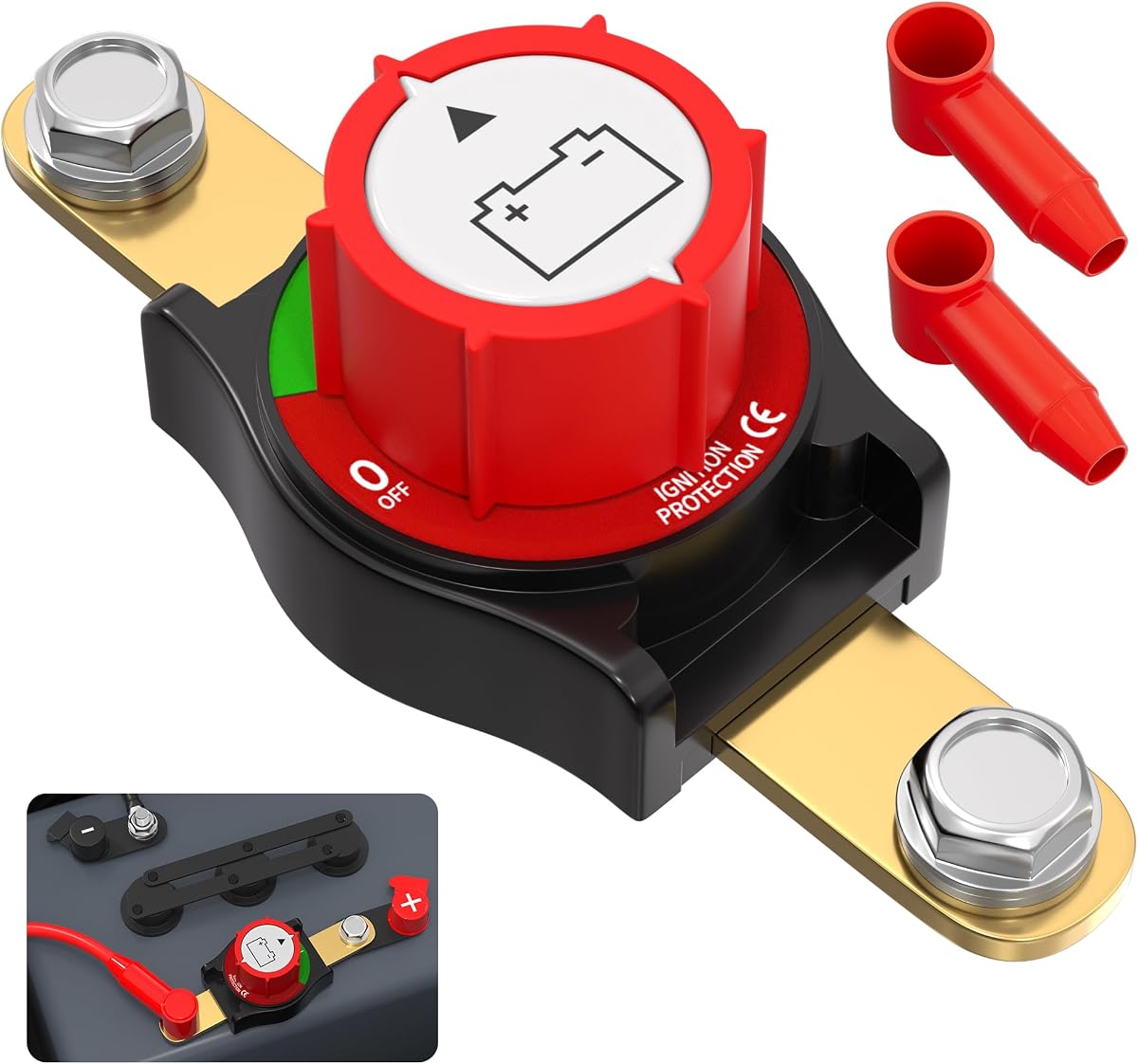
This compact top-post switch is built for installations where hood or compartment clearance is the central concern. It is listed at 4.3 and stands out with a height of only 1.5 inches, a 300A continuous rating, a 900A cranking rating, and an IP66 waterproof-protection designation.
We may earn a commission when you buy through this link, at no additional cost to you.
Its features go beyond compactness. The large red knob provides direct manual control and can be removed to discourage unauthorized use. Heavy-duty copper terminals support conductivity, while the PA66 housing is rated from -40°F to 284°F. The package includes an installation guide, disconnect switch, SAE female negative battery clamp, SAE male negative terminal post, and adjustable spacer.
One notable operational consideration is that the switch powers down the entire battery-connected system, so electronics that retain data, such as a radio, may lose memory each time it is turned off. Its compact dimensions and complete hardware package also mean the installer must confirm physical clearance and terminal arrangement before committing to the installation.
This is the strongest choice for someone who prioritizes a low-profile negative-post switch, weather protection, and anti-theft control. It works particularly well for cars, trucks, RVs, marine vessels, and other equipment where space is limited and the included spacer can accommodate the battery configuration.
At a listed height of 1.5 inches, the switch is designed for tighter layouts than many conventional alternatives. Checking the nearby hood, cables, brackets, and air intakes before installation helps prevent clearance problems.
The IP66 rating adds confidence in exposed marine or outdoor environments, while the removable knob makes it less convenient for an unauthorized user to restore power. Neither feature replaces sound cable and fuse protection.
We may earn a commission when you buy through this link, at no additional cost to you.
The BURMONG 275A switch delivers the core functions buyers usually need from a battery disconnect switch at an economical price point. Its 4.2 rating reflects a well-received general-purpose product with a 12V–48V range, a continuous current rating up to 275A, and uncomplicated 90-degree rotation.
We may earn a commission when you buy through this link, at no additional cost to you.
The stated construction combines a solid brass or copper clamp with an ABS plastic housing. It is designed for straightforward bolt-on installation, normally on the negative battery terminal, and its clear on/off positions make operation easy to understand. Compatible applications include cars, trucks, RVs, marine boats, ATVs, campers, and battery banks.
The trade-offs reflect its position as a budget-focused option. It does not offer the advanced remote cutoff logic, compact profile, or explicitly stated waterproof rating of some higher-feature alternatives. In addition, the universal description should not be treated as a substitute for checking the actual battery-post dimensions, cable arrangement, and required current capacity.
The BURMONG model is a sensible recommendation for a DIY owner who wants dependable power isolation, a simple manual control, and broad system compatibility without paying for remote automation. It is best suited to routine vehicle storage, maintenance, and general electrical-system isolation.
A clear 90-degree rotation reduces the chance of confusion during storage or maintenance. The manual format also has no remote module to configure and no automatic threshold to interpret.
The copper or brass clamp provides a conductive path between the battery and cables, while the ABS housing supports safe handling. This combination is appropriate for many common automotive, marine, and recreational applications.
We may earn a commission when you buy through this link, at no additional cost to you.
The Joinfworld Top Post Battery Disconnect Switch is a conventional manual switch for negative top-post batteries. It offers a 12V–48V operating range, 250A DC continuous capacity, 1000A DC cranking capacity, and a clear two-position on/off layout.
We may earn a commission when you buy through this link, at no additional cost to you.
Its installation-oriented design includes a negative battery clamp and a tapering post. The housing is made from ABS plastic, while copper components in the clamp and post are intended to support reliable conductivity. The product is marketed for cars, vehicles, RVs, boats, campers, travel trailers, trucks, ATVs, UTVs, and battery banks.
Because no customer rating is supplied, the product's appeal must be assessed primarily from its specifications rather than established review history. Its 250A continuous rating is also below the 275A and 300A figures associated with several alternatives. The top-post design is unsuitable for side-post batteries, so terminal compatibility must be confirmed before purchase.
This Joinfworld model is a useful option for owners of compatible top-post systems who want a straightforward 12V–48V switch and the included clamp-and-post installation arrangement. It is less compelling for applications requiring the highest listed continuous capacity or an adjustable or remote design.
Including both a negative clamp and tapering post simplifies the battery-end connection. The design is intended to make a direct top-post installation more convenient than repeatedly removing a loose cable.
The 12V–48V specification supports use across many automotive, marine, and stationary systems, provided the switch is installed according to its negative-post configuration and current limits.
We may earn a commission when you buy through this link, at no additional cost to you.
This adjustable top-post switch is built around installation flexibility rather than a fixed-angle arrangement. It carries a 4.4 rating and is designed for 15–17mm negative battery posts, with three control settings: on, off, and a removable-knob position.
We may earn a commission when you buy through this link, at no additional cost to you.
Its Nylon 66 housing and solid brass construction are intended to provide strength, flame resistance, conductivity, and corrosion resistance. The switch can mount directly to the negative post with the clamp end or be connected through wire lugs, giving installers a choice between a quick clamp-on setup and a more integrated cable arrangement.
Its main limitation is the stated 12V system rating, which is narrower than products explicitly designed for 12V–48V use. Fitment also requires careful measurement because posts outside the 15–17mm range may not be suitable. The removable knob is a security benefit, but it must be stored safely when the vehicle is in use.
This is an appealing choice for a 12V vehicle where the cable angle is awkward or compartment space is restricted. It is especially useful for owners who want both a direct battery-post installation and the option of custom wire-lug wiring.
The adjustable mounting angle helps cables meet the battery without being forced into an unnatural position. That can reduce installation strain and make routing easier in a crowded engine compartment.
A direct clamp installation provides speed, while wire-lug connections offer flexibility for a custom cable setup. Choosing the more appropriate method depends on cable length, routing, and available space.
We may earn a commission when you buy through this link, at no additional cost to you.
The RVBOATPAT 240A model adds remote and automatic control to a traditional battery-isolation function. It has a 4.3 rating, is designed for 12V systems, handles 240A continuous current and 1000A instantaneous current, and uses a magnetic latching relay with 3mA standby consumption.
We may earn a commission when you buy through this link, at no additional cost to you.
Its defining feature is the automatic protection function. When voltage falls below 11.8V, the switch can cut power to help limit deep discharge. During engine cranking or when voltage rises above 13.2V, the remote is disabled to reduce the risk of accidentally interrupting power while driving. The system manages battery power and does not modify the vehicle's original emissions equipment.
This sophistication also introduces more installation considerations than a purely mechanical switch. A remote module and associated connections must be positioned safely, and the listed 12V specification excludes use on higher-voltage systems. As with any electrically isolated vehicle, correct fuse, cable, and terminal work remains essential.
Choose the RVBOATPAT when automatic cutoff and remote access are more important than minimum complexity. It is well suited to cars, trucks, RVs, and boats that spend extended periods parked and could benefit from protection against forgotten lights, standby electronics, aging wiring, or prolonged low-voltage conditions.
Automatic cutoff below 11.8V can help prevent a parked battery from remaining deeply discharged. The feature is particularly relevant during long storage periods when parasitic loads are not readily monitored.
Disabling the remote during cranking and at higher operating voltage addresses the most serious potential misuse. It gives users convenient control without leaving the same interruption risk active under normal driving conditions.
We may earn a commission when you buy through this link, at no additional cost to you.
This remote battery disconnect switch combines anti-theft control with automatic low-voltage protection. It is rated 4.3, operates on 12V, and uses a mechanical magnetic switch with a standby current of 0.003A. A remote lets the user isolate the battery without returning to the engine compartment.
We may earn a commission when you buy through this link, at no additional cost to you.
Its smart safety logic detects two important operating conditions. If voltage falls below 11.8V, the remote kill switch automatically cuts power after 120 seconds. If voltage rises above 13.2V, the remote is disabled to help prevent accidental shutdown while driving. A manual control option provides a backup method during emergencies or electrical work.
The product is aimed at long-term parking situations affected by electronics, aging wiring, or forgotten lights. Its low standby requirement is helpful, but users still need to understand the product's timing and threshold behavior. Remote electronics also call for careful grounding, secure placement, and protection from moisture and physical damage.
This model is a good fit for a 12V car or truck owner who wants remote security and automatic battery protection. It is less suitable for higher-voltage systems or for people who prefer a simple mechanical switch with no remote module or timing logic.
Remote isolation lets the owner disable the battery-connected electrical system without direct access to the terminal. It adds a practical deterrent for parked vehicles without replacing separate physical security measures.
The included manual option provides a fallback if the remote is unavailable or the vehicle needs to be placed in service. It also gives installers and owners another way to establish a safe working state.
We may earn a commission when you buy through this link, at no additional cost to you.
The Joinfworld Side Post Battery Disconnect Switch is designed specifically for side-post battery installations. It supports 12V–48V systems and is listed for 275A DC continuous, 455A DC intermittent, and 1250A DC cranking current, with two 3/8-inch M10 studs.
We may earn a commission when you buy through this link, at no additional cost to you.
Installation is streamlined by the included copper conductive mounting brackets, which connect the switch to compatible side-post batteries without requiring the top-post hardware found on many competing models. The ABS housing and rear terminal cover add structural protection and insulation, while the tinned copper studs support conductivity and corrosion resistance.
No customer rating is available for this listing, so there is no established review score to help compare user satisfaction. Its 275A continuous and 1250A cranking figures are competitive, but those ratings are specifically stated at 12V. The fixed side-post configuration is also a defining constraint rather than a universal fit.
This is the option to consider when your battery uses side posts and the application includes a car, boat, RV, camper, trailer, truck, ATV, UTV, or battery bank. It is especially useful for marine installations that need a straightforward manual switch with high cranking capability and direct side-post mounting.
The brackets and M10 studs are designed around a side-post layout, avoiding the need to adapt a top-post switch. Accurate post measurement and cable placement remain important for reliable contact.
The insulated rear cover and copper components suit the moisture-prone environments common in marine use. The switch should still be installed with sound seals, strain relief, and protection from standing water.
We may earn a commission when you buy through this link, at no additional cost to you.
The Dual Rotating Terminal Switch stands out with a 4.6 rating and flexible terminals that can rotate through 180 degrees. The design is intended to help fixed battery cables align naturally in tight engine compartments instead of being forced into sharp or awkward angles.
We may earn a commission when you buy through this link, at no additional cost to you.
Its thickened high-purity copper contact structure is designed to support stable current flow while limiting resistance and heat associated with poor contact. The product works with 12V–24V systems and is fitted for SAE top-post negative terminals measuring 17–19mm.
Fitment is the key limitation. The switch is not designed for side-post batteries, positive terminals, or posts smaller than 17mm. Installation is described as a three-step process: remove the negative cable, fit the disconnect, then reconnect and tighten it. A wrench and two washers are included, though the installer may still need appropriate hand tools and safe battery-handling procedures.
Choose this switch when cable orientation is causing installation problems and you have a compatible 17–19mm negative top post. It is a solid middle ground between a basic fixed-angle switch and a more elaborate remote system, with strong ratings and a notably flexible connection design.
Independent terminal rotation gives cables more freedom to reach the battery. This is useful when a fixed switch would create excess bend, tension, or rubbing elsewhere in the engine compartment.
Thickened high-purity copper contacts are intended to provide a solid electrical path and reduce heat from resistance. Proper tightening and clean terminal surfaces remain necessary for the contact to perform as intended.
We may earn a commission when you buy through this link, at no additional cost to you.
This two-pack provides a pair of manual rotary battery disconnect switches for 12V and 24V systems. Its 4.0 rating is the lowest numerical score among the rated products, but the package offers a distinct advantage for dual-battery installations, backup isolation, or keeping one switch available for another vehicle.
We may earn a commission when you buy through this link, at no additional cost to you.
Each switch uses a pure copper contact structure intended to provide high conductivity, low resistance, and reduced voltage drop. Manual rotation through 90 degrees turns power off when raised and restores it when lowered. The design contains no electronics, so there is no remote signal, timing function, or automatic threshold to configure.
The trade-off is a less advanced feature set. It does not provide the automatic low-voltage protection, driving lockout, or compact waterproof housing found in more specialized products. The 4.0 rating should also be weighed alongside the overall value created by receiving two units. Installation requires basic tools and careful attention to correct negative-side isolation.
This package is best for a project involving two battery banks, a replacement and a spare, or separate vehicles. It is also appealing to users who deliberately prefer a straightforward mechanical switch over remote electronics and want broad compatibility with common 12V and 24V battery layouts.
Two independently controllable switches can isolate separate battery banks or provide a spare for future maintenance. The installer should confirm that each cable, terminal, and protection plan is appropriate for the circuit being isolated.
The direct rotary mechanism has no electronic control to program and no remote battery drain to consider. Its state is communicated by the switch position, which is useful during routine parking and servicing.
We may earn a commission when you buy through this link, at no additional cost to you.
A useful battery disconnect switch must match the battery, cable system, environmental conditions, and control needs of the equipment. The most important considerations are terminal compatibility, electrical capacity, installation space, and whether manual or automatic operation provides the required convenience.
Start by determining whether the battery uses top posts or side posts and whether the intended connection is on the negative or positive side. Most vehicle battery-isolation setups are performed at the negative terminal. A top-post model will not suit a side-post battery unless appropriate adapters are used, while a side-post model generally cannot be mounted to a conventional top post. The listed post dimensions matter as much as the general terminal type; examples range from 15–17mm to 17–19mm for top-post designs.
Measure the battery post and inspect the existing cable hardware before buying. A compatible switch that is difficult to orient can still create poor cable alignment, so confirm both the physical connection and the space around the terminal.
Check the operating voltage against the vehicle or battery bank. Many choices cover 12V–48V, some are limited to 12V, and others support 12V–24V. Current capacity is equally important: compare continuous, intermittent, cranking, and momentary figures rather than treating them as interchangeable. A switch intended to carry cranking current may be installed on a system whose accessories also place a sustained load on the circuit.
Use the manufacturer or seller's stated ratings as the deciding guide, especially when loads are substantial or the equipment is used in demanding conditions. Do not assume a switch can safely handle current beyond its specified continuous rating.
A manual rotary switch is direct, dependable, and easy to understand. It can be switched off before storage or service, and models with removable knobs add a basic anti-theft measure. Remote switches offer the ability to disconnect power from a distance and may include automatic low-voltage cutoff, but they introduce a control module, additional wiring, and threshold logic that must be installed correctly.
Choose manual control when simplicity is the priority. Choose remote control when convenience, automatic battery protection, or vehicle security justifies the added installation complexity.
Engine compartments, battery boxes, and marine compartments offer different amounts of working room. A low-profile switch can solve a hood-clearance problem, adjustable or rotating terminals can ease cable routing, and remote modules need a separate protected location. Before purchasing, look at the switch dimensions and consider nearby brackets, air intakes, covers, and moving engine components.
Also plan the cable path before installation. A switch should not force a sharp bend, place strain on the terminal, or interfere with a hood latch. A little space planning can prevent a technically compatible part from becoming difficult to use.
Marine and outdoor installations demand attention to moisture, corrosion, and temperature. Products use ABS or Nylon 66 housings, copper or brass contacts, and in some cases an IP66 waterproof designation. These features improve suitability for exposed environments, but no housing replaces proper sealing, strain relief, and sound cable protection.
Choose materials that suit the location rather than relying on a general waterproof claim. Clean the battery posts, protect exposed metal, and keep the switch away from standing water or abrasive debris whenever possible.
Some switches mount directly to the negative post using a clamp and tapered terminal, while others require brackets, lugs, bolts, or a separate enclosure. Models that include washers, a wrench, an installation guide, or a spacer can make setup more convenient. Adjustable-angle designs and rotating ends can also reduce the need for custom cable fabrication.
Review the full package and installation method before ordering. A direct clamp-on arrangement is often convenient, while wire-lug installations can be preferable when the cable routing needs a custom configuration.
A removable knob is a useful deterrent because the switch cannot easily be returned to the on position without the component. Remote systems may add further anti-theft control, but battery isolation should be treated as one layer of vehicle security rather than a replacement for locks, tracking, or visible parking precautions.
Remember that disconnecting the battery can reset electronics, affect memory, and create data or convenience issues. Vehicles with stored radio settings, programmed systems, or other memory-dependent devices deserve particular consideration before installation.
The best switch for a car in long-term storage may not be the ideal choice for a boat exposed to salt, an RV with numerous circuits, or a battery bank requiring serviceable connections. Match the product's stated applications to your own equipment and consider whether it must be lockable with other switches, carry unusually heavy current, or operate within a particular temperature range.
Use the application lists as a starting point, not a substitute for technical fitment. A switch intended for trucks and boats is not automatically appropriate for every heavy electrical system, and the cable, fuse, and alternator setup must also be considered.
Begin by identifying the negative battery terminal and the correct terminal type. Disconnect the negative cable first, inspect the post and cable clamp for corrosion, and confirm that the switch's post range and mounting method are compatible. Position the switch before tightening anything so that the cable exits in a natural direction without strain or sharp bends.
Install the switch according to its supplied instructions, using the specified clamp, post, brackets, lugs, washers, or bolts. Clean the contact surfaces, secure the connections, and inspect for loose hardware. Reconnect the negative cable and test the switch in a controlled area. For remote models, follow the threshold and pairing procedures supplied by the seller and confirm that cranking protection behaves as described.
During routine care, keep the terminals clean and dry, check fastener tightness, and inspect cable insulation for cracking or abrasion. Use the manual control only when the vehicle is parked and the equipment is safe to disconnect. Remote models should also be protected from excessive moisture and physical damage. Avoid using the switch as a substitute for a properly rated fuse, and remember that turning off the battery may erase settings stored in vehicle electronics.
Battery disconnect switches are most commonly installed on the negative battery terminal. Disconnecting the negative side opens the circuit to the vehicle's electrical system while reducing the chance that a tool or loose conductor can contact a powered positive terminal. Some specialized systems use other arrangements, so follow the wiring plan for the product and vehicle rather than relying solely on general advice.
It can eliminate the normal vehicle load when the circuit is fully opened, but not every parasitic drain is necessarily eliminated. Remote models may themselves consume a small standby current, and some connected electronics may use separate wiring paths. If a battery continues to discharge, inspect hidden circuits, abnormal loads, and the switch's actual position before assuming the product has failed.
Only if the manufacturer permits it and the necessary compatible adapters or hardware are used. A top-post model may not clamp securely to a side-post terminal, creating poor contact or an unsafe installation. The safest approach is to select a switch specifically designed for the battery's terminal type and post dimensions.
The switch should handle the system's expected continuous load and any cranking demand without exceeding its published limits. Compare current figures at the actual system voltage, because a rating specified at 12V may not apply unchanged at 24V or 48V. For heavily loaded or unusual systems, seek guidance based on the alternator output, starter, cable size, and protection plan.
It can. The product listing for the compact 300A switch specifically notes that electronics which store data, such as a radio, may lose memory whenever the battery system is powered off. Vehicles with extensive electronic memory, security modules, or adaptive settings may behave differently, so test the vehicle's requirements before making the switch a routine part of parking.
A switch with a stated waterproof rating may be better suited to marine environments, but installation quality remains critical. Use suitable cable, corrosion protection, secure strain relief, and seals that remain intact. Salt water and standing water can damage terminals and conductors even when the switch housing itself is well made.
It can discourage unauthorized use by making the electrical system harder to reactivate, especially when it has a removable knob or remote control. It is not a complete security system and may cause inconvenience if an unauthorized person alters the switch. It should be combined with normal vehicle locks and other sensible anti-theft measures.
Doing so can interrupt power to vehicle systems, potentially affecting engine operation, safety systems, and electronics. Remote models in this list include safeguards that disable the remote during cranking or at higher operating voltage. Manual switches offer no electronic lockout, so they should be operated only while parked and after the equipment has been safely shut down.
The Nilight 90015A is the strongest all-around selection because it combines a 4.7 rating, a 12V–48V range, clear on/off control, insulated construction, and extensive vehicle compatibility. The compact 300A model is more specialized, offering low-profile installation, IP66 protection, and a removable knob for users with limited clearance or a need for weather-conscious construction.
For value-focused buyers, the BURMONG 275A provides the essential manual functionality, broad voltage compatibility, and a straightforward 90-degree control without remote complexity. Before choosing any model, prioritize correct terminal fit, post dimensions, system voltage, continuous and cranking capacity, and available installation space. Remote operation is worth considering only when its automatic features and additional wiring are genuinely useful.
Finally, compare current ratings, package contents, and installation requirements closely, and check the latest listing before buying because prices, availability, and product details can change. Confirm that the switch will not interfere with memory-dependent electronics and that the complete electrical system includes appropriate cable protection and fusing.