
Rosewill RDCR-12001
Four-slot card reader
2.5-inch SATA drive dock
Hot-swappable drive access
SDXC support
Internal SATA card readers turn an unused drive bay into a convenient way to transfer photos, videos, documents, and files without repeatedly reaching around the back of a desktop. The right model should support the cards you actually use, provide adequate front-panel connectivity, and install cleanly in a compatible 3.5-inch or 5.25-inch bay.
This guide compares ten internal reader and front-panel options based on their stated card formats, USB interfaces, storage connections, mounting requirements, operating-system support, and included features. It covers dedicated card readers, multifunction media dashboards, USB hubs, and one PCIe SATA expansion card, because each can solve a different internal-access need.
The recommendations show which products stand out for broad card compatibility, simultaneous media access, high-speed front connections, compact installation, or added SATA and USB expansion. Product details and availability can change over time, so check the current listing, case dimensions, motherboard headers, and card requirements before making a final purchase.
4.5Editor score

4.0Editor score
As an Amazon Associate we earn from qualifying purchases.
The table below compares all ten options by their physical format, connection speed, card support, and principal benefit, making it easier to identify the right internal solution for a particular desktop.


The SABRENT 74 in 1 3.5 Inch Internal Flash Media Card Reader/Writer with USB Port (CR-USNT) carries a 4.0 rating and stands out for its unusually broad card-format support. Its six physical slots accept numerous media families, including M2, XD, SD and SDHC, SDXC, MMC, microSD variants, CF, MD, and MS, giving it particular appeal for computers that still handle older media.
We may earn a commission when you buy through this link, at no additional cost to you.
Its defining benefit is versatility. Rather than concentrating only on modern SD and microSD formats, the reader is designed to accommodate a large assortment of flash media, and some cards may require an adapter. The internal power connector helps ensure connected USB devices receive adequate power from the system rather than depending solely on a potentially undersupplied internal hub.
The principal compromise is the front USB 2.0 interface. That port is useful for peripherals and basic accessories, but it cannot deliver the transfer bandwidth associated with newer USB standards. The listed operating-system support also includes older Windows releases, Linux, and Mac OS X, so buyers should verify that their present desktop environment is covered before installation.
This SABRENT model is most compelling for a photographer, archivist, technician, or collector who needs to read less common cards alongside contemporary formats. It is less attractive for someone whose only priority is moving very large video files as quickly as possible. For unusually diverse media support in a compact internal package, however, it remains a distinctive choice.
The reader's support for XD, CF, MD, MS, M2, and multiple SD families is the central reason to consider it. That makes it more adaptable than a modern SD-focused reader when an old camera or portable device produces less frequently used cards.
The 3.5-inch format can make better use of a desktop's available space than a full 5.25-inch dashboard. Its front USB port also provides a convenient connection point for a keyboard, controller, flash drive, or other peripheral.
We may earn a commission when you buy through this link, at no additional cost to you.
The Kingwin Powered USB Hub 3.0 w/ 1 USB-C Port, SD Card Reader & Micro SD Card Reader – Sata Power Port w/Lightning Speed Data Transfer Up to 5Gbps – 5.25" Computer Case Front Bay, black (KW525-3U3CR) has a 4.0 rating and is the most feature-dense option in this guide. It combines an internal card reader, a powered USB hub, USB-C, eSATA, SATA power, and a full set of front-access ports in a 5.25-inch bay.
We may earn a commission when you buy through this link, at no additional cost to you.
Its eleven positions include three USB 3.0 Type-A ports, one USB-C port, one eSATA connection, and six dedicated card-reader slots. The USB 3.0 interfaces are specified at up to 5Gbps, while the media section supports SD, MMC, SDHC, CF, CF II, HS-CF, MD, MS, MS Duo, MS Pro, XD, TF, T-Flash, and M2 formats. This concentration of functions makes it a natural choice for a workstation where front access is valuable.
There is a trade-off in complexity. A dashboard with this many ports generally requires more internal connections than a dedicated reader, and the 5.25-inch opening must be available. The SATA power connection is also a notable feature for users who want a powered hub rather than relying entirely on limited front-panel header power.
Choose the Kingwin when your desktop is being upgraded as a creative workstation and you want one front panel to handle card imports, removable storage, charging, and data connections. It is excessive for a simple card-copying task, but for a carefully planned PC build, its combination of access and flexibility is hard to match in this category.
Three USB-A ports, one USB-C port, and eSATA cover many of the accessories used around a desktop. Keeping those connections at the front can reduce cable clutter and make media ingestion or temporary storage much easier.
Six card slots support common photographic, mobile, and legacy formats. That variety is useful for creators who move between devices rather than working with only one card type.
We may earn a commission when you buy through this link, at no additional cost to you.
The ACAGALA Multi-Function USB 3.0 Hub eSATA SATA Port Internal Card Reader PC Dashboard Media Front Panel Audio for SD MS CF TF M2 MMC Memory Cards Fits 5.25 is built for users who need more front I/O than a standard desktop provides. It combines media reading, eight USB ports, SATA and eSATA connections, and front microphone and speaker jacks in a 5.25-inch installation.
We may earn a commission when you buy through this link, at no additional cost to you.
The panel supports SD, CF, TF, M2, MMC, and MS cards, covering the formats most commonly encountered by photographers and mobile-device users. Its USB arrangement includes two USB 3.0 and six USB 2.0 ports according to the product description, with transfer rates stated at up to 5Gbps for USB 3.0, 480Mbps for USB 2.0, 1.5Gbps for SATA, and 3Gbps for eSATA.
The large number of connections is both its strength and its main installation challenge. A system with limited internal USB headers may not be able to use every port, and the additional storage and audio connections can make cable routing more involved. It is also important to distinguish the listing's port descriptions carefully, as some feature wording appears inconsistent between the listed USB counts and the repeated summary in the same description.
This ACAGALA is a good match for a system builder who wants one front panel to consolidate high-speed USB, legacy USB, storage access, and audio. It should not be selected merely to read one SD card, but as a broad internal connectivity upgrade it can eliminate several separate front-panel accessories.
Eight USB positions make this panel unusually useful for peripherals that would otherwise occupy rear ports or a separate external hub. The mix of USB generations can support both high-bandwidth devices and more conventional accessories.
Front SATA and eSATA connections provide alternative routes for storage devices, while microphone and speaker connectors avoid reaching behind the chassis during calls or media work.
We may earn a commission when you buy through this link, at no additional cost to you.
The Rosewill RDCR-12001 Multi-in-one USB 2.0 & SATA Internal Card Reader w/ 2.5" HDD/SSD Enclosure offers a focused combination of flash-card reading and internal 2.5-inch drive access. Its four card slots and hot-swappable SATA HDD or SSD dock are useful for a builder who wants to use one internal panel for more than memory cards.
We may earn a commission when you buy through this link, at no additional cost to you.
The product supports SDXC, while the drive side accepts 2.5-inch SATA hard drives or solid-state drives. Hot-swappable operation means a compatible drive can be inserted or removed without treating the enclosure as a permanently installed storage device, provided the rest of the system and connections support that use.
Its main limitation is the USB 2.0 interface, which will not take full advantage of the fastest modern flash media or SSDs. That matters most when transferring large RAW photo libraries, high-resolution video, or a full system image, but it can still be appropriate for routine card imports, document transfers, and occasional drive access.
The Rosewill RDCR-12001 is best for a practical desktop setup that values two functions without requiring a large collection of front USB ports. Check bay dimensions, SATA power requirements, and the supplied connection method before installation. For users whose primary goal is simpler media import at the fastest available interface, a USB 3.0 model would be a stronger fit.
The card reader and 2.5-inch dock address different workflows. Flash cards can be imported directly, while a SATA SSD or HDD can be mounted for temporary access, backup, or a transfer workspace.
Hot-swappable support makes the drive bay more flexible than a fixed internal connector. It is particularly useful for maintenance, data transfer, and keeping temporary storage out of the main drive bay.
We may earn a commission when you buy through this link, at no additional cost to you.
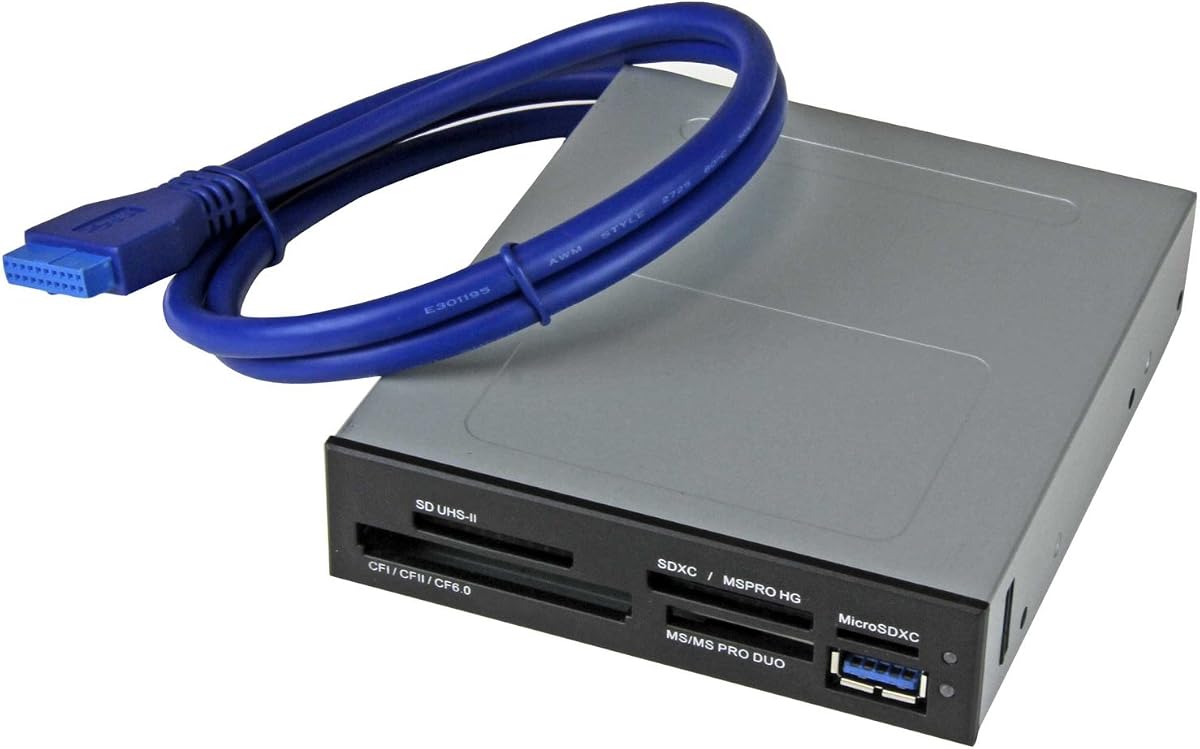
The StarTech Internal Card Reader USB 3.0 UHS-II 3.5in Bay, TAA (35FCREADBU3) has a 4.5 rating and offers the strongest balance of card compatibility, useful capacity, cross-platform operation, and clear practical features. It is a dedicated reader rather than a broad media dashboard, making it easier to recommend for photographers, filmmakers, podcasters, and everyday desktop users.
We may earn a commission when you buy through this link, at no additional cost to you.
Four card slots can be used at the same time for different media types. Supported formats include CompactFlash Type I, SD, miniSD, microSD, SDHC, SDXC, numerous MMC variants, Memory Stick variants, M2, and xD Picture cards. The reader also has a front-facing USB 3.0 port and built-in power and activity indicators that make its status easy to understand.
Installation requires a free 3.5-inch bay and a 20-pin motherboard header; the package includes a 20-pin IDC cable and screws. It supports Windows, macOS, and Linux without tying the installation to one operating system, and the product is described as TAA compliant for professional or government-oriented procurement environments.
This is the top general recommendation because it concentrates on the core job of reading many kinds of cards without requiring the buyer to navigate a large collection of USB, audio, and drive ports. It is especially attractive for a build with a free 3.5-inch bay. Users who need a 5.25-inch dashboard, USB-C, or a front USB hub should instead look toward the multifunction panels.
Simultaneous access to four different card types reduces repeated swapping during a shoot or media workflow. The same-format exclusion is sensible because one physical slot cannot read multiple cards of the same family at once.
Windows, macOS, and Linux support makes the reader practical for mixed-use computers. Its TAA compliance, activity lights, and stated two-year backing with ongoing multilingual assistance also suit managed workstation environments.
We may earn a commission when you buy through this link, at no additional cost to you.
The TCC-QL5E 5.25 Inch PC Multifunction Dashboard Media Front Panel is a full front-I/O solution for desktops that lack convenient external connections. It combines a five-in-one card reader, USB 3.0 and USB 2.0, SATA and eSATA, front audio, power, and status indicators in a single 5.25-inch bay.
We may earn a commission when you buy through this link, at no additional cost to you.
The reader supports SD, MMC, MS, TF, and M2 cards, with the listed description indicating support for memory cards up to 64GB. USB 3.0 is specified at up to 5Gbps and USB 2.0 at up to 480Mbps. The supplied connection set includes a 20-pin USB 3.0 cable, a four-pin power lead, a USB 2.0 cable, two SATA data cables, and an audio cable.
Because the panel introduces several separate internal interfaces, compatibility depends on available headers and power. A case with a free 5.25-inch bay is required, and the installer should plan cable routing carefully. The older Windows and Linux operating-system language in the listing is another point to verify against a current system.
The TCC-QL5E makes sense for a system builder who wants the appearance and utility of a modern media dashboard in an older desktop. It can provide storage expansion, peripheral access, and card import without requiring several separate front panels. Buyers who only need SD and microSD should consider a simpler unit to avoid unnecessary connections.
The panel gives a conventional tower a more accessible front interface. That can be particularly useful when rear USB ports are inconvenient for cameras, portable drives, controllers, or headsets.
USB, SATA, eSATA, audio, and five card formats are integrated into one unit. The included cable set supplies the main motherboard and power connections, though each must still be routed and secured inside the chassis.
We may earn a commission when you buy through this link, at no additional cost to you.
The Internal Card Reader 5.25inches High Speed Front USB 3.0 Interface Multifunction Internal Card Reader Dashboard PC Front Panel,Equipped with eSATA and USB 3.1 Port has a 4.1 rating. Its defining feature is six card-reader slots combined with three USB 3.0 ports, one USB 3.1 port, and an eSATA connection in a 5.25-inch front bay.
We may earn a commission when you buy through this link, at no additional cost to you.
That mixture makes it suited to a desktop used as a workstation, media-editing station, or general-purpose home computer. The card slots are described as supporting M2, MSO, MS, XD, and 64GB CF cards, while the overall reader is positioned around common flash media used with cameras and portable devices.
The product information contains some awkward wording, particularly in its list of card formats, and does not provide every installation detail as clearly as the StarTech listing. For that reason, buyers should consult the current package contents, connector diagram, and manual before ordering. It is also important to confirm what the USB 3.1 port offers in practice and whether the motherboard supplies the necessary internal header.
This panel is a good candidate for a builder who values the number of available front ports and card slots more than a minimal installation. Its LED indicator provides visible operating feedback, and the combination of eSATA and USB connectivity gives external storage options. It is less suitable for a compact case with no 5.25-inch bay or for a user who needs guaranteed support for a specific card format.
Six card positions remove the need to keep separate readers for different media families. Three USB 3.0 connections and the additional USB 3.1 and eSATA ports handle peripherals and storage from the front of the case.
The integrated LED indicator provides a quick visual cue when the panel is active. This is useful during file transfers or when connecting devices in a dim workspace.
We may earn a commission when you buy through this link, at no additional cost to you.
The 5.25inch Media Dashboard Multi Function USB 3.0 Hub has a 3.8 rating and is designed as a broad front-panel solution for photographers, content creators, and PC builders. It combines a USB 3.0 hub, USB 2.0, eSATA, a multi-format card reader, front audio, and drive-status lights.
We may earn a commission when you buy through this link, at no additional cost to you.
The reader supports M2, TF, SD, MMC, MS, and CF cards, with the product information indicating card support up to 64GB. USB 3.0 is stated at up to 5Gbps, USB 2.0 at 480Mbps, and the eSATA connection adds a wired external-storage option. The panel also advertises simultaneous access across multiple card types, which can streamline a creative workflow involving more than one memory format.
Its published 3.8 rating is the lowest among the products with numerical feedback in this guide, so prospective buyers should pay particularly close attention to current reviews and compatibility details. The listing contains a few incomplete or unclear phrases, including its operating-system wording and a reference to dual connections that is not fully explained.
Despite those concerns, the dashboard offers a useful package for a system that needs more than basic SD access. It includes a 20-pin USB 3.0 cable, four-pin power, USB 2.0 jumper, storage connection, and audio connectors, and it is built from ABS plastic with mounting hardware. It is best for a planned front-I/O upgrade rather than a quick, minimal card-reader installation.
Support for TF, SD, M2, MMC, MS, and CF cards covers several media ecosystems. Simultaneous multi-card access is particularly relevant when footage, still images, or temporary files arrive on different card types.
Speaker and microphone connectors make the panel practical for calls and editing sessions, while eSATA and USB connections offer convenient ways to attach storage or accessories without using rear ports.
We may earn a commission when you buy through this link, at no additional cost to you.
The PCIe SATA Card 6 Ports With 6 Cables and Low Profile Bracket is not a memory-card reader in the conventional sense, and this distinction is important. It is a PCI Express expansion card that adds six SATA 3.0 data connections for hard drives or solid-state drives, making it relevant to the broader topic of internal SATA connectivity.
We may earn a commission when you buy through this link, at no additional cost to you.
Its ASM1166 chip is specified to improve stability and compatibility, while the card supports up to 6.0Gbps transmission and six SATA 3.0 devices simultaneously. Six cables are included, drivers are not required according to the listing, and hot swapping is supported. A low-profile bracket broadens its usefulness in compact cases as well as full-size towers.
The system requirements are Windows XP, 7, 8, or 10 and Linux, with support for PCI Express lanes from x1 through x16. It therefore won't be relevant to macOS users based on the supplied information. Buyers should also verify case expansion-slot clearance, available power connectors, and whether the motherboard's chipset or platform provides adequate SATA resources.
Choose this card only when the need is more internal drive connections, not when the objective is reading SD, microSD, CF, or other flash cards. It can help a storage-heavy desktop connect several drives in a neat internal arrangement, but it does not provide front-access media slots. Keeping that distinction clear prevents an expensive and entirely wrong purchase.
The six SATA ports provide room for additional hard drives or SSDs in a system that has reached its motherboard's native storage limit. Included cables simplify the physical connections.
The included low-profile bracket allows the expansion card to fit systems with limited physical clearance. The range of listed PCI Express lane support also makes it adaptable to different motherboard slots, subject to platform and driver support.
We may earn a commission when you buy through this link, at no additional cost to you.
The 3.5 Inch Front Panel Hub has a 4.6 rating, the highest numerical score among the products in this guide. It offers a focused upgrade for an older desktop: two USB-A ports, one USB-C port, and SD and microSD card slots fitted into an otherwise often-unused 3.5-inch bay.
We may earn a commission when you buy through this link, at no additional cost to you.
The panel is aimed at content creators who want a more convenient way to import RAW photos, 4K video, and other large files, while also providing front access for keyboards, mice, flash drives, and cameras. Its USB 3.0 compliance and SD/microSD slots make it more contemporary than a basic internal reader, without the complexity of a full 5.25-inch dashboard.
Installation requires a free 19-pin USB 3.0 motherboard header, and the package includes the relevant USB 3.0 Type-A-to-19-pin cable, a 15-pin SATA power lead, screws, and a manual. If the computer has only a 5.25-inch optical bay, a separate conversion bracket is required and is not included. The stated one-year replacement for confirmed manufacturing issues adds a modest layer of reassurance.
This is the best compact choice for a desktop with an available 3.5-inch bay and modern front-header connection. It is less versatile than a multifunction panel because it lacks front audio, eSATA, legacy card formats, and a large USB hub, but its simple feature set, sturdy SPCC metal housing, and rating make it a focused and attractive upgrade.
USB-C and two USB-A connections provide the types of front access increasingly used by current accessories. A 3.5-inch installation also leaves a 5.25-inch optical bay open for larger storage or a traditional drive.
The included 19-pin cable and SATA power lead simplify assembly when the motherboard has the correct header. The required conversion bracket for a 5.25-inch-only case should be considered before ordering.
We may earn a commission when you buy through this link, at no additional cost to you.
The most important considerations are physical fit, the exact cards you use, the speed of the internal connection, and whether the extra front-panel features are genuinely useful in your desktop.
Internal card readers are not standardized around one universal opening. Some models fit a 3.5-inch bay, while multifunction dashboards usually require a 5.25-inch bay. The SABRENT CR-USNT and StarTech 35FCREADBU3 occupy 3.5-inch spaces, whereas the Kingwin, ACAGALA, TCC-QL5E, and several other dashboards use the larger 5.25-inch format. A desktop can have both openings, but using a 3.5-inch reader in a 5.25-inch bay may require an adapter that is not supplied.
A universal-looking multi-slot reader does not necessarily support every card standard or capacity. Modern photographers may only need SD and microSD, while a legacy device might produce CompactFlash, Memory Stick, xD, or M2 media. The StarTech reader supports a particularly broad list, and the SABRENT model emphasizes 74 media types. Check both the format names and capacity limits, especially when the listing mentions a 64GB ceiling.
The connection between the reader and motherboard can be the limiting factor even when a memory card supports faster transfers. USB 3.0 is specified at up to 5Gbps in several listings, while USB 2.0 is limited to 480Mbps. The 5.25-inch dashboards also offer SATA or eSATA for storage devices, but those interfaces do not automatically improve flash-card read performance. For large video files, prioritize a USB 3.0 reader and a matching USB 3.0 motherboard header.
Some internal readers double as powered USB hubs. The Kingwin provides three USB 3.0 Type-A ports and one USB-C port, while the ACAGALA panel advertises eight USB positions across USB 3.0 and USB 2.0. More ports can reduce desk clutter, but each functional hub may require suitable internal headers and adequate power. A simple card reader is usually easier to install and less likely to create header conflicts.
Multifunction panels can include SATA, eSATA, front microphone, and speaker connections. These features are useful in a workstation with several external devices, especially when the existing case lacks accessible front ports. They also add installation complexity because the panel must be connected to power, data, storage, and audio headers. Choose these panels when each added connection has a clear purpose rather than simply to maximize the specification list.
An internal reader still needs a way to communicate with the motherboard. The StarTech unit uses a 20-pin header, the compact USB-C front panel uses a 19-pin USB 3.0 header, and multifunction dashboards may need separate USB 3.0, USB 2.0, SATA, power, and audio connections. Inspect the motherboard manual and count free headers before purchasing. A free bay alone does not guarantee that every advertised front port can operate.
Cross-platform support makes a reader easier to move between computers. The StarTech model is listed for Windows, macOS, and Linux, while several dashboard descriptions emphasize Windows and Linux, and the PCIe SATA card lists Windows XP through Windows 10 plus Linux. Operating-system language on older product pages may not reflect current testing, so verify the manual and manufacturer resources. The MZHOU expansion card states that no drivers are required.
A front panel is touched repeatedly, so its housing, fasteners, and fit matter. The 3.5-inch USB-C model uses an SPCC metal housing, while the 5.25-inch dashboard uses ABS plastic. The StarTech package includes screws and a cable, and some dashboards list mounting hardware, but not every product details its full accessory set clearly. Review the package contents and installation diagram, and ensure cables can reach their headers without obstructing drives or airflow.
Before installation, power down the desktop completely, disconnect its power cable, and use appropriate tools to open the case. Identify the correct bay, motherboard headers, SATA power connection, and any front-audio or USB headers. Mount the panel securely, route cables away from fans and storage drives, and confirm that the card-reader portion is recognized before installing the operating system or copying important files.
For day-to-day use, insert media only when the system is powered on and the card is properly aligned with its slot. The operating system should normally detect the reader automatically, after which the card appears as removable storage. Before removal, use the system's eject command or safely stop all transfers. Do not pull a card out while files are being read or written, and do not force a card that does not fit.
Good card handling extends both card life and reader reliability. Keep contacts clean and dry, avoid forcing cards into the wrong orientation, and transport cards in a protective case. Periodically inspect internal cables and the panel mount, and clean the bay and card slot with dry, compressed air rather than moisture. If transfer errors occur, try another card, another port, or a different reader before assuming the internal panel has failed.
They can be, because an internal USB 3.0 reader may connect directly to the motherboard rather than through an external enclosure. Actual speed still depends on the reader's controller, the card itself, the motherboard header, and the computer's storage. A USB 2.0 internal reader will not outperform a comparable external USB 3.0 reader.
It depends on the reader. The compact 3.5-inch USB-C front panel specifically requires a free 19-pin USB 3.0 header, while the StarTech 35FCREADBU3 uses a 20-pin header. USB 2.0 readers and multifunction panels may use different combinations of headers and power leads. Check the manual for the exact model before ordering.
No, because case bay sizes and mounting arrangements vary. A 3.5-inch reader needs a suitable 3.5-inch opening, and a 5.25-inch dashboard needs that larger bay. Even when the dimensions match, check the depth, screw positions, front bezel, and nearby components that could obstruct installation.
A dedicated card reader is built primarily for reading and writing flash media. A front media dashboard adds functions such as USB-A, USB-C, SATA, eSATA, audio, power indicators, and drive activity lights. A dashboard can be convenient in an older case, but it normally requires more internal cables and motherboard connections.
It depends on the model. Some listings explicitly mention 64GB support, while others state broader compatibility without giving a capacity ceiling. A card can physically fit yet fail if its format, speed class, or capacity is not supported by the reader's controller. Verify the manufacturer's compatibility list and the card's type before use.
Most standard internal readers that use USB are designed to work through the host operating system's built-in USB storage support. The MZHOU PCIe SATA card specifically states that no drivers are required. For any model, follow the included instructions and check the manufacturer website if the device is not detected or if a recent operating system requires an update.
Only if the reader is installed in a desktop that remains powered, and the other computer can access the media through a network or shared connection. The listed readers are internal devices rather than portable standalone units, so they cannot simply be unplugged from one PC and carried to another like a small external reader.
No. The MZHOU PCIe SATA Card adds six SATA 3.0 data ports for connecting hard drives and solid-state drives. It does not read SD, microSD, CF, or other flash cards. It is included to show a different form of internal SATA expansion and should only be chosen for storage-device connections.
The StarTech 35FCREADBU3 is the strongest all-around choice because it combines a 3.5-inch footprint, USB 3.0, four simultaneously accessible card slots, extensive format support, and Windows, macOS, and Linux compatibility. The compact 3.5-inch USB-C front panel is ideal for a modern upgrade with straightforward SD and microSD needs, while the Rosewill RDCR-12001 offers a practical card reader and hot-swappable 2.5-inch SATA dock.
Prioritize fit and card requirements before any extra feature. A dashboard with numerous ports is not automatically better if the case lacks the necessary bay, headers, power, or cable space. For a broad front-I/O upgrade, the Kingwin KW525-3U3CR is the most complete option, but the additional connections make it more involved to install than a dedicated reader.
Finally, check the current listing, compatibility documentation, package contents, and physical dimensions before purchasing. Card standards, supported capacities, firmware details, and included accessories can change as a product listing evolves. Confirming those details against your desktop will help ensure that the selected internal reader or SATA expansion card is genuinely compatible.