
SVBONY SV172 Dew Heater
4.6Editor score
Compact 50 mm band
USB-powered operation
Three heating levels
Dew can form on a telescope objective faster than many imagers expect, especially during humid nights, autumn observing sessions, and long exposures near dawn. A telescope dew heater adds controlled warmth to the optical surface, helping keep the view clear and protecting imaging sessions from condensation, fog, and frost.
This guide compares ten dew heater options based on heating design, temperature adjustment, power requirements, coverage dimensions, cable flexibility, and likely compatibility with telescopes, camera lenses, and eyepieces. It includes compact USB models, larger 12-volt bands, and a model-specific aluminum ring for popular Celestron optical tubes.
The selections show how practical convenience differs from equipment-specific fit and why the correct diameter, power source, and mounting style matter. Ratings and listed specifications reflect the supplied product information, while product availability and prices can change. Always confirm the current dimensions and connector type before ordering.
4.6Editor score

4.7Editor score

4.6Editor score
As an Amazon Associate we earn from qualifying purchases.
The comparison below places each heater’s length, power method, control options, and intended optical equipment side by side, making it easier to identify the model that matches a telescope's diameter and an observing setup's available power.


The SVBONY SV192 combines a 480 mm heating strip with three-speed temperature regulation, giving it more flexibility than a compact lens warmer while remaining more general-purpose than a model-specific aluminum ring. Its 4.7 rating reflects a strong balance of heating performance, construction, and telescope-focused design.
We may earn a commission when you buy through this link, at no additional cost to you.
The strip is intended for astronomical primary mirrors with an outside diameter below 152 mm and may also suit compatible camera lenses. A 5.5 by 2.1 mm female interface provides a conventional connection point for 12-volt power. The three heat settings let an observer respond to changing humidity, temperature, and dew-point conditions rather than operating at one fixed output.
Its layered SBR and black-T heat-preservation material is designed to limit heat loss, while the flexible construction can bend without leaving wrinkles on the inner surface. These details are especially relevant when the band must lie against a cylindrical telescope tube or another curved optical housing. The trade-off is that it depends on a suitable 12-volt source rather than operating directly from a basic USB charger.
This is a strong general recommendation for owners of compatible reflectors, refractors, and larger camera lenses who want adjustable control without buying a ring for one exact telescope model. Measure the objective diameter and available power before ordering, then start at a lower setting and increase it only as needed.
The three-speed regulator makes the SV192 useful across different nights. A low setting may be sufficient during mild dampness, while stronger output can help when the lens approaches the dew point. Starting conservatively also reduces the need to compensate later with a separate controller.
At 480 mm, the strip offers substantially more coverage than a small camera-lens band. That makes it a practical option for a compatible telescope whose larger objective would otherwise be difficult to heat evenly with a compact warmer.
We may earn a commission when you buy through this link, at no additional cost to you.
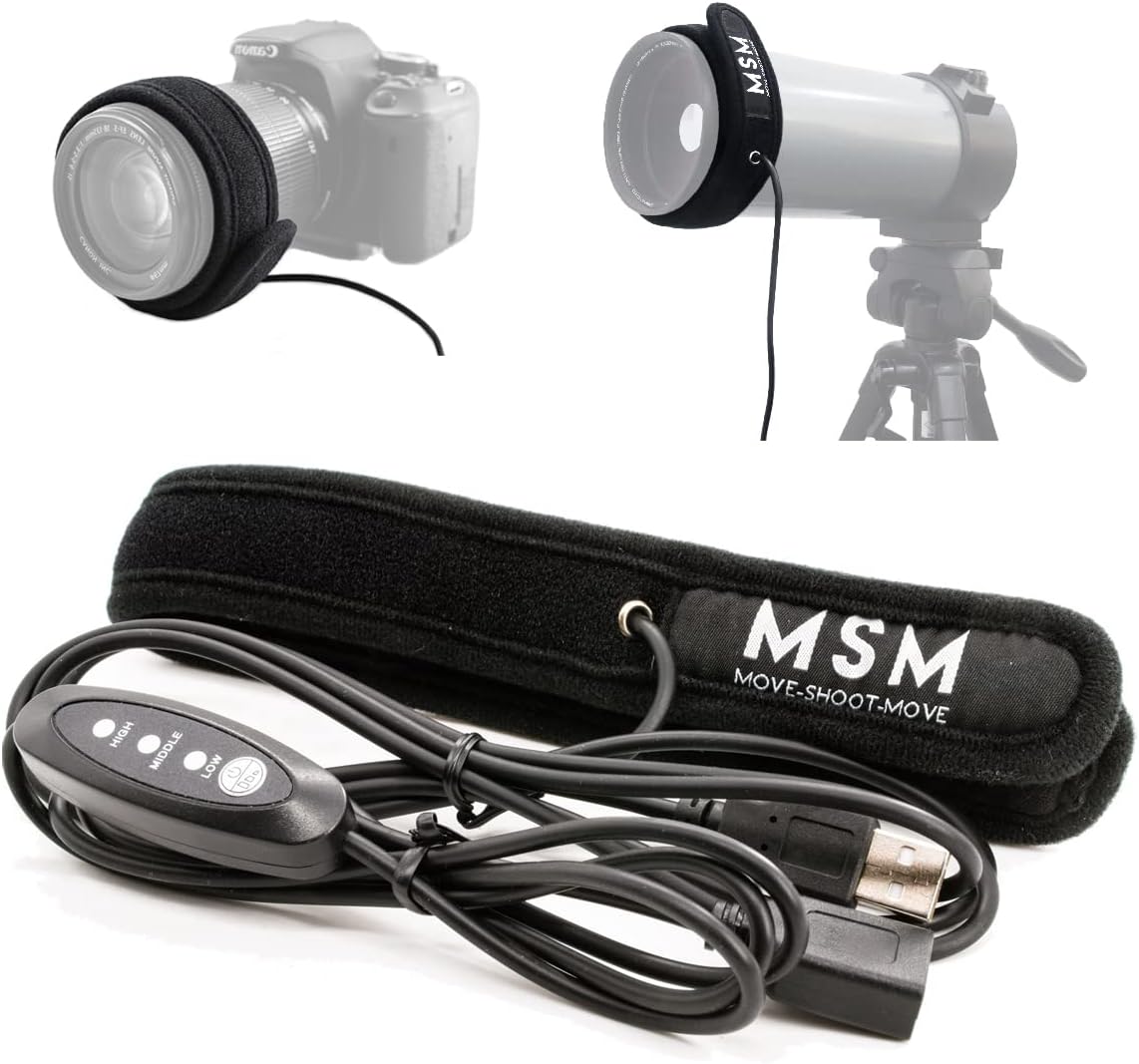
The SVBONY SV172 is a compact, USB-powered warmer designed for telescope and camera lenses with an external diameter below 76 mm. Its 4.6 rating and three heating levels make it a practical option for smaller refractors, guide-scope cameras, and compact optical systems that benefit from a narrow band.
We may earn a commission when you buy through this link, at no additional cost to you.
The 50 mm-wide strip is intended not to interfere with focusing and is described as avoiding dark corners in the field. At 66 grams, it adds little bulk to a portable telescope setup. Power comes through a 1.8-meter USB cable, with listed input requirements of 5 volts and approximately 1.9 to 2.0 amps.
An aluminum construction and alloy-fiber heating wire are used for fast, even warming, while three layers of insulation are intended to reduce heat dissipation. The controller offers strong, medium, and weak modes, allowing output to be matched to ambient conditions. The limitation is size: this is not intended for a large objective or an aluminum dew shield that requires full-perimeter heating.
The SV172 is best for mobile imagers who already carry a power bank and need a lightweight dew-control accessory for a small telescope, camera lens, or similar item. Verify the objective's outside diameter, allow room for the cable, and select the lowest adequate setting during the first test.
USB power is convenient for a field setup because many imagers already carry a portable battery. The included 1.8-meter cable adds placement flexibility while keeping the controller away from the optical surface, which is helpful when condensation is already forming.
The 240 mm length and 50 mm width are useful for compact optical components. They are particularly relevant to smaller telescopes and camera lenses where a wide wrap would interfere with focusing, filters, or image coverage.
We may earn a commission when you buy through this link, at no additional cost to you.
This 350 mm neoprene lens warmer is distinguished by a power cable that is listed as remaining flexible down to -25 degrees Celsius. Its 4.5 rating reflects a construction aimed at cold outdoor use, with a maximum diameter of 4.26 inches and a 60.23-inch USB cable.
We may earn a commission when you buy through this link, at no additional cost to you.
Premium neoprene is used to limit heat loss and provide a soft surface that can wrap around a lens. The heating system is described as warming rapidly and continuously, with three incremental temperature levels controlled from the power cable. A power bank or another suitable USB source provides the required 5-volt, 2.0-amp connection.
An adhesive strap makes installation and removal straightforward, while the unusually long cable gives considerable freedom in placing the heater around a telescope or camera. The maximum diameter is the important limitation: instruments larger than 4.26 inches, or those requiring full-circumference coverage, need a larger model.
This warmer is a sensible choice for cold-night backyard imagers using a compact telescope or camera lens within the stated size limit. Check the diameter carefully, secure the strap without blocking vents or controls, and carry a suitable USB power source capable of maintaining operation throughout the session.
The listed -25-degree Celsius cable flexibility is a meaningful advantage when a stiff power lead could crack or become difficult to arrange. Flexible routing also makes it easier to position the controller away from the optical tube without creating excess strain.
A 60.23-inch power cable can reach a distant power bank or USB source without forcing the warmer to sit awkwardly. That separation can also make it easier to inspect the controller and adjust the heating level during a session.
We may earn a commission when you buy through this link, at no additional cost to you.
The R-Sky Astro Instruments 6-inch dew heater band is designed for cold or humid observing conditions and carries a 5.0 rating. It uses a 12-volt RCA connection and is listed for a range of telescope designs, including SCT, Maksutov, refractor, and RASA models.
We may earn a commission when you buy through this link, at no additional cost to you.
Special construction is intended to distribute heat evenly across the surface, reducing the chance of one protected area leaving a narrow zone vulnerable to condensation. The power cord is described as durable, flexible, and resistant to tangling, with the ability to remain soft in sub-zero temperatures.
Unlike a controller-equipped product, this band does not list integrated heat-level selection. It is therefore best paired with a compatible dew controller or a 12-volt setup that provides suitable control. The multiple-size availability also means buyers should confirm that the selected six-inch version corresponds to their telescope's actual dimensions.
This model is a compelling choice for someone with a compatible six-inch telescope who values a straightforward, evenly heated band and a cold-rated cable. Its strongest use is alongside a suitable 12-volt controller, allowing the user to tune the output to the dew point rather than relying on a fixed warming level.
Even heat distribution is the core benefit of this design. A band that warms consistently can protect more of the objective area, particularly when fitted close to the front of a compatible telescope tube or dew shield.
A power lead that remains soft in sub-zero conditions is easier to route and less likely to become a brittle liability during a long winter session. The stated tangle resistance also helps with repeated setup and breakdown.
We may earn a commission when you buy through this link, at no additional cost to you.
The Celestron 8-inch aluminum dew heater ring provides an equipment-specific solution for owners of an 8-inch Schmidt-Cassegrain, EdgeHD, or RASA telescope. Its 4.6 rating reflects the appeal of a precise fit, rigid construction, and neatly managed wiring rather than a generic wraparound band.
We may earn a commission when you buy through this link, at no additional cost to you.
The ring is designed to heat the Schmidt corrector lens, helping prevent dew formation during both observing and imaging. Its aluminum construction remains lightweight while supporting the heating cable around the front of the optic. An included cable-management clip corrals essential wiring and elevates unnecessary cable weight.
Continuous heat comes from an external 12-volt DC source. This requirement makes the ring suitable for observers who already use powered telescope equipment or a portable battery, but it is less convenient for a completely USB-only field setup. Exact model compatibility also means buyers should verify the telescope designation before purchasing.
This is the premium choice for a compatible Celestron 8-inch owner who values a model-specific fit and orderly installation. The product is backed by a two-year US warranty and unlimited support from Celestron's US-based team, adding assurance that the ring is intended as a long-term accessory.
A dedicated ring is likely to sit more consistently than a generic band on supported Celestron telescopes. That consistency can improve the appearance of the installation and make it easier to protect the full corrector area.
The integrated clip addresses a small but meaningful problem in mobile observing setups: loose heater leads can pull against the tube or interfere with other accessories. Elevating excess wiring keeps the installation orderly.
We may earn a commission when you buy through this link, at no additional cost to you.
The NEEWER HW-23B is a long USB heater strip for cameras, telescopes, binoculars, and other optics. Its 4.4 rating reflects a versatile format, three clearly defined temperature settings, and a 23.6-inch length that gives it more reach than a typical camera-lens warmer.
We may earn a commission when you buy through this link, at no additional cost to you.
The listed effective heating length is 20 inches, or 500 millimeters. It can fit optical equipment with a circumference up to 18.7 inches, or 475 millimeters, and a diameter of 150 millimeters. The strip uses touch fasteners so it can be wrapped, adjusted, and removed without complex hardware.
Its regulator provides three ranges: high at 55 to 65 degrees Celsius, medium at 45 to 55 degrees Celsius, and low at 35 to 45 degrees Celsius. USB power simplifies field use with a portable charger, laptop, or USB adapter, and the supplied 4.9-foot cable provides some placement flexibility.
This model is well suited to imagers who want one warmer to cover several moderate-sized optical items. Temperature selection should be approached carefully because the published ranges are specific, and the strip must be attached to a surface capable of tolerating the selected level. Verify dimensions and test from the lowest setting.
The 23.6-inch length gives the HW-23B enough reach to serve telescopes, camera lenses, and binoculars within the listed size limits. That flexibility can reduce the need to carry a separate compact warmer for every optical component.
The three published temperature ranges make it easier to make incremental adjustments than with an uncalibrated heat setting. These ranges are especially useful when moving between cool, damp conditions and a warmer environment.
We may earn a commission when you buy through this link, at no additional cost to you.
The Astromania 25cm USB dew heater offers compact heating and stepless temperature regulation for cameras and telescopes. Its 4.1 rating is the lowest among the rated products in this group, so buyers should distinguish its useful control features from the stronger overall ratings of the alternatives.
We may earn a commission when you buy through this link, at no additional cost to you.
A sliding controller knob allows continuous adjustment rather than selection among a few fixed modes. The strip operates from 5-volt USB power and can be connected to a power bank or another suitable source. Its stated compatibility extends to most telescopes, cameras, and other lenses with an outside diameter below 80 millimeters.
Beyond optics, the product can also be used to warm a water bottle or feeding bottle and can function as a wrist strap in cold weather. These alternate uses do not determine telescope-heating performance, but they show that the band is designed around flexible thermal use.
The Astromania is most appropriate for compact optics where fine control is valued and the diameter is within range. Its rating does not outweigh the practical appeal of stepless adjustment, but careful measurement and conservative use are advisable. Confirm that the controller and power source are comfortable to access during the night.
A continuous adjustment can be helpful when the optimal warming level is not represented cleanly by a three-position switch. Small changes may be easier to make without moving between fixed temperature levels.
The USB power arrangement suits observers who want simple access to an existing battery bank. Its compact scale also makes it manageable for a small imaging kit used in a backyard or on an organized field trip.
We may earn a commission when you buy through this link, at no additional cost to you.
This adjustable telescope dew heater band offers sizes ranging from 4 to 37 inches, with the reviewed listing representing the 6-inch option. It is intended for telescope objectives, camera lenses, and binoculars, and it has no customer rating displayed in the supplied information.
We may earn a commission when you buy through this link, at no additional cost to you.
The selected band uses a 12-volt DC power source through an RCA connector. This is a familiar connection for portable telescope and astrophotography power systems, making the product easier to integrate with existing equipment than a proprietary connector would be.
A secure fastening mechanism keeps the strip in contact with the optical housing, while the adjustable design accommodates different tube dimensions. The broad size selection is useful for imagers who may change telescopes or cameras, although the chosen listing corresponds specifically to the 6-inch size.
The product is best for a user who values size flexibility and already has 12-volt equipment. Because no customer rating is available, it is especially important to confirm the exact diameter, connector, and controller compatibility. A suitable adjustable controller is also necessary if the band does not provide heat-level adjustment itself.
The range of four-, six-, 15-, 27-, and 37-inch options is useful for mixed equipment collections. It allows a user to select a band for a small guide scope or a substantially larger imaging tube while keeping the same basic power style.
A heater must remain close to the surface it protects to transfer warmth effectively. The listed fastening mechanism is therefore an important part of the product, particularly for a tube whose diameter may vary slightly from the nominal size.
We may earn a commission when you buy through this link, at no additional cost to you.
The USB Lens Warmer is designed for telescopes, camera lenses, viewfinders, and eyepieces with diameters below 80 millimeters. It carries a 4.5 rating and combines a USB supply with a 1.5-meter controller offering low, medium, and high modes.
We may earn a commission when you buy through this link, at no additional cost to you.
The heating wire is listed as capable of withstanding temperatures as low as -40 degrees Celsius without freezing and breaking during prolonged cold exposure. Materials are selected for fast heat transfer and good thermal insulation, both of which support the goal of keeping an optical surface from fogging.
The product can also be used with thermoses, drinking cups, and baby bottles, although the telescope application remains the primary consideration here. A note in the supplied information says the controller's appearance has been adjusted while its function remains unchanged, meaning old and new versions may be mixed in inventory.
This is a good compact option for smaller imaging optics and eyepieces, especially in very cold conditions. Check the controller version when it arrives, since appearance may differ from earlier stock. Confirm that the optical diameter is below 80 millimeters and that the attached USB source can maintain the required load.
The listed -40-degree Celsius wire tolerance distinguishes this model for observers working in severe cold. Flexible, cold-resistant wiring is important because a brittle lead can fail at the exact moment dew management is most important.
The compact strip is intended to be adjusted and removed quickly. That makes it practical for eyepieces, small guide-scope cameras, and other compact accessories used during rapid changes between imaging and visual observing.
We may earn a commission when you buy through this link, at no additional cost to you.
The R-Sky 6-inch strip is a compact 12-volt heater intended for six-inch telescopes. It holds a 5.0 rating and emphasizes consistent warmth across the heater surface, flexible cabling, and compatibility with 150-millimeter refractors as well as SCT and Mak designs.
We may earn a commission when you buy through this link, at no additional cost to you.
Its standard RCA plug works with common dew controllers and 12-volt power setups, reducing the need for a special adapter. A 47-inch power cord provides enough distance to place the controller away from the tube while remaining shorter and easier to organize than a very long lead.
The cord is described as soft in freezing conditions and resistant to tangling. This matters for field use because a stiff cable can pull against a heated band or become frustrating to pack. The strip is also listed as hand-assembled by R-Sky, emphasizing its construction and component quality.
This model is a strong choice for a compatible six-inch telescope owner seeking a straightforward, evenly heated 12-volt band. The 6-inch size and RCA connector are the two most important checks. Use a suitable controller to regulate the output, and attach the strip securely so that its full heating surface remains in contact with the optic.
Uniform surface warming is the main operational benefit. Even coverage is particularly helpful on a telescope objective where localized fogging can quickly obscure a large portion of the field or interrupt an imaging run.
The 47-inch cable gives the controller enough separation from the optical tube without creating a large excess of wire. It is listed as soft in freezing conditions and designed to resist tangling during repeated setup.
We may earn a commission when you buy through this link, at no additional cost to you.
The right telescope dew heater depends less on a single universal feature than on matching the strip to the optical diameter, available power, and desired level of control. These factors determine whether a heater fits neatly, warms the correct surface, and can remain reliable throughout a cold session.
In short, measure the actual mounting surface and compare it with the product's stated diameter limit before ordering.
In short, match both the connector and the electrical capacity of the power source, rather than assuming every USB or 12-volt setup is equivalent.
In short, use a controller that lets you respond to dew-point conditions, and avoid assuming that maximum heat is always the safest or most effective setting.
In short, favor even coverage of the actual optical surface, but ensure the heater does not interfere with focusing, filters, or image corners.
In short, pay close attention to low-temperature cable ratings and flexible construction, particularly for winter observing and all-night imaging.
In short, prioritize a secure, unobtrusive installation and plan the cable route before the observing session begins.
In short, select the design that fits the observing location, available batteries, optical equipment, and willingness to manage cables.
In short, verify every listed specification and included component, and treat compatibility details as more important than a marketing label.
Begin by measuring the optical surface, cleaning and drying the area, and choosing a heater that fits without covering controls or obstructing focus. Connect the controller to a suitable power source before wrapping the strip. Start with a low heat setting or the controller's lowest dew-control threshold, then increase gradually until condensation is suppressed.
Place the strip so its full heating surface lies in close, even contact with the lens cell, tube, or camera barrel. Secure the closure without pinching the cable. Route excess wiring away from the focuser, cooling vents, and any moving equipment, and leave enough slack to avoid pulling the band out of position.
During the session, watch for changes in humidity and temperature and adjust the output as needed. Turn the heater off before disconnecting power, remove the strip before cleaning the telescope, and keep the heating surface away from sharp edges. Allow the band and controller to reach room temperature before storage, then coil the cable loosely and keep the heater dry.
Measure the outside diameter of the lens cell or other surface that the strip will heat, then compare it with the product's stated maximum diameter. A telescope's aperture alone may not provide enough detail, so also check the physical cell width and available space near the focuser. Purpose-built rings should be matched to the exact telescope model.
They can be, provided the USB power source maintains the required voltage and current for the entire session. A capacity power bank may be more practical than a small adapter, and the cable should be routed so it cannot be pulled loose. Cold weather can reduce battery performance, so observers should account for that when planning power duration.
It depends on the heater. Products with built-in three-mode or stepless regulators can be adjusted directly, while fixed-output or externally controlled 12-volt bands generally benefit from a compatible dew controller. A controller allows the heater to operate only when the temperature approaches the dew point, reducing unnecessary energy use and heat.
Improper heating can create uneven temperatures across an optical surface, potentially affecting image quality. Use a size that provides even coverage, maintain consistent contact with the surface, and avoid setting the output unnecessarily high. Allow the optic to stabilize after attaching the heater, and check the resulting frames for uneven illumination or temperature-related effects.
Only if the heater is flexible enough and large enough to cover the intended surface. Several universal products are explicitly listed for telescopes, camera lenses, eyepieces, and binoculars, but their diameter limits still apply. A separate small band may be safer for a guide-scope camera when the telescope requires larger coverage.
A strip wraps around a tube or optical barrel and is more adaptable to different equipment. A ring is shaped for a specific front assembly, often giving a more exact fit and cleaner installation. Rings may be preferable for model-specific optics, while strips are usually easier to carry and use across multiple instruments.
Cable flexibility depends on the materials and temperature rating of the heater. Several listed products specifically advertise cold-resistant wiring, including one rated for very low temperatures. A stiff or brittle lead is inconvenient and may be more vulnerable, so a low-temperature-rated cable is preferable for winter use.
There is usually no benefit to powering a heater when dew conditions are gone, and unnecessary operation can waste power. Turn it off after the session or when the controller determines that heating is unnecessary. If the telescope will be stored in a damp environment, allow the optics to acclimate before covering or packing the instrument.
The SVBONY SV192 stands out as the most versatile general recommendation, combining a long strip, three heat settings, and compatibility with larger optical surfaces. The SVBONY SV172 is a convenient budget choice for compact USB-powered equipment, while the Celestron 8-inch aluminum ring offers the most equipment-specific fit for supported models.
For other needs, prioritize the heater that matches your objective diameter and power system rather than selecting on rating alone. Long 12-volt bands suit established dew-control setups, USB strips improve portability, and cold-rated cables matter during winter sessions. Check the attachment method and controller requirements before every purchase.
Ratings, specifications, and availability can change, and current prices should be checked on the product page before ordering. Taking a few minutes to measure the optical surface, identify the power source, and plan cable routing will prevent most compatibility problems and lead to a more dependable dew-control setup.