
Kingwin Digital Power Supply Tester with LCD Screen
4.6Editor score
Real-time digital voltage display
Wide PSU format compatibility
Aluminum portable enclosure
Designed for quick diagnostics
Discover the best ATX Computer Power Supply Testers, comparing voltage readouts, alarm features, connector support, portability, accuracy, and ease of use.
An ATX computer power supply tester provides a convenient way to inspect the voltage rails and power-good signal of a desktop PSU. A worthwhile model combines a readable LCD, audible fault warnings, broad connector compatibility, and clear status indicators, helping technicians, builders, and computer owners diagnose potentially faulty power supplies with less guesswork.
The products in this guide were compared using the information supplied for each model, including supported formats, connector coverage, display functions, alarm behavior, portability, material construction, and user rating. The list includes compact diagnostic tools for ATX, BTX, ITX, and TFX supplies, with variations in LCD readouts and LED-based peripheral testing.
Each review explains the most useful features, practical limitations, and ideal users for that tester. The top selections prioritize a strong combination of diagnostic visibility, compatibility, and ease of operation. Marketplace listings and product details can change, so readers should confirm the current specification and connector arrangement before purchasing.
4.6Editor score

4.8Editor score

4.5Editor score
This side-by-side comparison highlights the principal differences among the ten testers, including supported power supply formats, connector types, display technology, warning behavior, housing material, and diagnostic scope.
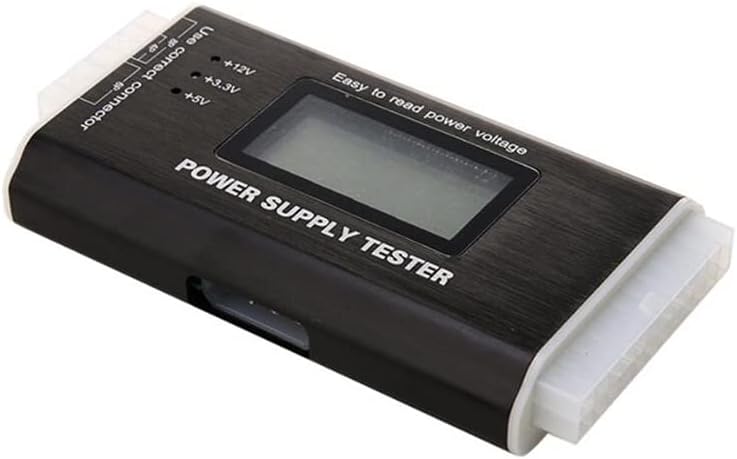


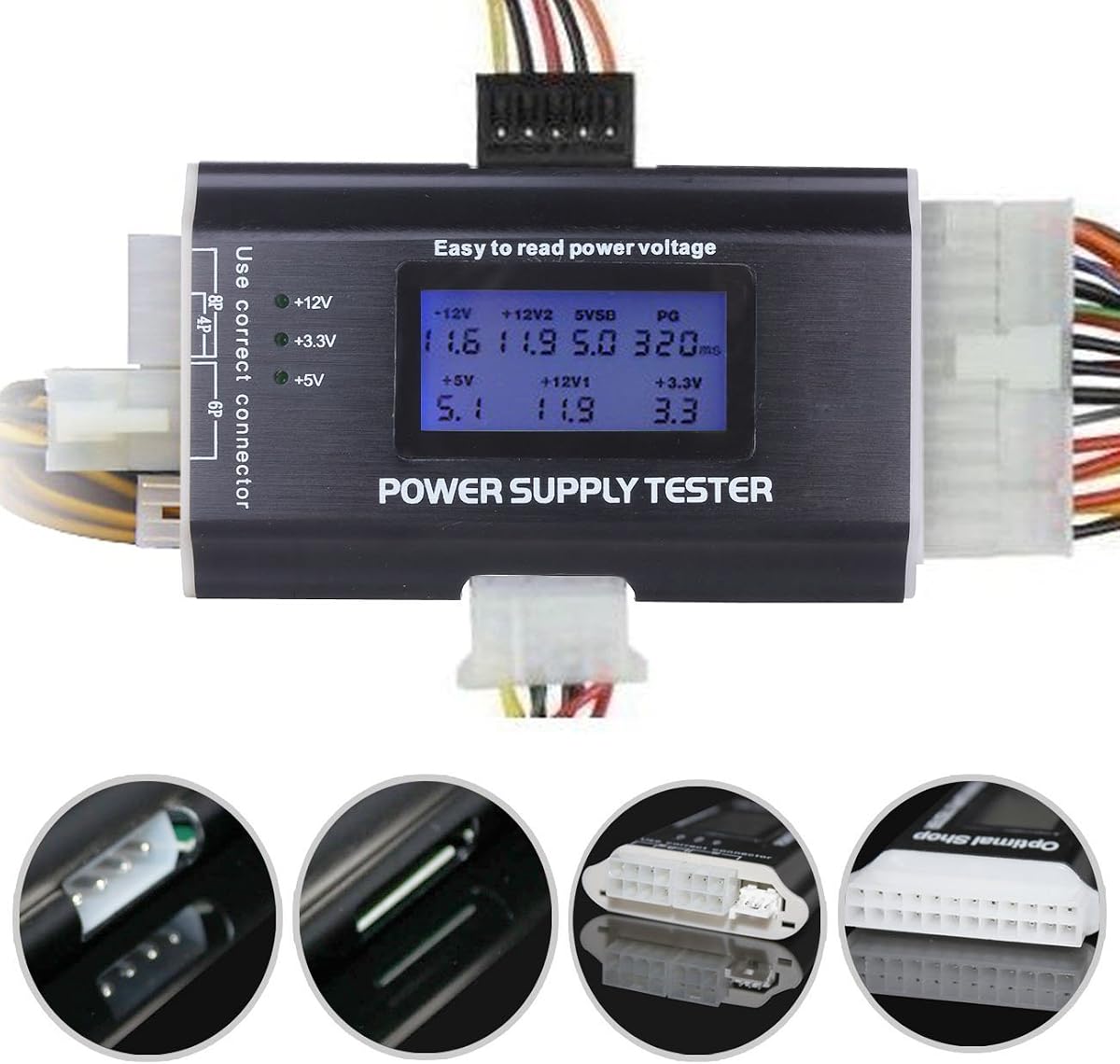
The Computer PC Power Supply Tester is an eight-in-one diagnostic device with a 4.5 rating. It supports 20-pin and 24-pin ATX connections along with HDD, floppy, 4-pin, PCI Express 6-pin, EPS 8-pin, and SATA connectors. Its main attraction is the combination of a 1.8-inch LCD, individual rail indicators, and a buzzer that alerts the user when readings fall outside the normal range.
We may earn a commission when you buy through this link, at no additional cost to you.
The LCD presents the principal ATX readings, including 3.3-volt, 12-volt, 5-volt, negative 12-volt, standby 5-volt, and power-good status. Peripheral connectors use the LEDs on the left, giving a quick visual indication of available power rails. The protective film placed over the display may initially look like scratches, although the supplied information clarifies that it can be removed if preferred.
One important limitation is that the EPS 8-pin connector is supported, but the PCI Express 8-pin configuration is not. A tester intended for modern graphics equipment should therefore be checked against the exact connector layout of the PSU. The display is also vulnerable to scratches, so retaining its protective film and avoiding contact with tools is sensible during repeated bench use.
This tester is a practical choice for computer repair technicians, system builders, and owners of older or mixed-connector power supplies. It offers more diagnostic visibility than a basic cable tester while remaining compact and straightforward. Buyers seeking a broad set of legacy connections and audible fault notification will find this model particularly useful.
The LCD provides detailed numerical information from the main ATX connection, while LEDs cover the peripheral outputs. The buzzer adds a hands-free warning signal, making it easier to notice an abnormal reading while the PSU remains connected to the tester.
Support for floppy, IDE, SATA, 4-pin, 6-pin, and EPS connections makes the device useful for inspecting a varied collection of desktop components. It is especially handy for technicians who encounter older hardware alongside newer graphics cards.
We may earn a commission when you buy through this link, at no additional cost to you.
This 20/24 Pin LCD Computer PC Power Supply Tester carries a 4.4 rating and is designed for quick inspection of ATX, BTX, ITX, and TFX power supplies. The LCD displays output voltage and PG information, and the device states a measurement accuracy of plus or minus 0.01 volt. This makes it useful for users who want more detail than a simple power indicator without relying on a full bench multimeter.
We may earn a commission when you buy through this link, at no additional cost to you.
Its diagnostic behavior is designed to be noticeable. When a parameter exceeds the normal range, the buzzer sounds and the corresponding LCD value flashes. Supported interfaces include 20-pin and 24-pin ATX, SATA, 4-pin and 8-pin power, PCI Express 6-pin graphics, floppy, and hard-disk connections. The main display receives detailed voltage information when the 20-pin or 24-pin connector is attached.
Peripheral outputs do not receive individual numerical LCD readouts. Instead, the P4, P6, P8, SATA, and IDE connections are represented by status lights. This division of information is sensible for a compact tester, but it means the LCD should be viewed primarily as a main-rail diagnostic tool rather than a complete multi-rail digital meter.
The device suits technicians, enthusiasts, and repair shops that want an inexpensive, compact way to check whether a PSU is producing normal outputs. It is particularly useful when a computer fails to POST, shuts down unexpectedly, or exhibits symptoms that could point to an unstable power supply. Its straightforward alarm and flashing-value system makes abnormal conditions easier to recognize.
The stated plus or minus 0.01-volt display precision helps users compare multiple outputs quickly. It is most useful when evaluating the main ATX rails and confirming whether the power-good signal is behaving as expected.
Combining a buzzer with flashing values reduces the chance that an abnormal reading will be overlooked. That makes the tester convenient for rapid inspection of multiple candidate power supplies.
We may earn a commission when you buy through this link, at no additional cost to you.
The Kingwin Digital Power Supply Tester has a 4.6 rating, making it one of the strongest-rated products in this guide. It is positioned as a comprehensive diagnostic tool for ATX, ITX, IDE, HDD, SATA, and BTX power supplies. The digital LCD provides real-time voltage information, while the simple connection process makes the device approachable for first-time users as well as experienced repair personnel.
We may earn a commission when you buy through this link, at no additional cost to you.
A useful feature set includes readouts for common rails such as 12, 5, and 3.3 volts, a multi-connector design, and a compact aluminum enclosure. The product information also describes safeguards intended to protect against short circuits and overvoltage. These characteristics make the tester more than a basic on-and-off power indicator, particularly when a suspect PSU needs to be assessed before it is returned to a computer.
The supplied information does not spell out the exact numerical resolution or the precise way every abnormal condition is indicated. It says that quick diagnostic results help identify faulty power supplies, but unlike several competing models, it does not explicitly describe flashing values and an automatic buzzer. Buyers who depend on audible alarms should confirm that feature in the current listing before ordering.
This tester is a strong option for system builders, repair technicians, and computer owners who want a compact, dedicated PSU diagnostic tool. Its strong rating, broad compatibility, readable display, and straightforward operation make it a particularly balanced recommendation. The lack of a fully enumerated connector list and alarm explanation prevents it from being an effortless choice for every user.
Real-time digital readings make it easier to evaluate a PSU without attaching a complex multimeter setup. The screen is intended to provide enough numerical context for routine troubleshooting and routine maintenance.
Compatibility with several established desktop PSU formats makes the device useful in varied workshop environments. It can serve as a general-purpose inspection option for anyone building or maintaining older and mixed computer systems.
We may earn a commission when you buy through this link, at no additional cost to you.
The Computer PC Power Supply Tester with 20/24 Pin LCD is a 4.4-rated diagnostic tool for ATX, BTX, ITX, and TFX supplies. Its LCD presents 12-volt, negative 12-volt, 5-volt, negative 5-volt, 3.3-volt, standby, and PG information. That breadth of visible information gives users a more complete picture of PSU behavior than a tester that only displays whether power is present.
We may earn a commission when you buy through this link, at no additional cost to you.
Fault signaling is handled through both sound and screen movement. An intelligent monitoring system triggers a buzzer and flashes the abnormal parameter when a voltage leaves the normal range. The stated measurement precision of 0.01 volt also supports more deliberate troubleshooting, particularly for an intermittent PSU that seems to work but produces inconsistent readings.
Connector support includes 20-pin and 24-pin ATX, SATA, 4-pin, 8-pin, PCI Express 6-pin, floppy, and several other power interfaces. The product is described as lightweight and intuitive, reducing the need for advanced technical knowledge. One minor ambiguity is that the supplied information does not explain whether the LCD includes a removable protective film, something clearer in listings for some competing devices.
The tester is well suited to computer repair personnel and advanced users who want broad signal visibility in a portable format. It can be used during routine maintenance, when reusing a stored PSU, or when a system will not power normally. Its combination of multiple readouts, precision, and two forms of fault warning makes it a versatile bench companion.
Showing standby and PG alongside the common voltage rails helps users determine whether a PSU has reached a proper operating state. This is more useful than focusing on a single output when investigating a no-start condition.
Flashing parameters direct the user's eye toward the problem, while the buzzer provides a second indication. The combination is valuable when testing several PSUs in succession or when a bench is otherwise noisy.
We may earn a commission when you buy through this link, at no additional cost to you.
The ATX Power Supply Tester is a 4.3-rated model aimed at desktop PC power supply inspection. It supports ATX, BTX, ITX, and TFX formats, with a 20-pin or 24-pin connection supplying the main LCD information. Its stated display accuracy is plus or minus 0.01 volt, and an automatic buzzer alerts the user when a defect is detected.
We may earn a commission when you buy through this link, at no additional cost to you.
The tester can also measure P4, P6, P8, SATA, and IDE output wiring. These peripheral readings are represented by indicator lights rather than separate numerical LCD values. That arrangement keeps the device compact, but it also means the display is most informative when the main ATX connector is attached. For users who want a screen for every rail, this is less comprehensive than a dedicated multi-channel meter.
The main appeal is convenience. Instead of manually setting up a multimeter for a basic power check, a user can connect the tester and review the LCD for an immediate indication of output status. The supplied information describes the device as small and practical, with multiple test functions intended for quick diagnostics. Its 4.3 rating suggests generally favorable user reception, though it trails the highest-rated models in this selection.
This tester is a sensible option for ordinary desktop owners, repair technicians, and system builders who want a straightforward PSU check. It works particularly well for quickly sorting a suspect supply from a healthy one before deeper investigation. Users who require detailed numerical monitoring of every peripheral output should choose a tester with a more extensive display.
The plug-in workflow reduces the learning curve for basic power supply checks. It is a practical tool for quickly confirming the behavior of common ATX rails without manually arranging multiple meter probes.
Although peripheral outputs use LEDs rather than numerical screen values, the indicators still offer a convenient presence check. They are useful for confirming the presence of expected power on legacy and modular PSU cables.
We may earn a commission when you buy through this link, at no additional cost to you.
The Computer Power Supply Tester is a compact 20/24-pin diagnostic device with a 4.2 rating. It supports ATX, BTX, ITX, and TFX power supplies, and its LCD provides real-time voltage readings. When the PG value fails, the tester sounds a buzzer and the corresponding display flashes, giving users both an audible and visual indication of a problem.
We may earn a commission when you buy through this link, at no additional cost to you.
Its aluminum construction offers a lightweight body with good thermal conductivity, while the compact format makes it easy to carry between locations or keep in a repair kit. Multiple connectors broaden the range of PSUs that can be inspected. The product information describes the layout as practical and emphasizes quick diagnosis, which makes the tester approachable for computer owners with limited electrical experience.
The product listing says built-in measures can help prevent short circuits, but it provides limited detail about the exact protection mechanism or the accepted operating conditions. As a result, users should continue to use sensible testing practices and avoid forcing connectors. The 4.2 rating is the lowest among the products here, which may matter for buyers who place greater weight on customer feedback.
This model is best suited to lightweight diagnostics, storage in a home workshop, or quick checks between larger repair tasks. It is useful when a PC exhibits intermittent power symptoms and the owner wants to screen a PSU before investing time in other components. Users prioritizing stronger feedback, more detailed specifications, or broader documented precision may prefer another option in the guide.
The small aluminum enclosure is easy to store and carry, which helps ensure the tester is available when a power-related problem appears. Its modest footprint also makes it suitable for a crowded workbench.
The PG alarm focuses attention on a failed startup signal, a useful clue when a PSU powers some outputs but does not bring a system to a normal state. The flashing value reinforces the audible warning.
We may earn a commission when you buy through this link, at no additional cost to you.
The Computer PC Power Supply Tester ATX Testing Kit is the highest-rated product in this roundup at 4.8. It is designed for 20-pin and 24-pin power supplies and supports ATX, BTX, ITX, and TFX formats. The LCD displays voltage groups and PG values, while a buzzer provides automatic warning when a defect is detected.
We may earn a commission when you buy through this link, at no additional cost to you.
Operation is straightforward: connect the tester to the PSU's ATX connector, and the screen shows whether the principal outputs appear normal. Peripheral P4, P6, P8, SATA, and IDE connections are handled by light indicators rather than numerical LCD values. This arrangement gives technicians a quick way to evaluate several cable types without making the tool excessively large.
The enclosure uses thick plastic described as hard to break or damage. While it does not have the premium appearance or heat dissipation of an aluminum model, that does not appear to conflict with its primary function. The main limitation is the same one found in many compact competitors: a peripheral rail may be present, but the tester does not provide a separate numerical voltage for it on the screen.
This kit is an excellent general recommendation for computer repair work, system building, and PSU reuse. Its high rating, simple workflow, clear display, and automatic alarm make it approachable without sacrificing useful diagnostic feedback. It is especially valuable for users who want one device capable of handling several common desktop PSU formats and legacy output connectors.
The combination of a strong customer rating and a simple one-connection workflow supports confident routine use. Users can screen a PSU quickly and move to the next stage of troubleshooting with useful information in hand.
The tester handles the major ATX connection and several legacy peripheral interfaces. This versatility makes it valuable for mixed hardware collections and repair technicians who regularly encounter older cables.
We may earn a commission when you buy through this link, at no additional cost to you.
The 20/24 4/6/8 Pin Computer PC Power Supply Tester is a 4.4-rated compact tool for ATX, BTX, ITX, and TFX supplies. It offers an LCD with stated accuracy of plus or minus 0.01 volt and an automatic alarm, while its connector selection includes 4-pin, 6-pin, and 8-pin formats alongside SATA and HDD connections.
We may earn a commission when you buy through this link, at no additional cost to you.
The tester connects to the ATX connector and displays voltage and PG values, making it possible to judge the behavior of a supply with minimal setup. P4, P6, P8, SATA, and IDE outputs are represented by lights, whereas the 20-pin or 24-pin connection supplies the detailed LCD voltage display. This is an efficient division of information for a small diagnostic device.
The supplied bullet points contain an unusual description of the alarm operating when a value is within the normal range, even though the surrounding text calls it an automatic fault alarm. This inconsistency makes it sensible to check the current instructions and observe the display rather than assuming every sound represents a problem. The peripheral information limit also remains relevant for advanced rail analysis.
The device is well matched to owners of older desktop systems and technicians who want a small tool for routine inspection. Its connector variety makes it more versatile than a tester restricted to the main ATX plug, while the LCD provides the numerical detail needed for a basic power diagnosis. It is a practical selection for a home maintenance kit.
The small form factor is convenient for storage and transport. Despite its modest size, the LCD and individual rail indicators provide enough information to conduct a meaningful first-stage PSU assessment.
Support for 4-pin, 6-pin, 8-pin, SATA, and HDD connections makes the tool useful beyond modern 24-pin-only systems. It can be particularly useful when maintaining equipment that predates modular power supplies.
We may earn a commission when you buy through this link, at no additional cost to you.
The PC Power Supply Diagnostic LCD Testing Device is a 4.4-rated model for ATX, BTX, ITX, and TFX power supplies. It displays voltage and PG information with a stated accuracy of plus or minus 0.01 volt. If a voltage or PG problem is detected, the corresponding value flashes and the buzzer provides a warning signal.
We may earn a commission when you buy through this link, at no additional cost to you.
Its testing process is accessible: after connecting the ATX plug, the user can see whether each main circuit is operating within the expected range. The device supports 20-pin and 24-pin configurations along with 4-pin, 6-pin, 8-pin, SATA, IDE, and HDD-related connections. It is also described as useful for power sales personnel and companies involved with computer components.
One shortcoming is that the supplied information provides less detail about the exterior material and construction than the descriptions for several competitors. It does not establish whether the housing is aluminum, plastic, or a combination, which may matter to buyers who prefer a particularly durable enclosure. The information also focuses on ATX, SATA, and IDE rather than providing a fully exhaustive port inventory.
The tester is a good fit for owners seeking a simple LCD diagnostic and for service staff who need a portable power-check tool. It provides useful numerical context, audible alerts, and broad compatibility in a compact package. The balanced feature set and solid rating make it a credible option for everyday PC troubleshooting.
The LCD combines voltage values with PG status, giving new users more information than a simple illuminated tester. Its straightforward connection process helps make a basic diagnosis less intimidating.
The ability to display fault information and provide an audible warning makes the device useful beyond a home desktop. It can support quick inspection workflows involving multiple candidate power supplies.
We may earn a commission when you buy through this link, at no additional cost to you.
The 20+4 Pin LCD Computer Power Supply Tester is a 4.5-rated diagnostic device for SATA, IDE, HDD, ATX, ITX, and BYI-style connections. Its 1.8-inch LCD displays output voltage, and a buzzer sounds if the PSU's PG value fails. The product also carries a removable screen film intended to reduce accidental scratches.
We may earn a commission when you buy through this link, at no additional cost to you.
Its eight-in-one design covers 20-pin and 24-pin IDE, HDD, floppy, PCI Express 6-pin, 4-pin, 8-pin, and SATA connectors. When testing the peripheral connections, LEDs show the presence of 12-volt, 3.3-volt, and 5-volt power. The aluminum alloy enclosure is described as lightweight, strong, thermally conductive, and resistant to corrosion.
The 20+4-pin design and extensive legacy connector focus make this more suitable for older or mixed hardware than for users who only need to examine modern desktop supplies. The supplied information does not clearly discuss BTX or TFX compatibility, and the screen's scratch sensitivity remains a minor concern even with the protective film. Numerical values for individual peripheral rails are not shown.
Despite those limitations, this tester offers a strong rating, a metal housing, and a capable eight-in-one connector set. It is a practical choice for repairing and maintaining older PCs, testing legacy storage cables, or supplementing a workshop where a mix of ATX-era components remains in service.
The aluminum alloy shell gives the tester a sturdy, portable feel and helps protect the internal display and connector assembly. It is a practical enclosure for a device likely to move between repair benches or storage locations.
Floppy, IDE, PCI Express 6-pin, and multiple ATX connections cover many cable types found in older systems. This makes the device especially useful for retro-computing maintenance and mixed-vintage workshop inventories.
We may earn a commission when you buy through this link, at no additional cost to you.
The right ATX computer power supply tester depends on the connectors and power supply formats in your collection, the depth of numerical information required, and how often the device will be used. The following factors help narrow the field without overlooking important safety or compatibility details.
Begin with the connector used by the power supplies you intend to inspect. Most modern desktop PSUs use a 24-pin ATX plug, while many older units use a 20-pin connection or a 20+4 arrangement. Every product in this guide supports 20-pin and 24-pin operation, but the physical cable layout and included adapters still matter. A tester that fits the supply mechanically is only half the requirement; it must also display the relevant voltage and PG signals from that connection.
A useful tester should make the primary voltage rails visible rather than merely indicating that the unit has power. Look for displays covering 12, 5, and 3.3 volts, along with negative 12-volt, standby 5-volt, and PG where practical. PG is especially important because a PSU can produce some voltages yet fail to signal that the system is ready to operate. Models that combine numerical readings with PG status provide a more complete first-stage diagnosis.
A tester designed for broad repair work may also need to check 4-pin, 6-pin, 8-pin, SATA, IDE, floppy, and EPS connections. The products differ in how they report these outputs: many use status LEDs instead of placing each peripheral voltage on the LCD. LEDs are fast and convenient for presence checks, while dedicated numerical readings would be better for detailed analysis. Match the tester to the actual cable types found in the systems you maintain.
Audible and visible alerts are valuable during a quick inspection. Most models in this guide use a buzzer for abnormal readings, and several also flash the corresponding LCD value. This dual approach helps draw attention to the rail or PG status that needs investigation. Descriptions are not always perfectly consistent, so users should consult the current instructions and learn whether silence, a tone, or a flashing display corresponds to normal operation before evaluating a PSU.
The LCD is the main diagnostic interface, so its readability should matter more than decorative controls. Several products use a 1.8-inch screen, which is large enough to present essential rail values while keeping the enclosure compact. Digital figures should be distinguishable at a normal bench viewing distance, particularly if the tester will be used in a poorly lit workspace. The display may also be scratched easily, as noted in some product descriptions, so keeping the protective film is a practical precaution.
Consider where the tester will live. Aluminum models are lightweight and can offer effective heat conduction, while a thick plastic shell can provide impact resistance at a lower weight. A compact enclosure is easier to store in a technician's toolkit and convenient for owners who only need occasional checks. Material alone does not determine diagnostic quality, so it should be considered alongside the display, connectors, and fault-warning features rather than in isolation.
ATX is the main focus, but many desktop power supplies use related form factors. Nine of the ten products in this guide explicitly mention ATX, BTX, ITX, and TFX support, while the 20+4-pin model emphasizes ATX and ITX along with legacy storage connectors. Confirming format support is useful for workshop inventories, but a label alone may not describe every electrical nuance. Users should still match the tester to the PSU's physical connectors and observed signaling.
There is a meaningful difference between a quick power-presence check and a detailed investigation of every output. A basic LED tester may be sufficient for routine cable inspection, while an LCD with precise readings is better for troubleshooting shutdowns, failure to POST, and unstable behavior. None of these compact testers should be treated as a complete substitute for expert electrical analysis in every circumstance, but the more informative models can narrow down a suspected fault much faster.
Before testing, switch the PSU off, unplug its mains cable, and allow any stored power to dissipate. Connect the tester to the appropriate 20-pin, 24-pin, or 20+4 ATX connector without forcing it. Review the tester instructions to identify which cable supplies the LCD with power and which additional connectors use LED indicators. Once connected, the tester can be used to observe voltage and PG behavior.
Turn on the power supply and allow the display to stabilize before drawing conclusions. Compare the displayed rails with the expected values, and note whether the PG indication appears normal. If the tester sounds an alarm or flashes a value, record which parameter is abnormal, disconnect the PSU from mains, and unplug the tester before examining the power supply. Use the appropriate peripheral connector only when the PSU's cable design and connector type are compatible.
After use, disconnect the mains power and then remove the tester from the ATX connector. Avoid pulling on the display, exposed leads, or connector shells. Keep the protective screen film in place, clean the enclosure with a dry or lightly damp cloth, and store the tester in a dry place away from conductive tools. Periodically inspect the connectors for bent pins, loose parts, or debris that could produce misleading results.
An ATX power supply tester checks the output of a desktop PSU without placing the unit directly into a computer. Depending on the model, it displays voltage rails and PG status and may provide LED indications for SATA, IDE, 4-pin, 6-pin, or 8-pin outputs. It is useful for screening a suspect PSU before further troubleshooting.
A tester can reveal abnormal voltage, missing outputs, and PG faults, but a normal reading does not guarantee long-term reliability. Intermittent behavior, poor load regulation, and issues appearing only under sustained load may require additional testing. The results should therefore be considered alongside symptom details and the PSU's history.
No. Most provide detailed numerical readings from the 20-pin or 24-pin ATX connection, while peripheral connectors are represented by LEDs. These LEDs are useful for checking whether expected rails are present, but they do not provide the same numerical precision as a full digital measurement across every cable.
PG stands for power good, a signal that indicates the PSU believes its outputs have stabilized and the system may begin startup. A missing or failed PG indication can explain why a power supply appears to turn on but the computer does not start normally. It should be considered alongside the voltage readings rather than in isolation.
It is safer and generally more appropriate to test the PSU outside the computer. Disconnecting the computer reduces the risk of confusing a computer or cable fault with a power supply fault. The tester should also be handled according to its instructions, with the correct connector used and the unit disconnected from mains before removing it.
If you own only modern desktop systems, a 24-pin-capable tester will usually handle the main power connection. Support for 20-pin and 20+4 arrangements is valuable for older computers, refurbished systems, and repair technicians with mixed hardware. Every product in this roundup supports both 20-pin and 24-pin connections.
The buzzer is generally intended to warn that a voltage or PG reading is outside the expected range. One product description contains ambiguous wording, so users should confirm the alert behavior in the current instructions. Watching the LCD and identifying the flashing parameter is the most reliable way to understand the warning.
It depends on the connector design. Many of these testers support 4-pin, 6-pin, 8-pin, or EPS-style connections, but connector appearance alone may not guarantee full compatibility with every modern graphics cable. Check the PSU's connector layout, and confirm both the physical fit and the type of voltage the tester is designed to identify.
The Computer PC Power Supply Tester ATX Testing Kit is the leading all-around choice because it combines a 4.8 rating with a readable voltage and PG display, automatic fault warnings, and broad compatibility. The Kingwin Digital Power Supply Tester is a strong premium-oriented alternative for users who value real-time numerical readouts, a compact aluminum body, and straightforward operation across common desktop PSU formats.
The standard Computer PC Power Supply Tester is an appealing practical selection for mixed-connector systems because it supports eight connection types, an LCD, individual LEDs, and an audible alarm. Buyers should prioritize the formats and cables they actually use, confirm how peripheral voltages are reported, and consider whether an aluminum or plastic housing better fits their storage and handling habits.
Before making a final choice, review the current product listing, connector illustration, supported formats, and user feedback. Marketplace details and availability can change, and the most reliable purchase is the tester whose display, warnings, and connections match the equipment you expect to diagnose.