
GANA Bidirectional HDMI Switcher
4.3Editor score
4K at 60Hz
Bidirectional switching
No external power
Three HDMI ports
Aluminum enclosure
This HDMI Y Splitter guide compares ten splitters and switchers for resolution, refresh rate, HDCP, audio, display count, and setup needs in 2026 for shoppers.
An HDMI Y splitter sends one source to two displays at the same time, making it useful for duplicating a game, presentation, or movie across multiple screens. A capable unit should provide stable video, compatible audio, straightforward setup, and enough bandwidth for your intended resolution and refresh rate.
We compared the ten products below by examining their input and output arrangements, supported resolutions, HDCP versions, audio formats, cable requirements, included accessories, and practical limitations. The list includes dedicated splitters, a four-output model, and bidirectional devices that can also function as switches.
Each review identifies the setup for which that product is best suited, along with important trade-offs such as mirror-only operation, shared bandwidth, missing cables, or switcher behavior. Product ratings and technical details reflect the supplied information, while current prices and availability may change over time.
4.3Editor score

4.7Editor score

4.5Editor score
The comparison below highlights each device's core function, maximum resolution, copy or switch behavior, and practical connection needs. Remember that a true Y splitter mirrors one source, whereas a bidirectional switcher generally shows only one connected display at a time.




The avedio links HDMI Splitter is a dedicated one-input, two-output duplicator built for showing identical content on two displays. Its 4.1 rating reflects a practical and affordable design, with the standout advantage being the included four-foot high-speed HDMI cable. The splitter can transmit video and audio to both connected screens at the same time, although it cannot present separate desktop content on each display.
We may earn a commission when you buy through this link, at no additional cost to you.
Resolution support reaches 4K at 30Hz and includes 1080p at 50Hz and 60Hz, along with several legacy formats. The supplied guidance recommends an HDMI 2.0 AWG26 cable no longer than 16 feet for 4K and no longer than 32.8 feet for 1080p. Deep color at 12-bit or 16-bit and formats including DTS-HD, Dolby TrueHD, LPCM 7.1, Dolby AC3, and DSD make the device more versatile than a basic video-only adapter.
The most important limitation is that this is a mirror-only splitter. It is not an extended desktop solution, a source switcher, or an audio extractor, so it cannot connect two source devices to one display or independently route sound to a soundbar. HDCP 2.2 is not supported, and stable operation calls for a connected 5V 1A USB power adapter, which is not included in the package.
This splitter is a sensible option for duplicating a console, laptop, or streaming presentation across two televisions when both screens need identical content. Buyers who already have suitable cables and do not need 4K at 60Hz will appreciate the included lead and broad format support. It is less suitable for modern high-refresh gaming, protected 4K content, or users requiring independent screen extensions.
This device handles the common requirement of showing the same source on two screens without adding another cable to the box. The included four-foot lead also makes it easier to complete a basic installation, although longer or higher-bandwidth runs should follow the stated AWG26 recommendations.
External USB power can improve stability and reduce the likelihood of no-signal output or flickering. HDCP 1.4 support should also be checked against any protected source you plan to use, since the splitter does not support HDCP 2.2.
We may earn a commission when you buy through this link, at no additional cost to you.
The OREI 1×2 HDMI Splitter is a compact duplicator designed to send one identical source to two televisions or monitors. It carries a 4.4 rating and supports resolutions up to 4K at 30Hz, making it a solid option for standard home entertainment, presentations, and mirrored console play. It is explicitly intended for duplicate displays rather than laptop or desktop extension.
We may earn a commission when you buy through this link, at no additional cost to you.
The splitter accepts a broad range of source devices, including computers, game consoles, streaming devices, Blu-ray and DVD players, satellite receivers, projectors, and Chromecast-style devices. It supports 3D, 1080p at 30Hz and 60Hz, 4K x 2K at 30Hz, and a broad collection of standard video formats. Audio pass-through includes the common digital formats expected by home-theater users.
One awkward wording point in the supplied listing says it will not work with HDCP while also identifying HDCP 1.4 support; the more specific technical description states that it supports HDCP 1.4 but does not bypass it. It also does not support HDCP 2.0 or 2.2. HDMI cables are not included, and the manufacturer recommends high-quality cables no longer than 30 feet for stable performance.
Choose this OREI model for portable or international use because the package includes a dual-voltage power supply and an international adapter/converter. It is a good fit for users who need two screens to show the same content and already own suitable HDMI cables. It is not the right choice for protected HDCP 2.2 content, 4K gaming at 60Hz, or independent multi-monitor desktops.
The included dual-voltage supply and international adapter/converter reduce the need to find a separate compatible power source while traveling. The metal enclosure also helps dissipate heat, supporting more consistent operation in compact entertainment setups.
This splitter keeps setup straightforward when both displays should show the same presentation, channel, or game. Buyers should plan to supply their own HDMI cables and verify that the source uses a compatible HDCP standard.
We may earn a commission when you buy through this link, at no additional cost to you.
The WARRKY HDMI 2×1 is a compact bidirectional HDMI switch with a 4.4 rating and support for 4K at 60Hz. Unlike a dedicated Y splitter, it can be configured in two ways: selecting between two source devices on one display or toggling between two displays connected to one source. In display-switching mode, only one of the two displays operates at a time.
We may earn a commission when you buy through this link, at no additional cost to you.
The fixed three-point-three-foot braided HDMI pigtail is a thoughtful design element. It can reduce connection clutter and avoid some problems associated with loose or low-quality third-party leads. The aluminum shell, only 0.51 inches thick, helps with heat dissipation. An LED indicator provides a visible indication of the active connection, while the underlying device uses a 10.2Gbps chip and AWG26 HDMI 2.0 wire.
Video support includes 4K at 60Hz, 2K, 1080p, 3D, HDR, and HDCP 2.2. The listed audio capabilities include uncompressed digital 7.1, 5.1, and 2-channel audio, with Dolby Atmos and DTS compliance noted for compatible systems. However, it does not support ARC, and the display-toggle mode should not be confused with simultaneous dual-screen output.
This is the most versatile option in the list for someone who wants to consolidate game consoles, streaming boxes, and other sources into one television. It also works when a single source needs access to two displays in alternation. It is best for users who understand that the product is a switch first and a splitter second, rather than someone requiring two screens to remain on simultaneously.
Mode 1 connects two sources to the female ports and lets you switch between them on one display. Mode 2 reverses the arrangement so you can change between two displays, although only the selected display remains active.
Support for 4K at 60Hz, 2K at 144Hz, HDR, and HDCP 2.2 makes the device suitable for modern consoles and demanding displays. Its short fixed cable simplifies source-side placement, though users with unusual port geometry should check the connector orientation.
We may earn a commission when you buy through this link, at no additional cost to you.
The OREI UltraHD 1×2 is a dedicated one-input, two-output splitter aimed at users who need the same content on two displays at up to 4K at 60Hz. Its 4.3 rating and 18Gbps bandwidth make it more future-facing than the common 4K30 duplicator. The device is designed for mirroring, not for extending a computer into two separate workspaces.
We may earn a commission when you buy through this link, at no additional cost to you.
It works with HDMI 1.3, 1.4, and 2.0 equipment and supports 3D alongside LPCM, Dolby AC3, DTS 7.1, DSD, Dolby, and DTS-HD Master Audio. Compatibility extends to Roku devices, 4K televisions, projectors, game consoles, Apple TV, HDMI televisions, cable boxes, Blu-ray and DVD players, PCs, and set-top boxes. The package includes the splitter, power supply, manual, and an international adapter/converter.
The principal limitation is that this is not a desktop extender. Both screens receive the same picture and sound, so it will not create independent productivity areas for a PC. The manufacturer also warns that cables longer than 30 feet will not work, which is a meaningful constraint in large rooms or commercial installations.
This model is a good middle ground between basic 4K30 splitters and higher-end multi-output devices. It suits two-screen gaming, retail demonstrations, conference-room duplication, or home viewing where both screens must remain active. It is a better fit for 4K60 use than the 30Hz models, but buyers should verify protected-content compatibility for their particular source before purchasing.
The combination of 4K at 60Hz and 18Gbps bandwidth provides enough headroom for common high-resolution use. Its broad audio support also makes it useful beyond a basic game-console duplication setup.
A metal-style enclosure, supplied power supply, international adapter, and one-year warranty make the product practical for regular installations. Cable length remains the main physical constraint.
We may earn a commission when you buy through this link, at no additional cost to you.
The GANA Bidirectional HDMI Switcher is a budget-oriented three-port device that can either connect two HDMI sources to one display or let one source toggle between two displays. It supports 4K at 60Hz and 2K and 1080p output, with compatibility listed for computers, Xbox systems, PlayStation consoles, Blu-ray and DVD players, televisions, monitors, and projectors.
We may earn a commission when you buy through this link, at no additional cost to you.
Its core strength is simplicity. A manual button changes the active connection, and two LED indicators show which port is selected. No external power supply is needed, reducing clutter and making the unit convenient to deploy near a television. The aluminum housing is also more substantial than the typical lightweight plastic switch.
The most important distinction is that this is not a simultaneous two-screen Y splitter. When used in display mode, only one display works at a time, just as the selected source works at a time in source-switching mode. For vivid 4K video, the supplied guidance calls for a standard HDMI 2.0 cable with a total length of no more than three meters, and no HDMI cable is included.
This is a strong choice for consolidating several sources behind one television without adding power wiring. It also works for alternating between two displays when only one needs to be active. It is less appropriate for mirroring two screens simultaneously, ultra-long cable runs, or environments that depend on automatic source detection.
Because the unit operates without external power, it is easy to install and relocate. The manual button and status lights provide a clear operating method without requiring software or complicated configuration.
The product can be described as a bidirectional switcher with splitter terminology, but it does not keep two displays active together. Checking that distinction before buying prevents disappointment for users who need simultaneous mirroring.
We may earn a commission when you buy through this link, at no additional cost to you.
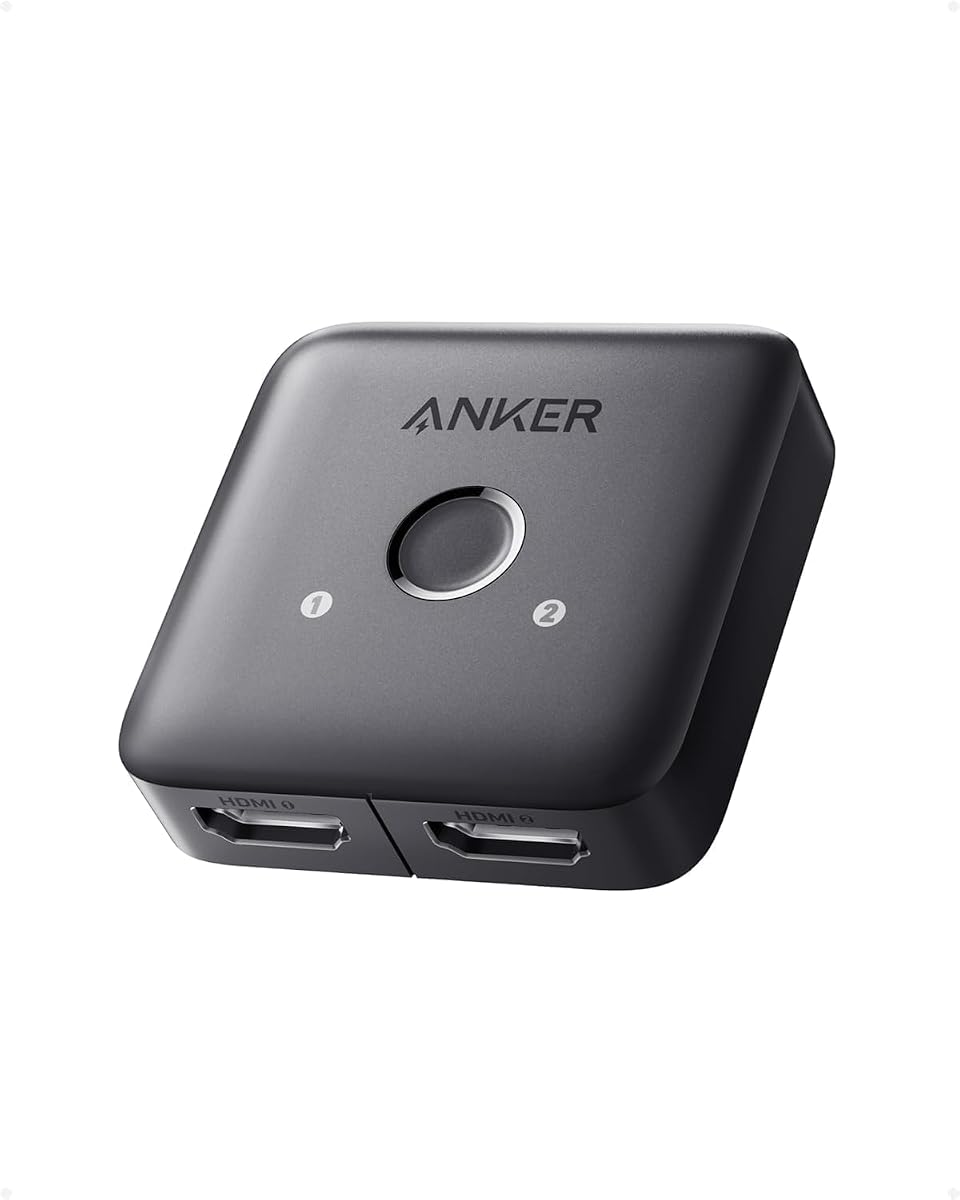
The Anker HDMI Switch is a streamlined two-input, one-output switch for people who want an uncomplicated way to move between a game console, laptop, or streaming device. Its 4.4 rating reflects a well-liked product centered on 4K at 60Hz support and a single manual selection button.
We may earn a commission when you buy through this link, at no additional cost to you.
The device works with common source categories including laptops, game consoles, televisions, and VR headsets. It sends the selected source to one display at a time and does not provide simultaneous dual-display output. A safety guide and 18-month warranty are included, along with customer support from the brand.
There are two clear operational limits. Automatic signal detection is not supported, so the user must press the button to change sources, and HDMI CEC is also absent. For 4K60 output, Anker recommends input and output cables under 3.3 feet using 30AWG, with a combined cable length no greater than 6.5 feet. Those are meaningful limitations for installations with longer cable runs.
Choose this switch when clean operation and straightforward source selection matter more than multi-screen duplication. It is well suited to a desk with a console and laptop, or a television connected to several streaming and gaming sources. It should not be chosen for simultaneous Y-style output, automatic switching, HDMI-CEC control, or installations requiring long cables.
A single manual control keeps the switch easy to understand and prevents accidental source changes. The absence of automatic detection also means there is no dependence on source signaling to trigger a transition.
The 4K60 capability suits current consoles and computers, but short cable requirements should be planned before installation. Keep both sides of the connection compact when possible to preserve signal margin.
We may earn a commission when you buy through this link, at no additional cost to you.
The OREI UltraHD 1×4 is the most capable distribution model in this guide, sending one source to four displays simultaneously. Its 4.5 rating, 18Gbps bandwidth, and support for 4K at 60Hz make it well suited to retail displays, classrooms, bars, presentations, and commercial home-entertainment installations.
We may earn a commission when you buy through this link, at no additional cost to you.
Audio support includes LPCM, Dolby AC3, DTS 7.1, DSD, Dolby TrueHD, and DTS-HD Master Audio. The heavy-duty metal enclosure assists with heat dissipation, while plug-and-play installation means no drivers are required. EDID support can help the source identify an appropriate display configuration, an important consideration when a splitter feeds several different screens.
Like the dedicated two-output splitters in this roundup, it mirrors the same signal rather than creating four independent desktops. The output experience depends on all connected displays, so mixing widely different panel capabilities may constrain the shared signal. Recommended HDMI cable length is up to 30 feet for good stability, and longer runs may require better-quality cables or a different distribution approach.
Choose this model when simultaneous display count matters more than minimalism or a two-screen-only setup. It is the premium selection here because it combines four active outputs, 4K60 capability, broad audio support, and a durable enclosure. It is less suitable for PC extension, unusually long cable routes, or installations that need independent content on every screen.
The 1×4 arrangement is valuable in environments where the same content must be visible across a room or across several screens. All four outputs operate simultaneously rather than cycling between displays.
EDID support can help stabilize source-to-display recognition across multiple screens. The metal enclosure and driver-free setup reduce installation complexity, while the stated cable guidance should still be followed carefully.
We may earn a commission when you buy through this link, at no additional cost to you.
The OREI Compact 1×2 provides a simple way to duplicate one HDMI source across two televisions. Its 4.4 rating and support for resolutions up to 4K at 30Hz, 1080p, 720p, and VGA through WUXGA make it appropriate for standard mirrored viewing rather than high-refresh gaming or advanced computing.
We may earn a commission when you buy through this link, at no additional cost to you.
The central function is uncomplicated: one source feeds two identical outputs. There are no promises of independent desktop extension, source switching, or different content on each screen. This focus makes it easy to understand and potentially useful for duplicating a television signal, game, or presentation across a second TV.
The supplied product information is concise and provides fewer installation details than some competing listings. It does not describe a complete package of HDMI cables or explain power requirements in the same detail. The 30Hz ceiling at 4K should be considered carefully because many current televisions and gaming systems output 4K at 60Hz, and the splitter may then have to fall back to a lower mode.
This model is best for a straightforward dual-TV setup in which mirrored 4K at 30Hz is acceptable. It can work for casual media viewing, shared displays, and simple demonstrations. Buyers seeking high-refresh gaming, a broad audio specification, included cables, or a confirmed international power kit should consider one of the more fully specified alternatives.
The product focuses on the core task of copying one source to two screens. That makes it approachable for users who do not need switching, extension, or advanced source management.
Its stated 4K30 ceiling is sufficient for many standard viewing scenarios but falls short of high-refresh demands. Confirm the refresh rate produced by the source before relying on 4K operation.
We may earn a commission when you buy through this link, at no additional cost to you.
The llano HDMI 2.1 Splitter is the high-end performance option, with the highest rating in the group at 4.7 and specifications aimed at modern gaming displays. It duplicates one input to two outputs while supporting up to 8K at 60Hz and 4K at 120Hz or 240Hz. Both screens show the same content, so this is not a solution for separate desktop extensions.
We may earn a commission when you buy through this link, at no additional cost to you.
Its next-generation 8K chip incorporates signal amplification, and the listing describes improved anti-interference performance for steadier transmission. HDCP 2.3, HDR10, and Dolby Vision support make it particularly appropriate for current consoles, televisions, and computer setups. It is compatible with PS5, Xbox Series X, Nintendo Switch 2, Apple TV, laptops, PCs, Blu-ray players, and streaming boxes.
There are still important boundaries. ARC and eARC do not work, and advanced functions such as ALLM and VRR require support from every connected display rather than functioning on just one screen. Most importantly, the shared video output is limited by the lowest resolution supported across all connected devices. If one screen or intermediary cannot accept the preferred mode, both outputs may be limited accordingly.
Choose llano when high refresh rates, 8K capability, modern protected-content standards, and gaming performance matter most. It is particularly compelling for matching high-end displays that can both handle the target mode. It is less appropriate when the second display is older, when independent desktops are required, or when audio return functionality is essential.
Support for 4K at 120Hz and 240Hz addresses demanding console and PC gaming use. The amplified 8K chip and aluminum enclosure are designed to support stable transmission as the signal load increases.
Both displays must participate in the final mode. A capable 8K television paired with a 4K audio receiver or less advanced second screen can reduce the output on both connections, so compatibility should be checked before installation.
We may earn a commission when you buy through this link, at no additional cost to you.
The OREI 4K 1×2 is a straightforward splitter for duplicating one HDMI source across two screens simultaneously. Its 4.4 rating, broad device support, and clear explanation of mirror-only behavior make it a practical option for home entertainment, presentations, classrooms, and gaming setups that use matching displays.
We may earn a commission when you buy through this link, at no additional cost to you.
The product supports 4K at 30Hz, 1080p at 60Hz, and 3D. Recommended cable lengths reach up to 26 feet for 4K and 30 feet for 1080p, giving buyers more installation flexibility than many short-cable switch designs. Compatibility includes Xbox and PlayStation systems, Blu-ray and DVD players, Fire Stick, Roku, Chromecast, PCs, laptops, satellite receivers, HDTVs, projectors, and monitors.
Its limitations are centered on modern video standards. HDR is not supported, and the unit supports HDCP 1.4 only; it does not bypass or strip HDCP 2.0 or 2.2. HDMI cables are not included. The package does include the splitter, a USB-to-micro-USB power cable, and a user manual, so a suitable USB power source and display cables must be arranged separately.
This model is well suited to users who want uncomplicated 4K30 duplication and recognize that both screens must display identical video and audio. It is useful in offices, classrooms, retail environments, and homes with a second television or monitor. It should be avoided for high-refresh gaming, HDR content, modern protected 4K sources, or independent multi-monitor workflows.
The specified 26-foot limit for 4K and 30-foot limit for 1080p provide a clear basis for installation planning. High-quality cables within those limits are advisable for dependable results across both outputs.
The splitter focuses on simultaneous duplication rather than switching, extension, or audio extraction. That narrow purpose makes behavior easy to predict, provided the source and both displays are compatible with its supported standards.
We may earn a commission when you buy through this link, at no additional cost to you.
Choosing an HDMI Y splitter starts with defining the exact task: simultaneous mirroring, independent desktop extension, source switching, or four-screen distribution. Resolution, refresh rate, content protection, cable length, and included accessories then narrow the field.
A Y splitter normally duplicates one source to two displays, so both screens show identical video and audio. This is useful for a presentation watched in two rooms, a game visible on two televisions, a retail display, or a mirrored desktop. It is not the same as an extended desktop, where each monitor contains a separate portion of the computer workspace. Several products in this guide explicitly warn that they cannot extend displays, while the bidirectional models are primarily switchers that alternate between sources or displays.
Resolution alone does not tell the full story. A device labeled for 4K may support only 30Hz, while a 4K60 model is more suitable for contemporary consoles, computers, and televisions. Gaming users may also want 2K at high refresh rates or 4K at 120Hz or 240Hz. The source, both displays, and every intervening cable must support the intended mode. Products with higher bandwidth are not automatically compatible with every source, so check the complete signal chain rather than relying only on the headline specification.
HDCP governs protected commercial content such as many streaming titles, Blu-ray movies, and cable programming. A splitter with older HDCP support can show a black screen, flicker, or otherwise refuse the protected source. HDCP 1.4, 2.0, 2.2, and 2.3 are not interchangeable in the products reviewed. Several 4K30 units explicitly lack HDCP 2.2, while the llano and WARRKY options support newer versions. Confirm the source's requirements and whether the splitter passes content without bypassing or stripping protection.
An HDMI splitter that duplicates video generally duplicates embedded audio as well, but supported formats vary. The avedio links model lists DTS-HD, Dolby TrueHD, LPCM 7.1, Dolby AC3, and DSD; the OREI four-output model includes DTS-HD Master Audio and Dolby TrueHD. None of the products should be assumed to extract analog or optical audio for a soundbar or speakers. ARC and eARC are also unsupported on the llano model, while the Anker switch does not support HDMI CEC. Check every audio-related limitation if your installation depends on separate sound equipment.
Long runs consume signal margin and can lead to flicker, dropouts, or no picture. OREI recommends cables no longer than 30 feet for several products, and the avedio links model advises AWG26 HDMI 2.0 cable no more than 16 feet for 4K and 32.8 feet for 1080p. By comparison, Anker's switch recommends input and output leads under 3.3 feet, with a combined length under 6.5 feet for 4K60. Measure the full route, including wall runs and hidden furniture gaps, and use good-quality cables appropriate to the resolution and distance.
Most one-in-two-out splitters are sufficient for two displays, but a 1×4 model can drive four screens simultaneously. Bidirectional three-port switchers can offer two source inputs or two display choices, yet they normally activate only one route at a time. Match the port arrangement to the number of displays that truly need to remain active. A four-output device is valuable for digital signage, classrooms, bars, and retail displays, while a two-output unit is usually enough for home viewing or a simple presentation.
Power requirements differ sharply. The avedio links splitter requires a 5V 1A adapter, the latest OREI 1×2 includes a USB-to-micro-USB power cable, the OREI 1×2 and 1×4 models include power supplies, and the GANA and Anker switches need no external power. Cable inclusion is inconsistent: avedio links provides a four-foot HDMI lead, WARRKY has a fixed three-point-three-foot pigtail, while several OREI products and GANA do not include HDMI cables. Count what you already own before choosing a model.
A metal enclosure is not merely cosmetic; it can dissipate heat more effectively than lightweight plastic. The WARRKY switch, GANA switch, llano splitter, and OREI 1×4 splitter all emphasize aluminum or metal construction. A compact design may also be useful behind a television or beside a monitor, but the connector orientation and fixed cable should be checked against available space. Choose a solidly built, properly ventilated unit when it will remain powered continuously in a professional setting.
Begin by confirming that the device is actually a simultaneous splitter rather than a source or display switch. Connect the source to the splitter's input, then connect each display to a separate output. For every cable, seat the connector fully without forcing it, avoid sharp bends in the wire, and avoid placing the splitter beneath a heavy component that can stress the connectors. If the model uses a USB power lead, connect the appropriate power source before testing the displays.
Power on the source and displays in a sensible order, then allow the system a few seconds to negotiate a common resolution and refresh rate. A splitter generally sends the same image to both screens, so set the source to its native output mode rather than forcing an unsupported setting. If there is no picture, reseat every connection, test a shorter cable, and confirm that both displays can accept the current mode. Protected content may require compatible HDCP support, and an older second display can constrain the shared output.
For regular care, keep the unit dry, ventilated, and away from direct heat. Do not open the enclosure, and do not use a power adapter with a different output rating than the one specified by the manufacturer. When changing displays, switch off or disconnect the source before rearranging cables. Periodically inspect connector strain and dust, particularly in retail or classroom environments, because repeated replugging can loosen sockets even when the splitter itself remains undamaged.
Most true HDMI Y splitters in this guide show identical content on both displays because they operate in mirror mode. A product that extends a computer desktop can divide content between screens, but that is a different device category. The bidirectional models here can alternate between sources or displays, yet they generally activate only one route at a time.
A properly functioning splitter that supports the intended mode should not introduce a meaningful gameplay delay, but performance depends on its chip, bandwidth, cables, and source. High-end gaming demands are better met with a model that supports the desired refresh rate, such as the llano splitter at up to 4K240Hz. Using a splitter that only supports 4K30 can force a lower mode, but frame timing may still remain consistent within that mode.
A black second display can result from incompatible resolution, refresh rate, HDCP, or an inadequate cable. Check that both screens support the mode being sent and that the splitter's specifications cover the source. Reseat the connectors, try shorter high-quality cables, and verify that any required power cable is connected before moving to a more complex troubleshooting process.
Physical HDMI compatibility is usually straightforward, but protected streaming content may require a newer HDCP version. The avedio links and older OREI models support HDCP 1.4 and do not support HDCP 2.2, while the WARRKY and llano products list newer standards. Confirm the HDCP requirement of the specific streaming service and source before purchase.
These products generally duplicate embedded HDMI audio to the connected displays rather than extracting it as a separate analog or optical feed. A soundbar may work if it has an HDMI input and receives the split audio that way. If it requires optical, coax, or analog output, an explicit audio extractor is needed, and ARC or eARC support cannot be assumed.
The appropriate length depends on resolution, refresh rate, cable quality, and the splitter's specifications. Several OREI products recommend cables no longer than 30 feet, while the avedio links model recommends no more than 16 feet for 4K using AWG26 cable. Anker's switch has a much shorter recommendation for 4K60, so always follow the guidance for the exact product being installed.
A 1×2 splitter takes one source and sends the same signal to two outputs simultaneously. A 2×1 switcher takes two sources and sends the selected one to one display. Bidirectional models can reverse their roles, but display switching generally means only one chosen display is active at a time rather than both showing a picture.
No. The GANA and Anker switchers operate without external power, while other models use USB power or include a dedicated supply. Follow the specific product instructions and use the specified voltage and current. A compatible power connection can reduce no-signal output or flickering, particularly when several high-bandwidth displays are connected.
The llano HDMI 2.1 Splitter stands out for advanced display and gaming capability, reaching 8K60 and 4K240 while mirroring one source to two screens. The GANA Bidirectional HDMI Switcher is the budget selection for users who mainly need to alternate between sources, and the OREI UltraHD 1×4 is the premium choice when four simultaneous displays are required.
For most simple two-screen installations, prioritize simultaneous mirroring, the required refresh rate, compatible HDCP, and manageable cable lengths over extra switching features. Dedicated models such as the OREI 1×2 4K60 or OREI 4K 1×2 are straightforward choices, while bidirectional devices are better when managing multiple sources or alternating displays is the central requirement.
Before finalizing, verify every device in the signal chain and confirm the splitter's included cables and power accessories. Current prices, promotions, availability, and product details can change, so check the latest listing information and customer-support guidance before making a purchase.