
G-PLUG 15FT RG8X
4.5Editor score
Double-shielded RG8X construction
Gold-plated PL259 center pins
Flexible weather-resistant PVC jacket
Ideal for shorter station runs
Our guide compares the best Coax Cables for Ham Radio, evaluating loss, shielding, connectors, length, impedance, and construction for different radio stations.
Coax cables for ham radio carry the signal between a transceiver, antenna, feed line, and sometimes external tuner or analyzer. A quality cable should preserve that signal while resisting interference, moisture, and mechanical stress. The right choice depends on frequency, cable length, installation environment, connector style, and the power level of the station.
We compared the ten products in this guide using their stated construction, impedance, shielding, connector design, operating-frequency information, length, and intended applications. The list covers 50-ohm RG8X, RG8, RG58, KMR400, and RG316 options, with ready-made PL259 assemblies and one bulk cable designed for connector installation.
Each review explains where the cable fits best, what makes it distinctive, and which trade-offs may matter in a real station. The leading options serve different needs, including shorter runs, flexible routing, heavy-duty outdoor use, and higher-frequency equipment. Product prices and availability can change, so compare the current listing details before buying.
4.5Editor score

4.6Editor score
4.7Editor score
The comparison below highlights the cable type, length, shielding or conductor arrangement, and connector approach of each option. These distinctions help identify the most suitable choice for portable work, fixed installations, compact stations, or long outdoor feed lines.



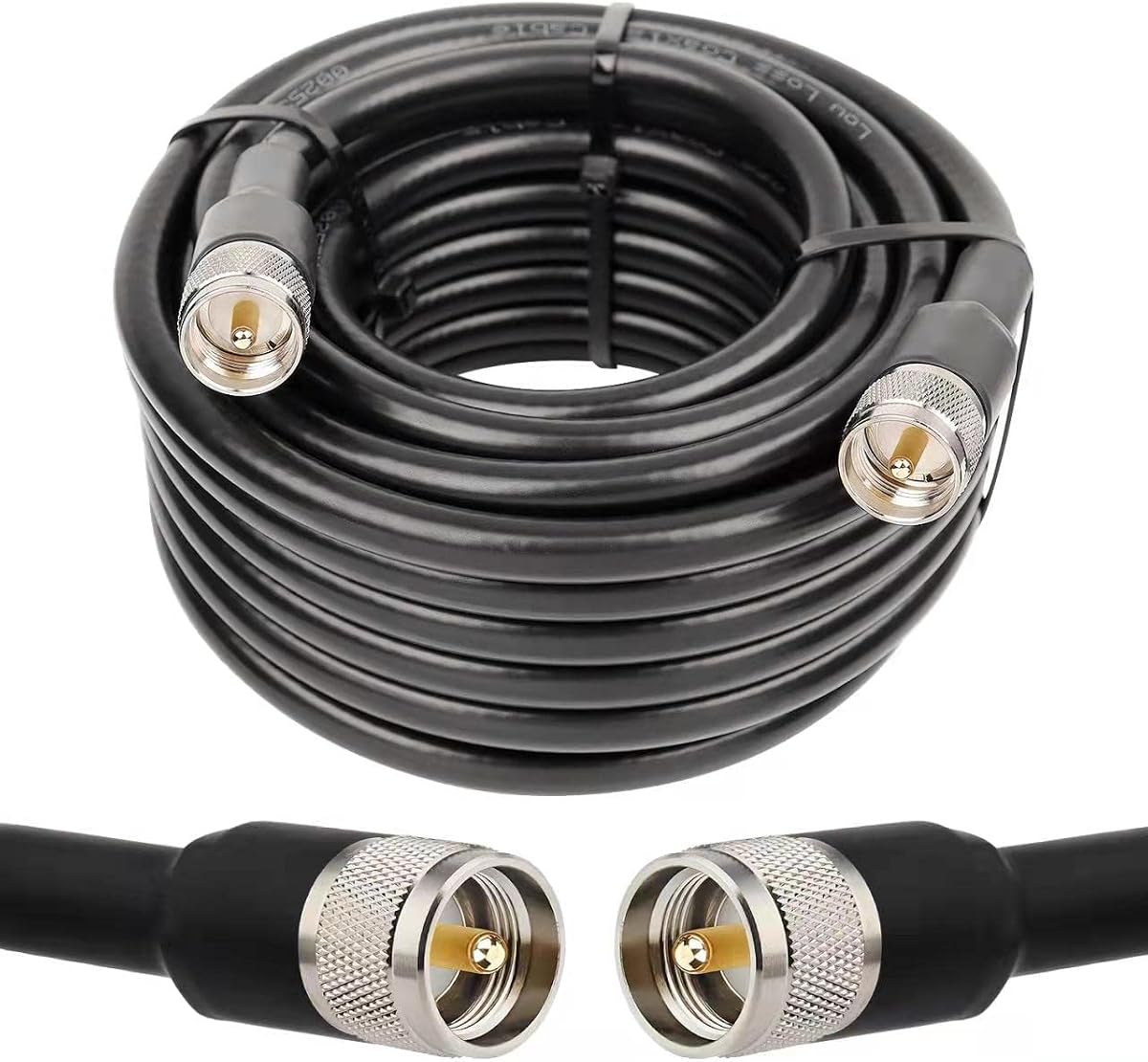

The RG8x Coaxial Cable 50ft is a well-balanced ham radio feed line for operators who want a substantial conductor, 50-ohm impedance, and ready-made PL259 connections. It has a 4.6 customer rating, and its most compelling feature is the use of a 17AWG pure-copper inner conductor. That is a meaningful step up from the center conductors used in many lightweight RG58 jumpers.
We may earn a commission when you buy through this link, at no additional cost to you.
Double shielding is the second major strength. The cable is designed to limit signal leakage, external interference, and avoidable loss, making it a sensible option for a fixed base station, CB radio, antenna tuner, SWR meter, dummy load, or antenna analyzer. Fully molded nickel-plated brass UHF PL259 connectors with gold-plated center pins add mechanical and electrical consistency at both ends.
The flexible PVC jacket is described as waterproof and suitable for indoor or outdoor routing. It can be bent and secured without the rigidity associated with some heavier feed lines, although users planning a very long elevated run should still minimize sharp bends and unsupported sections. Its stated suitability for high-powered applications makes it more versatile than a thin cable intended only for short or low-power connections.
This is a strong all-around choice for a typical 50-foot station installation. It suits operators who want a robust 50-ohm cable without moving to the largest KMR400-class option. The main limitation is length: stations needing more than 50 feet, particularly across a large property, may prefer a 100-foot assembly or a separate bulk cable. Confirm that every device in the signal path accepts PL259 connectors before ordering.
The 17AWG pure-copper center conductor provides a useful margin for higher-powered amateur radio work. It also makes the cable more versatile when the same feed line may serve CB radio, HF, VHF, or radio test equipment rather than one narrowly defined task.
Molded PL259 connectors create a more integrated termination than a loose adapter arrangement, while the double-shielded design is intended to protect the signal from leakage and incoming interference. Those features are especially useful around computers, switching power supplies, and other noisy electronics.
We may earn a commission when you buy through this link, at no additional cost to you.
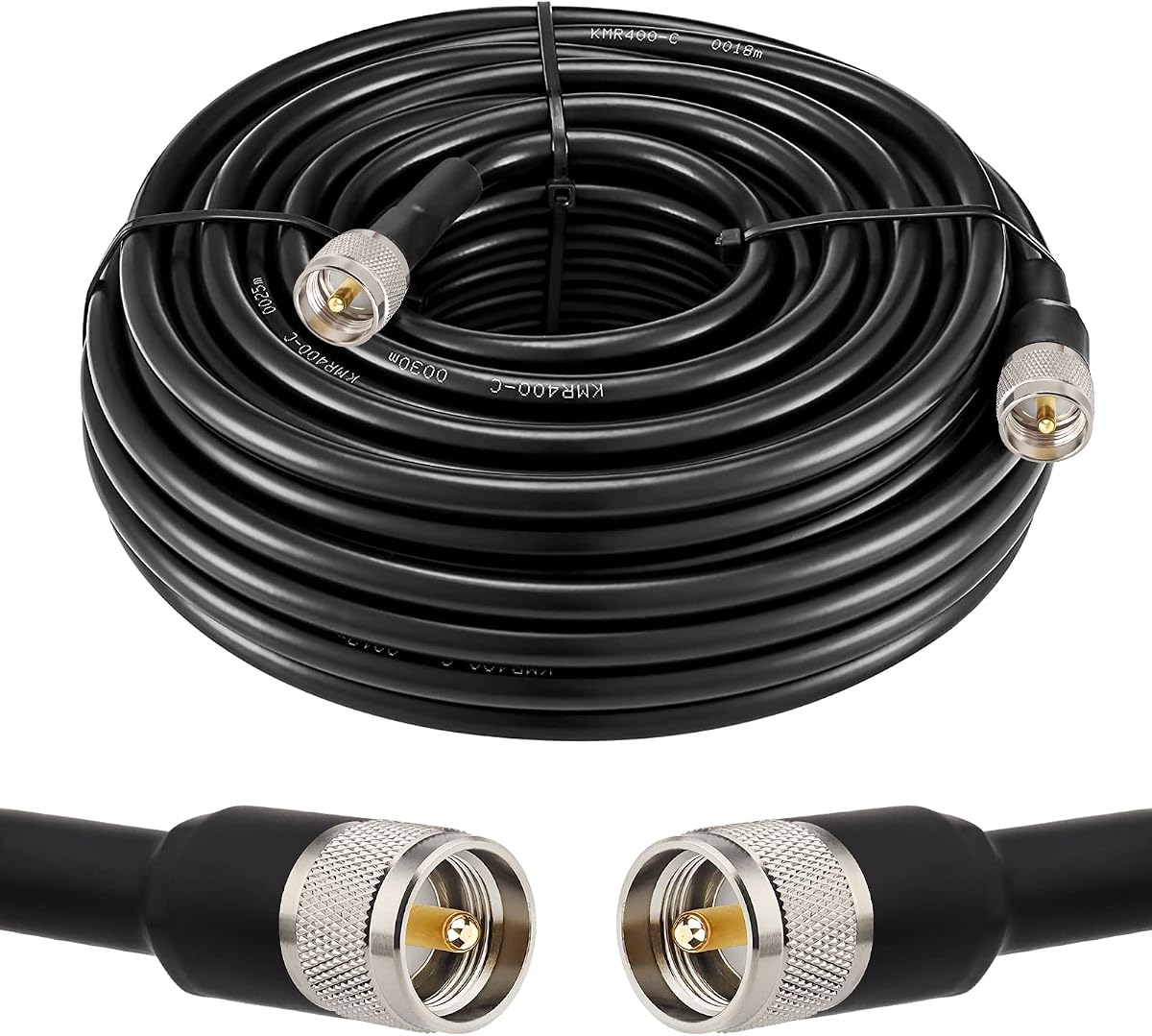
The MOOKEERF 50ft KMR400 is built for operators who want a low-loss feed line with substantial shielding and robust connector terminations. Its 4.7 rating reflects strong customer reception, while the product data gives a loss figure of less than 2.8dB at 450MHz and an SWR at or below 1.25 for the stated 50-foot configuration.
We may earn a commission when you buy through this link, at no additional cost to you.
The center conductor uses copper-clad aluminum, while the outer conductor combines aluminum foil and tinned copper braid. This arrangement is designed to protect the signal over distance and provide resistance to oxidation. A quality PVC jacket and nickel-plated copper connector shells support use in outdoor environments where moisture and corrosion can quickly damage lesser assemblies.
One especially practical detail is the 2.2-inch adhesive-lined heat-shrink tube joining the connector to the cable. The extended strain relief is longer than on ordinary assemblies and helps prevent the connector from pulling away under handling stress. The trade-off is added bulk and weight, which can make this cable less convenient for portable antennas, cramped vehicle routing, or repeated field deployment.
Buy this cable when low loss and mechanical strength matter more than minimum weight. It fits base stations, marine VHF installations, analyzers, tuners, surge-protection devices, and other 50-ohm RF equipment that accepts PL259. It is also a strong choice for a user who wants a heavier KMR400-class cable without moving to a 100-foot run.
The larger KMR400 construction and shielding arrangement are aimed at preserving signal quality across longer distances and at higher frequencies. That makes the cable appropriate for VHF radio and other applications where a thin RG58 or RG316 run would leave less performance margin.
The extended adhesive-lined heat-shrink section protects the vulnerable transition between cable and connector. It adds strain support and helps seal the termination against moisture, which is valuable for rooftop, mast, marine, and other exposed installations.
We may earn a commission when you buy through this link, at no additional cost to you.
The STEREN RG8X 50 ft is a popular 50-ohm feed line intended for ham radio, CB radio, base antennas, analyzers, tuners, and other station equipment. Its 4.7 rating indicates a favorable customer reception. The product presents itself as an upgrade from RG58 for high-powered applications and installations where greater conductor size and durability are desirable.
We may earn a commission when you buy through this link, at no additional cost to you.
Fully molded PL259 connectors are one of its most useful features. They provide a secure connection to compatible radios and accessories, while nickel plating helps the terminations withstand handling and outdoor exposure. The cable is also described as suitable for firestick antennas, 10-meter antennas, 1.8-meter antennas, SWR meters, and 2-way radio applications.
The buyer should note an inconsistency in the supplied product information. The title identifies a 50-foot cable, while one feature bullet refers to a premium 6-foot cable. Since the actual cable length is central to installation planning, purchasers should verify the package contents and dimensions on the listing before ordering. That is a reasonable precaution rather than evidence that the product will perform poorly.
For a conventional 50-foot base-station run, this is a versatile RG8X option. It does not offer the very large center conductor of a KMR400-class cable, but it provides a practical middle ground with molded connectors and broad equipment compatibility. Confirm length, connector sex, and station requirements to avoid unnecessary returns.
RG8X offers a larger conductor and a more substantial feel than RG58, which can make it preferable for high-power stations, fixed installations, and runs that will remain connected for extended periods. It also preserves the familiar 50-ohm system used by most amateur radio equipment.
The listed applications extend beyond a single radio and antenna. A PL259-to-PL259 cable can connect a transceiver to an external SWR meter, analyzer, antenna switch, tuner, or dummy load, provided the equipment offers compatible connectors and the intended system impedance is 50 ohms.
We may earn a commission when you buy through this link, at no additional cost to you.
The G-PLUG 15FT RG8X is the most compact ready-made option in this guide and is well suited to a radio positioned near its antenna. It has a 4.5 rating and combines 50-ohm RG8X construction with a pure copper core, double shielding, and PL259 connectors. Those details make it more than a basic extension for a bench or basic station.
We may earn a commission when you buy through this link, at no additional cost to you.
Gold-plated center pins and nickel-plated brass connector bodies are intended to create a stable, corrosion-resistant connection. The flexible PVC jacket is described as weather resistant, making the cable practical for rooftop antennas, mobile setups, and indoor stations. Its short length reduces excess cable that could add clutter or create awkward loops around the operating position.
A 15-foot cable cannot cover many conventional installations, particularly when an antenna is mounted on a mast, pole, or elevated rooftop. It also does not accommodate flexible placement of a radio within a room. For those situations, a 50-foot or 100-foot assembly will usually be more useful. Connector compatibility remains essential in every case.
This is a sensible pick for a close-mounted antenna, a temporary operating position, a radio test bench, or an amateur station using a short jumper between accessories. It offers the strongest blend of compactness and construction in this list. Just make sure the planned path can be completed without a sharp bend, strain on the terminations, or an improvised extension.
A 15-foot lead can be ideal when the transceiver, tuner, analyzer, and antenna are close together. Keeping the run short can also reduce avoidable loss and make it easier to keep connectors away from moving parts and moisture sources.
Gold-plated center pins and nickel-plated brass bodies provide a useful combination for repeated connection cycles and outdoor exposure. Proper strain relief remains important, so the cable should be supported near the connector rather than hanging by the plug.
We may earn a commission when you buy through this link, at no additional cost to you.
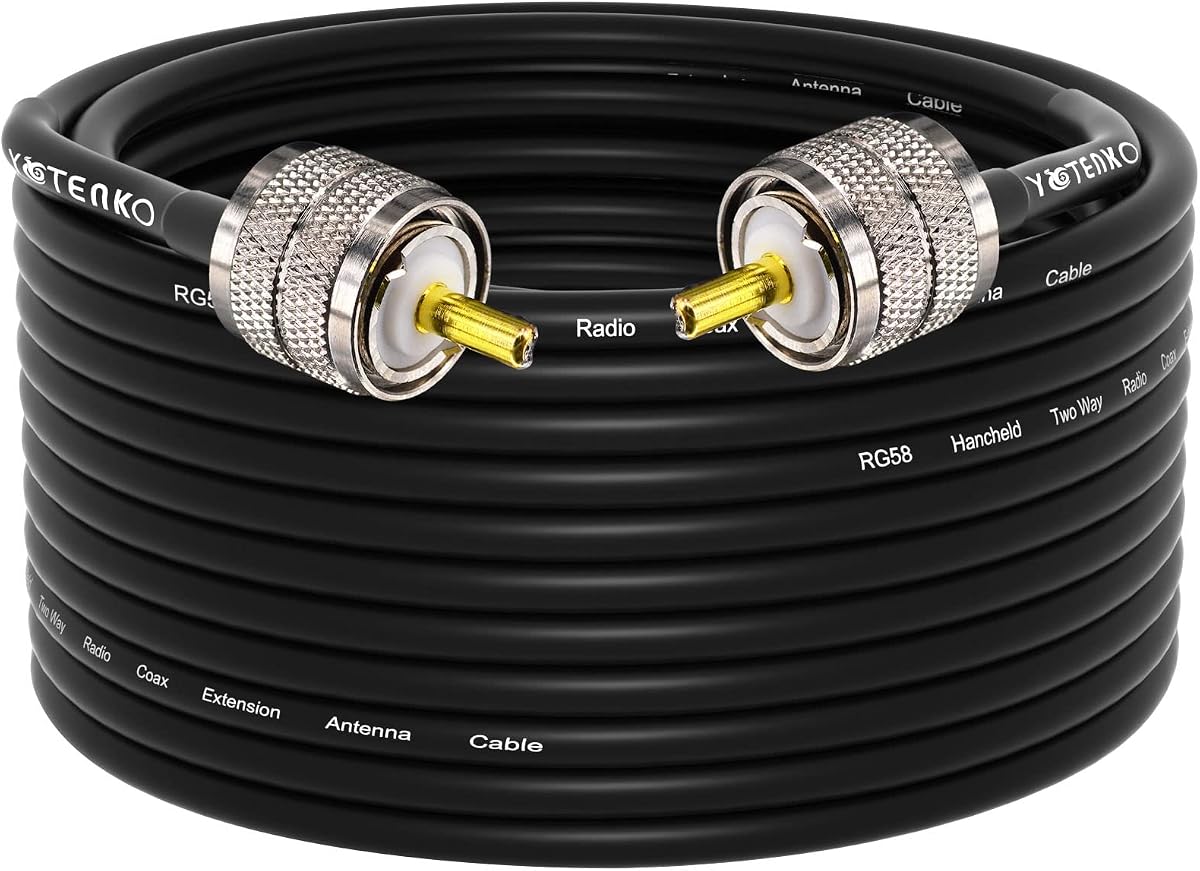
The YOTENKO RG58 49.2ft is designed for operators who need a long, flexible 50-ohm cable more than maximum power handling or minimum loss. It carries a 4.6 rating and is specified for amateur radio bands including 10 meters and 2 meters, along with CB radio and frequencies within 1–300MHz.
We may earn a commission when you buy through this link, at no additional cost to you.
Its 0.195-inch diameter is a major practical advantage over stiffer RG8-class cable. It can pass through window openings, vehicle conduits, and other tight routes where a heavier feed line would be difficult. The bare copper braided shield is also described as more useful for soldering than copper-clad aluminum, giving it an advantage when a custom connector or repair is needed.
The extended 6-centimeter heat-shrink strain relief is designed to spread stress away from the connector solder points. That makes the assembly a better fit for mobile use, temporary field deployments, and installations where the cable will be handled repeatedly. Its limitation is inherent to RG58: more loss and lower power capability than the larger RG8X and KMR400 choices in the list.
Choose this cable for vehicle installations, portable stations, CB radio, and moderate-power equipment on a relatively short path. It is not the first choice for a high-power home station with a long elevated feed point. If flexibility and routing ease are your main priorities, however, its nearly 50-foot length and substantial strain relief make it a convincing package.
The small diameter is particularly valuable in cars, trucks, recreational vehicles, and temporary installations. A flexible feed line is easier to place without fighting a stiff coil or creating the sharp bends that can degrade RF performance.
The extended heat-shrink section helps isolate the connector from bending and pulling forces. It is a meaningful distinction for mobile use, where a cable may be disconnected, repositioned, or handled more often than a permanently installed base-station feed line.
We may earn a commission when you buy through this link, at no additional cost to you.
The exgoofit RG8X 100ft solves the distance problem that affects many ready-made ham radio cables. It has a 4.6 rating, a 100-foot length, and a 16AWG center conductor made from 19 strands of tinned pure copper. The stranded design gives the cable some flexibility while retaining a larger conductor than common RG58 assemblies.
We may earn a commission when you buy through this link, at no additional cost to you.
Double shielding is intended to reduce leakage, interference, and signal loss. The outer flexible PVC jacket is described as waterproof and suitable for indoor or outdoor use. Fully molded nickel-plated brass PL259 connectors with gold-plated center pins provide ready-made terminations for radios, analyzers, tuners, SWR meters, dummy loads, and other 50-ohm systems.
The main practical drawback is that 100 feet is often more cable than an installation needs. Excess length should be coiled neatly, supported, and kept away from sharp edges rather than left to create a long loop near the antenna. Also, larger PL259 connectors can be difficult to route through a narrow wall opening or crowded equipment panel.
This is a strong option for an antenna mounted far from the operating position, a larger property, or an outdoor station with a long feed path. The heavier conductor and double-shielded construction suit operators who want more than a thin temporary jumper. If the installation can use 50 feet or less, a shorter assembly may be easier to manage.
A 100-foot cable gives installers more freedom to place the radio relative to the antenna. That flexibility can be valuable on large properties, at portable sites, or anywhere a mast and operating position cannot be brought close together.
The 19-strand tinned copper core is intended to combine a large conductor with manageable flexibility. It is a useful design for long runs that must be routed around structures without becoming as difficult to handle as a solid-core alternative.
We may earn a commission when you buy through this link, at no additional cost to you.
The XRDS 100FT KMR 400 is the premium heavy-duty option in this guide, combining a large 0.41-inch cable with 100 feet of reach. It has a 4.7 rating and is aimed at ham, amateur, CB, HF, VHF, marine, and two-way radio installations where low loss and secure terminations are priorities.
We may earn a commission when you buy through this link, at no additional cost to you.
The copper-clad aluminum center conductor is larger than that found in RG58 or similarly thin cable. The product data specifically positions it as a better signal-retention choice than RG58 and 240-type coax. A flexible UV-resistant RF-PVC jacket is designed for long outdoor exposure, including harsh operating environments.
Its PL259 connectors use a clamp design instead of a crimp-only approach, which is intended to resist coming apart. Adhesive-lined heat-shrink tubing extends as far as 2.2 inches to seal the cable-to-connector transition. These construction choices are particularly valuable for a long line that may be exposed to weather, movement, and maintenance strain.
This cable is best for a serious fixed installation, elevated or distant antenna, or a high-frequency setup needing a low-loss 100-foot run. It is unnecessarily cumbersome for a nearby antenna or temporary portable station, and the large diameter can complicate entry through windows or panels. Choose it when installation quality and performance margin outweigh weight and ease of routing.
The oversized KMR400 profile gives a larger center conductor than thinner coax, supporting better signal retention over a long route. It is particularly relevant where the antenna is far from the radio and the installation covers a substantial distance.
Clamp-style connectors and adhesive-lined sealing reduce concern about connector separation and moisture intrusion. The combination is well suited to exposed fixed installations where the cable may remain connected for long periods between inspections.
We may earn a commission when you buy through this link, at no additional cost to you.
The MOOKEERF 50ft RG8 offers a middle path between lightweight RG58 and the largest KMR400-class cables. It has a 4.6 rating, 50-ohm RG8 construction, and a stated loss below 1.5dB at 450MHz with SWR at or below 1.25 for the listed configuration.
We may earn a commission when you buy through this link, at no additional cost to you.
Its copper-clad aluminum center conductor is surrounded by aluminum foil and tinned copper braid. The product information describes the cable as equivalent to LMR400 and RG8U, which helps frame its intended performance class. Nickel-plated copper connector shells provide corrosion resistance, while the flexible PVC jacket is designed to withstand outdoor conditions.
The clamp-style connector approach is one of the strongest construction details. Rather than relying only on a crimp, the connector is designed to resist pulling away from the cable. The 2.2-inch adhesive-lined heat-shrink section exceeds the length cited for many competing cables and helps seal out moisture and contaminants.
This is a good choice for a fixed 50-foot station run, CB radio, HF amateur radio, marine VHF, antenna tuner, analyzer, or surge protector. It is less convenient for tight mobile routing because of its heavier construction, but it should remain manageable for most base-station paths. It is especially compelling for operators who prioritize low loss and connector security over minimum weight.
The 50-foot length is convenient for many base stations, while the RG8 construction is intended to minimize loss compared with thinner coax. The stated 450MHz performance makes it relevant for VHF-oriented installations as well as traditional HF use.
Clamp-style construction, extended heat-shrink, and nickel plating all contribute to a termination that is better able to withstand handling and weather. For an exposed antenna feed, those details can be as important as the electrical specification of the cable.
We may earn a commission when you buy through this link, at no additional cost to you.
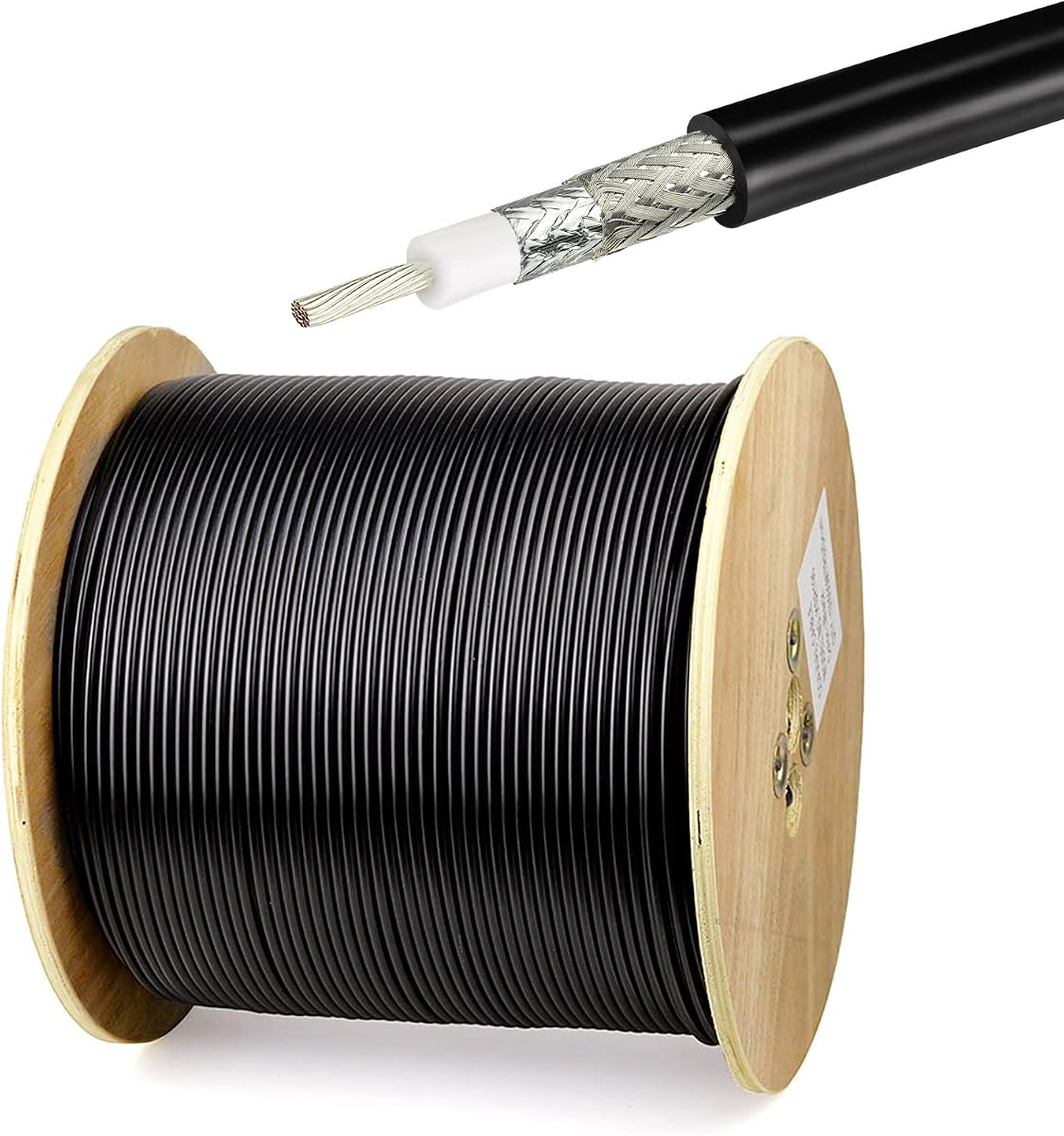
The XRDS RF RG-316 Cable is different from the other ready-made leads because it is a 50-foot bulk cable. It has a 4.8 customer rating, the highest in the group, and is intended for users who want to build a custom cable or add their own connector types. Its 0.1-inch diameter makes it exceptionally easy to route.
We may earn a commission when you buy through this link, at no additional cost to you.
The center conductor and braid use silver-plated copper, while a Teflon jacket provides flexibility and resistance to harsh outdoor conditions. The stated maximum frequency is 6GHz, attenuation is given as no more than 0.45dB per foot at 3GHz, and VSWR is listed at or below 1.15. Those figures make it a credible choice for high-frequency interconnections.
Because connectors are not preinstalled, this option requires suitable crimp-on or other connector work and appropriate tools. The product data specifically mentions using SMA connectors. It also needs careful attention to the 50-ohm system: the connector, dielectric, and installed termination must be genuinely suitable for 50-ohm RF rather than merely fitting physically.
Choose this cable for compact VHF or UHF interconnections, balun and antenna projects, ham radio patch work, cellular or Wi-Fi equipment, ADS-B applications, or other thin cable needs. It is less appropriate for a long high-power HF feed line, where RG8X, RG8, or KMR400-class cable provides more appropriate loss and power characteristics.
Bulk coax allows the user to match the connector to the device instead of accepting a preinstalled PL259 configuration. It is particularly useful when a station mixes PL259, SMA, BNC, TNC, or N-type connections and needs a short custom jumper.
The stated 6GHz maximum frequency and thin Teflon jacket make RG316 appropriate for applications where compact routing and wide frequency coverage matter. Its small profile is especially useful in crowded cabinets, mobile installations, and compact antenna assemblies.
We may earn a commission when you buy through this link, at no additional cost to you.
The Superbat RG8x Coaxial Cable is a versatile 50-foot RG8X lead with a 4.7 rating. It is positioned as an upgrade from RG58 for higher-power use and higher-frequency operation, with a stated SWR below 1.15. The key appeal is its ability to serve both amateur radio and other 50-ohm RF applications.
We may earn a commission when you buy through this link, at no additional cost to you.
Its waterproof PVC jacket is designed for outdoor use and can be bent and strapped without inducing signal interference according to the product information. This makes it a practical choice for a base antenna, mast installation, cell booster, or Wi-Fi repeater arrangement, provided the terminations and impedance are appropriate for the connected system.
Unlike several competing listings, the supplied title does not identify the connector configuration. The about section mentions compatibility with PL259, SMA, BNC, TNC, UHF, and N connectors, but that wording should not be treated as proof that every version includes every connector type. Buyers should inspect the package contents and connector specification before ordering.
This cable is a solid general option for a 50-foot run, especially for users who want something more substantial than RG58 but do not need the weight of a 100-foot KMR400. It is flexible, broadly applicable, and has a strong customer rating. Confirm the actual terminations and keep unsupported cable sections properly dressed to preserve performance.
The 50-ohm RG8X format can serve amateur radio, CB radio, analyzers, SWR meters, and other compatible RF systems. That flexibility makes it a practical general-purpose feed line for a mixed station.
The manufacturer states that it can provide customized coaxial cable lengths. For operators whose installation has an unusual routing requirement, this service may help avoid an awkward surplus or a run that is too short.
We may earn a commission when you buy through this link, at no additional cost to you.
The right ham radio coax depends on the bands, power level, antenna distance, routing path, and connector arrangement of the station. Comparing these factors is more reliable than choosing by cable diameter alone.
Most amateur radio antennas, transceivers, tuners, analyzers, and SWR meters are designed around a 50-ohm system. A 50-ohm cable such as RG8X, RG8, RG58, KMR400, or suitable RG316 is therefore the safest starting point. Using a cable with a very different characteristic impedance can create reflections, alter the antenna's behavior, and reduce the efficiency of the overall station.
Confirm impedance at every stage, including the antenna feed point, coax, adapters, baluns, and any inline device. A physically fitting connector does not guarantee electrical compatibility. When possible, choose matching 50-ohm equipment and avoid unnecessary adapters.
A 15-foot lead is convenient for a close-mounted antenna, while 50 feet covers many fixed base stations. A 100-foot assembly becomes useful when the radio must be separated from the antenna by a substantial distance. Measure the intended route rather than estimating from a floor plan, and include service loops, turns, and entry points.
Avoid buying an excessively long cable just in case it may be needed. Excess coax should be arranged in a broad, supported service loop rather than tightly coiled beside the radio. For very long runs, compare loss at the highest relevant frequency instead of relying on general low-loss language.
RG58 is thin, light, and easy to route, making it a common choice for mobile and portable stations. RG8X uses a larger conductor and is a better general option for higher-power fixed stations. RG8 and KMR400-class cable provide still more loss and power margin, although they are heavier and less convenient in tight spaces.
RG316 serves a different purpose. Its tiny diameter and high-frequency capability are useful for compact interconnections and custom-built jumpers, but it is not the natural selection for a long, high-power feed line. Match the construction to the installation rather than assuming one cable works equally well everywhere.
Effective shielding reduces incoming interference and keeps the transmitted signal from coupling into nearby electronics. Double-shielded RG8X, foil-and-braid KMR400 or RG8, and braid-only RG58 each address this need in different ways. In urban, mobile, or computer-equipped environments, strong shielding and consistent terminations deserve particular attention.
Center conductor material also matters. Solid copper, stranded copper, tinned copper, and copper-clad aluminum each offer different compromises involving conductivity, flexibility, weight, oxidation resistance, and solderability. Read the complete construction description because terms such as RG8X alone do not reveal every component used by a manufacturer.
PL259 male-to-male cables are common because they connect directly to many PL259-equipped radios, tuners, meters, and antenna feed points. Confirm the sex, impedance rating, and connector body size before ordering. Equipment that uses SO239 sockets, N-type connections, or smaller coax may require an appropriate cable or adapter.
Pay attention to whether the connector is molded, crimped, or clamp-style, and whether the cable includes adhesive-lined heat-shrink. Those details influence strain resistance and moisture protection. For a custom bulk cable, the operator also needs the correct connector, compatible 50-ohm design, suitable crimp tooling, and enough experience to install a clean termination.
Cable loss and heating rise with operating power. For a high-power station, a heavier RG8X, RG8, or KMR400-class cable generally provides more margin than a thin RG58 or RG316 cable. The antenna, tuner, feed-point hardware, and connectors must also be able to handle the transmitter output; a superior cable cannot compensate for an unsuitable system elsewhere.
For low-power digital modes, VHF work, receive-only antennas, or short bench connections, loss requirements may be modest. Nevertheless, matching cable power handling to the transmitter remains a sound practice, especially when operating continuously at the upper end of a radio's range.
The best electrical cable can still perform poorly if it is sharply bent, pinched, repeatedly flexed, or unsupported over a long span. Choose a diameter you can route without forcing the cable around tight corners. A thicker cable offers greater installation resilience, but a thinner one may be the only practical choice in a confined space.
For outdoor installations, look for a weather-resistant jacket, sealed terminations, and suitable UV exposure. Secure the cable at intervals, keep it away from sharp metal edges and moving components, and provide a drip path so water does not collect at a connector. Planned maintenance access is important as well.
Listings may describe cables, bulk coax, custom options, and connector variants within the same product family. Check the exact package contents, cable length, connector configuration, and included hardware. This is especially important when the title does not explicitly state the connector type or when the information mentions several possible connector standards.
A complete order should contain the intended cable length, correct male or female ends, and any adapters required for the station. Before installation, inspect the jacket and connectors, and confirm that protective covers remain on unused ports. Taking a few minutes to verify the package prevents the most common installation delay.
Before installation, inspect the entire cable for damaged jackets, crushed sections, loose connectors, or moisture contamination. Connect the cable directly to the intended 50-ohm equipment first when practical, then check the system with an SWR meter or antenna analyzer. Remember that a good cable cannot hide a mismatch caused by the antenna, tuner, or feed-point hardware.
Route the coax with smooth bends and avoid twisting the connector body. Secure it to masts, towers, vehicles, or structures at intervals with supports that do not deform the jacket. Keep it away from sharp edges, antenna elements, hinges, exhaust heat, and other sources of abrasion or movement. At the radio, form a small supported service loop rather than hanging the connector.
Periodically inspect outdoor terminations, exposed sections, and the points where the cable enters a building or vehicle. Moisture and UV exposure can degrade even a well-built coax over time. Disconnect power before changing connections, avoid transmitting during repairs, and recheck the system whenever the cable is replaced or rerouted.
For most fixed stations, 50-ohm RG8X is a practical balance of low loss, power handling, flexibility, and manageable size. RG8 or KMR400-class cable is worth considering for higher power, higher frequency, or longer runs, while RG58 is easier to route in mobile and portable installations. The correct answer also depends on the distance between the radio and antenna.
RG8X generally has a larger center conductor and lower loss than RG58, making it the better choice for high-power or long fixed-station runs. RG58 remains useful when low weight and easy routing are more important, such as in a car, truck, or temporary field setup. Both are normally used as 50-ohm cables.
Loss depends on cable type, length, and frequency, so no single number applies to every installation. The relevant figure is the attenuation at the highest frequency and power you plan to use. Compare that value with the run length, and remember that additional adapters, poor terminations, and sharp bends can add avoidable problems.
RG8X is a strong choice for VHF because its larger conductor offers more performance margin than thin coax. It is not mandatory for every low-power VHF setup, however; a short, well-made RG58 or suitable RG316 installation can work well when loss and power requirements are modest. Longer runs and higher power favor heavier cable.
PL259 connectors are commonly found on 50-ohm amateur radio equipment, including some transceivers, tuners, SWR meters, antenna analyzers, and antenna feed points. A male-to-male cable often connects female equipment ports, but installations vary. Confirm connector sex and body size before ordering, and do not force a connector that does not fit correctly.
Yes, but the process requires the correct 50-ohm connector and suitable installation tools. The center conductor and dielectric must match the connector design, and the shield termination must be prepared correctly. A good solder joint, correct crimp, and proper strain relief are essential; poor workmanship can create high loss or intermittent faults.
Support the cable at regular intervals with brackets, clamps, or cable ties that do not pinch or abrade the jacket. Keep it clear of sharp edges and moving parts, avoid excessive tension, and allow a controlled drip path at connectors. Inspect the cable after severe weather or whenever the antenna and its supports are moved.
A damaged, corroded, or loose connector can create significant loss, intermittent operation, or a safety concern. Replace the complete cable if the connector is damaged or was installed poorly, especially for outdoor or high-power use. If only the equipment port is damaged, have it inspected rather than forcing a replacement cable into a questionable connection.
The G-PLUG 15FT RG8X is a compact choice for nearby antennas, the RG8x Coaxial Cable 50ft is the strongest all-around option for a conventional fixed station, and the XRDS 100FT KMR 400 stands out for long, heavy-duty runs. The other picks provide useful alternatives for flexible mobile routing, 100-foot RG8X installations, custom high-frequency interconnections, and 50-foot RG8 equipment.
Prioritize 50-ohm impedance, low loss at the frequencies you use, adequate power handling, and reliable connectors. Length and routing are equally important: a heavier cable offers little benefit if it cannot be installed without sharp bends, while a thin cable may be unnecessary when the antenna is only a few feet away. Always match the cable to the antenna and all inline equipment.
Check the current listing details before ordering, particularly the exact length, connector configuration, and package contents. Ratings and product information can change over time, as can pricing and availability. Confirm that the selected cable satisfies your antenna system, planned route, operating bands, and transmitter power before making the final purchase.
