
HF96 Thermal Camera
4.5Editor score
Live super resolution enhancement
Thirty-thousand-plus image capacity
Integrated laser pointer
Infrared cameras for ghost hunting can reveal temperature variations, heat signatures, and unusual thermal patterns that may be difficult to see with the naked eye. However, the best thermal imager is determined by sensitivity, image clarity, portability, and ease of use rather than paranormal marketing alone. A dependable device also needs a clear display and dependable battery life.
This guide compares ten thermal cameras and infrared-capable camcorders based on their published resolution, temperature ranges, thermal sensitivity, field of view, storage options, power systems, and investigation features. It covers practical tools for home searches, outdoor monitoring, and evidence documentation, while also explaining where a conventional night-vision camcorder serves a different purpose.
The picks show how the right camera changes depending on the investigation. Compact models suit mobile searches, higher-resolution devices suit detailed room scans, and rugged systems fit prolonged field work. Product ratings and specifications may change over time, so readers should confirm current availability, included accessories, and pricing before purchasing.
4.5Editor score

4.4Editor score
4.2Editor score
As an Amazon Associate we earn from qualifying purchases.
This side-by-side comparison highlights the major differences in thermal resolution, sensitivity, display size, battery life, and recording features across the ten cameras, including one infrared night-vision camcorder.


The TOPDON TC004 Mini combines a genuinely compact body with features that are unusually useful for paranormal investigation. It carries a 4.4 rating, and its standout qualities include TISR-enhanced imaging, a 40-degree by 30-degree field of view, smooth 25Hz thermal updates, automatic temperature alerts, and automatic photo capture. Those features make it easy to sweep a room quickly while still preserving visual records of thermal changes.
We may earn a commission when you buy through this link, at no additional cost to you.
The camera begins with 128×128 thermal imaging and enhances the view to an effective 240×240 resolution with TISR technology. This enhancement should not be confused with the native resolution of dedicated research-grade thermal sensors, but it can make small temperature variations easier to interpret on a compact screen. Users can select center, highest, and lowest temperature points, switch among five palettes, and set warning thresholds for anomalous readings. When a threshold is exceeded, the TC004 Mini not only displays a warning but also captures a photograph automatically.
Its stated 15-hour runtime is one of the most appealing aspects for a device that may be carried between locations or used throughout a long investigation. Automatic shutoff at 5, 10, or 20-minute intervals provides additional control. Storage is limited to 512MB of eMMC and a stated capacity of up to 8,000 photos, so regular file transfers may be necessary. The supplied charging cable does not include a charging head, and the paper manual is omitted in favor of a downloadable electronic guide.
The TC004 Mini is best for investigators who want a balanced, travel-ready thermal camera without moving to a larger professional system. Its 240-gram-scale portability, IP54 protection, and claimed survival of drops up to 2 meters suit active field searches. It may not offer the storage, native detail, or software tools of the HF96 or RT280, but its excellent battery life and automatic evidence capture make it the most versatile choice in this group for many ghost-hunting scenarios.
Choose the TOPDON TC004 Mini when the priority is a small, long-running device that can record unusual thermal patterns without constant charging. For serious technical analysis, users wanting large internal storage, or investigators who require native high-resolution thermal data, one of the more specialized models may be a better fit.
Automatic photo capture is particularly useful during room sweeps because it reduces the need to operate controls when a temperature threshold is reached. Investigators can review the captured images later and compare timestamps, positions, and environmental changes.
The long stated runtime reduces downtime and makes the camera practical for searches conducted across multiple locations. Automatic shutoff options also help preserve power during periods when the device is packed away or forgotten.
We may earn a commission when you buy through this link, at no additional cost to you.
This handheld infrared thermal imager offers an appealing balance of native resolution, simple controls, and affordability, reflected in its 4.6 rating. Its 320×240 thermal image appears on a 2.8-inch LCD, while maximum, minimum, and center-point temperature readings provide a useful framework for identifying a changing area. The device is explicitly positioned as portable ghost-hunting equipment, but its measurement features also make it practical for general diagnostics.
We may earn a commission when you buy through this link, at no additional cost to you.
The stated temperature range is -30°C to +200°C with ±2°C accuracy and an 8Hz refresh rate. That is sufficient for scanning ordinary indoor spaces, watching for heat changes, and documenting differences across walls, floors, doors, and nearby objects. A robust FR4 epoxy shell is designed for protection and portability, while the compact, lightweight body should be easier to carry throughout a building than a larger imager. The camera can also function while charging, which is helpful during stationary monitoring.
Storage is the main limitation for extended investigations. Integrated SPI Flash memory holds up to 100 images, so the most useful evidence will need to be transferred promptly through the included USB-C connection to a computer or mobile device. The 3.7V lithium-ion battery provides up to four hours of continuous use, which is adequate for shorter searches but less convenient for all-night sessions than the TOPDON or GT14S options.
The handheld is a strong choice for beginners, apartment investigators, and users who want native 320×240 detail without moving to a larger dedicated system. Its relatively high rating and straightforward design make it approachable, although the refresh rate and limited storage may restrict advanced analysis. It is best suited to quick sweeps and mobile documentation rather than continuous, unattended recording.
Overall, this imager delivers the most accessible combination of screen size, thermal resolution, and measurement features at a modest level of complexity. Buy it if easy portability and immediate point-and-shoot operation matter more than extensive onboard storage or all-day battery life.
Automatic maximum, minimum, and center-point tracking helps users identify whether a region is warming or cooling. This is useful for comparing doors, walls, floor areas, and objects during a controlled search.
The ability to operate while charging supports longer stationary sessions, although it requires access to a power source. It is especially helpful when monitoring a room from a fixed position.
We may earn a commission when you buy through this link, at no additional cost to you.
The ORDRO Night Vision Camcorder is included because ghost-hunting equipment often serves two distinct purposes: recording visible-light footage and mapping thermal differences. With a 4.1 rating, it stands apart from the true thermal cameras in this list by prioritizing video, audio recording, zoom, and night visibility. It records at 2880×2160 at 24fps and offers other modes, including 1080P at 60fps and 720P at 120fps.
We may earn a commission when you buy through this link, at no additional cost to you.
Its IMX258 CMOS sensor, 3.1-inch IPS touchscreen, and 30x digital zoom make it more suitable for documenting a scene and creating shareable recordings. A built-in infrared light supports black-and-white night recording up to 16 feet, while the included external IR light can improve visibility in darker conditions. The time-lapse function is valuable for investigators who want to record changing conditions without supervising every moment. A hot shoe also permits compatible accessories to be attached.
This is not a substitute for a thermal imager because it does not display temperature maps or measured heat patterns. Its 16-foot IR range is also much more limited than the coverage offered by thermal cameras, and the 4K-style output should not be confused with 4K thermal resolution. The included lens hood, stabilizer, remote control, two batteries, charger, camera bag, strap, 64GB memory card, and USB and HDMI cables make it a convenient all-in-one video kit.
The ORDRO camcorder is ideal for creators, group investigators, and anyone who wants conventional night footage alongside thermal documentation. It is less suitable for measuring subtle temperature changes or scanning broad spaces. If a long, continuous video record is more important than quantitative thermal data, its touchscreen, zoom, and time-lapse functions make it a valuable companion tool.
Choose this camcorder for recording visual activity and nighttime scenes, then use one of the dedicated thermal models to identify temperature anomalies. Its accessibility and bundled accessories make it more of a complete recording package than a single-purpose inspection camera.
Built-in illumination and an external IR light provide flexibility in dim rooms and confined areas. The monochrome night footage is useful for documenting movement or changes that visible light does not reveal clearly.
Time-lapse recording is useful when an investigation requires consistent coverage over a long interval. External power is recommended for extended sessions, and the included batteries provide additional flexibility.
We may earn a commission when you buy through this link, at no additional cost to you.
The GT14S Thermal Imaging Camera with Edge Enhancement is built around subtle temperature detection and broad-area scanning. It has a 4.6 rating, a 240-gram body, and a high-sensitivity sensor with a stated NETD below 50mK. The specifications claim detection of temperature differences as small as 0.05°C, making this one of the most sensitive devices in the roundup for detecting subtle environmental changes.
We may earn a commission when you buy through this link, at no additional cost to you.
Its 50-degree field of view covers a broad area and helps users scan a room or exterior location more quickly than a narrow imager. Center, hot, and cold spot modes support comparative work, while a separate thermometer mode offers direct numerical readings. Adjustable emissivity and distance settings are valuable because different surfaces reflect infrared energy differently. Seven color palettes, level and span controls, and customizable high and low alarms help distinguish meaningful variation from background conditions.
The 2500mAh rechargeable battery supports up to 14 hours of continuous operation. That is nearly as useful as the TOPDON's longer stated runtime and is especially valuable during extended home searches. The balanced, non-slip grip and straightforward button controls should reduce the learning curve, while full-screen imaging helps users follow moving subjects without switching views. On the other hand, the supplied information does not specify how many images or videos the device can store, which is an important consideration for documentation-heavy investigations.
This GT14S is a strong choice for investigators focused on subtle changes, large-area scans, and long sessions without frequent charging. It also functions as a conventional inspection tool for insulation, heating, automotive, and household temperature checks. It may be less attractive than the HF96 or RT280 for users who require extensive storage, computer analysis, or documented scene recognition.
Choose this camera when sensitivity, a wide field of view, and long runtime matter most. Its combination of compact handling and advanced thermal controls makes it particularly effective for methodical room-by-room searches and repeated environmental comparisons.
A low stated NETD can reveal modest thermal changes that are harder to distinguish on a less sensitive display. This makes the camera useful for investigating whether a suspicious area differs consistently from its surroundings.
The 50-degree field of view reduces the need to rotate or reposition the camera during a broad scan. It is a practical advantage in large rooms, hallways, and outdoor perimeter checks.
We may earn a commission when you buy through this link, at no additional cost to you.
The GT14S Ultra-Light Thermal Camera is a portable option centered on sensitivity and ease of handling. Its 4.6 rating, 240-gram weight, and straightforward button layout make it a practical choice for investigators who carry a camera between locations. The design combines full-screen thermal imaging, center and hot or cold spot modes, and a dedicated thermometer function.
We may earn a commission when you buy through this link, at no additional cost to you.
Thermal sensitivity is specified below 50mK, with subtle differences stated down to 0.05°C. The measurement range extends from -4°F to 1022°F, and adjustable emissivity and distance settings improve readings across materials such as cement and ceramic. A 50-degree field of view supports broad scanning, while seven color palettes and adjustable level and span settings provide control over how variations appear on screen.
The biggest advantage over bulkier models is its 240-gram weight, balanced body, and non-slip grip. Its 2500mAh battery provides up to 14 hours of continuous operation, so users are less likely to carry a spare battery during moderate-length searches. Custom high and low alarms allow investigators to define the conditions that merit closer inspection. The included one-year warranty adds a layer of support, although the product information does not state onboard storage capacity or detail a computer analysis package.
This model suits users who need a highly sensitive and genuinely portable thermal camera without moving to a more complex inspection platform. It is also useful for home energy checks, automotive work, and other heat-diagnosis tasks. Users who need to retain large numbers of captures for later analysis may prefer the HF96 or FOXWELL RT280.
Overall, the GT14S Ultra-Light is a convincing all-around option for mobile ghost hunting. Prioritize it when low weight, long runtime, and sensitive temperature detection outweigh advanced reporting and extensive internal memory.
The low weight and balanced grip make the camera easier to carry and operate over extended periods. That comfort can encourage more systematic scanning instead of abbreviating an investigation because of fatigue.
Emissivity and distance adjustments help account for the way different materials emit infrared energy. Using these settings can make a visual comparison more consistent across walls, floors, and household objects.
We may earn a commission when you buy through this link, at no additional cost to you.
The Kanayu package is unusual because it combines a 320×240 thermal imager with four flashing, motion-activated cat toys marketed for ghost-hunting experiences. It carries a 3.8 rating, the lowest in this list, and its appeal depends heavily on whether the buyer values a bundled novelty kit. The camera itself uses an MLX90640ESF-BAB sensor, a 2.8-inch display, and a shell built from FR4 epoxy sheet.
We may earn a commission when you buy through this link, at no additional cost to you.
The imager tracks maximum, minimum, and core temperature values, stores up to 100 pictures, and transfers files to a computer or mobile phone through a data cable. Its lithium-ion battery runs for up to four hours and supports operation while charging. These are straightforward functions that should be easy to understand, although no detailed refresh rate, thermal sensitivity figure, or measurement accuracy is provided in the supplied specifications.
The included flashing balls may add a playful atmosphere to an investigation, but they do not improve the camera's thermal performance or provide useful evidence. The 3.8 rating and lack of more advanced specifications make the package less compelling than a similarly compact standalone imager. The decisive benefit is variety: a buyer receives an immediately usable thermal tool and several additional themed accessories from one listing.
This kit is most appropriate for casual investigators, teams seeking a novelty package, or users who want an approachable thermal camera without researching a complex model. It is less suitable for technical users who require known thermal sensitivity, broad temperature accuracy, advanced software, or large onboard storage. Serious investigators should judge the camera specifications separately from the promotional framing.
Choose the Kanayu bundle when the complete themed experience and included cat balls are part of the appeal. If the goal is professional-grade measurement and evidence capture, one of the higher-rated dedicated thermal cameras offers a clearer path to dependable results.
The stated MLX90640ESF-BAB sensor model gives buyers a useful technical reference. It also shows why the display resolution should not be viewed as the only indicator of the camera's overall capability.
The four illuminated cat balls add atmosphere and interaction to a ghost-hunting session. They are best understood as accessories rather than substitutes for controlled evidence documentation.
We may earn a commission when you buy through this link, at no additional cost to you.
The HF96 is one of the strongest all-around thermal cameras here, combining a 4.5 rating with high sensitivity, large storage, scene recognition, and practical investigation accessories. Its live super resolution enhancement produces a 240×240 image during live viewing and photo capture, while a thermal sensitivity below 50mK is stated to reveal variations as small as 0.05°C. A smooth 25Hz refresh rate helps users scan without distracting visual stutter.
We may earn a commission when you buy through this link, at no additional cost to you.
IntellFault technology uses deep learning to identify likely water leak and insulation gap locations. The feature is accessed through the Scene setting after downloading current firmware from the manufacturer's website. It does not provide moisture readings, so its output should be treated as visual scene recognition rather than proof of a specific defect. A 50-degree field of view, hot and cold spot tracking, center-point display, custom alarms, and manual level and span controls make manual analysis available as well.
Storage is one of the major strengths. The built-in 4GB capacity is stated to hold more than 30,000 images and 14 hours of video, reducing the risk of losing evidence during a multi-session investigation. The rechargeable battery provides up to 11 hours of continuous use. Seven palettes, a tripod mounting point, a laser pointer, and a compact 3.8-by-6.3-by-10.4-inch body support a wide range of working environments.
The HSF Studio Windows software adds point, line, and area analysis, screen projection, real-time monitoring, and 3D plotting. However, the listed feature set does not explicitly address macOS compatibility, so users with Apple computers should verify support before buying. The camera is also rated IP54 and has a stated 6.6-foot drop tolerance, making it more rugged than several compact alternatives.
The HF96 is an excellent choice for evidence-heavy investigations where image volume, sensitivity, and post-capture analysis matter. It may be overkill for casual users, but its feature set creates a compelling value proposition for dedicated investigators who want more capability than a simple handheld imager.
The stated capacity for over 30,000 images and 14 hours of video allows teams to document many sessions without frequent transfers. This is especially useful when creating chronological records of a location.
IntellFault can flag areas that resemble leaks or insulation gaps, accelerating the first visual review. Because it does not measure moisture, investigators should verify every flagged scene with direct inspection and additional evidence.
We may earn a commission when you buy through this link, at no additional cost to you.
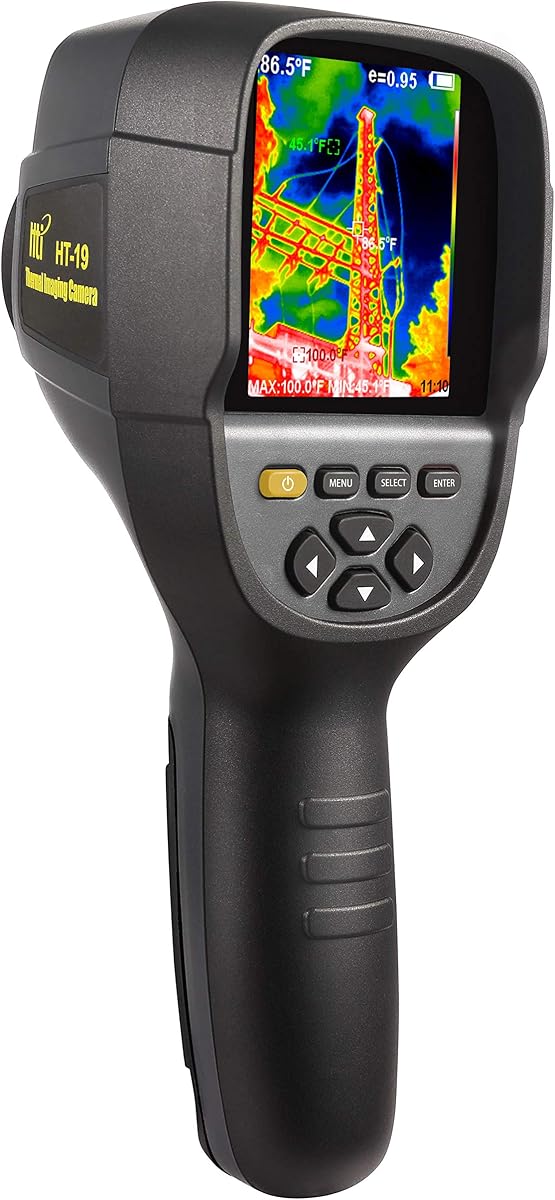
The HTI-19 stands out as the roundup's premium pick because it combines a native 320×240 thermal sensor with a comparatively large 3.2-inch color display. Its 4.2 rating is modest relative to some newer models, but the published specifications are focused and include a stated temperature accuracy of 2.5°F. That makes it appealing to users who prioritize traditional thermal detail over a dense collection of automated features.
We may earn a commission when you buy through this link, at no additional cost to you.
Five palettes—Rainbow, Iron Red, Cold Color, Black and White, and White and Black—allow users to choose how the thermal image appears. The larger display makes it easier to inspect fine spatial differences, while push-button operation is designed to work without a steep learning curve. The camera is positioned for home inspections, firefighting, farming, electronics, traffic studies, archaeology, hobbies, and scientific work, giving it value beyond paranormal research.
A 3GB built-in memory card is included and can be used to store captures, while micro-USB provides a way to display information on a laptop or another device. The rechargeable battery offers two to three hours of continuous work, which is the principal weakness for lengthy investigations. Its 389-gram weight remains manageable, and the ergonomic handle plus travel pouch support regular field use.
The three-year warranty from the manufacturer's North Carolina branch is a meaningful advantage. For a device used repeatedly over many months, longer warranty coverage can reduce concern about accidental damage or component failure. Against newer competitors, the HTI-19 lacks modern conveniences such as large internal storage, advanced scene recognition, integrated laser pointers, and sophisticated desktop analysis.
This premium choice is best for investigators who value a large screen, native thermal resolution, straightforward operation, and extended warranty coverage. Users who need all-day power or advanced reporting may find the HF96 or RT280 more convenient, but the HTI-19 remains a credible high-detail tool.
A native 320×240 sensor provides a clearer technical foundation than an enhanced lower-resolution image. This is valuable when comparing small thermal features across a controlled scene.
The 3.2-inch color screen supports detailed review, while the three-year warranty offers extended reassurance. Together, these qualities suit a buyer who expects to use the camera regularly over a long period.
We may earn a commission when you buy through this link, at no additional cost to you.
The Mini Handheld Thermal Camera is a lightweight, entry-level option designed around portability, non-contact measurement, and basic paranormal-investigation use. It carries a 3.5 rating, the lowest score in the group, and its 24×32 resolving power is substantially below the native resolution of several alternatives. That limitation is important because small thermal features may not be represented with the same clarity.
We may earn a commission when you buy through this link, at no additional cost to you.
The device measures from -40°C to 300°C with a stated accuracy of ±2°C and displays the image on a 2.8-inch TFT screen. It can be used on moving objects, live electrical circuits, insulation work, and other situations where direct contact is undesirable. An 800mAh rechargeable lithium-ion battery supports portable operation, and up to 100 captured images can be stored for later comparison through a Type-C connection to a PC.
The main advantage is simplicity. There is no indication of complicated scene-recognition software, extensive palettes, or a large internal drive, and that simplicity may be attractive to a first-time buyer. At the same time, the limited resolution and lower rating make it harder to recommend for serious comparative work. Users who need to distinguish subtle thermal signatures in a large or complex environment may find a higher-resolution camera more revealing.
The camera is most suitable for beginners, quick room checks, and users who want a small device that can be carried without planning around battery packs. It can also be used for basic household heat checks. The Type-C connection is convenient, though the supplied information does not mention a mobile app, and the 100-image limit requires regular file management.
Choose the Mini Handheld for basic, inexpensive thermal exploration rather than professional evidence analysis. A more capable camera with higher native resolution, better documented sensitivity, or stronger customer feedback will likely serve dedicated investigators more effectively.
Measuring temperature without touching an object is useful around heat sources, live circuitry, and moving targets. This makes the camera practical for quick preliminary checks as well as paranormal searches.
The camera can hold 100 images and connect to a computer by Type-C. Investigators can compare captured scenes later, though they should transfer files regularly to preserve space for new observations.
We may earn a commission when you buy through this link, at no additional cost to you.
The FOXWELL RT280 combines a sharp 2.8-inch 320×240 LCD with a strong software and storage package. It has a 4.5 rating, a 25Hz frame rate, and TISR enhancement that raises the effective thermal detail from 120×90 to 240×180. The display resolution and enhanced thermal resolution are separate figures, so users should understand that the camera is not presenting a native 320×240 thermal sensor array.
We may earn a commission when you buy through this link, at no additional cost to you.
The biggest strength is its Windows PC software. It supports point, line, and area temperature analysis, 2D and 3D thermal views, real-time monitoring, and automatic report generation. These tools can turn a simple visual scan into a more structured record, making the RT280 well suited to investigators who want to document patterns rather than merely capture a dramatic image. The included software is specifically described as Windows-compatible and not Mac-compatible.
Built-in 8GB eMMC can store more than 20,000 images and videos. The camera automatically tracks the highest, lowest, and central temperatures, and custom alarms provide audible and visual warnings. Nine palettes, a built-in laser pointer, and an LED light help users find and inspect targets in dark or confined spaces. Measurement range is -4°F to 1022°F with stated accuracy of ±3.6°F or ±2%.
The RT280 is also designed for demanding environments. It has a stated 6.6-foot drop tolerance, an IP54 rating, and an ergonomic portable design. Its 50-degree by 38-degree field of view provides broad coverage, while the 25Hz rate should make live scanning smooth. As with any device that relies on enhanced processing, a cautious investigator should use alarms and numerical readings as supporting evidence rather than treating color alone as proof of an anomaly.
This is an excellent choice for Windows users who want professional analysis, large storage, and rugged construction. Mac owners should look elsewhere unless compatibility can be confirmed. It is more technically capable than many compact competitors, although the HTI-19 offers higher native thermal resolution and the HF96 includes a 50-degree view and scene recognition.
Point, line, and area analysis allows investigators to isolate specific regions instead of evaluating an entire image qualitatively. Automatic report generation can also help organize observations across a sequence of searches.
The laser pointer identifies a particular area of interest, while the LED provides visible illumination in a confined space. Together they reduce the need to infer exactly where the operator is pointing.
We may earn a commission when you buy through this link, at no additional cost to you.
A useful paranormal-investigation camera must combine thermal detail, portability, dependable power, accurate measurement, and evidence storage. The most important factor depends on whether the device will be used for rapid room sweeps, long field sessions, close visual comparisons, or formal technical reporting.
Native resolution indicates the number of thermal measurements the sensor can produce for each scene. A native 320×240 array generally provides more spatial information than a 24×32 or 128×128 sensor, which can help users distinguish small features and compare narrow areas. Some cameras enhance the displayed image to 240×240 or 240×180 through processing, and those results can look clearer, but enhancement does not create the same amount of physical sensor detail as a native array.
Prioritize native resolution when close visual analysis matters, such as examining wall sections, doorways, or isolated temperature patterns. An enhanced image is acceptable for broad searches and can still reveal broad thermal differences, but buyers should not assume the enhancement number is equivalent to native resolution.
Thermal sensitivity, commonly expressed as NETD, describes the smallest temperature difference a sensor can distinguish. A lower figure generally supports detection of more subtle changes. The GT14S and HF96 specify sensitivity below 50mK and claim the ability to detect differences around 0.05°C, making them compelling for investigators seeking subtle environmental variations rather than only obvious heat signatures.
Sensitivity should be considered together with stability, calibration, emissivity settings, and image stability. A sensitive camera can still produce misleading comparisons if surface properties are not accounted for, so use controls and repeated scans rather than relying on one vivid frame.
A wide temperature range can be useful when moving from ordinary room conditions to warm electronics, heating systems, or outdoor surfaces. Accuracy matters more for repeatable comparisons. The listed products provide stated accuracies from ±2°C to ±3.6°F, with the HTI-19 advertising readings accurate to 2.5°F. Adjustable emissivity and distance are particularly valuable because they can improve readings on materials with different infrared characteristics.
For ghost-hunting work, look for maximum, minimum, and center-point tracking rather than a single number. Track the same three points during repeated passes and record the environmental conditions. The ability to set alarms is helpful, but an alarm is only a prompt to investigate, not proof that an unusual event has occurred.
Field of view determines how much of a room or outdoor area can be covered in one pass. A wider view such as 50 degrees can accelerate broad scans, while narrower views may help the operator concentrate on a specific area. Refresh rate affects how smoothly moving targets and changing temperatures appear. The TC004 Mini, HF96, and RT280 use 25Hz, while the compact 320×240 handheld is stated at 8Hz.
Balance field of view with control. A very wide view can make small features harder to locate, while a narrow view can require more sweeping. Start with a broad scan, mark interesting areas, and then revisit them with a more deliberate scan or another device.
Battery runtime should be matched to the length and style of an investigation. The TC004 Mini is rated for up to 15 hours, the GT14S models for up to 14 hours, and the HF96 for up to 11 hours. At the other end of the range, the HTI-19 provides two to three hours, while the smaller handheld models are designed around shorter sessions. Devices that operate while charging are useful for fixed monitoring stations.
For a full night of roaming searches, a long-running camera is more convenient than carrying spare batteries. For stationary work, continuous charging may be more useful than maximum mobility. Check the included charging equipment before an investigation and avoid relying on a cable or adapter that is not supplied.
Storage determines how many thermal captures and videos can remain on the device. The FOXWELL RT280 offers 8GB of eMMC with a stated capacity for more than 20,000 images and videos, while the HF96 provides 4GB and claims more than 30,000 images plus 14 hours of video. Smaller cameras generally store around 100 images, requiring frequent transfers. The TC004 Mini has 512MB and a stated limit of up to 8,000 photos.
Computer software can add considerable value. The RT280 offers point, line, and area analysis, 3D views, and automatic reports, while the HF96 includes HSF Studio tools. Check operating-system compatibility before buying, especially if you use a Mac. A practical workflow is to capture a thermal image, record relevant metadata, save an original file, and create a separate working copy for enhancement or analysis.
A camera used during night searches should be easy to hold for long periods and protected against common hazards. The GT14S models weigh 240 grams, the HTI-19 weighs 389 grams, and the TC004 Mini has a pocket-friendly design. Several options include IP54 protection or drop resistance, making them more suitable for damp basements, old buildings, and outdoor locations than basic handheld devices.
Durability specifications do not guarantee that any device can detect a paranormal presence. They simply make the tool more dependable in the physical environments where investigations occur. Choose a secure grip, consider the weight over a long session, and use a protective pouch or case when moving between locations.
Thermal imaging does not replace visible-light or infrared night recording. A laser pointer can show which object is being inspected, while an LED light provides context in a dark room. The HF96 and RT280 include integrated pointers, and the RT280 also adds an LED. The ORDRO camcorder takes a different approach with built-in and external infrared lights, a 3.1-inch touchscreen, zoom, and time-lapse recording.
A complete kit may also include a manual, wrist strap, cable, storage card, battery, charger, tripod mount, or analysis software. Check the package contents because some devices include a charging cable without a charging head or rely on downloadable manuals. The best evidence system is one that records thermal, visual, contextual, and time-stamped observations without altering the original files.
Before an investigation, charge the camera fully, install or format its storage, verify the date and time, and learn the spot-tracking, palette, alarm, and capture controls. Establish a repeatable route through the building and mark reference points. Take baseline thermal images of doors, walls, floors, windows, appliances, and other likely areas before moving equipment or opening rooms.
Scan slowly and deliberately. Hold the camera a consistent distance and angle when comparing locations, while allowing enough time for the image to stabilize after the camera moves. Use multiple palettes when necessary, but do not switch constantly if that makes comparisons harder. Record the location, direction, environmental conditions, and observer notes alongside every capture so that later interpretation has useful context.
Afterward, transfer original files to more than one storage location and verify that the copies open correctly. Clean the lens gently, keep the charging contacts dry, and protect the camera from impact and extreme moisture. Review battery guidance, download any required firmware in a safe setting, and avoid interpreting a single unusual image as conclusive evidence without corroboration.
An infrared thermal camera can measure heat and display temperature differences, but it cannot independently confirm the presence of a ghost. A ghost-hunting camera is best used to document changes in the environment, such as unexpected warmth, cooling, or moving heat signatures. Any unusual result should be checked for external causes and corroborated with video, environmental records, witness notes, and repeated scans.
Higher native resolution can make small features and narrow temperature differences easier to distinguish. It does not guarantee better paranormal detection, however, because thermal sensitivity, stability, calibration, and display quality also affect the image. A highly sensitive camera with practical controls may be more useful than a higher-resolution model operated without careful setup.
A thermal camera detects infrared radiation and converts temperature differences into a visible heat map. Infrared night vision instead illuminates darkness with infrared light and records a monochrome or near-monochrome image. The ORDRO camcorder in this guide is useful for conventional night video, while the other products are true thermal imagers for viewing heat patterns.
The appropriate duration depends on the location, objective, available controls, and safety conditions. A brief baseline scan is more meaningful when followed by repeated checks under similar environmental conditions. Long sessions should account for battery life, data storage, rest breaks for observers, and whether any anomalies can be reproduced or independently corroborated.
Emissivity settings can affect how accurately a thermal camera estimates surface temperature across different materials. If the goal is reliable temperature comparisons, use settings appropriate to the dominant surface and keep them consistent. If the goal is purely visual comparison, document the settings and avoid changing them midway through a sequence of comparable scans.
Several models have IP54 protection, and the TOPDON, HF96, and FOXWELL RT280 also list drop-resistance specifications. That makes them better suited to outdoor or damp conditions than unprotected electronics, but no rating eliminates every environmental risk. Keep ports covered, avoid immersion, protect the display from impact, and account for weather, glare, and rapidly changing outdoor temperatures.
Multiple palettes can make subtle differences easier to notice, and high-contrast modes may be helpful during a live scan. For evidence review, retain the original image and document the palette used at capture time. Avoid increasing contrast so aggressively that normal variation begins to resemble a distinct shape or event.
Transfer original files promptly, keep them in more than one location, and avoid overwriting files with filtered or enhanced versions. Record the camera model, date, time, location, environmental conditions, camera settings, and operator notes in a separate log. If a potential anomaly appears, reproduce the scan and seek corroboration before drawing conclusions.
The TOPDON TC004 Mini is the most versatile overall option because it combines a compact body, enhanced 240×240 imaging, automatic photographic capture, and an exceptional stated 15-hour runtime. The HF96 is the best budget-oriented choice for investigators who want high sensitivity, extensive storage, scene recognition, and Windows analysis tools. The HTI-19 earns the premium position with native 320×240 detail, a large color screen, and a three-year warranty.
For smaller budgets or lighter packing needs, the handheld 320×240 imager and GT14S models offer compact operation, while the FOXWELL RT280 is ideal for Windows users who want sophisticated reporting. The Kanayu bundle prioritizes novelty, the Mini Handheld prioritizes simplicity, and the ORDRO camcorder is valuable for visible and infrared night recording rather than temperature measurement.
Prioritize the specifications that match your investigation method rather than expecting any camera to produce supernatural conclusions. Confirm current specifications, included accessories, software compatibility, storage capacity, and pricing before buying, since both product availability and technical details can change over time.