
Digital Barometer Weather Forecast Clock
4.3Editor score
Calibratable local pressure display
24-inch multifunction screen
Front-button navigation
Desk or wall placement
A digital barometer measures atmospheric pressure and translates changing readings into useful clues about weather conditions. A good model should be easy to read, maintain a stable trend over time, offer relevant alerts, and suit the location where it will be used. The best options range from compact desktop instruments to full wireless weather stations with remote sensors and atomic clocks.
The ten products in this guide were compared using their stated pressure functions, forecast capabilities, temperature and humidity monitoring, display design, wireless range, power options, alarms, calibration features, mounting flexibility, and included accessories. Particular attention was given to practical distinctions such as local versus sea-level pressure readings, sensor support, trend history, and the availability of records or software.
Each review identifies the product's strongest use case and any meaningful trade-offs. The list includes dedicated precision instruments, compact forecast clocks, multifunction handheld meters, and complete indoor-outdoor weather stations. Ratings and availability can change over time, and prices also fluctuate, so readers should confirm current product details before purchasing.
4.3Editor score

4.7Editor score

4.1Editor score
As an Amazon Associate we earn from qualifying purchases.
The comparison highlights major differences in measurement purpose, sensor support, forecast features, data retention, display type, power, and portability so buyers can distinguish dedicated laboratory-grade instruments from home weather stations and handheld meters.


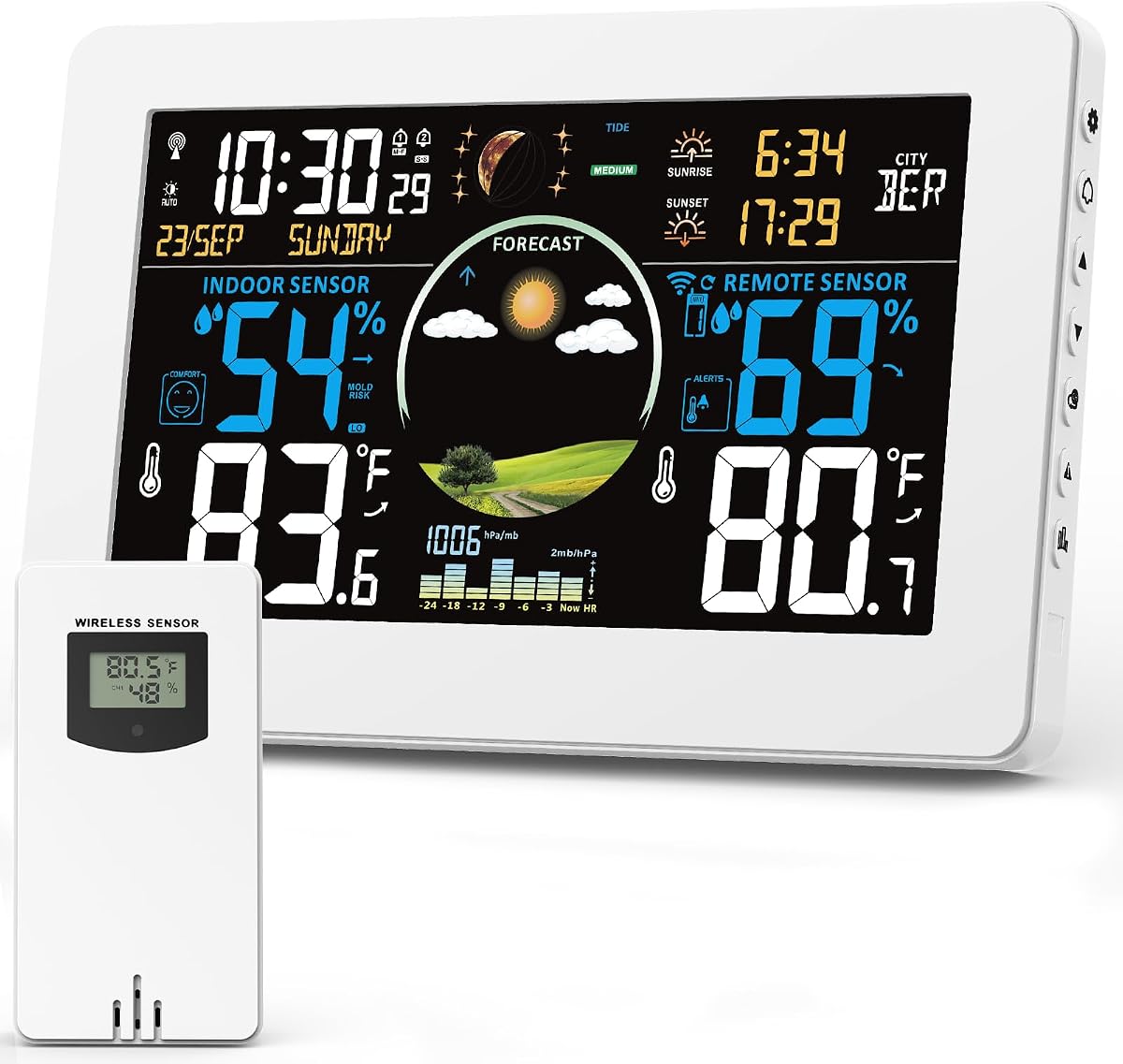

The Newentor Weather Station is a versatile home forecasting console with a 4.3 rating and one of the most comprehensive feature sets in this guide. Its large color LCD combines indoor and outdoor temperature, humidity, daily high and low records, customizable alerts, time, date, an alarm clock, snooze, weather forecasts, moon phase, and barometric pressure. That combination makes it easier to treat as an everyday information center rather than a single-purpose barometer.
We may earn a commission when you buy through this link, at no additional cost to you.
The main strength is flexibility. The base unit supports up to three remote sensors, although one is included, so the system can expand to monitor multiple rooms or outdoor locations. Its forecast is calculated for the next 12 to 24 hours, and the listed seven-to-ten-day calibration process allows the device to learn the local pressure pattern. The included DC adapter supports continuous operation, while battery mode dims the display after a brief illumination period to conserve energy.
There are trade-offs. A single remote sensor limits out-of-box flexibility, and the colorful screen occupies more space than a compact numerical display. As with other pressure-based forecast systems, the forecast should not be treated as a guarantee of specific weather events. The device is more ambitious than a minimal barometer, so buyers primarily interested in long-term numerical pressure records may find a dedicated instrument more suitable.
This is the strongest all-around choice for a home, office, classroom, or similar indoor location. It combines pressure monitoring with remote temperature and humidity sensing, forecasts, clock features, and a highly readable display. Choose it when you want one screen to answer several routine weather questions and can accommodate a larger tabletop or wall-mounted console.
The Newentor places barometric pressure within a wider dashboard that also covers humidity, temperature extremes, forecasts, moon phase, time, and alarms. That makes it particularly useful for users who want a single glanceable display rather than a bare pressure readout.
Support for three remote sensor channels allows users to add sensors without replacing the console. The included sensor is suitable for immediate indoor-outdoor comparisons, while additional channels can extend coverage to other areas.
We may earn a commission when you buy through this link, at no additional cost to you.
The Traceable Calibrated Digital Barometer holds the highest rating in this group at 4.7 and stands apart through its emphasis on documented measurement quality. It measures barometric pressure, temperature, and relative humidity in environments such as laboratories and plant-care areas, making it well suited to users who need reliable records rather than only a household forecast icon.
We may earn a commission when you buy through this link, at no additional cost to you.
Its four-line LCD presents pressure trends in a bar graph and also shows time of day. Minimum and maximum readings are stored internally every hour and remain available for the past 24 hours. High and low audible and visual alarms can be configured for pressure, temperature, and humidity, so the instrument can serve both observation and notification roles without relying on a separate device.
The package includes a wall mount, flip-open stand, three AAA batteries, and a NIST-traceable calibration certificate with data. Optional software can capture real-time measurements from up to eight barometers on a PC, then save, view, print, merge, report, or email the data. That capability is valuable for structured records, although buyers without a compatible computer workflow may not need it.
This is the pick for laboratories, controlled environments, professional monitoring, or serious home weather records. The combination of calibration documentation, alarms, and stored history outweighs the simpler consumer focus of most competing models. Choose it when traceability and recordkeeping matter more than a colorful forecast display or wireless outdoor sensors.
The included NIST-traceable certificate and stated accuracy specification make this model attractive where documented instrument performance is important. It is the most specialized recommendation in the guide rather than merely the most elaborate consumer display.
Internal hourly storage preserves minimum and maximum values for 24 hours, while optional PC software expands record analysis to multiple instruments. This combination supports both short-term observation and more structured data collection.
We may earn a commission when you buy through this link, at no additional cost to you.
The 308-1417 Wireless Barometric Pressure Weather Station combines a clear 24-hour pressure graph with a changing forecast display and tendency indicators. Its 4.3 rating reflects a balanced feature set for users who want to examine how pressure has moved, not merely see a current number or a single forecast icon.
We may earn a commission when you buy through this link, at no additional cost to you.
The wireless sensor transmits indoor and outdoor temperature in Fahrenheit or Celsius, humidity, and minimum and maximum records. Its stated 330-foot range applies when there are no obstructions, and the included sensor is weather resistant for suitable outdoor placement. Customizable temperature alerts add practical value for greenhouses, patios, workshops, and other places where conditions may change quickly.
The console also handles time and calendar functions through automatic WWVB time setting, automatic daylight-saving reset, and a selection of United States time zones. It operates on three AA alkaline batteries for the console and two AA batteries for the sensor, with batteries not included. Portability is therefore straightforward, but users should plan for regular battery replacement.
This model is a good choice for monitoring changing pressure trends at home or in a small work area. Its historical graph gives it an advantage over display-only options, while the remote sensor and forecast tendencies provide context. It is less compelling for anyone needing data export, extensive color graphics, or formal calibration documentation.
The 24-hour graph makes rising and falling pressure easier to interpret. When combined with tendency indicators, it gives users a visual basis for evaluating changing conditions rather than relying on a single instantaneous reading.
The included weather-resistant sensor supports 330-foot wireless transmission in unobstructed conditions. Placement decisions still matter because walls, structures, and interference can reduce practical performance.
We may earn a commission when you buy through this link, at no additional cost to you.
The DreamSky Weather Station is a large-display home console rated 4.4, combining indoor and outdoor temperature, humidity, atomic time, calendar information, weather forecasts, and barometric-pressure-based predictions. Its oversized numbers and colorful screen are designed to remain readable from across a room, making it useful in kitchens, offices, family rooms, and workshops.
We may earn a commission when you buy through this link, at no additional cost to you.
The station supports three outdoor sensors, with one included, and provides high and low temperature alerts. Its forecast covers the next 12 to 24 hours using local pressure characteristics, with a stated seven-day calibration period. WWVB atomic reception automatically sets the time and date, while automatic daylight-saving adjustment removes the need for manual clock changes twice a year.
Power comes from electricity with battery backup, and a USB port is provided for convenient charging. When running on backup power alone, the display illuminates for about 10 seconds and then dims. Five adjustable backlight levels help balance visibility and comfort. The console measures 5 by 7.9 by 1.2 inches, so it is substantial without being excessively large.
DreamSky is a strong choice for households that want an attractive, readable forecast station with atomic-clock convenience. It provides more visual refinement and nighttime control than many basic models, although the lack of a supplied charging cable is a small inconvenience. Buyers primarily interested in raw pressure records should look elsewhere.
Large numbers, a colorful interface, and forecast information positioned for quick scanning make the DreamSky easy to check from across the room. This is a meaningful advantage over compact numerical instruments in busy household spaces.
Five backlight levels reduce glare in a dark room, while the ten-second illumination on backup power avoids leaving the display on continuously. The balance suits bedside, office, and living-area use.
We may earn a commission when you buy through this link, at no additional cost to you.
The Digital Barometer Weather Forecast Clock is a compact, straightforward instrument with a 4.3 rating. It shows time, indoor temperature, humidity, local barometric pressure, the pressure trend, and weather icons on a four-inch display, covering the essential needs of users who want more than a bare pressure gauge but do not need a full wireless weather station.
We may earn a commission when you buy through this link, at no additional cost to you.
A major advantage is manual pressure calibration. The product measures actual pressure at its current location, which may differ from sea-level-corrected figures shown by weather apps or airport reports. Users can adjust the displayed value from the front controls, along with time, temperature units, pressure units, and calibration settings. A short press of the backlight button illuminates the screen for approximately 10 seconds.
The trend icons are intended as a simple reference based on pressure changes. The instructions advise allowing approximately 24 to 48 hours after setup or relocation for the trend to stabilize, so immediate forecasts should not be treated as definitive. Its compact size and lack of a remote sensor also limit its suitability for tracking conditions in a separate outdoor location.
This is the best budget option for a protected indoor location such as a home office, garage, RV, boat cabin, or workshop. The built-in stand supports desk use, while a wall mount works for a more permanent installation. Choose it when straightforward readings, local calibration, and a trend indicator matter more than sensor expansion or historical graphs.
Manual calibration helps reconcile readings with locally useful references when official forecasts use sea-level correction. It also provides a way to check whether placement or configuration is affecting the displayed trend.
Front-mounted buttons keep time, unit, backlight, and calibration adjustments accessible without navigating hidden controls. The result is an approachable device that can move between a desk and a wall.
We may earn a commission when you buy through this link, at no additional cost to you.
The BTMETER BT-100WM is a handheld anemometer with a 4.1 rating that places digital barometry within a broad field-measurement toolkit. It measures wind speed, wind temperature, wind chill, relative humidity, dew point, barometric pressure, and altitude, making it useful for activities where local conditions matter more than a stationary home forecast.
We may earn a commission when you buy through this link, at no additional cost to you.
Wind speed covers 0.67 to 67.1 miles per hour with a stated accuracy of plus or minus 5 percent, while temperature covers -10 to 45 degrees Celsius. The LCD supports maximum, minimum, and average readings, along with mph, ft/min, km/h, m/s, and knots for wind. Pressure can be displayed in inHg, hPa, or mbar, which improves its usefulness for different technical conventions.
The instrument can log 16 groups of barometric pressure data, allowing users to compare pressure with temperature, humidity, and height. A data log, tripod hole, backlit display, low-battery indicator, and automatic shutdown after 10 minutes of inactivity make it practical for field sessions. The measurement bundle is extensive, but the device is clearly aimed at users who will actively use its other functions too.
Choose the BT-100WM for sailing, hiking, shooting, kite flying, drone operation, HVAC testing, or general outdoor measurement. It is less convenient as an always-on household display and does not provide the polished forecast dashboard seen in dedicated weather stations. Its advantage is the ability to collect barometric and environmental data wherever the user goes.
Combining barometric pressure with wind, altitude, humidity, dew point, and temperature gives the instrument broader analytical value. Users can investigate how environmental variables change together instead of collecting pressure in isolation.
Sixteen stored pressure groups support recordkeeping and comparison during a session. Automatic shutdown and a low-battery warning help preserve operating time when the meter is used away from mains power.
We may earn a commission when you buy through this link, at no additional cost to you.
The Unni Indoor Outdoor Thermometer Wireless Weather Station offers a 4.2 rating and emphasizes frequent remote updates. It transmits temperature and humidity data within a stated 330-foot radius every 30 seconds, making it suitable for users who want to follow changing conditions without relying on a slow refresh cycle.
We may earn a commission when you buy through this link, at no additional cost to you.
The listed specifications call for a Swiss-made high-precision sensor, with indoor temperature from 14.2 to 122 degrees Fahrenheit, outdoor temperature from -58 to 158 degrees Fahrenheit, and humidity from 1 to 99 percent. Stated temperature accuracy is plus or minus 0.5 degrees Fahrenheit, while humidity accuracy is listed as plus or minus 2 percent. The screen includes a barometer reading and barometric history chart alongside forecast information.
The console can be powered through the included USB cable or operated on batteries, and it has a tabletop or wall-mountable design. The backlight offers high, low, and off settings. Support extends to three sensors, although the package includes one outdoor sensor. Batteries are not covered by the stated one-year warranty.
This model is best for homes, offices, or hobby environments where frequent indoor-outdoor updates are important. The 30-second interval and broad stated temperature ranges offer useful responsiveness, but there is no atomic clock or premium color interface. It remains a practical choice for users who prioritize data cadence and a barometric history view over clock sophistication.
Frequent transmissions can make the display feel more current than systems that update less often. This is useful for monitoring a rapidly changing indoor environment, a workshop, or an outdoor area close to the console.
The console supports as many as three sensors, giving users room to monitor separate locations. Additional sensors must be assigned to different channels, and only one is included in the package.
We may earn a commission when you buy through this link, at no additional cost to you.
The La Crosse Technology S77925-INT is a polished wireless color weather station rated 4.4. It combines dynamic forecast icons, trend arrows, indoor and outdoor temperature, humidity, a 24-hour barometric-pressure graph, and an atomic self-setting clock in a display intended to serve as a central home information panel.
We may earn a commission when you buy through this link, at no additional cost to you.
Temperature and humidity alerts can be customized, while dew point and heat index views add useful derived readings. The forecast requires seven to ten days for barometric calibration, a meaningful setup consideration for shoppers who want immediate predictions. The pressure graph is adjusted to fluctuating pressure to help present relevant historical context.
The atomic clock supports 12- or 24-hour display, a Crescendo alarm, ten-minute snooze, automatic daylight-saving reset, seven time-zone settings, and a complete calendar date. It runs on the included power cord for a constant adjustable backlight, with three AA alkaline batteries available as optional backup. The included TX141TH-B outdoor sensor requires two AA batteries, and compatible add-on sensors are sold separately.
This station is well suited to users who value presentation and established home-weather features. Its color forecast screen, trend arrows, and pressure history offer a balanced mix of visual appeal and information. The main drawbacks are the need for calibration and the additional cost of expanding beyond the included sensor, neither of which undermines its value as a premium home display.
Dynamic icons and trend arrows make pressure-derived conditions easier to interpret at a glance. The 24-hour graph adds a historical dimension, helping users understand how the current forecast developed.
Atomic time, alarms, calendar information, temperature, humidity, dew point, and heat index complement the barometer. This breadth makes the station useful as a daily dashboard rather than a single-purpose meter.
We may earn a commission when you buy through this link, at no additional cost to you.
The 7.5-Inch Wireless Weather Station has a 5.0 rating, the highest listed rating among the products here, and delivers the largest display in the group. Its HD VA panel offers wide viewing angles, high static contrast, and a clearly partitioned layout for indoor and outdoor temperature, humidity, time, date, forecast, and barometric pressure.
We may earn a commission when you buy through this link, at no additional cost to you.
The station uses barometric pressure trends to predict conditions for the next 12 hours. According to the listed product information, a seven-to-ten-day calibration period allows the system to estimate microclimates within an 8-to-12-mile radius of the home. This is a hyperlocal approach, but users should allow the stated adjustment period before relying heavily on its predictions.
Five adjustable brightness levels make the screen adaptable to different rooms, while the adapter-powered mode keeps it continuously illuminated. On battery power alone, a top-button tap activates the backlight for 15 seconds before automatic shutoff. The system supports up to three sensor channels and includes one sensor; high and low temperature alerts provide additional notifications. WWVB atomic synchronization and automatic daylight-saving adjustment handle the clock and date.
This is a compelling pick for a large kitchen, office, family room, or workshop where a wall-mounted dashboard is desirable. Its expansive screen and comprehensive local forecast set it apart, though the 5.0 rating should not be interpreted as evidence of independent laboratory testing. Buyers should also account for the large footprint, calibration period, and need for separate batteries for additional sensors.
The 7.5-inch VA display and large numerical information are designed for quick scanning at a distance. Wide viewing angles are especially useful when the screen is mounted in an open room or viewed from different positions.
The system analyzes barometric pressure trends to estimate the next 12 hours of conditions. Its stated 8-to-12-mile microclimate coverage is more focused than a broad regional forecast, provided the seven-to-ten-day calibration is completed.
We may earn a commission when you buy through this link, at no additional cost to you.
The Taylor Digital Wireless Thermometer and Barometer is a straightforward indoor-outdoor monitoring station with a 4.1 rating. It focuses on the fundamentals: a large LCD, remote temperature monitoring, barometric pressure, pressure history, and forecast indicators without the more elaborate graphics found on several competing stations.
We may earn a commission when you buy through this link, at no additional cost to you.
Its wireless remote sensor transmits temperature data up to 200 feet, making it suitable for patios, garages, backyards, greenhouses, nurseries, and offices. The console can sit on a countertop or desk or be mounted on a wall. Barometric history and forecast indicators help users interpret rising or falling pressure, while the display keeps current indoor and outdoor readings visible together.
The indoor temperature range is listed as 32 to 122 degrees Fahrenheit. The outdoor range reaches -4 to 140 degrees Fahrenheit with alkaline batteries and -40 to 158 degrees Fahrenheit with lithium batteries. That flexibility makes it useful across seasonal conditions, though remote sensor placement and battery selection can affect the available range. The product title also identifies a timer function.
The Taylor is a sensible choice for buyers who prioritize straightforward monitoring and flexible placement over large color screens, atomic clocks, or advanced forecasts. Its 200-foot range is shorter than several alternatives, and the 4.1 rating is modest, but the core functions are well defined. It is especially practical for greenhouses, nurseries, workshops, and home environments where a remote temperature reading is the central requirement.
The focus is clear from the design: indoor and outdoor temperature, barometric pressure, history, and forecast indicators in an easy-to-read format. This direct approach suits users who do not need many secondary functions.
The listed indoor and outdoor temperature ranges cover common household and outdoor environments. Battery choice can expand the outdoor operating range, making setup awareness important in extreme conditions.
We may earn a commission when you buy through this link, at no additional cost to you.
The right digital barometer depends on whether you need a precise standalone instrument, a compact indoor forecast display, a portable field meter, or a complete wireless home weather station. Consider measurement documentation, sensor coverage, forecast calibration, data history, display readability, power, and placement before choosing.
Accuracy claims should be evaluated alongside calibration support. The Traceable Calibrated Digital Barometer leads this group with a stated 0.1 Hg resolution, 0.12-inch Hg accuracy, and a NIST-traceable certificate, making it appropriate for controlled or documented monitoring. Consumer weather stations typically emphasize forecasts and trends rather than formal traceability. If accurate numerical records matter, look for clear accuracy, resolution, and calibration information rather than relying on a forecast icon alone.
Digital barometers may show pressure at the device's location or a sea-level-corrected value. Local readings can differ noticeably from official weather reports, especially in elevated areas. The compact forecast clock supports manual local-pressure calibration, which can make comparisons more meaningful. Before purchasing, determine whether you need raw local pressure, an adjusted value, or both, and check how the manufacturer describes the reference level.
Pressure-based forecasts improve as the device learns the local pattern. Several products specify seven to ten days of calibration, while the compact model suggests allowing 24 to 48 hours after setup or relocation. A 24-hour pressure graph can be more informative than a static icon because it shows the direction and pace of change. Forecasts should supplement rather than replace official weather warnings.
Remote sensors distinguish home weather stations from single-display barometers. The Newentor and DreamSky support three channels, the Unni supports three sensors, and the Taylor offers a 200-foot connection. The 308-1417 specifies 330 feet without obstructions, while the La Crosse model supports optional add-on sensors. Check range, included accessories, channel count, and weather resistance before choosing, because outdoor placement exposes sensors to rain, sunlight, and seasonal temperature changes.
History ranges from a simple barometric trend icon to a 24-hour graph, automatic hourly records, and optional PC software. The Traceable model stores minimum and maximum values hourly for 24 hours and can capture data from up to eight barometers with compatible software. The 308-1417, La Crosse station, and Unni station offer graphical history. Decide whether you want a quick visual trend or exportable records for analysis and reporting.
A large display can make information easier to read from a distance, but smaller units may be preferable for a desk or protected enclosure. The 7.5-inch station leads in screen area, while the DreamSky uses large colorful numbers and the 308-1417 emphasizes a pressure graph. Front controls on the compact model simplify setup. Consider viewing distance, lighting, button accessibility, unit selection, backlight controls, and whether color adds meaningful value.
Alerts can notify you of pressure extremes, temperature changes, or humidity conditions. The Traceable instrument supports audible and visual alarms for all three measurements, while several home stations add high and low temperature alerts. Atomic time and dual alarms are useful for bedrooms and offices, although they are secondary to pressure quality for a dedicated barometer. Choose clock features only when they will be used regularly.
Power options affect display continuity and maintenance. Some consoles accept an adapter with optional battery backup, while the compact forecast clock and several portable models use AAA or AA batteries. The BTMETER offers a ten-minute automatic shutdown for field use. Placement also matters: the barometer should remain in stable indoor air away from direct heat, sunlight, vents, and rapidly changing temperatures unless the product is specifically designed for harsher conditions.
Begin by choosing a stable location away from direct sunlight, heating vents, ovens, fireplaces, exterior doors, and large windows. Outdoor sensors should be protected from direct rain where possible and placed where they can measure representative air conditions without being warmed by a wall or roof. Install the batteries as directed, select the correct time zone and display units, and place the console where it can be read easily.
Set the correct time, date, and pressure reference, then use the calibration controls if local pressure differs from an official sea-level-corrected source. After setup, leave the unit in place through its stated calibration period. Resist the urge to move it frequently, because pressure trends become meaningful only when the device remains stable. Review the history graph or trend indicators and use forecasts as a planning aid alongside official weather information.
For care, replace batteries on a consistent schedule and replace them promptly if a low-battery warning appears. Keep the display and vents free of dust, moisture, and residue, and avoid using harsh chemicals on either the console or remote sensor. Outdoor sensors should be checked seasonally for corrosion, water intrusion, and secure placement. Follow the manufacturer's instructions for calibration, cleaning, storage, and disposal, particularly for the Traceable model with its formal calibration certificate.
A digital barometer measures atmospheric pressure and displays the result numerically, often alongside a pressure trend or forecast indicator. Some models also measure temperature, humidity, dew point, wind, or altitude. Because atmospheric pressure changes with altitude and weather, readings are most useful as trends observed over time in the same location.
The device may report local pressure while the weather app displays sea-level-corrected pressure. Altitude, placement, and calibration settings can also create differences. Comparing only readings from the same reference level and allowing several days for local calibration will make the two sources easier to evaluate.
Calibration time varies by model and forecast method. Several weather stations in this guide specify seven to ten days, while one compact model suggests approximately 24 to 48 hours after setup or relocation. The device should remain in a stable location during this period so it can learn the local pressure pattern.
It can estimate the likelihood of changing conditions from pressure trends, but it does not directly measure rainfall or snowfall. Forecast icons and predictions are general guidance rather than guarantees. Official forecasts and severe-weather alerts should remain the primary sources for safety-sensitive decisions.
A remote sensor is useful when you need outdoor readings while viewing the display indoors. It also allows comparison between indoor and outdoor conditions. If the barometer will remain in a protected room and local indoor pressure is your main interest, a single-console model can be simpler and less expensive to operate.
A barometer focuses primarily on atmospheric pressure, often adding a simple forecast trend. A weather station includes pressure as one part of a broader system with temperature, humidity, remote sensors, records, alarms, and a clock. The more capable stations in this guide function as complete home weather consoles rather than standalone pressure meters.
Choose an interior location with stable air, away from sunlight, heating vents, coolers, ovens, fireplaces, and exterior doors. Avoid placing it directly against an exterior wall where indoor and outdoor temperatures can distort the reading. A central, stable position provides the most representative pressure trend.
Formal calibration is usually unnecessary for casual trend monitoring and general forecasts. It becomes relevant when readings are used for research, controlled environments, compliance, or records requiring documented traceability. In those cases, a model with a NIST-traceable certificate and clear accuracy specifications is the more appropriate choice.
The Newentor Wireless Weather Station is the most well-rounded home option, combining barometric readings with forecasts, remote temperature and humidity monitoring, multiple sensor channels, a color display, and clock features. The Traceable Calibrated Digital Barometer is the leading choice for precision-oriented users because it adds documented calibration, detailed records, alarms, and optional PC data capture. The Digital Barometer Forecast Clock offers the most approachable way to add local pressure trends to a home or office.
Prioritize the type of information you actually need. Choose a dedicated calibrated instrument for documented measurements, a compact calibrated display for local pressure monitoring, a handheld meter for outdoor field work, or a wireless weather station for indoor-outdoor forecasts and remote sensors. Also consider calibration time, display readability, power requirements, history, and where the unit can be placed without distortion.
Ratings, availability, and prices can change, and the final selection should reflect both your location and your monitoring priorities. Check the current listing for included sensors, batteries, cables, mounting hardware, software compatibility, and the manufacturer's latest setup instructions before making a final purchase.