
KITUREK 12V 1300mA Charger
4.4Editor score
Compact sealed lead-acid charging
Automatic charging cutoff
Short-circuit and overcurrent protection
LED charging status indicator
Simple positive and negative connection
Our Lead Acid 12V Battery Charger guide compares ten smart chargers for charging, maintaining, repairing, and safely supporting common 12V lead-acid batteries
A Lead Acid 12V Battery Charger is more than a convenience for vehicles, powersports, lawn equipment, and stored batteries. The right unit should charge efficiently, maintain voltage without overcharging, display useful status information, and provide dependable protection against incorrect connections and electrical faults.
We compared all ten products by examining supported battery chemistry, charging stages, current output, repair functions, weather compensation, safety controls, included accessories, and intended applications. The list covers compact maintainers, general-purpose smart chargers, onboard units, and higher-current models for larger lead-acid batteries.
Each pick highlights a different way to approach battery care, from a budget-friendly sealed lead-acid maintainer to feature-rich automatic and heavy-duty chargers. Ratings and product details reflect the supplied information, while prices and availability can change, so confirm the current listing before purchasing.
4.4Editor score

4.8Editor score

4.4Editor score
This side-by-side comparison highlights each charger's battery compatibility, charging approach, maintenance features, and ideal role, from a compact 1300mA unit to a high-current model with selectable output and repair modes.
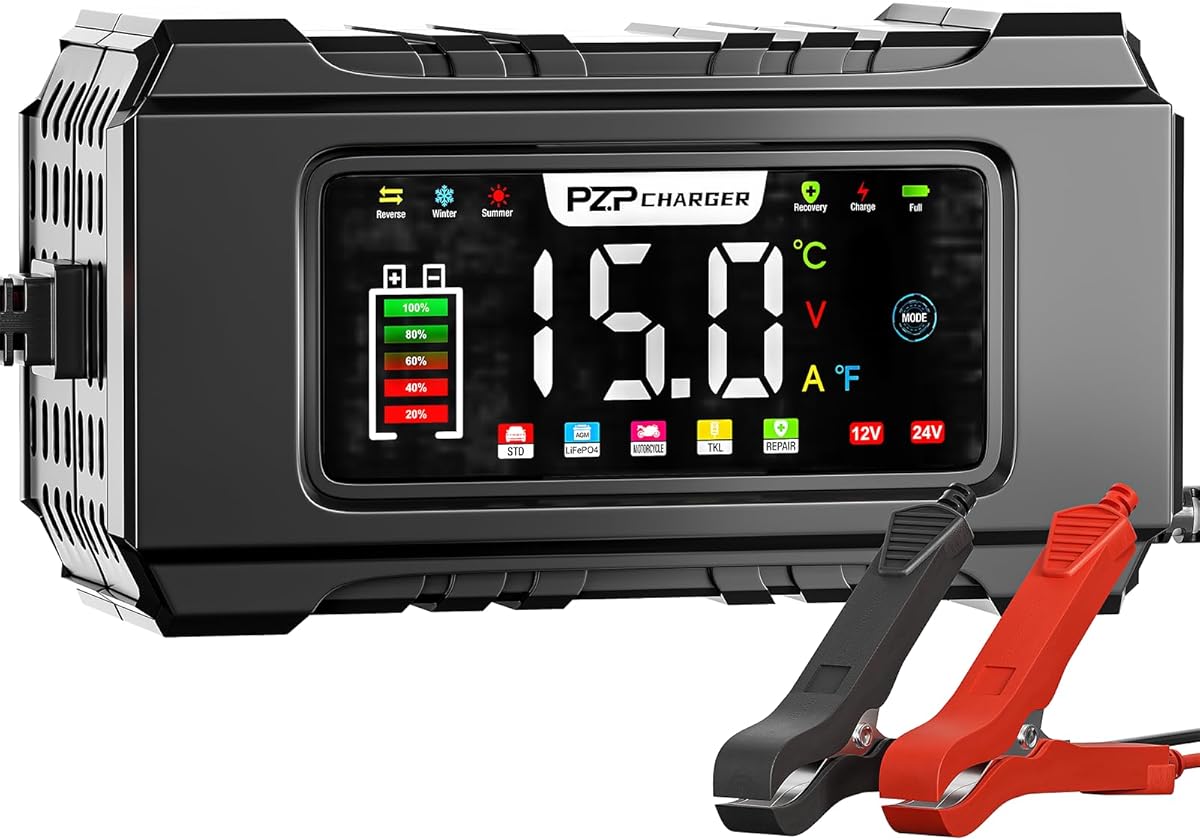


The PZ.P 15-Amp Smart Charger is a broad-purpose charging and maintenance unit rated 4.5 stars. Its standout quality is flexibility: it supports 12V and 24V systems, lead-acid batteries in AGM, gel, SLA, and flooded configurations, as well as LiFePO4 chemistry. That makes it useful for cars, trucks, motorcycles, boats, lawn mowers, and other equipment without requiring a separate charger for each battery family.
We may earn a commission when you buy through this link, at no additional cost to you.
Its nine-stage process is intended to handle charging, restoration, and long-term float maintenance in one cycle. A large color screen reports charging voltage, current, internal temperature, charge percentage, and seasonal mode, while a 6.7-foot cable improves reach. Automatic pulse repair is designed to detect sulfation and acid stratification, and temperature compensation adjusts charging behavior across the listed operating range of 14°F to 82°F.
The trade-offs relate primarily to scope. A 15-amp 12V output is substantial, so it is not the first choice for a small battery that should only receive a gentle maintenance charge. The supplied information also explicitly notes that the pulse function cannot activate or charge a completely dead battery. Repair claims should therefore be treated as restoration support for neglected but serviceable batteries, not as a substitute for battery replacement.
This is a strong recommendation for owners who need one charger to cover several vehicles and battery types, particularly when a clear display and automatic seasonal adjustments are priorities. For a single small motorcycle battery or a permanently installed compact application, a lower-output maintainer may be more convenient. Even so, the PZ.P combines impressive versatility with an unusually thorough protection package.
Supporting both 12V and 24V systems, along with common lead-acid types and LiFePO4, reduces equipment duplication. It is especially practical for households with multiple vehicles, marine equipment, or seasonal machinery.
The color display presents voltage, current, temperature, and charge information in real time. Seasonal indicators and automatic temperature compensation further help align the charging process with changing conditions.
We may earn a commission when you buy through this link, at no additional cost to you.
The KITUREK 12V 1300mA Sealed Lead Acid Smart Battery Charger Maintainer is a straightforward option rated 4.4 stars. It targets a narrower need than the larger smart chargers in this guide: charging and maintaining 12V sealed lead-acid batteries in a small, portable package. Its 1300mA output and 13.8-volt output suit applications involving motorcycle batteries, automotive batteries, standby and emergency equipment, solar systems, audio installations, ATVs, and lawn mowers.
We may earn a commission when you buy through this link, at no additional cost to you.
Operation is intentionally straightforward. Connect the red lead to the positive terminal, connect the black lead to the negative terminal, and plug in the charger. An LED indicator communicates charging status, and the charger automatically stops when the battery reaches full charge. Protection circuitry is listed against short circuits, overcurrent, overheating, high-voltage spikes, and low-voltage drops.
The main limitation is its specialization. It is specified for 12V sealed lead-acid batteries rather than the broad 12V/24V, flooded, AGM, gel, or LiFePO4 support offered by several competitors. It also lacks the multi-stage screens, explicit repair modes, selectable current, and temperature readouts that make premium models easier to diagnose. For a basic SLA application, however, those omissions may matter little.
Choose the KITUREK when you need an uncomplicated sealed lead-acid charger without spending for a feature-heavy unit. It is particularly suitable for a small battery, an indoor backup battery, or a powersport battery that will be stored for extended periods. The compact shell and automatic cutoff make it a sensible budget pick, provided its battery type and 12V limitation match your equipment.
The charger begins its process after connection and stops automatically once the battery is full. This makes it suitable for routine upkeep without requiring repeated monitoring or complicated menu settings.
Short-circuit, overcurrent, overheating, and voltage-spike protection provide a useful safety baseline. The lightweight housing is particularly convenient where storage space is limited.
We may earn a commission when you buy through this link, at no additional cost to you.
The Battery Tender Junior 12V is the strongest all-around choice in this roundup, earning a 4.8 rating. It is specifically designed as a charger and maintainer for 12V powersport batteries, with compatibility for flooded, AGM, and gel-cell lead-acid batteries. Its 750mA output is restrained enough for smaller batteries while still providing a full charge before settling into float mode.
We may earn a commission when you buy through this link, at no additional cost to you.
A four-step program—initialization, bulk charge, absorption, and float—allows the unit to optimize charging without overcharging. Two-color LEDs show the charging state, and adaptive charging resumes full output if battery voltage falls too far under load. Spark-proof circuitry and automatic reversed-hookup detection improve connection safety, while the compact 3.3-by-1.3-by-2.4-inch body is easy to store.
The included package is unusually practical: a 12-foot output cord, a fused-ring terminal harness for inaccessible batteries, alligator clip cables, a five-year warranty, and lifetime customer support. The main limitation is that it does not advertise a desulfation or repair function. It is a maintenance-focused charger rather than a recovery specialist, and its 12V-only format rules it out for 24V systems.
This is the pick for a motorcycle, ATV, powersport vehicle, or other smaller 12V lead-acid battery that benefits from dependable long-term storage. It is also ideal for users who want established automatic stages, clear hookup protection, and included accessories without paying for a high-current display model. For routine battery care, its simplicity and consistency are major strengths.
After completing the bulk and absorption stages, the charger moves into float mode to maintain a proper voltage. If load causes the voltage to drop too far, it automatically resumes full output, making it suitable for intermittent battery use.
The fused-ring harness reaches batteries tucked beneath panels or inside compartments. Automatic reversed-hookup detection and spark-proof circuitry reduce the likelihood of accidental polarity or connection problems.
We may earn a commission when you buy through this link, at no additional cost to you.
The MOTOPOWER MP00205A is a 4.5-rated automatic charger, maintainer, trickle charger, and desulfator for 12V lead-acid batteries. It supports flooded and sealed maintenance-free batteries, including AGM and gel-cell configurations, making it a broad fit for many cars, motorcycles, powersports, and stored recreational equipment.
We may earn a commission when you buy through this link, at no additional cost to you.
Its primary appeal is automatic desulfation. The unit detects sulfation problems and applies pulse current during charging, attempting to optimize battery performance without manual intervention. It also charges to 14.4V, maintains at 13.6V, and uses a 24-hour timer before shifting into maintenance mode. A zero-output standby setting prevents the connected battery from being drained while the charger is waiting.
The practical limitations are modest. There is no external display for voltage, current, temperature, or stage information, so users rely more heavily on the charger's automatic behavior. It also supports only 12V batteries and cannot manage 24V systems. Spark-free lead connection plus overcharge, short-circuit, and reverse-polarity protection provide reassuring fundamentals.
This is a good fit for owners seeking simple automatic maintenance with the added possibility of desulfating a neglected battery. Plug it in, connect the leads, and allow the programmed cycle to do the work. Choose it over a display-heavy model when simplicity, compact maintenance, and desulfation support matter more than detailed readouts or adjustable output.
Pulse-current technology is incorporated into the automatic charging cycle. This may help address sulfation in batteries that have sat unused, although it does not guarantee recovery from every failed battery.
The charger produces zero output in standby mode, avoiding unnecessary battery drain. A 24-hour timer terminates the main charge before the unit transitions into a lower-output maintenance mode.
We may earn a commission when you buy through this link, at no additional cost to you.
The NOCO GENIUS2D is a 4.6-rated onboard charger designed for permanent installation near a 12V battery. Unlike a portable maintainer that must be connected when needed, its mounting bracket and included hardware create a fixed charging system for vehicles, boats, and recreational equipment that spend time in storage.
We may earn a commission when you buy through this link, at no additional cost to you.
The charger supports flooded, maintenance-free, deep-cycle, marine, RV, AGM, gel, SLA, and VRLA batteries. A thermal sensor adjusts charging based on ambient temperature, helping reduce overcharging in hot conditions and undercharging in cold weather. Pulse charging is included to address sulfation and acid stratification, while automatic monitoring allows the unit to remain connected for long-term maintenance.
One of its most notable features is low-voltage charging. The unit can charge batteries down to one volt, and Force Mode is specified for batteries down to zero volts. That makes it more ambitious than chargers that require a partially charged battery. The trade-off is that this is an onboard installation rather than a grab-and-go tool, and it remains limited to 12V systems.
The box includes the 2A charger, 24-inch AC and DC cables, eyelet terminals, a mounting bracket, screws, and a three-year warranty. Choose the GENIUS2D when a vehicle's battery needs consistent top-ups through extended storage and you prefer a clean, permanent installation over repeated manual connections.
Automatic monitoring adjusts charging and allows safe long-term connection. This suits seasonal vehicles and boats that benefit from maintained voltage without regular visits to the battery.
Charging from one volt and a manually selected Force Mode distinguish this model from basic trickle chargers. These features are valuable for batteries neglected long enough to lose much of their usable charge.
We may earn a commission when you buy through this link, at no additional cost to you.
This 12V/24V Heavy-Duty Battery Charger is a 4.4-rated option aimed at users with varied lead-acid batteries and a need for adjustable output. It supports AGM, gel, wet, EFB, calcium, maintenance-free, and deep-cycle batteries, covering applications from cars and trucks to boats, motorcycles, RVs, and lawn mowers.
We may earn a commission when you buy through this link, at no additional cost to you.
Its 0-to-15-amp range includes both rapid charging and low-current maintenance. The stated capacity extends to 400Ah, making the unit relevant to larger batteries and substantial banks. A repair mode is intended to restore some older or neglected batteries, while separate winter and summer modes adjust charging parameters for cold and hot environments.
There is an important caveat for small batteries. The supplied information says lead-acid batteries under 30Ah should only be charged for emergencies, with charging limited to one to three hours and stopped manually. That restriction makes the product less flexible for tiny motorcycle or lawn-mower batteries than a dedicated low-output maintainer. It also cannot revive severely depleted batteries.
This model makes the most sense for users with medium or large 12V systems who also need 24V capability and appreciate adjustable current. Its automatic shutdown, short-circuit protection, over-voltage protection, reverse-polarity protection, and overheat and overcharge safeguards create a comprehensive safety framework for regular charging work.
The adjustable output and stated support for batteries up to 400Ah extend the charger beyond small powersport applications. It is a practical option for larger vehicle, marine, and deep-cycle installations.
Winter and summer modes are intended to reduce overcharging in hot weather and support fuller charging in cold conditions. That seasonal flexibility is useful for outdoor equipment exposed to changing temperatures.
We may earn a commission when you buy through this link, at no additional cost to you.
The Foval Automatic Trickle Battery Charger earns a 4.6 rating and combines a 1A charger, maintainer, float charger, and desulfator in a compact 12V package. It supports SLA, VRLA, gel-cell, AGM, and wet lead-acid batteries, making it one of the more versatile compact models in the list.
We may earn a commission when you buy through this link, at no additional cost to you.
A four-step sequence covers initialization, bulk charging, absorption, and float operation. Once charging is complete, the unit automatically transitions to float voltage. Its LED indicators provide basic diagnostic feedback: green shows power, green with red indicates charging, and green with yellow indicates a full battery. Automatic desulfation adds a recovery-oriented function without requiring manual activation.
Portability is a notable strength. The enclosure measures 3.9 by 2.4 by 1.25 inches, weighs 10.5 ounces, and includes ring and alligator connector options across a combined 102-inch AC and DC cable. Its limitations are the lack of a numeric display and its restriction to 12V batteries. It therefore gives less visibility than premium models with voltage, current, temperature, and stage readouts.
Choose the Foval for compact storage, broad compatibility, and simple maintenance across numerous recreational or utility battery types. It is a good middle ground between a minimal sealed-battery charger and a larger high-current smart charger, especially when portability and multiple connector styles matter more than detailed telemetry.
The small enclosure and light weight simplify storage in a garage, trailer, or tool area. Despite its size, it supports cars, motorcycles, tractors, boats, snowmobiles, classic cars, and many other 12V applications.
Ring terminals support a semi-permanent connection, while alligator clips offer flexibility for occasional charging. The extended cable length improves reach when the battery sits beneath a seat or inside a compartment.
We may earn a commission when you buy through this link, at no additional cost to you.
The E-FAST 25A Smart Charger is the most feature-dense premium option here, earning a 4.4 rating. It delivers up to 25 amps on 12V systems and 15 amps on 24V systems, supports lead-acid, AGM, gel, SLA, flooded, EFB, and LiFePO4 batteries, and automatically detects the connected voltage. That combination makes it suitable for trucks, SUVs, boats, and RVs as well as smaller equipment.
We may earn a commission when you buy through this link, at no additional cost to you.
Five current settings—2A, 8A, 20A, 25A, and Auto Mode—give users meaningful control over charging speed. Auto Mode assesses internal resistance to select a suitable rate, while the manual settings allow a small motorcycle or lawn-mower battery to receive a lower current than a large vehicle battery. An eight-stage charging process includes a dedicated 16-hour repair mode for old, idle, or sulfated batteries.
Its Booster Mode is designed for jump-start assistance, delivering a maximum surge for 200 seconds before ending the countdown. The feature applies only to 12V batteries. Winter Mode below 10°C and Summer Mode above 28°C adjust charging behavior, while reverse-polarity, spark, short-circuit, and overcharge protections support safer operation. The aluminum shell and cooling fan improve heat dissipation during sustained high-current use.
Choose this charger when you regularly service different battery sizes, need both 12V and 24V capability, or want manual control that basic maintainers cannot provide. It is overkill for maintaining one small battery, but for a multi-vehicle garage or workshop, the flexibility is substantial and justifies the premium positioning.
The manual current choices prevent a one-size-fits-all approach. Low output can serve smaller batteries, while the maximum setting supports faster charging on compatible larger batteries.
An aluminum alloy housing and active cooling fan are designed to dissipate heat during high-amp charging. These physical features complement the electrical protections against sparks, short circuits, reverse polarity, and overcharging.
We may earn a commission when you buy through this link, at no additional cost to you.
The E-FAST 20A Smart Charger is a 4.4-rated all-in-one charger, maintainer, trickle charger, and desulfator. It provides up to 20 amps on 12V batteries and 10 amps on 24V batteries, supporting flooded, gel, AGM, SLA, deep-cycle, marine, and LiFePO4 applications. The broad chemistry support makes it relevant to cars, trucks, SUVs, boats, motorcycles, farm vehicles, and lawn mowers.
We may earn a commission when you buy through this link, at no additional cost to you.
Its seven-stage program includes desulfurization, trickle charging, constant-current and constant-voltage phases, current detection, compensation charging, and float charging. The display reports voltage, current, temperature, and charging stage, then shows a full state when charging concludes. If the dE5 mode appears, the instructions advise waiting at least five minutes for the charger to adjust and resume automatically.
The pulse repair function uses high-frequency and low-frequency pulse technology to address vulcanization and restore some lost performance in old or idle batteries. Important limits remain: the charger cannot activate a dead battery, repair a physically damaged battery, or jump-start a car. Those boundaries distinguish maintenance and restoration from emergency starting.
This E-FAST is a balanced choice for users who want more power and information than a basic maintainer without moving to the highest-output model. It suits mixed 12V and 24V service as well as mixed lead-acid and LiFePO4 batteries, provided operators understand its repair limits and battery-size requirements.
The sequence adapts from recovery-oriented stages through bulk and controlled voltage charging, then compensation and float. It offers a more structured process than a simple constant-voltage trickle charger.
Voltage, current, temperature, stage, and full-charge status appear directly on the display. This visibility helps users understand progress instead of relying entirely on generic LEDs.
We may earn a commission when you buy through this link, at no additional cost to you.
The Battery Tender Plus 12V is a 4.7-rated charger and maintainer for automotive, motorcycle, ATV, and lawn-mower batteries. Its 1.25-amp output is slightly higher than the Junior model while preserving the same practical concept: charge fully, transition to float, and resume full output if load causes the voltage to fall too far.
We may earn a commission when you buy through this link, at no additional cost to you.
The adaptive four-step program adjusts to the battery's needs and is designed to promote optimal health without overcharging. A two-color LED indicates the charge state, providing a simple way to see whether the unit is actively charging or maintaining. This uncomplicated feedback suits owners who want dependable storage care without navigating detailed screens or selectable modes.
Its quick-disconnect harness adds convenience because the user can remove the connection without fully unwiring a permanent setup. The package includes fused ring terminals, alligator clips, a ten-year manufacturer warranty, and lifetime customer support. The main limitations are the absence of a numeric display and its focus on 12V lead-acid batteries rather than 24V or lithium systems.
Choose the Battery Tender Plus when dependable everyday maintenance and long-term support matter most. It is well suited to a car, motorcycle, ATV, or lawn mower stored for weeks or months, especially when you want a charger that can remain connected without constant supervision. The quick-disconnect and extensive warranty strengthen its case as an easy ownership experience.
The charger moves into float mode after charging, then resumes full output when voltage drops too far under load. This behavior is useful for batteries that occasionally power equipment while being stored.
The included harness allows the charger connection to be removed without rebuilding the entire setup. That convenience makes routine inspections, battery swaps, and seasonal storage more practical.
We may earn a commission when you buy through this link, at no additional cost to you.
The right charger depends on battery chemistry, capacity, vehicle type, and how you intend to use it. Consider the electrical specifications and connection method before comparing extra features, because a sophisticated charger is only useful when it safely matches the battery.
Match the charger's voltage exactly to the battery. A 12V charger should not be connected to a 24V system, and a dual-voltage model must be configured correctly. If you own batteries with different chemistries, a versatile unit can be more useful than several basic chargers, but only if its supported modes and automatic detection are clearly documented.
Do not assume that the highest available current is always best. Excessive current can overheat a small battery, so use the manufacturer's recommended battery-size guidance. Models with an automatic mode can simplify selection, while manual current controls are valuable for workshop users who regularly handle batteries of different sizes.
Choose a multi-stage design if you expect to charge from a partially depleted state rather than only top off a healthy battery. A simple charger can maintain a battery effectively, but it may lack the controls needed for deeper discharge. Confirm that float or trickle maintenance is automatic so you can leave the charger connected safely during storage.
Look for clear limits and realistic expectations. If you routinely find severely depleted batteries, prioritize a charger with low-voltage charging, force mode, or a robust recovery stage. If your main goal is preventive care, a reliable maintainer may provide better value than an expensive charger with elaborate but unnecessary restoration features.
Temperature compensation is especially valuable for outdoor equipment. Cold weather can increase charging voltage requirements, while heat can make overcharging more likely. Seasonal modes or an integrated sensor can adjust the process, but the charger should still be operated within its specified environmental limits. Always use properly rated cables and follow the battery manufacturer's guidance.
Check the included cable length and connector types before buying. Ring terminals support semi-permanent connections, alligator clips allow quick access, and fused-ring harnesses add protection. An extended lead helps reach batteries beneath seats or inside compartments, but overly long cables should be routed carefully to avoid snagging or damage.
A large screen does not automatically make a charger better, so consider whether you will actually use the information. Simple maintainers are easier to understand, while advanced displays suit users who want to monitor stages, diagnose battery condition, or select current levels. Look for recognizable full-charge and error indicators rather than relying only on color changes.
Compare the complete package rather than warranty length alone. A unit with a ring-terminal harness, suitable cable length, clear instructions, and accessible support may provide more day-to-day value. For extended storage, choose a charger explicitly approved for indefinite or long-term float maintenance rather than assuming every automotive charger is suitable.
Before connecting the charger, identify the battery's voltage and chemistry, inspect it for cracks, corrosion, swelling, leaks, or other damage, and read both the battery and charger instructions. Position the charger in a dry, ventilated location away from ignition sources, heat, and combustible materials. Use the supplied leads and connectors, clean the battery terminals if necessary, and make sure your hands and nearby metal objects do not bridge the terminals.
Connect the positive lead to the positive battery terminal and the black lead to the negative terminal. Most modern chargers will indicate an incorrect connection or refuse to begin, but polarity should still be confirmed manually. Plug the charger into the appropriate power source and select the correct voltage or battery mode. For adjustable-current models, use a setting appropriate for the battery's size and follow any special instructions for very small batteries.
Allow the charger to complete its programmed stages, then check the status display or indicator lights before disconnecting. Turn off or unplug the charger first if the manual instructs you to do so, remove the negative lead, and then the positive lead. Clean and store the leads dry, inspect them for damage, and reconnect the charger periodically when a battery is stored for long periods so its charge level remains maintained.
A charger specifically designed for long-term float or trickle maintenance can remain connected to a compatible battery indefinitely. It should stop adding significant current once the battery is full and resume only when voltage drops under load. Confirm that the product is rated for continuous maintenance and follow its instructions, especially when using it in extreme temperatures.
Only if the charger explicitly supports those battery types. AGM, gel, flooded, SLA, and VRLA batteries can use different charging voltages and profiles, so compatibility should be checked before connection. Several chargers in this guide cover multiple lead-acid formats, while the KITUREK model is focused specifically on sealed lead-acid batteries.
Usually not reliably. Some advanced chargers can begin charging at very low voltage or include force mode, but a totally dead battery may have suffered irreversible internal damage or open-circuit failure. The supplied product information repeatedly notes that several repair or pulse modes cannot activate completely dead batteries, so a voltage test and possible battery replacement may still be necessary.
A basic trickle charger applies a small, relatively constant current, while a smart maintainer follows multiple charging stages and adjusts its behavior according to battery status. A properly designed smart charger can bulk charge, absorb, and then float, making it better suited to batteries that begin charging below full voltage.
A lower current is generally more appropriate for small motorcycle, lawn-mower, or other compact batteries. Some high-output chargers provide dedicated 2A settings, while basic maintainers typically operate around 750mA to 1.25A. Always follow the battery manufacturer's guidance, especially when using a charger with a much higher maximum output.
Yes, if the model has a documented dual-voltage function and you configure it correctly. Several products in this guide support both voltages and automatically detect the connected system. Never assume a nominal 12V charger is safe for a 24V battery, and verify the selected voltage before attaching the leads.
No. Repair and pulse modes may improve charging acceptance or help reverse mild sulfation in a serviceable battery, but they cannot fix physical damage, leaks, severe corrosion, or a battery that has lost capacity. Use recovery mode as a maintenance tool and test or replace a battery when it cannot hold a proper charge.
Follow the charger's instructions and the vehicle manufacturer's guidance. A portable charger should generally be disconnected before operating the vehicle because cranking and charging-system voltage can create conflicts with some maintenance units. Onboard chargers are specifically designed for permanent use, but their installation and connection should still match the supplied instructions.
The Battery Tender Junior 12V stands out for a balanced mix of four-stage charging, adaptive float maintenance, useful safety features, and the highest rating in the guide. The KITUREK 1300mA maintainer is a practical budget choice for basic sealed lead-acid upkeep, while the E-FAST 25A Smart Charger offers the most control for mixed batteries, larger systems, and workshop-style use.
Prioritize battery compatibility, appropriate current, and safe long-term float behavior before extra features. A compact maintainer is often better for one small motorcycle or lawn-mower battery, while a dual-voltage smart charger earns its place when you service trucks, boats, RVs, or batteries with different requirements. Repair modes, seasonal modes, displays, and connectors should support your actual use rather than dictate the decision.
Confirm the current product listing, included accessories, warranty terms, and availability before buying. Ratings can change over time, and product configurations may vary, so reviewing the latest listing helps ensure that the selected charger still matches the battery, equipment, and storage conditions you have in mind.