
USB Fingerprint Reader for Windows 10/11
4.3Editor score
Match-in-sensor biometric processing
Ten-fingerprint multi-user support
Four-foot extension cable
Compare the 10 best Fingerprint Reader for Windows 11 options, comparing Windows Hello support, security features, compatibility, setup, and everyday performanc
A fingerprint reader for Windows 11 can turn a familiar Windows Hello prompt into a faster, more convenient way to sign in, lock a shared computer, and protect local accounts. The right device should work with genuine Windows systems, place matching inside the sensor, provide reliable angle recognition, and sit comfortably where you use your computer.
This guide compares ten USB fingerprint readers based on their documented Windows Hello support, biometric architecture, user capacity, cable placement, security functions, and platform limitations. It also examines specialized features such as FIDO capabilities, Windows Hello for Business support, encrypted folders, anti-spoofing, multi-user enrollment, and compatibility with password managers.
Each review identifies the strongest reasons to consider a particular model, along with restrictions that could affect your setup. The top three receive budget, overall, and premium designations, while every remaining reader receives an individual assessment. Product availability and pricing can change, so check the current listing before purchasing.
4.3Editor score

4.1Editor score

3.7Editor score
This side-by-side comparison highlights the operating-system support, enrollment capacity, security architecture, placement options, and additional authentication features that distinguish each Windows 11 fingerprint reader.


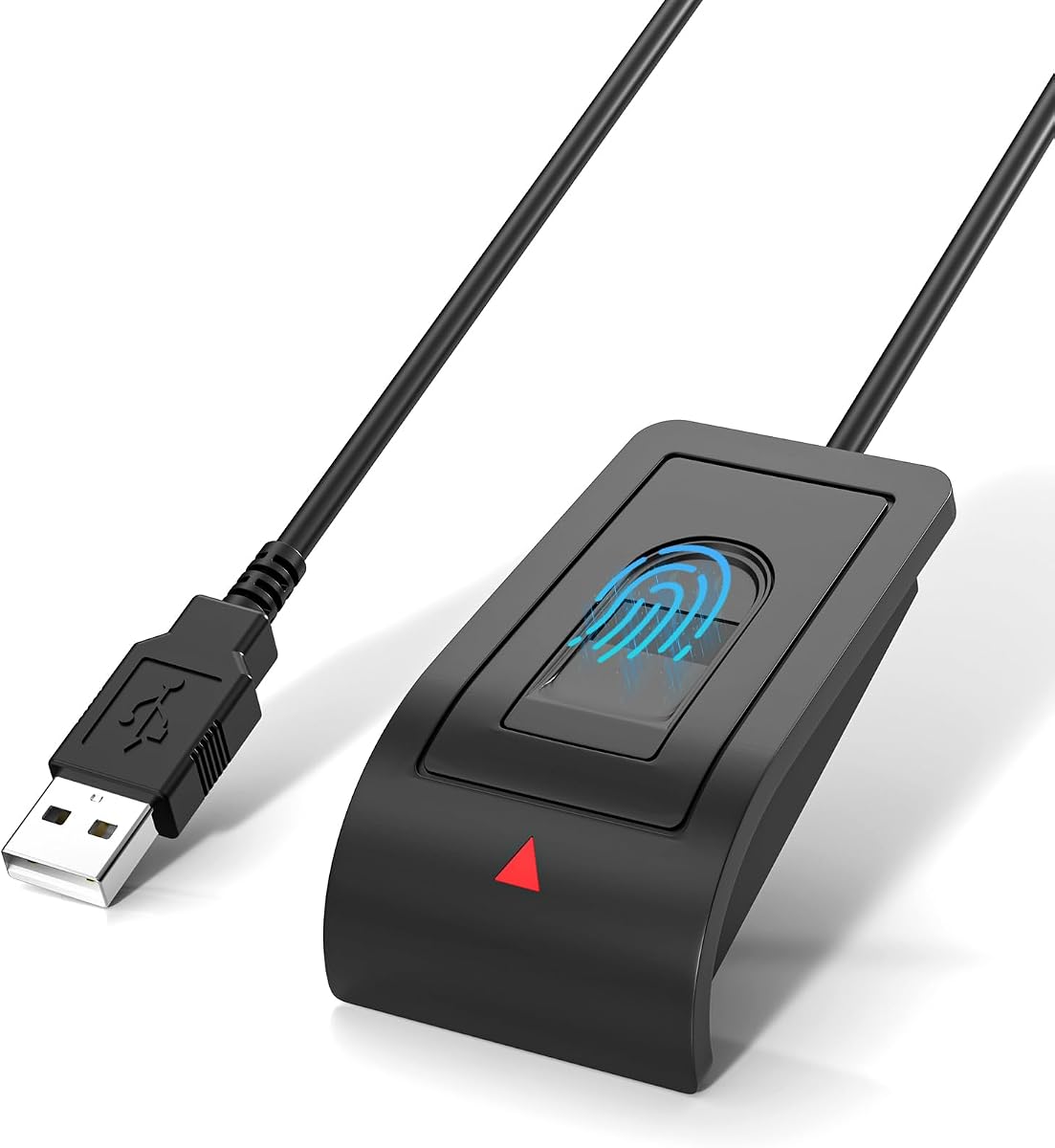


This USB fingerprint reader earns the Best Budget designation because it combines a 4.3 rating with the core capabilities most Windows 11 users seek. It provides native Windows Hello sign-in, match-in-sensor processing, an angled sensor surface, and room for up to 10 fingerprints without requiring a separate application.
We may earn a commission when you buy through this link, at no additional cost to you.
Its strongest feature is the clear privacy boundary. Fingerprint matching occurs within the sensor, while biometric data remains on the local Windows device and is not uploaded or synchronized externally. The reader acts as an input device for Windows Hello rather than communicating independently with websites, so the services available for biometric sign-in still depend on Windows and the account provider.
Setup is designed to remain straightforward on genuine Windows 10 and Windows 11 systems. Plug the reader into a USB port, use Windows Hello to enroll fingerprints, and it becomes available for sign-in. If Windows Hello is missing or disabled, the product description notes that a system update or configuration change may be necessary, which keeps the potential issue clearly within the operating system.
This is a compelling choice for a home office, personal desktop, or shared household computer where several people need separate Windows accounts. It is less appropriate for Mac, Linux, or mixed-platform households, and it does not offer the expanded FIDO, Windows Hello for Business, or password-manager functions found in higher-end models. Even so, it delivers a focused and economical Windows Hello experience.
Match-in-sensor processing means the device performs matching within the sensor and transfers only the result needed by Windows. The documentation also makes an important distinction: the reader does not directly authenticate individual websites or applications, so service support remains governed by Windows Hello and the relevant provider.
Support for up to 10 fingerprints makes the device practical for a household with several Windows user accounts. Enrollment is still managed by Windows, allowing each authorized user to maintain separate biometric sign-in without relying on a vendor-specific account system.
We may earn a commission when you buy through this link, at no additional cost to you.
The Kensington VeriMark Desktop 1.0 receives the Editor's Choice designation because it extends beyond basic Windows Hello login into a broader authentication platform. Its 4.1 rating is supported by Windows Hello certification, Windows Hello for Business support, FIDO U2F certification, and FIDO2 WebAuthn compatibility.
We may earn a commission when you buy through this link, at no additional cost to you.
For organizations, the most meaningful details are its support for Microsoft services, passwordless and multifactor workflows, and compatibility with standards used for stronger authentication. The device also combines match-in-sensor processing with anti-spoofing technology and documents a false rejection rate of 2% and false acceptance rate of 0.001%.
The main limitation is platform scope. The product supports Windows 10 and Windows 11 but is not currently supported on Windows ARM-based computers. A tap-and-go workflow is also described as applying to services using the older FIDO U2F standard, where the fingerprint reader serves as a security-token interface rather than as a general biometric login method.
Choose this model if you need FIDO functionality, Windows Hello for Business, or a device suitable for organizational deployment. For a straightforward personal Windows 11 login, less specialized readers may be adequate, but the VeriMark Desktop offers the most comprehensive combination of Microsoft integration and security standards in this list.
FIDO U2F and FIDO2 compatibility extend the reader beyond PC unlock into passwordless, dual-factor, multifactor, and security-key workflows. This makes it relevant to users who want one hardware peripheral to interact with supported browser-based authentication services.
Windows Hello for Business and additional Microsoft service support make this reader especially attractive to organizations. Its 3.9-foot cable also gives administrators and users more freedom when positioning the device near a monitor or docking station.
We may earn a commission when you buy through this link, at no additional cost to you.
The Kensington VeriMark Gen2 is the Best Premium pick for users who want a Windows 11 fingerprint reader that also functions as an advanced security key. Its 3.7 rating is the lowest of the three featured selections, but the product's match-in-sensor design, CTAP2 support, and password-manager compatibility justify consideration for security-focused buyers.
We may earn a commission when you buy through this link, at no additional cost to you.
Fingerprint data is isolated and secured within the sensor, and only an encrypted match is transferred. The device supports Windows Hello, Windows Hello for Business, passkey access through Tap and Go, and popular password managers such as Dashlane, LastPass Premium, Keeper Premium, and RoboForm.
Its limitations are meaningful. It does not work with MacOS or ChromeOS, and the stated 3.7 rating suggests that some buyers have been less satisfied overall than users of the two higher-rated options. Its enterprise focus can also exceed the needs of someone who only wants effortless local PC sign-in.
This reader is best for a Windows-centered professional or organization that values CTAP2, passkeys, and password-manager integration alongside biometric login. Buy it for its specialized authentication capabilities, not merely for PC unlock. If those features are unnecessary, the lower-rated but more budget-oriented models offer a more focused Windows Hello experience.
Tap-and-go CTAP2 support lets the reader participate in passkey and passwordless workflows across a broad device ecosystem. The product documentation also identifies compatible premium tiers of several leading password managers, adding value for users who want hardware-assisted credential access.
The sensor performs fingerprint matching internally and sends an encrypted result rather than exposing raw biometric data. Combined with anti-spoofing technology, this supports users who want a security key designed around local biometric protection rather than a simple reader.
We may earn a commission when you buy through this link, at no additional cost to you.
This upgraded USB-A reader has a 4.2 rating and emphasizes speed, broad fingerprint orientation, and multi-user convenience. It offers a claimed response of 0.05 seconds, 360-degree recognition, anti-spoofing technology, and support for up to 10 user IDs through Windows Hello.
We may earn a commission when you buy through this link, at no additional cost to you.
The product is particularly useful in shared homes, offices, or workspaces where several people access the same PC through separate Windows accounts. Its list of features also mentions access to website credentials and designated private folders, although those capabilities ultimately depend on the relevant Windows Hello-supported functions and system configuration.
Installation should be easy for most users because no third-party software or complicated driver installation is required. A 1.5-meter extension cable provides useful placement flexibility, while the compact body is easy to carry between home, office, and travel setups. The documented error rates are 1.92% for false rejection and 0.002% for false acceptance.
This is a strong alternative for anyone prioritizing quick recognition and multi-user enrollment. Its drawbacks are the Windows-only restriction and the lack of explicit FIDO, Windows Hello for Business, or CTAP2 features. Choose it for a straightforward personal or family Windows login, particularly when quick recognition matters more than enterprise authentication.
The capacitive sensor is specified to recognize fingerprints from virtually any angle, reducing the need to place a finger in one exact orientation. That focus on everyday convenience makes the reader useful for users who may approach the sensor differently throughout the day.
Support for up to 10 user IDs allows family members or coworkers to enroll authorized fingerprints while retaining separate Windows profiles. Enrollment remains a Windows Hello process, so the device does not need to maintain its own centralized user database.
We may earn a commission when you buy through this link, at no additional cost to you.
This Windows Hello USB reader is a straightforward option for anyone who wants one-touch sign-in on a Windows 10 or Windows 11 PC. It carries a 4.1 rating and centers on fast biometric recognition, local processing, a four-foot cable, and an angled surface designed for regular desktop use.
We may earn a commission when you buy through this link, at no additional cost to you.
The documentation says biometric processing occurs inside the sensor, while fingerprint information remains stored locally and is not uploaded or shared externally. The reader supports PC access, screen locking, and Windows user-account management through the built-in Windows Hello interface.
Its appeal comes from a short learning curve. Connect it over USB, use Windows Hello to register a fingerprint, and begin using it for sign-in without installing a vendor application. The angled sensor and extension cable also make it easier to keep the device in a natural position beside a monitor rather than plugging it into an awkward rear port.
This is a sensible choice for a personal computer or straightforward shared workstation. It lacks the explicit FIDO, CTAP2, and Windows Hello for Business functions found in the Kensington options, and it is not intended for Mac or Linux. Its appeal lies in doing the core Windows Hello job cleanly and locally.
Because the reader relies on Windows Hello, there is no separate application to install or manage. Users can connect the device, follow the operating system's enrollment steps, and then use a touch for sign-in or screen lock.
Local biometric processing and local storage are central selling points. The reader is presented as a Windows input device rather than a service that collects or synchronizes fingerprints independently.
We may earn a commission when you buy through this link, at no additional cost to you.
The ineo reader is a practical choice for people who often step away from a Windows 11 computer and want a quick way to lock it. Its 4.1 rating and one-touch lock function distinguish it from readers marketed primarily around broader security-key protocols.
We may earn a commission when you buy through this link, at no additional cost to you.
Instead of requiring a separate key sequence, the product highlights the Win plus L shortcut as a simple way to secure the session with a fingerprint touch. A high-precision optical sensor provides fingerprint recognition, while the described plug-and-play process is intended to get the reader operating within minutes.
Its five-foot cable and compact body make it easy to place the scanner on a desk without leaving a small device beside a monitor. The design is particularly relevant for offices and shared spaces where fast, repeatable locking is more important than advanced FIDO capabilities.
Choose the ineo model if your priority is simple Windows login and screen locking with a tidy footprint. The absence of documented CTAP2, FIDO, or Windows Hello for Business support makes it less attractive for specialized authentication tasks, while the explicit Mac exclusion narrows its use to Windows PCs.
The one-touch lock workflow is useful when a user regularly steps away during work. Combining a touch with the documented keyboard shortcut offers a convenient alternative to reaching for a password every time the workstation is unattended.
The five-foot cable allows the sensor to sit where it is easy to reach, while its small footprint avoids crowding the desk. This is particularly useful when the computer's USB port is at the back of a tower or underneath a monitor.
We may earn a commission when you buy through this link, at no additional cost to you.
The RGB Windows Hello reader stands out visually and technically, with a 3.0 rating, 38 lighting effects, a five-foot cable, and support for FIDO U2F and FIDO2. It targets users who want their desktop security accessory to look as distinctive as its feature set.
We may earn a commission when you buy through this link, at no additional cost to you.
Its primary functions remain familiar: one-touch Windows Hello login, 360-degree touch recognition, and one-touch locking. The listing also associates the scanner with website and application two-factor authentication, including services such as Google, Facebook, Dropbox, and Microsoft accounts when they support the applicable FIDO workflow.
Compatibility is described as above 95% on genuine Windows devices, with a manual driver update sometimes needed for individual non-genuine systems. That distinction is important for buyers with modified Windows installations, because plug-and-play behavior may not be identical across every environment.
The device supports up to 10 fingerprints and claims authentication in under 0.5 seconds, with documented rates of 0.001% false acceptance and 0.1% false rejection. Its 3.0 rating is the lowest in the group, so buyers should place more weight on current user feedback. It is most appealing as a stylish, multifunction desktop reader with broad FIDO ambitions.
The touch-controlled RGB lighting provides 38 flowing effects and a breathing-light mode. Beyond appearance, the light can help indicate that the reader is active or ready, while the compact body keeps the unit suitable for either a laptop or desktop setup.
FIDO U2F and FIDO2 capabilities distinguish this model from basic Windows Hello readers. Support for up to 10 fingerprints also makes it appropriate for shared devices, provided each authorized person enrolls through the appropriate Windows account.
We may earn a commission when you buy through this link, at no additional cost to you.
The Yoidesu reader has a 3.9 rating and focuses on a small footprint, approximately 0.5-second recognition, and flexible 360-degree touch detection. It is designed for Windows 10 and 11 PCs and laptops that lack a built-in fingerprint sensor.
We may earn a commission when you buy through this link, at no additional cost to you.
Its setup follows the normal Windows Hello path. On most genuine Windows systems, no extra application is required; the reader is plugged in, a fingerprint is registered, and touch sign-in becomes available. The compact unit can move easily between a desktop, laptop bag, office, or home setup.
The product also supports multiple Windows accounts and up to 10 fingerprints per user account, while Smart-ID features can extend biometric access to supported saved passwords and encrypted folders. These functions still depend on Windows Hello and the compatible services enabled within the operating system.
The important caveat concerns streamlined Windows editions and USB connections. The product is not suitable for the streamlined version of Windows, and the maker recommends a motherboard USB 2.0 port because USB 3.0 docking stations can introduce power or interference problems. This is a capable compact reader when those constraints are understood.
The reader's lightweight, compact design makes it easy to carry and deploy on different Windows laptops. Its 0.5-second recognition target and 360-degree touch support focus on a smooth experience when users interact with the device frequently.
The recommendation to use a USB 2.0 motherboard port is worth considering before purchase. It reflects a stated concern about power delivery or interference through USB 3.0 docks, making direct connection the more predictable route when recognition is inconsistent.
We may earn a commission when you buy through this link, at no additional cost to you.
The Verifi P2000 is a desktop-oriented reader with a 3.9 rating, Windows Hello certification, and support for Windows Hello for Business. Its feature set extends beyond local sign-in through passkey compatibility and compatibility with leading password-management software.
We may earn a commission when you buy through this link, at no additional cost to you.
The hardware uses high-definition fingerprint imaging based on three-dimensional touch capacitance. This approach is intended to support reliable recognition and distinguishes the unit from basic optical-style desktop scanners. The black-and-silver enclosure is designed to remain visible and accessible beside a monitor.
Its passkey and password-manager support can be valuable for users who want a single peripheral to assist with online authentication. However, the supplied information does not describe enrollment capacity, cable length, sensor error rates, or a specific user limit, so buyers should examine the current listing for those details.
The P2000 makes sense when Windows Hello certification, passkeys, and password-manager compatibility matter more than a detailed multi-user specification. Its 3.9 rating should be weighed against the more highly rated newer readers, but its established support for Microsoft services may appeal to Windows-focused professionals.
Passkey support can simplify compatible website authentication, while password-manager compatibility extends the reader's usefulness beyond Windows sign-in. The exact services and workflows available depend on the account, browser, and installed password manager.
High-definition, three-dimensional touch capacitance is the defining technical feature. It gives the reader a different sensing approach from devices that use a conventional optical sensor, although the supplied data does not provide numerical error-rate figures.
We may earn a commission when you buy through this link, at no additional cost to you.
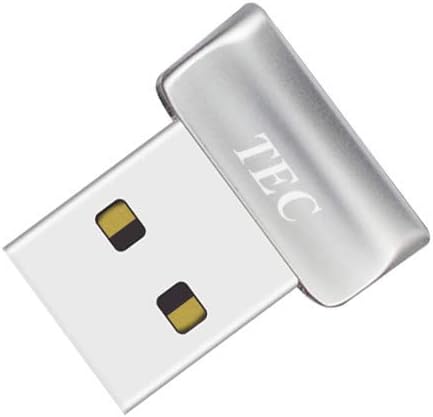
The TEC Mini reader combines a 4.2 rating with a compact dongle design and support for Windows Hello authentication. It also advertises document and folder encryption, giving it a broader local-security focus than a reader intended solely for sign-in.
We may earn a commission when you buy through this link, at no additional cost to you.
Its capacitive-style matching is described as supporting 360-degree touch recognition, which helps users place a finger naturally rather than requiring a precise orientation. Multi-fingerprint registration makes it suitable for different authorized users, assuming each person enrolls within the appropriate Windows account.
Setup is not presented as entirely driver-free. The product information points to troubleshooting instructions for installing the device driver and directs buyers to the store for assistance. This makes the device less convenient than readers that explicitly advertise automatic recognition and no complicated installation, but the documentation at least acknowledges the potential need for configuration.
A critical limitation is the absence of ARM chipset compatibility. Buyers with an ARM-based Windows device should choose another option. For a compatible x86 Windows PC or laptop, the TEC Mini is appealing when a small footprint and file-encryption features are more important than FIDO, CTAP2, or Windows Hello for Business support.
Document and folder encryption is the feature that most clearly separates this reader from basic login devices. It is particularly relevant to users who want fingerprint-assisted access to protected local content as well as their Windows account.
The mini dongle format is easy to carry between compatible computers. The explicit ARM chipset exclusion, however, is important: traditional Windows 10 and 11 hardware has a better chance of meeting the stated requirements than an ARM-based system.
We may earn a commission when you buy through this link, at no additional cost to you.
The most useful fingerprint reader is one that integrates cleanly with your version of Windows, fits your workstation, and supports the authentication functions you actually need. Consider compatibility, sensor security, enrollment capacity, connection method, and intended use before comparing models.
Begin with the operating system and processor architecture. Most readers in this guide are designed specifically for genuine Windows 10 or Windows 11 systems, with several excluding Mac, Linux, and ChromeOS outright. The Kensington VeriMark Desktop is not currently supported on Windows ARM-based computers, and the TEC Mini also states that it is incompatible with ARM chipsets. The Yoidesu reader additionally warns that it does not support the streamlined edition of Windows. Verify the edition, architecture, and connector arrangement before buying rather than assuming that every Windows computer can use every USB reader.
A dedicated Windows 11 fingerprint reader should work through Windows Hello instead of requiring a separate account, cloud service, or proprietary management platform. Plug-and-play models are generally the simplest because Windows recognizes the sensor and presents its standard enrollment interface. Some environments may need a Windows update, configuration change, or driver update, as noted by several products. Business users may also want Windows Hello for Business rather than only consumer Windows Hello, while online authentication depends on whether the relevant website or application supports the appropriate Windows or FIDO method.
Match-in-sensor processing keeps fingerprint comparison inside the reader, and several products in this list emphasize it. This local boundary is reassuring because it reduces the amount of biometric information that needs to leave the device. The related claim that fingerprint data remains local on the PC should be distinguished from online service compatibility: a reader does not independently authenticate a website, and service-level biometric sign-in still depends on Windows Hello and the provider. Review the product documentation for specific data-handling, encryption, and anti-spoofing claims rather than treating all biometric hardware as interchangeable.
If the reader will serve a family, office, or shared PC, enrollment capacity can determine whether it fits. The Windows 10/11 USB Reader, Upgraded USB-A Reader, VeriMark Desktop, VeriMark Gen2, RGB reader, and Yoidesu reader all describe support for multiple fingerprints, with several specifying as many as 10. Windows normally associates biometric enrollment with individual user accounts, so multiple enrolled fingers do not necessarily mean that unrelated users share the same Windows profile. Confirm that every intended user can enroll through the account and device configuration you plan to use.
Windows Hello sign-in and FIDO security-key functions solve related but different problems. Windows Hello handles supported local and Microsoft authentication, while FIDO U2F and FIDO2 enable security-key workflows in compatible websites and applications. Passkey support may also extend across devices and operating systems. The Kensington VeriMark Gen2 supports Tap and Go with CTAP2 and names several compatible password managers, while the VeriMark Desktop supports FIDO U2F and FIDO2. The Verifi P2000 and RGB reader also advertise passkey or FIDO functionality. If you need these advanced workflows, verify the exact protocol and service support rather than assuming every Windows Hello reader is a portable passkey key.
Fast matching is noticeable during daily use, particularly when a user locks and unlocks a workstation many times per day. The Upgraded USB-A Reader lists a 0.05-second response, the RGB reader advertises authentication under 0.5 seconds, and the Yoidesu reader cites approximately 0.5-second recognition. Published response times are not directly comparable because testing methods can differ, but they still provide a useful indication of the intended experience. 360-degree or capacitive recognition can also reduce sensitivity to finger placement, making these features worthwhile for shared computers or users who want less deliberate touch placement.
The length and flexibility of the USB cable can determine whether a reader feels natural to use. Products in this list include 1.5-meter extension cables, 3.9-foot and four-foot cables, and five-foot options. A longer cable allows the sensor to sit beside the monitor instead of remaining near a rear USB port, while a compact enclosure keeps the footprint small. Consider your desk layout, monitor height, docking habits, and whether you will move between a desktop and laptop. Portable designs are especially helpful when one reader needs to support several computers in the same Windows environment.
Anti-spoofing, encrypted matching, false acceptance rates, and false rejection rates provide useful evidence of a reader's security design. The Kensington VeriMark models document a 0.001% false acceptance rate and 2% false rejection rate, while the Upgraded USB-A reader lists 0.002% and 1.92%. The RGB reader states 0.001% and 0.1%. These figures are manufacturer-supplied specifications and should not be treated as a guarantee for every finger, hand, or environment. Consider them alongside local matching, reliable enrollment, anti-spoofing features, and compatibility with the Windows security features you actually intend to use.
Start by confirming that the computer runs a supported edition of Windows and that its processor architecture is supported. Connect the reader directly to a suitable USB port, preferably using the included extension cable if the computer's port is difficult to reach. Open Windows Settings, enter the account sign-in options, and locate the Windows Hello fingerprint section. If it is unavailable, update Windows, check the account policy, and confirm that the reader is recognized.
Follow the Windows enrollment prompts and touch one finger at a time when requested. Register more than one finger if convenience or shared access matters, and use a different finger for each hand when possible. After enrollment, test the reader by signing out or locking the PC. Online sign-in remains service-dependent, so test each supported site separately and continue using its normal authentication or multifactor method until you have confirmed that it works.
Keep the sensor surface clean and dry, and avoid pressing so hard that you leave a visible indentation. Use a lightly damp lint-free cloth for the housing, but do not flood the sensor or use abrasive cleaners. Route the cable so it cannot snag, protect the reader from moisture and impact, and periodically check whether additional fingerprints are needed. If recognition becomes inconsistent, clean the sensor, retry enrollment, and consult the manufacturer's troubleshooting instructions before changing Windows settings.
Most readers in this guide are designed to work directly through Windows Hello without extra software on genuine Windows systems. Connect the reader, open the Windows sign-in options, and follow the fingerprint enrollment prompts. Some products or unusual system environments may require a driver update, so review the listing before purchase and keep Windows current.
Generally, no. Most of the included readers are explicitly limited to Windows 10 or Windows 11, and several state that they do not work with Mac, Linux, macOS, or ChromeOS. Biometric standards and system-level enrollment interfaces differ, so a Windows Hello reader should not be assumed to function on another operating system.
Windows Hello is the operating-system authentication system used for supported PC sign-in and Microsoft services. FIDO U2F and FIDO2 support extends a reader into compatible security-key workflows, including certain website sign-ins and passkey experiences. A reader can have strong Windows Hello support without supporting every FIDO protocol, so check the feature list carefully if online authentication is important.
Several of the included readers support up to 10 fingerprints, including the Windows 10/11 USB Reader, Upgraded USB-A Reader, VeriMark Desktop, VeriMark Gen2, RGB reader, and Yoidesu reader. Windows manages enrollment within individual user accounts, so a shared computer may require each authorized person to enroll through their own profile. Confirm the current product listing for exact capacity.
It can assist with website or credential access when the relevant Windows Hello or FIDO workflow is supported. The reader itself does not independently communicate with every application, and service availability varies. A Windows Hello password is also not the same as saving a reusable password in a browser, so use a password manager when that functionality is required.
Not every model. The Kensington VeriMark Desktop currently states that Windows ARM-based computers are not supported, and the TEC Mini explicitly excludes ARM-based chipsets. Other readers do not provide the same limitation in their supplied information, but you should still confirm processor compatibility before buying for an ARM device.
Possible causes include an outdated Windows installation, disabled biometric options, an unsupported Windows edition, an ARM processor, or a connection through an unstable dock. Update Windows, connect the device directly, and check the manufacturer's troubleshooting guide. Some products specifically recommend a USB 2.0 port to reduce interference or power-related recognition issues.
Yes, provided the computer, operating system policy, and individual Windows account allow enrollment. Multi-user support is common in this category, including models with capacity for up to 10 fingerprints. Business deployments may also benefit from a reader with Windows Hello for Business support, such as either Kensington VeriMark model.
The Windows 10/11 USB Reader stands out as the best overall value, combining a 4.3 rating with match-in-sensor processing, ten-fingerprint support, and a simple local privacy model. The Kensington VeriMark Desktop is the Editor's Choice for users who need Windows Hello for Business and FIDO authentication, while the VeriMark Gen2 is the premium selection for CTAP2, passkeys, and password-manager integration.
For most personal users, prioritize native Windows Hello support, a reliable connection, comfortable placement, and enough enrollment capacity for everyone who will use the PC. Advanced FIDO, CTAP2, passkey, or Windows Hello for Business features are most valuable in professional and managed environments. Check processor architecture, Windows edition, and physical placement before ordering.
Product features, customer ratings, availability, and pricing can change over time. Review the current listing and seller information before purchase, and verify that the reader's requirements match your specific computer and the authentication services you plan to use.