
LONELY BINARY Logic Analyzer Kit
4.2Editor score
Eight digital capture channels
24 MHz sampling capability
Breadboard adapters included
USB-A and Type-C cables
Wide computer compatibility
Compare 10 of the best logic analyzer for electronics projects, including channel counts, sampling rates, protocol decoding, portability, and compatibility.
A logic analyzer reveals the timing and state of digital signals, making it invaluable for debugging microcontrollers, serial buses, sensors, communication links, and mixed-signal circuits. A useful model should provide enough channels, suitable sampling performance, dependable connections, and software that turns raw voltage transitions into readable waveforms and decoded data.
This guide compares ten logic analyzers for electronics projects across channel count, sampling rate, input flexibility, protocol support, storage options, software compatibility, and portability. It includes affordable eight-channel tools for students and hobbyists, professional portable analyzers, mixed-mode devices, and an all-in-one laboratory instrument for more advanced work.
Each pick highlights the capabilities that distinguish it within the category, along with practical limitations to consider before purchase. Ratings reflect the supplied customer feedback, while availability and pricing can change over time. Review the current listing and software requirements before committing to a model.
4.2Editor score

4.6Editor score
4.8Editor score
The following comparison places all ten analyzers side by side, emphasizing channel count, maximum sampling performance, input types, software support, and the kinds of electronics projects each device is best suited to handle.




The LONELY BINARY Logic Analyzer Kit is a budget-oriented eight-channel analyzer designed for hobbyists, students, and professionals working with embedded systems and IoT projects. Its 4.2 rating reflects a generally useful package, with the standout combination of 24 MHz digital capture, breakout boards, breadboard access, and a broad accessory kit.
We may earn a commission when you buy through this link, at no additional cost to you.
The kit is designed to move quickly from unpacked to useful. All eight channels are broken out to 2.54 mm male pins and pads, while the included logic-level expansion board and breadboard adapter make it easier to connect to development boards, jumper-wire setups, and test clips. Both USB-A and Type-C cables are included, reducing connection friction across older PCs and modern laptops.
The main limitation is its performance ceiling. A 24 MHz sampling rate is well suited to many common embedded and serial-bus debugging tasks, but it does not offer the headroom of the higher-rate professional models. The supplied information also focuses exclusively on digital analysis, so buyers who need meaningful analog capture should look elsewhere.
This analyzer is a strong choice for first-time users, classroom kits, breadboard prototypes, and makers who value a complete accessory package. Its inclusion of ten test clips, five alligator clips, jumper wires, and a storage case makes it especially practical for organized, portable work.
The breakout board, 2.54 mm pins, breadboard adapter, test clips, alligator clips, and jumper wires create several practical ways to attach probes. That assortment reduces the need to assemble a separate connection kit before basic debugging begins.
Eight channels and 24 MHz sampling cover many common I2C, SPI, UART, and general digital timing investigations. The analyzer is therefore most compelling for learners and prototype work rather than demanding timing investigations.
We may earn a commission when you buy through this link, at no additional cost to you.
The LA1010 is a handheld USB logic analyzer offering 16 input channels and a maximum 100 MHz sampling rate per channel. Its 4.5 rating and extensive protocol-decoding support make it a compelling option for embedded development, FPGA testing, digital circuit analysis, and long-duration signal monitoring.
We may earn a commission when you buy through this link, at no additional cost to you.
KingstVIS converts captured activity into digital waveforms and can decode more than 30 standard protocols, including I2C, SPI, UART, and CAN. Simultaneous visualization of 16 signals helps reveal relationships between clock lines, data buses, chip selects, interrupts, and other digital events that can be difficult to diagnose from firmware logs alone.
Its limitations are important for buyers with mixed-signal requirements. The product information identifies 16 digital inputs rather than configurable analog inputs, and no analog sample rate is stated. It also lacks the enormous on-device memory found in some newer analyzers, making the host computer and software central to capture management.
Choose the LA1010 when you need more than eight channels, substantial protocol support, and a portable analyzer for embedded or FPGA projects. Its Windows, macOS, and Linux support makes it a versatile workstation-based option for engineers who do not need analog measurement.
With 16 inputs, the LA1010 can observe more of a digital system at once. This is valuable when relating processor activity to address, data, control, or communication lines.
Support for more than 30 protocols can turn a changing signal into understandable bus data. It is especially helpful when the exact fault is not obvious from the raw waveform alone.
We may earn a commission when you buy through this link, at no additional cost to you.
The Saleae Logic Pro 16 is a high-performance portable analyzer with 16 inputs that can operate as digital or analog channels. Its 4.8 rating is the highest among the listed products, reflecting a strong reception for its combination of sampling performance, protocol support, portability, and ease of use.
We may earn a commission when you buy through this link, at no additional cost to you.
Digital signals can be sampled at up to 500 MS/s, while analog inputs reach 50 MS/s. The device supports decoding for SPI, I2C, and more than 23 other protocols. Capture storage can reach more than 10 billion digital samples and 500 million analog samples by using PC memory through USB 3.0, allowing analyses that would be impractical on compact eight-channel tools.
The primary trade-off is cost relative to entry-level analyzers. Its advanced specifications also may not benefit a beginner who only needs to inspect a handful of slow digital lines. Owners should consider whether their workflow genuinely needs analog capture, very high digital sampling, and large captures rather than choosing solely on headline sample rates.
For professional embedded work, FPGA development, advanced protocol analysis, or mixed digital-and-analog investigations, this is the most premium-focused recommendation in the guide. Its portable form factor also makes it appropriate for field debugging away from a permanent bench.
The ability to use each of the 16 inputs for digital or analog work broadens the analyzer beyond bus inspection. It can support investigations where timing relationships matter alongside slower voltage behavior.
Capture depths above 10 billion digital samples and 500 million analog samples can help users retain long or high-resolution records. USB 3.0 and host memory make the analyzer well suited to substantial investigations.
We may earn a commission when you buy through this link, at no additional cost to you.
The Saleae Logic Pro 8 provides eight configurable digital or analog inputs in an ultra-portable format. Its 4.8 rating indicates strong customer satisfaction, and its 500 MS/s digital sampling rate, 50 MS/s analog rate, and broad decoder support make it appealing for serious electronics work.
We may earn a commission when you buy through this link, at no additional cost to you.
The analyzer can capture more than 10 billion digital samples and 500 million analog samples using PC memory over USB 3.0. That capacity supports detailed timing studies and long acquisition windows, while support for SPI, I2C, and more than 23 other analyzers simplifies common embedded debugging tasks.
Compared with the Logic Pro 16, this model provides half as many inputs. Projects requiring many simultaneous lines, particularly parallel buses or multi-channel signal relationships, may eventually exceed its capacity. As with the larger Saleae model, acquisition cost is a significant factor for new users.
This is a strong recommendation for an engineer who values sampling speed, software workflow, and analog flexibility in a portable device but can manage with eight inputs. It is less suitable when channel count is the primary requirement.
A 500 MS/s digital rate provides strong temporal resolution for fast edges and narrow timing windows. It also leaves room for protocols operating well above the speed of typical entry-level analyzers.
The compact enclosure and cross-platform operation suit engineers who need to investigate systems away from a dedicated electronics bench. The host software remains consistent across Mac, Windows, and Linux.
We may earn a commission when you buy through this link, at no additional cost to you.
This eight-channel USB logic analyzer is aimed at Arduino, ARM, FPGA, and general embedded debugging. It receives a 4.5 rating and supports both Saleae Logic Analyzer software and PulseView, giving users more than one familiar route for viewing captured waveforms and examining protocol activity.
We may earn a commission when you buy through this link, at no additional cost to you.
Its maximum sampling rate is 24 MHz, and the software can select rates from 24 MHz down to 25 kHz. This flexibility allows users to trade temporal detail for longer usable records in slower investigations. The analyzer supports UART, SPI, IIC, and other common protocol debugging.
Its input interpretation is defined by a 1.5 V threshold, with signals below that level treated as low and signals above it treated as high. The stated voltage range is 0 V to 5.5 V. Users working with other logic standards or sensitive signal levels should verify compatibility before connecting the probes.
The analyzer is a practical choice for makers who already recognize Saleae-style software or PulseView and want an inexpensive eight-channel tool. It is best suited to common digital projects rather than demanding high-speed timing work.
Compatibility with Saleae Logic Analyzer software and PulseView lets users select an established analysis workflow. This is valuable for learners who may already have tutorials or projects using either environment.
Twelve sampling-rate options help balance waveform detail against record length. A lower rate can be more appropriate for extended observations, while the 24 MHz maximum is available for faster digital activity.
We may earn a commission when you buy through this link, at no additional cost to you.
The DSLogic Plus is a 16-channel USB logic analyzer built around a 400 MHz sampling rate and 256 Mbits of onboard SDRAM. Its 4.6 rating reflects a favorable balance of channel count, performance, storage, and software, making it the most versatile value-oriented choice for advanced electronics projects.
We may earn a commission when you buy through this link, at no additional cost to you.
Dual-mode operation is the key feature. Stream mode transfers captured data into PC memory in real time for extended recordings, while buffer mode temporarily stores data onboard so the device can sustain higher sample rates. Stream-mode combinations include 100 MHz across three channels, 50 MHz across six, 25 MHz across twelve, and 20 MHz across all sixteen.
Buffered configurations reach 400 MHz across four channels, 200 MHz across eight, and 100 MHz across sixteen. An adjustable threshold in 0.1-step increments, shielded fly wires, and a unibody aluminum case support cleaner waveforms. The USB 2.0 interface, however, places a ceiling on sustained real-time transfer compared with newer or higher-bandwidth connections.
DSView adds nearly 100 protocol decoders and runs on Windows, macOS, and Linux. The software is also open source. Choose this analyzer when you need many channels and high-speed bursts without moving to the top tier of professional portable instruments.
Stream mode favors longer captures by moving data continuously to the computer. Buffer mode favors high sample rates by retaining a burst in onboard memory before transfer.
Shielded fly wires, an aluminum enclosure, and adjustable thresholds help reduce noise and improve the reliability of transitions. These details matter when the signal itself is becoming difficult to interpret.
We may earn a commission when you buy through this link, at no additional cost to you.
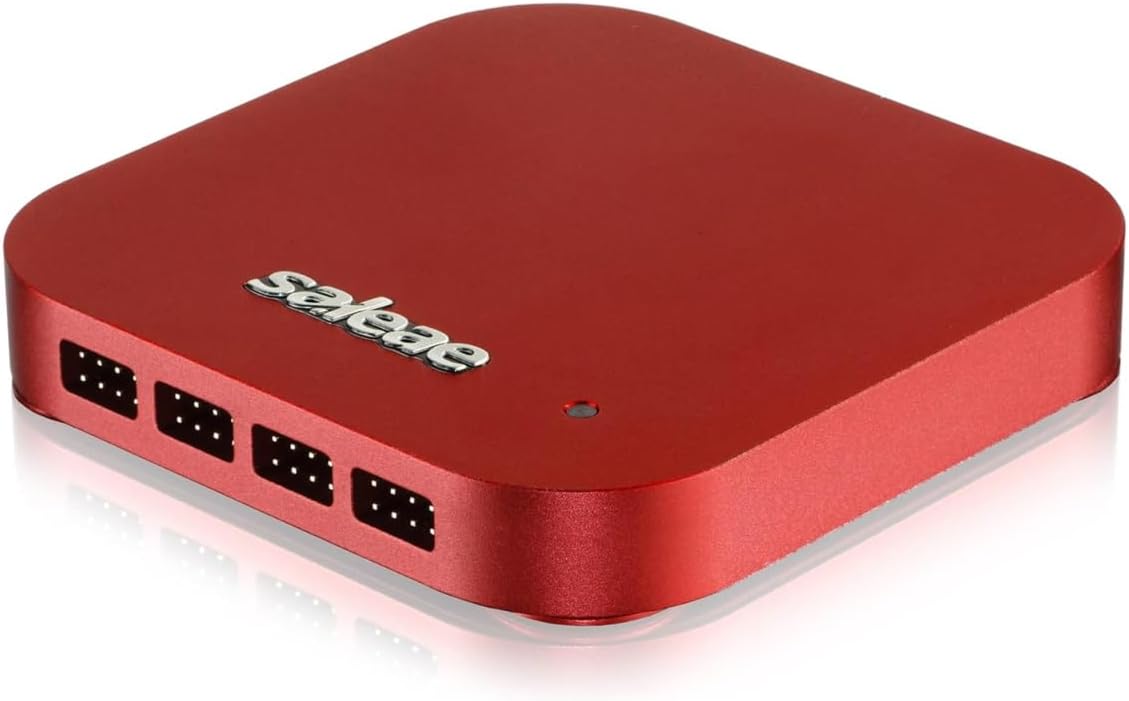
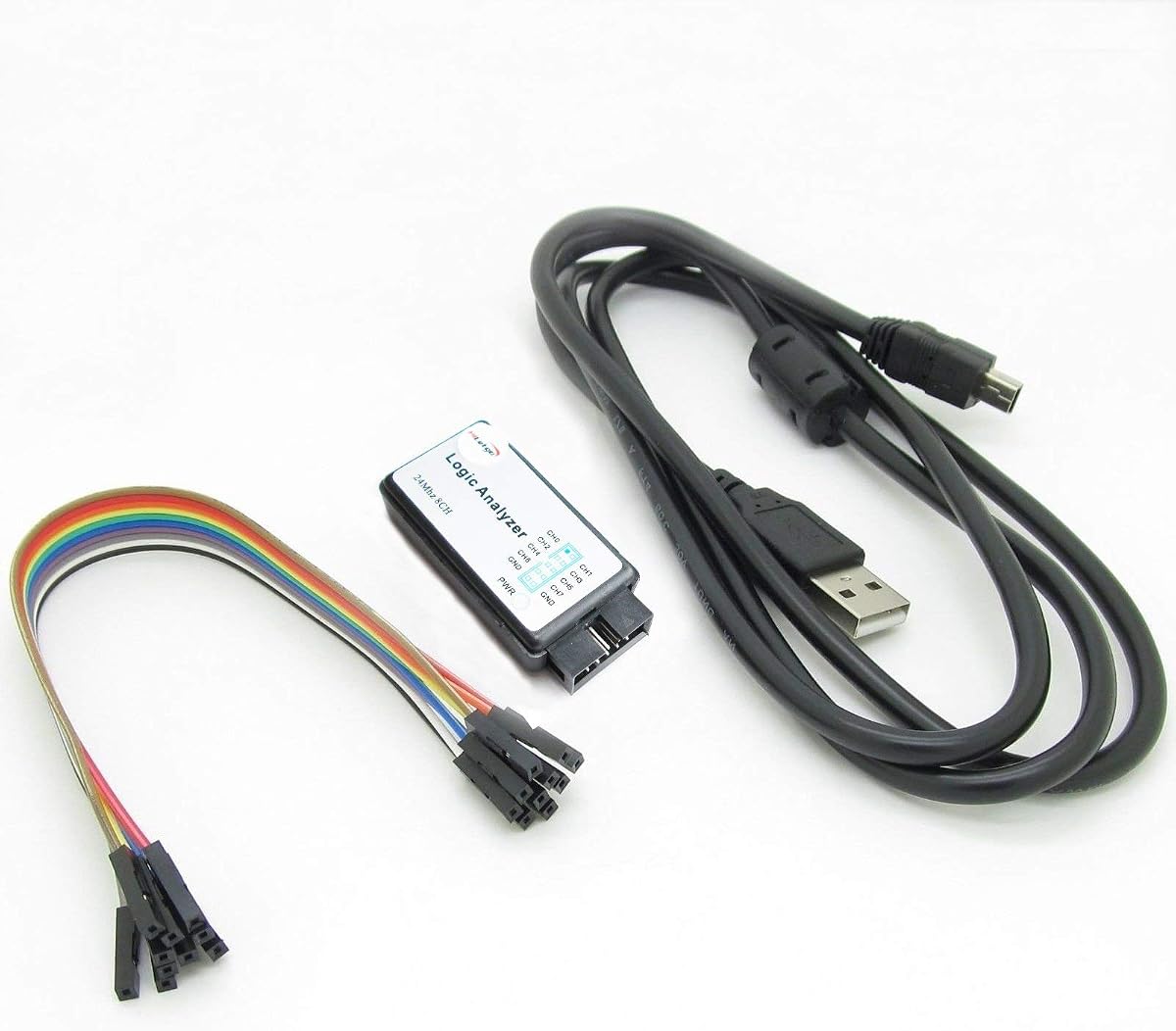
The HiLetgo USB Logic Analyzer is a compact eight-channel analyzer with a maximum 24 MHz sample rate. Its 4.5 rating reflects a well-regarded basic tool for UART, IIC, SPI, and other digital investigations, while the included EMI ferrite ring around the USB cable is designed to help limit interference.
We may earn a commission when you buy through this link, at no additional cost to you.
Users can select among twelve sample rates ranging from 24 MHz to 25 kHz. Published input specifications include a -0.5 V to 5.25 V range, a low-input range of -0.5 V to 0.8 V, and a high-input range of 2.0 V to 5.25 V. Typical input impedance is listed as 1 MOhm in parallel with 10 pF.
These defined electrical characteristics are useful because they make it easier to determine whether a particular signal falls within the analyzer's operating range. The maximum sampling performance still sits well below the professional models, and the device should not be treated as an analog measurement tool.
This analyzer is a sensible choice for common embedded projects, particularly for users who value a ferrite-protected USB cable and clear input specifications. It is most appropriate when eight channels and 24 MHz are enough to capture the behavior under investigation.
The ferrite ring around the USB cable is intended to suppress high-frequency interference carried along the connection. Cleaner power and data links can make otherwise unstable captures easier to evaluate.
Explicit low and high input thresholds help users judge whether a circuit's logic levels fit the device. Checking these values before probing avoids interpreting an out-of-range transition as a legitimate logic state.
We may earn a commission when you buy through this link, at no additional cost to you.
The original Saleae Logic 8 combines eight multi-use inputs with digital sampling up to 100 MS/s and analog sampling up to 10 MS/s. Its 4.5 rating and portable design make it a recognizable professional option for embedded systems, protocol debugging, and mixed digital-and-analog inspection.
We may earn a commission when you buy through this link, at no additional cost to you.
The analyzer supports SPI, I2C, and more than 23 other protocol decoders. Capture capacity can exceed 10 billion digital samples and 500 million analog samples by using PC memory through USB 2.0. This gives it more analytical headroom than basic 24 MHz analyzers despite its lower maximum sampling figures than the newer Logic Pro 8.
Compared with the Logic Pro 8, its headline sample rates and transfer interface are lower. Users who require the fastest possible edge capture or the highest sustained data throughput may prefer the newer model. The eight-channel limit also constrains large parallel systems.
Choose the Logic 8 for portable, professional-style analysis with useful analog input support and extensive decoding. It bridges the gap between inexpensive hobbyist tools and higher-tier Saleae hardware.
Support for SPI, I2C, and more than 23 additional analyzers makes it easier to move from visual inspection to meaningful decoded data. The result is a more productive debugging workflow.
Digital and analog channels allow related signals to be investigated within one portable device. The 100 MS/s digital and 10 MS/s analog rates are suited to many practical debugging tasks.
We may earn a commission when you buy through this link, at no additional cost to you.
This DSLogic Plus listing combines 16 channels, a 400 MHz sampling rate, 16 Gsample stream depth, and 256 Mbits of onboard memory. Its 4.7 rating makes it one of the strongest-rated devices in the guide, particularly for users who want high channel density and extensive protocol support.
We may earn a commission when you buy through this link, at no additional cost to you.
Stream mode captures and transfers data to the computer in real time for longer acquisition periods. Buffer mode stores a burst on the analyzer before transfer, supporting higher sample rates. The combination allows users to choose between duration and resolution according to the investigation, rather than relying on a single operating mode.
The listing highlights an adjustable threshold, shielded wires, and a cleaner waveform outcome. Compatibility is listed for Windows XP through Windows 10, macOS, and Linux, while nearly 100 protocol decoders are available through open-source software on GitHub. Users on newer Windows releases should verify driver availability before purchasing.
This model is a strong fit for embedded professionals and advanced students who need numerous digital channels without moving to a premium portable analyzer. Its main interface constraint is USB 2.0, which affects sustained real-time throughput even though buffer mode preserves high-rate captures.
Sixteen inputs provide room for multi-line buses and parallel control relationships. The device is especially attractive when a conventional eight-channel probe set would leave important signals unobserved.
Nearly 100 protocol decoders and access to open-source software give users a broad set of inspection tools. This is valuable for projects involving several communication standards.
We may earn a commission when you buy through this link, at no additional cost to you.
The Analog Discovery 3 is much more than a conventional logic analyzer. It combines a two-channel oscilloscope, a two-channel arbitrary waveform generator, a 16-channel logic analyzer and pattern generator, and programmable power supplies in one portable instrument. Its 4.5 rating reflects the versatility of that integrated approach.
We may earn a commission when you buy through this link, at no additional cost to you.
The logic section provides 16 configurable digital inputs and outputs at up to 125 MS/s per channel, with individually configurable 3.3 V digital I/O and 5 V-tolerant inputs. It supports SPI, I2C, UART, CAN, JTAG, ROM logic, custom protocols, and other analysis functions. This makes it relevant to projects that move beyond simple digital observation.
The analog section adds two differential channels with 14-bit resolution, up to 125 MS/s per channel, a plus-or-minus 25 V input range, and more than 30 MHz bandwidth with the BNC adapter. Other instruments include spectrum, network, and impedance analyzers, a voltmeter, data logging, and in-app scripting. C, C++, Python, LabVIEW, and MATLAB support broadens automation options.
Its complexity and platform commitment make it less convenient for a user who only needs to check a few GPIO lines. It is instead an excellent choice for a serious electronics workbench where reusable stimulus generation, programmable power, analog measurement, and digital analysis can justify an integrated laboratory platform.
The combination of measurement, stimulus generation, and programmable power reduces the number of separate tools required for many bench tasks. A project can be observed digitally, checked with the oscilloscope, driven by generated waveforms, and supplied from adjustable rails.
Support for C, C++, Python, LabVIEW, and MATLAB makes the device suitable for scripted investigations. The SDK and virtual instruments help connect physical measurements with repeatable automated workflows.
We may earn a commission when you buy through this link, at no additional cost to you.
The right logic analyzer depends on the signals, protocols, and working environment involved. Consider channel requirements, timing performance, input limits, software, memory, portability, and the kinds of tests you expect to perform before choosing a device.
Every connected signal consumes a channel, so count not only the data lines but also clocks, chip selects, enables, resets, interrupts, and control outputs. Eight channels cover many simple projects, while 16 channels are more appropriate for parallel buses, processor peripherals, or devices whose timing relationships span several signals. A higher count also gives you room to compare a working reference channel with the suspect line.
Sampling rate determines how finely the analyzer can resolve transitions and timing intervals. A 24 MHz device is useful for many common embedded tasks, but 100 MHz, 125 MS/s, and 400 MHz models provide more detail for faster edges and narrower events. Compare the highest rate with the actual signal speed, and check whether the stated maximum applies to every channel simultaneously.
A device may stream data continuously to the computer or buffer a capture in onboard memory before transfer. Streaming supports longer durations but depends on host and bus throughput, while buffering can preserve higher rates over shorter bursts. Onboard memory of 256 Mbits is notable on the DSLogic Plus models, while the Saleae devices use substantial PC memory through USB.
Most inexpensive logic analyzers are digital-only, which is enough for GPIO, serial buses, and digital timing. Mixed-use inputs expand the scope to analog voltage behavior and are valuable when a suspected digital fault begins with a weak or distorted signal. The Saleae models and Analog Discovery 3 provide analog capabilities, but their different resolutions, input ranges, and bandwidths should be checked carefully.
Protocol decoding turns transitions into readable commands, addresses, and data, which can greatly shorten debugging time. Look for support for the protocols in your project, such as UART, SPI, I2C, CAN, JTAG, or custom formats. The LA1010 lists more than 30 decoders, the DSLogic Plus models list nearly 100, and the Saleae devices support more than 23 named analyzers.
A logic analyzer must recognize the voltage levels produced by the circuit under test. The entry-level models describe thresholds around 1.5 V, the HiLetgo lists explicit low and high input ranges, and the Analog Discovery 3 supports configurable 3.3 V digital signals with 5 V-tolerant inputs. Check absolute maximums, thresholds, impedance, and whether your circuit can exceed the stated limits.
The hardware is only half of the measurement system. The LONELY BINARY kit supports Windows, Mac, Linux, and Ubuntu, the LA1010 uses KingstVIS, the DSLogic Plus devices use DSView, and the Saleae devices work across Windows, Mac, and Linux. The entry-level Saleae-compatible analyzer also works with PulseView. Verify driver support, protocol availability, and operating-system requirements before installation.
A small analyzer with a sturdy cable and organized probe set is easier to use across a bench, classroom, or field site. The LONELY BINARY kit includes a storage case, jumper wires, test clips, alligator clips, and breadboard adapters. The HiLetgo includes an EMI ferrite ring, while the Analog Discovery 3 ships with headers, labeled fly wires, a project box, and a programming cable. Accessories can determine how quickly a device becomes useful.
Before connecting probes, identify the circuit's supply voltage, expected logic levels, and the exact signals to observe. Confirm that every selected line stays within the analyzer's input range, ground the reference clip to a safe circuit ground, and power the analyzer according to its instructions. Begin with a conservative sample rate if the signal speed is unknown.
Install the compatible software, select the appropriate input threshold, and connect the analyzer before starting the target circuit or capture. Assign meaningful channel labels, capture a short baseline, and then add protocol decoders only after the raw waveform is stable. Use the shortest practical ground leads and route probe wires away from noisy switching nodes to reduce unwanted transitions.
After the session, save waveforms, screenshots, decoder settings, and notes that explain the fault. Disconnect probes before removing power from the tested board, and avoid flexing cables at their connectors. Store the analyzer in a dry environment, keep the storage case organized, and inspect probe insulation and connector pins for wear before the next project.
A logic analyzer records the high and low states of digital signals so you can examine timing, protocol traffic, and relationships between circuit lines. It is especially useful for debugging I2C, SPI, UART, CAN, GPIO, interrupts, and microcontroller peripherals. Because it focuses on many digital inputs rather than continuous analog voltage behavior, it often complements rather than replaces an oscilloscope.
Four channels may be enough for a small serial interface, but eight channels are more useful when clock, enable, chip-select, and data lines must be viewed together. Sixteen channels are preferable for parallel buses and complex processor systems. Count all lines involved in the fault, including reference and control signals, before deciding.
Many common Arduino and microcontroller signals can be examined with a 24 MHz analyzer, especially when troubleshooting standard serial protocols or GPIO timing. Faster signals, narrow pulses, and more demanding embedded systems benefit from 100 MHz or higher sampling. Also check whether the maximum rate is available simultaneously on every active channel.
Usually not. A basic digital logic analyzer is optimized for showing bit states, timing relationships, and decoded protocol messages, while an oscilloscope displays continuous voltage behavior. Mixed-use professional analyzers and the Analog Discovery 3 can provide analog measurement as well, but their bandwidth, resolution, and operating modes differ from a dedicated oscilloscope.
The products use several software environments. The LA1010 includes KingstVIS, the DSLogic Plus models use DSView, and the Saleae devices use their cross-platform software. The entry-level 24 MHz analyzer supports Saleae Logic Analyzer software and PulseView, while the LONELY BINARY kit is described as compatible with Windows, Mac, Linux, and Ubuntu.
Only after checking the specific model's stated input range. Several eight-channel analyzers support levels around 5 V, but their maximum ratings and thresholds differ. Do not rely on a general expectation of compatibility. Verify voltage limits, logic thresholds, impedance, and exposed-pin behavior against the device documentation before probing.
Choose buffering for high-speed bursts that must be captured at a high sample rate without interruption. Choose streaming when you need long-duration recordings and can accept the transfer speed of the host connection and USB interface. Devices such as the DSLogic Plus support both modes, making them flexible for different kinds of investigation.
No. Raw waveforms are often enough for simple GPIO and timing tests, but decoders can expose invalid data, misplaced clock edges, incorrect addresses, and unexpected command sequences much more quickly. Select a decoder when communicating with a known protocol and use the raw waveform alongside it to understand what the decoder is interpreting.
The LONELY BINARY Logic Analyzer Kit is the strongest budget-oriented choice because it combines eight channels with breakout boards, breadboard adapters, test leads, and broad computer compatibility. The DSLogic Plus stands out for professional-style flexibility, offering 16 channels, 400 MHz buffered sampling, onboard memory, and nearly 100 decoders. The Saleae Logic Pro 16 is the premium recommendation for users who need exceptional digital performance, analog inputs, large captures, and extensive protocol support.
Prioritize the constraints that affect your actual workflow. Match channel count to the number of relevant signals, sampling speed to the fastest edge, voltage limits to the circuit under test, and software to your computer and protocols. Extra bandwidth, memory, and decoding options are useful only when your projects need them; otherwise, a simpler eight-channel analyzer may be more practical.
Before purchasing, review the current product listing, supported operating systems, included accessories, and software requirements. Ratings and product configurations can change, and prices fluctuate over time. Checking the latest information helps ensure that the selected analyzer remains compatible with your project and represents good value for your needs.