
Lenovo Chromebook 14
4.4Editor score
Eight-core Kompanio processor
Full HD touchscreen display
Useful accessory bundle
A laptop for kids to learn coding should balance useful computing power with a manageable interface, durable construction, and features that make learning enjoyable. The right device can support browser-based programming, Scratch projects, Python exercises, online classes, and everyday schoolwork while remaining appropriate for younger users.
The products in this guide range from full-size Chromebooks and student laptops to compact educational computers designed around offline activities. We compared their processors, memory, displays, connectivity, input methods, learning features, portability, and suitability for common coding tasks, while distinguishing introductory toys from general-purpose computers.
Each review explains who the device is best for, its most useful strengths, and any limitations to consider. Product configurations and prices can change over time, so readers should confirm the current specifications and availability before purchasing for a particular child or curriculum.
4.4Editor score

4.2Editor score

5.0Editor score
As an Amazon Associate we earn from qualifying purchases.
The table below compares all ten options by device type, display, core specifications, and coding-related strengths, making it easier to identify a suitable balance of computing power, portability, and child-friendly features.




The HP Chromebook 14 x360 Plus combines a conventional keyboard with a touchscreen and rotating display, giving children several ways to work with coding tutorials. Its 4.2 rating reflects a general-purpose Chromebook designed for study, browsing, media, and light creative tasks rather than demanding programming workloads. The convertible form is particularly useful when a child alternates among writing code, watching a lesson, and presenting a project.
We may earn a commission when you buy through this link, at no additional cost to you.
The Intel N150 processor provides enough capability for ChromeOS applications, browser-based editors, Scratch, documentation sites, and routine multitasking. Memory and storage are more modest, with 4GB of LPDDR5 RAM and 128GB of UFS storage. That combination works well for cloud-oriented learning, while parents should consider how much local project storage an older child may accumulate.
Its 14-inch WUXGA touchscreen provides a useful balance of workspace and portability. Narrow borders, 300-nit brightness, and an anti-glare coating can make extended study sessions more comfortable. Wi-Fi 6 and Bluetooth 5.4 support modern classroom networks and accessories, while USB-C, USB-A, and an audio jack cover essential connections.
This is a strong recommendation for a child moving from block-based coding into more structured browser-based lessons. The touchscreen and convertible design encourage interactive learning without sacrificing a full keyboard. Families that need heavier local development or extensive project libraries may want more memory or storage, but for everyday coding education, the x360 Plus is adaptable and well equipped.
The 360-degree hinge supports laptop, tent, stand, and tablet modes. Children can use touch interaction for controls and animations while retaining the stable keyboard setup needed for writing code.
ChromeOS provides a straightforward environment for web-based courses, Google Workspace, cloud backups, and thousands of educational apps. Its automatic updates also reduce the need for hands-on system maintenance.
We may earn a commission when you buy through this link, at no additional cost to you.
The Lenovo Chromebook 14 combines a Full HD touchscreen with an eight-core MediaTek Kompanio 520 processor, giving it a useful balance of display quality and everyday performance. Its 4.4 rating makes it an appealing general-purpose option for families seeking a capable learning computer without moving into larger premium devices. ChromeOS remains well suited to online lessons and web-based coding tools.
We may earn a commission when you buy through this link, at no additional cost to you.
The octa-core processor includes four A73 and four A53 cores, which should comfortably handle browser tabs, Google Classroom, video calls, documentation, and introductory programming. The included 64GB memory card expands the base 64GB eMMC storage, creating a practical split between internal system space and portable files. Four gigabytes of RAM remains the main constraint for more demanding work.
The 14-inch 1920×1080 IPS touchscreen offers wide viewing angles and a large canvas for Scratch, block-based exercises, and written lessons. A privacy shutter helps with video calls, while Wi-Fi 6 and Bluetooth 5.1 cover everyday connectivity. The accessory bundle adds a USB-C hub, HDMI and USB cables, mouse pad, wireless mouse, and storage card.
For a child learning coding through browser-based platforms, this Lenovo Chromebook provides more than the essentials without adding unnecessary bulk. The touchscreen is useful for interactive instruction, and the bundled accessories make it easy to connect a larger display or store project files. It is a particularly good pick for budget-conscious families who want a complete, adaptable school setup.
The 1920×1080 IPS panel gives young programmers more room to display editors, lesson instructions, and documentation side by side. Touch support adds another way to navigate interactive learning tools.
The included hub, cables, mouse, mouse pad, and storage card create a more complete workstation. These additions are especially helpful when a child uses an external monitor or needs separate project storage.
We may earn a commission when you buy through this link, at no additional cost to you.
The HP Chromebook 11A G8 is designed around the needs of school-aged users, with a compact 11.6-inch display, full-size backlit keyboard, and spill-resistant construction. Its 4.5 rating indicates a well-regarded education Chromebook for browsing, assignments, video calls, and introductory coding courses. It is a sensible pick when durability and manageability matter more than maximum performance.
We may earn a commission when you buy through this link, at no additional cost to you.
Inside, a dual-core AMD A4-9120C processor with Radeon R4 graphics is supported by 4GB of DDR4 memory. That is adequate for ChromeOS applications and lightweight coding activities, especially when projects are stored in the cloud. The 32GB eMMC drive offers less room for downloads and local files, so families should plan storage accordingly.
Its 1366×768 anti-glare display is compact and functional, while the 220-nit brightness is more suited to a desk than a bright outdoor setting. The full-size island keyboard includes a backlight, and the webcam, microphone, speakers, and multi-touch touchpad support remote classes. USB-C, two USB-A ports, a microSD slot, and an audio jack provide practical connectivity.
This Chromebook makes sense for children in elementary or middle school who are beginning with Scratch, block coding, or introductory web-based lessons. Its compact size and spill-resistant keyboard suit shared family environments. Older learners working on large Python projects, simultaneous development tools, or media-heavy applications may need a faster processor and more storage.
The spill-resistant, backlit keyboard is designed for regular use in homes, libraries, and classrooms. Its compact footprint also leaves room on a shared desk for notebooks and other learning materials.
The integrated camera, microphone, speakers, and multi-touch touchpad cover remote instruction and collaboration. ChromeOS keeps the workflow familiar for browser-based lessons and cloud applications.
We may earn a commission when you buy through this link, at no additional cost to you.
The VTech Genio JuniorBook is not intended to replace a classroom laptop or run modern programming tools. Instead, it offers more than 80 child-friendly activities that introduce computer use, keyboard skills, and early logical thinking. Its 4.5 rating reflects a well-liked introductory learning device for children who need a simplified, controlled environment before tackling actual code.
We may earn a commission when you buy through this link, at no additional cost to you.
Activities cover subjects including math, science, language arts, music, and Spanish. Every activity can be used in English or Spanish, allowing children to explore the same material in two languages. The full-size QWERTY keyboard and cursor controller help children build familiarity with computer layouts, while the laptop-like design makes the experience feel less like a toy.
No internet connection is required because all activities are preloaded and run offline. That makes the device useful for travel, screen-time boundaries, and children who are not yet ready for open web access. It requires four AA batteries, which are included for demonstration purposes; new batteries are recommended for regular use.
The JuniorBook is best viewed as a first step into digital learning rather than a laptop for learning coding in the conventional sense. It can help young children become comfortable with a keyboard, icons, sequences, and problem-solving activities before they encounter Scratch or Python. Families seeking real programming should eventually move to a general-purpose Chromebook or student laptop.
The fully offline design removes ads, browsing distractions, and most online risks. Parents can provide a structured educational experience without adding the child to an open internet environment.
Every activity is available in English and Spanish. This bilingual approach can support language development while children practice common computer controls and school subjects.
We may earn a commission when you buy through this link, at no additional cost to you.
The NIMO 15.6 Student Laptop combines a large Full HD display with practical family-friendly features such as a fingerprint reader, backlit keyboard, and broad port selection. Its 5.0 rating is the strongest in this group, though ratings should be considered alongside the fact that this is a renewed configuration. It is well suited to schoolwork, online lessons, and browser-based coding education.
We may earn a commission when you buy through this link, at no additional cost to you.
The Intel N150 processor and 4GB of DDR4 memory support daily learning tasks, including web browsing, document editing, video playback, and lightweight programming. A 128GB SSD provides a more responsive and conventional storage experience than a small eMMC drive. A microSD slot gives families an easy way to keep lesson recordings or larger project files separate.
The 15.6-inch 1080p panel offers an expansive workspace for documentation, browser-based code editors, and educational videos. A 175-degree lay-flat hinge supports reading and shared viewing, while the backlit keyboard helps during evening study. The system also includes dual USB-C ports, HDMI, three USB-A ports, a headphone jack, and a microSD slot.
NIMO includes a 65-watt USB-C charger, a long cable, and a 4700mAh battery, which makes charging easier around the home. The included two-year manufacturer warranty and 90-day return policy add reassurance for family buyers. The renewed condition should be checked carefully, but the overall feature set makes this a strong general-purpose option for a student who needs a larger screen.
The touchpad fingerprint reader and fTPM chip allow quick sign-in without forcing a child to type complicated passwords. That convenience can make a shared family computer feel more personal and secure.
Multiple USB-A ports, USB-C, HDMI, and microSD expansion make it easy to add a mouse, external display, storage card, or classroom equipment. The included long charging cable adds flexibility around shared tables.
We may earn a commission when you buy through this link, at no additional cost to you.
The HP 11 Fortis G1m11 is an education-oriented 11-inch Chromebook configuration built around a MediaTek MT8186 processor, 8GB of memory, and 64GB of storage. Unlike several toy-like alternatives in this guide, it appears intended to serve as a practical school computer. The supplied information is limited, however, so buyers should examine the current listing for display, battery, and port details.
We may earn a commission when you buy through this link, at no additional cost to you.
Its 8GB of memory is a meaningful advantage over the 4GB configurations common in entry-level Chromebooks. That extra headroom can help when a child keeps a browser-based code editor, documentation tabs, messaging, and video-call tools open simultaneously. The 64GB drive is modest but adequate for applications, system files, and cloud-based schoolwork.
The Fortis name is associated with HP's rugged education line, which is relevant for children who may use the device in a busy classroom or shared home. Nevertheless, the provided data does not explicitly state detailed durability tests, so the guide does not assign specifications beyond the confirmed processor, memory, storage, display size, and listed weight.
This model makes the most sense for families or schools seeking a compact Chromebook with more memory than many entry-level alternatives. Confirming the exact display resolution, connectivity options, included accessories, and warranty before purchase is important. It is a potentially strong fit for older elementary and middle school students beginning structured coding courses.
Eight gigabytes gives a young programmer more room for browser tabs, cloud documents, and lesson applications. It is a useful advantage when the device must handle schoolwork alongside coding practice.
Because the supplied listing information is limited, buyers should verify screen quality, ports, warranty terms, and included accessories. Those details can differ from one Fortis G1m11 configuration to another.
We may earn a commission when you buy through this link, at no additional cost to you.
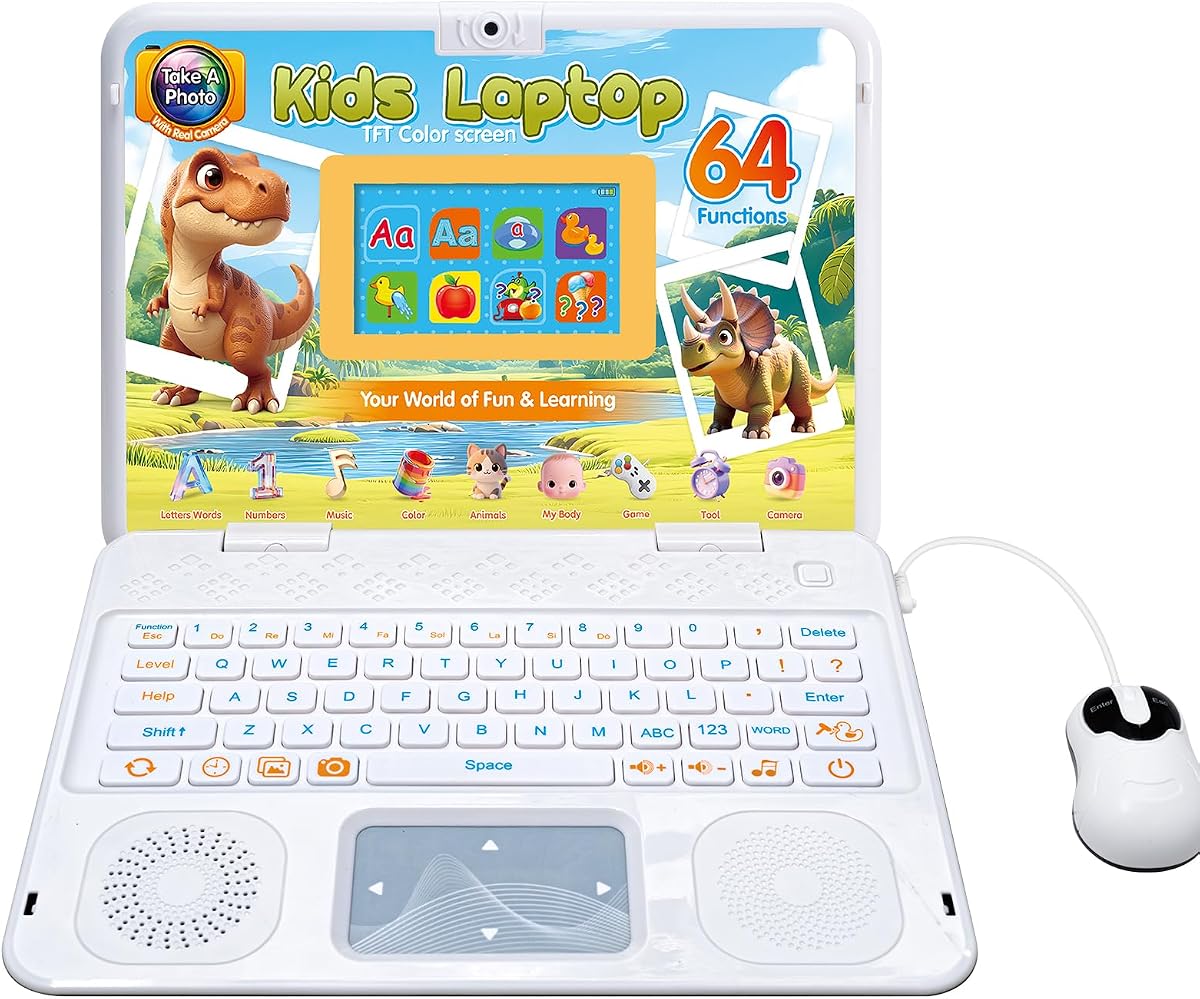
The Kids Camera Learning Laptop is a compact educational toy designed for children aged five and older. Its 4.6 rating indicates a well-liked option for younger users, particularly when entertainment and creativity need to be part of learning. With 64 modes, it offers more variety than many similar compact learning computers.
We may earn a commission when you buy through this link, at no additional cost to you.
Activities include the camera, alphabet, mathematics, colors, animals, music, and games. The camera includes decorative photo frames and filters, allowing children to experiment creatively rather than using the device only as a conventional learning tool. This balance can help sustain interest while children practice basic digital navigation.
A 4.3-inch TFT color display is large enough to remain visually engaging while still fitting comfortably in a child's hands. The keyboard and mouse mimic the layout of a grown-up laptop, which helps children learn where controls belong. The refined shape also appears more like a real computer than a brightly molded toy.
This device is appropriate for foundational computer familiarity, creative exploration, and early logic practice, but it does not provide a conventional coding environment. It should not be chosen for Scratch projects, Python, web development, or school platforms. Families can use it as an introductory offline toy before transitioning to a full Chromebook or student laptop.
Photo frames and filters turn the camera into a creative activity rather than a passive learning feature. Children can make pictures while practicing menus, buttons, and digital decision-making.
The realistic keyboard and mouse help young users learn standard navigation habits. That familiarity can make the eventual move to a full-size school laptop feel more natural.
We may earn a commission when you buy through this link, at no additional cost to you.
The LeapFrog ABC and 123 Laptop is designed for preschool and early elementary children, with an emphasis on letters, counting, and basic computer skills. Its 4.7 rating is among the strongest in the guide, reflecting a well-received educational toy. It is also one of the few products here that explicitly lets children create simple code programs.
We may earn a commission when you buy through this link, at no additional cost to you.
Across 11 activities, children can press letter and number keys to hear their names and trigger animations. Pixel's face, hands, and antenna respond while the character talks, sings, dances, and tells jokes. That immediate feedback can sustain attention with younger learners who may not be ready for text-heavy programming interfaces.
Simple code programs can be created to clean or cuddle Pixel, followed by text exchanges with another character. Although these activities are not equivalent to writing Python or JavaScript, they introduce sequencing, cause and effect, commands, and problem solving. Those concepts are foundational to later coding education and can be explored in a child-friendly setting.
The device requires four AA batteries, with batteries included only for demonstration and new batteries recommended for regular use. It is best for ages three to seven and for families seeking an introduction to computational thinking rather than a capable computer. Children ready for actual language-based programming will need a full Chromebook or laptop.
Children create short programs to direct Pixel through simple tasks. Even this basic form introduces ordered instructions, repetition, and the idea that a computer follows a defined sequence.
Pixel's expressive animations and spoken responses provide instant feedback. That kind of responsive interaction is particularly helpful for pre-readers and children developing keyboard confidence.
We may earn a commission when you buy through this link, at no additional cost to you.
The 48-Mode Kids Learning Laptop focuses on foundational subjects and computer familiarity rather than modern programming. It has a 4.0 rating and is best suited to children aged five and older who want a broad collection of educational and game activities. Its simplicity can make it a low-distraction option for early learning.
We may earn a commission when you buy through this link, at no additional cost to you.
The listed modes cover alphabet, mathematics, colors, animals, general knowledge, logic, music, clock reading, and calendar skills. Logic and memory games add problem-solving elements that connect loosely to computational thinking. The diversity helps children vary their activities without needing separate devices for each subject.
Its 4.3-inch color display uses a protective film that should be removed before use. The dimensions of 11 by 8 by 1.2 inches give it a realistic laptop shape while remaining compact enough for small hands. A keyboard handles answers and game commands, and the mouse provides familiar pointer practice.
This laptop can help children learn standard computer controls and build confidence with logic activities, but it cannot support modern coding curricula. Parents should treat it as an optional educational toy rather than the primary device for a coding course. A Chromebook becomes the better choice when children reach Scratch, Python, robotics software, or browser-based programming.
Logic, memory, and speed games encourage children to follow patterns, make choices, and try again after mistakes. These behaviors support the mindset children need for later programming projects.
Alphabet, mathematics, music, calendar, and general-knowledge modes provide broad practice in a single device. Variety can keep a child engaged without introducing complex setup menus.
We may earn a commission when you buy through this link, at no additional cost to you.
The LEXiBOOK LAPTAB 10 is a compact touchscreen laptop that combines Android-style app access with family controls and educational tools. Its 4.2 rating makes it a practical choice for children who need a portable general-purpose device rather than a specialized coding toy. The 10.1-inch size is especially convenient for travel and shared spaces.
We may earn a commission when you buy through this link, at no additional cost to you.
Its octa-core processor, 128GB of storage, and 4000mAh battery support everyday browsing, educational apps, media, and light coding activities. The touchscreen can help with interactive lessons and visual programming interfaces, although the included specifications do not identify a particular operating system version or detailed processor model.
Education features include the Power Academy app, 300 eBooks through ReadEra, a 15-language translator, and access to Google Play apps and games. Customizable profiles, parental controls, and the Qwant Junior browser give parents more control over how the device is used. These tools make it easy to establish boundaries around apps and online activity.
The LAPTAB 10 is best for children who need a smaller, portable screen and broad learning content. It can serve as an entry point to programming through Android coding applications and browser-based lessons, but it is not optimized as a professional development machine. Older students working on intensive projects should favor a Chromebook with a larger display and keyboard.
Custom profiles and app-management tools allow adults to shape each child's experience. The Qwant Junior browser provides a more controlled starting point for younger learners exploring the web.
Power Academy, ReadEra with 300 eBooks, and a 15-language translator add meaningful educational value. These tools can complement coding practice by supporting reading and multilingual instruction.
We may earn a commission when you buy through this link, at no additional cost to you.
The right choice depends on the child's age, programming experience, curriculum, and need for a full computer. These factors help distinguish introductory learning devices from capable Chromebooks and general-purpose student laptops.
Very young children often benefit from simplified interfaces, immediate visual feedback, and activities that introduce sequencing without requiring reading complex instructions. Products such as the LeapFrog ABC and 123, VTech Genio JuniorBook, and compact activity laptops are better suited to that stage. They can teach keyboard familiarity, logical order, and cause and effect without exposing children to the distractions of a general-purpose computer.
Choose a toy-style laptop for introductory play and early computational thinking. Choose a general-purpose computer for actual coding courses.
Browser-based programming is usually less demanding than desktop development, but multiple tabs, video calls, documentation, and an editor still benefit from additional memory. Intel N150 and MediaTek Kompanio configurations can support ordinary school and coding tasks, while 8GB provides more breathing room than 4GB when several applications remain open. Dedicated graphics hardware is rarely necessary for introductory coding, but a modern processor improves responsiveness.
Match processing power to the workload. Four gigabytes suits light use, while eight gigabytes handles heavier multitasking.
Typing code requires a stable, full-size keyboard with familiar key placement. A backlight is useful for evening study, and a touchpad should support basic pointing and scrolling. Touchscreens add value when interactive blocks, diagrams, or visual programming are part of the lesson, but they should complement rather than replace a usable keyboard. Compact toy laptops are better for foundational practice than prolonged coding work.
Prioritize a proper keyboard for typing. Treat the touchscreen as a useful addition for interactive lessons.
A 14-inch display offers a practical balance between workspace and portability for school desks and shared home tables. Larger 15.6-inch screens provide more room for code, documentation, and split-screen instruction. Smaller 10- or 11-inch devices are easier to carry and may be more comfortable for younger children, but they can feel cramped once browser documentation and a code editor are open.
Choose 14 or 15.6 inches for regular coding. Choose a smaller screen for portability and young children.
Cloud-based courses need relatively little local storage, but downloaded packages, images, videos, and Python projects can accumulate quickly. A 64GB drive is workable for light use, while 128GB gives families more room and makes offline access easier. Memory cards and USB hubs can expand storage, though a card should not substitute for adequate internal capacity when an operating system and several coding environments need space.
Allow at least 128GB when possible. Use removable storage for archives and shared project files.
Young children benefit from curated browsers, individual profiles, app restrictions, and clearly enforced limits. ChromeOS includes a simple, secure environment designed for online work, while the LEXiBOOK LAPTAB 10 explicitly offers customizable profiles, parental controls, and Qwant Junior. Completely offline educational laptops minimize exposure to web content, although they cannot run conventional coding environments. Families should compare supervision tools with the child's maturity.
Use profiles and curated browsing for younger children. Add unrestricted access only when readiness and supervision support it.
Children travel between bedrooms, kitchens, libraries, and classrooms, so durability matters. The HP Chromebook 11A G8 includes a spill-resistant keyboard, and the Fortis name is associated with rugged education laptops, although the supplied listing contains limited detail. Convertible hinges and touchscreen designs need careful handling, especially around young users. A protective case can extend the life of any model, but reliable construction remains the foundation.
Look for spill resistance, sturdy hinges, and a case that fits. Everyday care is still necessary.
The required curriculum determines which platform is appropriate. Scratch and many introductory courses run in a browser, making a Chromebook a strong option. Python, JavaScript, HTML, and game-development lessons may require a specific editor, runtime, or operating system. Check the course requirements before buying. Wi-Fi 6, USB-C display support, HDMI, USB-A, and a headphone jack can make a device more adaptable to online classes and shared workspaces.
Verify course requirements and available ports first. A browser is convenient, but not every lesson works everywhere.
Begin with a structured introduction rather than immediately opening a complex programming environment. Show the child how to create folders for projects, name files consistently, save work, and keep school assignments separate from coding exercises. For a young learner, begin with visual coding, sequencing, or a guided browser activity; for an older student, work through one structured course at a time and save a small project after each lesson.
Create a consistent routine that includes short breaks away from the screen. A clear folder system and cloud backup can prevent lost work, while separate user profiles can keep personal files and browser activity organized. If the child shares the computer, establish expectations for notifications, downloads, camera use, passwords, and any online communication. Parents should also agree on which courses and websites are appropriate.
Protect the device with a suitable case, gentle cleaning, and careful charging. Avoid placing food or drinks near the keyboard, use a dry cloth on the screen, and keep ports free of dust. Charge on a hard surface with the cable routed so it cannot be pulled. Software updates should be completed promptly, and a backup or cloud copy of important projects should be maintained in case the device is lost or replaced.
Children as young as three or four can begin with visual sequencing and coding-inspired games, provided the activity language is simple and the device offers immediate feedback. Around ages five to seven, basic keyboard practice, logic games, and beginner visual programming become more appropriate. Older children are generally ready for browser-based coding courses, but readiness depends more on reading ability, persistence, and interest than age alone.
A Chromebook is sufficient for many browser-based courses, Scratch projects, HTML and CSS exercises, and introductory Python work. Its automatic updates, security, and simple interface make it convenient for children. Advanced software, large local project libraries, specialized robotics tools, or intensive multitasking may require more memory and storage than an entry-level model provides.
Scratch is often easier for younger learners because it uses visual blocks and immediate feedback. It teaches sequences, conditions, loops, events, and debugging without requiring syntax memorization. Python is a strong next step once a child can comfortably type, read instructions, and understand basic logic. Some children can use both simultaneously, but a gradual transition usually produces a less frustrating learning experience.
Four gigabytes is usually adequate for light browser-based lessons, a code editor, documentation, and a few open tabs. Eight gigabytes offers more comfortable multitasking, especially when video calls or additional educational applications remain open. The processor, storage type, and quality of the browser experience also influence responsiveness, so memory should be considered alongside the complete configuration.
They can be useful for teaching computer controls, sequencing, cause and effect, and early computational thinking. Products such as the LeapFrog ABC and 123 even use simple code programs to direct an animated character. However, toy laptops generally cannot run Scratch, Python, web-development tools, or standard desktop applications, so they are best treated as an introductory step rather than a complete coding platform.
No. A comfortable physical keyboard is more important for writing and correcting code. A touchscreen can improve the experience with visual programming, block-based exercises, diagrams, and touch-friendly lessons. Devices with both features give children more options, but a smaller screen with an excellent keyboard may serve coding better than a large touchscreen with an awkward layout.
Useful controls include separate user profiles, app restrictions, time limits, a curated browser for younger children, and visibility into account activity. ChromeOS offers a relatively controlled and secure environment, while some general-purpose laptops provide more explicit family-management tools. Parents should also establish offline time and review any application permissions involving the camera, microphone, location, or personal files.
The full-size Chromebooks and student laptops can handle browsing, documents, email, video calls, presentations, and cloud-based school applications. The compact educational toys are less versatile and are better limited to their supported activities. For a child who needs one device for both school and coding, a general-purpose computer with a proper keyboard, adequate memory, and current browser support is the safer choice.
The HP Chromebook 14 x360 Plus stands out as the most versatile top pick because its touchscreen, convertible hinge, and modern processor support both schoolwork and interactive coding lessons. The Lenovo Chromebook 14 offers a strong Full HD screen and useful accessories for families seeking capable everyday value, while the NIMO 15.6 Student Laptop provides a large workspace, convenient fingerprint access, and reassuring warranty coverage.
For younger children, match the device to developmental stage rather than expecting every learning laptop to support real programming. The LeapFrog ABC and 123 introduces simple code programs, while the VTech Genio JuniorBook and other activity laptops build keyboard familiarity and logical thinking offline. Once a child reaches visual or text-based programming, move to a proper Chromebook with adequate memory, storage, and a full keyboard.
Finally, confirm the exact model, software requirements, included accessories, warranty, and current market pricing before making a purchase. Product configurations and prices can change, but the general selection criteria remain stable: a comfortable keyboard, sufficient processing power, safe software, useful parental controls, and a display that fits the child's learning style.