
Tera Wireless 1D Reader
4.4Editor score
Wireless 2.4G connectivity
USB wired fallback
Broad 1D code support
Best Pos System for Retail with Barcode Scanner guide comparing 10 scanners for speed, compatibility, wireless freedom, 2D reading, and hands-free checkout.
A barcode scanner can transform retail checkout by reducing manual data entry, improving product lookup accuracy, and helping staff move customers through a transaction more efficiently. The right device must fit your POS software, read the barcode formats on your products, and suit the physical demands of your counter, warehouse, or stockroom.
We compared these scanners by examining their supported code types, connection methods, scanning modes, compatibility claims, hardware design, special features, and suitability for common retail workflows. The list covers wired, wireless, Bluetooth, handheld, and desktop options, including scanners for 1D labels, 2D codes, and mobile screens.
Each pick reveals a different practical path for retail operations, from a flexible wireless reader to a hands-free countertop model. Ratings and product details reflect the supplied information, while availability and pricing can change, so shoppers should verify current listing details and confirm compatibility before buying.
4.4Editor score

4.4Editor score
4.3Editor score
The table below compares all ten scanners by code support, connectivity, form factor, and retail workflow, making it easier to identify the model that matches your POS environment and counter setup.


The Tera Wireless 1D Reader is a cordless retail scanner rated 4.4, combining 2.4 GHz wireless operation with a USB 2.0 wired alternative. Its standout qualities are the flexibility to move around a counter, a visible battery-level indicator, and broad support for the 1D barcode families commonly found on conventional retail products.
We may earn a commission when you buy through this link, at no additional cost to you.
A 2-in-1 connection design is especially useful for a store that wants fewer cables without giving up a dependable wired fallback. The stated range reaches up to 328 feet in a barrier-free environment, while the USB receiver or cable supports plug-and-play operation without driver installation. The extended curved handle, smooth trigger, and orange anti-shock silicone cover are designed for frequent staff use.
The main limitation is that this is a 1D reader rather than a general-purpose 2D imaging scanner. It supports formats including EAN-13, UPC-A, ISBN, Code 128, Codabar, Code 39, and several industrial and interleaved types, but retailers using QR codes, Data Matrix, PDF417, or mobile-screen coupons may need a more capable model. Its laser-focused design also means it should not be expected to read the same varied 2D symbols as the imaging options in this list.
This scanner is a strong fit for small retailers, convenience stores, and stockrooms that primarily scan standard product barcodes and value uncomplicated cordless operation. It offers a practical balance of mobility, protection, and setup simplicity, making it an accessible choice when 2D scanning is not required.
The scanner can switch between its 2.4 GHz receiver and a direct USB connection, giving staff room to serve customers around a counter without committing to a permanently tethered setup. The USB option is also useful for initialization or another point-of-sale workstation.
Its widened curved handle, smooth trigger, and silicone outer cover improve grip and help protect the housing from friction, scratches, and drops. The battery indicator is a practical way to reduce interruptions caused by an unexpectedly depleted scanner.
We may earn a commission when you buy through this link, at no additional cost to you.
The ScanAvenger is a rated 4.4 handheld scanner that combines Bluetooth, 2.4 GHz wireless, and USB connectivity. It supports 1D and 2D symbologies and includes a rechargeable battery, vibration feedback, and a next-generation charging stand, making it the most adaptable all-around option in this roundup.
We may earn a commission when you buy through this link, at no additional cost to you.
Its compatibility with Mac and Windows computers, Android and Apple mobile devices, and POS systems makes it useful for more than a fixed checkout lane. Staff can choose manual, continuous, or auto-sense scanning depending on the task, while the stand can hold the device and charge it through its lighting connectors. The 2D support includes QR, PDF417, Aztec, Data Matrix, and Micro PDF formats.
There are two important boundaries. First, the stated POS compatibility excludes systems that require proprietary hardware or direct app-level integration. Second, the scanner does not support Maxicode. Those limitations matter for businesses with specialized software ecosystems, and buyers should test a representative scanner with their exact POS workflow before making a fleet purchase.
For a broad retail operation that needs conventional barcodes and QR-style codes across computers, tablets, phones, and POS terminals, the ScanAvenger offers an excellent mix of connection choices and workflow modes. Its included stand and vibration feedback make it particularly appealing where employees work in noisy environments or need to move around a sales floor.
Bluetooth, 2.4 GHz, and USB modes let the same device serve a fixed counter, a mobile sales associate, or another computer. That flexibility reduces the need to standardize on one connection method across every department.
Manual triggering suits deliberate item-by-item checkout, continuous mode supports rapid passes, and auto-sense can reduce unnecessary button presses. These options make the scanner adaptable to different products and transaction rhythms.
We may earn a commission when you buy through this link, at no additional cost to you.
The NetumScan Desktop Barcode Scanner is a 4.5-rated omnidirectional reader designed for high-volume retail use. It captures 1D and 2D codes from labels, paper, phones, and computer displays while freeing both hands of the cashier during checkout.
We may earn a commission when you buy through this link, at no additional cost to you.
Automatic smart sensing is the defining convenience. The scanner enters a sleeping state when inactive and wakes when an item is moved into its reading window, allowing staff to pass products across the scan area without repeatedly picking up or aiming a device. Its non-slip base and anti-vibration design improve countertop stability, and IP54 protection helps guard against dust.
The fixed desktop format is not ideal for every retail setting, and a wired USB cable can limit counter placement flexibility. More importantly, the supplied information explicitly states that it is not compatible with Square, Clover, or Shopify. Its listed operating-system support is broad, but software compatibility must be confirmed separately from operating-system support.
This is a strong option for a conventional counter, service desk, library, or warehouse station where a hands-free reader can remain in a fixed location. It is particularly compelling for high-volume environments that want to scan printed labels and customer phone screens with one device and avoid the handling required by a handheld scanner.
The induction trigger and sleep mode let the scanner wake as merchandise moves into range. This can reduce aiming and button handling, which is useful when a cashier is simultaneously bagging items or processing payment.
The scanner can read standard 1D barcodes and 2D or QR codes from paper and digital displays. That versatility supports packaged products, digital coupons, and mobile loyalty codes, although highly distorted or reflective labels may still require careful positioning.
We may earn a commission when you buy through this link, at no additional cost to you.
The NetumScan Handheld USB 1D Barcode Scanner is a 4.3-rated wired reader with a stand and CCD imaging technology. It is designed for supermarkets, convenience stores, warehouses, libraries, bookstores, drugstores, and other environments where a dependable handheld 1D reader is needed.
We may earn a commission when you buy through this link, at no additional cost to you.
Its CCD sensor can capture common 1D codes from paper or screens, including UPC, EAN, ISBN, Code 128, GS1-128, Codabar, MSI, and several 2-of-5 formats. The claimed ability to read deformed, smudged, fuzzy, or reflective codes makes it more adaptable than a reader limited to pristine printed labels. Plug-and-play USB operation and listed support for Mac, Windows, and Linux simplify initial setup.
Its wired design keeps the counter straightforward and eliminates wireless pairing concerns, but the cable may restrict movement or complicate cleaning around a busy register. The scanner reads 1D symbologies only, so it is not the right choice for QR-code-heavy retail programs, PDF417 documents, or other 2D workflows. A note in the supplied data also identifies an unrelated seller warning, so shoppers should confirm they are purchasing the legitimate NetumScan merchant listing.
This model is a practical fit for standard barcode checkout, stock counting, library circulation, and inventory work where 1D labels dominate. The included stand makes it easy to place on a counter when not actively used, while the handheld form remains more flexible than a desktop scanner for reaching items in bins or behind merchandise.
CCD imaging gives the scanner the ability to read 1D codes from both printed surfaces and displays. Its support for imperfect codes is helpful when labels are smudged, damaged, tightly printed, or slightly reflective.
USB plug-and-play operation avoids a complicated installation process. The included stand creates a designated home for the reader, while the wired cable keeps charging and connectivity concerns out of the daily workflow.
We may earn a commission when you buy through this link, at no additional cost to you.
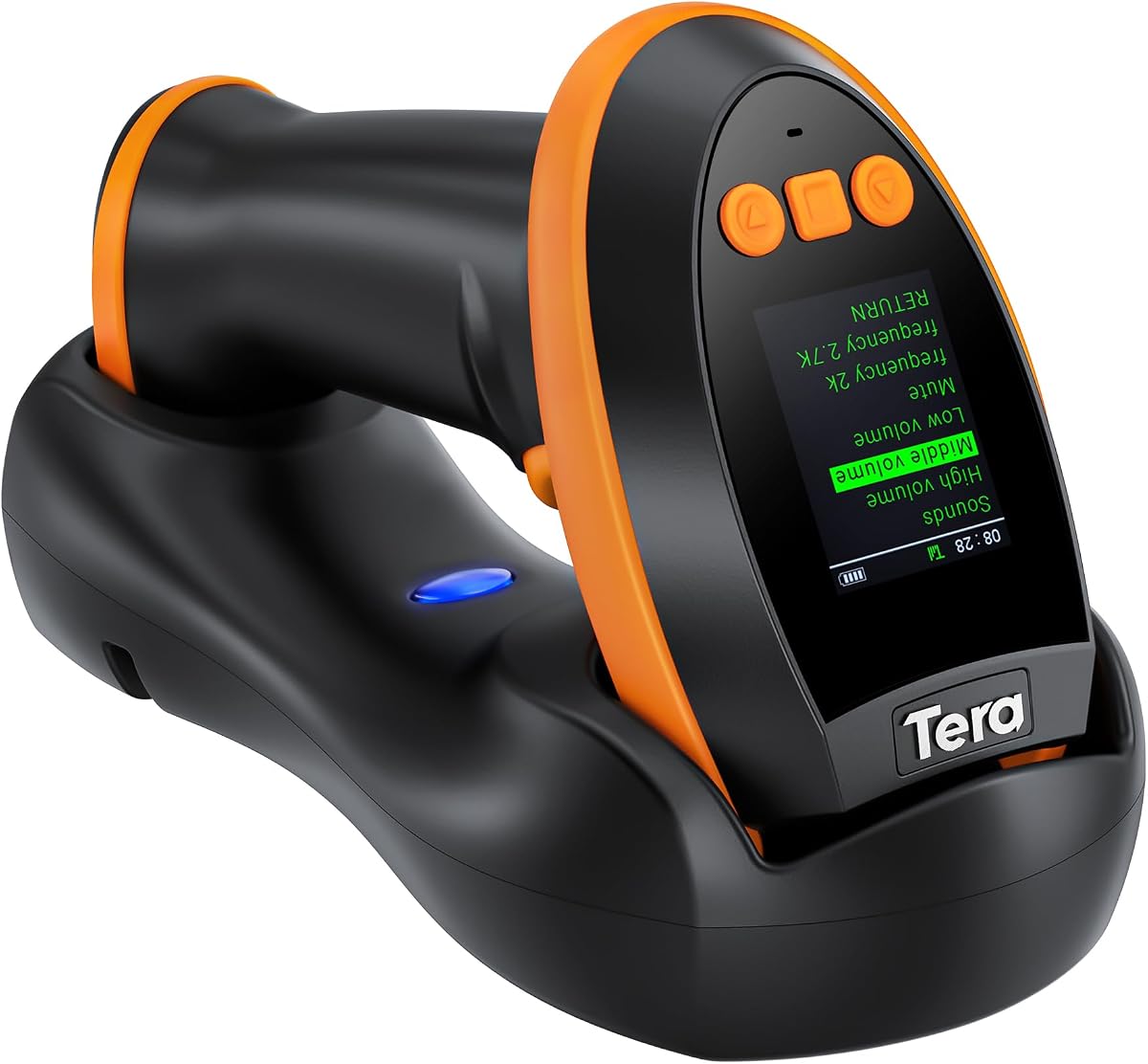
The Tera HW0009 is a 4.3-rated wireless scanner distinguished by its onboard screen, setting keypad, and charging cradle. It reads conventional 1D codes and a broad collection of 2D formats, making it the most feature-rich premium option in the group.
We may earn a commission when you buy through this link, at no additional cost to you.
The screen allows users to customize language, volume, connection settings, and barcode display information without relying entirely on setup barcodes. A 2500mAh rechargeable battery and cradle support regular use, while the cradle's built-in 2.4 GHz receiver removes the need to track a separate dongle. The scanner offers Bluetooth, 2.4 GHz wireless, and USB wired operation across phones, tablets, computers, and POS systems.
Its global CMOS imaging engine is designed to handle ordinary and high-density codes, including PDF417 on driver's licenses, reflective materials, and challenging formats. The listed 2D repertoire includes QR, Data Matrix, Aztec, Maxicode, Micro QR, and Micro PDF417, while the 1D list includes UPC/EAN, GS1-128, ITF-14, Codabar, and other common standards. Wireless range varies by environment, with longer stated distance in open areas and a shorter range when obstacles are present.
This model is best for a retail operation that wants more control, broader code support, and the flexibility to move between devices. It is also a sensible choice for inventory staff who need to review scanned data on the unit. Shops with only standard 1D labels and a fixed terminal may find a simpler reader sufficient.
The display and keypad provide a more direct way to adjust language, volume, connection behavior, and stored barcode views. This is helpful for multi-user environments where relying on hidden setup commands would be inconvenient.
The 2.4 GHz receiver is built into the charging cradle, so users can keep the receiver with the dock instead of storing a separate USB dongle. The cradle also gives the scanner a consistent charging location between shifts.
We may earn a commission when you buy through this link, at no additional cost to you.
The NETUM NT-1228BC is a 4.4-rated Bluetooth CCD reader designed for phones, tablets, and computers. It supports Bluetooth, 2.4 GHz wireless, and wired connections, giving it particular value for mobile inventory work and retail teams that move between devices.
We may earn a commission when you buy through this link, at no additional cost to you.
Its high-resolution CCD sensor can read 1D and stacked barcodes, including ISBN codes, from paper or screens. The scanner can also read through glass and plastic shrink wrap, which is valuable when products remain behind a display or are still packaged. Manual, continuous, auto-sensing, and storage modes cover different working patterns, while programmable prefixes, suffixes, deleted characters, keyboard commands, and terminators help tailor transmitted data.
Its most distinctive retail feature is offline storage for up to 100,000 barcodes. A worker who moves beyond Bluetooth or wireless range can scan records and transfer them later after reconnecting, helping preserve inventory accuracy in large stores, stockrooms, and warehouses. However, the supplied compatibility note says it does not work with Square POS, Divalto, DoorDash, or Lightspeed POS systems, so buyers must verify their software.
This scanner is best for mobile staff, stockroom teams, and businesses that need flexible programming beyond a simple keyboard-style reader. It is less suitable for a retail operation standardized on Square or one of the other excluded platforms, and its 1D focus means it should not be selected when QR or 2D checkout is a core requirement.
Storage mode allows employees to continue scanning when the scanner is temporarily outside its connection range. Once the device reconnects, the captured barcode records can support a more complete inventory session.
Prefixes, suffixes, deleted characters, and keyboard terminators can adapt output to different software fields. This configurability helps when a POS or inventory system expects a particular data structure rather than a raw barcode string.
We may earn a commission when you buy through this link, at no additional cost to you.
The NetumScan 2D Desktop is a 4.2-rated fixed scanner built for fast, hands-free work. Its defining specifications are a claimed rate of up to 300 barcodes per minute, a 1280-by-800 one-megapixel CMOS sensor, and an adjustable head designed to improve reading angles at a busy station.
We may earn a commission when you buy through this link, at no additional cost to you.
Automatic sensing lets users pass barcodes through the scanning window without manually triggering the device. The CMOS sensor is intended to recognize 1D, 2D, and QR codes, including small, blurred, or damaged labels on both screens and paper. Its format list covers UPC/EAN, ISBN/ISSN, Code 128, GS1-128, DataBar, several 2-of-5 standards, Data Matrix, PDF417, QR, Aztec, Maxicode, and Han Xin Code.
The weighted base is designed to resist tipping, and the head can tilt from plus 25 degrees to minus 55 degrees so users can align the reading window with products at different heights. Shock absorption is stated for drops up to five feet, while the matte finish helps resist scratches. USB plug-and-play connectivity works with Windows, Mac, and Linux, and the product includes instructions for prefix, suffix, and volume adjustments.
This scanner fits fixed retail counters, warehouses, libraries, and drugstores where high item volume justifies a dedicated desktop unit. It is less attractive to businesses that need to scan shelves, aisles, or mobile carts because it has neither wireless mobility nor a handheld form. Fixed placement also requires adequate cable routing and counter space.
The stated 300-scans-per-minute capability targets workflows where many products pass through one window. High-resolution imaging also supports smaller codes and more demanding labels that may be difficult for entry-level readers.
The weighted base helps prevent accidental movement, while the broad tilt range helps users direct the reading window toward labels on different sized products. This makes the fixed form more adaptable than a stationary scanner with one rigid angle.
We may earn a commission when you buy through this link, at no additional cost to you.
The Eyoyo EYH2 is a 4.3-rated wired handheld reader for 1D, 2D, and QR-style codes. Its ability to scan screens is particularly relevant for mobile coupons, digital wallets, and loyalty cards, while its simple USB design keeps setup straightforward.
We may earn a commission when you buy through this link, at no additional cost to you.
The scanner connects without installing a driver or dedicated application and is listed for Windows, Mac, Android, and Linux. It supports common retail symbologies such as EAN, UPC, Code 39, Code 128, UCC/EAN 128, Codabar, ITF, ISBN, ISSN, GS1 DataBar, and Matrix 2 of 5, as well as QR, Data Matrix, and PDF417. Screen scanning works best when the display brightness is increased.
There are important limits. The product information notes that extremely small Intel 2D codes and some blurry or dense PDF417 symbols may not read reliably, and it is not compatible with Square POS or Square Register. The wired cable can also restrict a cashier's reach, although it avoids pairing issues and keeps the device connected continuously.
The EYH2 is a good fit for independent retail counters that want to handle both package labels and customer phone screens without an elaborate wireless setup. Its trigger and auto-sensing modes support either deliberate checkout scanning or faster item-by-item processing, while mute control can reduce noise in a quiet shop.
Screen support extends the scanner beyond printed packaging to mobile coupons, digital wallet displays, and loyalty cards. Raising screen brightness before scanning can improve contrast and recognition in many everyday situations.
Custom prefixes and suffixes, character deletion, and keyboard commands allow staff to adapt how barcode data reaches compatible software. Triggered and auto-sensing modes give managers flexibility over the checkout pace.
We may earn a commission when you buy through this link, at no additional cost to you.
The Tera 9700 is a 4.1-rated hands-free desktop scanner with a 360-degree omnidirectional scanning window. It offers a straightforward way to read 1D, 2D, and QR codes without aiming a handheld device, making it a practical fixed-counter option.
We may earn a commission when you buy through this link, at no additional cost to you.
The scanner connects by USB and is listed for Windows XP through Windows 10, Mac OS, and Linux, with no software installation required. Omnidirectional optics allow products to be read from virtually any angle as they pass across the window. It can capture codes on labels, paper, plastic cards, mobile phones, and computer displays, which broadens its use beyond conventional product packaging.
As with every desktop model, the wired design limits movement and requires a permanent place on the counter. The 360-degree claim also describes the scanning geometry, not guaranteed success with every damaged or extremely low-contrast label. A retailer should still test its actual labels and POS configuration, particularly if it depends on specialized codes or software integration.
This model fits supermarkets, retail stores, libraries, logistics teams, healthcare counters, and banking desks where hands-free scanning is valuable. It is especially useful for bulky items because a cashier can keep one hand on the merchandise and the other near payment or bagging. Businesses that need to carry a scanner around the sales floor will be better served by a wireless handheld model.
The 360-degree window reduces the need to align every barcode precisely. This can speed up checkout and make scanning less finicky when staff are handling irregular packages or moving items quickly.
Plug-and-play operation and broad operating-system support reduce installation barriers. Once connected, the fixed reader can remain positioned at the primary checkout station without a charging or pairing routine.
We may earn a commission when you buy through this link, at no additional cost to you.
The Symcode Barcode Scanner is the highest-rated product in this roundup at 4.7. It combines 1D, 2D, QR, Data Matrix, and PDF417 decoding with automatic hands-free scanning, a sturdy stand, and a wired USB connection for computers, POS systems, and Mac devices.
We may earn a commission when you buy through this link, at no additional cost to you.
The hands-free stand suits a fixed counter where merchandise can be passed directly in front of the reading window. Automatic mode reduces button handling and allows staff to concentrate on payment, bagging, or customer service. The scanner is also designed to read multiple common formats, including blurry or damaged codes, and provides configurable prefix, suffix, and character-deletion options.
Audio feedback can be adjusted or turned off, which is helpful in stores with different noise levels or customer-service policies. The wired setup avoids wireless configuration and provides a consistent connection at a fixed station. However, the supplied information says the device is not compatible with Square, and the platform details are less comprehensive than those given for several competing models, making direct testing especially important.
This scanner is best for a compact retail operation that wants hands-free checkout, broad code coverage, and useful data-output controls without a wireless setup. Its high supplied rating and included stand make it an attractive candidate, but buyers should still verify the exact POS platform, scanning distance, and label formats used in their store.
The included stand creates a dedicated hands-free scanning position. Products can be moved through the reading area without picking up the device, improving workflow when a cashier is handling payment or packing items simultaneously.
Prefix, suffix, and deletion settings help shape barcode output for compatible software. Adjustable audio feedback lets managers tune the scanner for a louder open store or a quieter counter without replacing the unit.
We may earn a commission when you buy through this link, at no additional cost to you.
The best retail barcode scanner is the one that reads your products, communicates with your POS software, and fits the way employees work. These factors help narrow a large category of wired, wireless, handheld, and desktop options.
A scanner can work with an operating system but still fail to communicate properly with a particular point-of-sale platform. Several products in this guide explicitly exclude Square, Clover, Shopify, Divalto, DoorDash, or Lightspeed, while the ScanAvenger excludes proprietary hardware integrations and direct app-level integration. Check the manufacturer's current compatibility notes and test a representative unit with your software, payment hardware, and operating system before ordering an entire fleet.
The safest choice is a scanner that explicitly supports your POS and works in the expected keyboard, HID, or other required input mode. Do not assume that a USB connection guarantees compatibility.
Most conventional retail labels use 1D formats such as UPC, EAN, Code 128, and Code 39, but mobile coupons, loyalty programs, driver's licenses, and trackable items may require QR, Data Matrix, PDF417, Aztec, or another 2D symbology. A 2D imaging scanner is more versatile for future needs, while a dedicated 1D reader may be sufficient for a tightly controlled product catalog. Always test the actual labels, including any damaged, reflective, or small codes the business encounters.
Choose 2D capability when customers or staff scan phone screens or when your inventory may expand beyond ordinary UPC and EAN labels.
Handheld scanners suit mobile counter work, stockroom aisles, and situations where staff need to reach a label at different angles. Desktop scanners provide a stable reading window and hands-free operation at a fixed checkout. Wireless handheld models add movement, while desktop models generally simplify setup and reduce battery management. Consider counter space, cable routing, customer flow, and the frequency with which employees change devices before choosing a physical design.
Choose a handheld model for mobility, or a desktop model for repeatable fixed-counter scanning.
USB wired scanners offer a simple and consistent connection without pairing, but cables can restrict placement or become an obstacle around a register. Bluetooth and 2.4 GHz wireless options provide mobility and work well with phones, tablets, or computers, although they introduce battery and pairing considerations. Some premium scanners also keep the wireless receiver inside a charging cradle, reducing the chance of losing a separate dongle.
Choose wired operation for a fixed lane, or wireless connectivity when staff must roam or use several devices.
Manual triggering is precise and works well for deliberate checkout scans. Continuous mode supports rapid passes over many items, while auto-sensing wakes the scanner when a product enters its field. A storage mode can protect inventory work during temporary connection loss by retaining scans for later transfer. The best configuration depends on whether your team prioritizes accuracy, speed, or uninterrupted operation away from a computer.
Match the available modes to the workflow, and favor auto-sense or continuous scanning for busy fixed counters.
Wireless scanners need enough battery life to cover a full shift and a convenient way to recharge. The Tera HW0009 and NETUM NT-1228BC include substantial rechargeable batteries, and the ScanAvenger and HW0009 include charging stands. A fixed counter can eliminate this concern with a wired model, while a mobile team should pay closer attention to stated battery life, standby behavior, and whether the charging cradle also carries the wireless receiver.
For wireless use, prioritize a long battery life and a dock that makes charging and pairing easy.
Retail scanners encounter drops, dust, cables, crowded counters, and occasional impacts from merchandise. Look for stated drop protection, anti-shock construction, non-slip bases, and dust resistance. The Tera wireless reader includes an anti-shock silicone cover, several desktop models use weighted bases, and some products state IP54 protection. These features are particularly useful in stockrooms and high-traffic locations where the scanner is handled frequently.
For busy or mobile environments, prioritize grip, drop resistance, and a stable base over a lightweight shell.
A barcode scanner should deliver information in a format the receiving software can use. Several models allow custom prefixes and suffixes, deleted characters, keyboard commands, terminators, volume control, and programmable symbology settings. These options can improve workflow when a system expects a particular field structure, but incorrect configuration can also distort item data. Confirm the required output format and retain the product manual for setup and reset procedures.
Use configurable output only when needed, and test a sample scan before rolling the scanner out across all registers.
Begin by confirming the scanner's supported operating systems, POS platforms, connection mode, and barcode formats. For a wired model, connect the USB cable and allow the computer or POS terminal to recognize the device. For Bluetooth or 2.4 GHz operation, pair the scanner with the correct receiver or host using the manufacturer's procedure, then scan a known barcode to verify that the product name, price, and quantity appear correctly.
Choose the scanning mode that matches the task. Use a manual trigger for individual products, continuous scanning for multiple items, and automatic sensing for a fixed hands-free station. Position the barcode within the reading window with adequate light and contrast, and clean phone screens before scanning digital codes. If a label reads inconsistently, adjust the distance and angle rather than repeatedly forcing the scanner against the packaging.
For daily care, wipe the scan window with a soft, lint-free cloth and avoid abrasive cleaners or excess liquid. Keep the device dry, inspect the cable or charging contacts, and return wireless scanners to their dock when finished. Periodically test a standard label and document any changes to prefixes, suffixes, trigger behavior, or symbology settings so that troubleshooting remains straightforward.
No. A scanner may support common operating systems and still be incompatible with a specific POS platform, proprietary hardware, or app-level integration. Products in this guide explicitly exclude some versions of Square, Clover, Shopify, Divalto, DoorDash, and Lightspeed. Confirm the exact POS and payment setup with the manufacturer, and test a scanner before purchasing multiple units.
A 1D reader is sufficient when every scanned item uses traditional UPC, EAN, Code 128, or similar linear labels. A 2D reader is preferable for QR codes, Data Matrix, PDF417, mobile coupons, digital loyalty cards, and future product-marking programs. Because a 2D scanner can generally read 1D codes too, it offers a broader long-term option at the cost of added capability.
Wireless scanners are usually better for mobile employees, large counters, and stockroom work because staff can move without pulling a cable. Wired scanners are simpler for a fixed checkout lane, provide a consistent connection, and eliminate battery and pairing concerns. The best choice depends on mobility, counter layout, device compatibility, and how frequently employees change workstations.
Yes, if the scanner has 2D imaging support and the phone display is visible to its reading window. Increasing screen brightness can improve contrast and recognition. The Eyoyo EYH2, Tera 9700, NetumScan desktop models, and several other imaging scanners in this guide list screen-scanning support, while basic 1D readers generally cannot read QR symbols.
Hands-free scanning means the scanner sits in a stand and activates automatically when an item enters its reading window. The cashier can pass merchandise across the scanner without picking it up or pressing a trigger. This can improve efficiency, particularly with bulky items, but the counter must have suitable space and the POS must receive the scan correctly.
Most models in this roundup are designed for plug-and-play operation and function as keyboard-style input devices without dedicated software. Some still require a pairing step for Bluetooth or 2.4 GHz use, and some include configuration commands or manuals for prefixes, suffixes, and scan modes. POS compatibility is separate from driver installation, so both should be verified.
Connect or pair the scanner to the intended POS device, then test every barcode type used in the business. Include normal labels, difficult or damaged labels, and QR codes displayed on a phone if digital checkout is part of the workflow. Verify item matching, price accuracy, trigger behavior, and output formatting, and test for dropped scans during realistic checkout activity.
Keep the reading window clean and free of dust, adhesive residue, and fingerprints, since surface contamination can affect recognition. Inspect cables, charging contacts, and the battery during routine use, and follow the charging guidance for wireless units. Periodic test scans and a record of configuration changes help catch problems before they create incorrect prices or missed inventory.
The Tera Wireless 1D Reader stands out as a budget-minded option for standard linear barcodes, while the ScanAvenger is the most versatile choice for businesses that need 1D and 2D scanning across several connection methods. The Tera HW0009 takes the premium position with a configurable screen, broad symbology coverage, a rechargeable battery, and a cradle with an integrated wireless receiver.
Most stores should prioritize confirmed POS compatibility and the barcode formats already appearing on products or screens. Form factor comes next: choose wireless handheld freedom for mobile work, a wired handheld for simple fixed counters, or a desktop reader for fast hands-free scanning. Programming options, charging convenience, and durability can then be matched to the operating environment.
Finally, verify current listing details, compatibility notes, and pricing before purchasing, because product availability, software requirements, and retailer conditions can change. A single test unit is a sensible way to confirm that the selected scanner handles your actual labels, POS configuration, and busiest checkout periods before a wider rollout.

