
waveshare 2.4inch LCD Display Module
4.2Editor score
65K RGB color support
240 × 320 resolution
Low pin-count SPI interface
LCD graphic displays range from compact, solder-friendly modules for embedded projects to larger touchscreen panels and complete human-machine interface systems. A useful display must suit the controller, available pins, power requirements, viewing environment, and intended interface rather than simply offer the largest screen. Resolution, color depth, touch response, and documentation can be equally important.
We compared all ten products by examining their stated screen size, resolution, display technology, controller, communication method, touch capability, expansion options, voltage compatibility, and supplied learning resources. The list covers Arduino modules, ESP32 development boards, SPI and parallel displays, an OLED graphic module, and a magnetic desktop-PC sub-display, providing options for several project types.
Each review explains the most suitable use for the display, its documented strengths, and any practical trade-offs visible in the supplied specifications. The top picks demonstrate how different priorities affect the decision: one is a flexible microcontroller module, one is a complete ESP32 touchscreen platform, and one is a premium full-color case display. Prices and availability can change.
4.2Editor score
4.0Editor score

3.8Editor score
As an Amazon Associate we earn from qualifying purchases.
The comparison below places all ten displays side by side, emphasizing the distinctions that matter most: physical size, resolution, interface, controller, touch support, and expansion potential. It also separates simple modules from fully integrated ESP32 platforms and a desktop-PC sub-display.


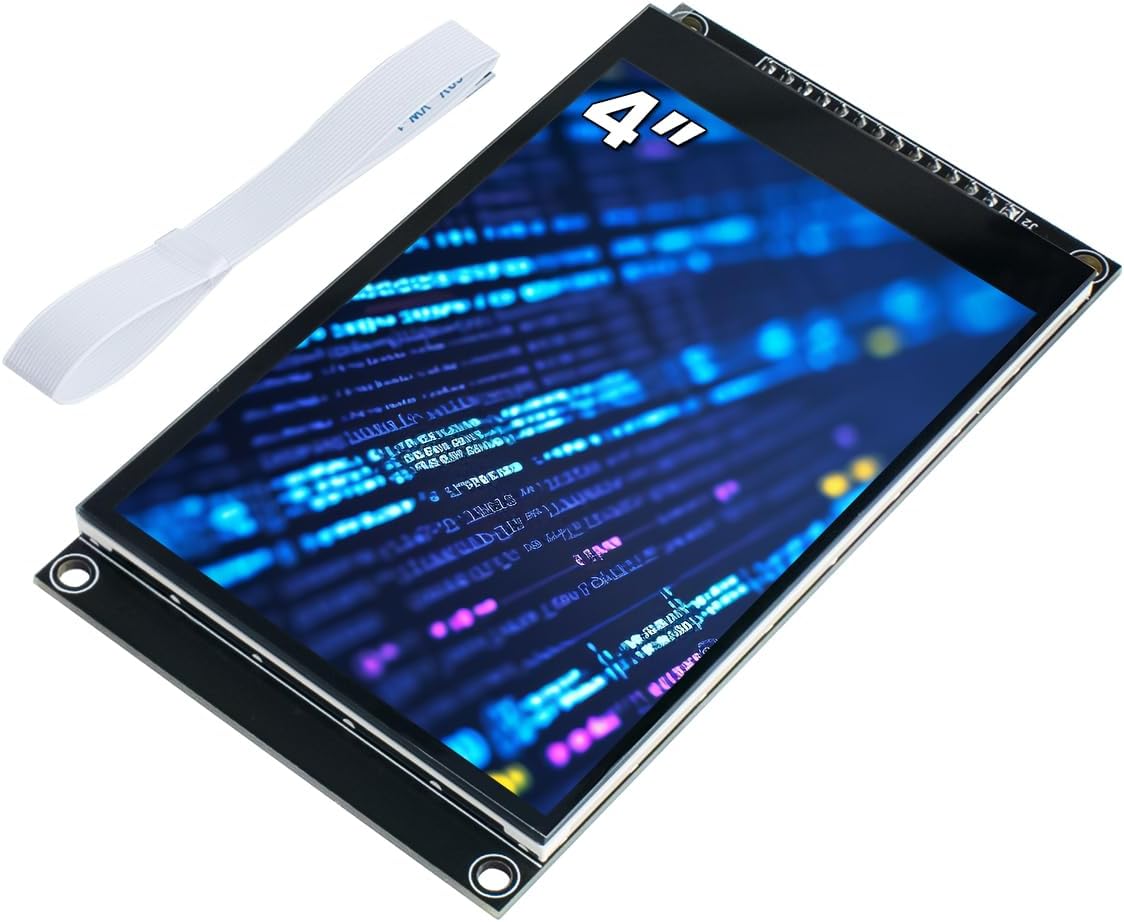
The Hosyond 4.0 Inch 320×480 TN Capacitive Touch Screen is a versatile embedded display module rated 4.0 by customers. It combines a 4.0-inch TN panel, 320 × 480 resolution, 65K colors, and capacitive touch in a package intended for Arduino R3, Mega2560, ESP32, and other supported development platforms. Its principal appeal is flexibility: it can function as a conventional graphic output or become the primary interface for a touch-driven project.
We may earn a commission when you buy through this link, at no additional cost to you.
The four-wire SPI bus helps preserve a microcontroller's available I/O pins, while the onboard level-conversion circuit supports both 5V and 3.3V MCU operation. A 2.54-pin interface and FPC extension interface provide installation options, and a micro TF card slot offers a way to expand storage. The product is also listed as supporting example learning programs for ESP32, STM32, Arduino R3 and Mega2560, C51, and CH32, plus low-level driver support.
There are trade-offs. The TN panel does not offer the viewing-angle consistency associated with IPS, and 320 × 480 is less detailed than the 800 × 480 resolution found on the larger ESP32 options. Buyers must also ensure that their chosen controller, voltage, and example code align with the supplied documentation. Touch accuracy should be evaluated within the intended enclosure because the physical mounting and panel surface can affect interaction.
This is the strongest general-purpose choice for makers who want touch without purchasing a complete development board. It suits Arduino prototypes, ESP32 instruments, embedded control panels, and compact information screens. Choose it when SPI efficiency, controller flexibility, and touch are more important than IPS-grade viewing angles or the room available on a larger touchscreen platform.
Capacitive touch is less mechanically demanding than a resistive panel and is described as more convenient and accurate in the product information. That makes this module appropriate for menus, settings, selectors, and other controls that need immediate interaction.
Four-wire SPI reduces the number of required I/O lines, while onboard level conversion broadens compatibility. The micro TF slot and FPC extension add practical flexibility for projects that need more storage or alternative physical connections.
We may earn a commission when you buy through this link, at no additional cost to you.
This two-pack of 3.12-inch 256 × 64 OLED modules holds a 4.7 customer rating, the highest listed rating in this guide. Each module uses an SSD1322 controller and is described as a green OLED graphic display with a 16-pin interface. It is aimed at Arduino projects requiring a wide, relatively short status screen rather than a conventional full-color graphical interface.
We may earn a commission when you buy through this link, at no additional cost to you.
The board supports three communication methods: 8-bit 6800 parallel, 8-bit 8080 parallel, and both four-wire and three-wire SPI as described in the specifications. That range lets a builder choose between a lower-wire-count connection and parallel data transfer. At 256 × 64, the screen is particularly suitable for text, status indicators, waveform labels, compact menus, and monitoring strips where crisp legibility matters more than detailed imagery.
Because the modules are primarily graphic and text-oriented, they are not a natural choice for photography, detailed dashboards, or touch interfaces. The package also appears oriented toward soldered integration rather than a plug-and-play shield arrangement. As a two-pack, it may be useful for comparing displays, building a paired instrument, or keeping a spare module available.
The display is a strong choice for small embedded status panels, laboratory readouts, compact Arduino projects, and custom information strips. Select it when an OLED-style appearance, clear lettering, and multiple wired interfaces matter more than color photography, touch input, or a large graphical workspace.
The elongated 256 × 64 format gives text and compact graphics a natural presentation area. It is well suited to sensor readings, operating states, timers, and short diagnostic messages that need to remain easy to interpret.
SPI can conserve connections, while the supported parallel modes may suit projects with different timing or data-transfer priorities. The correct mode must match the controller library and wiring configuration used by the project.
We may earn a commission when you buy through this link, at no additional cost to you.
The Thermalright Trofeo Vision LCD Black Edition is a 6.86-inch full-color case sub-display with 1280 × 480 resolution and a customer rating of 3.8. Unlike the bare modules in this list, it is designed to work inside a desktop PC system, where it can show monitored parameters, static graphics, or dynamic customized content. It offers the highest resolution among the products compared.
We may earn a commission when you buy through this link, at no additional cost to you.
The IPS panel is described as accurately restoring color while maintaining stable viewing angles. Its TRCC software can monitor various system parameters, switch between static and dynamic images, and support personalized themes. The magnetic panel system allows installation in different chassis positions, and the product can also be paired with compatible Trofeo Vision series radiator screens.
The main limitation is scope. This is not a general-purpose microcontroller module and cannot be chosen in the same way as an SPI LCD for an Arduino build. It requires a compatible motherboard 9-pin USB connection for power and data, careful attention to the supplied wiring, and installation of the software before operation. The product's fixed 187.2 × 72.1 × 21 mm dimensions also require adequate case space.
PC builders who want a large, detailed, customizable system display will find this option especially compelling. It is better suited to enthusiasts creating a polished monitoring station or personalized interior than to makers needing a portable development interface. Confirm USB connection compatibility, physical clearance, and software support before buying.
The 1280 × 480 panel provides enough space for detailed charts, system information, and custom themes. TRCC expands the display beyond a fixed hardware readout by enabling dynamic and static content changes.
The magnetic panel can be positioned in different areas of a compatible case and can also work with compatible Trofeo Vision cooling hardware. This gives builders more freedom than a permanently fixed auxiliary screen.
We may earn a commission when you buy through this link, at no additional cost to you.
The waveshare 2.4inch LCD Display Module is a compact color screen with a 4.2 customer rating. It uses an embedded ILI9341 driver, supports 65K RGB colors, and operates at 240 × 320 resolution. Its defining feature is simplicity: the SPI bus minimizes required GPIO pins, making it approachable for first-time display projects and compact embedded installations.
We may earn a commission when you buy through this link, at no additional cost to you.
The module supports controller boards such as Raspberry Pi and STM32 and is listed as including development resources with examples for both platforms. That combination of common interfaces and supplied examples is useful for learners, prototyping, sensor interfaces, and small control panels. A 2.4-inch format is also less demanding in terms of enclosure space and power than the larger ESP32 touchscreen systems.
The module has no stated touch capability, so it works best for visual output rather than direct interaction. Its 240 × 320 resolution is suitable for compact menus, graphs, and status pages, but it offers less room for elaborate dashboards than the 4.0-inch, 5-inch, and 7-inch alternatives. Buyers will also need to confirm the electrical and connection details for their specific controller.
This display is a sensible starting point for Raspberry Pi or STM32 projects that need a clear color screen without a complex HMI. Choose it when simplicity, documented examples, and a modest footprint matter more than touch input or a large interface. It is also a strong choice for educational builds where getting a reliable first graphic output matters most.
Using SPI reduces the number of connections compared with many parallel TFT modules. That leaves more pins available for sensors, actuators, and other project hardware while keeping the wiring manageable.
The 65K RGB palette and 240 × 320 resolution are sufficient for icons, waveforms, menus, and data visualizations. It provides a useful balance between visual capability and compact dimensions.
We may earn a commission when you buy through this link, at no additional cost to you.
The HiLetgo 3.5-inch TFT LCD Display has a 4.3 customer rating and is designed to plug directly into an Arduino Mega2560. Its 480 × 320 resolution, 36-pin layout, and support for ILI9486 or ILI9488 controllers make it a familiar option for Arduino projects that need a conventional graphic output. The product is explicitly listed as a non-touch screen.
We may earn a commission when you buy through this link, at no additional cost to you.
Direct insertion simplifies the physical relationship between the display and Mega2560, while the onboard level-conversion chip allows operation with 3.3V and 5V MCU signal levels. The broad Arduino-series compatibility statement is useful, although the stated 36-pin fit specifically points toward the Mega2560 rather than every Arduino board. Builders should not assume the module will fit smaller Uno-style headers.
Its main limitation is the absence of touch. Users cannot interact directly with on-screen controls, and a resistive or capacitive panel would need to be sourced separately if required. The 36-pin connection also makes this less attractive for projects using unusual Arduino-compatible layouts. Software support must also match the available ILI9486 or ILI9488 controller variant.
This display is well matched to data visualization, environmental monitoring, industrial-style readouts, and educational Arduino systems centered on the Mega2560. It is a strong fit when users want a sizable, detailed, non-touch screen and a direct board connection. For interactive projects, choose a touch-equipped option instead.
The 36-pin interface is intended to insert directly into a compatible Arduino Mega2560. That reduces adapter work and makes the module convenient for established Arduino project layouts.
At 480 × 320, the panel offers enough space for charts, sensor information, and multi-line status pages. It provides a meaningful step up from smaller monochrome-style information strips without requiring a complete touchscreen computer.
We may earn a commission when you buy through this link, at no additional cost to you.
The ELECROW 7 Inch ESP32 Display combines a 7.0-inch 800 × 480 touchscreen with an ESP32-S3-WROOM-1-N4R8 controller. Its 4.2 customer rating reflects a product positioned as a complete human-machine interface platform rather than a simple display module. The integrated dual-core 32-bit LX6 processor, Wi-Fi, and Bluetooth make it suitable for connected control panels and IoT interfaces.
We may earn a commission when you buy through this link, at no additional cost to you.
The screen uses EK9716BD3 and EK73002ACGB drivers and supports touch operation. Development can take place in Arduino IDE, Espressif IDF, PlatformIO, or MicroPython, with compatibility listed for the LVGL graphics library. A TF card slot, USB interface, speaker interface, battery interface, and additional peripheral connections broaden the platform's role in finished devices.
As the largest embedded display in the list, it requires more space, power, and enclosure planning than a simple Arduino LCD. The feature set also introduces more software and hardware complexity. Touch calibration, controller firmware, graphics libraries, and the chosen development environment must be configured correctly before the display can fulfill its intended function.
The ELECROW panel is a strong candidate for automotive HMI concepts, medical-device interfaces, smart-home controllers, industrial panels, home automation, and connected IoT appliances. It is particularly attractive when Wi-Fi and Bluetooth functionality should live directly in the display controller. Choose it when an integrated platform is worth more than a minimal, inexpensive module.
The ESP32-S3 handles both graphics and connected-control tasks, reducing the need for a separate controller in many prototypes. Wireless connectivity can simplify distributed sensor, monitoring, and automation concepts.
Support for Arduino IDE, Espressif IDF, PlatformIO, MicroPython, and LVGL lets developers choose a familiar workflow. That range of tools is valuable for both quick prototypes and more structured embedded applications.
We may earn a commission when you buy through this link, at no additional cost to you.
The FSTN(+) 240 × 128 graphic module is a 20-pin transflective display measuring 170.0 × 103.5 millimeters. It offers a traditional 240 × 128 pixel grid for instrument-style readouts, simple menus, and embedded information. Unlike several TFT options in this guide, it does not present itself as a touch or full-color multimedia panel.
We may earn a commission when you buy through this link, at no additional cost to you.
Transflective operation is an important distinction. The display is designed to remain visible using reflected ambient light, which can make it useful where a backlit TFT or OLED is not necessary. The 20-pin module format and straightforward resolution also suit users who already work with graphic LCD controllers and want a conventional display rather than a wireless-capable HMI computer.
The supplied product information is limited, and no customer rating is available for this listing. Details such as color capability, contrast ratio, viewing-angle behavior, operating voltage, exact pin assignments, and included accessories should therefore be confirmed with the seller or manufacturer before ordering. A buyer also needs an appropriate controller or driver for the 20-pin interface.
This module is best suited to legacy-style embedded instruments, industrial information panels, and projects where reflective visibility and a familiar resolution matter more than color graphics or touch. It is less convenient for beginners because the product record provides fewer integration details than the development-oriented alternatives. Confirm the electrical and mechanical requirements before committing to it.
A transflective display uses reflected light as part of its viewing behavior. That can be advantageous for readable instrument readouts in environments where a continuously illuminated display is unnecessary.
The 20-pin graphic module format implies that the display needs compatible driving electronics. Projects should confirm the pinout and controller requirements before designing a PCB or enclosure around it.
We may earn a commission when you buy through this link, at no additional cost to you.
The ESP32 Display 5 Inch HMI Basic RGB TFT LCD Touch Screen offers a 5-inch 800 × 480 panel, capacitive touch, and an integrated ESP32-S3 controller. It has a 3.8 customer rating and is supplied with a protective acrylic case. The product sits between bare LCD modules and the larger 7-inch ELECROW system in both size and integration level.
We may earn a commission when you buy through this link, at no additional cost to you.
The ESP32-S3-WROOM-1-N4R8 provides a dual-core 32-bit LX6 processor with integrated Wi-Fi and Bluetooth. The display is driven by EK9716BD3 and EK73002ACGB, while support for Arduino IDE, Espressif IDF, PlatformIO, MicroPython, and LVGL gives developers a range of familiar options. A TF card slot, USB, speaker interface, battery interface, and multiple peripheral interfaces support more advanced HMI builds.
Its enclosure is both a benefit and a constraint. The included acrylic case can make the unit easier to prototype and gives a finished-looking display, but the dimensions and mounting needs must fit the intended project. Compared with a bare TFT module, the integrated controller, touch layer, and housing add complexity and are less convenient for users who only need a simple information output.
This display is well suited to automotive HMI prototypes, medical-device concepts, smart-home controllers, industrial interfaces, consumer electronics, and IoT systems. The protective case and touchscreen make it particularly useful for interactive demos. Choose it when a 5-inch interface is the right size and an integrated ESP32 platform offers more value than a disconnected display module.
Five inches provides a practical balance for controls, dashboards, and demonstrations. The 800 × 480 panel retains enough space for readable labels while remaining smaller than the 7-inch alternative.
The supplied acrylic case offers a degree of protection and a professional appearance during prototyping. It also creates a fixed physical assembly that should be measured before final installation.
We may earn a commission when you buy through this link, at no additional cost to you.
The Hosyond 4.0-inch 480 × 320 TFT Touch Screen is rated 4.2 by customers and combines a four-inch color panel with touch and an ST7796S driver. It is listed as compatible with Arduino R3, Nano, and Mega controller boards. Compared with the other Hosyond 4.0-inch option in this guide, its 480 × 320 specification provides more pixel detail.
We may earn a commission when you buy through this link, at no additional cost to you.
The module uses an SPI serial bus, requiring only a few I/O connections to operate the display. An SD card slot and included touch pen support expanded functionality, while sample programs and underlying driver technical support help users begin development. The color display supports 65K colors, making it appropriate for menus, instrument readings, simple graphics, and touch navigation.
The listing does not identify the touch technology, so buyers should verify whether the panel is resistive or capacitive before assuming it behaves like the other Hosyond touchscreen in this guide. It also lacks the explicitly stated onboard level conversion found on that alternative. Physical pin compatibility, voltage, and sample-code requirements therefore deserve careful review.
This module is a good fit for Arduino R3, Nano, and Mega projects that need a detailed four-inch display with touch. It can suit educational controllers, environmental monitors, configuration panels, and compact interactive instruments. Choose it over the lower-resolution TN version when pixel density is important, while confirming touch type and electrical compatibility.
The 480 × 320 resolution provides 50 percent more listed pixels than the 320 × 480 four-inch alternative. That difference is valuable for small text, denser menus, and more detailed visual information.
Compatibility with Arduino R3, Nano, and Mega boards gives makers several familiar choices. Supplied examples and driver support are especially useful when building the first touch interface.
We may earn a commission when you buy through this link, at no additional cost to you.
The 2inch LCD Module is a compact IPS display with a 4.3 customer rating, 240 × 320 resolution, and support for 262K RGB colors. It measures 58 × 35 millimeters overall, with a stated active display area of 30.60 × 40.80 millimeters. Its small footprint makes it relevant to portable instruments, miniature controllers, and tightly constrained custom panels.
We may earn a commission when you buy through this link, at no additional cost to you.
The ST7789V controller operates through SPI and requires only a minimum number of GPIO connections. An LED backlight, 0.0975 × 0.0975 millimeter pixel size, and support for both 3.3V and 5V operation make it a broadly adaptable module. The product information specifically warns that power-supply and logic voltages must be consistent for proper operation.
Its very small screen limits the amount of information that can be presented at once, and no touch function is listed. At 240 × 320, it can display crisp text and compact graphics, but it is not suited to complex dashboards or large controls. The voltage warning also means that connections should be planned carefully rather than treated as universally interchangeable.
The display is a sensible choice for embedded status readouts, small sensor interfaces, wearable-adjacent prototypes, and custom instruments where every millimeter matters. It is particularly useful for builders who prefer the viewing characteristics of IPS and a broad color range but do not need touch input. Confirm pin assignments, voltage, and driver-library support before integrating it.
At 58 × 35 millimeters, the module is among the most compact options in the guide. It can fit into small custom panels and handheld-style projects where a 4.7-inch or 7-inch display would be impractical.
The listed 262K RGB support and IPS technology provide a visually capable output despite the small dimensions. The ST7789V controller and SPI interface keep integration manageable for compatible microcontrollers.
We may earn a commission when you buy through this link, at no additional cost to you.
Choosing an LCD graphic display involves balancing screen size, detail, interface, controller compatibility, power requirements, and the environment in which the project will be used. The most capable panel is not automatically the most practical one; the best choice is the one that integrates cleanly with the intended controller and enclosure.
Screen size affects both the amount of information available and the space required for mounting. The products compared range from a 2.0-inch module measuring 58 × 35 millimeters to a 7.0-inch ESP32 touchscreen, with a 6.86-inch desktop sub-display also included. Small modules suit portable instruments and embedded controls, whereas 4.0-inch to 7.0-inch panels provide more room for menus, charts, and touch targets. Measure the intended enclosure rather than relying only on diagonal size, and leave space around the bezel, connectors, and controls.
Resolution determines how much detail the controller must send and how finely text can be rendered. The 240 × 128 FSTN module is intended for instrument-style information, while several TFT options offer 240 × 320, 320 × 480, 480 × 320, or 800 × 480. The Thermalright panel reaches 1280 × 480, making it the most detailed option but also the most specialized. Consider readability at the expected viewing distance rather than choosing solely by the largest pixel count.
Touch is essential for dashboards, configuration panels, and any display that must accept direct commands. The Hosyond 4.0-inch 320 × 480 module explicitly uses capacitive touch, as do the ELECROW 7-inch and ESP32 5-inch platforms. The 4.0-inch 480 × 320 Hosyond module also includes touch, although its technology is not stated. Several alternatives are output-only, including the waveshare, HiLetgo, FSTN, and compact 2-inch modules. Choosing a non-touch display can reduce complexity, but users will need buttons, switches, rotary encoders, or another input method.
LCD, OLED, IPS, and TN technologies have different visual characteristics. IPS is associated with stable viewing angles, as noted for the compact 2-inch and Trofeo Vision displays. TN can provide a conventional color module at a more modest resolution, while OLED is particularly suited to bright text and status information. The FSTN module uses transflective operation, which is relevant when ambient-light visibility matters. Consider contrast, viewing angle, backlight requirements, and whether the display will be viewed directly or from an angle.
A display must communicate with a compatible controller and use software drivers that support its chip. Bare modules such as the waveshare 2.4-inch and 2-inch IPS screen are intended for compatible boards such as Raspberry Pi, STM32, and other microcontrollers. The HiLetgo module is shaped for direct Mega2560 use, while both Hosyond modules emphasize Arduino and ESP32 compatibility. Integrated ESP32 platforms include their own processor, wireless connectivity, touch controller, and development environment, reducing controller selection but adding system complexity.
The interface determines wiring complexity, refresh behavior, and how many controller pins remain available for other tasks. SPI appears across multiple products and is attractive because it uses relatively few I/O lines. The 3.12-inch OLED supports SPI and 6800 or 8080 parallel modes, giving it additional integration options. Parallel TFTs may transfer data differently but often occupy more connections. Count pins for the display, touch controller, storage, and peripherals, and verify that the selected board exposes the necessary signals in the required arrangement.
Power and logic compatibility are frequent sources of blank or unstable displays. The Hosyond 4.0-inch TN module includes onboard level conversion for 5V and 3.3V MCUs, and the HiLetgo Mega module also supports both operating levels. The compact 2-inch IPS module lists 3.3V and 5V operation but warns that supply and logic voltages must agree. Larger integrated systems add USB, speaker, battery, and peripheral interfaces. Consider current requirements, heat, available power rails, and whether removable storage such as a TF card is useful for the project.
Hardware capability is only useful when the project can be programmed effectively. The Hosyond modules list sample programs, low-level driver support, and updates for several controller families. The waveshare module includes Raspberry Pi and STM32 examples. The integrated ESP32 options support Arduino IDE, Espressif IDF, PlatformIO, MicroPython, and LVGL, plus tutorials and technical support. The Trofeo Vision depends on TRCC software, while the FSTN listing has limited integration information. Favor products whose examples, driver documentation, and update path match the developer's experience.
Before connecting any module, identify the display controller, power requirements, logic voltage, and correct pinout. Compare the board's 3.3V or 5V levels with the module documentation, especially on boards that accept both voltages. Install the relevant controller library and example program first, then make a minimal test that fills the screen with a color, line, or text before adding touch calibration, storage, or complex graphics.
Route the SPI, touch, reset, and backlight connections carefully, especially in compact enclosures. Keep the panel away from sharp hardware, conductive debris, moisture, and excessive mechanical pressure. For integrated ESP32 screens, install the required development environment and graphics library, then follow the supplied tutorials through a simple static display before enabling wireless functions. For the Trofeo Vision, verify the motherboard USB connection, install TRCC, and confirm that the selected static or dynamic content appears as intended.
Care for the panel by cleaning it with a soft, lint-free cloth and avoiding aggressive solvents or compressed air directed at the edges. Do not place heavy objects on an LCD or OLED, and do not flex a flexible display to test its limits. Monitor heat in enclosed systems, preserve ventilation around integrated boards, and back up any custom software or image assets. If the image becomes unstable, separate power, wiring, driver, and signal issues before assuming the physical panel has failed.
A graphic LCD can display individual pixels, allowing images, icons, lines, charts, and arbitrary text layouts. A character LCD is usually limited to predefined character positions and a small set of built-in symbols. The graphic modules in this guide provide resolutions ranging from 240 × 128 to 1280 × 480, giving designers much greater control over the interface.
SPI usually uses fewer controller pins and is convenient for compact embedded projects. Parallel interfaces can suit designs that favor a particular data-transfer method and can provide additional wiring options, as on the 3.12-inch OLED. The better choice depends on available pins, driver-library support, refresh requirements, and the physical layout of the project.
The ELECROW 7-inch and ESP32 5-inch options integrate an ESP32-S3 controller directly into the display assembly. A separate microcontroller is therefore not required for the basic display function. You still need suitable software, development tools, and project-specific code, and accessories such as storage, speakers, or a battery may be added through the listed interfaces.
Yes, but users will need another way to enter commands. Buttons, switches, rotary encoders, a keypad, or a remote controller can work well with a non-touch display. Touch screens are more convenient for direct menu interaction, while output-only displays can simplify firmware, reduce power use, and make enclosure design more straightforward.
It means the display can communicate with a controller using either of those common signal levels, provided the power and logic setup is correctly matched. A module with onboard level conversion handles this conversion for the microcontroller. The compact 2-inch IPS listing specifically warns that the power supply and logic voltage must be consistent or the module may not operate properly.
An 800 × 480 screen contains substantially more pixels than a 240 × 320 panel, allowing smaller text, denser charts, and more detailed controls. It also requires more data transfer, a more capable controller, and typically more power and enclosure space. The lower-resolution module can be sufficient for a simple status page or instrument readout.
They can be useful in certain environments, but suitability depends on ambient light and interface design. The transflective FSTN module uses reflected light as part of its operation, while OLED displays can offer bright, clear text. Neither should be assumed to outperform every backlit LCD outdoors without evaluating contrast, viewing angle, temperature behavior, and power requirements in the actual location.
Begin by checking power, logic voltage, the backlight, pin orientation, and the selected driver library. Confirm that the example program targets the actual controller and that the required SPI or parallel connections are correct. For touch displays, verify the separate touch connection and calibration. If the backlight works but graphics are absent, controller compatibility and data wiring deserve the closest attention.
The Hosyond 4.0-inch 320 × 480 capacitive touch module stands out as the most flexible general-purpose embedded display, combining touch, SPI, level conversion, flexible interfaces, storage expansion, and broad example support. The waveshare 2.4-inch module is a practical lower-complexity starting point, while the Thermalright Trofeo Vision LCD represents the premium desktop route with its large 1280 × 480 full-color panel and magnetic placement.
For a complete connected touchscreen platform, the ELECROW 7-inch or ESP32 5-inch display may be more appropriate than any bare module. Choose a 2-inch or 3.5-inch screen when physical size is critical, a 4.0-inch panel for a balance of detail and control, and a larger HMI system when touch, wireless connectivity, and expanded interfaces matter. Always verify pinouts, voltage, driver chips, and physical dimensions before purchasing.
The final choice should balance resolution, touch, software support, power, and enclosure constraints rather than focusing on one headline specification. Current prices, availability, and seller details can change, so review the latest listing information and product documentation before ordering. That final verification helps ensure the display integrates successfully instead of creating avoidable hardware or software problems.