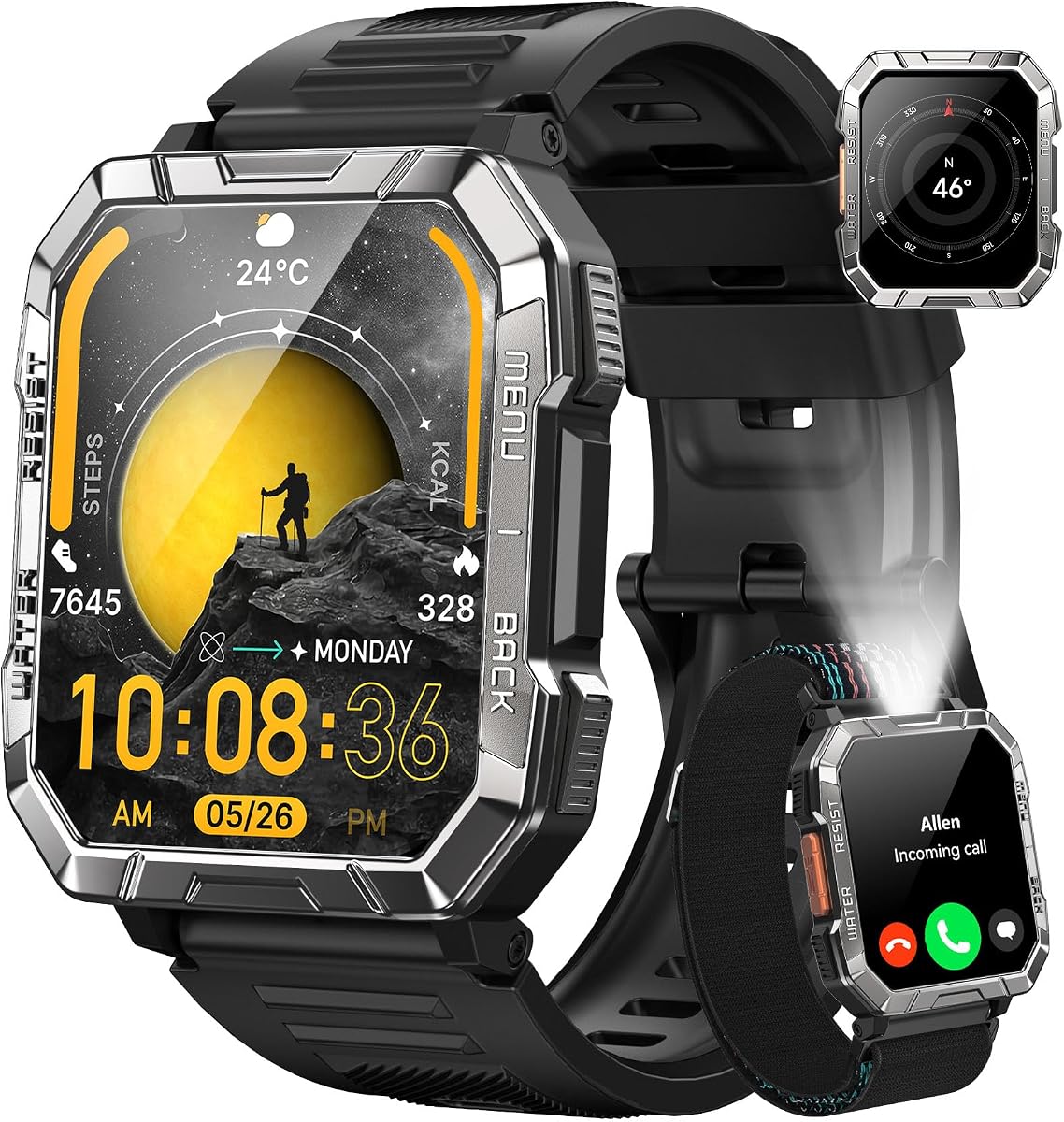
Military Smart Watch for Men with 100-Day Standby/Flashlight/Compass
5.0Editor score
Claimed 30-day daily battery
Aluminum alloy military-style construction
LED flashlight and compass
120 sports modes and GPS routing
A smartwatch for extreme heat must do more than track workouts. It needs a readable display, dependable navigation, useful health sensors, and hardware suited to demanding outdoor conditions where heat, dust, intense sunlight, and long hours away from power can quickly become problematic.
This guide compares 10 rugged, multisport, running, and fitness-focused smartwatches based on verified heat-related specifications, outdoor durability, battery claims, navigation, display quality, water resistance, and wellness features. It covers models explicitly tested for severe heat alongside options better suited to general hot-weather use.
Each review explains where a watch stands out, where its specifications leave questions, and who should consider it. The three leading choices are highlighted separately, while availability and feature details can change, so readers should verify current specifications before buying.
5.0Editor score
5.0Editor score

4.1Editor score
As an Amazon Associate we earn from qualifying purchases.
The comparison below highlights the most important distinctions for hot-weather use, including published heat tolerance, battery endurance, navigation hardware, display characteristics, and the practical limitations that can affect suitability in extreme conditions.




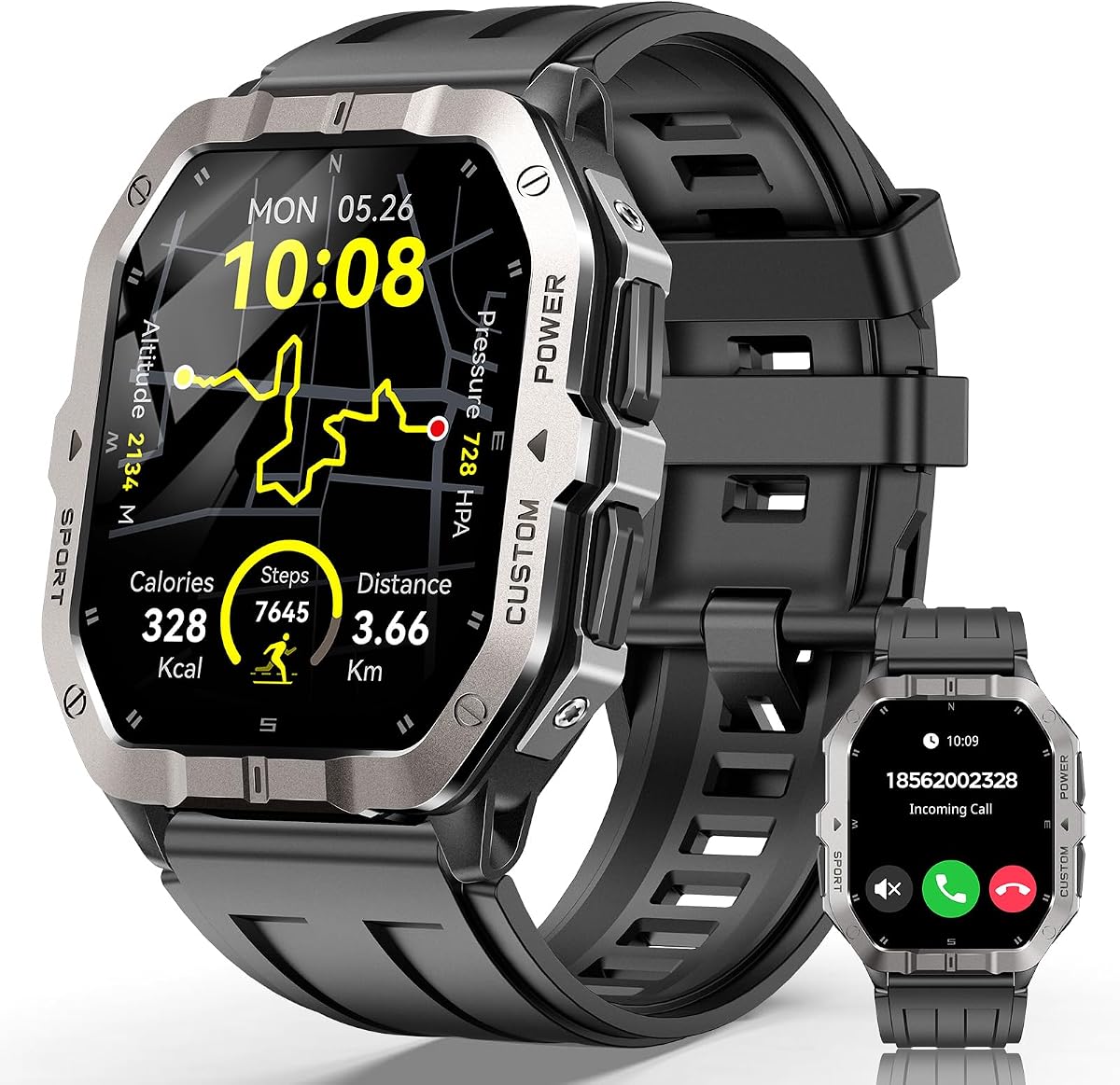
This military-style smartwatch has a 5.0 rating and stands out because its supplied specifications explicitly state heat resistance up to 187.96°F. That published figure makes it the clearest choice in this roundup for buyers who need a documented temperature tolerance rather than simply a rugged-looking case.
We may earn a commission when you buy through this link, at no additional cost to you.
Its standalone GPS is especially valuable when a phone can overheat, run out of power, or become inconvenient to carry. The watch also includes a compass, altimeter, and barometer, allowing it to support route tracking and environmental awareness without a constant phone connection. A sharp 2.02-inch display with enlarged fonts is designed to remain readable in direct sunlight, while the claimed 12-plus-day battery with Bluetooth calling enabled reduces charging interruptions.
The composite body, aluminum alloy bezel, and claims of military-grade testing add confidence for demanding outdoor work. However, the stated heat tolerance should not be interpreted as permission to leave the watch in direct sun or expose it to damaging conditions beyond the manufacturer’s limits. The product also provides a 170-plus sport mode count, but mode quantity is less important than reliable sensors and readable feedback during prolonged activity.
This is the strongest recommendation for high-heat work sites, remote hikes, and other situations where documented thermal resistance matters. Buyers should still confirm whether the watch is worn directly on the skin, whether the band traps heat, and whether current product documentation retains the same operating limits. For users who prioritize proven heat specifications over polished ecosystem features, it is the most purpose-focused choice here.
The stated 187.96°F heat resistance gives this model a measurable advantage over general-purpose fitness watches. It still requires sensible use: avoid excessive direct solar exposure, keep the sensors clean and dry, and follow the manufacturer’s operating guidance.
Built-in GPS, a compass, an altimeter, and a barometer make this watch more useful away from reliable cellular coverage. Those tools support safer route planning and situational awareness during remote travel.
We may earn a commission when you buy through this link, at no additional cost to you.
This Blackview military smartwatch carries a 5.0 rating and is a practical option for buyers seeking long battery life in a rugged-style device. Its 900mAh battery is claimed to provide up to 100 days on standby and 30 days of daily use, reducing the likelihood of a dead watch during an extended trip.
We may earn a commission when you buy through this link, at no additional cost to you.
The aluminum alloy frame has reportedly passed 12 military tests, and the listing describes resistance to dust, water, and extreme environments. That broad positioning makes it appealing for camping and field use, although the absence of a numerical maximum operating temperature is a meaningful limitation. The watch’s actual response to direct sun and retained case heat should therefore be treated cautiously.
A 2.01-inch full-touch color display, LED flashlight, compass, customizable faces, 120 sports modes, and phone-connected GPS routes create a well-rounded outdoor package. Bluetooth calling and message notifications add everyday convenience. However, the IP68 rating explicitly excludes saunas, hot water, swimming, and diving, so it should not be treated as a heat-and-water activity watch.
This model is best for budget-conscious travelers and workers who value long standby time, a large screen, and multiple included straps more than independently confirmed thermal limits. It is also a sensible choice for anyone avoiding the charging burden of a full smartwatch. Those needing authoritative temperature ratings or swimming support should look toward a more specialized alternative.
The headline battery claims make this watch particularly useful for long camping trips, multi-day work rotations, and travel where carrying a charger is inconvenient. Actual life will vary with Bluetooth calls, screen use, workout frequency, and signal conditions.
The flashlight, compass, replaceable-style straps, and sunlight-oriented display create practical value beyond standard step tracking. These features are particularly helpful during outages, night walks, and unfamiliar terrain.
We may earn a commission when you buy through this link, at no additional cost to you.
The Garmin vívoactive 5 has a 4.3 rating and is a balanced smartwatch for hot-weather fitness routines that need more than basic activity tracking. Its bright AMOLED display presents information clearly in daylight, while the claimed 11-day battery in smartwatch mode is strong enough for many multi-day trips.
We may earn a commission when you buy through this link, at no additional cost to you.
Garmin’s wellness platform is the main attraction. Body Battery estimates, sleep coaching, HRV status, stress tracking, nap detection, and a morning report help users interpret demanding activity rather than merely recording it. More than 30 built-in indoor and GPS sports apps cover walking, running, cycling, HIIT, swimming, golf, and other pursuits. Wheelchair mode also makes the watch unusually inclusive for users who push rather than take conventional steps.
For extreme heat, the vívoactive 5 should be treated as a general fitness watch rather than a specialized high-temperature instrument. Its supplied data does not state a maximum operating temperature or advertise military heat certification. The lighter lifestyle design and smaller 42mm case may also offer better everyday comfort than a large expedition watch, but it lacks the reinforced construction and emergency tools found in more rugged models.
This is an excellent match for fitness-focused users who want thoughtful recovery guidance, broad activity support, and a polished display without moving to a large adventure watch. It works especially well for warm-weather running, swimming, and daily wear where comfort and health interpretation matter more than satellite communication or a flashlight.
Body Battery, stress estimates, nap detection, and sleep coaching can help users balance exertion with recovery during hot training blocks. These measurements are estimates and should not be treated as clinical diagnoses.
At 42mm, the watch is less bulky than many expedition models while still offering AMOLED clarity, GPS, music controls, and extensive workout profiles. That balance makes it comfortable for daily wear and travel.
We may earn a commission when you buy through this link, at no additional cost to you.
WalkerFit’s rugged smartwatch receives a 4.2 rating and differentiates itself with a claim that its hardware was tested to withstand extreme cold and severe heat. Although no exact operating-temperature figure is supplied, that direct testing language makes it one of the strongest candidates for hot environments.
We may earn a commission when you buy through this link, at no additional cost to you.
The zinc alloy frame, drop-resistant glass, and 5ATM water resistance give the watch a more convincing outdoor foundation than many entry-level fitness devices. Its 1.43-inch always-on AMOLED remains visible in direct sunlight, and the claimed 15 days of daily use or 35 days on standby reduce charging frequency. A magnetic fast charger is said to restore a full charge in about two hours.
Health and activity functions are extensive, including continuous heart rate, blood-oxygen tracking, stress monitoring, sleep-stage analysis, 178-plus sports modes, Bluetooth calls, and notifications. These features make it a capable general-purpose sports watch. The lack of a numerical heat limit remains the main uncertainty, and users should not expose it to damaging heat merely because the word severe appears in the description.
Choose the WalkerFit when outdoor durability and water resistance are priorities alongside a bright screen and long battery. It is well suited to hiking, cycling, camping, and wet-weather sports where a lifestyle watch might feel inadequate. Buyers seeking a precisely defined thermal threshold or professional satellite tools should still compare the published specifications carefully.
A high-strength zinc alloy frame, drop-resistant display glass, and 5ATM rating create a durable platform for demanding outdoor use. The severe-heat testing claim is encouraging, though the absence of an exact limit warrants conservative operation.
The battery estimate of 15 days during daily use is highly relevant on extended trips. Bluetooth calling, continuous sensor tracking, and frequent sports modes may shorten that duration, so carrying a backup cable for remote journeys remains sensible.
We may earn a commission when you buy through this link, at no additional cost to you.
The Samsung Galaxy Watch9 has a 4.5 rating and emphasizes connected health intelligence in a compact 40mm form. It is not marketed as a specialized high-temperature watch, so its heat suitability depends on general operating guidance rather than a published thermal figure. For many warm-weather wellness users, that distinction is less important than the depth of its health features.
We may earn a commission when you buy through this link, at no additional cost to you.
Vitals tracks changes during sleep and offers tailored guidance, while the Heart Health Score combines sleep, BMI, activity, and vascular-load inputs. Advanced Sleep Coaching and Bedtime Guidance encourage healthier routines, and the Fitness Index personalizes suggestions for goals such as endurance or muscle development. The watch can also be calibrated with a separately sold blood-pressure cuff for convenient wrist-based measurements.
Comfort is a major strength because prolonged heat makes a bulky watch difficult to wear. The soft sports band includes a breathable air-pocket design, which may be advantageous during active use. Voice interaction, Tap to Pay, and close Samsung Health integration make it especially useful for users already invested in the Android ecosystem.
This is a compelling choice for office-based workers, indoor athletes, and everyday health trackers who still want a watch that can accompany outdoor exercise. It is less convincing for search-and-rescue teams, desert field technicians, or anyone requiring certified heat tolerance and rugged emergency equipment.
Vitals, Heart Health Score, sleep coaching, and the Fitness Index turn raw measurements into actionable routines. These tools can help users recognize changes in sleep, stress, and recovery during demanding periods.
The 40mm case and ventilated sports band prioritize comfort during long wear periods. It is likely to feel less cumbersome than a 51mm expedition watch, although it still requires protection from severe impacts and excessive heat.
We may earn a commission when you buy through this link, at no additional cost to you.
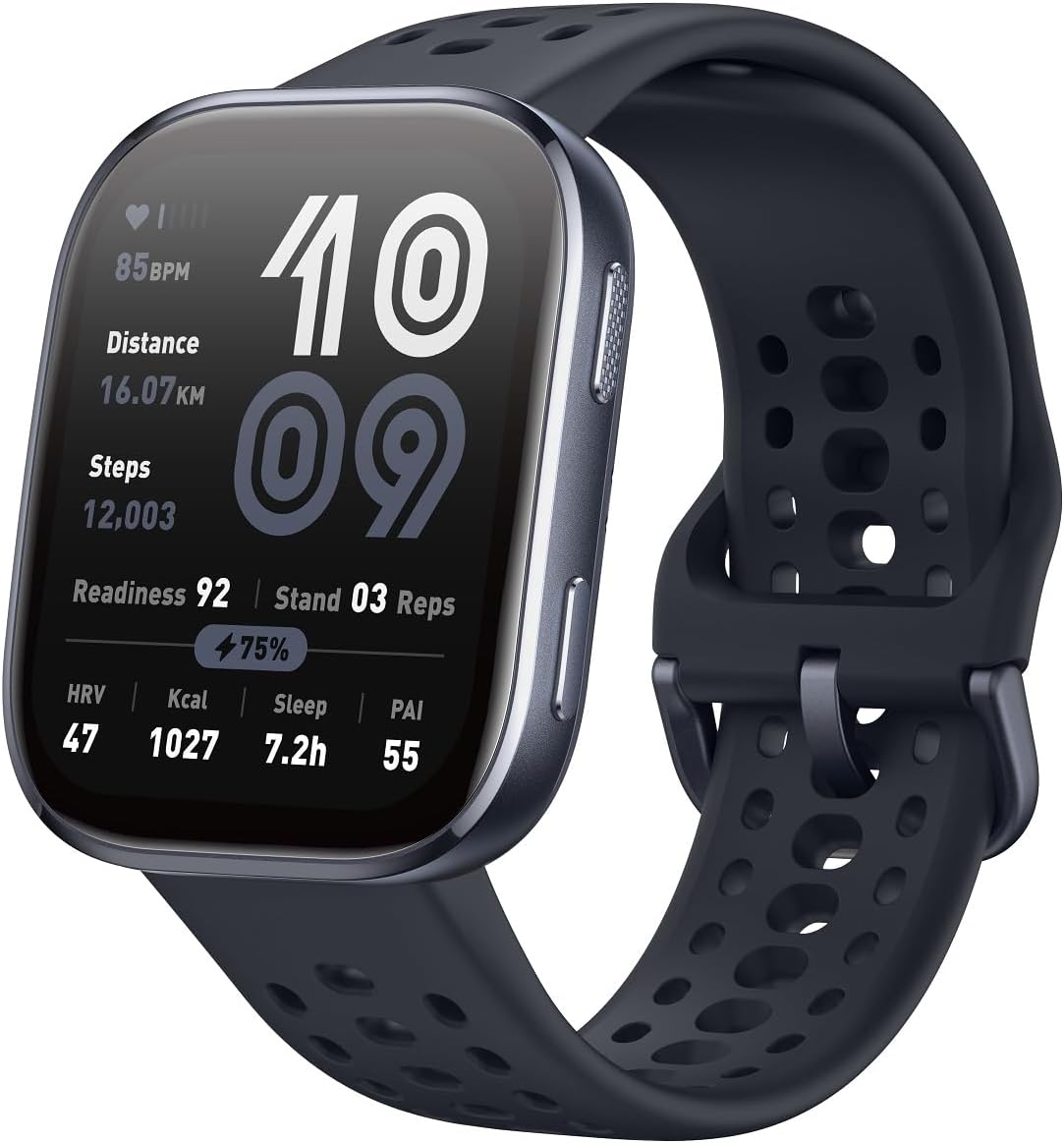
The Amazfit Bip 6 has a 4.2 rating and combines a large, vivid AMOLED display with a claimed 14-day battery life. That endurance makes it a practical choice for warm-weather travelers who want a bright screen without charging the watch every night.
We may earn a commission when you buy through this link, at no additional cost to you.
Free downloadable maps, turn-by-turn directions, and support for five satellite systems improve its outdoor usefulness. The lightweight aluminum construction is another meaningful advantage during hot activities because a watch that feels light is easier to wear consistently. More than 140 workout modes, including HYROX Race and strength training, cover both structured exercise and everyday movement.
Continuous heart-rate, sleep, blood-oxygen, and stress monitoring add wellness value, though the listed data is intended for general fitness use rather than diagnosis. The 50-meter water rating is also more practical for swimming and wet conditions than IP68 fitness watches that expressly prohibit hot tubs, saunas, or immersion. No numerical heat limit is provided, however, so this remains a general outdoor watch rather than a certified extreme-heat device.
The Bip 6 is most attractive for runners, hikers, and commuters who prioritize battery life, readability, and navigation in a relatively light package. It also suits users of both iOS and Android who do not want a platform-locked ecosystem. Buyers working in genuinely harsh heat should choose it only after confirming acceptable operating conditions and using a breathable strap.
A claimed two weeks of typical use is a major advantage when sweat, heat, or travel makes charging inconvenient. Workout frequency and display use will influence the real-world result.
Downloadable maps and multi-system GPS support are useful on trails and in unfamiliar cities. Turn-by-turn directions improve general outdoor usability, though the watch lacks the rugged case and emergency communications of an expedition device.
We may earn a commission when you buy through this link, at no additional cost to you.
This second Blackview military smartwatch earns a 5.0 rating and offers an interesting combination of long battery life, field-oriented hardware, and conventional smartwatch functions. The 960mAh battery is claimed to exceed 100 days on standby and 30 days of daily use, making it attractive for remote work and travel.
We may earn a commission when you buy through this link, at no additional cost to you.
Its high-brightness LED flashlight, compass, scratch-resistant case, and zinc alloy housing are particularly useful away from civilization. The 1.45-inch TFT display is smaller than the other Blackview model in the roundup, but tempered glass and PET film offer some protection. Custom watch faces, Bluetooth calls, message notifications, and a two-strap package improve versatility.
The watch includes 120-plus sports modes and connects to a phone’s GPS for route recording through the Da Fit app. Its IP68 rating is for everyday dust and water exposure, not saunas, hot tubs, swimming, or diving. Health readings cover heart rate, blood oxygen, stress, and sleep, but the manufacturer explicitly says the results are reference data and not suitable for medical diagnosis.
Choose this model if a flashlight, compass, and long standby time matter more than a large display or independent navigation. It is a practical backup watch for camping, emergency kits, and physical jobs. It is less appropriate for swimmers, remote navigators who cannot carry a phone, or users who need a bright screen and explicit heat-tolerance figures.
The single-button LED flashlight is quick to access during night hikes, campsite tasks, or outages. It reduces the need to carry a separate light for basic illumination.
The battery specification supports the idea of keeping the watch ready for extended periods without frequent charging. Actual performance depends on calls, notifications, workouts, and sensor use.
We may earn a commission when you buy through this link, at no additional cost to you.
The Garmin fēnix 9 Pro has a 4.1 rating and is the premium expedition option in this guide. Its 51mm titanium case, sapphire lens, 1.5-inch AMOLED display, and built-in flashlight make it visually and physically distinct from lighter fitness watches designed for routine workouts.
We may earn a commission when you buy through this link, at no additional cost to you.
LTE connectivity allows messages, calls, and LiveTrack location sharing without carrying a phone, while inReach adds satellite messaging and interactive SOS when paired with an active plan and available coverage. Those features can be important in hot deserts, mountains, and remote work zones where cellular service is absent. The watch also includes more than 100 activity profiles, advanced stamina metrics, rowing enhancements, and rucking tools.
The large titanium case may become hot to the touch in direct sunlight, and the supplied specifications do not publish a numerical heat-resistance limit. Users must not confuse rugged construction with permission to ignore thermal guidance. Satellite features also carry subscription requirements and coverage limitations, while regulatory restrictions may apply in some jurisdictions.
This is the premium recommendation for expedition travelers, serious outdoor athletes, and field professionals who value independent navigation and emergency options above compactness. Its 51mm dimensions are substantial, so smaller hands or those wearing wristbands all day may prefer a smaller model. Even so, it remains the most capable remote-adventure watch in this group.
LTE and optional satellite connectivity extend communication beyond ordinary phone coverage. SOS and location services can improve emergency planning, but they depend on subscriptions, coverage, and local regulations.
Titanium, a sapphire lens, and a rugged multisport platform suit demanding routes. The substantial 51mm case and flashlight improve utility but add weight and bulk compared with slimmer watches.
We may earn a commission when you buy through this link, at no additional cost to you.
The Garmin Forerunner 165 has a 4.6 rating and is a refined choice for runners who want intelligent training guidance in a lightweight watch. The AMOLED touchscreen combines clear visuals with traditional buttons, allowing users to operate the device without fumbling for touch controls during intense sessions.
We may earn a commission when you buy through this link, at no additional cost to you.
Built-in GPS tracks pace and distance, while wrist-based heart rate, morning reports, HRV status, recovery estimates, and adaptive workout suggestions provide a detailed training picture. Garmin Coach and race-adaptive plans add structured preparation, and more than 25 activity profiles cover running, cycling, HIIT, and strength training.
In hot conditions, this watch provides sensible everyday battery endurance of up to 11 days in smartwatch mode. During GPS activity, the claimed 19-hour runtime covers long runs and rides, though continuous use may still be affected by heat, signal quality, and feature settings. The product does not state a maximum operating temperature, and its construction is less expedition-oriented than the fēnix or Instinct line.
The Forerunner 165 is ideal for runners and triathletes prioritizing coaching, recovery, and low distraction. Incident detection and Assistance can provide added safety when paired with a compatible phone and network coverage. It is less appropriate for users needing a rugged case, flashlight, independent satellite communication, or documented severe-heat tolerance.
Personalized workouts, recovery time, training effect, and morning reports help athletes adjust intensity. The information is most useful when combined with experience rather than treated as a medical prescription.
The AMOLED screen improves visibility in bright environments, while physical buttons remain reliable when sweat or movement makes touch interaction awkward. That combination suits fast-paced running and cycling.
We may earn a commission when you buy through this link, at no additional cost to you.
The Garmin Instinct 3 AMOLED has a 4.6 rating and offers a strong balance of toughness, navigation, and everyday wearability. Its 45mm fiber-reinforced polymer case and metal-reinforced bezel create a rugged platform without moving into the oversized 51mm territory of the fēnix 9 Pro.
We may earn a commission when you buy through this link, at no additional cost to you.
The 1.2-inch AMOLED display is vivid and easy to read, while the built-in flashlight offers variable intensity and strobe modes for nighttime visibility. A three-axis compass, barometric altimeter, and multi-band GPS with SatIQ provide dependable navigation across remote trails. The claimed 18-day battery is particularly attractive for extended field use.
Health features include wrist-based heart rate, advanced sleep monitoring, and Pulse Ox, with the caveat that Pulse Ox is not available in every country. As with the other Garmin models, the listed health data is intended as an estimate rather than a medical diagnosis. No numerical heat-resistance rating is provided, so users should keep the watch within its documented operating limits and avoid unnecessary direct solar exposure.
The Instinct 3 is a strong all-around choice for hikers, outdoor workers, and users who want Garmin navigation in a comparatively compact rugged design. It lacks the fēnix 9 Pro’s satellite communications, but it compensates with strong battery life and broad utility. It is also less specialized than the explicit heat-rated military watch, so extremely harsh work remains its main uncertainty.
Multi-band GPS with SatIQ, a compass, and an altimeter support confident movement through unfamiliar terrain. The system is designed to balance positioning performance with battery efficiency.
The reinforced polymer case and metal bezel provide outdoor toughness at a more wearable size than the fēnix 9 Pro. Its flashlight adds useful capability without relying entirely on a phone.
We may earn a commission when you buy through this link, at no additional cost to you.
Choosing a smartwatch for extreme heat requires balancing documented thermal limits with display readability, battery endurance, sensor reliability, navigation, comfort, and protection from dust and moisture. A watch that works well at the gym may not be appropriate for a desert worksite or prolonged remote expedition.
A numerical operating-temperature specification is more useful than broad words such as military-grade or extreme-environment-ready. The Built-in GPS Military Smartwatch leads this list by publishing heat resistance up to 187.96°F, while the WalkerFit states that its hardware was tested for severe heat. These claims are not directly interchangeable because one gives a specific limit and the other describes testing without a threshold.
Prioritize a documented operating range, then compare it with the actual temperature of the wrist, vehicle dashboard, machinery, or direct sunlight. Consider whether the watch will remain connected to the body, where heat accumulates, or sit on a hot surface. Follow manufacturer limits and avoid treating ruggedness as permission for unrestricted exposure.
A bright AMOLED screen offers vivid colors and strong outdoor visibility, while TFT displays may be adequate but less impressive. Screen size matters because users may be wearing gloves, sweating, moving quickly, or dealing with dust. Larger displays show more information but consume more power and may feel heavy on the wrist.
Choose a screen with high contrast, large information, and simple menus that remain readable at a glance. Always-on capability is useful for checking time and navigation prompts, though it can reduce battery life. Test the controls and font size in real daylight before committing to a model used for critical navigation.
Long claimed battery life can matter more than short-term feature depth in remote locations. The Blackview models claim more than 30 days of daily use, WalkerFit claims 15 days, Amazfit claims 14 days, and Garmin models range from 11 to 18 days depending on configuration. These figures come from different usage assumptions and should not be compared as perfectly equivalent.
Prioritize endurance when charging is uncertain. Check how battery life changes with continuous GPS, Bluetooth calls, always-on display, notifications, and workout tracking. For multi-day trips, carrying a compact backup cable remains prudent even with a long-lasting watch.
Built-in GPS avoids the need to keep a phone exposed to heat, and offline maps or turn-by-turn guidance can be more useful than basic breadcrumbs. The Built-in GPS Military Smartwatch, Amazfit Bip 6, Garmin Forerunner 165, Garmin Instinct 3, and Garmin fēnix 9 Pro all provide dedicated navigation capabilities.
Determine whether your route requires phone-connected GPS, full onboard maps, or satellite communication. Remote expedition users may value inReach or LTE functions, but those services require subscriptions and are subject to coverage. Others will find multi-band positioning, a compass, and an altimeter sufficient.
Water-resistance standards help separate watches that tolerate rain and sweat from models suitable for swimming. The WalkerFit offers 5ATM, the Amazfit Bip 6 has 50-meter water resistance, and the Garmin fēnix 9 Pro provides 5ATM plus the option to use its flashlight underwater. By contrast, both Blackview military watches explicitly warn against saunas, hot tubs, swimming, and diving.
Choose a rating appropriate to the environment, not merely one that sounds high. A sauna combines heat and moisture and can violate a watch’s warranty even when the watch is waterproof. Confirm the manufacturer’s prohibited activities and rinse or clean the watch according to its care instructions after dusty or sweaty use.
Extreme heat often accompanies rough work, falls, vibration, dust, and crowded equipment. Reinforced polymer, titanium, aluminum alloy, composite bezels, and scratch-resistant glass can improve durability. The fēnix 9 Pro emphasizes titanium and sapphire, the Instinct 3 uses a reinforced polymer case and metal bezel, and the military-style models use alloys and military-oriented testing claims.
Balance strength against weight and bulk. A larger titanium expedition watch may feel uncomfortable during a long hot shift, while a slimmer lifestyle watch may not tolerate impacts. Choose a case size that remains secure and comfortable, and inspect the band for heat retention, moisture drainage, and secure fit.
Continuous heart rate, blood-oxygen monitoring, stress tracking, sleep analysis, HRV status, and recovery estimates can help users adjust work or training intensity. Garmin’s Body Battery and recovery tools offer deeper interpretation, while the Galaxy Watch9 focuses on sleep patterns and a single Heart Health Score. Basic rugged watches provide useful trends but usually less context.
Treat all consumer readings as fitness estimates rather than medical measurements. Look for stable tracking, understandable recommendations, and features that match your routine. In extreme heat, dehydration, exertion, and heat stress can affect how the body and sensors behave, so no watch should be used to diagnose or monitor a medical condition.
A watch used in hot conditions should be comfortable enough to wear consistently. The Galaxy Watch9’s breathable band, Amazfit’s lightweight aluminum build, and the Garmin Forerunner’s 43mm case prioritize everyday wear, while the 51mm fēnix provides more expedition capability at the cost of bulk. Screen glare, raised buttons, and band material can all influence usability.
Also evaluate Bluetooth calling, notification support, music control, app compatibility, and the availability of emergency tools such as a flashlight. Choose the features you will actually use rather than paying attention to a long mode list. Confirm smartphone compatibility and whether basic navigation works without the phone.
Before a hot-weather outing, fully charge the watch, install the latest available firmware and companion-app updates, and confirm that its location permissions and fitness profiles are configured. Create an emergency contact plan, download any required maps offline, and test navigation in a safe area. Review the manufacturer’s stated temperature range, water restrictions, and care guidance before relying on the watch in severe conditions.
Wear the watch where it remains stable and can communicate effectively with the skin, but choose a breathable band that does not trap excessive moisture. Direct sunlight can raise the case temperature far above the surrounding air, so move the watch away from dashboards, machinery, and hot equipment when possible. Pause nonessential sensors and notifications if battery life matters more than continuous tracking.
After use, cool the watch gradually and rinse off sweat, sand, and salt when its water-resistance guidance permits. Dry the case and band fully, clean the sensors with a soft lint-free cloth, and avoid harsh chemicals. Keep the charging contacts clean and store the watch in a dry, moderate-temperature location. A periodic battery check and sensor inspection helps identify wear before an important trip.
The Built-in GPS Military Smartwatch lists heat resistance up to 187.96°F, making it the model with the clearest numerical temperature specification in this roundup. The WalkerFit also states that its hardware was tested for severe heat, but it does not provide the same kind of exact threshold. Buyers should verify the published limits and warranty conditions before operating either watch in hazardous temperatures.
No. Water resistance and heat resistance are separate properties, and the combination of heat and moisture can damage seals, adhesives, sensors, and displays. Both Blackview military watches explicitly state that they are not suitable for saunas, hot tubs, swimming, or diving. Even watches rated for swimming should be checked for manufacturer guidance regarding steam, heated pools, and extended immersion.
Built-in GPS is useful when heat makes carrying or operating a phone difficult, or when the route passes beyond cellular coverage. It also reduces the risk of phone overheating while navigating. A phone-connected watch can still be adequate for casual walks, but remote work, hiking, and desert travel benefit from independent positioning, a compass, and offline map support.
The Garmin Forerunner 165, Samsung Galaxy Watch9, and Amazfit Bip 6 are among the lighter and less bulky options in the guide. The Galaxy Watch9 also uses a breathable sports band, while the Forerunner combines a 43mm case with physical controls. Personal comfort varies with wrist size and activity, so wrist fit and band ventilation are as important as the listed dimensions.
Consumer smartwatches track metrics such as heart rate, blood oxygen, stress, sleep, and recovery, but they are not designed to diagnose heat exhaustion or heat stroke. Sudden or concerning readings should not be used to make safety decisions. Anyone showing symptoms of a heat emergency should stop activity, move to a cooler location, and seek appropriate medical assistance.
A week or more away from power favors a watch with a long claimed daily-use runtime and low-friction charging. The Blackview military models, WalkerFit, Amazfit Bip 6, and Garmin Instinct 3 are positioned around long endurance, though their test conditions differ. Carry a backup cable if the trip includes continuous GPS, calls, or intensive workout tracking.
Military-style models often provide more explicit heat claims, larger displays, flashlights, compasses, and long battery specifications. Garmin watches tend to offer deeper training analysis, refined navigation, and a more established sports ecosystem. The right choice depends on whether documented thermal tolerance, training metrics, satellite communication, or low-light illumination matters most.
Avoid leaving the watch on a hot dashboard, exposed metal surface, or direct sunlight longer than necessary. Removing a tight wristband during breaks, limiting continuous sensor use, and keeping the device shaded can reduce heat absorption. If the watch becomes unusually hot, stop using it, move it to a cooler environment, and consult the manufacturer if the condition persists.
The Built-in GPS Military Smartwatch is the leading choice because it combines the clearest published heat-resistance figure with standalone GPS, a compass, an altimeter, a barometer, a large sunlight-readable display, and long claimed battery life. The Blackview Military Smartwatch is a compelling budget-oriented alternative with excellent endurance, while the Garmin fēnix 9 Pro serves premium expedition users who value satellite communication and rugged titanium construction.
For buyers who do not need documented high-temperature tolerance, the WalkerFit, Amazfit Bip 6, Samsung Galaxy Watch9, Garmin vívoactive 5, Garmin Forerunner 165, and Garmin Instinct 3 provide a choice of lighter designs, health tools, navigation, and activity features. Prioritize the environment first, then match the case, battery, display, and sensors to the way the watch will actually be used.
Before purchasing, verify the current operating-temperature guidance, water restrictions, band fit, phone compatibility, offline navigation features, and battery conditions. Retail listings and manufacturer documentation can change, and extreme environments carry risks that no consumer smartwatch can eliminate. Use the device as a supplemental tool, carry appropriate backup equipment, and follow all manufacturer safety instructions.