
DARKBOOM Cordless Submersible Pump
4.6Editor score
Battery-powered cordless operation
13.2 GPM maximum flow
Two batteries and charger included
Discover the best DC powered sump pump options, comparing battery backups, cordless transfer pumps, utility models, flow rates, installation needs, and
DC powered sump pumps provide a practical way to move water without relying exclusively on household electricity. The best model depends on whether you need emergency backup, portable transfer capability, automatic basement protection, or a compact utility pump for draining pools, patios, and other areas.
This guide compares ten pumps using the supplied specifications, including power source, rated flow, maximum head, discharge options, safeguards, and intended applications. It covers complete battery-backup systems, cordless pumps, AC utility pumps that clarify the broader sump-pump market, and a water-powered emergency alternative.
Each review identifies the strongest feature and the important limitations, helping you match the pump to your drainage situation. Product details, availability, and pricing can change, so verify the current listing and installation requirements before making a final purchase.
4.6Editor score

4.1Editor score
3.9Editor score
The comparison below highlights the power source, rated capacity, head capability, and major practical distinction of each pump, from cordless transfer models to professionally installed backup systems and a water-powered emergency option.



This 12V DC submersible utility pump holds a 4.3 rating and combines a 1,500 GPH maximum flow with portability for jobs away from wall outlets. It is designed for basements, yards, pools, flat roofs, window wells, camping vehicles, boats, ponds, and other locations where battery power is more useful than a permanent AC connection.
We may earn a commission when you buy through this link, at no additional cost to you.
Its rated 13.5 amp motor, 6,000 RPM speed, and maximum lift of 25 feet make it more versatile than a basic low-output transfer pump. The removable 1-1/4-inch NPT discharge and included 3/4-inch garden-hose adapter make connection straightforward, while a 20-foot cord with an inline switch and alligator clips provides practical reach.
The main trade-offs are that it requires a suitable 12V battery, which is not included, and the manufacturer explicitly prohibits dry operation. It also handles solids only up to 1/8 inch, so it should not be treated as a heavy-debris pump. These limitations make supervision more important than for a pump with automatic shutoff.
Choose this model when you need an inexpensive, mobile DC pump for a range of moderate transfer jobs. It suits owners who already have a compatible battery or vehicle electrical system and want a pump that can move both clean and lightly contaminated water without requiring a dedicated outlet.
The alligator-clip connection makes the pump easy to deploy from a vehicle, battery box, or other 12V DC source. The 20-foot lead adds useful placement flexibility while keeping the motor and controls away from the water being moved.
The stated ability to handle clean or dirty water broadens its use beyond clear transfer jobs, although the 1/8-inch solid-handling limit means debris larger than that should be removed before pumping.
We may earn a commission when you buy through this link, at no additional cost to you.
The DARKBOOM cordless submersible pump earns a 4.6 rating and stands out as the most complete budget-oriented battery option in this group. It includes two compatible batteries, a charger, hose adapters, and a hose clamp, removing much of the guesswork and accessory shopping associated with cordless transfer pumps.
We may earn a commission when you buy through this link, at no additional cost to you.
Its output reaches 13.2 GPM, or 50 liters per minute, with a maximum lift of 26.2 feet. Compatible 18V and 21V batteries offer flexibility, while the anti-clog bottom plate is designed to reduce debris blockage at the intake. The included adapters cover common 1/2-inch, 3/4-inch, and 1-inch hose connections.
This model is intended for clean-water applications such as pools, ponds, tubs, tanks, and garden irrigation. A hose is not included, and a battery pump does not make this an automatic basement sump system: it lacks a float switch, discharge check valve, and permanent installation components. It is best viewed as a portable transfer pump rather than a primary sump pump.
For homeowners who want useful battery performance and included power accessories without installing a permanent system, this is a strong budget selection. It is especially suitable for draining a pool, moving water from a tank, or watering where extension cords are inconvenient.
Two batteries and a charger are supplied, allowing one pack to power the pump while the other is available for later use. Battery indicators are not specified, so runtime should be confirmed with the seller for the exact workload.
The pump is best suited to pools, ponds, tubs, tanks, and irrigation. For dirty basement water containing larger debris, choose a model explicitly rated for that material and equipped with appropriate safeguards.
We may earn a commission when you buy through this link, at no additional cost to you.
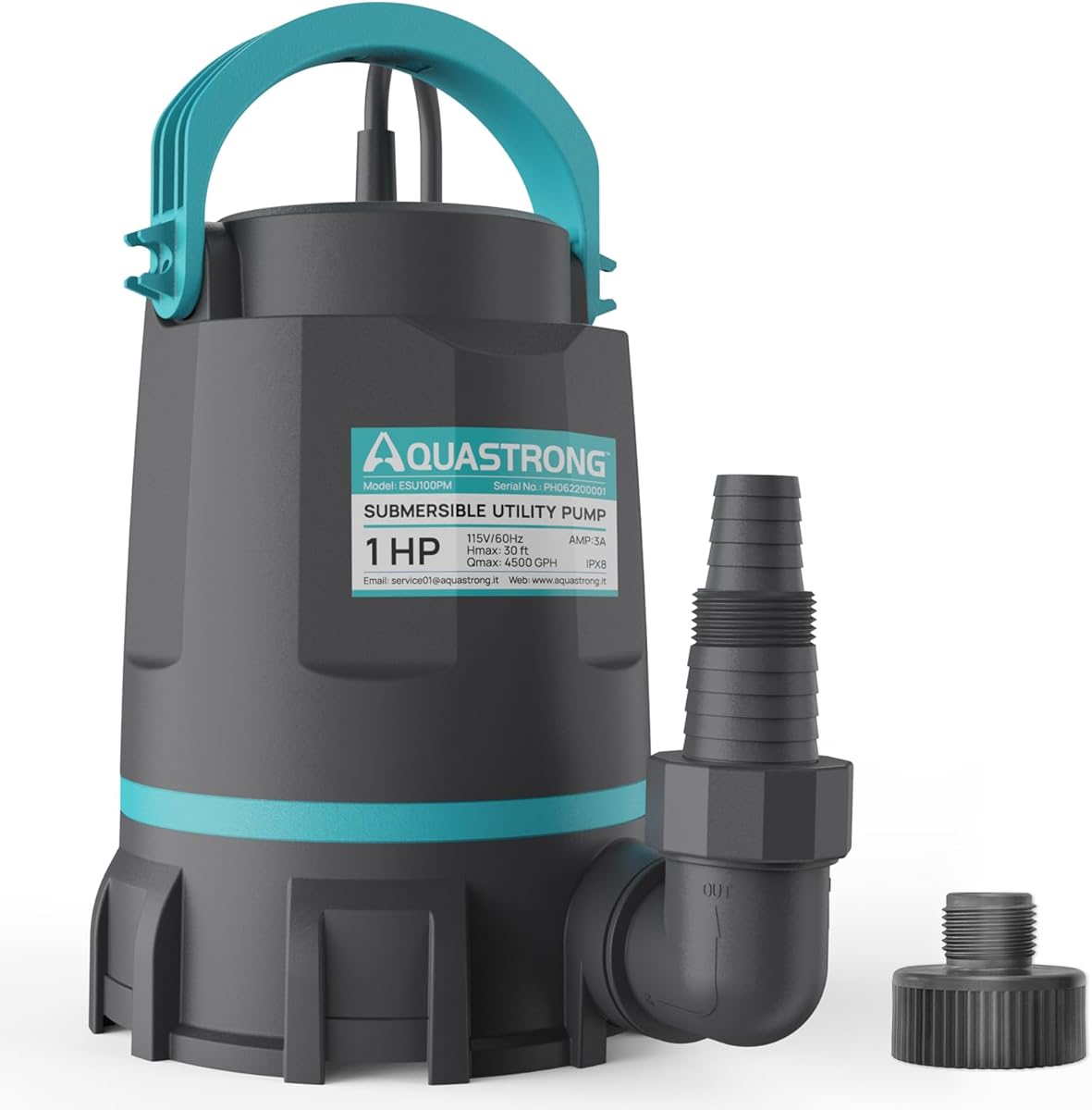
This AQUASTRONG 1 HP pump receives a 4.4 rating and is built around substantial utility-pump output. It can move up to 4,500 gallons per hour at a five-foot lift and is advertised to pump water vertically as high as 30 feet, making it suitable for demanding drainage tasks.
We may earn a commission when you buy through this link, at no additional cost to you.
The bottom-suction configuration filters debris and can reduce water to within 1/5 inch of the surface. It handles solids up to 1/5 inch, and the discharge includes a 1-1/4-inch NPT connection plus adapters for several common hose sizes. A 10-foot UL-listed cord provides reasonable reach around wet areas.
This is an AC pump rather than a DC model, so it does not fulfill an outage-resilient role. Operation is also manual: plugging in starts the pump, while unplugging stops it. Thermal overload protection helps prevent motor damage during dry running, but the pump should not be used as a fully automatic sump installation.
It is a sensible option for major water-removal work where a wall outlet is available, such as draining hot tubs, pools, window wells, or temporary floodwater. Buyers focused specifically on DC backup should instead consider the Zoeller or Westinghouse systems, but this model offers strong raw flow for mobile AC-powered use.
A rated maximum flow of 4,500 GPH and 1 HP motor provide more capacity than the compact battery pumps here. Actual output falls as lift and hose friction increase, so the 4,500 GPH figure should not be treated as a constant rate at every discharge height.
The supplied elbow and snap-coupling adapters make it easier to connect common discharge arrangements. Confirm the pit layout, hose diameter, and required vertical lift before selecting a coupling.
We may earn a commission when you buy through this link, at no additional cost to you.
The Zoeller Aquanot Fit 508 has a 4.1 rating and is the most sophisticated DC-focused option in the list because it combines a 12V backup pump with an automatic controller and built-in Wi-Fi. It can deliver 35 GPM at a ten-foot lift and provide up to six hours of continuous high-performance operation when primary power is interrupted.
We may earn a commission when you buy through this link, at no additional cost to you.
The Fit controller handles automatic charging and pump protection. Features include a low-battery indicator and alarm, a redundant high-water switch, self-testing, early-warning diagnostics, Z Control notifications, and remote access through the associated cloud service and app. These functions make the system more informative than a basic battery transfer pump.
The package includes an integrated DC pump discharge check valve, an additional AC pump check valve, a tee, and an adapter. A 12V battery and primary sump pump are not included, so this is not a complete drop-in basement system. Installation also requires compatible plumbing, a suitable basin, and correct electrical connections.
This is the top pick for buyers who want connected monitoring and a capable DC backup without choosing the largest complete system. It is less attractive for simple pool draining or portable jobs, but for a technology-conscious homeowner with an existing primary sump setup, its diagnostics and remote alerts are particularly valuable.
Built-in Wi-Fi supports self-testing, diagnostics, and notifications through Z Control. A homeowner can receive high-water, low-battery, or fault information rather than learning about a problem only after water has accumulated.
The included check valves, tee, and adapter support integration with an existing AC pump. A separate 12V battery, adequate discharge capacity, and professional-quality installation remain necessary for dependable basement protection.
We may earn a commission when you buy through this link, at no additional cost to you.
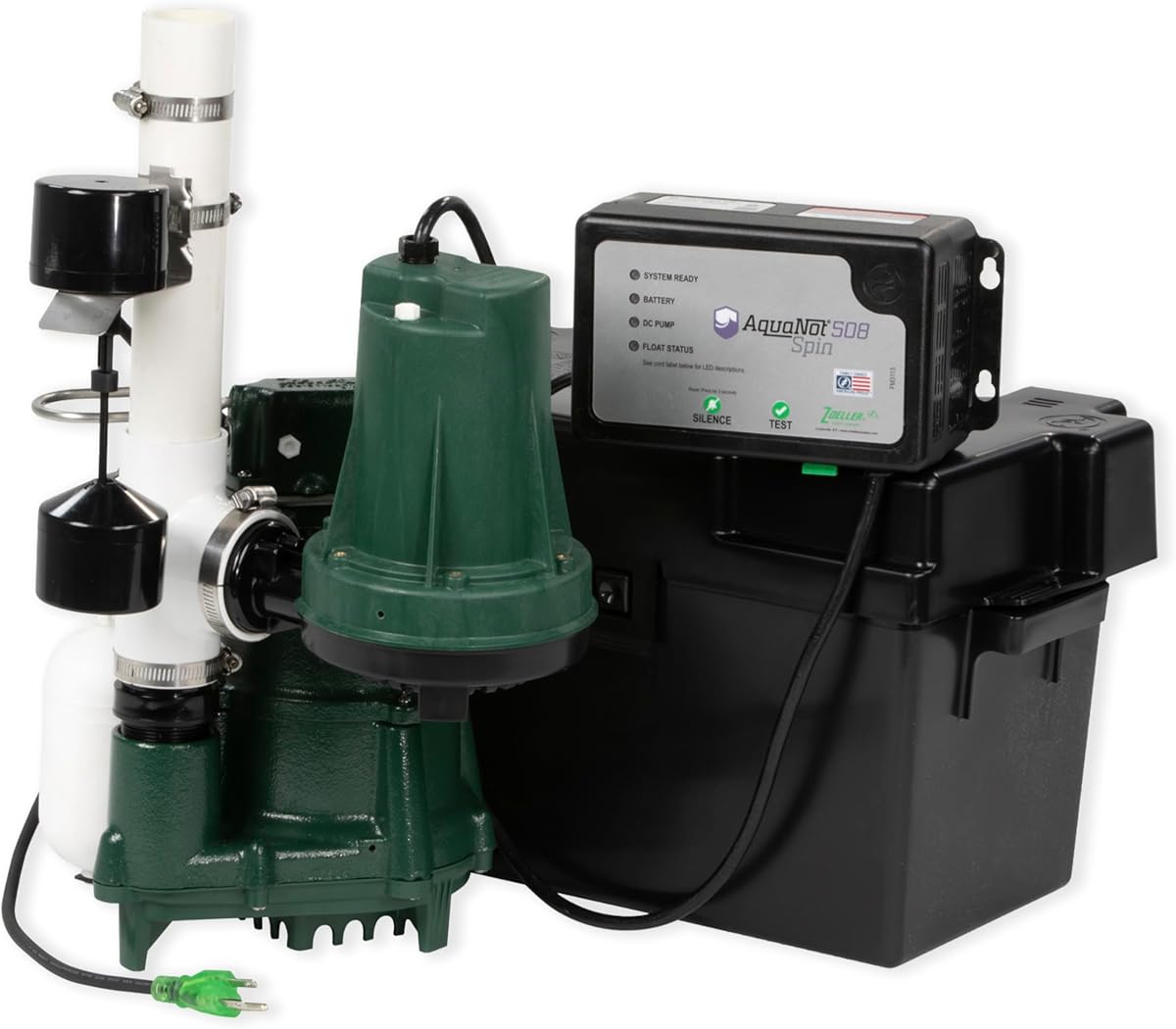
The Zoeller AquaNot Spin 508 ProPak is the premium complete system in this guide, with a 3.9 rating. It combines a 1/2 HP Model M98 primary pump, the AquaNot Spin 508 controller and 12V DC backup pump, check valve, float switches, and PVC discharge piping in one coordinated package.
We may earn a commission when you buy through this link, at no additional cost to you.
The DC backup is advertised to run for up to six continuous hours, or more than 48 hours at a 10 percent duty cycle, on a fully charged battery. The controller continually checks the installation and provides alerts for power outages, high water, obstructed switches, and pump faults. This focus on diagnostics distinguishes it from a simple standalone pump.
Its construction includes a double-sealed 12V DC pump, corrosion-resistant components, and a glass-filled thermoplastic vortex impeller. The ProPak is pre-plumbed with 1-1/2-inch Schedule 40 PVC and arrives factory tested, reducing assembly work compared with assembling a backup pump, controller, and discharge components separately.
It is best for a homeowner or installer seeking a comprehensive, integrated basement protection package rather than a portable transfer device. Be sure to confirm battery inclusion, basin compatibility, local code requirements, and the space needed for the controller, primary pump, float switches, and discharge piping before ordering.
The primary pump, DC backup, controller, float switches, check valve, and PVC piping reduce the number of separate components that must be selected. This coordinated approach is convenient for planned installations.
The advertised six-hour continuous runtime and 48-plus-hour low-duty-cycle operation provide meaningful protection during extended outages. Actual runtime depends on battery condition, capacity, water volume, and discharge lift.
We may earn a commission when you buy through this link, at no additional cost to you.
This cordless 1 HP utility pump carries a 4.4 rating and combines a 2,113 GPH maximum flow with a stated 49-foot maximum head. The two included 4.0Ah batteries can be alternated, making it well suited to draining pools and spas, moving rainwater from barrels, or handling storm cleanup where extension cords are inconvenient.
We may earn a commission when you buy through this link, at no additional cost to you.
Its brushless motor is designed to run more quietly and coolly than a conventional brushed motor. Triple protection includes automatic shutoff, overheat protection, and overload protection. The pump also stops when the water level falls below 0.4 inches, reducing the risk of accidental dry running during shallow transfers.
This is a clean-water transfer pump, not a debris-handling sump system. The instructions specifically warn against sewage, mud, or debris-laden water. Its 23-foot power cord connects the battery assembly to the pump, which adds reach but is not as streamlined as a fully integrated cordless unit.
The model is well suited to users who want more head capacity and battery features than a basic 12V pump without installing a permanent sump system. It is especially useful for controlled jobs where the water is clear and automatic low-water shutoff adds convenience.
Automatic shutoff below 0.4 inches of water protects the motor when a transfer job reaches its end. This is particularly useful for unattended pool or barrel-draining tasks, provided the pump remains within its stated clean-water limits.
Two 4.0Ah packs with charge indicators allow users to keep working while one battery is in use. Their availability adds convenience, although real operating time will vary with lift, flow, and battery condition.
We may earn a commission when you buy through this link, at no additional cost to you.
The WAYNE CDU980E earns a 4.6 rating and is the highest-output automatic pump in the comparison, with a stated maximum flow of 5,490 gallons per hour. It uses a 3/4 HP motor and is designed for permanent basement drainage, combining a vertical float switch with heavy-duty cast iron and stainless steel construction.
We may earn a commission when you buy through this link, at no additional cost to you.
Its top-suction design is intended to reduce clogging and helps eliminate the need for a weep hole during suitable installation. The integrated vertical float provides automatic operation while allowing the unit to fit into relatively narrow sump pits. The stated five-year warranty also adds reassurance for a permanent installation.
This is an AC pump, not a DC-powered model, and it does not protect against an outage by itself. It should be paired with a separately selected battery backup if uninterrupted drainage is the goal. Installation must also account for basin dimensions, discharge piping, electrical safety, and local requirements.
The CDU980E is best for someone who wants a rugged primary sump pump with automatic operation and high capacity. It is a strong complement to a DC backup system, but it should not be mistaken for an all-in-one outage-resistant package.
The cast iron and stainless steel construction is a notable step up from all-plastic utility pumps. A robust vertical float switch and five-year warranty make this model relevant to owners planning a long-term primary installation.
A 5,490 GPH maximum flow provides high capacity for removing accumulated basement water. Real performance depends on lift, discharge piping, and hose restrictions, so the figure should be evaluated as a maximum laboratory-style rating.
We may earn a commission when you buy through this link, at no additional cost to you.
The Westinghouse WH50BBU has a 4.6 rating and combines a 1/2 HP AC primary with an automatic 12V DC backup pump. The system is designed for uninterrupted basement drainage, with the backup activating when household power is lost and the primary handling normal everyday water removal.
We may earn a commission when you buy through this link, at no additional cost to you.
Both pumps use corrosion-resistant stainless steel housings, and the primary motor includes thermal overload protection, lubricated ball bearings, and a sealed shaft. The top-suction intake is intended to limit airlock and debris buildup, while dielectric oil around the motor supports cooling and pump life.
Although the backup is described as capable of 5,200 GPH, the rating may not describe both pumps under every condition. The supplied information also does not list a battery, so buyers must budget separately for a compatible 12V battery and confirm that it is maintained properly. Installation should account for the dimensions of both pumps and the float arrangement.
This system is a strong option for residential basements and light commercial applications where a compact dual-pump design is desired. It is a better fit for fixed basement protection than the portable cordless pumps, although it does not offer the connected diagnostics of the Zoeller Aquanot Fit.
The DC backup is designed to activate when the AC primary loses power. This makes the system more appropriate for flood prevention than a standard AC sump pump, provided the battery, discharge line, and float switch are correctly installed.
A compact dual-pump configuration and integrated vertical float can be advantageous in restricted sump pits. Measure the basin and available discharge space before installation to avoid conflicts with piping, floats, and the battery.
We may earn a commission when you buy through this link, at no additional cost to you.
The FOTING 1 HP sump pump receives a 4.3 rating and offers a strong combination of clean-water and dirty-water utility capability. Its maximum flow is 4,600 GPH at a five-foot lift, with vertical lifting stated up to 31 feet, making it suitable for pools, ponds, hot tubs, window wells, and temporary basement flooding.
We may earn a commission when you buy through this link, at no additional cost to you.
The bottom suction filters debris and can reduce the remaining water level to 1/5 inch. The pump handles solids up to 1/5 inch, while a removable bottom simplifies cleaning and maintenance. A 10-foot power cord, rounded handle, thermoplastic housing, and adapters for common discharge and hose arrangements improve usability.
The crucial limitation is that it operates manually and does not support automatic start and stop. It is therefore not a complete sump-pump system for an unattended basement pit. A float switch and proper discharge check valve would be needed for that role, and those accessories are not identified as included in the supplied specifications.
Choose it for demanding manual transfer work where high flow, dirty-water tolerance, and easy intake cleaning matter more than automatic operation. Users should submerge the pump at an angle before starting to release trapped air, as recommended by the manufacturer.
The stated 1/5-inch solid handling makes this model more appropriate for moderately dirty water than a fine-filter clean-water pump. Large stones, roots, sludge, and dense debris remain outside its intended use.
The removable bottom allows trapped debris to be cleaned away rather than remaining inside the pump. Regular inspection is particularly important after draining yard, hot tub, or pond water.
We may earn a commission when you buy through this link, at no additional cost to you.
The SumpJet Water Powered Backup Emergency Sump Pump has a 4.6 rating and offers a distinctive alternative to conventional DC systems. Instead of relying on a battery, it uses pressurized water as its power source, allowing emergency pumping when electricity is unavailable.
We may earn a commission when you buy through this link, at no additional cost to you.
The pump accepts inlet pressure from 20 to 100 psi and operates fully automatically. Its compact, fully assembled construction may simplify certain retrofit applications. Because the energy source is the incoming water supply, it needs an appropriate pressurized supply and installation arrangement rather than a conventional electrical connection.
The supplied specifications do not provide a gallon-per-minute figure, maximum lift, discharge size, or detailed compatibility requirements. Those omissions make it difficult to compare performance directly with the battery and AC pumps in this guide. It should be treated as a specialized emergency backup rather than a general-purpose sump or utility pump.
SumpJet is worth considering for a homeowner seeking protection that remains operational during electrical outages and who can provide the required water pressure. Consult the current instructions and a qualified installer to confirm pipe sizing, connection method, and whether it complements the available drainage layout.
Using inlet water pressure removes the battery from the operating equation. That can be valuable during prolonged outages, provided the required pressure and continuous supply are available.
The SumpJet is best positioned as an emergency component rather than the sole pump handling all normal drainage. Confirm flow, lift, and discharge requirements before integrating it with an existing sump basin.
We may earn a commission when you buy through this link, at no additional cost to you.
The right DC powered sump pump depends on whether you need portable transfer, automatic basement protection, connected monitoring, or a complete dual-pump installation. Consider water conditions, available power, discharge layout, and installation demands before comparing output figures.
A portable DC transfer pump is controlled manually and is intended to remove water from pools, tanks, yards, or temporary flood areas. A DC battery-backup sump pump is installed in a basin, connects to a permanent discharge, and responds automatically to rising water or a power failure. A complete dual-pump system adds a primary AC pump and coordinated controller. These categories serve different purposes and should not be treated as interchangeable.
Choose a portable model for occasional transfer, and choose an installed backup system for basement flood protection. A pump advertised with high flow but no float switch cannot provide unattended sump operation by itself.
Flow describes how quickly water can be moved, while head describes the vertical lift the pump can overcome. A quoted 4,000 GPH figure may apply at a relatively low lift and often decreases as water must travel farther upward or through restrictive hoses. Check both values, especially the lift at which the stated output was measured.
Match maximum head to the actual sump depth and discharge height. For remote transfer tasks, look for enough lift to clear the destination and enough hose-adapter support to prevent avoidable flow loss.
Common DC options include a 12V lead-acid battery, rechargeable 18V or 21V battery packs, and a dedicated standby battery connected to a charging controller. Some listings include batteries, while others explicitly omit them. Battery capacity, age, charging method, and parallel-battery compatibility can be as important as the pump's stated power rating.
For an installed backup, verify the required battery type, charging system, runtime expectations, and maintenance plan. For portable use, prioritize a complete package with batteries, a charger, and a clear indicator of remaining charge when available.
Manual pumps start and stop through a switch, while sump installations generally require a float switch or another water-level control. The Zoeller and Westinghouse systems are designed for automatic activation, and the Zoeller ProPak adds controller-based testing and alerts. A redundant high-water switch and self-testing can improve confidence in unattended installations.
Look for automatic operation only when the product is intended to be permanently installed. A portable pump with automatic low-water shutoff is useful for a transfer job, but that feature does not replace a float-controlled sump system.
Clean-water pumps are optimized for pools, tubs, tanks, and irrigation. Dirty-water models can tolerate small solids, but every pump has a limit. The listed 1/8-inch and 1/5-inch solid-handling figures describe meaningful differences: a 1/5-inch model can accept larger debris than a 1/8-inch model, yet neither should be used on stones, dense sludge, roots, or sewage.
Choose the least aggressive pump compatible with the job, and remove large obstructions before startup. For permanent basement systems, consider a corrosion-resistant housing and an accessible intake that can be inspected and cleaned.
Pump output depends on the discharge pipe diameter, length, fittings, and vertical rise. The listed pumps use different standards, including 1-1/4-inch NPT, 1-1/2-inch NPT, and 1-1/2-inch Schedule 40 PVC arrangements. Included adapters make setup easier, but they do not guarantee compatibility with every basin.
Measure pit dimensions, pipe route, and available fitting space before buying. Permanent sump systems need a suitable check valve to reduce reverse flow, while portable pumps require compatible hose adapters and enough hose to reach the discharge point.
Connected monitoring can provide early notice of a power outage, high water, low battery, blocked float, or pump fault. The Aquanot Fit 508 includes built-in Wi-Fi and Z Control connectivity, while the AquaNot Spin 508 ProPak provides controller testing and alerts without the listed Wi-Fi feature. These systems can be especially valuable when the sump pit is remote or cannot be inspected frequently.
Choose smart diagnostics when remote awareness is a priority, but confirm app availability, account requirements, network access, and notification reliability. A monitoring feature is valuable only if the pump, battery, float switch, and discharge plumbing are all correctly installed.
Dry-run protection, thermal overload, corrosion-resistant materials, sealed shafts, and mechanical seals help protect pumps and surrounding areas. The portable models most clearly identify automatic low-water shutoff, while the AQUASTRONG and FOTING pumps use thermal overload protection. A one-year, three-year, five-year, or longer warranty can also indicate the manufacturer's confidence in a product.
Follow every prohibition and operating limit. A pump that prohibits dry running must be switched off before the water level drops too far, and a dirty-water rating should never be interpreted as permission to pump sewage or uncontrolled debris.
Before operating any pump, confirm that the voltage, battery type, flow direction, and discharge connection match the manual. Submerge the pump sufficiently to release trapped air, place the intake away from visible debris, and check that the discharge line is open. For a permanent installation, verify float clearance, check-valve placement, battery connections, and the need for qualified electrical or plumbing work before energizing the system.
For a portable transfer job, begin with a low flow and observe the pump and hose connections. Stop the pump before the water falls below the permitted operating depth, and never defeat automatic shutoff. Clean the intake after each use, especially when moving pond, hot tub, or muddy water. Store a cordless pump with dry terminals and a protected battery, while a 12V lead-acid system should be kept charged and inspected for corrosion or swelling.
Automatic sump systems need periodic attention even when they appear quiet. Test the float or high-water control according to the manufacturer's instructions, clean the basin, confirm the battery remains charged, and inspect the check valve and discharge route for blockage. After a storm or extended outage, check for water, debris, unusual noise, and a tripped controller, and service the pump before returning it to automatic service.
DC powered sump pumps are particularly valuable as backups because they can continue operating during a power outage. AC pumps generally serve as the primary pump and are often more appropriate for continuous high-capacity drainage. The best setup can combine an AC primary with a DC backup, allowing normal efficiency and emergency resilience.
Usually not when automatic basement protection is the goal. Cordless models are primarily portable transfer pumps controlled by a user and may lack a float switch, permanent discharge check valve, and integrated high-water alarm. They are better suited to draining pools, tanks, or temporary water accumulation.
The exact battery specification depends on the pump and controller, so follow the product instructions rather than choosing only by voltage. Battery capacity affects runtime, while age and charging condition affect reliability. For permanently installed systems, use the battery type and charging method specified by the manufacturer.
A pump has less energy available for horizontal and vertical movement as the required lift increases. Friction in hoses and fittings creates additional resistance, so real flow is usually below the maximum rating under a difficult installation. Compare rated flow at the same lift when evaluating alternatives.
Not unless the manufacturer expressly states that the model is designed for that material. The portable pumps here are primarily for clean water or, in two cases, limited small-solid dirty water. Sewage, sludge, roots, stones, and dense sediment can clog the impeller, damage the motor, or shorten service life.
A properly installed sump system normally requires a check valve to prevent water from flowing backward through the standby pump. The Zoeller Aquanot Fit lists a discharge check valve among its included components, while other systems may require separate parts. Follow the complete system instructions and verify pipe compatibility.
The Zoeller systems are advertised for up to six hours of continuous high-performance operation, with the ProPak also described as offering more than 48 hours at a 10 percent duty cycle. Actual runtime varies with battery age, capacity, pump load, water volume, and discharge lift, so these figures should be treated as maximum claims.
No pump should be intentionally run dry. The first product in the list explicitly prohibits operation without water, while several other models include thermal overload protection or automatic shutoff. Protection reduces the risk of damage but does not make dry running appropriate or a substitute for supervision.
The DARKBOOM cordless pump is the strongest budget-oriented option for portable clean-water transfer because it includes two batteries, a charger, and useful adapters. The Zoeller Aquanot Fit 508 stands out for connected DC backup monitoring, while the Zoeller AquaNot Spin 508 ProPak offers the most complete, coordinated installation for serious basement protection.
Prioritize the function you actually need rather than selecting solely on maximum flow. Portable users should consider battery compatibility, included accessories, hose fittings, and dry-run protection. Basement owners should evaluate automatic controls, check valves, discharge plumbing, battery inclusion, diagnostics, and the space available in the sump pit.
Before ordering, verify the current product listing, warranty terms, battery contents, and installation requirements. Prices, package contents, availability, and product details can change over time, so checking the live listing helps ensure that the selected pump still matches the application you have planned.