
HOKENITY Electric Fence Polywire
4.5Editor score
Nine stainless-steel conductor strands
Up to 180-pound break strength
High-visibility black-yellow design
Electric fence wire for predator defense must do more than carry a shock. It needs to remain visible, withstand weather and animal pressure, transmit energy over the full fence line, and discourage repeated contact without becoming brittle or difficult to maintain.
This guide compares ten products ranging from portable stainless-steel polywire to long aluminum spools, heavy-duty tinned copper rope, and insulated underground cable. We evaluated the supplied specifications for conductivity, conductor count, length, tensile strength, visibility, corrosion resistance, reel compatibility, and intended applications.
The list reveals which options suit rotational grazing, permanent perimeters, livestock, poultry, crops, and wildlife exclusion. Ratings and specifications can change as manufacturers update products, so readers should verify current listing details, particularly dimensions and included accessories, before purchasing.
4.5Editor score
4.7Editor score

4.6Editor score
As an Amazon Associate we earn from qualifying purchases.
The comparison covers the ten available wire and cable options, emphasizing conductor material, usable length, mechanical strength, outdoor durability, visibility, and compatibility with common electric-fence systems.




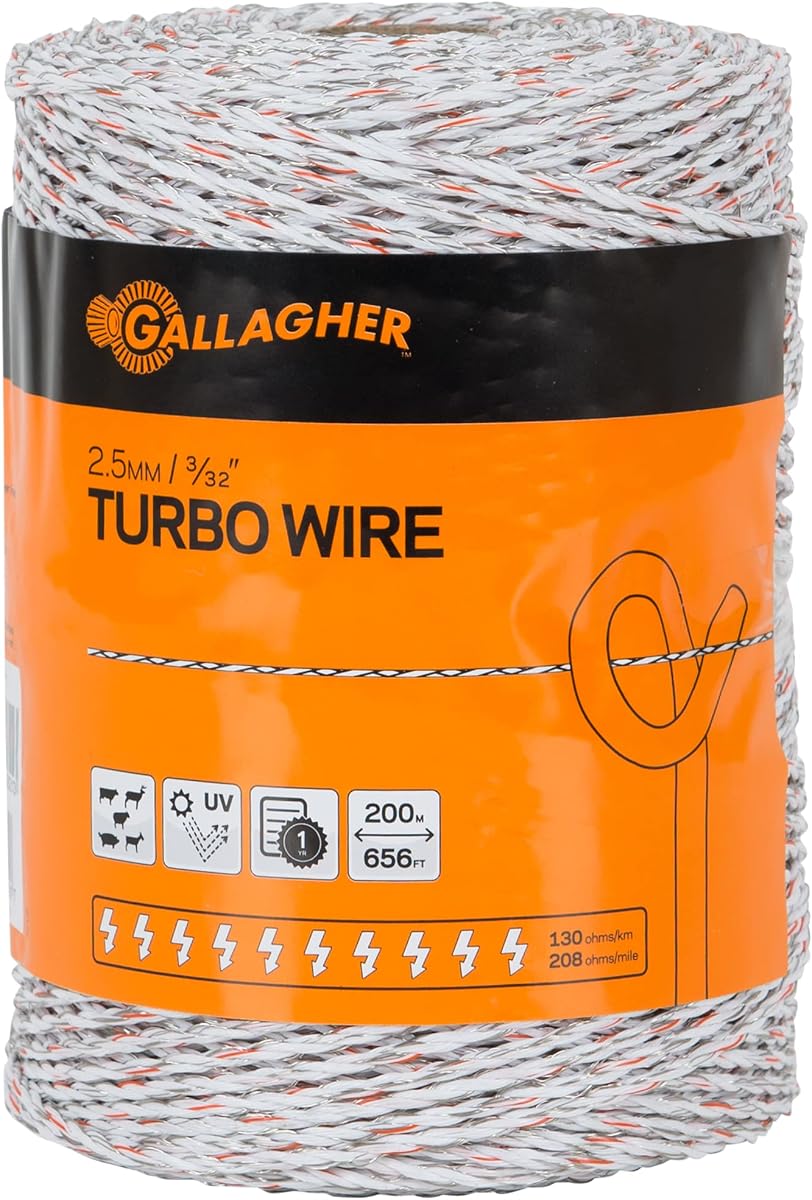
Gallagher Turbo Polywire is a portable electric-fence option built for users who need dependable power over long fence lines. It carries a 4.7 rating, the highest among the products in this guide, and stands out for its nine inter-woven metal strands, including stainless steel and copper. The manufacturer specifically positions it for demanding distances and extended portable-fence use.
We may earn a commission when you buy through this link, at no additional cost to you.
The central advantage is electrical performance. Mixed-metal construction gives the line lower resistance than conventional polywire, while the copper component supports strong current transmission over substantial distances. That makes the product attractive for separating livestock from predators, protecting a large pasture, or creating temporary boundaries where every inch of wire must remain effective rather than merely visible.
The wire is also designed with outdoor longevity in mind. Its listed rust resistance and UV resistance help it retain performance through changing weather, and its 3/32-inch diameter makes it more substantial than many lightweight polywire products. Compatibility with standard polywire reels allows it to be deployed without specialized winding equipment, while the reusable roll format supports repeated seasonal installation.
The main limitation is length. At 656 feet, this roll provides less coverage than the 1,650-, 1,640-, 2,000-, 3,366-, and 3,500-foot products listed, so buyers with a broad perimeter may need more than one roll. Even so, it is the strongest overall choice here for long-distance performance, portability, and dependable conductivity.
The stainless-steel and copper strands are the reason this product stands apart. This construction is especially useful where long runs, vegetation, or changing terrain could otherwise reduce the effectiveness of a lighter polywire line.
Standard-reel compatibility makes deployment and retrieval straightforward. Reusability is particularly useful for rotational grazing, seasonal predator barriers, and properties that move fence lines instead of maintaining one permanent boundary.
We may earn a commission when you buy through this link, at no additional cost to you.
HOKENITY Electric Fence Polywire combines a 1/8-inch profile with nine stainless-steel conductor strands and 30 reinforced polymer lines. Its 4.5 rating reflects a well-rounded product with an emphasized breaking strength of up to 180 pounds. That combination of mechanical toughness and conductivity gives it a strong position for portable predator barriers.
We may earn a commission when you buy through this link, at no additional cost to you.
Nine conductive strands offer more parallel pathways for current than many standard polywires. The manufacturer describes the 304 stainless-steel conductors as corrosion-resistant and capable of maintaining efficient transmission over long distances. The bright black-and-yellow design adds another practical benefit: livestock and wildlife can see the boundary more readily, which may reduce accidental collisions and repeated impacts.
Mechanical reinforcement matters when deer, dogs, livestock, or other animals brush against or crash into a fence. A stated 180-pound break strength gives this polywire a durable profile, while UV-resistant additives are intended to limit sun damage. The wire is also described as lightweight, easy to cut, and reusable, supporting installation in temporary pastures, orchards, gardens, and rotational systems.
This is not a universal fence-line cable. It is intended for supported, above-ground use with proper insulators and compatible equipment rather than direct burial. Within that category, however, it is a premium option for buyers who value conductor count, visibility, and tensile strength over the longest possible spool length.
The nine stainless-steel strands provide multiple conductive paths through the braided line. This is useful for temporary predator exclusion and portable livestock fencing where the entire line must remain responsive.
A stated break strength of up to 180 pounds gives the wire more resistance to hard contact than lighter conventional lines. High visibility complements that strength by helping animals recognize the fence before testing it.
We may earn a commission when you buy through this link, at no additional cost to you.
Zareba Aluminum Wire is a practical option for smaller predator-control boundaries, paddock sections, and permanent fence lines. The 4.6-rated product uses 17-gauge aluminum wire on a 250-foot spool. Its straightforward design and broad insulator compatibility make it useful for buyers who want a conventional metal conductor rather than braided polywire.
We may earn a commission when you buy through this link, at no additional cost to you.
Aluminum is described as conducting electricity four times better than steel, while the wire's stated 38,000-psi tensile strength and 90-pound breaking load provide meaningful mechanical durability. The built-in spool spins freely during installation, reducing the awkwardness of handling a conventional wire roll. It also works with all post types and with plastic or porcelain insulators.
The aluminized surface is described as resistant to rust, which helps preserve electrical performance over time. However, the 250-foot length is the clearest trade-off. It is among the shortest rolls in the comparison and may require several spools for a medium or large property. It also cannot function as an electric fence without a suitable energizer and correctly installed insulators.
For a small chicken enclosure, dog run, garden edge, or short livestock paddock, this is an affordable and uncomplicated choice. It is less appropriate for a long temporary line or a large portable operation, where a longer polywire spool would reduce the number of joins and installation time.
The free-spinning spool and compatibility with plastic or porcelain insulators simplify installation around conventional posts. It is a natural fit for fixed boundaries where portability is not required.
The product combines strong current-carrying characteristics with a rust-resistant finish. Its 90-pound breaking load offers adequate strength for many routine livestock and wildlife applications.
We may earn a commission when you buy through this link, at no additional cost to you.
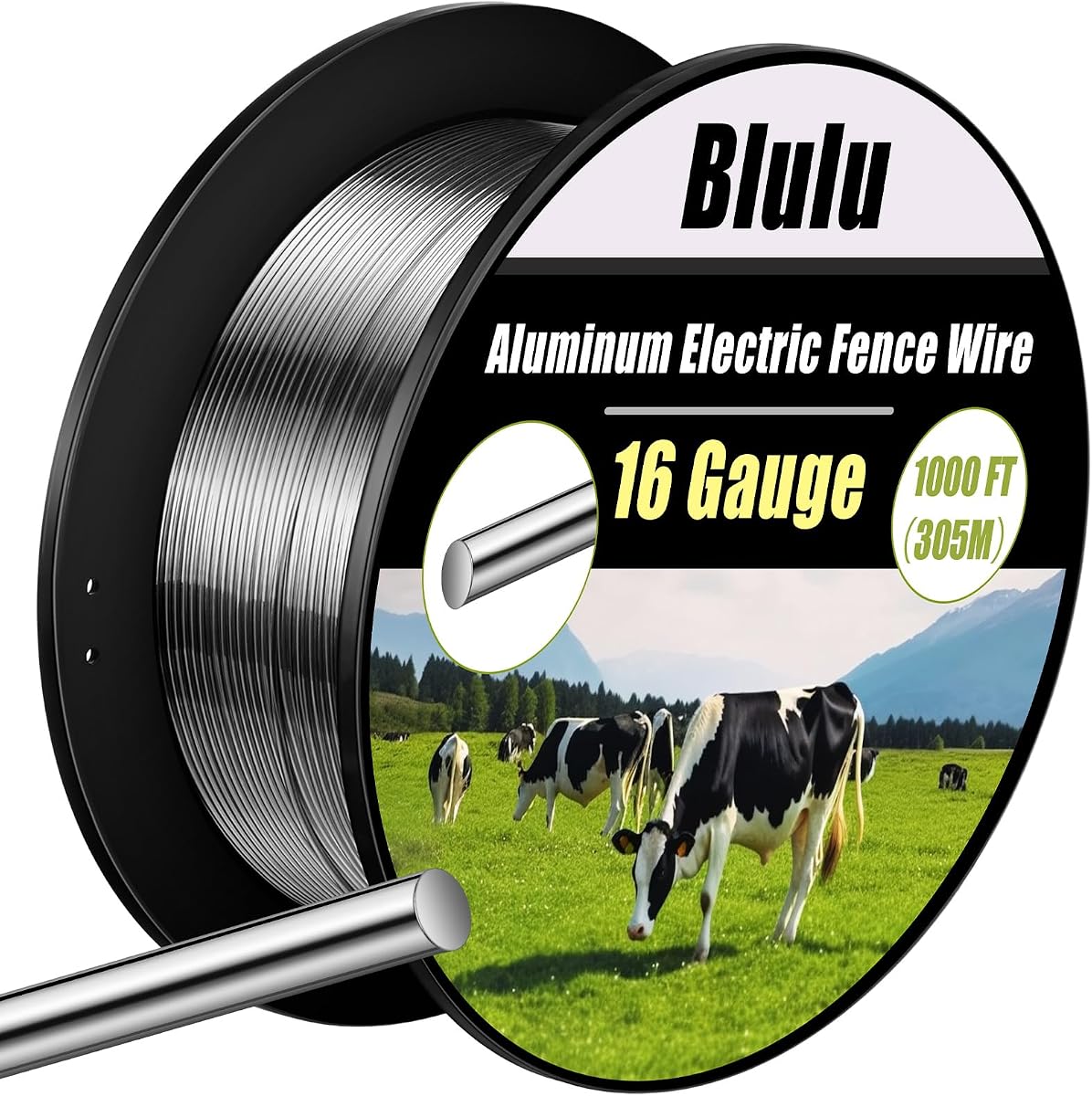
Blulu's 1,000-foot aluminum electric-fence wire is a balanced choice for properties that need more coverage than a small spool but prefer conventional wire to flexible polywire. It carries a 5.0 rating, and its distinguishing feature is the use of an aluminum-magnesium alloy described as stronger and more corrosion-resistant than ordinary aluminum.
We may earn a commission when you buy through this link, at no additional cost to you.
The wire is specified as 16 gauge with a tensile strength of 260 megapascals. Its low-resistance construction is intended to deliver current efficiently through the fence, while the alloy composition is claimed to withstand rain, snow, and prolonged exposure without corroding or degrading. That makes it a candidate for permanent or semi-permanent predator boundaries.
Installation is straightforward: the wire can be pulled, cut, and mounted from its reel, and it works with most electric-fence systems using plastic or ceramic insulators. Compared with polywire, however, it lacks the same easy reel-in portability and may be less convenient for rapidly changing grazing layouts.
This product is best for buyers seeking a long, rigid aluminum line with an upgraded alloy and strong listed rating. The 1,000-foot length covers more ground than the 250-foot Zareba spool, but it still falls short of the largest polywire options for expansive properties.
The alloy is designed to combine conductivity with mechanical strength and corrosion resistance. That balance is valuable for exposed fence lines subject to rain, snow, and general outdoor wear.
The wire is described as easy to pull, cut, and install. Its compatibility with plastic and ceramic insulators gives owners flexibility when assembling a new line or replacing part of an existing fence.
We may earn a commission when you buy through this link, at no additional cost to you.
ACLASTOOL Electric Fence Wire offers the greatest roll length in this guide, providing 3,500 feet of 1/8-inch polywire. Its 4.6 rating and six stainless-steel conductors make it a strong option for long portable boundaries, rotational grazing, and predator exclusion where minimizing the number of spools and splices is important.
We may earn a commission when you buy through this link, at no additional cost to you.
The wire combines six 304 stainless-steel conductors with 15 thicker polymer strands and a stated 140-pound breaking strength. The stainless-steel core is designed to resist rust and maintain conductivity over distance, while UV-resistant additives protect the polymer from sunlight. The integrated reel and marked starting end simplify setup and storage.
Its easy reel-out, splice, repair, and reel-in design makes it more flexible than conventional metal wire. That portability is valuable for temporary seasonal fences, but correct insulators and supports remain necessary. The product is intended for supported above-ground installation rather than direct burial.
The principal trade-off is that six conductors are fewer than the nine offered by the HOKENITY and Gallagher products. Even so, the combination of very long coverage, rust resistance, and mechanical strength makes ACLASTOOL one of the most versatile choices for large temporary fencing.
At 3,500 feet, this spool can cover more perimeter with fewer joins than any other product here. It is well suited to farms, orchards, and temporary rotational enclosures where long runs are the norm.
The integrated reel, marked starting end, and flexible construction make the wire easier to deploy and retrieve. Those details matter for users who install and remove predator barriers throughout the season.
We may earn a commission when you buy through this link, at no additional cost to you.
Upgraded Electric Fence Polywire provides 3,366 feet of portable fencing in a 1/8-inch profile. The product has a 4.6 rating and uses six stainless-steel conductors intended to provide low resistance and reliable conductivity. It is a close length alternative to the 3,500-foot ACLASTOOL roll.
We may earn a commission when you buy through this link, at no additional cost to you.
Its stainless-steel construction is presented as resistant to rust, while UV-stabilized polymer webbing is intended to withstand extended outdoor use. The bright color helps the line stand out from its surroundings, an advantage when the goal is to keep livestock or wildlife from approaching the boundary unexpectedly.
The lightweight construction is easy to install, cut, splice, repair, and rewind. It is also designed to work with electric-fence reels and is suitable for horse, dog, goat, and other portable livestock applications. These characteristics make it useful for temporary predator barriers as well as routine animal containment.
Buyers should note that the listing describes compatibility with fencing reels but does not clearly state that a reel is included. The wire also needs suitable insulators and a correctly matched energizer. Its strongest case is long, visible, reusable coverage rather than premium conductor count.
The 3,366-foot length is suitable for substantial temporary boundaries without requiring the number of joins found with shorter spools. Flexible construction also makes transport and redeployment more manageable.
A bright line is easier for animals to recognize, while UV-stabilized webbing and rust-resistant conductors support dependable outdoor performance. These are useful qualities for exposed farm and ranch installations.
We may earn a commission when you buy through this link, at no additional cost to you.
Zareba Insulated Cable is a specialized accessory rather than a full perimeter predator fence. The 4.6-rated UGC50 contains 50 feet of Class III galvanized wire protected by double insulation. It is designed to carry electric-fence connections underground, including beneath permanent gates.
We may earn a commission when you buy through this link, at no additional cost to you.
Its 20,000-volt rating and insulated construction are intended to limit unintended voltage loss. This makes it useful when a visible fence line has to cross a driveway, gate, path, or other area where exposed wire would be inconvenient or unsafe. The UV-protected sleeve is built to withstand outdoor conditions.
This product should be matched with the fence's energizer, ground system, and compatible perimeter conductor. The appropriate conductor, grounding, and installation practices remain necessary for the whole system to work as intended.
The key advantage is specialized voltage retention in underground sections. The key limitation is that its 50-foot length and insulated construction do not make it a general-purpose boundary wire. It is best selected as a planned component of a complete electric-fence layout, particularly where a permanent gate or buried crossing requires it.
Double insulation helps carry power beneath permanent gates without energizing nearby conductive structures. This is a practical solution for properties where a surface-mounted wire would interfere with access.
The 20,000-volt rating and Class III galvanized wire are designed for electric-fence use. The UV-protected sleeve adds durability for sections exposed to changing weather.
We may earn a commission when you buy through this link, at no additional cost to you.
BESTEEL Electric Fence Polywire is a versatile 1,650-foot portable wire with a 4.6 rating. It uses six inter-woven stainless-steel conductors surrounded by 30 nylon strands and three-strand polymer webbing, producing a 1/8-inch line described as durable, reusable, and resistant to rust and UV exposure.
We may earn a commission when you buy through this link, at no additional cost to you.
One useful detail is the stated resistance of 6,000 ohms per kilometer, or 9,656 ohms per mile. Electrical resistance is an important predictor of how effectively current travels along a fence, particularly over long runs. The six stainless-steel conductors are intended to keep that resistance low while supporting dependable current.
The product is lightweight and easy to install, cut, splice, rewind, and repair. It works with electric-fence reels and is suitable for horse, dog, goat, cattle, calving, and temporary wildlife-control fencing. Those broad applications make it a practical middle ground between short rigid wire and very long polywire spools.
The listing specifies that a reel and electric-fence insulator are not included, so buyers need to account for those accessories. Despite that requirement, it is a balanced and versatile option for a farm or ranch seeking one portable line for several kinds of temporary barriers.
The published resistance figure helps buyers compare the wire's expected performance over distance. It is a meaningful advantage when the goal is a dependable predator barrier rather than only a visual boundary.
Lightweight construction, straightforward splicing, and reel compatibility make the line convenient for temporary use. It can be adapted to different livestock, crop, garden, and wildlife-control applications.
We may earn a commission when you buy through this link, at no additional cost to you.
Tinned Copper Electric Fence Wire is the most mechanically robust product in this comparison. The 1,000-foot rope has a 1/4-inch diameter, four tinned-copper strands, and PVC-coated high-density fiberglass construction, producing a stated breaking strength of 900 pounds. It is intended for demanding livestock and equine containment.
We may earn a commission when you buy through this link, at no additional cost to you.
Copper is the key electrical feature. The manufacturer claims conductivity 40 times that of standard stainless-steel polyrope and lists a maximum resistance of 50 milliohms per meter. The tinned finish and anti-rust construction are designed to maintain current flow and resist environmental deterioration.
The bright strands improve visibility for horses and other animals, while the thick fiberglass rope resists wear. It can be set up, spliced, and repaired directly in the field, and installation instructions are printed on the label. Despite its rope form, it is substantially heavier and more rigid than ordinary lightweight polywire.
Its 4.1 rating is the lowest of the ten products, which is the main reason it is not ranked higher. The trade-off is clear: buyers give up some portability for exceptional tensile strength and very high conductivity. It is best for high-pressure boundaries, sensitive animals, and applications where mechanical durability is the priority.
The stated 900-pound break strength and fiberglass-reinforced rope provide a major mechanical advantage. That makes the line less likely to fail when large animals press against or strike the boundary.
Four tinned-copper conductors and a low stated resistance support powerful, consistent current delivery. Copper is especially useful where maximum conductivity is more important than minimal weight.
We may earn a commission when you buy through this link, at no additional cost to you.
This 1,640-foot aluminum wire provides a long conventional option for permanent predator barriers, pasture boundaries, and livestock enclosures. It has a 4.6 rating and uses 16-gauge, 1.6-millimeter aluminum wire with a stated tensile strength of 38,000 psi and a 90-pound breaking load.
We may earn a commission when you buy through this link, at no additional cost to you.
The electrical specification is equally notable: aluminum is described as conducting electricity four times better than steel. That makes the line suitable for owners who prefer rigid metal conductors to polymer rope. The aluminized finish is intended to resist rust and preserve usefulness over the life of the fence.
Its long roll reduces the number of joints needed across medium and large properties. At the same time, the product is less convenient to deploy and retrieve than polywire. Installing it efficiently requires a suitable reel or payout method, secure posts, and correctly positioned insulators.
This is a good general-purpose aluminum choice when a permanent boundary is the plan. It is less compelling for rapidly changing portable barriers, where lightweight polywire wins. For fixed fencing, however, the combination of coverage, conductivity, strength, and rust resistance is difficult to ignore.
The 1,640-foot roll is suited to extended perimeters where permanent support and insulation are practical. Its rigid form remains in place without frequent winding and rewinding.
The stated conductivity, tensile strength, and breaking load provide a useful balance for routine livestock and wildlife pressure. The aluminized surface is designed to resist rust over time.
We may earn a commission when you buy through this link, at no additional cost to you.
The most effective predator fence balances electrical performance, visibility, mechanical strength, weather resistance, coverage, and compatibility with the rest of the electric-fence system. The right choice depends on whether the line is permanent, frequently moved, underground, or built around particularly large animals.
Conductor material directly influences how reliably a fence delivers an effective pulse, especially over long distances or through wet vegetation. Stainless steel offers corrosion resistance and consistent performance, while copper provides very high conductivity. Aluminum is lightweight and highly conductive, but its oxide layer can change over time, so it should be installed and maintained so the conductive surface remains effective. Mixed-metal products combine different conductors to balance current flow and mechanical properties.
Choose a wire with low stated resistance and enough conductor strands for the length and terrain. Higher conductor count can improve performance, but real results also depend on proper energizer output, grounding, insulation, vegetation management, and connections.
Roll length determines how much perimeter can be installed before another spool or splice is required. Products here range from 50 feet of specialized insulated cable to 3,500 feet of portable polywire. Longer rolls are advantageous on large farms because fewer joins can mean less installation time and fewer potential weak points. Shorter spools are easier to handle and may suit compact gardens, chicken runs, gates, or trial installations.
Measure the actual boundary before purchasing, then add space for contours, temporary lanes, and future adjustments. Choose the longest practical roll that remains convenient to transport and reel for the intended use.
Predator fences can be struck, rubbed, leaned on, or tested by livestock. Tensile strength and breaking load help the wire remain intact under those forces. Conventional aluminum options in this guide list a 90-pound breaking load, while the HOKENITY polywire is rated up to 180 pounds and the tinned-copper fiberglass rope reaches a stated 900 pounds. More force resistance is useful around cattle, horses, deer, and other strong animals.
Match the wire's strength to the animals likely to test it. Stronger is not always more practical: heavy rope resists impact but can be difficult to move, while lightweight polywire prioritizes portability and easier installation.
A predator fence should be recognizable so animals see the boundary before making contact. Bright or contrasting colors are especially useful in open pastures, gardens, and orchards. The HOKENITY product uses a black-and-yellow design for this reason, while the tinned-copper rope also emphasizes noticeable strands. Visibility does not replace electrical performance, but it can reduce collisions and help livestock remain clear of the line.
For dark terrain or dense vegetation, choose a contrasting line and maintain a cleared strip where practical. Consistent visibility is especially helpful for horses and other animals that may move quickly and unpredictably around boundaries.
Outdoor fence wire is exposed to sunlight, rain, snow, moisture, and temperature changes. UV-resistant polymer helps protect polywire, while stainless steel and an anti-rust finish protect the electrical conductors. Aluminum is naturally valued for corrosion resistance, although the long-term performance of aluminum electric-fence wire can depend on its surface condition and connection quality. For underground crossings, insulation and UV protection become even more important.
Select materials matched to the installation environment rather than relying on a generic durability claim. Inspect weathered sections regularly, replace damaged strands, and keep connections clean and secure.
Polywire is flexible, lightweight, easy to splice, and convenient for portable or rotational fencing. It is often easier to reel onto a standard fence reel and less likely to tangle. Conventional aluminum wire is rigid, simple to tension, and well suited to permanent boundaries, but it is heavier to move and can be less convenient for frequent redeployment. Heavy fiberglass rope falls between these categories, combining rope flexibility with exceptional strength.
Choose polywire for seasonal barriers and frequent repositioning. Choose aluminum for fixed lines where simplicity and long service life matter most. Choose heavy rope when mechanical strength is the dominant concern.
A wire can only perform correctly when it is supported by appropriate insulators, posts, and an energizer. Polywire generally requires more frequent insulators than rigid wire because it is flexible and prone to contact with vegetation. Some listings explicitly include compatibility with plastic or ceramic insulators or standard polywire reels, while others note that the reel and insulators are not included. The Zareba insulated cable serves a different role and must be integrated into the fence's underground electrical path.
Confirm that the wire, reel, insulators, controller, and grounding system are designed to work together. Check the package contents carefully, especially when a listing mentions compatible accessories rather than included components.
Portable polywire is easiest to use on relatively even terrain that allows the line to remain clear of grass and brush. Dense vegetation can drain current and make animals more likely to touch the fence repeatedly. Permanent aluminum wire is well suited to established posts and straight runs, while underground insulated cable solves gate and crossing problems. Before purchasing, consider terrain, access points, wildlife pressure, and how often the fence will be inspected.
Plan for routine checks of posts, insulators, vegetation, and connections. A fence is only as dependable as its weakest point, and regular maintenance helps identify damaged wire before it creates a larger gap.
Plan the fence route before unrolling the wire. Identify the energizer, grounding point, insulators, posts, gates, underground crossings, and any areas where livestock, vehicles, or people will pass. Measure each run and confirm that the selected roll is long enough for the planned coverage, allowing some extra material for termination and repairs.
Mount the perimeter supports at regular intervals and use insulators appropriate to the wire type. Keep flexible polywire away from metal posts and structures that could cause unintended contact. Do not connect a universal wire to an energizer without checking the manufacturer's voltage, current, and grounding recommendations. The Zareba insulated cable should be used only for its intended underground or gate-crossing connections.
Inspect the fence regularly for vegetation, damaged strands, loose insulators, corrosion, animal interference, and grounding problems. Trim growth that could intercept the line, replace broken sections with compatible wire, and make secure, conductive connections. When the season ends, portable polywire can be carefully wound onto its reel, inspected, and stored dry for reuse.
The best type depends on the property, target animals, and fence length. Stainless-steel polywire is portable and corrosion-resistant, copper offers very high conductivity, and aluminum is effective for permanent lines. Whichever material is chosen must be paired with suitable insulators, an appropriately powered energizer, and a sound grounding system.
No. Thickness can improve mechanical strength, but electrical performance also depends on conductor material, resistance, total run length, vegetation, connections, and energizer output. A heavy rope may withstand large animals better, while lightweight polywire may be more practical for a temporary fence that must be moved frequently.
The UGC50 is intended for specialized electrical connections, such as beneath permanent gates and for underground links between fence sections and a controller. It is not a substitute for a conventional perimeter conductor. Its 50-foot length, double insulation, and 20,000-volt rating make it useful as part of a properly planned system.
The required quantity depends on post spacing, terrain, wire tension, and the manufacturer's recommendations. Flexible polywire generally needs more support points than rigid metal wire because it can move and contact vegetation. Use purpose-made electric-fence insulators and avoid improvised supports that could leak current.
No. Rust-resistant conductors and UV-resistant polymers reduce deterioration, but every electric fence still needs routine inspection. Check insulators, posts, connections, vegetation, and grounding, and replace damaged portions before animals can find a weak point.
Aluminum is highly conductive and can work well in a permanent line, while stainless-steel polywire is easier to deploy, resists corrosion, and is convenient for temporary or rotational use. Mixed-metal or copper constructions may be preferable when very high conductivity is needed over long distances. Terrain, vegetation, and energizer capability also affect the comparison.
Many products in this guide are designed to be reusable if they are handled correctly. Inspect the line for cuts, crushed strands, damaged insulation, and connector failure, then clean and store it dry on a suitable reel. Replace any section with compromised conductors rather than returning questionable wire to service.
Confirm that the controller is designed for the wire type and intended fence load, and verify the grounding arrangement according to the energizer instructions. Install insulated supports, clear conductive vegetation, secure all connections, and post appropriate warning signs. Test the fence before allowing livestock or wildlife to encounter it.
Gallagher Turbo Polywire is the strongest overall option for buyers prioritizing long-distance conductivity, mixed-metal construction, and portable deployment. HOKENITY stands out as the premium polywire choice with nine stainless-steel conductors, a stated 180-pound break strength, and high-visibility coloring, while Zareba's 250-foot aluminum spool is the budget pick for small permanent boundaries.
For larger temporary properties, ACLASTOOL's 3,500-foot roll and the 3,366-foot Upgraded Electric Fence Polywire offer the most coverage with relatively few joins. The tinned-copper fiberglass rope is the mechanical heavyweight for demanding animals, and Blulu or the 1,640-foot aluminum option may suit owners building fixed boundaries. Prioritize conductor performance, resistance, visibility, tensile strength, and compatibility rather than choosing on roll length alone.
Product details, ratings, availability, and pricing can change, so confirm the current listing before buying. Compare the wire with your energizer, insulators, posts, terrain, target animals, and installation plan, then select the option that balances electrical reliability, mechanical strength, portability, and ongoing maintenance.