
Golf Pad TAGS
4.0Editor score
Lightweight NFC club tags
No tag charging required
Distance and accuracy analysis
Explore the best GPS tracking golf balls and shot-tracking systems, comparing tracking features, compatibility, performance balls, and game insights for
GPS tracking golf balls promise a more data-driven way to understand where shots travel, how clubs perform, and which parts of a game need attention. However, the category includes embedded GPS balls, radar-compatible balls, club sensors, and full shot-tracking systems, so their capabilities differ considerably.
This guide compares all ten products according to tracking method, compatibility, shot data, course support, hardware requirements, and the additional value offered to golfers. It also identifies practical alternatives for players interested in tracked equipment, launch monitoring, or performance balls designed for specialized measuring systems.
Each selection reveals what a product can contribute to practice and on-course analysis, along with its most important limitations. Product ratings and availability can change over time, and shoppers should compare current listings, device requirements, and included features before making a final purchasing decision.
4.0Editor score

2.5Editor score

4.3Editor score
This comparison separates embedded GPS balls from radar-compatible models, launch monitors, and club-based tracking systems. It highlights the most useful technical distinctions so golfers can choose equipment aligned with their desired level of shot data and course analysis.



Chiping GPS Tracked Golf Balls are the most literal interpretation of the GPS tracking golf ball category in this guide. The six-ball set uses built-in tracking technology and connects with the Chiping GPS App, which provides access to more than 35,000 courses worldwide. Its 2.5 rating is the lowest among the ten products, so buyers should treat the concept as promising but examine current user feedback carefully.
We may earn a commission when you buy through this link, at no additional cost to you.
The system is designed to reduce the guesswork associated with locating shots, helping golfers assess pace, direction, and distance from the result. Course selection appears to be a major strength because a useful shot tracker must recognize the layout of the course being played. A broad course database can also make the experience more useful for golfers who travel or regularly play at unfamiliar venues.
Performance is addressed through a four-piece design with a urethane core, active mantle, Surlyn cover, and special rubber core. The cover is intended to reduce driver spin, while the active mantle is designed to improve control. These specifications make the product more than a simple electronic novelty, although the supplied information does not independently establish how accurately the electronics perform during real play.
The low rating is the clearest caution. A low user score can reflect reliability, setup, app experience, or the normal early stage of a niche product category, but it makes careful review essential. Golfers who specifically want balls with embedded GPS rather than club sensors should examine this option, while conventional golfers may obtain more dependable shot data from established sensor systems.
Unlike products that track the club, these balls attempt to identify the location of the shot itself. That distinction could provide a more direct record of where the ball finishes, although current feedback should be checked for consistency before committing to the system.
The multi-layer construction targets distance, control, and feel, while the companion app supports tens of thousands of courses. Together, these features create a useful package for travelers and golfers interested in both shot location and ball performance.
We may earn a commission when you buy through this link, at no additional cost to you.
Golf Pad TAGS is a lightweight approach to golf tracking that uses NFC tags attached to club grips rather than electronics built into the balls. A golfer taps a tag to a compatible phone before each shot, and the app records distance, accuracy, and the club used. Its 4.0 rating reflects a practical system with clear benefits, though it does not automate every step in the way club-sensor competitors can.
We may earn a commission when you buy through this link, at no additional cost to you.
The tags are especially appealing because they require no charging, syncing cables, or separate hardware beyond a compatible phone. Once configured, the interaction is straightforward: identify the club and tap its tag. The app then builds a round record that can be reviewed for club averages, accuracy percentages, putting statistics, and scoring trends.
Device compatibility is the primary limitation to verify. Golf Pad TAGS supports NFC-enabled Android devices and iPhone 7 or later, excluding the original iPhone SE. Golfers without a compatible handset should not assume they can use the system with an older device, and those who dislike touching their phone during play may find the workflow less convenient than fully automatic sensors.
Golf Pad TAGS is a strong option for budget-conscious golfers who want meaningful shot statistics without maintaining chargeable club hardware. It is especially useful for players already comfortable with mobile apps. Those wanting a ball to report its location automatically should instead examine embedded GPS or radar-compatible equipment.
NFC communication removes the need for batteries within the tags and reduces setup complexity. The trade-off is that the player must initiate each shot record manually through the phone, making consistency and habit the main determinants of data completeness.
The app goes beyond basic scorekeeping by presenting club averages, accuracy rates, putting information, and trends. That makes the system useful for golfers who want to compare performance across rounds or share selected results with a coach.
We may earn a commission when you buy through this link, at no additional cost to you.
The Titleist Golf Ball 2023 Pro V1x RCT is designed specifically for radar ballistic measuring instruments such as supported Trackman systems. It does not contain a GPS transmitter, so it should not be confused with an independently trackable ball. Instead, it is a premium performance model engineered to work correctly with compatible launch-measuring devices, earning a strong 4.8 rating.
We may earn a commission when you buy through this link, at no additional cost to you.
Its urethane elastomer construction and Tour designation position it as a performance ball rather than a visibility or training novelty. The RCT model name is especially important for golfers using radar-based equipment because it signals the intended measuring context. It is also a sensible option for a player who wants one ball for both monitored sessions and regular rounds.
The central limitation is dependence on external hardware. A golfer without a compatible radar instrument receives a premium golf ball but no tracking functionality. Even with the right equipment, users must confirm that the instrument supports this specific ball and that the ball is appropriate for the session or play conditions.
This is a strong choice for golfers who already own compatible radar launch equipment and want a refined Tour model. It is less suitable for someone seeking app-based GPS course maps or automatic club-by-club records. For those needs, a club-sensor or embedded GPS system will deliver a more direct form of tracking.
The RCT designation connects the ball directly to radar-based measuring workflows. This focus reduces the need to use a general-purpose ball whose behavior may not be intended for detailed ballistic analysis.
A urethane elastomer cover and Tour positioning place this model among the more performance-oriented choices. It can therefore serve double duty for players who alternate between measured practice and conventional rounds.
We may earn a commission when you buy through this link, at no additional cost to you.
The Titleist Golf Pro V1 RCT Balls 12-Pack pairs the Pro V1 model with a twelve-ball quantity for golfers who regularly practice with a radar-based measuring system. It carries a 4.9 rating, the highest in this group, which indicates strong customer satisfaction with the product as presented. Like the Pro V1x RCT, it is designed for measurement rather than self-contained GPS tracking.
We may earn a commission when you buy through this link, at no additional cost to you.
The Pro V1 construction uses a urethane elastomer cover and carries a Tour designation. The practical advantage of the larger pack is convenience: a golfer can keep a consistent supply available for launch-monitor sessions, short-game practice, and rounds without frequently replenishing a smaller supply.
Radar compatibility does not turn the ball into a standalone tracker. The user still needs suitable equipment, must verify model support, and must follow the manufacturer's ball-selection guidance. Buyers looking for an app to map courses or report shot locations should not infer those features from the RCT name.
The Pro V1 RCT 12-Pack is ideal for regular players with compatible radar hardware who prefer a well-known Tour model and want a generous quantity. Its strong rating and familiar construction make it a low-uncertainty choice within the specialized radar-ball segment, even though it does not independently provide GPS or club data.
A twelve-ball pack suits golfers who use a launch monitor several times a week. It also makes it easier to dedicate the same ball model to monitored practice and normal play without switching models frequently.
The urethane cover and Tour positioning support the product's premium performance orientation. Combined with the highest rating in the lineup, it offers a reassuring choice when purchasing for a specialized instrument.
We may earn a commission when you buy through this link, at no additional cost to you.
The Garmin Approach CT10 Full Set is a premium, club-based tracking system containing 14 sensors. Once installed, the sensors automatically record every shot and pair with a compatible Garmin golf watch to capture stroke location, distance, and club type. Its 4.3 rating reflects a solid all-around option for golfers already invested in the Garmin ecosystem.
We may earn a commission when you buy through this link, at no additional cost to you.
Automatic collection is the defining advantage. Because the sensor is installed in a club and records the stroke when the club is removed from the bag, the player can focus on playing rather than tapping a phone before each shot. Compatible watches also surface club-specific data, including typical distance and accuracy relative to the fairway or green.
The major condition is ecosystem dependence. A compatible Garmin golf watch is needed to use the full tracking experience, and the sensor hardware itself introduces a charging routine. Although that requirement makes the package less convenient than a simple NFC tag system, it enables a more automatic and detailed workflow for equipped golfers.
This system is a strong premium recommendation for Garmin users who want a complete, automatic solution and already own a compatible watch. It is less appropriate for golfers without Garmin hardware, those unwilling to charge multiple devices, or anyone whose priority is a physically trackable ball. The CT10 tracks clubs, not the ball's final resting position.
Installed sensors remove the need to enter each club manually. That convenience makes it easier to capture a complete round, especially for golfers who dislike interrupting their rhythm to operate a phone.
Compatible Garmin watches display typical hitting distance and accuracy for equipped clubs. That granularity helps golfers identify which clubs produce the desired result and where distance or dispersion needs improvement.
We may earn a commission when you buy through this link, at no additional cost to you.
The Rapsodo Golf Launch Monitor is a detailed swing-analysis system rather than a GPS ball or ordinary club tracker. It uses Doppler radar and dual cameras to capture 15 metrics, including spin rate, spin axis, carry distance, club speed, club path, and launch angle. Its 3.8 rating reflects broad interest, though this type of equipment involves a more demanding learning curve than tag-based tracking.
We may earn a commission when you buy through this link, at no additional cost to you.
The hardware is designed for both indoor and outdoor use, and the included Pro V1 balls provide a starting point for monitored sessions. The dual-camera system adds a visual dimension by recording the swing from different angles, while impact video and slow-motion contact views can help golfers examine delivery patterns that basic distance data does not reveal.
Software expands the product's value through premium features. The supplied information mentions simulated courses, third-party app integration, a target range, impact vision, shot combining, speed training, and more than 30,000 included home simulator courses with the premium membership. Access beyond the trial period requires understanding the membership terms, and some golfers may find the extensive feature set excessive.
Rapsodo is most appropriate for golfers pursuing detailed performance diagnosis rather than simply locating balls around a course. It offers the deepest swing data in this list, but the launch monitor, included balls, and membership ecosystem require a more intentional investment. New users should prioritize a few relevant metrics rather than attempting to interpret every displayed number at once.
Spin, launch direction, club speed, and path data expose relationships that carry distance alone cannot. These metrics are particularly useful when a golfer wants to understand why a ball is moving through the air in a specific way.
Multiple camera angles and slow-motion contact footage complement the numerical output. Simulated courses and training tools add practice variety, although a longer premium membership commitment should be considered.
We may earn a commission when you buy through this link, at no additional cost to you.
Titleist Velocity is a distance-focused performance ball with a 4.7 rating, although it does not include GPS, radar, or electronic shot tracking. Its arrow alignment design helps players line up putts, while a high-speed LSX core, 350-octahedral dimple construction, and fast NAZ plus cover support a combination of long distance and playable greenside performance.
We may earn a commission when you buy through this link, at no additional cost to you.
The alignment graphic is a subtle but meaningful benefit for golfers who struggle to line up a putt. It adds visual guidance without suggesting that the ball is primarily a putting-training device. The stated design objective of full-throttle speed and maximum distance makes the model more relevant to golfers focused on overall distance and carry.
Because there is no embedded electronics, players will need to pair this ball with a launch monitor, GPS rangefinder, club tracker, or another external system if they want data. It is therefore best viewed as a performance option within the wider tracking ecosystem rather than a tracking product itself.
Velocity suits golfers who want a highly rated distance-oriented ball and may use it with a separate measuring device. It is less appropriate for anyone shopping specifically for embedded GPS or automatic shot logging. Even so, its combination of distance design, alignment aid, and greenside playability makes it a useful standalone choice for performance-focused rounds.
The high-speed core and dimple structure are explicitly designed to support maximum distance and a high ball flight. Those characteristics appeal to golfers who want more carry without moving to a ball labeled exclusively as a two-piece distance model.
The arrow graphic gives putts a clear visual reference, making the ball useful for more than full-swing distance. It is a simple feature that can help golfers settle quickly over the ball.
We may earn a commission when you buy through this link, at no additional cost to you.
The Titleist Pro V1x RCT Golf Balls provide the Pro V1x Tour model in a listing centered on radar tracking compatibility. The product has a 4.7 rating, placing it among the better-reviewed selections. It does not provide GPS tracking by itself; its value comes from serving as a performance ball designed for compatible radar ballistic measuring instruments.
We may earn a commission when you buy through this link, at no additional cost to you.
This option is particularly relevant to golfers who prefer the Pro V1x model and want a single-ball format for a monitored session. The ability to use a familiar Tour ball can make equipment changes less disruptive when switching between a launch monitor and regular play.
As with every radar-compatible ball in this guide, compatibility is the decisive issue. The device must support the model, and golfers should review the launch monitor's ball requirements. A player without that equipment should not expect location data, course maps, or automatic statistics from the ball itself.
The Pro V1x RCT is a sensible specialized pick for a golfer already using a supported radar system. It combines a highly rated, premium model with measurement compatibility, but its lack of embedded electronics makes it less relevant to someone whose priority is hands-free round tracking. In that case, a sensor system will be more useful.
Golfers who already prefer the Pro V1x can keep a consistent ball model during measured practice. That familiarity may make it easier to focus on swing changes rather than adjusting to unfamiliar ball behavior.
The RCT version is most useful when paired with supported radar equipment. Its performance design remains relevant, but it does not provide a general-purpose GPS or automatic shot-tracking experience.
We may earn a commission when you buy through this link, at no additional cost to you.
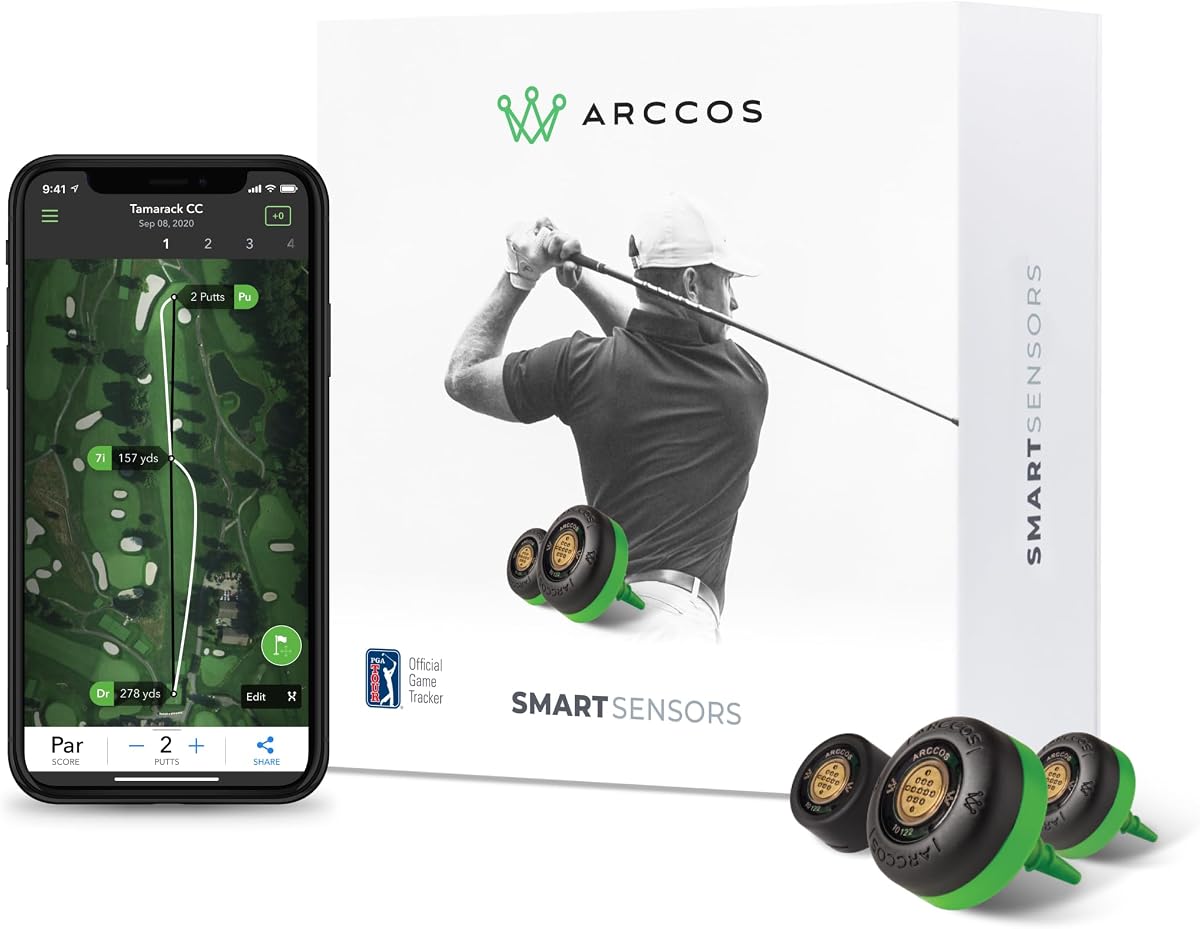
Arccos Smart Sensors form a complete automatic golf tracking system with 14 ultra-light, weather-resistant sensors, including 13 regular club sensors and a putter sensor. The system records shots hands-free and uses an AI-powered GPS rangefinder to provide club distances adjusted for wind, gusts, elevation, temperature, humidity, and altitude. Its 4.1 rating indicates a well-rounded product with meaningful course features.
We may earn a commission when you buy through this link, at no additional cost to you.
The environmental adjustment system is the standout feature. A traditional GPS map may identify the distance to a target, while the Arccos Caddie app also accounts for changing conditions in real time. This makes the rangefinder more useful when a static yardage does not reflect how far the ball will actually roll or fly in the current environment.
The trade-off is the ongoing membership model. The first year is included from activation, after which a membership is required. Sensors also need battery management, and golfers must install and carry them in their clubs. Those requirements add complexity, but they support a more automated workflow than tapping a phone before every stroke.
Arccos is a strong choice for golfers who value automatic shot capture, detailed distances, and weather-adjusted course guidance. It is not a trackable-ball product, so buyers should understand that the sensors and app identify shots and distances through the club and GPS. Golfers who accept the membership model will find considerably more course intelligence than a simple scorekeeping tag.
Adjusting for wind, gusts, elevation, temperature, humidity, and altitude gives the rangefinder a more nuanced yardage than a static map. This is particularly useful on courses where elevation and weather materially affect club selection.
Once installed, the club sensors capture shots without a phone tap. The 14-sensor set covers the full bag, including a dedicated putter sensor, supporting more complete statistics with less interruption.
We may earn a commission when you buy through this link, at no additional cost to you.
Chromax High Visibility Distance Golf Balls focus on making the ball easier to locate rather than embedding tracking electronics. The six-ball pack uses Chromax visibility technology and is available in green, gold, and silver. Its 4.6 rating suggests that golfers value the practical benefit of finding a lost ball, particularly in low light or unfamiliar surroundings.
We may earn a commission when you buy through this link, at no additional cost to you.
A translucent soft Surlyn coating and 90 compression construction are intended for golfers with faster swing speeds and lower handicaps. The product is described as professional-level performance, but golfers with slower swings should recognize that compression and cover choices can influence feel and overall performance.
Because the balls contain no GPS, radar, or sensor capabilities, they cannot record shot location or club performance. Their tracking benefit is visual and physical: a brighter ball can be found more easily, reducing lost-ball time and helping a golfer complete a hole or practice session more efficiently.
Chromax is a useful complementary choice for golfers who want easier ball retrieval or use a separate launch monitor to collect data. It is best suited to stronger swing speeds and players who prioritize visibility. Those seeking automatic statistics should consider a club-sensor system rather than expecting the ball itself to provide them.
The high-visibility treatment is designed for different light conditions, and green, gold, and silver provide personal options. This can reduce the frustration and time lost when a ball leaves the fairway or becomes difficult to identify in vegetation.
The 90 compression and soft Surlyn cover align the model with golfers who have faster swings and lower handicaps. Players outside that profile should consider how compression and feel may suit their game before making a selection.
We may earn a commission when you buy through this link, at no additional cost to you.
The most important first step is deciding what kind of tracking you actually want. Embedded GPS balls, radar-compatible balls, club sensors, launch monitors, and visible distance balls solve different problems, so the right choice depends on whether your priority is ball location, swing data, automatic statistics, or easier retrieval.
Only the Chiping set in this guide is described as having GPS tracking built into the balls. Most products with tracking in their name actually record shots through sensors installed in clubs, measure ball flight with a radar launch monitor, or simply make the ball easier to see. These systems should not be treated as interchangeable. A golfer who wants a final ball-location record should investigate embedded GPS, while a golfer seeking club distance and accuracy can consider NFC tags or automatic club sensors.
Compatibility determines whether a sophisticated product can be used as intended. Golf Pad TAGS requires an NFC-enabled Android device or an iPhone 7 or later, with the original SE excluded. Garmin Approach CT10 requires a compatible Garmin golf watch, while radar-compatible balls must be supported by the launch monitor being used. Check current manufacturer requirements before buying, especially if you plan to replace your phone or watch soon.
Automatic club sensors can capture strokes with minimal interaction, which is convenient during a full round. A tap-based system is simpler in hardware terms but asks the player to remember a repeated action. Embedded tracking promises the most direct result but also introduces more specialized technology. Consider whether you will consistently use the required workflow and whether interruption is acceptable when accuracy of the record matters.
Different products provide different levels of insight. Golf Pad TAGS presents club averages, accuracy percentages, putting stats, and scoring trends. Garmin CT10 focuses on club-by-club distance, stroke location, and accuracy. Arccos adds a weather-adjusted GPS rangefinder, while Rapsodo captures 15 launch and swing metrics. Choose based on a specific improvement goal rather than assuming more data automatically produces better practice.
Course recognition is essential for any GPS-based system. Chiping supports more than 35,000 courses, while Arccos combines GPS rangefinding with an AI-powered caddie application. Course-database size alone does not guarantee a flawless experience, so buyers should also investigate update practices, app compatibility, map accuracy, and recent user feedback. For sensor systems, verify that exported rounds and statistics can be reviewed or shared as needed.
Some tracking systems derive much of their value from software subscriptions. Arccos includes the first year from activation and then requires a membership, while Rapsodo provides a premium trial with additional simulator and training features available through its premium membership. A full system may still provide value without software, but budget for the long-term cost of features you genuinely expect to use.
A tracked ball must still fit the player's swing and desired feel. Titleist's RCT models use urethane elastomer covers and Tour positioning for radar-compatible play. Velocity is designed around distance, a high-speed core, and alignment graphics. Chromax uses a translucent soft Surlyn cover, 90 compression, and bright colors for stronger swing speeds and visibility. Consider compression, cover, flight, and intended playing conditions along with tracking features.
Convenience often depends on maintenance. Golf Pad TAGS requires no charging because its NFC tags contain no active electronics. Garmin CT10 and Arccos systems use electronic sensors that must remain powered, while the Rapsodo launch monitor has a more substantial hardware setup. Build charging time into practice and travel routines, and verify battery expectations before relying on a system for tournament or extended-round use.
Begin by confirming compatibility, installing the required app, and testing the tracking setup away from a full round. For an embedded GPS ball, charge it as directed, link it to the app, and verify that the selected course appears correctly. Radar-compatible balls should be tested with the launch monitor before a monitored session, while club sensors should be assigned to the proper clubs and confirmed on the paired phone or watch.
Use the system consistently during practice or play. For tag-based tracking, tap the correct club immediately before the shot and confirm the entry. For automatic sensors, make sure each club contains its assigned device and that the required app or watch is connected. Launch-monitor users should follow the instrument's setup procedure, use a compatible ball, and avoid changing the ball model unless the manufacturer says it is appropriate.
Care for the equipment according to the manufacturer's instructions. Protect electronic sensors from excessive moisture, extreme heat, and impact, and keep battery contacts clean. Store balls in a dry place away from prolonged direct sunlight, and remove devices before exposing them to conditions outside their stated limits. After a round, review the data for missing shots, inaccurate club entries, and course-mapping issues, then resolve those problems before relying on the records for club selection.
The Chiping GPS Tracked Golf Balls are the only product in this guide explicitly described as containing built-in GPS technology. The other tracking products work through external methods, including NFC club tags, electronic club sensors, radar launch monitors, or GPS rangefinder software. Buyers should therefore read the tracking description carefully rather than assuming every product in a golf roundup contains electronics inside the ball.
A GPS golf ball is intended to report its own location on a course. A club tracking sensor identifies the shot through the club and combines that information with phone, watch, or GPS data. Club systems can still create detailed distance and accuracy records, but they are not physically tracking the ball. The right choice depends on whether direct ball location or automatic club statistics are more important.
The Rapsodo Golf Launch Monitor in this guide is designed for both indoor and outdoor use. Radar-compatible Titleist RCT balls should be used only with a compatible instrument and under its operating conditions. Outdoor placement, surrounding space, wind, and the launch monitor's setup requirements can affect the setup, so the manufacturer's instructions should be reviewed before the first session.
That depends on the system. Garmin Approach CT10 pairs with compatible Garmin golf watches, while Arccos uses its own sensors with the Arccos Caddie app. Golf Pad TAGS uses NFC-enabled phones and does not require a smartwatch. Check the current device requirements because compatibility lists can change as manufacturers update their platforms.
A system with a simple workflow and understandable statistics may be the most useful starting point. Golf Pad TAGS offers distance, accuracy, club averages, putting information, and scoring trends without requiring active tags, making it approachable for users comfortable with a phone. Beginners should begin with a small number of meaningful measures, such as fairway accuracy and club distance, rather than trying to interpret every available statistic.
No. Chromax High Visibility Distance Golf Balls improve the chance of locating a ball by making it easier to see, but they do not contain GPS electronics or record shot statistics. They can complement a launch monitor or GPS rangefinder, but actual data collection still requires separate equipment. This makes them a visibility and distance-performance option rather than a tracking system.
First, confirm that the launch monitor supports the exact ball model and intended use. Some radar instruments are designed for specific models or measured conditions, so visual similarity or a similar name is not enough. Golfers should also consider the ball's construction, feel, intended playing conditions, and whether the same model will be practical for regular rounds.
They can be worthwhile when the software, analysis, and practice tools solve a recurring need. Membership value depends on how often you play or practice, which features you use, and whether the associated hardware suits your device ecosystem. Review the first-year benefits, renewal terms, and exclusive features before committing. A no-subscription tag system may better suit a casual golfer who only wants basic shot records.
The strongest choices depend on the form of tracking a golfer actually needs. Chiping is the most direct embedded GPS option, Golf Pad TAGS offers an approachable phone-based club record, and Garmin CT10 delivers premium automatic tracking for compatible Garmin watch users. Titleist RCT balls and the Rapsodo launch monitor serve the specialized needs of golfers focused on measured performance.
Before buying, identify the outcome you want most: a visible ball, a recorded club stroke, a final location, environmental playing distances, or detailed launch data. Check device compatibility, course coverage, charging needs, and any continuing membership. That focused approach is more likely to produce useful insights than choosing the product with the largest collection of technical features.
Customer ratings can change, software interfaces evolve, and hardware requirements may be updated, so shoppers should check current listings and manufacturer guidance before ordering. Comparing recent user feedback alongside the features that matter to your game will help identify the most suitable system for your practice routine, budget, and equipment ecosystem.