
Jackery Explorer 300 Portable Power Station
4.6Editor score
292Wh portable capacity
300W rated output
Seven device connections
7.5-pound carrying weight
Compare the best lithium portable solar power stations for capacity, output, charging, portability, and backup use with our expert buying guide in 2026.
Lithium portable solar power stations combine rechargeable battery storage, AC and USB outputs, and solar charging in a single portable package. They are useful for camping, road trips, tailgating, mobile work, and emergency preparedness, but the best model depends heavily on capacity, continuous output, charging speed, weight, and the number and type of connections.
We compared all ten products using the information supplied for each unit, including battery chemistry, stored energy, rated and peak output, solar charging capability, port selection, UPS behavior, physical size, and intended applications. The list covers compact power banks, capable camping systems, RV-ready units, and larger home-backup models, so readers can compare options across several use cases.
Each review identifies the most useful strengths and the practical limitations implied by the specifications. The top three picks represent our best overall, budget-conscious, and premium choices, while the remaining reviews explain where alternative capacities or port layouts may be preferable. Product availability, bundle contents, and current listings can change, so buyers should verify the final details before purchasing.
4.6Editor score
4.7Editor score

4.7Editor score
The comparison below places all ten stations side by side, emphasizing the differences that matter most: energy capacity, continuous output, charging flexibility, portability, and specialized backup features.


The Jackery Explorer 300 is a compact, lightweight lithium portable solar power station designed for users who want useful AC output without carrying a large battery. It has a 4.6 rating and stands out for a 292Wh capacity, a 300W rated output, a 600W peak surge, and a weight of only 7.5 pounds. Those specifications make it a credible choice for weekend camping, hiking, travel, and emergency kits where portability matters as much as raw power.
We may earn a commission when you buy through this link, at no additional cost to you.
Its connection selection is well suited to modern devices. Two AC outlets support standard household electronics, while a 100W USB-C PD port can provide more efficient charging for compatible phones, tablets, and laptops. Two USB-A ports broaden compatibility, and the 120W car port is useful for automotive accessories. The 300W continuous rating is appropriate for cameras, drones, laptops, lights, small fans, and other moderate loads, although it is not intended for high-wattage household appliances.
The LiFePO4 battery is another major strength. According to the supplied information, the unit is designed for more than 4,000 charge cycles before reaching 70% capacity, supporting a service life of more than 11 years under the stated conditions. Solar charging is also flexible: the station can reach approximately 80% capacity in 2.8 hours when paired with a compatible 100W Jackery panel, while a 40W panel can reach the same level in about 7.5 hours. A panel is not included, which is the main caveat for buyers seeking a ready-made solar kit.
The Explorer 300 is best for campers, road travelers, photographers, and households building a lightweight outage kit. It cannot replace a full home battery system, and its output will not support large refrigerators, heaters, or power tools. Even so, it balances capacity, portability, and charging flexibility unusually well, making it our strongest all-around recommendation for the most common portable solar power use cases.
At 7.5 pounds, the Explorer 300 is easier to carry than most one-kilowatt-hour alternatives. Its integrated handle and relatively low weight make it practical for moving between a tent, vehicle, picnic area, or emergency kit without treating it like permanently installed equipment.
The mix of two AC outlets, USB-C PD, USB-A, and a 12-volt car connection lets users charge several device categories at once. USB-C PD is particularly helpful for compatible laptops and phones that can accept higher input than older USB-A connections.
We may earn a commission when you buy through this link, at no additional cost to you.
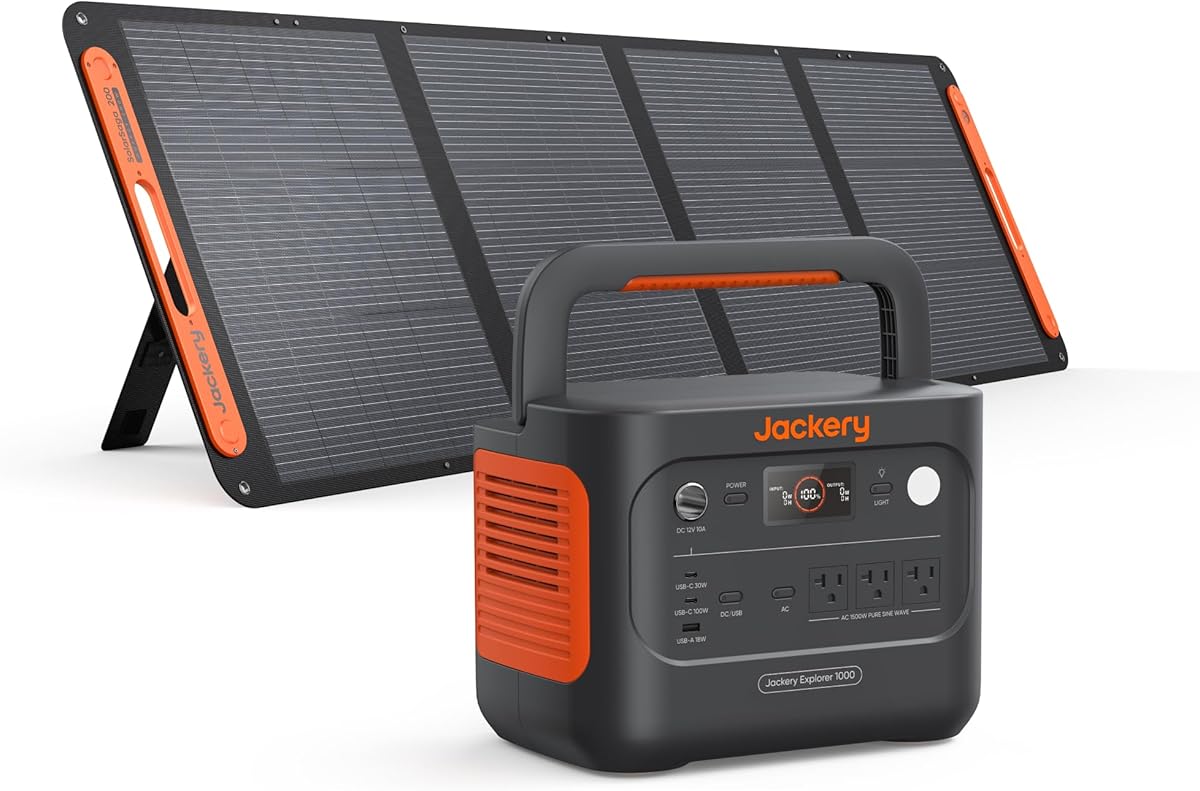
The Jackery Solar Generator 1000 v2 is a complete solar bundle pairing a 1,070Wh power station with a 200W foldable solar panel. It carries a 4.5 rating and is a strong fit for buyers who want the convenience of receiving both pieces together. Its 1,500W continuous AC output, 3,000W surge capability, and pure sine wave outlets give it considerably more appliance flexibility than the smaller Explorer 300.
We may earn a commission when you buy through this link, at no additional cost to you.
The included panel can charge the station to approximately 80% in six hours, making it a practical starting point for extended camping or temporary off-grid use. Wall charging is faster: the unit can complete a full charge in about 1.7 hours by default, while an app-enabled emergency mode can take it from empty to full in one hour. Jackery also lists a three-hour full charge using a 600W alternator charger, giving owners multiple ways to prepare before a trip.
Output and connectivity are well considered. Two USB-C ports, one USB-A port, a DC car port, and three AC outlets allow phones, cameras, laptops, routers, and suitable household appliances to be connected. The 100W USB-C PD port is valuable for faster charging of compatible electronics, while pure sine wave AC output is generally well suited to electronics with sensitive power requirements. LED lighting adds a small convenience for camps and outages.
The trade-offs are weight and complexity. At 23.8 pounds, this is a substantial piece of equipment, and using the fastest emergency charging mode requires enabling the function in the Jackery app beforehand. It also does not include the separate E1000v2 generator and 200W panel if they are shipped separately, as noted in the supplied listing. Despite those details, it is a convincing all-in-one option for people who want meaningful output and solar capability without selecting a panel independently.
The bundled 200W panel removes the need to match a separate solar panel before the first trip. It also gives users a practical baseline for maintaining the battery during a weekend away from household power, subject to sunlight, positioning, and environmental conditions.
Jackery's app provides access to emergency charging, quiet overnight charging, and energy-efficiency settings. The default 1.7-hour mode is a sensible balance between fast replenishment and long-term battery health, while the emergency setting offers maximum speed when circumstances justify it.
We may earn a commission when you buy through this link, at no additional cost to you.
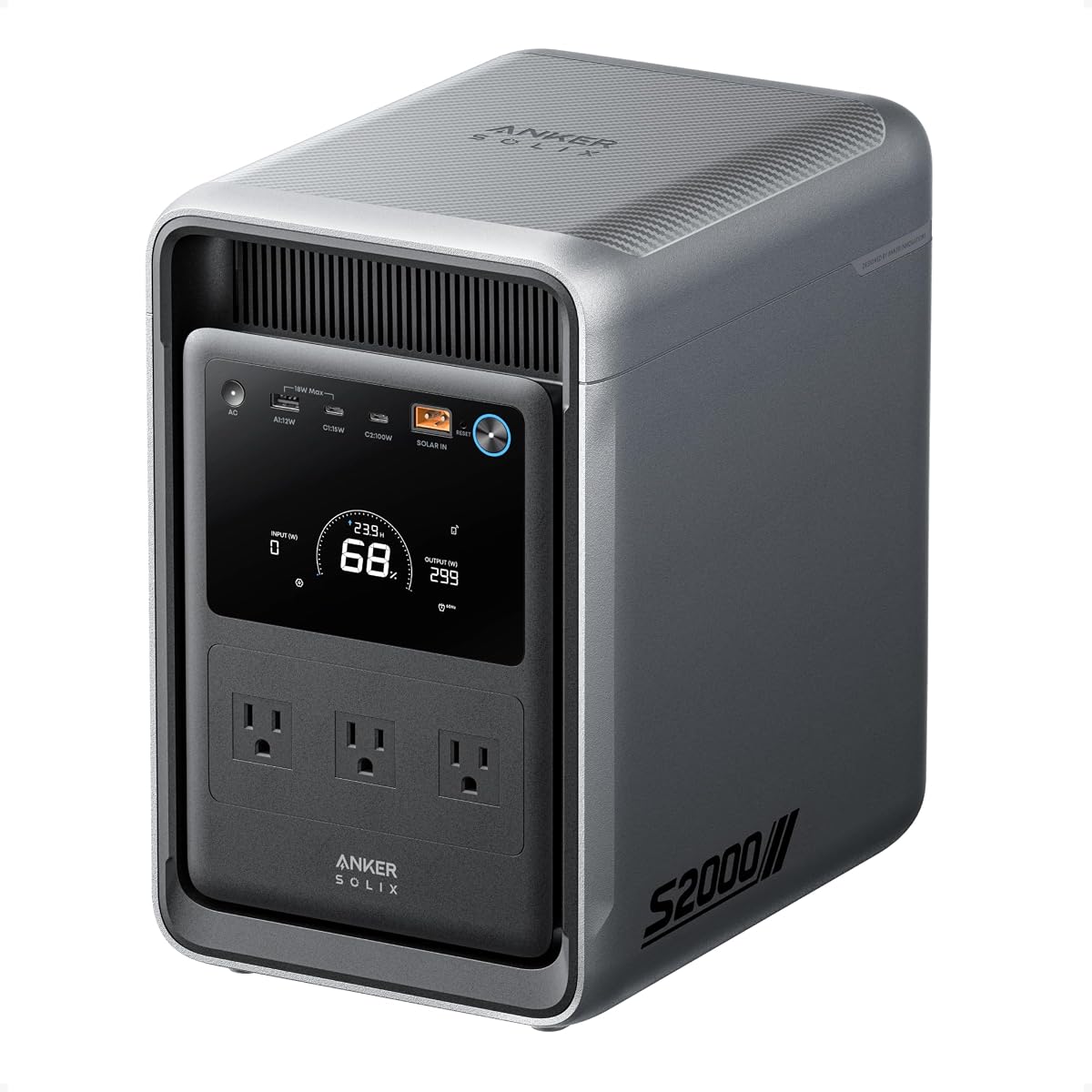
The Anker SOLIX S2000 combines substantial energy capacity with a 1,500W continuous output rating, placing it among the most versatile options in this guide. It has a 4.7 rating, stores 2,010Wh, supports 3,000W peak output, and weighs 35.7 pounds. That makes it more of a portable home and RV power system than a lightweight camping accessory, but its capability is well suited to extended trips and emergency preparation.
We may earn a commission when you buy through this link, at no additional cost to you.
One of the most attractive specifications is its low idle draw. The listed six-watt idle consumption is designed to improve efficiency, and Anker states that the unit can run a refrigerator for up to 35 hours. Actual runtime will vary with the refrigerator, interior temperature, ambient conditions, and usage pattern, so that figure should be treated as a comparative benchmark rather than a guarantee. The 314Ah LFP battery is also rated for 10,000 cycles and a 15-year lifespan.
Charging flexibility is a major strength. The S2000 accepts AC and solar simultaneously, as well as wall power, generator charging, dedicated solar panels, an alternator charger, and a car outlet. Solar input can reach 400W, giving it considerable flexibility for RV, van, cabin, and backup applications. Output is arranged across both front and rear sides, allowing frequently used devices to remain easy to reach while always-on connections sit on the opposite face.
The lack of a dedicated 12V DC port is worth noticing because some portable-power buyers expect one for automotive accessories. The 35.7-pound weight also requires planning, particularly if the station must be moved frequently. Even so, the S2000 is recommended for users who want more capacity than a one-kilowatt-hour unit, appreciate flexible recharge paths, and want a dual-sided layout that reduces cable clutter.
A 2,010Wh battery gives the S2000 more headroom than most camping stations, allowing it to serve multiple devices over a longer period. The 1,500W continuous rating remains appropriate for many portable appliances while preserving a useful 3,000W surge allowance for compatible startup loads.
Placing outlets on both sides makes the unit easier to use in vehicles, camps, and workspaces where one cable orientation is not convenient. This design is particularly helpful for keeping critical connections separate from frequently disconnected phone or camera cables.
We may earn a commission when you buy through this link, at no additional cost to you.
The BROWEY S1600 has the highest listed rating in this roundup at 4.8, and its defining feature is the solar panel integrated directly into the enclosure. It also provides 1,024Wh of capacity, 1,600W continuous output, and 3,200W peak surge. This combination makes it an intriguing choice for buyers who want a self-contained solar-ready system without having to carry or position a separate panel.
We may earn a commission when you buy through this link, at no additional cost to you.
The built-in panel works with an MPPT controller and can also connect to other compatible solar panels for increased charging efficiency. Its stated 40W solar charging is appropriate for maintaining the battery, but it is much slower than the 300W to 600W solar input figures available on several higher-end alternatives. The advantage is convenience: the station can collect sunlight while supplying power, and the user does not need to unpack another component.
Its output capabilities exceed the capacity-based expectation of a simple portable power bank. Eight ports cover AC, DC, and 100W USB-C PD, while the pure sine wave AC output is suitable for sensitive electronics and common household tools. The LiFePO4 cells are stated to last more than 10 years and support over 3,000 cycles to 80% capacity. The advanced battery management system adds protections against overvoltage, overheating, and short circuits.
Recharging is flexible as well. The unit can reach 80% capacity in around three hours by using the AC adapter and 100W PD USB-C input simultaneously. Car charging and additional solar panels are also supported, and the accessory bundle includes an AC adapter, car cable, DC output and input cable, conversion plugs, a carrying bag, and a user guide. The S1600 is best for campers and emergency users who value a built-in panel and strong output more than the fastest possible solar recovery.
The integrated panel gives the unit a cleaner, more self-contained design. It is particularly convenient for car camping, tailgating, and emergency kits where every separate component adds another item that must be stored, connected, and protected.
The 1,600W continuous rating and pure sine wave AC waveform make the S1600 more flexible than a phone-charging power bank. It can serve suitable refrigerators, CPAP machines, tools, computers, and other household electronics, provided their power needs remain within the rated limits.
We may earn a commission when you buy through this link, at no additional cost to you.
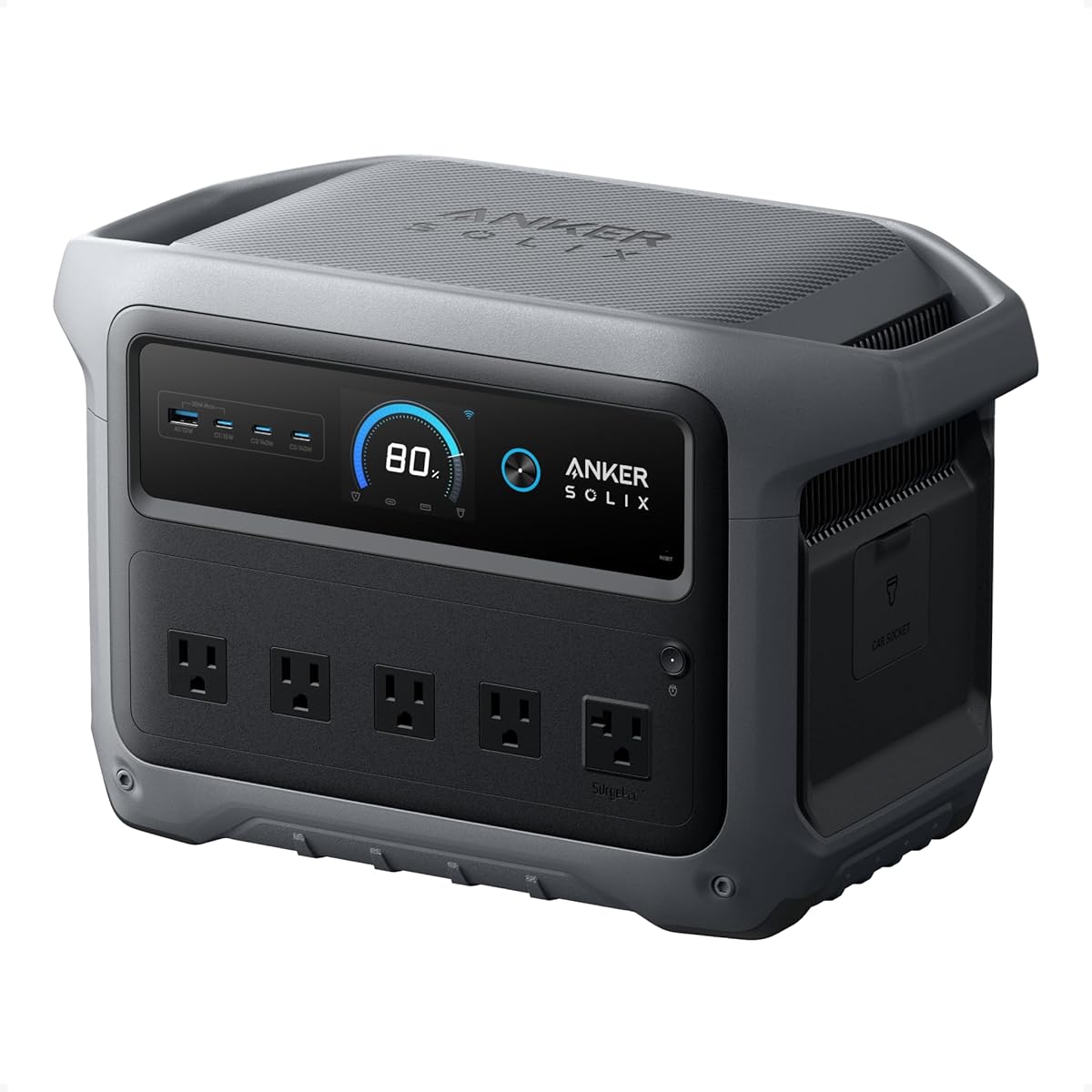
The Anker SOLIX C1000 is a 1,056Wh portable power station designed around fast replenishment and broad appliance compatibility. Its 4.7 rating reflects a strong overall result, while the listed UltraFast technology can take the battery from empty to 80% in approximately 43 minutes when enabled through the Anker app and operated within the stated 68–122°F temperature range. A full charge can be completed in under an hour.
We may earn a commission when you buy through this link, at no additional cost to you.
SurgePad technology allows the unit to deliver up to 2,400W of surge power, and the supplied information says it can power 99% of appliances through eleven ports. In practical terms, buyers should still compare the exact wattage and startup requirements of their appliances with the unit's limits. The large port count is useful for a mixed collection of AC, USB, and automotive devices, reducing the need to carry multiple adapters.
Solar charging can reach 600W, allowing a full charge in about 1.8 hours under favorable conditions. The LiFePO4 battery is rated for 3,000 cycles over a ten-year lifespan, and the enclosure is stated to be 15% smaller than comparable one-kilowatt-hour units. The Anker app lets users customize charging behavior and inspect real-time power statistics, which adds visibility when planning energy use.
The principal caveat is that the fastest charging behavior requires the appropriate app setting and suitable operating temperatures. Likewise, the stated solar recharge time is a best-case figure influenced by light, panel alignment, and charging losses. The C1000 is recommended for owners who want rapid turnaround, a generous selection of outputs, and enough stored energy for home, RV, and camping use without moving to a large two- or three-kilowatt-hour system.
Fast wall charging is particularly valuable when an outage warning arrives, a trip begins unexpectedly, or the station must be topped up between uses. The ability to reach 80% in 43 minutes makes the C1000 easier to maintain as an active backup resource than slower-charging models.
Eleven ports offer more flexibility than most competitors in the same capacity class. The broad selection allows users to connect AC appliances, USB-C equipment, USB-A accessories, and vehicle-powered devices without repeatedly moving a single adapter between sockets.
We may earn a commission when you buy through this link, at no additional cost to you.
The BLUETTI Elite 300 is the most premium-oriented station in this guide, with 3,014Wh of capacity, 2,400W continuous output, and 4,800W surge capability. It has a 4.7 rating and is built for RV travel, home backup, and off-grid road trips. Frost & Sullivan recognition cited in the supplied data supports its positioning as an unusually compact three-kilowatt-hour system, though buyers should still plan around the reality of moving a large energy store.
We may earn a commission when you buy through this link, at no additional cost to you.
RV compatibility is a major distinguishing feature. A TT-30 outlet and 12V/30A DC output support appliances such as 12-volt refrigerators, water pumps, and diesel heaters, reducing the need for adapters designed only for household receptacles. For home outages, the battery can operate refrigerators, routers, lights, televisions, CPAP machines, and other essentials. Runtime will depend on each load, but the larger reserve gives it more flexibility than typical portable camping stations.
The 10ms UPS function allows computers, routers, and home-office equipment to continue operating when utility power fails, assuming the station is configured correctly and the connected loads are compatible. Recharging is flexible through AC outlets, solar panels, or a car charger, and the unit can reach 80% in as little as 78 minutes. The BLUETTI app provides monitoring, output controls, and configuration options for changing energy demands.
This is not the most convenient model for hand-carrying, nor is it intended for people seeking a tiny camping accessory. Its advantages appear when it serves as a mobile RV power system, a weekend cabin supply, or a home battery that must cover multiple critical loads. For those needs, the Elite 300 offers the most capacity and one of the strongest output ratings in the group, justifying our premium selection.
The TT-30 socket and high-current 12V output distinguish the Elite 300 from general-purpose portable stations. These connections are especially relevant to RV owners who need to power refrigeration, pumps, heating equipment, or other vehicle systems with appropriately rated components.
A three-kilowatt-hour battery can support a broader mix of essential appliances than a one-kilowatt-hour unit. The 2,400W continuous output and 4,800W surge rating also provide more headroom for resistive loads and appliances that draw extra power while starting.
We may earn a commission when you buy through this link, at no additional cost to you.
The BLUETTI Elite 30 V2 is a compact 288Wh lithium portable solar power station for buyers who prioritize manageable size over extended runtime. It weighs 9.4 pounds, carries a 4.4 rating, and provides 600W of continuous output. That combination is sufficient for lights, speakers, laptops, routers, CPAP machines, car refrigerators, and many smaller essentials, but it should not be approached as a substitute for a full home backup battery.
We may earn a commission when you buy through this link, at no additional cost to you.
Its standout feature is Power Lifting Mode, which can raise available output to 1,500W for compatible devices. The supplied information compares this with a typical 600W limit and notes support for small kettles and toasters among the examples. This feature is useful when a device briefly needs more than the normal continuous allowance, although users should confirm appliance compatibility and avoid exceeding the unit's overall electrical limits.
Efficiency receives particular attention. The listed standby draw is 4.5 watts, DC draw is five watts, and AC draw is eight watts, with the upgraded UltraCell technology and cooling system intended to reduce power consumption by 50%. The unit supports eight charging modes, including adjustable AC input, solar, and car charging. It can reach 80% capacity in 45 minutes and complete a full charge in 70 minutes through its battery-safe wall-charging mode.
A 10ms UPS switch helps protect laptops, routers, and CPAP equipment during short outages. The 288Wh capacity remains the main limitation, and the Elite 30 V2's 9.4-pound weight is slightly above the lightest model in the list. It is still highly portable and recommended for short camping trips, mobile offices, car fridges, and emergency kits where low standby consumption and fast replenishment matter more than all-day appliance support.
At 600W continuous output, the Elite 30 V2 moves well beyond the phone-and-tablet category. It can run appropriate camping equipment and small household appliances, giving users more freedom than a conventional power bank while retaining a relatively easy carrying weight.
The 380W wall input and 70-minute full-charge time make the station easy to prepare between outings. Solar and car charging add flexibility, while the stated low-power consumption helps preserve stored energy when the unit is not actively serving a large load.
We may earn a commission when you buy through this link, at no additional cost to you.
The Anker SOLIX C1000 Gen 2 is a balanced 1,024Wh power station with 2,000W continuous output, 3,000W peak output, and ten ports. Its 4.7 rating and combination of rapid charging, 10ms UPS response, and a relatively compact enclosure make it one of the most complete options for camping, RV use, remote work, emergency backup, and off-grid living.
We may earn a commission when you buy through this link, at no additional cost to you.
The key charging upgrade is HyperFlash technology. With the appropriate app setting, the unit can be fully recharged at 1,600W in approximately 49 minutes. That speed is valuable when a station must be ready for an approaching storm or when users have limited time between trips. Solar input of up to 600W is also supported, with a stated full recharge in 1.8 hours under ideal conditions. A compatible panel is not included, so buyers must add one if solar operation is important.
Despite its capabilities, the C1000 Gen 2 is stated to be 14% smaller and 11% lighter than similar models, making it easier to move from room to room, into an RV, or to a park. It can support up to ten devices, including emergency essentials, remote-work electronics, and household appliances within the output limit. The 10ms UPS feature can maintain compatible CPAP machines, laptops, and routers when utility power stops.
The LFP battery is rated to retain at least 80% capacity after 4,000 cycles, supporting a long service life. The app also provides time-of-use mode, real-time monitoring, and control of charging behavior. We recommend this model for buyers who want high output and fast turnaround without carrying a three-kilowatt-hour system. Its balance of size, power, charging, and battery longevity is especially persuasive.
A full recharge in 49 minutes minimizes downtime between uses. This is particularly helpful for households treating the unit as emergency equipment because it can remain near full capacity between outages without requiring an extended overnight recharge every time it is used.
Ten ports and 2,000W continuous output are enough for a varied collection of electronics and suitable appliances. The station can support laptops, communications equipment, household devices, and RV accessories without forcing users into a narrow one-device-at-a-time setup.
We may earn a commission when you buy through this link, at no additional cost to you.
The BLUETTI AC180 combines a 1,152Wh LiFePO4 battery with 1,800W continuous output, giving it more power than many similarly sized camping stations. Its 4.6 rating reflects a solid overall profile, while the ability to fully charge in one hour at 1,440W AC input makes it especially convenient for users who need to replenish energy quickly.
We may earn a commission when you buy through this link, at no additional cost to you.
Eight outlets provide enough flexibility for a mixed set of devices, and an app-based Power Lifting mode can raise the available output to 2,700W. That extra allowance is helpful for compatible appliances with high startup demand, although the total connected load must remain appropriate for the system's capabilities. The AC180 can support refrigerators, electronics, tools, and other equipment depending on their individual power requirements.
Solar input of 500W is generous for the class. The supplied information estimates a solar-only recharge in approximately 2.8 to 3.3 hours, or about one hour when an AC source is added. Those figures show that the station can be replenished quickly when multiple inputs are available. The 20ms UPS mode can keep essential devices running during an outage, offering useful continuity for compatible electronics.
The supplied bundle includes an AC charging cable, car charging cable, solar charging cable, user manual, and a five-year warranty. The AC180 is recommended for campers, homeowners, and mobile workers who want strong continuous output and rapid AC recharging in a familiar mid-capacity format. Those needing nearly instantaneous backup switching may prefer one of the 10ms UPS models in this guide.
A 1,440W AC input enables a full charge in about one hour, one of the strongest recovery figures among the included products. It makes the AC180 practical for short-notice trips and reduces the time the unit spends partially depleted.
The 500W solar input allows meaningful replenishment in a single sunny session, while combining solar and AC can shorten the total cycle further. Users can also recharge from a vehicle, making the station adaptable to road trips and remote work locations.
We may earn a commission when you buy through this link, at no additional cost to you.
The ZeroKor Portable Solar Kit offers a different approach from the larger stations: it includes a 300W main power station with a 280Wh lithium battery, a foldable 40W solar panel, and a separate 100W portable power unit. The bundle has a 4.8 rating, making it one of the highest-rated options here, and it is intended for basic camping, RV, home, and outdoor charging needs.
We may earn a commission when you buy through this link, at no additional cost to you.
The main unit includes two 110-volt AC outlets rated for up to 300W, a DC output, three USB-A ports, and a QC3.0 USB port. A flashlight provides reading and SOS modes, which are useful around camps and during outages. The smaller 100W unit adds two AC outlets, DC and USB connections, a QC USB port, and a USB-C port. Together, the two units offer more flexibility than a single compact power bank.
The 40W foldable panel is straightforward for maintaining a modest battery reserve, but it is slow compared with the 200W to 600W solar input offered by several competitors. The main station can charge compatible phones, tablets, laptops, headphones, cameras, drones, and other small camping electronics. Its pure sine wave AC output is also useful for compatible low-to-moderate loads.
The listing clearly warns against using electrical appliances over 300W, especially heat-producing devices and products with built-in compressors, such as coffee makers, hair dryers, and water pumps. That limitation makes this kit more appropriate for lightweight travel and emergency communication than extended home backup. It is recommended for buyers who value a complete two-unit package, a foldable panel, and straightforward outputs more than high continuous wattage.
The main station and smaller power unit can be carried separately, placed in different vehicles, or used for different device groups. That flexibility can be helpful in travel scenarios where one device is needed in a tent while another remains with equipment in the vehicle.
Both units include flashlights, while the main unit offers reading and SOS modes. Low-noise, gas-free operation also makes them comfortable to use indoors, although runtime and device support remain limited by the modest battery capacities.
We may earn a commission when you buy through this link, at no additional cost to you.
The most useful lithium portable solar power station is not necessarily the one with the largest specification. Capacity, output, charging speed, UPS response, and portability must be balanced according to the devices you plan to run and how often the unit will be moved.
Match capacity to realistic use, and avoid calculating runtime from a single device alone. Start with the combined wattage of everything you expect to operate, estimate their hours of use, and then add a reasonable reserve for conversion losses and changing conditions. Choose the smallest capacity that comfortably covers that plan.
Do not select a station solely by its peak number. Peak output does not mean the load can run continuously, and power-lifting modes may involve compatibility limits. Prioritize continuous ratings for normal operation, then verify that surge capacity comfortably covers startup behavior.
For occasional use, prioritize wall or car charging speed. For prolonged off-grid use, match the panel to the station's input limit and consider a folding or portable panel. Real solar results will be slower in heat, cloud, shade, or poor orientation, so treat published charge times as best-case estimates.
List every device you intend to connect, then verify the matching outlet type, voltage, and maximum current. USB-C is not automatically universal, and a 12V socket does not guarantee support for every accessory. Confirm compatibility before the unit leaves the return window.
Choose a station with UPS only if uninterrupted operation is genuinely important. Keep essential equipment connected through the appropriate output, test the setup with the wall disconnect before relying on it, and confirm that the device remains within the station's power and capacity limits.
Measure the intended storage and transport area before buying. Check the listed dimensions and weight, not just capacity. If frequent manual carrying is required, favor a compact unit and accept a smaller reserve; if the station will be stationary, prioritize output and capacity.
Favor LiFePO4 when longevity and thermal stability are priorities. Store the unit partially charged, keep it in a temperature-appropriate location, and follow the manufacturer's guidance for long-term storage. Inspect the battery and replace it if capacity becomes inadequate or physical damage appears.
App control is an advantage, not a substitute for understanding the hardware. Review the available charging modes before departure, preserve emergency settings for genuine need, and use real-time monitoring to identify unexpectedly high standby or appliance consumption.
Before first use, read the included manual, inspect the station and cables for visible damage, and confirm that the battery is at a reasonable charge level. Connect only compatible loads, observe polarity on DC connections, and avoid exceeding the continuous output rating. For initial charging, use a clean wall outlet and the supplied or manufacturer-approved cable. If the product has an app, install it and review the available charging modes before enabling the fastest setting.
Plan solar use with realistic expectations. Position the panel where it receives direct, unobstructed sunlight, angle it toward the sun, and avoid placing it on hot vehicle roofs or where heat can build up. A station can often supply small loads while charging, but continuous heavy output may reduce the rate of solar recovery. Check the panel voltage and connector type, use the proper solar cable, and never connect an incompatible panel. Monitor charging through the display or app rather than assuming every session will achieve the published fastest time.
For outages, test UPS support before you need it by disconnecting the wall input while compatible critical devices are operating. Keep heavy loads off the UPS side if the station does not have enough capacity, and allow ventilation around the enclosure. Store the unit in a dry, temperature-controlled place, partially charged if it will sit unused for an extended period. Recharge it periodically, inspect cords and connectors, and stop using the station if it becomes excessively hot, swells, leaks, or shows cable damage.
For lightweight camping, a station between 280Wh and 300Wh is usually enough for phones, cameras, lights, speakers, laptops, and smaller car refrigerators. A roughly 1,000Wh model is better for several days away from mains power or for higher-draw appliances. Choose based on your device list and how much runtime you need rather than selecting the largest unit that can be carried.
It depends on the refrigerator's running and startup power requirements and the station's capacity. Models with 600W to 2,400W continuous output can run many suitable car or standard refrigerators, but runtime varies with compressor behavior and ambient temperature. A larger capacity will generally last longer, while surge capacity must cover the compressor's startup demand.
A built-in panel is convenient because it removes the need to carry another component, but it is often relatively low wattage. Separate 200W to 600W panels can recharge supported stations much faster when sunlight and positioning are favorable. A built-in design is convenient for maintenance and emergencies, while a larger external panel is usually better for sustained off-grid use.
A 10ms UPS switchover means the station begins supplying power within roughly ten milliseconds after an outage is detected. That is generally fast enough for many computers, routers, and other sensitive electronics. It does not guarantee compatibility with every device, so critical equipment should be tested before relying on automatic backup.
Yes, when the combined device demand remains within the station's output and battery limits. Models in this guide offer as many as eleven ports, including AC, USB-C, USB-A, and DC connections. Adding more devices does not create additional power, so high-draw appliances can reduce runtime or trigger protection, and some ports may share a power budget.
LiFePO4 is generally favored for portable power stations because of its strong cycle life, thermal stability, and safety record. The models listed here claim service lives ranging from about 10 years to 15 years under stated conditions. Actual longevity depends on temperature, charge depth, charging practices, and maintenance, so owners should still follow the manufacturer's care instructions.
The appropriate panel depends on the station's maximum solar input and how quickly you want to recover. A 40W panel is suitable for small stations and maintenance charging, while 100W to 200W panels offer more flexibility, and 300W to 600W inputs can support rapid recharging where supported. Even with a larger panel, clouds, heat, orientation, and system losses increase actual charge times.
Keep the station charged, along with its approved charging cables, the correct solar-panel connector if applicable, and a cable for the devices you expect to operate. An AC extension lead, plug adapter, flashlight, and basic first-aid supplies can also be useful. Store everything in a dry bag and rehearse the setup so you do not have to troubleshoot unfamiliar connections during an outage.
The Jackery Explorer 300 is the strongest general recommendation for buyers seeking a light, easy-to-carry station with a practical mix of AC and USB connections. The Anker SOLIX C1000 Gen 2 stands out for fast recharging, 2,000W continuous output, ten ports, and useful UPS support, while the BLUETTI Elite 300 is the premium choice for buyers who need more than three kilowatts of stored energy and RV-specific connections.
Prioritize the specifications that affect your actual equipment. Small-capacity units are easier to carry and recharge, mid-capacity systems suit many camping and emergency needs, and high-capacity systems are most valuable when they can remain in an RV, workshop, or home. Always check continuous output, surge limits, connector types, UPS response, solar compatibility, battery age, and the exact contents of the package before making a final decision.
Solar capability, included accessories, firmware behavior, and product details can change over time, so compare the current listing with the specifications discussed in this guide. Checking recent customer feedback, confirming the latest manufacturer instructions, and verifying compatibility with your devices will help ensure that the selected lithium portable solar power station fits the job.