
XbotGo Chameleon AI Auto Sports Action Camera
3.8Editor score
Tracking across 20 sports
360-degree panoramic tracking
Live streaming included
Our guide compares 10 court cameras with auto tracking for tennis, evaluating sports AI, tracking modes, court coverage, streaming options, mounting flexibility
Recording tennis alone is difficult because the ball can move faster than an operator can pan, tilt, and zoom. A court camera with auto tracking uses AI-assisted framing to follow players or the ball, helping preserve the rally when nobody is available to operate a traditional tripod camera manually.
The products in this guide were compared using their stated tracking technology, supported sports, camera type, viewing coverage, recording resolutions, live-streaming functions, installation options, and included accessories. The list includes dedicated sports cameras, phone-based tracking systems, and professional PTZ cameras that may require more setup than a consumer sports solution.
Each review explains the product's strongest use case, practical limitations, and suitability for tennis. The top picks represent the most compelling balance of tracking, court coverage, setup convenience, and production flexibility, although the ideal choice depends on whether you need a portable sideline camera, a phone-assisted system, or a permanent live-production installation. Prices and availability change over time.
3.8Editor score

3.9Editor score

4.7Editor score
This side-by-side comparison evaluates each camera's tracking approach, recording capability, court coverage, connectivity, and physical setup, with particular attention to how useful each system may be for tennis.


The XbotGo Falcon is a dedicated AI sports action camera designed to record games without requiring a person to remain behind the lens. Its 3.9 rating is not the highest in this guide, but its sports-specific design, dual-lens arrangement, and 6 TOPS AI processing make it one of the most relevant choices for the stated goal of capturing tennis automatically. The all-in-one approach is especially attractive for parents, coaches, and club volunteers.
We may earn a commission when you buy through this link, at no additional cost to you.
Its AI system is intended to recognize the principal action and keep it centered, which could help preserve a rally when a player crosses a wide court. The dedicated recording lens captures 4K footage, while a second AI-assisted lens supports tracking. A standard 1/4-inch tripod interface, Wi-Fi live streaming, and support for microSD or cloud storage give the Falcon more flexibility than a basic fixed camera.
The important caveat is that the supplied product information does not explicitly identify tennis as a supported sport. AI tracking also cannot be assumed to follow a tennis ball with the same consistency as a system specifically trained on ball movement. Its 3.9 rating suggests some user experience may be less than ideal, so buyers should verify tennis recognition and court framing before committing to a long-term setup.
Despite those limitations, the Falcon is the strongest all-in-one recommendation for tennis users who want a portable sports camera rather than a complicated PTZ production system. It is a practical choice for practices, recreational matches, and livestream highlights, particularly when a tripod and a clear line of sight can be established. A buyer primarily interested in formal court coverage should test the tracking behavior on a similar surface first.
The Falcon's AI tracking and 8-core processor are designed to keep the main action centered without continuous manual control. That hands-free philosophy is particularly relevant on tennis courts, where rapid lateral movement can pull a fixed camera away from the point of interest.
The camera combines 4K dual-lens recording with Wi-Fi live streaming, microSD support, and cloud storage options. A standard tripod mount also makes it easier to place the unit at the end or side of a court without constructing a permanent installation.
We may earn a commission when you buy through this link, at no additional cost to you.
The XbotGo Chameleon is an AI sports camera system with a 3.8 rating, 4K 60 FPS recording, and a 360-degree panoramic tracking feature. Its title emphasizes soccer and basketball, but the stated xbotVision AI 2.0 algorithm supports more than 20 sports, making it a potentially versatile choice for households or clubs that record several activities. Tennis is not specifically named in the supplied sports examples, so users should confirm compatibility.
We may earn a commission when you buy through this link, at no additional cost to you.
The camera combines a 120-degree ultra-wide-angle AI lens with panoramic tracking to preserve more context during movement. AI-assisted editing can produce montages and highlights, while integrated live streaming makes it practical for sharing a match with family or followers. A Bluetooth remote, Apple Watch integration, and compatibility with iOS and Android improve control when the phone or camera is positioned near the court.
No subscription is required, which removes an ongoing cost from the purchase decision. The trade-off is its 3.8 rating, the lowest numerical score among the rated products here, and the lack of an explicit tennis-specific claim. The panoramic system may also need careful placement so that digital reframing does not crop important parts of the court during fast exchanges.
This is a compelling value-oriented choice for buyers who want one sports camera for several activities and do not need a professional broadcast installation. It may be especially useful for doubles play, where keeping both players and the ball within the frame is important. Confirm the app experience, tracking setup, and tennis recognition before the first important match, then use the included remote for quick framing adjustments.
With support claimed for more than 20 sports, the Chameleon can serve as a general sports-recording system rather than a single-purpose accessory. That breadth is useful for families, recreational leagues, and coaching professionals who cover more than one activity.
The stated no-subscription design covers live streaming and AI-assisted editing without requiring a recurring service. Buyers can therefore focus on the initial hardware setup rather than ongoing feature access.
We may earn a commission when you buy through this link, at no additional cost to you.
The BallerCam AI System combines a 180-degree ultra-wide lens with software that digitally follows the ball and key action. Its 4.4 rating is strong, and the full-field design avoids the mechanical panning errors that can occur when a PTZ camera moves too quickly. However, the listed sports are basketball, soccer, futsal, flag football, and volleyball, with no explicit tennis support.
We may earn a commission when you buy through this link, at no additional cost to you.
The system uses sports-tracking AI built on more than two million games and recognizes the court or field before centering the action. Unlike a physical pan-tilt-zoom camera, it remains stationary and changes the digital framing. It also supports live-stream links, app-based clipping, downloads to the camera roll, and instant sharing, with 20 hours of cloud storage included and optional paid upgrades.
The major limitation is tennis suitability. A tennis ball is smaller and faster than most balls in the named sports, and the system may not recognize the court, ball, or movement pattern correctly. The product is also tied to an iPhone 15 Pro and requires the phone to be mounted on a tripod, so it is not a self-contained camera like the Falcon or Chameleon.
For a buyer seeking extremely wide digital coverage and quick social sharing, BallerCam is interesting, but it should not be selected as a confirmed tennis tracker without verification. It is more appropriate for a player who already owns the required phone and wants a simple app-based setup. For tennis, the XbotGo models have a closer connection to sports auto-tracking, while the PTZ options offer a more traditional camera platform.
The 180-degree lens keeps a wide view of the playing area while the software digitally reframes the action. This can reduce missed points caused by a physical camera lagging behind rapid movement.
The companion app supports live links, highlight clipping, camera-roll downloads, and immediate sharing. These features are useful for parents and coaches who want short clips rather than lengthy full-match uploads.
We may earn a commission when you buy through this link, at no additional cost to you.
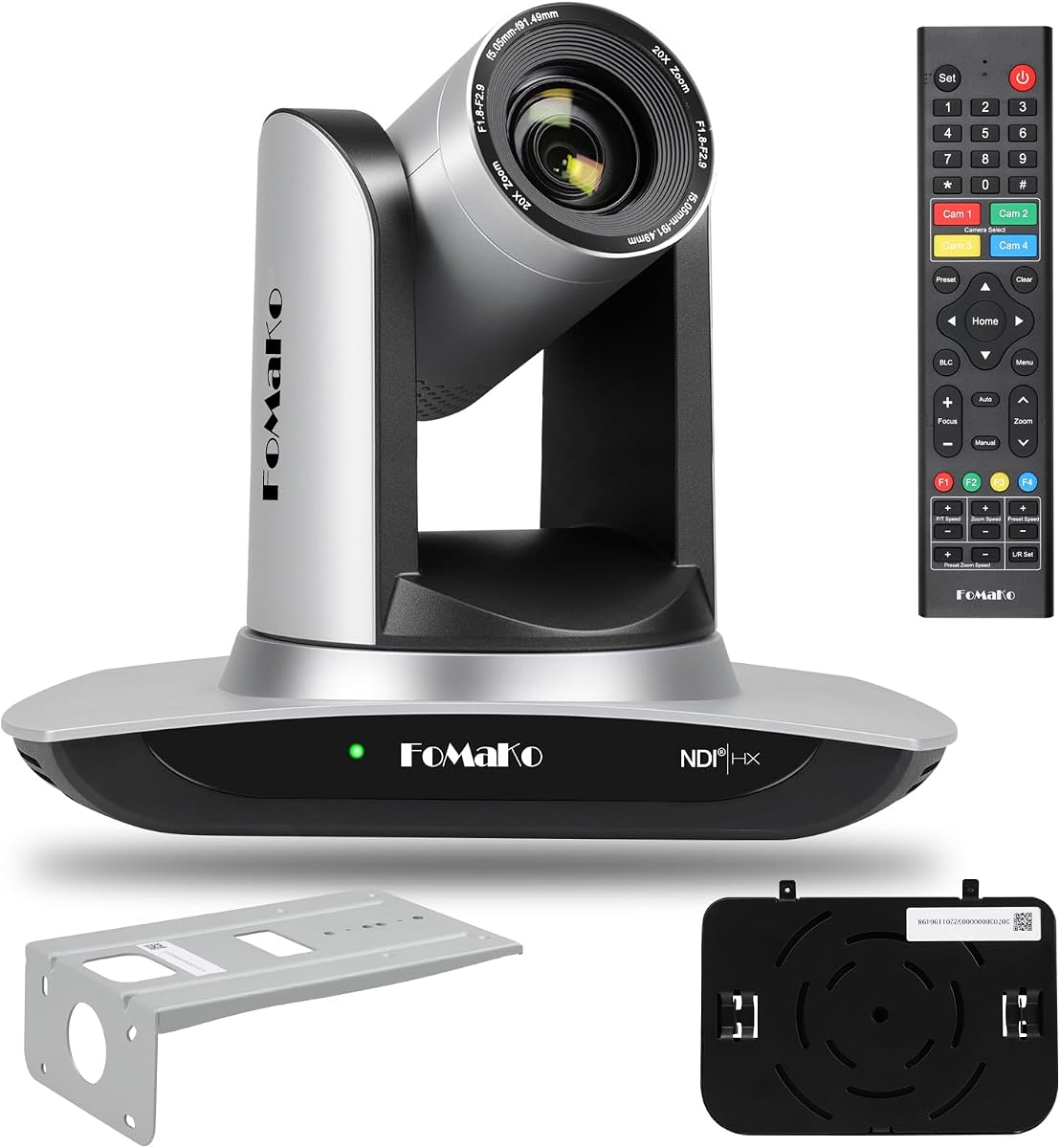
The FoMaKo K20UH is a professional PTZ camera with a 4.4 rating, 20x optical zoom, and third-generation AI tracking. It is designed for churches, education, conferences, and live production rather than being marketed exclusively as a sports camera. Nevertheless, its motorized pan, tilt, zoom, and adjustable tracking modes could make it a flexible option for covering tennis from a fixed installation.
We may earn a commission when you buy through this link, at no additional cost to you.
The camera outputs 4K at 30 FPS through HDMI, with 1080p at 60 FPS also available. It supports USB 3.0, LAN, NDI HX3, PoE, RTSP, RTMP, SRT, and common PTZ control protocols. Tracking settings include sensitivity, target size, character position, lost-target behavior, real-time tracking, and regional tracking, allowing an installer to adapt the camera to a particular court.
The main concern is that this is a general PTZ system, not a ball-tracking tennis camera. Its human and regional tracking may follow a player or defined area, but the supplied information does not state that it recognizes a tennis ball. A fast baseline exchange could also exceed the practical response of a camera configured for presenters and large-room production. Setup also involves networking and live-production software rather than a simple mobile sports app.
Despite these caveats, the K20UH is a strong choice for a tennis club, academy, or production team that already uses NDI or OBS-style workflows. Its optical zoom and remote controls can deliver a more polished, repeatable camera move than a phone app. A buyer should test target reacquisition during rapid tennis movement and ensure the selected tracking mode is appropriate before installing it beside a court.
Gen 3 AI tracking lets an installer adjust sensitivity, figure size, character position, and lost-target behavior. Those controls can reduce unnecessary camera movement, although they do not guarantee ball recognition on a tennis court.
HDMI, USB, LAN, NDI, PoE, and multiple network protocols support everything from direct recording to multi-camera live production. The broad connectivity makes the camera easier to integrate into an existing club or streaming system.
We may earn a commission when you buy through this link, at no additional cost to you.
The XbotGo Falcon NT4 Bundle combines the Falcon AI sports camera with an NT4 steel tripod, offering a ready-to-use setup for recording practices and matches. No customer rating is supplied for this bundle, so it cannot be evaluated through a numerical score. Its appeal comes from the convenience of receiving the camera and a stable support system together.
We may earn a commission when you buy through this link, at no additional cost to you.
The steel tripod is designed for dependable support and is light enough to move between fields or courts. Combined with the Falcon's AI auto-tracking, 4K recording, and hands-free operation, it removes the need to solve mounting separately. The bundle is listed as suitable for soccer, basketball, football, volleyball, baseball, softball, lacrosse, and other team sports.
Its limitation is that the bundle does not add a tennis-specific tracking mode or lens. Tennis remains outside the explicitly named sports in the supplied information, and the broader list emphasizes team sports with a larger ball and more players. Buyers should therefore not equate the inclusion of a tripod with a guarantee of precise tennis-ball following.
This bundle is best for buyers who value portability and quick setup over advanced manual controls. It should appeal to coaches, parents, and recreational players who want a dedicated sports camera and stable tripod in one package. It may also be easier to establish a consistent angle than a phone-based system. Verify tennis tracking behavior and field of view before using it for important footage.
The included NT4 steel tripod provides a dedicated support for the Falcon. Its quick assembly makes it possible to establish the same recording angle at different courts without separately sourcing a compatible mount.
The bundle brings together the core camera and support needed for unattended recording. That simplicity is valuable for volunteers and coaches who want a working setup without extensive configuration.
We may earn a commission when you buy through this link, at no additional cost to you.
The FoMaKo K600N Camera Bundle is the most production-oriented option in the list, with a 4.5 rating, three cameras, 20x optical zoom, and third-generation AI tracking. It can output 4K at 60 FPS through NDI HX3, HDMI, and USB, while 3G-SDI provides 1080p at 60 FPS. This configuration is designed for large live-production environments rather than a single casual court recording.
We may earn a commission when you buy through this link, at no additional cost to you.
Each camera supports AI tracking, automatic focus, motorized pan and tilt, and extensive network protocols. The bundle works with video switchers, controllers, vMix, OBS, and other production software. Three cameras can provide different angles, wider views, and close-ups during a tennis match, which may be more useful than asking one tracking camera to handle every framing decision.
The trade-off is complexity. Operating multiple PTZ cameras, configuring NDI or other video outputs, and managing a live production requires more knowledge and equipment than a dedicated sports camera. Although each camera tracks people and configurable regions, the supplied data does not identify tennis-ball tracking. Fast ball movement could also expose latency or reacquisition limitations.
This bundle makes sense for an academy, club, tournament organizer, or production team that needs a permanent multi-angle court system. It is the most complete infrastructure-oriented choice here, with 4K 60 FPS capability and professional outputs supporting live switching. For a single player who only wants occasional clips, a dedicated XbotGo camera is likely easier to operate.
Three PTZ cameras can cover the baseline, sideline, and a tighter view without forcing one unit to follow every movement. The result is more useful for broadcasts, coaching review, and tournament documentation.
Simultaneous NDI HX3, HDMI, USB, and 3G-SDI outputs support flexible production pipelines. The 4K 60 FPS capability is well suited to high-motion sports when the full system is configured correctly.
We may earn a commission when you buy through this link, at no additional cost to you.
The Tenveo 20X NDI PTZ has a 4.4 rating and uses deep-learning algorithms for humanoid and face tracking. Unlike ball-oriented sports cameras, its strongest feature is keeping a person centered. On a tennis court, that could work well for a player practicing serves at the baseline, a coach demonstrating technique, or a singles match where one competitor is the intended subject.
We may earn a commission when you buy through this link, at no additional cost to you.
The camera captures 4K at 30 FPS and 1080p at 60 FPS through a 1/2.8-inch Sony CMOS sensor with 8.29 effective megapixels. It has 20x optical zoom, 350-degree horizontal rotation, 180-degree vertical movement, silent operation, presets, and deep-learning tracking. It can retain a target after an obstruction, which is useful when a player briefly passes behind another person or an object.
The trade-off is that humanoid and face tracking is not equivalent to tennis-ball tracking. During a rally, the camera may lock onto a player's body rather than the ball, leaving the shot framed on the person instead of the most relevant point of contact. The supplied information also does not mention tennis as a specialized application. A PoE switch is needed for that connection method, and the camera has no built-in microphone.
This Tenveo is a good option for individual instruction, player-focused recording, and hybrid church or club production. It is less appropriate when the primary requirement is following a small, fast ball across a full court. It earns its place for sophisticated person tracking, flexible IP workflows, and reliable motorized framing rather than a dedicated tennis experience.
Dual body and face tracking can frame a single player more consistently than basic motion detection. The stated ability to recover a blocked target is useful during close drills or shots involving multiple people.
Silent pan, tilt, and zoom operation reduces distracting mechanical noise during instruction or streaming. Preset positions and multiple control interfaces also support repeatable event coverage.
We may earn a commission when you buy through this link, at no additional cost to you.
The PTZOptics Move SE 30x has a 4.7 rating, the highest numerical rating among the products in this guide. It is a 1080p PTZ camera designed for education, conferences, and live broadcasts, with 30x optical zoom and 60 FPS Full HD recording. It is not marketed as a tennis-specific system, yet its motorized framing and advanced optics make it a credible premium choice for a well-placed court camera.
We may earn a commission when you buy through this link, at no additional cost to you.
The camera provides simultaneous HDMI, SDI, NDI, USB, and IP outputs. Control is available through an IR remote, network connection, RS-232, RS-485, web interface, PTZ Control App, USB, and Camera Management Platform. Network discovery simplifies setup, while the 30x zoom allows a wide court view or a tighter view of a player without relying on digital cropping.
The resolution ceiling is 1080p rather than 4K, which may be a drawback for users who need aggressive cropping or very detailed court imagery. The supplied data also does not promise tennis-ball tracking, high-speed sports autofocus, or a tennis-specific tracking mode. The camera should therefore be evaluated as a general auto-tracking PTZ unit whose usefulness depends on placement and the software's target behavior.
The Move SE 30x is recommended for academies, clubs, and production-minded users who value strong optics, flexible outputs, and established control options. It is particularly attractive when a single camera must serve instructional, live-streaming, and recording functions. For a typical player wanting effortless tennis clips, the dedicated XbotGo systems are simpler, but this model offers more manual control and a stronger overall rating.
The 30x optical zoom lets an operator move from a full-court composition to a tighter player view while preserving image detail. That range is useful in facilities where the camera must serve several court sizes or camera positions.
Simultaneous HDMI, SDI, NDI, USB, and IP outputs make it possible to record, stream, and control the unit within different workflows. Numerous remote and network control paths also support both simple and professional operation.
We may earn a commission when you buy through this link, at no additional cost to you.
The AVKANS LV20N is a 4.6-rated PTZ camera with 20x optical zoom, 1080p at 60 FPS, and third-generation AI tracking. It is marketed for live events, worship, media production, and sports, but it does not promise tennis-ball tracking. In fact, the supplied information explicitly notes that the camera tracks one person and cannot track people who run like soccer or hockey players, which is a significant caution for tennis.
We may earn a commission when you buy through this link, at no additional cost to you.
Three tracking modes—presenter, zone, and hybrid—allow the camera to follow a subject, monitor a defined area, or combine both approaches. The camera can be adjusted by tracking area, sensitivity, and speed. It also supports HDMI, SDI, USB, and NDI outputs, with both NDI HX2 and HX3 available. OBS, vMix, Streamlabs, ProPresenter, Wirecast, and other NDI-compatible tools are named as suitable software.
For tennis, the one-person limitation and inability to follow running players are major drawbacks. A baseline rally, doubles point, or repeated directional movement could exceed the tracking behavior described in the product information. The 20x zoom and 1080p 60 FPS output are still useful for fixed views, court-wide coverage, and manual operation, but they do not resolve the underlying tracking limitation.
The LV20N is best suited to presenter-led instruction, an individual athlete demonstration, a fixed teaching area, or a facility that needs a general PTZ camera. A tennis club might use it with presets and manual control rather than relying on auto-tracking during a full match. It is a capable production camera, but it should not be purchased under the assumption that it will intelligently follow a tennis rally.
Presenter, zone, and hybrid modes make the camera adaptable to different spaces. For tennis instruction, presenter mode may work better for a stationary player, while zone mode can monitor a defined baseline or practice area.
HDMI, SDI, USB, and two NDI generations support recording and live production across different equipment. The included tally light can also indicate preview and program status in compatible NDI workflows.
We may earn a commission when you buy through this link, at no additional cost to you.
The FoMaKo FMK20UH NDI has a 4.6 rating and combines third-generation AI tracking with 20x optical zoom in a professional PTZ design. It supports Full HD video at up to 60 FPS through HDMI, USB 3.0, LAN, and NDI. The official NDI 6 and NDI HX3 certification makes it a solid choice for facilities that already operate IP-based live-production systems.
We may earn a commission when you buy through this link, at no additional cost to you.
Tracking can be customized through real-time or regional modes, sensitivity, figure size, character position, and lost-target behavior. Automatic focus supports Auto, Manual, and One Push Focus settings, while the camera offers pan, tilt, and zoom speed controls. It also includes a gravity sensor, auto-flip, a browser-based setup process, presets, and compatibility with common switching and streaming applications.
As with the other FoMaKo PTZ cameras, tennis is not identified as a specialized sport. The tracking system is more consistent with presenter, regional, or human-following behavior than rapid ball recognition. Full HD resolution is suitable for normal live viewing, but it offers less cropping latitude than a 4K model. Audio also requires an external microphone because no built-in mic is included.
The FMK20UH NDI is a good selection for a club, academy, or production team wanting dependable networked PTZ control. It may be especially useful when the same camera must record instruction, stream matches, and participate in a multi-camera production. For a tennis buyer, it is most appropriate as a general facility camera with manual presets and adjustable tracking, rather than a purpose-built tennis-ball follower.
Third-generation tracking provides several controls for target acquisition and reacquisition. These settings can be tuned for different courts and shooting positions, even though the camera is not described as a dedicated tennis-ball tracker.
Official NDI 6 and NDI HX3 certification supports low-latency IP workflows. Compatibility with OBS, vMix, StreamYards, Streamlabs, Wirecast, and Zoom makes the camera easier to integrate into an existing production environment.
We may earn a commission when you buy through this link, at no additional cost to you.
The right tennis camera depends on whether you value fully automated sports tracking, flexible digital framing, or professional PTZ control. Consider the camera's target type, court coverage, connection method, installation demands, and recording workflow before making a selection.
A player-tracking camera keeps a person or defined region centered and can work well for instruction, serving drills, and individual analysis. A ball-tracking sports camera attempts to preserve the ball and point of contact, which is more appropriate for a complete rally. The products here differ significantly: the XbotGo systems are described as sports AI cameras, while the PTZ models generally provide humanoid, face, presenter, zone, or hybrid tracking. Tennis is not explicitly listed as a supported sport for most of the general PTZ cameras.
Choose player tracking for coaching close-ups and choose ball-aware sports tracking for match highlights. Verify that the manufacturer explicitly supports tennis whenever possible.
A wide lens can preserve both players, the ball, and surrounding court context, but digital cropping may reduce apparent resolution. Mechanical PTZ cameras can zoom and pan to change the composition dynamically, yet they may struggle to keep up with a fast cross-court shot. The BallerCam system offers a 180-degree field of view, the Chameleon provides 360-degree panoramic tracking, and the professional PTZ options use 20x or 30x optical zoom.
Match the coverage method to court size and player movement. Wider views suit doubles and full-court recording, while optical zoom helps for baseline detail.
Tennis involves quick ball movement, so frame rate can influence clarity even when a recording looks sharp in a static frame. Several professional cameras provide 1080p at 60 FPS, while the Falcon records in 4K and the Chameleon supports 4K at 60 FPS. The FoMaKo bundle can output 4K at 60 FPS across several interfaces. Resolution also affects the ability to crop a wide court shot without losing detail.
Prioritize 60 FPS for motion and enough resolution for post-match cropping. Higher resolution is helpful, but tracking reliability matters more when the framing is wrong.
A dedicated sports camera is simpler to place and record without keeping a phone in use for every session. A phone-based system can be more affordable when the phone is already owned, and it may offer convenient clipping and sharing through an app. The BallerCam system specifically calls out iPhone 15 Pro compatibility and requires a tripod-mounted phone. Dedicated XbotGo cameras provide a more self-contained sideline experience.
Choose a dedicated camera for frequent use and fewer device dependencies. Choose a phone-based system when app-based editing and existing hardware matter most.
Live streaming is valuable for coaches, players, and families who want relatives or followers to watch remotely. Dedicated sports cameras commonly use Wi-Fi or companion apps, while professional PTZ cameras support NDI, RTMP, RTSP, SRT, OBS, vMix, and other workflows. The appropriate choice depends on whether you need a simple phone-based stream or a multi-camera production system.
Check the required platform and device before buying. Ensure the camera works with your streaming software, network, and account setup without unnecessary adapters.
The camera must be stable, protected from interference, and positioned with a clear view of play. Tripod compatibility is common, while some professional cameras also support wall, ceiling, monitor, and desktop mounting. A high end-court position can simplify baseline coverage, whereas a sideline angle may better show lateral movement. Mobile setups should be weighed against accidental knocks, cable hazards, and weather exposure.
Plan the mounting location before purchasing. Stable placement reduces vibration, unwanted movement, and missed rallies.
Full-match recording can create large files and take time to edit. Some systems support local microSD cards, computer storage, or cloud uploads, and app-based tools can create clips without editing a complete match. A sports camera with automatic editing may be convenient for families, while a production PTZ camera offers greater control for a dedicated editor. Check whether cloud access requires a subscription and how highlights are exported.
Favor the workflow you will actually use. Easy clipping is more valuable than unused high-resolution footage for many casual users.
A dedicated sports camera can often be mounted and configured without specialized knowledge. Professional PTZ cameras involve power, networking, video outputs, optional PoE equipment, and live-production software. The supplied FoMaKo and Tenveo listings mention setup assistance, remote support, warranties, and return options, but buyers should still confirm compatibility before installation. A complex system may be worth it for a venue with technical staff and less suitable for a single parent.
Match the equipment to the person responsible for operating it. Simpler systems are usually more likely to remain in use.
Start with a representative test rather than waiting for an important match. Set the camera in its intended position, record several points from different court areas, and verify that the intended player, ball, or region remains framed. Test both near and far movement, rapid directional changes, and the most likely obstruction. Review the footage with the same attention you would give a final match recording.
Mount the unit securely and keep the viewing path clear. Clean the lens regularly, protect the camera from rain and direct impact, and keep cables out of walking areas. For a phone-based system, maintain battery level and available storage while leaving ventilation space around the device. Check focus, exposure, horizon level, and tracking sensitivity before the first point rather than adjusting settings during play.
After recording, save important footage and create highlights while the session is still fresh. Clear temporary files only after confirming that recordings are backed up. Periodically inspect the mount, update the camera or app when appropriate, and retest tracking after moving the equipment to a different court. This routine helps identify battery, storage, network, or lens problems before they affect another match.
A dedicated sports camera with explicit tennis or ball-tracking support is generally the safest choice. The XbotGo Falcon and Chameleon are sports-oriented systems, but their supplied information does not explicitly list tennis, so compatibility should be verified. General humanoid or regional PTZ tracking may follow a player well without reliably following a small, fast-moving tennis ball.
It can be, provided the camera and placement can include both players, the ball, and enough court context. Wider systems such as the BallerCam or Chameleon may help, while optical zoom on a PTZ camera can isolate one player. Test the camera during a doubles point because framing that works for singles may cut off a partner near the net.
A stable tripod is strongly recommended because auto tracking is designed to handle framing rather than camera movement. Dedicated sports cameras generally use a standard tripod interface, while PTZ cameras commonly support tripod, wall, and ceiling mounting. A phone-based system also needs a stable tripod because software tracking does not correct for a moving or knocked-over phone.
It is helpful because the ball and players move rapidly, but it is only one part of image quality. Tracking accuracy, lens coverage, exposure, shutter behavior, storage, and the ability to crop the footage also affect the result. A well-positioned 1080p 60 FPS camera can still record a clearer tennis sequence than a poorly positioned higher-resolution camera.
Most professional PTZ cameras in this guide support common streaming workflows, including NDI, RTMP, RTSP, SRT, USB, HDMI, and software such as OBS or vMix. The exact output and resolution depend on the camera and network configuration. A multi-camera club production will need more careful planning than a single-camera stream.
Test the same camera position with similar players, lighting, court colors, and movement patterns. Verify that it acquires the intended subject quickly, recovers after obstruction, and does not chase background movement. Also test at the time of day when the match will occur, since brightness and contrast can change tracking behavior.
Audio support varies and is not consistently listed across the products. The FoMaKo and Tenveo PTZ descriptions specifically note that a built-in microphone is not included, requiring an external microphone with suitable power. For the sports cameras, check the current package and product manual for the exact audio accessories and connection method.
The required capacity depends on resolution, frame rate, codec, and whether you record continuously or save selected points. A 4K workflow will consume considerably more data than 1080p, and wireless uploads may take additional time. Test the recording duration with your actual storage and preserve important clips before clearing the device.
The XbotGo Falcon stands out as the most cohesive all-in-one sports option, combining AI tracking, 4K recording, live streaming, and flexible storage. The Chameleon is an attractive value choice for multi-sport households, while the PTZOptics Move SE 30x leads the professional PTZ group with a 4.7 rating, strong optical reach, and broad output support. Each serves a different level of automation and production complexity.
The most important decision is to match the tracking technology to the footage you want. A dedicated sports camera is generally more appropriate for unattended tennis highlights, while a PTZ camera is better when you need manual control, presets, long-range zoom, and integration with a live-production system. Before buying, confirm the product explicitly supports tennis and run a realistic test that includes fast cross-court movement, doubles positioning, and changing light.
Finally, compare the complete workflow rather than the camera alone. Consider tracking reliability, field of view, mounting requirements, storage, streaming software, support, and the accessories needed to operate the system. Prices, bundles, ratings, and availability can change, so check the current listing and included components before making a final purchase.