
Donner Amp Attenuator Pedal
4.3Editor score
Compact effects-loop signal control
True-bypass pedal design
Mute footswitch for instant silence
This expert guide compares the best attenuator for tube amp options, covering power handling, impedance control, tone, recording features, connectivity, and
A tube amp attenuator lets musicians unlock the responsive, harmonically rich character of a powerful amplifier without requiring the same physical volume. The right model can preserve dynamics, support the amplifier’s natural impedance, and create a practical solution for rehearsal, recording, home use, or stage backline situations.
The products in this guide were compared using the supplied specifications, with attention to power handling, passive or reactive designs, impedance support, output options, bypass behavior, recording integration, and physical format. The list includes compact pedals, floor units, and larger recording systems designed for different tube amplifier workflows.
Each review explains the standout features, practical trade-offs, and likely audience for the product. Ratings reflect the supplied product information, while availability and prices can change, so readers should confirm current details and compatibility before ordering. The guide does not rely on claims of personal testing.
4.3Editor score

4.3Editor score

4.4Editor score
The comparison covers ten distinct approaches to controlling tube amp output, from compact effects-loop devices to sophisticated reactive load and recording systems. Key differences include power capacity, impedance matching, passive operation, cabinet simulation, direct output, programmability, and suitability for live, rehearsal, or recording use.




The Bugera POWER SOAK PS1 is a passive 100-watt power attenuator designed for guitar and bass amplifiers. Its supplied rating is 4.3, and its defining advantage is the combination of broad amplifier compatibility and flexible output routing. It can reduce a powerful tube amp to a more manageable level while keeping the player connected to the instrument’s response.
We may earn a commission when you buy through this link, at no additional cost to you.
Multi-impedance input connectors for 4, 8, and 16 ohms give the PS1 more adaptability than a unit designed around one load. A dedicated line output with level control can feed recording equipment or another processor, while the emulated mic output offers a way to capture a microphone-like signal without relying on a conventional cabinet microphone. The passive format also removes the need for a power connection.
The main limitation is that the supplied specifications do not describe reactive speaker loading, equalization, or presets. This is therefore best understood as a straightforward power-soak solution rather than a programmable recording platform. Tube amp owners must also verify the amplifier’s output impedance and the input configuration on the PS1 before relying on it in a permanent rig.
This is an appealing choice for musicians who want a simple attenuator for rehearsal or lower-volume practice, particularly when their amplifier has a supported impedance. The combination of 100-watt capacity, selectable inputs, line output, and emulated mic output makes it more versatile than a minimal passive box, while users seeking deep simulation features should look elsewhere.
The dedicated line output and emulated mic output give the PS1 more routing options than a basic attenuator. These connections can help integrate the amplifier with a recorder, mixer, or another effects device while retaining control over the captured level.
Because the unit is passive, players do not need to add a dedicated power supply. That simplifies setup and makes the PS1 convenient for pedalboard-adjacent or mobile rehearsal configurations, provided the amplifier impedance is compatible.
We may earn a commission when you buy through this link, at no additional cost to you.
The JHS Pedals JHS Little Black Amp Box is a passive signal converter built to tame a loud tube amplifier through its effects loop. It carries a 4.6 rating in the supplied information, making it one of the strongest-rated products in this guide. Rather than functioning as a conventional speaker load, it reduces the signal reaching the amplifier’s power section.
We may earn a commission when you buy through this link, at no additional cost to you.
That operating principle allows the guitar’s preamp and tone-shaping circuits to remain active while the power stage receives less signal. The intended result is the natural feel and response of the amp’s sweet spot at lower listening levels. Its passive design needs no power, while the compact, sturdy enclosure and pedalboard-friendly proportions support straightforward integration.
The important trade-off is that it depends on an appropriate effects loop. It is not a general-purpose speaker load box, and the supplied information does not list impedance selection, line output, or cabinet simulation. Players with a modern multi-effects loop may find that useful, while those with limited or non-standard loop routing should verify compatibility carefully.
The Little Black Amp Box is best for a guitarist who already uses an effects loop and wants an affordable, simple way to engage the front end more aggressively without running the power section at full output. Its high supplied rating, passive operation, and compact form make it a particularly practical choice for rehearsal and practice.
Reducing signal before the power section lets the player work the preamp at a more expressive level. The amp can remain connected to its speaker while the output reaching the power stage is controlled for quieter practice.
The passive circuit and compact housing remove several common setup obstacles. It can be placed near a pedalboard or kept close to the amplifier without requiring another power connection.
We may earn a commission when you buy through this link, at no additional cost to you.
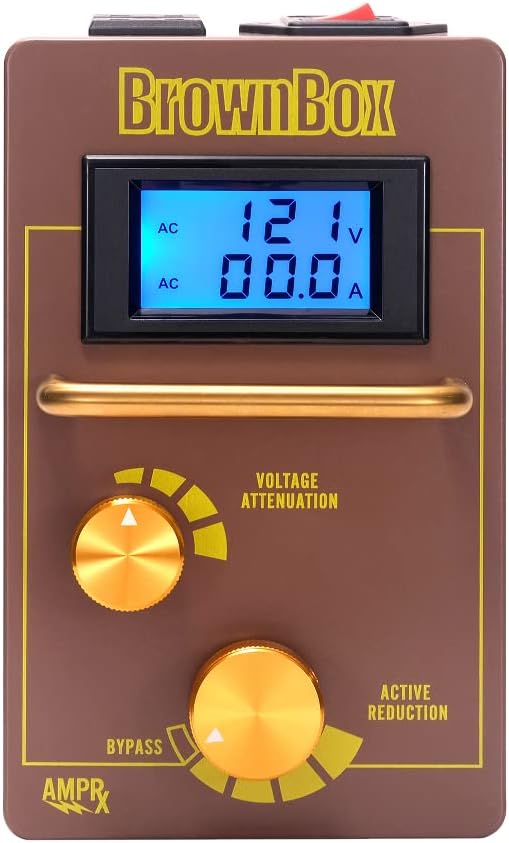
The BrownBox Tube Amplifier Input Voltage Attenuator is a full-sized device aimed at substantial tube amplifiers. It has a 5.0 supplied rating and is built around a 5-amp input AC rating, with an LCD voltmeter and four selectable output and input voltage options. The design is presented as a voltage-reduction solution for high-powered amplifier situations.
We may earn a commission when you buy through this link, at no additional cost to you.
The LCD meter is the most immediately useful diagnostic feature. It gives the user visual feedback while adjusting the device, which can make setup more methodical than a completely blind attenuator control. The four selectable input and output voltage choices also provide more adjustment range than a single-level knob, allowing the unit to be adapted to different amplifier operating conditions.
The available specification is limited, however. It does not list speaker impedance inputs, line or direct outputs, reactive loading, cabinet simulation, or bypass behavior. As a result, it is difficult to position the BrownBox as an all-in-one recording solution based on the supplied information alone. Compatibility should be confirmed directly with the seller and amplifier documentation before purchase.
This product is most appropriate for owners of large tube amplifiers who need a high-current attenuation device and value clear voltage feedback. Its rating and power-oriented design are compelling, but musicians needing a compact pedal, integrated DI, or known impedance settings should choose a product with those capabilities clearly documented.
The LCD voltmeter provides immediate visual information during setup. This can help users make more controlled adjustments when reducing input voltage to a powerful tube amplifier.
A 5-amp input AC rating positions the BrownBox for robust use with full-sized tube amplifiers. It is best suited to players who prioritize current capacity and voltage selection over a compact effects-pedal form.
We may earn a commission when you buy through this link, at no additional cost to you.
The Tone King Ironman II Mini is a 30-watt reactive power attenuator pedal with a supplied rating of 4.6. It combines a compact housing with a line output and footswitchable boost, making it more versatile than a basic passive volume solution. Its reactive approach is intended to interact with the tube amplifier more naturally than simple signal removal.
We may earn a commission when you buy through this link, at no additional cost to you.
The pedal format is especially useful for musicians who want attenuation in a live or rehearsal setup without adding a large floor unit. A line output allows the controlled signal to move into another device, while the footswitchable boost can restore playing intensity during transitions. Because it operates as a reactive attenuator, the unit is intended to preserve more of the amplifier’s response than an ordinary effects-loop level reduction.
Its main constraint is power handling. At 30 watts and 8-ohm operation, it is appropriate for many smaller and medium tube amplifiers but not for high-wattage models. Users should also check the amplifier’s output impedance and the unit’s input arrangement before assuming compatibility.
The Ironman II Mini is a strong choice for a guitarist seeking a compact reactive attenuator with useful routing and live-control options. It is less suited to someone who needs to attenuate a 100-watt classic, but within its stated range it offers a focused and practical solution.
A reactive load is designed to behave more like a real speaker than a simple passive level control. This can help preserve the amplifier’s natural breakup, response, and perceived playing dynamics at lower volume.
The built-in boost control gives the player a way to increase output on demand. That is particularly handy in rehearsal situations where dynamics need to change without reaching for another pedal.
We may earn a commission when you buy through this link, at no additional cost to you.
The Donner Amp Attenuator Pedal is a compact effects-loop controller designed to reduce the signal sent to a tube amplifier’s power section. It has a supplied rating of 4.3 and includes an adjustable output level, true-bypass operation, and a mute footswitch. The product is positioned as a practical way to reach an amplifier’s responsive range at lower volume.
We may earn a commission when you buy through this link, at no additional cost to you.
By working through the effects loop, the pedal allows the player to push the preamp harder while controlling what reaches the power stage. Its true-bypass design is intended to preserve the amp’s response and dynamics when the attenuation is switched out. The mute switch adds another layer of control, useful during setup, tuning, or quiet passages in a rehearsal environment.
The pedal requires a compatible effects loop, and the supplied information notes that a DC 9V adapter is not included. Its specifications also do not mention reactive speaker loading, multiple impedance settings, or a line output. It is therefore best understood as a budget signal controller rather than a full load-box or recording system.
For a player seeking a straightforward way to use a loud tube amp more quietly, the Donner is one of the most approachable options in the guide. It is particularly suitable when the amplifier already has a usable effects loop and the guitarist values a mute switch, compact format, and simple controls over extensive routing options.
The dedicated mute footswitch is a useful convenience beyond level reduction. It allows the amplifier’s signal to be silenced quickly without unplugging the guitar or changing the amplifier’s settings.
The pedal’s signal-control approach lets the preamp remain active while a controlled amount reaches the power section. Users with compatible loops can add attenuation to an existing pedalboard with minimal complexity.
We may earn a commission when you buy through this link, at no additional cost to you.
The Two Notes Torpedo Captor is an 8-ohm reactive loadbox, direct box, and attenuator combined in one unit. Its supplied rating is 4.5, and its breadth of functions makes it a natural middle ground between a simple power attenuator and a full recording system. It is intended for musicians who need to capture a tube amplifier while controlling its output and reducing dependence on a conventional speaker microphone.
We may earn a commission when you buy through this link, at no additional cost to you.
The direct box provides a path for connecting the instrument-level signal to recording equipment, while the speaker simulation and loadbox functions extend the unit beyond simple attenuation. Reactive loading is an important distinction because it can help maintain the amplifier’s natural behavior as output is reduced. Combining these features also reduces the number of separate boxes required in a home-studio signal chain.
The specified 8-ohm configuration limits compatibility with amplifiers using other output impedances, and the supplied description does not detail software control or the full range of internal settings. Players should therefore verify their amplifier’s impedance and confirm the required routing before purchasing. It may also be unnecessary for users who only need quiet practice and do not plan to record.
The Torpedo Captor is best suited to guitarists who want one box to handle attenuation, direct recording, and speaker-load duties. It offers a compelling balance of features for home and project studios, particularly for players working with a single compatible 8-ohm tube amplifier.
Combining a reactive loadbox, attenuator, and direct box reduces the need for separate routing devices. That makes the Captor convenient for a streamlined home-studio or rehearsal setup.
The integrated direct box can send a clean instrument-level signal to an interface, preamp, or recording chain. This provides a practical alternative to miking a loud physical speaker cabinet.
We may earn a commission when you buy through this link, at no additional cost to you.
The Universal Audio Ox Amp Top Box is a premium analog reactive load box and guitar recording system for tube amplifiers. It has a supplied rating of 4.4 and is built for musicians who want more than quiet practice. The system combines load control with virtual microphones, cabinets, and speaker modeling intended to produce record-ready sounds quickly.
We may earn a commission when you buy through this link, at no additional cost to you.
Five finely tuned attenuation levels range from silence to whisper-quiet operation and full band volume. That broad range makes the Ox useful across playing and recording situations rather than serving as a single-purpose volume accessory. The front-panel RIG control and expertly placed virtual microphones and cabinets are intended to eliminate the need to mic an amp conventionally, while UA Dynamic Speaker Modeling addresses speaker drive, breakup, and cone cry.
The trade-off is complexity and physical scale. This is a serious floor-based recording system, not a compact pedal, and it may be excessive for someone who only needs a basic power soak. The supplied information also emphasizes the premium analog system rather than listing every connector or software control in detail, so users should review current compatibility documentation.
The Ox Amp Top Box is an excellent fit for serious home-studio musicians, producers, and guitarists who want detailed virtual-capture options from a tube amplifier. It is the most comprehensive recording-oriented selection here, making it worthwhile for users who will regularly capture amp tones rather than merely reduce volume.
The built-in virtual microphones and cabinets provide a direct path from a tube amplifier to a recording workflow. That can save setup time and avoid the practical challenges of placing a microphone in front of a loud cabinet.
The selectable attenuation levels move from silence through very quiet operation to full band volume. This range supports silent recording, late-night practice, normal rehearsal, and louder performance requirements.
We may earn a commission when you buy through this link, at no additional cost to you.
The Warm Audio Reamper Routing Hub is an analog studio device built around independent re-amp signal paths, a 50-watt silent power soak, and variable impedance control. It is a specialized option for guitarists and producers who want to route recorded guitar parts back through an amplifier with deliberate control over load behavior.
We may earn a commission when you buy through this link, at no additional cost to you.
Independent signal paths can support a structured re-amping setup rather than forcing every take through a single fixed route. The power-soak function provides a way to use the amplifier at a controlled level, while variable impedance control gives the player another dimension for matching the load to an amplifier. These are valuable features for experimenting with amp response in a studio environment.
The product is less broadly applicable than a standard attenuator pedal or floor box. No customer rating is supplied, and the available information does not describe a built-in direct output, speaker simulation, physical control layout, or speaker-impedance inputs. Users focused on live performance or simple practice should verify that its studio-oriented routing meets their needs.
The Reamper Routing Hub is best for a home or project studio where re-amping is a frequent part of the recording process. Its combination of silent attenuation, multiple paths, and impedance adjustment makes it more specialized and potentially more useful than a basic volume pedal for producers working with amp tones.
Independent re-amp paths make it easier to organize recorded guitar signals before they return to an amplifier. This focus distinguishes the hub from ordinary live attenuators.
Variable impedance control can influence how the amplifier responds to the incoming signal. For studio experimentation, that can provide another dimension for shaping tone and dynamics.
We may earn a commission when you buy through this link, at no additional cost to you.
The Tone King Ironman II is a 100-watt precision-compensated reactive power attenuator with a supplied rating of 4.2. It is designed for high-powered tube amplifiers and combines attenuation with direct output, analog cabinet simulation, dual impedance controls, a presence switch, and bypass mode. That collection of features makes it a flexible floor-unit solution.
We may earn a commission when you buy through this link, at no additional cost to you.
Dual impedance controls are especially relevant for matching the load to different amplifier outputs. The direct output allows the controlled signal to feed a recording chain, while the analog cabinet simulation can provide a speaker-cabinet sound without relying entirely on a physical cabinet. Bypass mode and the presence switch add additional control over how the signal behaves in a live or recording context.
As with most high-wattage reactive devices, correct impedance matching is essential. The floor format takes more space than a pedal, and the supplied information does not detail the exact impedance values, signal-path routing, or control labeling. Users should compare those details with their amplifier and recording equipment before finalizing the installation.
The Ironman II is a strong recommendation for a guitarist with a powerful tube amp who wants attenuation, direct capture, and cabinet simulation in one package. It is less attractive for lower-wattage practice-only setups, but its 100-watt capacity and reactive design make it relevant to serious classic-rock and studio applications.
The 100-watt rating allows the unit to address many of the high-output tube amplifiers used for serious amplification. Reactive loading is intended to preserve a more natural amplifier response than a basic volume reduction.
Direct output, analog cabinet simulation, presence control, and bypass operation cover several common performance and capture needs. The combination reduces the need for separate routing and cabinet-simulation devices.
We may earn a commission when you buy through this link, at no additional cost to you.
The Boss WAZA Tube Amp Expander is a programmable tube amplifier command center with a supplied rating of 4.3. Its advanced variable reactive load supports tube amplifiers up to 150 watts, and the user-adjustable impedance is designed to retain the amp’s natural tone, dynamic feel, and distortion characteristics. It also includes a built-in 100-watt Class AB power amplifier.
We may earn a commission when you buy through this link, at no additional cost to you.
Ten recallable rig settings allow established combinations of impedance, output, and performance controls to be stored and retrieved. Deep real-time control is available through GA-FC or FS-series footswitches and MIDI I/O, making the Expander suitable for musicians who want direct computer or floor-controller integration. The built-in power amplifier expands its role beyond simple attenuation into a more comprehensive performance and routing system.
The scale and feature count are substantial compared with a simple passive attenuator. It occupies a larger footprint, has a broader learning curve, and may be unnecessary for someone who only wants quieter practice. Exact input and output behavior should also be checked against the player’s amplifier and preferred footswitch or MIDI setup.
The WAZA Tube Amp Expander is the most versatile choice for a serious guitarist who wants repeatable settings, detailed impedance control, extensive amp compatibility, and integrated power amplification. It is an especially strong fit for stage, project-studio, and experimental users who expect to change configurations rather than simply reduce one amplifier’s volume.
User-adjustable impedance matching is one of the Expander’s defining features. It allows the load to be aligned more closely with the connected tube amplifier, supporting the goal of preserving natural response and distortion behavior.
Ten recallable settings make it possible to move between known configurations quickly. Compatibility with GA-FC or FS-series footswitches and MIDI I/O adds deeper live and studio control for users who already work with programmable rigs.
We may earn a commission when you buy through this link, at no additional cost to you.
The right attenuator depends on amplifier power, output impedance, signal routing, and whether the primary goal is quiet practice, rehearsal, direct recording, or a complete performance system. These factors help narrow a large category of devices to the type that best fits a particular rig.
Begin with the amplifier’s maximum output wattage and choose a device rated to handle that level. A low-wattage reactive pedal may work beautifully with a 30-watt combo but offer little margin with a 100-watt head. Higher-capacity units are more versatile, although they usually require more space, power, and setup complexity. The correct match is especially important for reactive designs, which are intended to interact with the amplifier’s power section and output impedance.
Tube amplifiers commonly use 4-, 8-, or 16-ohm outputs, and the attenuator must present a load that the amplifier is designed to support. Some devices include multiple input connectors, while others specify one impedance. Connecting an amplifier to an unsuitable load can affect the response, and reactive devices may require a particular speaker or output impedance to achieve their intended behavior. Confirm the amp’s manual and the device’s specifications before installation.
A passive attenuator is simple, requires no power, and usually does not attempt to replicate a speaker load as precisely. A reactive attenuator uses active circuitry to create a more speaker-like load, which can help the amplifier retain its natural breakup, dynamics, and response. Reactive devices may offer richer integration but involve more controls and compatibility considerations. Effects-loop signal controllers are another distinct approach because they reduce what reaches the power stage rather than serving as the amplifier’s speaker load.
Consider where the attenuated signal needs to go. A basic unit may only reduce the amplifier’s output, while others provide line output, direct box output, speaker simulation, or dedicated recording paths. An effects-loop controller works inside the amplifier rather than at its speaker output, so it requires a compatible loop. For recordings, a direct output can provide a clean feed, whereas a cabinet simulation may add a speaker character before the signal reaches the interface.
Compact amp-box controllers are often inserted into an amplifier’s effects loop. This allows the preamp to remain active while the power section receives a controlled signal. Not every loop behaves the same, so users should check whether the amplifier provides a preamp send, power amp return, and a compatible level. A device that works in one amplifier’s loop may not provide the same result in another, particularly if loop levels, phase, or switching arrangements differ.
Recording-oriented attenuators can add a direct output, analog cabinet simulation, virtual microphones, or modeled speaker behavior. These features can save time by shortening the process from amplifier to recorded track, but they also add complexity and may introduce a specific sound. If the goal is a transparent signal, a simple line or direct output may be preferable. If the goal is repeatable studio sounds with minimal mic placement, a virtual or analog cabinet model can be more convenient.
Advanced systems may provide presets, MIDI, digital displays, and compatibility with external footswitches. These features are valuable when switching between amplifier loads, recording configurations, and performance levels. They matter less for a player who uses one amplifier and one setting. A system with many controls can also become a source of distraction if its menu structure is difficult to navigate, so consider how often presets will genuinely be used.
A pedal is portable and easy to include in a pedalboard, while a floor unit generally suits a permanent rehearsal or studio position. Passive devices avoid an external power connection, whereas active and programmable systems require reliable power. Consider the available shelf or board space, cable routing, ventilation, and whether the device needs to be switched with a footswitch during performance. A large system with extensive controls can be worthwhile only if those features will be used regularly.
Begin by confirming the amplifier’s output wattage and impedance, then read the attenuator’s connection diagram before moving any cables. With the amplifier powered down, connect the amp to the correct attenuator input. If using an effects-loop controller, place it in the specified send and return path instead of connecting it as a speaker load. Connect any line, direct, or recording output next, and keep the signal chain easy to trace from guitar to amplifier to destination.
Start with the amplifier at a familiar operating level and the attenuator at its least aggressive setting. Engage the device, raise the output gradually, and listen for the intended response rather than judging only by apparent volume. For reactive models, follow the manufacturer’s impedance guidance and allow the circuit to stabilize before changing settings. When using recording outputs or cabinet simulation, compare the captured result with the live sound and adjust the appropriate downstream controls instead of making several simultaneous changes.
For pedal units, secure cables away from foot traffic and use a reliable power supply where one is required. For larger systems, keep ventilation paths clear and avoid placing the unit where moisture, excessive heat, or unsecured cables could create a hazard. When switching between bypassed and active states, compare volume, tone, and dynamics at a controlled level, and periodically inspect connectors for looseness or corrosion. Always follow the amp manufacturer’s guidance and switch the amplifier off before changing speaker or impedance connections.
An attenuator reduces the output level of a tube amplifier so it can operate at a lower physical volume. Depending on the design, it may passively absorb signal, create a reactive speaker-like load, or control the signal sent to the amplifier’s power section through an effects loop. The goal is to retain much of the amp’s tone, response, and dynamics while making it more practical for practice, rehearsal, or recording.
A reactive attenuator is often preferred when the goal is to preserve a natural speaker-like interaction with the amplifier. It can better maintain the amplifier’s breakup and dynamic behavior as output is reduced. A passive attenuator is simpler, needs no power, and may be sufficient for straightforward volume control. The better choice depends on amplifier compatibility, tone priorities, budget, and the complexity the player is willing to manage.
No. Check the amplifier’s output wattage and impedance before connecting any attenuator. A reactive model should also be matched to the amp’s supported load, and an effects-loop controller requires a compatible loop arrangement. Connecting an unsuitable device can produce incorrect response or damage, so use the amplifier manual and the attenuator instructions rather than assuming every tube amp will behave the same.
Any attenuator can affect the result to some degree because it changes how the amplifier is loaded and how much signal reaches the power section. A well-matched reactive design is intended to preserve the amp’s natural response more closely, while a basic passive or effects-loop device may produce a different character. Evaluate the sound at matched levels and listen for changes in clarity, compression, sustain, and dynamics.
A cabinet simulation is optional rather than essential. It becomes useful when recording directly or when a player wants a repeatable speaker-cabinet sound without using a physical cabinet. If the amplifier already has a good speaker and the goal is simply quieter playing, attenuation alone may be enough. Recording-focused models often combine attenuation, direct output, and cabinet simulation to provide a more complete signal path.
A conventional speaker-load attenuator is designed to replace the amplifier’s speaker load, so the amplifier still needs to be connected correctly to that device. An effects-loop controller works differently and may leave the amp connected to its speaker while reducing the signal entering the power section. Check whether the product is a load box, an effects-loop unit, or a recording system before planning the connections.
Choose an attenuator whose power rating comfortably covers the amplifier’s maximum output. A 30-watt reactive pedal is intended for smaller tube combos, while 50-, 100-, and 150-watt devices address progressively larger amplifiers and studios. The wattage is only one part of compatibility; impedance, connection type, power requirements, and whether the unit is passive, reactive, or effects-loop based also need to match the amplifier.
Choose a pedal when portability, pedalboard integration, and a modest power range are most important. A floor unit is more appropriate for a permanent rehearsal space, a high-wattage amplifier, or a studio signal chain with extensive routing. Larger systems generally provide more connections, controls, and recording features, while smaller pedals are usually better for live use and quick setup.
The Donner Amp Attenuator Pedal is the most accessible pick for a guitarist with a compatible effects loop who wants simple, compact attenuation and a mute switch. The Boss WAZA Tube Amp Expander stands out for extensive control, ten recallable settings, MIDI integration, adjustable impedance, and support for tube amplifiers up to 150 watts. For serious recording, the Universal Audio Ox Amp Top Box provides the most comprehensive virtual-capture system in the group.
Prioritize amplifier wattage, impedance, and the intended connection method before considering secondary features. A passive pedal may be ideal for a straightforward effects-loop setup, while a reactive floor unit offers more natural amplifier loading and broader routing. Dedicated recording systems make the most sense when direct capture, cabinet simulation, or repeatable virtual sounds will be used frequently.
Finally, check the current product details, availability, and price before ordering, since specifications and commercial terms can change. Confirm that the device supports the tube amplifier’s output impedance and method of connection, and review the manufacturer’s setup instructions. With those checks completed, the right attenuator can make a powerful tube amplifier far more practical without surrendering the character that made it worth choosing.