
Mik-Nana Food Scale
4.5Editor score
22-pound weighing capacity
One-gram resolution
Six unit conversions
Container tare function
Compact stainless design
Scale for Soap Making buyer guide comparing 10 digital scales for precision, capacity, units, tare functions, cleanability, and recipe accuracy at home.
A dependable scale is one of the most important tools for soap making because even small measurement differences can affect the balance of oils, lye, water, additives, and fragrance. The right model should combine readable results with enough precision for delicate ingredients and a platform large enough for the containers used in your process.
We compared all 10 scales by considering capacity, increment, unit options, tare and hold functions, platform design, power source, readability, and ease of cleaning. The list includes compact gram scales, broad kitchen platforms, high-capacity commercial models, and dual-range designs that suit everything from small batches to larger soap-making workflows.
Each review identifies the scale that stands out for a particular use, while the comparison table makes the key differences easier to scan. Product ratings, specifications, and availability can change over time, so readers should confirm the current listing details and accessories before making a final purchasing decision.
4.5Editor score

4.6Editor score
4.4Editor score
The following comparison covers each scale's core capacity, resolution, display, and practical features, with special attention to the precision and platform size needed for accurate soap-making measurements.


The Etekcity Food Kitchen Scale is a straightforward digital scale with a 4.6 rating and a useful combination of compact construction and everyday measurement capacity. Its 11-pound limit, one-gram increments, and five-unit support make it practical for many standard soap recipes, particularly those composed primarily of oils, water, and premeasured additives.
We may earn a commission when you buy through this link, at no additional cost to you.
The backlit LCD uses large fonts, which helps when checking measurements across a busy work surface. Tare allows the weight of a mixing vessel to be removed before ingredients are added. The 304 food-grade stainless steel surfaces are easy to wipe down after handling oils or colorants, while the small profile makes the scale straightforward to store between batches.
Its main limitation is its one-gram resolution. That is sufficient for many cold-process formulas, but it is less appropriate for makers who routinely weigh very small fragrance, essential oil, or additive portions. There is also no listed percentage or hold function, so users who need those conveniences must handle ratio calculations and oversized containers differently.
This is a sensible option for new soap makers who want a simple, readable, and compact scale without paying for advanced laboratory-style features. Choose it when consistent one-gram measurements, straightforward cleaning, and limited storage space matter more than sub-gram precision.
The large, backlit display is one of this scale's most useful qualities for recipe preparation. Clear numerals reduce the chance of misreading a quantity, while the compact platform fits neatly beside a bowl during mixing.
The food-grade stainless steel surface can be wiped down after oily or colored batches. That straightforward maintenance makes the scale suitable for a dedicated craft area as well as a multipurpose kitchen.
We may earn a commission when you buy through this link, at no additional cost to you.
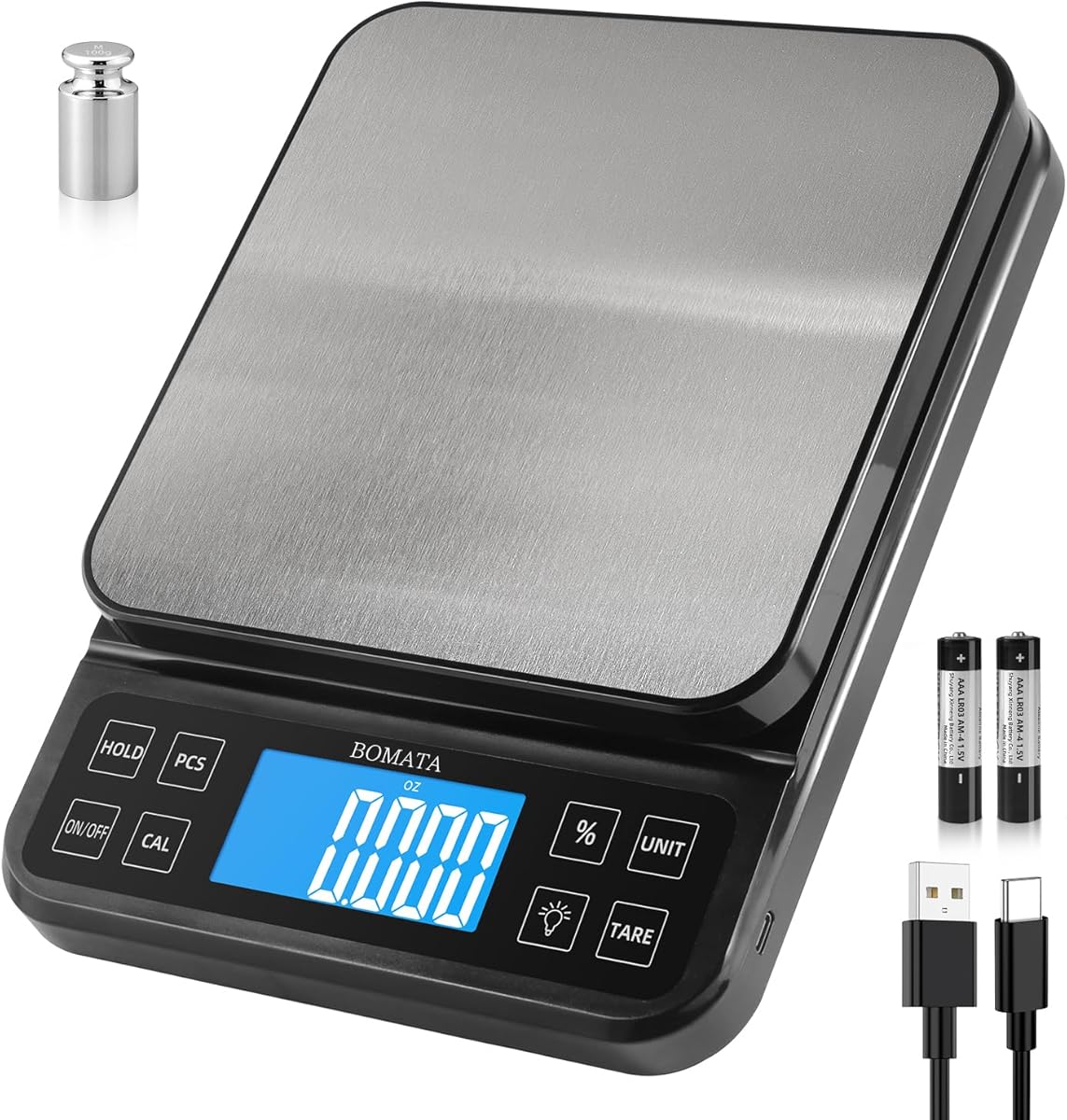
The BOMATA Large Kitchen Scale combines 0.1-gram resolution with a generous 7.2-by-7.2-inch platform, giving it a particularly useful balance for soap making. Its 4.4 rating reflects a versatile feature set, including percentage mode, hold, tare, counting, unit conversion, calibration, and a built-in 100-gram calibration weight.
We may earn a commission when you buy through this link, at no additional cost to you.
The weighing range extends from 0.5 grams to 5 kilograms, so the scale can handle both small additives and substantial quantities of oils or other base ingredients. A full-view-angle LCD helps make the reading easier to see, and the stainless platform is durable and easy to clean. The hold function can also be useful when a container extends beyond the weighing area.
Power is flexible because the rechargeable lithium battery can be charged by USB-C, while two AAA batteries provide an alternative. Users are instructed not to use the AAA batteries while the scale is charging. As with any high-precision scale, a stable, level surface matters, and the included calibration weight gives owners a way to maintain accuracy over time.
The BOMATA is a strong all-around choice for makers who need finer resolution than a standard kitchen scale but do not need laboratory-level 0.01-gram readings. It is especially attractive for recipes involving oils, pigments, clays, fragrance, or multiple small additions, provided the scale is kept level and calibrated as directed.
A 0.1-gram increment gives soap makers more room to measure small quantities than a one-gram scale. That makes the model better suited to additives, scent preparations, and other components where modest differences can affect the final batch.
The 7.2-inch square platform is larger than many compact kitchen scales. It offers space for a mixing bowl, beaker, or other vessel while keeping the display visible.
We may earn a commission when you buy through this link, at no additional cost to you.
The YONCON KF-H8U is a 22-pound commercial kitchen scale with a 4.2 rating and a 0.5-gram increment. Its defining advantage is flexibility: ratio mode helps manage ingredient proportions, while the removable stainless platform and smooth surfaces support straightforward cleanup.
We may earn a commission when you buy through this link, at no additional cost to you.
The listed range begins at 5 grams and extends to 10 kilograms, with a stated increment of 0.5 grams. That makes the scale more appropriate for full batches than for measuring tiny traces of material. Its 6.3-by-6.9-inch platform is large enough for sizable items without hiding the LCD, and the backlight supports easier reading.
Tare and piece-counting functions broaden its usefulness beyond soap making, while the percentage mode can assist with scaled formulas. Batteries and a power adapter are included, and a 10-minute automatic shutdown helps prevent unnecessary power loss. The removable platform is dishwasher safe according to the supplied information, which is useful when oils or pigments are involved.
This model suits high-volume makers or beginners who want a general-purpose scale for several workshop tasks. Its limitation is precision: the half-gram increment is less suitable than the 0.1-gram or 0.01-gram alternatives for very small ingredients. For large formulas, however, its capacity, readable platform, and cleaning-friendly design are convincing.
The percentage function reduces manual calculation when adapting a formula. It is particularly useful when a maker wants to compare portions of a batch or maintain a consistent ratio between components.
Smooth surfaces and a removable stainless platform make cleanup more convenient. The listed dishwasher-safe platform is useful after handling sticky ingredients or oils.
We may earn a commission when you buy through this link, at no additional cost to you.
The Mik-Nana Food Scale has a 4.5 rating and offers a practical combination of capacity, compact size, and familiar kitchen-scale features. Its 10-kilogram or 22-pound limit is ample for many soap batches, while the 7.4-by-5.5-by-0.6-inch body takes up relatively little room.
We may earn a commission when you buy through this link, at no additional cost to you.
Measurements appear in grams, kilograms, pounds, ounces, milliliters, and milk milliliters. A tare function removes the weight of a container, and the bright LCD is large enough to read without taking up excessive counter space. The food-grade 304 stainless platform is easy to maintain after working with oils or pigments.
The one-gram resolution is the key trade-off. It will suit recipes measured primarily in larger quantities, but it may frustrate a maker who frequently weighs fragrance, essential oils, or small color additives. Unlike some more specialized models, it does not offer percentage mode, hold, calibration, or dual platforms.
For a beginner building a first soap-making setup, this is a straightforward and economical way to obtain a capable kitchen scale without a complicated interface. It is best suited to batches whose components are measured in amounts that align comfortably with one-gram increments.
The slim profile makes this scale easy to place in a cabinet or carry to another work area. That portability is useful for makers who do not have a permanent dedicated studio.
Six available units make the display familiar across common kitchen and craft tasks. Grams remain the most relevant option for many soap recipes, while tare handles the frequent need to measure ingredients inside a container.
We may earn a commission when you buy through this link, at no additional cost to you.
The Large Digital Counting Scale is built around a 40-kilogram or 88-pound capacity, making it the strongest high-capacity option in this guide. It carries a 4.5 rating and uses one-gram increments within a five-gram to 40-kilogram range.
We may earn a commission when you buy through this link, at no additional cost to you.
Its feature set extends beyond basic weighing. Pricing, piece counting, tare, unit conversion, and a full-view green-backlit LCD make it useful for workshops, packing, inventory, and bulk production tasks. Grams, kilograms, ounces, pounds, and milliliters can all be selected, and the scale can operate with either batteries or AC power.
For soap making, the enormous capacity is most useful when handling a very large batch or multiple vessels. The stated limitation against items below five grams means it should not be chosen for small fragrance or additive measurements. Its 10.8-by-7-inch product dimensions also require more space than compact kitchen models.
The scale is best for makers who also need packaging, counting, or bulk-weighing capability and need more capacity than a normal kitchen scale provides. If all batches are modest and ingredients are added in small portions, a finer-resolution model will be more useful.
The 88-pound limit is the defining feature. It provides substantial headroom for large vessels and workshop tasks that would exceed the capacity of most conventional kitchen scales.
Counting and pricing modes make this more than a simple recipe scale. Those features are useful for packaging soap or managing other lightweight craft products after the batch is complete.
We may earn a commission when you buy through this link, at no additional cost to you.
The 0.01g High Precision Scale is designed for situations where very small quantities must be measured accurately. It offers a 1-kilogram maximum capacity and 0.01-gram resolution, supported by sensitive sensors, adjustable feet, and a level bubble to help establish a stable measurement position.
We may earn a commission when you buy through this link, at no additional cost to you.
The backlit LCD includes unit conversion across pounds, ounces, carats, pounds and ounces, grams, and kilograms. Percentage mode, tare, piece counting, precise weighing, and calibration expand its usefulness. A 100-gram calibration weight is included, allowing the owner to check accuracy over time.
The scale can operate on its included rechargeable battery or with two AAA batteries, although those AAA batteries are not included. Its 4.9-inch stainless platform is compact, which is appropriate for small dishes but less convenient for a large mixing vessel. Since no customer rating is currently supplied, its practical specifications are more informative than a rating-based comparison.
This model is a strong candidate for makers who measure tiny fragrance, color, or additive portions and place containers directly on the pan. It is less appropriate for large batches, where its limited capacity and small platform would be less convenient.
The 0.01-gram increment is the defining advantage. It gives makers a way to track very small additions that are beyond the resolution of ordinary one-gram kitchen scales.
Adjustable feet, a visible bubble level, and an included calibration weight all support consistent readings. Together they help users maintain a level platform and verify performance when conditions change.
We may earn a commission when you buy through this link, at no additional cost to you.
The 0.1g Large Baking Scale pairs a 5-kilogram capacity with 0.1-gram increments and a 4.7 rating, the highest published rating among the listed products. Its 5.9-by-5.9-inch stainless platform offers a practical middle ground between compact precision scales and oversized commercial platforms.
We may earn a commission when you buy through this link, at no additional cost to you.
The backlit display supports conversions among pounds, ounces, carats, pounds and ounces, grams, and kilograms. Percentage mode is useful for maintaining ingredient ratios, while tare and piece counting cover common preparation tasks. A rechargeable battery is included, and the scale can alternatively use two AAA batteries, which are not included.
Compared with a standard one-gram kitchen scale, the finer increment gives more control over small components without limiting the scale to tiny loads. However, the listed feature set does not mention a calibration weight, and the product is not positioned as a 0.01-gram laboratory scale.
This is an appealing option for soap makers who want a generous platform and sub-gram resolution in one device. It should appeal especially to users who work with both full batches and small scent, pigment, or additive measurements.
The five-kilogram capacity supports larger ingredient totals, while 0.1-gram increments preserve useful detail for smaller components. That combination reduces the need to own separate household and precision scales.
Percentage mode allows makers to work from a target ratio without manually converting every ingredient to a separate percentage. It can simplify formula adjustments and batch comparisons.
We may earn a commission when you buy through this link, at no additional cost to you.
The Mini 0.01g Food Scale is a compact, portable option designed for small ingredients. It measures up to 500 grams with 0.01-gram accuracy and carries a 4.3 rating. Its small format is particularly relevant to soap makers who prepare fragrance blends, color mixes, or other small components away from the main work surface.
We may earn a commission when you buy through this link, at no additional cost to you.
The scale uses a stainless platform with an ABS plastic frame and includes two protective trays that can function as containers. Nine units are available, including grams, ounces, troy ounces, pennyweights, carats, pounds, talbots, milliliters, and another gram-based option. Tare subtracts container weight, and piece counting can be used for small items.
Status indications for overload, low battery, and unstable placement help users interpret the display, while an automatic shutdown occurs after 180 seconds of inactivity. The limited 500-gram capacity means it cannot replace a full-batch scale, and its platform will not comfortably hold a large vessel.
This model is best used as a companion precision tool rather than the only scale in a soap workshop. It is especially useful for concentrated additives and small test batches, while its portability makes it easy to store away when not needed.
The pocket-sized format makes this model convenient for test formulas and concentrated additives. Two included trays support both weighing and temporary containment.
Nine unit options and tare provide broad measurement flexibility. These controls are useful when switching between weight-oriented formulas and small quantities handled in ounces or other units.
We may earn a commission when you buy through this link, at no additional cost to you.
The Nicewell Food Scale has a 4.7 rating and a large 9-by-6.3-inch platform. Four high-precision load sensors support one-gram or 0.1-ounce increments across a range from 3 grams to 10 kilograms, or 0.1 ounce to 22 pounds.
We may earn a commission when you buy through this link, at no additional cost to you.
Its roomy platform is a major benefit when a maker wants to position a mixing bowl, beaker, or tray directly on the scale. The large LCD offers readings in grams, kilograms, pounds and ounces, fluid ounces, and milliliters. A tare button removes the platform or container weight for easier net measurement.
The top combines a stainless steel surface with tempered glass, and an attached hook provides a convenient storage option. Two AAA batteries are included. The one-gram resolution is the primary limitation, particularly for small fragrance or additive measurements, and no percentage or hold function is listed.
This scale is best for makers who favor a familiar kitchen design and need plenty of platform space. It earns its place in the guide because the wide surface and 22-pound limit can make full-batch workflow more convenient than a compact model.
A nine-inch platform provides more room than most kitchen scales in the guide. It is useful for stabilizing a wider bowl or measuring a group of ingredients together.
Tare is particularly valuable when ingredients are measured directly in a vessel. Zeroing the container lets the display show only the weight added afterward.
We may earn a commission when you buy through this link, at no additional cost to you.
The KUAIVO Dual Platform Scale is the most versatile design in the guide, with separate large and small weighing areas. It carries a 4.6 rating, supports up to 33 pounds on the large platform, and provides 0.001-ounce resolution on the smaller platform.
We may earn a commission when you buy through this link, at no additional cost to you.
This dual-range arrangement addresses a common scale-design compromise. A large platform handles batch ingredients and conventional containers, while the small platform delivers much finer resolution for concentrated additives. Seven units—grams, kilograms, pounds, ounces, pounds and ounces, milliliters, and milk milliliters—cover common recipe and workshop needs.
Tare subtracts the weight of a container, while accumulation can sum weights measured across the two scales. The LCD remains readable in dim conditions, and an automatic shutdown occurs after 210 seconds of inactivity. The smooth, non-porous stainless surface is designed to resist staining and wipe clean easily.
The 10.8-by-7-inch overall size requires more counter space than a single-platform scale, and the dual-platform format may take slightly more time to learn. Nevertheless, it gives soap makers a credible way to manage both full batches and very small additions with one device. It is the most flexible choice for a dedicated craft workspace.
The separate weighing areas provide practical advantages at opposite ends of the size spectrum. Larger ingredients can be weighed on the broad platform while tiny components use the precision section.
Accumulation allows the user to combine measurements from the two platforms without manually transferring totals. This can streamline a formula that is divided across different vessel sizes.
We may earn a commission when you buy through this link, at no additional cost to you.
The right soap-making scale depends on batch size, ingredient types, available space, and the precision required by your formulas. Review the following factors before deciding which model fits your workflow.
Choose a resolution that matches the smallest amount you routinely measure. Paying for extreme precision without a practical need can lead to an unnecessarily small platform and limited capacity.
For most home makers, 11 to 22 pounds offers useful flexibility. Choose a high-capacity model only when the additional size and lower suitability for tiny portions align with your work.
Match the platform to your containers, not only to the formula weight. A scale that can technically hold a bowl but cannot keep it stable may be less useful than a smaller alternative.
Prioritize tare, then look for hold and percentage functions if they fit your recipes. Dual-range accumulation is also useful for makers who divide a batch between differently sized vessels.
Keep grams as your primary working unit and enable additional conversions when useful. A wide selection of units is helpful, but consistent metric measurement is more important than switching constantly.
Choose a display you can read without leaning over the scale or using a device to enlarge the numbers. Clear controls reduce handling errors during repeated measurements.
Favor non-porous, smooth surfaces and simple seams. Clean spills promptly, keep the load centered, and recalibrate when readings become inconsistent or the scale has been moved.
Rechargeable or battery flexibility is useful, but reliable readings take priority. Choose whichever power arrangement is convenient enough that you will maintain the scale and use it consistently.
Begin by placing the scale on a flat, stable, dry surface. Do not rely on a sloped shelf, folded towel, or uneven counter. For models with adjustable feet or a bubble level, confirm that the platform is level before every important measurement. If the scale is calibratable, follow the manufacturer's instructions and use the specified calibration weight on the clean platform.
Choose the correct unit before adding ingredients, with grams generally being the most consistent choice for soap formulas. If you will measure into a container, place the empty vessel on the platform, wait for a stable reading, and activate tare. Add the ingredient slowly while watching the display, and allow the platform to settle before recording the final value. Use hold or accumulation according to the manual when they make a multi-step batch easier to manage.
After the batch is finished, remove the vessel and wipe away residue with a soft, slightly damp cloth. Avoid harsh cleaners, abrasive pads, and flooding the display. Keep calibration weights stored separately from wet or oily tools, and recalibrate if readings appear inconsistent after a major move, temperature change, or heavy load. Always follow the specific care instructions supplied with the selected scale.
A one-gram scale is adequate for many recipes whose smallest ingredients are measured in relatively large amounts. A 0.1-gram scale is more useful when you divide formulas or add smaller quantities of scent, pigment, clay, or oils. A 0.01-gram scale is most useful for concentrated additives and should generally be treated as a companion to a larger-capacity scale.
A percentage function is convenient but not essential. It can make ratios easier to maintain when adapting a formula or comparing batches, yet a reliable tare function and suitable resolution remain more important. Consider percentage mode a workflow advantage rather than the only basis for choosing a scale.
Direct weighing is convenient because it reduces transfers and container loss. Place the bowl on the scale, tare its weight, and add the ingredient gradually. If the bowl is unstable, too wide, or extends beyond the platform, use a smaller container and transfer the measured ingredient instead.
Most home batches fit comfortably on a scale with 11 to 22 pounds of capacity. The correct figure should include both the total ingredients and the weight of the container. A much higher capacity is helpful for large or multiple batches but is usually unnecessary if it makes the scale bulky or less useful for small portions.
A laboratory-style scale is only necessary when the formula includes very small or concentrated quantities that need sub-gram resolution. For many cold-process recipes, a reliable kitchen scale with 0.1-gram or even one-gram increments is sufficient, especially if tare and a stable platform are included.
Wipe the platform after each use with a soft, slightly damp cloth, and remove residue before it becomes sticky. Keep liquids away from the display and controls, and never immerse the scale unless the manual explicitly allows it. A removable platform should be washed according to its listed care instructions.
Moving a scale can disturb its level, footing, or internal calibration. Place it on a stable surface, check the level, allow it to settle, and recalibrate it using the manufacturer's procedure if calibration is supported. If readings remain inconsistent, contact the manufacturer rather than relying on a compromised measurement.
Grams are generally easiest for consistent small-batch results because they are a metric unit and many soap formulas are written that way. Ounces can be useful for larger quantities, provided the scale is set correctly and the recipe is converted carefully. Choose one working unit and avoid unnecessary conversions during each batch.
The KUAIVO dual-platform scale offers the broadest workflow, combining a large weighing area with a separate high-resolution surface. The Mik-Nana scale stands out as a practical starter option, while the BOMATA model is a strong precision-focused choice with a roomy platform, percentage mode, hold function, and calibration weight.
Prioritize the smallest increment you genuinely need, enough capacity for the container and formula, a tare function, and a platform that feels stable in your workspace. Larger capacities help with heavy batches, but fine-resolution models are more appropriate for fragrance, essential oils, pigments, and concentrated additives. The best model is the one that supports your actual batch method rather than the one with the longest specification list.
Before purchasing, review the current listing, confirm the exact capacity and increment, check which calibration or accessory components are included, and verify that the power arrangement suits your setup. Product details and customer feedback can change, so checking the latest listing information will help ensure the selected scale still matches your soap-making needs.
