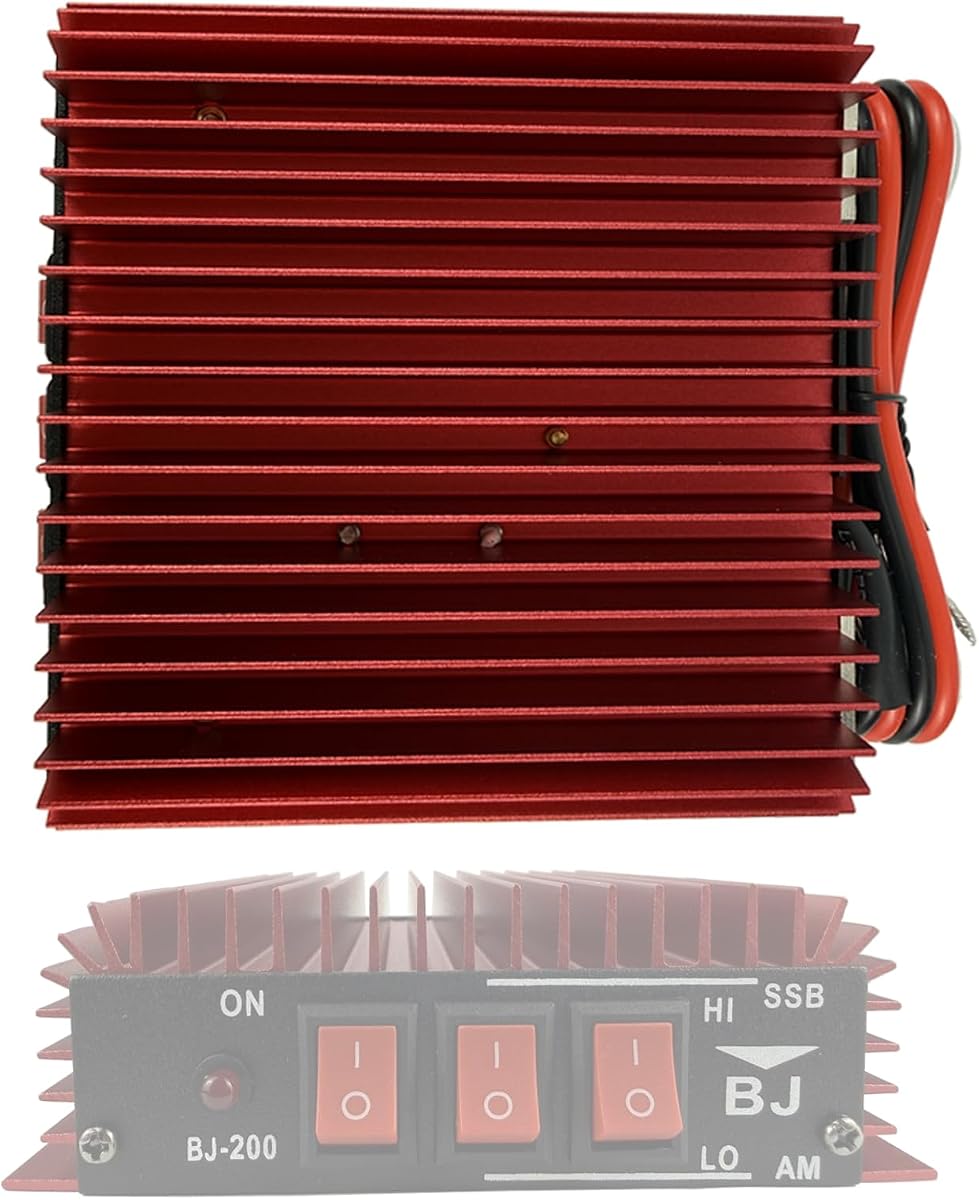
BJ-200 Linear Power AMP
5.0Editor score
Up to 150W SSB output
AM, FM, and SSB
13.8V DC operation
Polarity reversal protection
Aluminum heat sink
Discover the best High Drive CB Amplifier options, comparing power output, supported modes, cooling, protection, connectivity, and installation needs.
A high drive CB amplifier can increase the effective output of a compatible radio, improving signal strength and helping your transmissions carry over greater distances. The right unit depends on modulation mode, input power, cooling needs, connector type, electrical protection, and whether you need a complete radio-and-amplifier system.
We compared the ten listed products by examining their documented output ratings, supported operating modes, input requirements, power supplies, cooling systems, protection features, and installation details. The list includes dedicated linear power amplifiers, compact broadband units, a receiver-focused low-noise amplifier, a complete CB radio package, and a mobile SSB transceiver.
Each review explains what makes the product distinctive, who it suits, and where its limitations matter. The top selections reflect the most complete information and broadly useful feature sets, while ratings and product details should be checked on the linked listings. Prices and availability can change, so compare current offers before buying.
5.0Editor score

3.1Editor score

The table below compares all ten products by their core function, stated output, supported modes, power requirements, and notable hardware. Because the group includes transmit amplifiers, a receive preamplifier, a complete radio package, and a standalone transceiver, the most important first step is identifying which role your setup needs.


The BJ-200 Linear Power AMP is the strongest all-around value in this guide. It carries a 5.0 customer rating, although no review count is supplied, and its documented specifications cover the main needs of a high-drive CB installation. It works from a 3-5W radio signal, operates on 13.8V DC, and covers the 3-30MHz range while supporting AM, FM, and SSB. The stated maximum outputs are 50W for FM, 100W for AM, and 150W for SSB.
We may earn a commission when you buy through this link, at no additional cost to you.
Its practical appeal comes from a combination of output flexibility and installation safeguards. A dedicated HI/LO power adjustment gives the operator some control over drive conditions, while separate AM and SSB selectors help match the amplifier to the radio's modulation. Reverse-polarity protection reduces the risk of damage if the DC wiring is reversed. A clear ON/OFF switch and power-status LED also make everyday operation more understandable than a minimal, control-free design.
Thermal management relies on a red aluminum-alloy heat sink rather than a powered fan. That can be a sensible approach for a compact or mobile installation where continuous high-output operation is carefully managed. It also means the amplifier has fewer moving parts than fan-cooled alternatives. On the other hand, a buyer who expects sustained maximum output in a hot base-station environment should give careful attention to ventilation, mounting orientation, and duty cycle. The lack of a listed fan makes those installation details especially important.
This is a strong recommendation for an enthusiast who already has a compatible radio, antenna, coax, and 13.8V supply but wants more drive capability. The clearly stated modes, output levels, and input range make it easier to evaluate than listings that provide only generic power claims. Before ordering, confirm that your radio can supply the expected drive, that your mode selector matches the equipment, and that the installation can dissipate heat. For most such systems, it offers the most convincing balance of capability, controls, and protection in the group.
Because the amplifier works with a 3-5W input, it is designed to add substantial drive to a compatible two-way radio rather than replace it. The result is an approachable upgrade path for operators who already understand their radio, coax, antenna, and DC installation.
The HI/LO adjustment and AM/SSB selectors give users direct control over how the amplifier is driven. The status LED adds a simple visual confirmation that the unit is powered, reducing uncertainty during daily vehicle use.
We may earn a commission when you buy through this link, at no additional cost to you.
The BJ-300 Plus is the most fully documented amplifier in the group and earns the Editor's Choice designation for its comprehensive feature set. Its 3.1 customer rating is notably lower than the BJ-200's, and no rating count is provided, so the rating should be interpreted cautiously. Nonetheless, the product information is unusually complete, describing 100W FM, 120W AM, and 150W SSB output, active cooling, protection circuitry, input flexibility, and installation connections.
We may earn a commission when you buy through this link, at no additional cost to you.
Unlike many compact amplifiers, the BJ-300 Plus supports AM, FM, SSB, and CW. Its input requirements are 3-5W for AM/FM and 2-10W for SSB, making it relevant to more than one class of HF transceiver and CB radio. A high-efficiency fan works alongside a large red aluminum heat sink, which is a stronger thermal proposition for extended operation than passive cooling alone. Standard PL-259 connectors for the radio and antenna sides also simplify matching common CB accessories.
Protection is another important strength. Electronic reverse-polarity protection guards against an incorrectly connected DC supply, while dual 15A fuses provide a second layer of protection against electrical surges or overload conditions. Controls are intentionally straightforward: a power switch, mode selector, and high/low adjustment. This is not an advanced digital amplifier with menus or telemetry, but that simplicity can be valuable in a vehicle or base station where reliable operation matters more than customization.
Choose the BJ-300 Plus when continuous high output, multiple modes, and a broad input range are priorities. It is especially attractive for operators willing to provide proper ventilation around a fan-cooled unit and careful RF cabling. The lower rating means buyers should review recent customer feedback and verify fit, connector details, and mode compatibility in the listing. Even with that caution, its documented thermal management and protection package make it the most complete dedicated amplifier considered here.
The combination of an active fan and large aluminum radiator addresses one of the most important limitations of compact radio amplifiers. It is a more persuasive choice for extended operation when the installed position still permits airflow around the unit.
Reverse-polarity protection and dual 15A fuses help reduce damage from common DC installation mistakes. These safeguards are especially relevant in vehicles, where battery connections, ignition systems, and changing electrical conditions can expose wiring errors.
We may earn a commission when you buy through this link, at no additional cost to you.
The PNI Escort HP 9001 PRO complete pack is the best option for buyers who want a coordinated radio-and-amplifier system rather than an add-on amplifier alone. It combines the PNI Escort HP 9001 Pro CB radio, the PNI KL203P 100W amplifier, and a 50cm PNI R50 coax cable with PL259 connectors. No customer rating is available for the bundle, but the inclusion of both major components and their connecting cable is unusually convenient.
We may earn a commission when you buy through this link, at no additional cost to you.
The HP 9001 Pro provides 4W AM/FM operation, Automatic Squelch Control, European multi-standard support, and a front speaker intended to improve speech intelligibility. The KL203P raises transmission power to as much as 100W and supports AM, FM, and SSB. The included R50 cable is described as shielded and designed to minimize RF loss, helping preserve the output of the combined system. Together, these parts reduce the need to source a radio, amplifier, and suitable cable separately.
The main limitation is bundled flexibility. The included 50cm lead may be useful for a compact installation, but it may not be long enough for every antenna position, and users may eventually want different coax or connector arrangements. The package also does not include an antenna, mounting hardware, or a power supply, so it is not completely turnkey in the strictest sense. Buyers should also confirm regional channel and multi-standard requirements for the HP 9001 Pro.
This package is most attractive to a new CB user who wants a 100W-capable system with the major RF parts selected together. It removes much of the uncertainty around pairing a radio and amplifier, and the R50 cable is a deliberate part of that system. Experienced operators who already own a radio may find the separate BJ-series amplifiers more flexible. For a first complete installation, however, the coordinated PNI pack is the most complete offering in this roundup.
The included amplifier and shielded PL259 cable give buyers a clearer starting point than an amplifier sold on its own. Matching the radio, amplifier, and lead also reduces the chance of overlooking a basic connection requirement.
Automatic Squelch Control and the front speaker are useful features for a mobile radio. They help users hear speech more clearly in a vehicle, where road and engine noise can otherwise make incoming calls difficult to understand.
We may earn a commission when you buy through this link, at no additional cost to you.
The Mini High Power Full Mode Amplifier is a compact option aimed at users who want a large stated output from a relatively small-looking unit. Its 2.6 customer rating is among the lower scores in the guide, and the supplied product information is limited to a maximum power-per-channel statement of 131-200W. It is described as a switching-power, unilateral amplifier operating from a 12-14V supply.
We may earn a commission when you buy through this link, at no additional cost to you.
The 12-14V input range is well suited to standard automotive electrical systems and many mobile CB installations. Full mode and unilateral operation suggest that the unit is designed to process a radio's transmission in one direction rather than serving as a two-way signal path. Its switching-power approach is also consistent with a compact design, although the listing does not disclose enough detail to judge efficiency, harmonic performance, or thermal design.
The sparse specification is the primary concern. A broad 131-200W range can sound impressive, but it does not distinguish output by AM, FM, and SSB, define acceptable drive power, or reveal connector types. Users also cannot tell from the supplied information whether protection circuitry, a cooling fan, a detailed meter, or automatic mode detection is included. A low rating further makes it prudent to read current customer feedback before relying on the headline output claim.
This product may appeal to a mobile operator who prioritizes compact size and a high stated maximum output. It is less suitable for someone who needs predictable mode-by-mode specifications, clear installation guidance, or well-documented safeguards. Before buying, verify the exact connector configuration, supported drive level, required antenna system, cooling needs, and legal power limitations for the intended region. The listing can be considered, but due diligence is especially important here.
A 12-14V input range aligns with common automotive DC systems, making the unit relevant to mobile CB use. Proper fusing, grounding, and voltage-drop checks remain necessary regardless of the amplifier's stated compatibility.
The 131-200W per-channel claim is not a substitute for mode-specific output data. Buyers should seek a clear power table, acceptable drive range, and connector details in the listing or from the manufacturer before ordering.
We may earn a commission when you buy through this link, at no additional cost to you.
This BJ-300 Plus Broadband Linear AMP is another strong multi-mode option, rated 3.1 customer stars with no supplied count. Its documented output is 100W FM, 120W AM, and 150W SSB, while CW compatibility broadens its usefulness beyond the three modes most closely associated with CB voice transmission. It operates from 13.8V and includes a cooling fan, reverse-polarity protection, and dual 15A fuses.
We may earn a commission when you buy through this link, at no additional cost to you.
Its input flexibility is useful for a broad range of HF transceivers. The stated drive range is 3-5W for AM and FM and 2-10W for SSB, giving operators more latitude than a unit designed for one exact drive level. A power switch, mode selector, and high/low control simplify setup, while PL-259 connectors for the radio and antenna sides align with common CB installation hardware.
This listing appears closely related to the second-ranked BJ-300 Plus and provides almost identical specifications, including output, cooling, protection, and controls. The distinction may come down to packaging, seller variation, or an updated listing rather than a dramatic difference in hardware. Because the available information does not identify a unique technical advantage, buyers should compare the current listings, warranty terms, included accessories, and seller support rather than assuming the products are interchangeable.
The amplifier is a good match for users who need SSB, AM, FM, and CW capability in one unit and value active cooling. Its moderate customer rating makes recent review inspection advisable, particularly regarding noise, heat, and actual output under different modes. It remains a well-documented alternative for multi-radio operators, but the nearly identical second-ranked model may offer a more attractive package or offer at the time of purchase.
Including CW in addition to AM, FM, and SSB makes this unit relevant to amateur-radio-style setups as well as conventional CB use. A corresponding mode selector helps prevent the amplifier from being configured incorrectly.
Because another BJ-300 Plus listing has substantially the same stated specifications, check the current package contents and seller information. Small differences in accessories or support can determine which option offers the better installation experience.
We may earn a commission when you buy through this link, at no additional cost to you.
The Mini High Power Full Mode Amplifier CB Switching Supply Unilateral 12-14V is a compact amplifier with a 2.2 customer rating. The available listing information identifies it as an amplifier with a switching-power design, unilateral operation, and a 12-14V input, but it does not provide mode-specific output figures, drive requirements, connector details, or a clear description of included cooling and protection features.
We may earn a commission when you buy through this link, at no additional cost to you.
Its compact format and vehicle-oriented voltage range are the main reasons to consider it. Unilateral operation is appropriate where the amplifier sits in one direction of the transmission chain, and the 12-14V range is convenient for standard vehicle electrical systems. A switching design may help a smaller enclosure manage power conversion, but without efficiency, thermal, or noise specifications, the practical benefit cannot be quantified from the supplied information.
This is the least documented product in the roundup, and its customer rating is the lowest. That combination calls for caution. A user cannot confidently assess whether it is appropriate for a particular radio, how much drive it expects, or whether it can run at maximum output without an adequate cooling system. It would be unwise to rely only on the product title when planning a high-power installation.
The amplifier may fit a buyer who wants a small 12-14V unit and can independently confirm the technical specifications, connector layout, cooling design, and protection circuitry. For everyone else, a more fully documented amplifier provides a much safer basis for a purchase. Review the current listing, manufacturer documentation, and customer feedback carefully, and confirm all details before connecting it to a high-power radio and antenna system.
The mini format may help in a crowded vehicle, base-station shelf, or radio cabinet where a larger heat-sink assembly would be inconvenient. Actual mounting space should still be measured because connectors and cable clearance also matter.
The minimal listing information makes verification essential. Confirm mode support, output, RF connectors, input drive, and grounding before connecting a radio or relying on the amplifier in a working communications setup.
We may earn a commission when you buy through this link, at no additional cost to you.
The Low Noise RF Amplifier is different from the transmit amplifiers elsewhere in this guide. It is a receive-side low-noise amplifier intended to improve weak-signal reception rather than increase the output of a CB transmitter. It carries a 4.2 rating and covers 0.1-2000MHz, with a typical gain of 32dB and a maximum output of 13dBm, or 20mW, in a 50-ohm system.
We may earn a commission when you buy through this link, at no additional cost to you.
Its frequency range makes it useful beyond conventional CB. Applications include shortwave listening, FM broadcast reception, VHF and UHF systems, SDR equipment, spectrum analyzers, test gear, and remote-control receivers. It operates from 9-12V and draws only 27mA, so it can run from an appropriate battery or a fixed 12V adapter. That low consumption makes it convenient for portable receiving setups where mains power is unavailable.
The important limitation is output power. At a maximum of 13dBm, this amplifier is not a replacement for a 100W or 150W transmit amplifier. It also should not be treated as a general-purpose signal booster that can safely drive a transmitter. Its role is to add gain near the receiver, where low noise and weak-signal handling matter. A broad frequency range can also amplify out-of-band or unwanted signals, so filter use and system design remain important.
Choose this product for reception, SDR work, or shortwave listening rather than for extending a CB station's transmitted signal. It is particularly compelling for portable setups because of its low current draw and broad 9-12V operating range. Users should confirm that the target frequency sits comfortably within the amplifier's useful range and that the receiving system can tolerate the added gain. As a receive accessory, it is one of the better-documented products in the roundup.
The amplifier is positioned as a low-noise front end for weak signals. It can improve perceived sensitivity in suitable receivers, although actual results depend on the radio's own noise figure, antenna conditions, filters, and installation quality.
A 27mA draw at 9-12V is convenient for field and battery-operated receiving. It can support portable SDR, shortwave, or remote-control reception without requiring the substantial supply and cooling of a transmit amplifier.
We may earn a commission when you buy through this link, at no additional cost to you.
The AnyTone AT-5000 is a full-featured mobile CB transceiver rather than an add-on high-drive amplifier, making it an important comparison point for anyone focused on transmission capability. It has a 4.6 customer rating and supports 40 channels across AM, FM, USB, and LSB, with CW and PA also listed among its supported functions. Its SSB operation is a major distinction from basic AM-only mobile radios.
We may earn a commission when you buy through this link, at no additional cost to you.
The radio is aimed at semi-truck drivers, fleets, pickup owners, and off-road users. It runs from either 12V or 24V, making it versatile across different vehicles. Advanced Noise Reduction Circuitry works alongside the noise blanker and automatic noise limiter to improve intelligibility in noisy environments. VOX permits hands-free transmitting, while CTCSS and DCS tones can reduce unwanted chatter. A large TFT color display presents channel, frequency, and standing-wave information.
Its limitations relate directly to what it is. The listing does not provide a high-drive output figure, so it should not be compared directly with the 100W and 150W external amplifiers in this guide. It also needs an appropriate antenna, mounting solution, and power wiring to deliver its intended performance. SWR monitoring and protection are useful, but operators still need a correctly installed antenna system to realize the radio's capabilities.
The AT-5000 is a strong choice for a user who wants advanced SSB and noise-control features in a single mobile radio rather than an external amplifier add-on. Its 4.6 rating makes it one of the better-received products in the group, though the absence of a review count should be considered. Truck operators, convoy users, and off-road communicators may value VOX, dual-voltage support, and the TFT display. It is best understood as a capable radio, not a substitute for a dedicated amplifier.
USB and LSB operation gives the AT-5000 a major advantage over entry-level AM-only CB radios. SSB can offer better signal efficiency and penetration, making it useful for long-distance contacts when both stations have compatible equipment and conditions are suitable.
NRC, the noise blanker, and the automatic noise limiter work together to improve speech clarity. These features are particularly useful in trucks and off-road vehicles, where engine, road, and wind noise can easily obscure incoming conversations.
We may earn a commission when you buy through this link, at no additional cost to you.
This BJ-200 CB Radio Power Amplifier is presented as a premium mini linear amplifier engineered for mobile transceiver signal boosting. No customer rating is available, but the listing describes a direct replacement transmitting amplifier that matches BJ-200 specifications, accepts 12-14V DC, and supports AM, FM, and SSB. It includes standard RF input and output terminals as well as toggle switches.
We may earn a commission when you buy through this link, at no additional cost to you.
Its most visible feature is the red anodized aluminum heat-sink casing. The description says it is designed to withstand severe thermal loads and continuous operation, making the enclosure an important part of the product rather than simple decoration. The form is suitable for mobile or panel-style installations where a compact, robust amplifier is needed. Standard terminals should simplify integration with common radio and antenna cabling.
The major practical limitation is that the power supply is not included. A 12-14V source alone is not the entire installation: a user also needs an appropriate supply or a regulated vehicle connection, a correctly matched antenna system, suitable coax, and sound grounding. The listing does not provide detailed mode-specific output figures, input power, protection circuitry, or exact connector types. Those omissions make careful compatibility checking essential.
Consider this amplifier if you are seeking a compact BJ-200-style module with a rugged aluminum body and a mobile orientation. It may suit panel overhauls, ham-radio-style installations, or CB operators who already understand amplifier wiring. Before buying, verify the dimensions, terminal type, expected drive level, mode settings, and output requirements. It is a plausible mobile-focused alternative, but the lack of ratings and detailed electrical data makes it a purchase that demands more pre-sale scrutiny.
The red anodized aluminum casing is designed to carry heat away from the amplifier's internal components. It is a meaningful advantage in mobile use, where equipment may be tightly mounted and exposed to changing ambient temperatures.
Because the power supply is excluded, users must provide a suitable 12-14V source and safe wiring. That requirement should be included in the installation budget and planned before the amplifier arrives.
We may earn a commission when you buy through this link, at no additional cost to you.
The final BJ-200 CB Radio Power Amplifier is a straightforward 12-14V unit with an emphasis on simple installation. No customer rating is available. Its most useful documented detail is the three-wire connection arrangement: RF input, RF output, and DC power, with an SO-239 connector. The stated voltage range works with standard automotive power and suitable stationary CB supplies.
We may earn a commission when you buy through this link, at no additional cost to you.
A defined connector and simple connection scheme can reduce ambiguity during installation. The amplifier is described as compatible with most CB radios and antenna systems, which makes it relevant to both mobile and base-station users. It may be especially appealing to someone comfortable with a straightforward RF installation and seeking a compact amplifier to place between a radio and antenna.
Very little technical information is provided beyond the voltage, connector, and wiring description. The listing does not state output by mode, required input drive, frequency coverage, cooling, protection features, or included accessories. Those omissions are important because a 12-14V label alone does not establish compatibility or performance. The term BJ-200 appears in the title, but users should not infer specifications from similarly named products without confirming the seller's exact manual and technical sheet.
This amplifier is worth considering for a simple, connector-defined installation where the buyer can independently verify its electrical details. It is less convincing for someone who needs published power ratings, mode specifications, or a complete set of installation guidance. Review the current listing carefully, confirm the connector arrangement and RF requirements, and obtain manufacturer instructions before operation. With those checks completed, it may offer a practical way to add amplification to a compatible CB system.
The stated SO-239 connector and three-wire layout make the physical connection concept easier to understand. RF input, RF output, and DC power are separated clearly, which can simplify planning when the amplifier sits between existing equipment.
A 12-14V range suits a standard vehicle electrical system and properly selected stationary supplies. Users should still provide correct fusing, grounding, strain relief, and voltage regulation appropriate to the installation.
We may earn a commission when you buy through this link, at no additional cost to you.
The right high drive CB amplifier depends on what you expect it to do. A transmit amplifier, a receiver preamplifier, a bundled radio system, and an SSB transceiver solve different problems, so compatibility and intended function should be evaluated before output claims.
A transmit amplifier increases the RF power driven toward the antenna, usually accepting a low-power radio signal and producing a substantially higher output. A low-noise receive amplifier does the opposite in practical terms: it adds gain to a weak incoming signal near the receiver. The products in this guide are not interchangeable. The BJ-200, BJ-300 Plus, compact full-mode units, and PNI KL203P are presented as transmit amplifiers, while the wideband LNA is explicitly a receive-front-end device. The AnyTone AT-5000 is a complete transceiver rather than an external amplifier.
AM, FM, and SSB behave differently, and an amplifier that works well in one mode may not offer the same output or efficiency in another. The BJ-200 and BJ-300 Plus provide mode-specific output figures, while the BJ-300 models also support CW. AnyTone's radio includes AM, FM, USB, LSB, CW, and PA functions. For compact listings that only say full mode, ask for a mode-by-mode power chart, identify the mode selector behavior, and confirm that the connected radio can actually produce the required drive. Choosing a unit with an explicit mode selector is generally more practical than one with undocumented automatic behavior.
An amplifier can only perform as intended when the radio supplies the correct drive. The BJ-200 requires 3-5W input, while the BJ-300 Plus accepts 3-5W for AM/FM and 2-10W for SSB. Radio output wattage alone does not always reveal the relevant drive level because mode and circuit configuration matter. Check the radio manual, the amplifier's input range, and any required settings or attenuators. Also confirm the intended frequency coverage. The BJ-200 is described across 3-30MHz, but a wider amplifier range does not mean every radio or antenna can safely use every portion of that spectrum.
Power amplifiers generate heat, and sustained high output requires heat to move away from sensitive components. The BJ-300 Plus models combine a large aluminum heat sink with an active fan, making them better documented for extended operation. The BJ-200 uses a red aluminum-alloy heat sink without a listed fan, which can still be appropriate in a properly ventilated installation. Compact switching designs require particular attention to airflow and mounting clearance. Check ambient temperature, transmission duration, mounting orientation, and the distance between the amplifier and nearby surfaces. A heat sink cannot compensate for a crowded enclosure with no room for moving air.
The listed amplifiers generally operate from 12-14V or a nominal 13.8V DC supply, but voltage alone is not the whole installation. A high-output amplifier can draw substantial current, particularly while transmitting, so the supply, wiring, fuse, and ground must be appropriately rated. Reverse-polarity protection adds useful defense against a common wiring error. The BJ-300 Plus also uses dual 15A fuses. On compact products with sparse documentation, verify whether protection is present rather than assuming it. Never improvise a high-current DC installation with undersized wire, an unsuitable connector, or a shared circuit that cannot handle the load.
Connector format determines whether existing coax and adapter cables can be reused. The BJ-300 Plus products use standard PL-259 connectors, while the tenth BJ-200 listing specifies an SO-239 connector. PNI's complete package includes a 50cm PL259 cable, which helps create a coordinated system but may not suit every mounting position. Measure the amplifier, including connectors and service clearance, before drilling or selecting a location. Also allow access to the power switch and mode controls. A technically capable amplifier is less convenient if its switches are hidden or its cables must be strained to fit.
Stated maximum output is only meaningful when the mode, input drive, supply voltage, and operating conditions are identified. The BJ-300 Plus lists 100W FM, 120W AM, and 150W SSB, while the compact mini amplifier's available data states a broad 131-200W per-channel range without a mode breakdown. Compare like with like and review customer feedback. Users must also follow the broadcast-power and frequency rules applicable to their location. A larger number on a listing is not automatically a better purchase if the amplifier lacks clear controls, reliable cooling, or documented protection.
An amplifier cannot compensate for a poorly matched antenna, inadequate coax, or an unsuitable grounding system. Higher output makes correct impedance and standing-wave ratio more important because reflected power can stress the amplifier. The AT-5000 includes SWR monitoring, while dedicated amplifiers may not provide a built-in meter. Use an appropriate SWR meter or analyzer during setup, follow the antenna manufacturer's instructions, and keep cable runs as short and well shielded as practical. The goal is not merely to produce a high reading on the amplifier; it is to deliver a clean, stable signal into a correctly matched antenna system.
Begin by reading the amplifier's instructions and confirming compatibility with your radio, antenna, mode, and DC supply. Check the drive level, connector type, mode selector, and output limitations before applying power. For a mobile installation, route heavy power cables directly to a suitable supply or battery connection, use appropriately rated fuse protection, and ensure the chassis or ground arrangement follows the manufacturer's guidance. Do not install the amplifier before confirming that the radio, coax, and antenna are functional.
Install the amplifier where cooling air can circulate and where controls remain accessible. Connect RF input to the radio, RF output toward the antenna, and DC power with the correct polarity. Use quality coax with secure connector fittings, avoid pinched or sharply bent cable, and keep RF cables away from high-current wiring where practical. Begin with the lowest appropriate drive setting and monitor power, heat, audio, and antenna standing-wave ratio. The objective is a clean setup rather than reaching maximum output immediately.
During use, avoid keying the transmitter without an antenna or with a severely mismatched antenna. Do not leave the amplifier continuously powered at maximum output in a poorly ventilated space, and stop operation if it becomes unusually hot, noisy, or unstable. Periodically inspect connectors, cable strain relief, fuse condition, mounting hardware, and airflow. Clean dust from exposed heat-sink surfaces with a dry brush or suitable airflow, and follow the manual's instructions for any fan or removable cover. Before storage, disconnect power and allow the unit to cool in a dry location.
The correct drive depends on the amplifier. The listed BJ-200 accepts a 3-5W input, while the BJ-300 Plus accepts 3-5W for AM and FM and 2-10W for SSB. Always confirm the radio's output in the selected mode and follow the amplifier's setup instructions. Supplying too little drive may prevent full output, while excessive or incorrect drive can be harmful.
No. A low-noise RF amplifier is designed to improve weak-signal reception at the receive side of a system. The wideband 0.1-2000MHz unit in this guide is a receive preamplifier with a 13dBm maximum output, not a high-power transmit amplifier. It should not be connected as though it were a power amplifier for a CB transmitter.
Not all of them. The BJ-200, the PNI KL203P package, and the specifically described BJ-200 listings support AM, FM, and SSB, while the BJ-300 Plus adds CW. The compact mini listings use broad full-mode language but provide less detail, so their exact mode behavior should be confirmed. Compatibility must include both the amplifier and the connected radio.
Reverse-polarity protection helps prevent damage when the positive and negative DC connections are reversed. This is a common installation mistake, particularly in vehicles where battery and accessory wiring can be confusing. The BJ-200 and BJ-300 Plus explicitly include this protection. It does not replace careful installation, correct fusing, sound grounding, and attention to the manufacturer's wiring diagram.
It depends on the design, output, and operating environment. Fan-cooled models are generally more persuasive for sustained high-output use because the fan moves heat away from the electronics. A large passive heat sink can also work well when the amplifier is properly ventilated and transmission periods are controlled. Always allow airflow around the unit and follow its specified mounting and duty-cycle guidance.
The useful level depends on your radio, antenna, terrain, and local regulations. A compact lower-power unit may suit short-range communication, while a higher-output amplifier can improve available signal strength under suitable conditions. More output does not fix a poor antenna or excessive interference. Compare mode-specific ratings, verify legal limits, and consider whether SSB, AM, or FM is most important before choosing.
A vehicle installation can usually draw amplifier power from an appropriate 12V circuit, but it must be sized for the current draw and protected by suitable wiring and fusing. The ninth BJ-200 listing explicitly excludes its power supply, and some stationary units also require a separate 13.8V source. Never assume a wall adapter is suitable unless its voltage, current rating, and grounding method meet the amplifier's requirements.
Start with a properly matched antenna and suitable coax, then check standing-wave ratio before increasing drive. A poor match reflects power back toward the amplifier and can create heat or instability. The AnyTone AT-5000 includes SWR monitoring, while many external amplifiers require a separate meter. Keep connectors secure, prevent cable damage, and stop transmitting if the SWR reading is unexpectedly high.
The BJ-200 Linear Power AMP stands out as the best budget-focused selection, combining a 5.0 customer rating with clear AM, FM, and SSB output figures, straightforward controls, and reverse-polarity protection. The BJ-300 Plus offers the most complete dedicated feature set, including a cooling fan, CW support, flexible drive ranges, dual 15A fuses, and mode-specific output. The PNI Escort HP 9001 PRO package is the most convenient coordinated system for someone starting without both a radio and amplifier.
Prioritize the function you actually need before comparing headline power. A transmit amplifier should match your radio's drive, selected mode, DC supply, antenna, and available cooling. A receive amplifier should be evaluated around gain, noise, bandwidth, and receiver compatibility instead. For any installation, prioritize a documented input range, mode-specific output, reliable thermal design, proper protection, and connectors that fit the existing system.
Finally, check the current listing, customer feedback, included accessories, warranty terms, and present price before making a purchase. Ratings and product configurations can change, and similar BJ-300 Plus and BJ-200 listings may differ in package details. Compare the current offer against the complete installation requirements rather than choosing solely by the largest wattage number.

