
4 Stage Reverse Osmosis Aquarium Water Filter System RO+DI
4.2Editor score
Four-stage RO/DI filtration
100 GPD membrane capacity
Integrated pressure gauge
Quick-change 10-inch cartridges
Our Ro Unit for Aquarium guide compares 10 RO and RO/DI systems by filtration stages, flow rate, water purity, installation, monitoring, and maintenance ease
A reverse osmosis unit for an aquarium can produce water with fewer dissolved solids, metals, and other unwanted contaminants than many household sources provide. The right system should balance effective purification with adequate output, straightforward plumbing, useful monitoring, and cartridges that are reasonably easy to service and replace.
We compared ten aquarium-focused products using the information supplied for each listing, including filtration design, membrane capacity, DI capability, monitoring features, installation requirements, and maintenance considerations. The list covers full RO/DI systems, more compact RO-only alternatives, and a freshwater remineralizing product designed for use after RO filtration.
Each pick highlights the qualities that make it most useful for a particular setup, from budget-conscious freshwater maintenance to high-output reef preparation and premium monitoring. Ratings reflect the supplied listing information, while specifications and feature availability can change; check current product pages and local water conditions before purchasing.
4.2Editor score

4.3Editor score

4.5Editor score
The table below compares the ten products by purification approach, rated output, useful monitoring features, and the needs they are best suited to serve.



This four-stage RO/DI system combines sediment filtration, activated carbon, reverse osmosis, and deionization in a package listed at 4.2 stars. It is a strong budget-oriented option because it provides the full RO/DI format rather than stopping after an ordinary RO membrane. That makes it especially relevant for reef, breeding, crystal shrimp, and planted aquariums where minimizing dissolved contaminants is a priority.
We may earn a commission when you buy through this link, at no additional cost to you.
The front stages address sediment, chlorine, and organic matter before water reaches the RO membrane, which is listed as filtering up to 99 percent of soluble impurities and heavy metals. A DI resin stage then removes residual ions. Standard 10-inch cartridges simplify replacement, while the transparent housing lets the user watch the resin change color as it approaches exhaustion. The included pressure gauge also adds a useful early-warning signal for troubleshooting restrictions or declining performance.
Its wall-mounted metal bracket is practical for fish-room cabinets and utility spaces, allowing the system to conserve countertop area. However, the listed daily output of 100 gallons should be understood as a membrane rating rather than a guarantee that every installation will produce that amount immediately. Feed-water pressure, plumbing restrictions, cartridge condition, and water temperature can all influence real production. DI resin and pre-filters are consumables, so ongoing cartridge expense should be considered from the start.
This is a compelling choice for aquarists who want roomy housings, visible DI media, quick replacement, and system monitoring without moving to a larger tankless configuration. It is particularly appropriate for households planning regular water changes or preparing high-purity water for sensitive freshwater and marine systems. Among the budget-conscious choices, its combination of wall mounting, pressure feedback, and complete four-stage treatment makes it particularly well rounded.
The manufacturer describes the unit as suitable for coral, crystal shrimp, marine tanks, breeding tanks, and high-end planted tanks. Those applications benefit from low-mineral water, although the exact blend should always be adapted to the species and aquarium type. Reef systems still require appropriate salt mixing, and freshwater systems may need minerals reintroduced. The system itself is the purifier; it does not create the final balanced water chemistry for every aquarium.
Installation should follow the supplied guidance and local plumbing requirements. The user should confirm the available feed pressure, connect the stages in the proper order, flush the membrane as directed, and avoid pushing the system beyond the operating conditions described in its instructions. The quick-change format is helpful, but routine checks remain important because a simple cartridge replacement cannot compensate for every installation issue.
For buyers comparing affordable aquarium RO/DI units, this model offers a rare combination of transparent resin monitoring, standard cartridge sizing, wall mounting, and an integrated gauge. It is best suited to users who value clear maintenance visibility and flexible placement more than a tankless footprint or built-in pump. Those priorities make it a practical first RO/DI purchase for a dedicated aquarium room.
One important point of distinction is that near-zero TDS does not automatically mean the water is chemically complete for a freshwater aquarium. Some fish and plants benefit from moderate hardness and trace minerals. Aquarists should test source and finished water, mix salts or minerals as required, and avoid abrupt changes in dissolved solids. Used with that care, the system can be a strong foundation for consistent water changes.
The clear DI housing provides a practical visual indicator because the resin changes color as it is consumed. This makes routine inspections simple and helps owners notice declining performance before water quality is affected.
The built-in pressure gauge allows the operator to follow system conditions during production and maintenance. Sudden changes can help identify restrictions or other issues that deserve attention.
We may earn a commission when you buy through this link, at no additional cost to you.
The iSpring RCC1DP is the premium selection in this guide, combining five filtration stages, a pump-assisted RO/DI design, and a listed 150 GPD membrane capacity. Its supplied rating is 4.5 stars, tied for the highest among the ten products, and the feature set is aimed particularly at aquariums, laboratories, dental facilities, and other applications that need dependable purified water.
We may earn a commission when you buy through this link, at no additional cost to you.
Pump technology is the key distinction in environments where incoming pressure is inconsistent or naturally low. Rather than relying only on household line pressure, the system uses a pump to support a steadier operating environment. Its 150 GPD membrane offers more nominal capacity than most of the aquarium systems in the comparison, making it a logical choice for large tanks, frequent water changes, multiple aquarium rooms, or setups where demand is measured in gallons each day.
The system uses an RO membrane followed by a DI stage designed to bring total dissolved solids down to approximately 0 to 1 ppm according to the supplied listing. That low output is valuable when preparing water for sensitive reef and marine applications, where unwanted scale and dissolved minerals can interfere with salt mixing or produce unwanted deposits. The listing also identifies reductions in lead, chlorine, fluoride, and a broad range of other pollutants.
As a tankless design, the RCC1DP can be more convenient for owners who do not want a permanently mounted reservoir. The pump assists operation in lower-pressure conditions, while the high-output membrane reduces the need for multiple production runs. The trade-off is a more active system with a pump and electrical requirements, plus the ongoing cost of replacing pre-filters, the RO membrane, and DI resin as service schedules require.
This model best fits reef keepers, serious aquarium maintenance routines, and users producing water for several systems. It also has documented applications beyond aquariums, giving it broader utility. For freshwater-only use, owners should verify the final hardness target because purified RO/DI water may remove minerals that freshwater fish and plants require. The product does not replace an aquarium-specific salt mix or remineralization protocol.
The supplied listing states that customer support is available from Georgia and includes a 30-day money-back guarantee and a one-year limited warranty. Warranty terms can provide some reassurance for a filtration appliance, although buyers should read the current policy for exclusions, return procedures, and replacement-part details. Support and warranty do not eliminate the need to maintain filters and monitor output.
Compared with the four-stage budget systems, the RCC1DP adds both pumping support and a higher rated membrane capacity. Those upgrades are most useful when reliable production matters more than minimizing the number of components. Its premium position is therefore justified by practical performance features rather than decorative design or aquarium-specific appearance.
Overall, the iSpring RCC1DP is the strongest choice for a high-volume aquarium setup that benefits from tankless operation and assistance in lower-pressure conditions. It is particularly well matched to reef maintenance and other purified-water tasks where dependable production and very low residual TDS are important.
The built-in pump helps the RO membrane operate consistently when feed pressure is not ideal. This is valuable in fish rooms, rentals, and other installations where reliable production matters more than keeping the appliance completely passive.
The 150 GPD membrane provides substantial nominal capacity for large systems, frequent changes, or multiple aquariums. Actual output remains dependent on conditions such as feed pressure, temperature, and maintenance status.
We may earn a commission when you buy through this link, at no additional cost to you.
This Max Water system offers six stages of home water filtration in a 100 GPD RO/DI format designed for aquarium use. Its supplied rating is 4.3 stars, and its multi-stage layout gives it a more elaborate purification path than several four-stage competitors. It is a practical choice for owners who want clear installation organization and thorough contaminant reduction.
We may earn a commission when you buy through this link, at no additional cost to you.
According to the listing, the system filters particles down to 1/10,000 of a micron and claims 99.99 percent impurity reduction after the DI stage. The listed target contaminants include odors, lead, fluoride, copper, metallic ions, and cysts such as cryptosporidium, giardia, entamoeba, and toxoplasmosis. These details make the product appealing for users seeking a more comprehensive purification stage sequence.
The color-coded quick connections are one of the most useful practical features. They help reduce confusion during installation and make the separate housings easier to identify during replacement. The housings are also labeled, which supports routine maintenance. BPA-free components add another point of reassurance for household installation, although buyers should still examine materials and connections for their particular setup.
An important nuance is the inline carbon filter at the end of the system. The supplied information says that although DI can bring TDS to zero, the final carbon stage may cause the measured output to show a small amount of TDS. It also mentions that tiny carbon particles may temporarily register around 60 ppm on a TDS meter and then diminish through filtration. Buyers who require a strict meter reading should understand this behavior rather than assuming every reading reflects the DI stage alone.
A float valve is not included; the listing directs users to a separate compatible ASIN if an automatic shutoff is needed. That is worth noting because a pump-driven aquarium RO/DI unit can benefit from a float valve to stop production when the container is full. Planning for that accessory makes the installation more suitable for unattended use.
This Max Water model is well suited to freshwater and marine aquariums where low-mineral feed water is useful for mixing salt or preparing controlled water changes. The 100 GPD rating suits moderate to larger systems, although actual output varies with operating conditions. Like all membrane systems, it requires compatible feed pressure and periodic cartridge replacement.
Its strongest appeal is the combination of six stages, clearly labeled components, and a mature installation format. The product description also notes more than 15 years of filtration-industry experience for Max Water, although buyers should judge the current product by its specifications, support availability, and warranty rather than general brand history alone.
Overall, this is a strong mid-tier choice for aquarists who value clear organization, thorough filtration, and the added stages of a full RO/DI arrangement. It may be less attractive than a simpler three-stage unit for basic top-offs, but it offers a much more complete approach for routine purification and sensitive aquarium projects.
Color-coded quick connections make the plumbing sequence easier to understand, particularly during the first setup. Labeled housings also help owners select the correct replacement cartridge without confusion.
A final inline carbon filter can introduce a small measurable TDS reading even after the DI stage. Recognizing this feature helps owners interpret meter changes correctly and judge when further investigation is needed.
We may earn a commission when you buy through this link, at no additional cost to you.
The 4-Stage Aquarium Reverse Osmosis System with Flushing Valve is the editor's choice for its balanced combination of purification, convenience, and installation flexibility. It has a supplied rating of 4.3 stars and uses PP cotton, activated carbon, an RO membrane, and DI resin. The result is a compact four-stage package suited to both freshwater and saltwater aquariums.
We may earn a commission when you buy through this link, at no additional cost to you.
The final mixed-bed DI stage further reduces dissolved solids after the membrane, and the resin changes from a purple or blue tone toward brown as it approaches exhaustion. That visual cue makes cartridge status easy to assess without complicated instruments. The system is listed at 100 GPD under 60 psi, with an NSF-certified RO membrane and quick connections intended to simplify cartridge changes.
A major convenience is the integrated flushing valve. During initial use, the instructions call for rinsing the RO diaphragm for five minutes and leaving the flushing valve on during that period. Afterward, the valve can be turned off for filtered production. This design helps make membrane preparation more predictable and keeps the flushing control in one accessible location.
The included accessory package is extensive for a unit in this segment. It includes clips, expansion screws, mounting hardware, an English operating guide, instructional videos, and a 13-foot hose that can be cut to fit. Its small footprint makes it suitable below a cabinet or in a confined utility area, while the portable design also suits apartments, motorhomes, boats, yachts, and temporary setups.
Unlike a permanently plumbed tankless installation, this compact format can be moved when the aquarium location changes. That portability is valuable for renters and for anyone who does not want to commit to a complex plumbing project. Users should nevertheless plan the feed connection carefully and make sure only cold water enters the system, as stated in the supplied instructions.
The main trade-off is that the product does not include a built-in pump or a dedicated flow meter. It must operate within suitable feed-pressure conditions, and the owner will need to judge production from the container or another external method. It is also essential to follow the initial membrane-flushing procedure before treating the output as ready for aquarium use.
This model is best for aquarists who want near-zero-ppm RO/DI water, a visual DI indicator, and straightforward flushing without moving to a premium tankless unit. It is particularly attractive for medium or large aquariums, temporary setups, and locations where a compact, movable footprint is more important than fully automated production.
The recommendation rests on a useful balance: it includes all four major treatment stages, provides a rated 100 GPD capacity, adds a flushing valve, and includes the accessories needed for flexible installation. That combination makes it a strong general-purpose answer to the aquarium RO unit question.
The integrated flushing valve gives the owner a direct way to control membrane rinsing during initial preparation. Following the stated five-minute rinse procedure helps establish a cleaner operating routine.
A compact, movable design is useful for apartments, rentals, vehicles, and temporary aquarium placements. The included hose and mounting hardware allow the system to be configured for several common installation environments.
We may earn a commission when you buy through this link, at no additional cost to you.
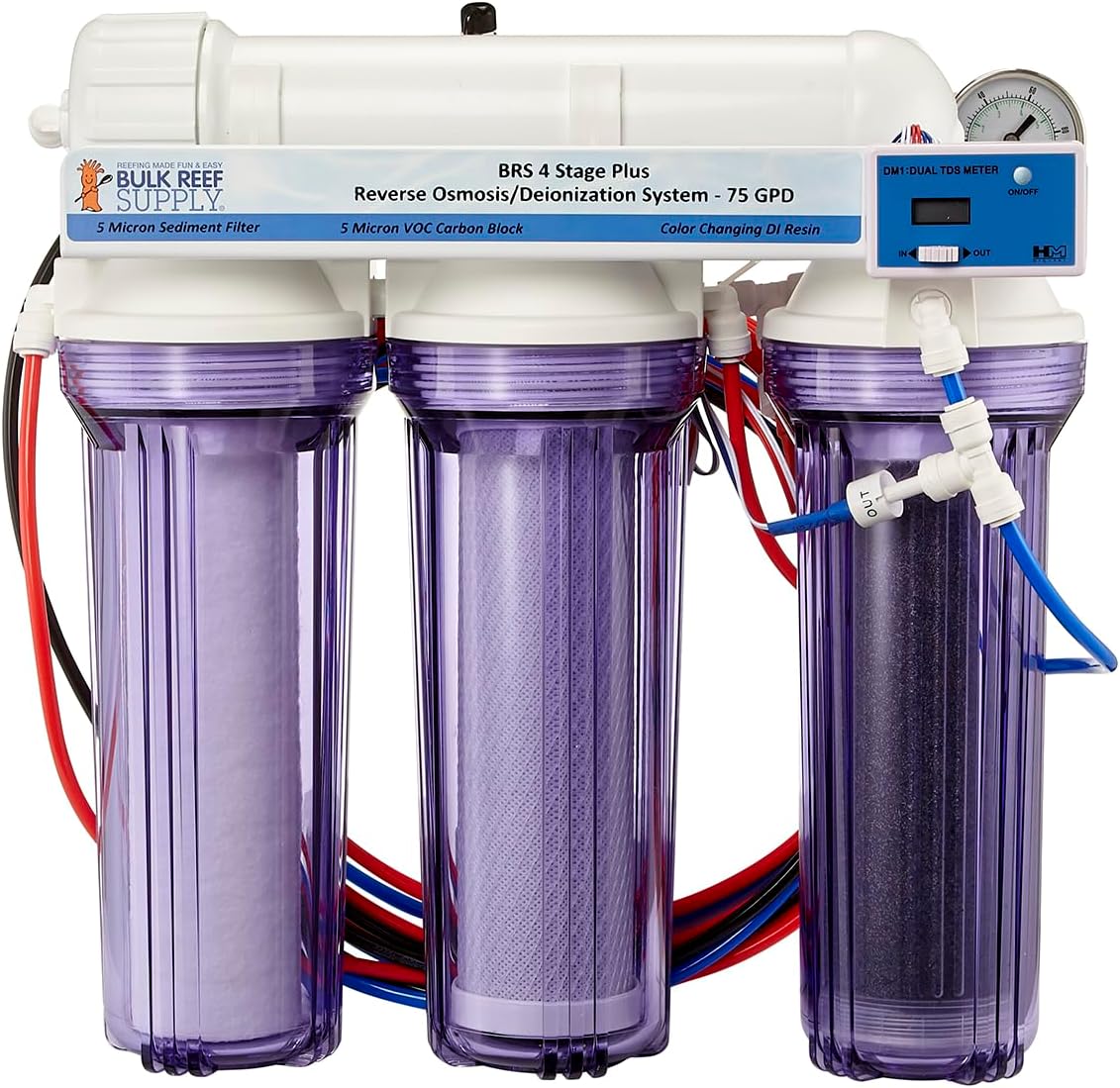
Bulk Reef Supply's four-stage Value Plus system combines 75 GPD production with unusually useful monitoring controls. Its supplied rating is 4.5 stars, placing it among the highest-rated products in the guide, and the integrated TDS meter gives aquarium owners a direct way to evaluate the water at different points in the filtration process.
We may earn a commission when you buy through this link, at no additional cost to you.
The filtration sequence covers sediment removal, chlorine and volatile organic compound reduction, RO treatment, and final DI resin polishing. The membrane is listed as delivering up to 99 percent efficiency. This arrangement is appropriate for reef and marine aquariums where the goal is to start with water containing very low levels of dissolved solids and then mix that water with the correct salt formulation.
Monitoring is the defining advantage. The built-in meter can measure pre-DI-resin and post-membrane levels, while a pressure gauge tracks the condition of the sediment pre-filter. Together, these tools give the operator more information about system performance than a basic model without instruments. They can help show when cartridge maintenance or further troubleshooting is warranted.
An Auto Shutoff Solenoid provides automatic stopping control, and an integrated cleaning flush valve supports membrane maintenance. The system also includes a garden-hose connection, a sink adapter with multiple sizing rings, and a canister wrench. This accessory set makes setup and cartridge changes more convenient, particularly for an aquarist assembling a dedicated purification station.
Its 75 GPD membrane is smaller than the 100 and 150 GPD options elsewhere in this roundup. It can still serve routine changes and top-offs, but users with large display tanks or frequent replacement schedules should estimate their true demand before choosing. Rated membrane capacity also does not guarantee constant real-world output under every pressure or temperature condition.
The automatic shutoff is particularly valuable if the system feeds a storage tank. A float-controlled or electronically controlled shutoff can prevent overflow when the container is full. The supplied listing names an Auto Shutoff Solenoid but does not describe a separate float valve, so buyers should confirm exactly how the unit is intended to stop and whether additional float hardware is needed for their installation.
This system is best suited to aquarists who value information and control over convenience alone. The built-in TDS meter and pressure gauge make it easier to establish a baseline, compare it during routine service, and investigate changes in production. Those features are particularly helpful for reef tanks, breeding projects, and users who prepare large volumes of RO/DI water regularly.
Overall, the Bulk Reef Supply system earns its place for monitoring depth and included maintenance accessories. The trade-off is a smaller membrane capacity, but the 75 GPD rating remains substantial for many aquariums. For owners who want transparent performance data and automatic shutoff, it is an especially compelling configuration.
The integrated TDS meter provides readings before the DI stage and after membrane treatment, helping owners see how each part of the system contributes to the final water quality.
An Auto Shutoff Solenoid is designed to stop production automatically, which is useful with a dedicated collection tank. Users should confirm the required shutoff arrangement during installation.
We may earn a commission when you buy through this link, at no additional cost to you.
This clear-housing Max Water system combines a six-stage RO/DI arrangement with a built-in TDS meter and a 100 GPD membrane. Its listed rating is 4.2 stars, and the transparent housings make cartridge condition easier to observe. The combination appeals to aquarists who want both detailed purification and visible maintenance.
We may earn a commission when you buy through this link, at no additional cost to you.
The listed filtration claims include 99.99 percent impurity reduction after the DI stage, along with reductions in odors, lead, fluoride, copper, cysts, and metallic ions. It is designed to turn tap water into a purified supply for aquariums, and the inclusion of deionization distinguishes it from a conventional three-stage RO unit. That makes it useful for sensitive marine, planted, and breeding setups.
The built-in TDS meter gives users a more objective view of finished water than visual inspection alone. It can help track the effect of new cartridges or reveal when performance changes. Because the TDS meter is integrated into the system, owners do not need to carry a separate meter for routine readings, although independent testing can still be useful for confirming important changes.
Color-coded quick connections support a more understandable installation, while the labeled housings help users identify the correct component during replacement. Clear shells also make it easier to observe sediment loading and resin color. These visibility-oriented details are particularly valuable in a permanent fish-room installation where the operator wants to conduct quick visual checks.
The component count creates a trade-off. Six stages mean more housings, more tubing connections, and a larger maintenance surface than a basic three-stage system. The product is therefore less attractive for someone seeking the smallest possible setup, but more appropriate for a user who prioritizes comprehensive treatment and systematic monitoring.
As with the related Max Water model, a float valve is not included and a separate compatible item is referenced in the listing. Users who plan unattended tank filling should address this need. The system should also be installed with a suitable cold-water feed and enough pressure for the membrane to operate as intended.
The 100 GPD capacity gives it enough nominal output for many freshwater and saltwater aquariums, especially when the owner collects purified water in batches. Actual production will vary with pressure, temperature, cartridge condition, and the amount of water being recovered as waste. Daily maintenance and planned cartridge changes are necessary to preserve performance.
This model is a good fit for dedicated aquarium rooms where transparency, TDS tracking, and a multi-stage layout are priorities. It is less compelling for casual top-off-only use, but it offers a comprehensive purification package for regular water changes and sensitive systems. The included meter makes it particularly practical for aquarists who want ongoing feedback rather than an entirely passive setup.
Transparent housings allow owners to inspect sediment and resin media without dismantling the system. That visibility makes it easier to schedule maintenance and notice gradual changes in cartridge condition.
The integrated TDS meter makes routine water-quality checks more convenient. It is particularly useful for comparing output before and after cartridge replacement or system maintenance.
We may earn a commission when you buy through this link, at no additional cost to you.
The AquaReady three-stage RO system offers a relatively simple way to produce purified water for regular aquarium maintenance. Its supplied rating is 4.4 stars, and the listing emphasizes straightforward installation, a compact footprint, and up to 75 gallons of daily filtration. It is best understood as an RO-only option rather than a full RO/DI system.
We may earn a commission when you buy through this link, at no additional cost to you.
The product listing states that it reduces chlorine, heavy metals, nitrates, fluoride, and other contaminants by as much as 96 percent. It is suitable for freshwater, reef, and saltwater aquariums where purified source water can help reduce unwanted dissolved material. Unlike the DI-equipped systems in this guide, however, it does not provide a final ion-removal stage.
That distinction matters. An RO membrane can remove a large percentage of dissolved contaminants, but some residual ions may remain. Aquarists who require extremely low or near-zero TDS for reef preparation may find that a full RO/DI system offers a more appropriate final treatment stage. For ordinary freshwater top-offs and many water changes, the simpler three-stage design can still be highly functional.
The compact system is designed to fit below sinks or in tight spaces and is described as portable. That makes it useful for apartments, rentals, temporary aquarium arrangements, and owners who do not want a permanent installation. Its easy DIY positioning also reduces the amount of specialized plumbing required compared with more complex tankless configurations.
The listing says the package includes everything needed to get started. This is helpful for first-time buyers because it reduces the need to identify separate components before installation. Users should still confirm their available pressure, use cold input water, follow the supplied instructions, and allow the membrane to flush appropriately before using the output.
The principal trade-off is the lack of DI resin. This means the system cannot claim the same final TDS reduction as the four- and six-stage RO/DI models. It also cannot remove every residual ion in the same way, and the listed reduction figure is not equivalent to perfect removal of all aquarium-relevant contaminants.
For reef aquariums, the distinction between RO and RO/DI can be significant because salt mixing begins with source-water chemistry. For freshwater planted systems, RO water may need minerals reintroduced according to the species and substrate. The AquaReady system solves the first part of the process—purifying source water—but it does not create the complete final recipe.
This is a good choice for aquarists seeking a straightforward, compact, and portable RO unit without the complexity of a larger multi-stage system. It is most attractive for freshwater maintenance, routine changes, and owners who understand that RO and RO/DI are not interchangeable. For very low-TDS applications, choose an RO/DI model instead.
The small footprint and portable format make the system practical below sinks, inside cabinets, or in temporary setups. It can move with the aquarium rather than requiring a permanent dedicated location.
The three-stage format removes more contaminants than ordinary household filtration while keeping the system relatively uncomplicated. It suits users who do not require final DI polishing.
We may earn a commission when you buy through this link, at no additional cost to you.
This Max Water six-stage RO/DI system provides a comprehensive purification path in a 100 GPD aquarium-oriented package. The supplied rating is 4.2 stars, and its clear housings, labeled components, and color-coded connections make it approachable for owners who want a methodical setup with visible maintenance points.
We may earn a commission when you buy through this link, at no additional cost to you.
The listing describes filtration down to 1/10,000 of a micron and 99.99 percent impurity reduction after the DI stage. Listed targets include lead, fluoride, copper, metallic ions, odors, and several cysts. The inclusion of deionization is especially important for reef and other sensitive applications where reducing residual dissolved solids can make water preparation more precise.
The clear filter housings are a defining physical feature. They allow the operator to inspect cartridge media and observe conditions such as sediment accumulation or DI resin color changes. Labeled housings make replacement easier, and the color-coded quick connections provide visible cues when assembling or checking the plumbing.
BPA-free components are listed as part of the construction. The product is also marketed for both aquarium and broader household filtration applications. Its six-stage arrangement gives it a more detailed treatment path than basic RO units, although every additional stage adds connection points and components that need routine inspection.
This version does not list an integrated TDS meter, unlike the related Max Water model with clear housings and a meter. That is an important distinction for users who want continuous numerical monitoring. Without the meter, an owner can still evaluate output using an external TDS device or observe cartridge condition, but the setup is less instrumented.
A float valve is again referenced as a separate purchase for installations where automatic tank-level control is needed. The absence of that accessory does not prevent basic operation, but it should be considered for a pump-driven system that fills a storage vessel. Careful setup and correct shutoff behavior are especially important in unattended fish-room environments.
The 100 GPD rating provides meaningful capacity for routine freshwater changes, top-offs, and moderate marine-tank preparation. Actual output depends on the feed pressure and operating conditions, so users should not treat the membrane rating as a guaranteed daily delivery figure. Correct cartridge condition and appropriate plumbing restrictions also influence production.
This product is best for aquarists who want six-stage RO/DI purification, visible cartridge media, and organized installation without the extra monitoring hardware found in the TDS-meter version. It is a sound middle option for dedicated setups and especially useful for users who prefer to inspect media visually rather than rely only on numerical instruments.
Clear housings help owners evaluate cartridge condition during routine checks. Visible resin and sediment media can make maintenance timing more intuitive and reduce unnecessary handling.
Color-coded quick connections and labeled housings guide setup and replacement. This organization is valuable in a permanent aquarium room where several components must remain easy to service.
We may earn a commission when you buy through this link, at no additional cost to you.
This 50 GPD four-stage RO/DI system is the most compact-capacity option in the guide and is positioned as an entry-level aquarium purifier. Its supplied rating is 3.7 stars, the lowest in the comparison, but the core filtration design is appropriate for small tanks, occasional changes, and aquarists building their first RO/DI setup.
We may earn a commission when you buy through this link, at no additional cost to you.
The sequence starts with sediment filtration for particles such as rust and suspended solids. A CTO Plus cartridge follows for chlorine, chloramines, odors, and discoloration. The RO membrane then removes most dissolved contaminants, and the final DI stage removes ions to produce ultrapure water. This provides more comprehensive treatment than a basic three-stage RO model.
The transparent DI bottle offers a useful visual maintenance cue. As the resin gradually turns orange, the owner knows that replacement is approaching. This feature is especially helpful in a compact system where adding several separate monitoring instruments may not be the owner's priority.
At 50 GPD, the membrane is best aligned with small aquariums, modest water-change schedules, and supplemental purified-water needs. It may be less suitable for a large reef display with frequent changes unless production is spread across a longer period. Rated capacity is also not the same as guaranteed output because pressure, temperature, and maintenance influence real results.
The system is described as plug-and-play and includes standard quick-connect interfaces and installation accessories. The package list includes the RO filter, sediment cartridge, CTO Plus cartridge, DI filter, housing, tubing, screws, tape, wrenches, adapters, clips, and a manual. The supplied note advises giving the filter water for three minutes before use.
Its 3.7 rating is the main reason to consider alternatives carefully. It does not mean the system lacks useful features, but it is the least favorably rated product in this data set and provides fewer monitoring tools than higher-rated choices. Owners who prioritize reliability signals, broader output, or integrated instruments may prefer spending more on another model.
The main use case is a compact system for a smaller freshwater or marine aquarium where the owner wants DI polishing without a large tankless footprint. The quick connections and supplied hardware reduce installation complexity, while the clear resin bottle gives the system one practical monitoring advantage.
Overall, this product works best as an affordable first RO/DI unit or a dedicated secondary purifier for smaller water needs. It should be chosen with realistic expectations about its rated output and its limited instrumentation. For frequent large-volume changes, one of the 100 GPD systems offers more practical capacity.
The complete four-stage configuration gives new users access to RO and DI treatment without a large tankless design. It is most practical for smaller aquariums and moderate water-production needs.
The transparent bottle lets users see the resin gradually turn orange as it is consumed. This visual signal provides a simple maintenance cue even without a digital TDS meter.
We may earn a commission when you buy through this link, at no additional cost to you.
Brightwell Aquatics Remineraliz P is not an RO filter, but it is an essential companion product for many freshwater aquariums. Its supplied rating is 4.4 stars, and it restores calcium, magnesium, potassium, and sodium to water that has been treated by reverse osmosis, deionization, or distillation. Without this step, very pure water can be unsuitable for freshwater fish and plants.
We may earn a commission when you buy through this link, at no additional cost to you.
The product is formulated for osmoregulation, metabolic function, and strong plant growth. It helps establish general hardness and total dissolved solids in a more biologically suitable range. These benefits are especially relevant for community tanks, biotopes, planted aquariums, and species from soft-water forest or river habitats that still require some dissolved mineral support.
Remineralization should follow the RO system rather than replace it. RO and DI units remove unwanted dissolved material, while a remineralizer restores selected minerals needed by aquarium inhabitants. That creates a controlled source water that can then be adjusted further with the appropriate substrate, salts, or conditioning products for a particular species.
Its primary limitation is scope. This product is designed for freshwater aquariums and does not replace proper salt mixing for reef or marine systems. It also cannot make unsafe tap water safe, remove contaminants, or substitute for a functioning RO/DI system. Owners should follow the product directions and test the resulting GH and TDS rather than adding an arbitrary amount.
The 1,000-gram package is described as an American-made product from an aquatic-care company with a focus on scientifically informed products. Its value lies in the final balance stage that many buyers overlook. A technically impressive RO unit can create water that is extremely clean but too mineral-deficient for some freshwater organisms, making controlled remineralization essential.
The best candidates are owners of soft-water planted aquariums and freshwater systems whose tap water has a high or inconsistent mineral load. RO/DI water can provide a stable base, and Remineraliz P restores a predictable mineral profile. The product is also useful when using distilled or deionized water from another source.
This selection also highlights why water chemistry should be considered as a complete system. Purifying the water is only the first step. In marine aquariums, the next step is salt mixing; in many freshwater habitats, it is controlled remineralization. Selecting the wrong follow-up product can lead to unsuitable hardness, osmotic stress, or plant-growth problems.
Overall, Remineraliz P is the essential freshwater finishing product in this guide. It is not the best standalone answer to the keyword because it performs no filtration, but it is highly relevant to anyone using RO water in a freshwater aquarium. Pair it with a capable RO or RO/DI system and test the finished water before use.
The formula replenishes calcium, magnesium, potassium, and sodium after RO or DI treatment. This creates a more suitable mineral balance for osmoregulation and routine freshwater aquarium health.
By helping establish GH and TDS, the product gives planted aquariums a more predictable baseline. The final level should still be matched to the species, plants, and substrate used in the system.
We may earn a commission when you buy through this link, at no additional cost to you.
Choosing an aquarium RO unit requires balancing the purity your livestock needs against daily water demand, available space, feed pressure, monitoring needs, and the ongoing cost of maintaining replacement media.
A standard RO unit uses a semipermeable membrane to reduce dissolved solids and many other contaminants. An RO/DI system adds deionization resin after the membrane to remove residual ions, producing much lower final TDS. Reef aquariums, breeding projects, and applications involving sensitive corals, shrimp, or difficult freshwater species often benefit from the additional DI stage.
Choose RO/DI when the lowest achievable dissolved solids are important. Choose basic RO for simpler freshwater maintenance, routine top-offs, or applications where the remaining dissolved fraction is acceptable.
The products in this guide range from 50 to 150 GPD. Larger aquariums, frequent water changes, multiple systems, and reef maintenance schedules justify higher rated capacity, while a small aquarium with occasional changes may need much less. Remember that GPD is a nominal membrane rating; real production depends on pressure, temperature, plumbing, and cartridge condition.
Estimate how many gallons you need per week and allow time for cartridge changes, flushing, and system recovery. Choose enough capacity to produce that volume without running the system continuously.
Compact units can sit below a sink, inside a cabinet, or in a dedicated fish-room area. Tankless systems require more permanent plumbing and often a pump, storage tank, and automatic shutoff. Portable systems suit rentals and temporary locations but may need a separate collection container and careful connection planning.
Confirm that the supplied components fit your available space and that the system will connect to a suitable cold-water feed. Look for color-coded fittings, clearly labeled housings, and compatible quick-connect tubing to simplify setup and maintenance.
RO membranes require adequate incoming pressure, and some models include a pump to support operation in low-pressure conditions. A system that cannot maintain suitable pressure may produce less water, wear components faster, or fail to keep the membrane in its intended operating range. Using the wrong feed or a restricted faucet can also make troubleshooting difficult.
Check the manufacturer's operating requirements before installation. If low pressure is common at the intended location, a pump-equipped model may be more dependable than a passive membrane system.
TDS meters, pressure gauges, visual resin windows, and color-changing cartridges each provide different maintenance information. TDS meters show how much dissolved material remains, pressure gauges can help reveal restrictions, and visual resin indicators show when deionization media is nearing exhaustion. No single indicator replaces all others.
Choose monitoring features that match your experience level. Beginners may appreciate an integrated TDS meter or a visible DI housing, while experienced aquarium-room operators may already monitor the setup with separate instruments.
The first purchase is only part of the ownership cost. Sediment cartridges, carbon cartridges, RO membranes, and DI resin eventually need replacement according to water use and condition. High-capacity systems may consume media faster simply because they produce more purified water. Accessories such as tubing, float valves, canisters, and seals can also add to the setup cost.
Check the cartridge format and availability before buying. Standard housings and common sizes may be easier to service, and a clear housing can make it easier to decide when replacement is needed.
Purification changes source water, but it does not automatically create suitable aquarium water. Reef aquariums require an appropriate salt mix, while many freshwater systems require controlled remineralization. Fish from soft-water environments may need less mineral support than species from hard-water habitats, and planted tanks may need a specific balance of macro and micronutrients.
Measure the source water, the RO or RO/DI output, and the finished aquarium water. Make changes gradually, especially when moving between water sources with very different TDS levels.
A storage tank lets an aquarium RO system run for longer sessions and makes collected water convenient to use. It also creates a need for reliable automatic shutoff. Float valves, electronically controlled valves, and overflow protection can prevent an unattended system from continuing to fill after the container reaches its limit.
Match the shutoff method to the system and storage container. Verify that the listed components include everything your installation requires, and add compatible accessories when they are sold separately.
Begin by reading the instructions supplied with the exact model, confirming that the feed connection uses cold water, and checking available space, pressure, drainage, and electrical requirements. Install the stages in their listed order, secure every tubing connection, and place the unit where cartridge changes and monitoring will be convenient. A dedicated collection container should include dependable shutoff protection.
Flush the new membrane and cartridges according to the manufacturer directions before collecting water for an aquarium. Start the system, check for leaks, and monitor both pressure and output. Test the finished water with a TDS meter and, when preparing a new aquarium, test hardness and other relevant parameters before adding salt or remineralizing products. Never assume unfiltered tap water is safe merely because it appears clear.
For maintenance, inspect the sediment filter and carbon stage at regular intervals and replace them when they become restricted or show meaningful decline. Follow the supplied schedule for the RO membrane and replace DI resin before its color change or performance indicator shows exhaustion. Keep the system protected from heat, inspect hoses and seals, sanitize compatible components appropriately, and never use chemically uncleaned replacement parts without following the relevant instructions.
An RO/DI system is generally better when you want the lowest possible dissolved solids because the DI stage removes residual ions left after the RO membrane. A standard RO unit can still be suitable for ordinary freshwater maintenance and routine top-offs. The best choice depends on your water source, livestock requirements, and budget.
A pump is useful when the available feed pressure is low or inconsistent because it helps the membrane operate under more stable conditions. Some compact systems work fine with suitable household pressure. Check the product requirements and ensure the installation can maintain the pressure needed for the selected membrane.
The amount depends on tank size, evaporation, livestock, and water-change frequency. A small aquarium with occasional changes may need much less than a large reef system requiring frequent changes. Add up the water you expect to replace over a week and select a rated capacity that can produce it within a reasonable operating window.
Pressure, temperature, restricted filters, membrane condition, DI resin exhaustion, and the position of the meter can all affect readings. Some systems also include a final carbon stage that may produce a small measured TDS contribution even after DI treatment. Test the feed water and each relevant stage to identify where the difference occurs.
Often, yes. RO and DI remove dissolved minerals that some freshwater fish, invertebrates, and plants need for proper osmoregulation and growth. A product such as Remineraliz P can restore selected minerals, but the final GH and TDS should be matched to the species and planted-tank requirements rather than chosen arbitrarily.
No. Salt should not pass through the membranes or replace the DI stage. For marine aquariums, collect the purified water first, then mix it with an appropriate reef salt in a clean, separate container according to the salt manufacturer's directions. Verify the final salinity before adding the water to the aquarium.
Replacement intervals depend on source-water quality, daily production, and the condition of each cartridge. Sediment and carbon stages generally need attention as they load, while DI resin should be replaced when its indicator shows exhaustion. RO membrane replacement is commonly based on measured performance decline and the manufacturer's maintenance guidance.
Yes, if its rated capacity and water-production schedule match the combined demand. High-output systems are better suited to multiple aquariums or frequent changes. Add a proper storage tank and automatic shutoff, and consider how much time each filter change and sanitization task will require.
The strongest all-around selection is the 4-Stage Aquarium Reverse Osmosis System with Flushing Valve because it combines four treatment stages, a 100 GPD rating, visible DI resin, a flushing valve, and flexible installation accessories. The 4 Stage RO+DI System stands out for budget-conscious owners who value wall mounting, quick-change cartridges, and a pressure gauge. For serious high-volume use, the pump-equipped iSpring RCC1DP offers the premium combination of 150 GPD capacity and tankless operation.
Prioritize the chemistry required by your aquarium before focusing on minor convenience differences. Reef and sensitive projects generally benefit from final DI polishing, while freshwater users need to restore appropriate minerals after treatment. Output, available space, feed pressure, monitoring, shutoff protection, and replacement-media availability should then determine which system fits your routine.
Before buying, compare the current listing details, warranty terms, included accessories, and cartridge specifications with your installation. Product configurations and promotional pricing can change, so check the live page before making a final decision. Most importantly, test the feed and finished water, follow the flushing instructions, and verify the resulting chemistry before adding purified water to a populated aquarium.