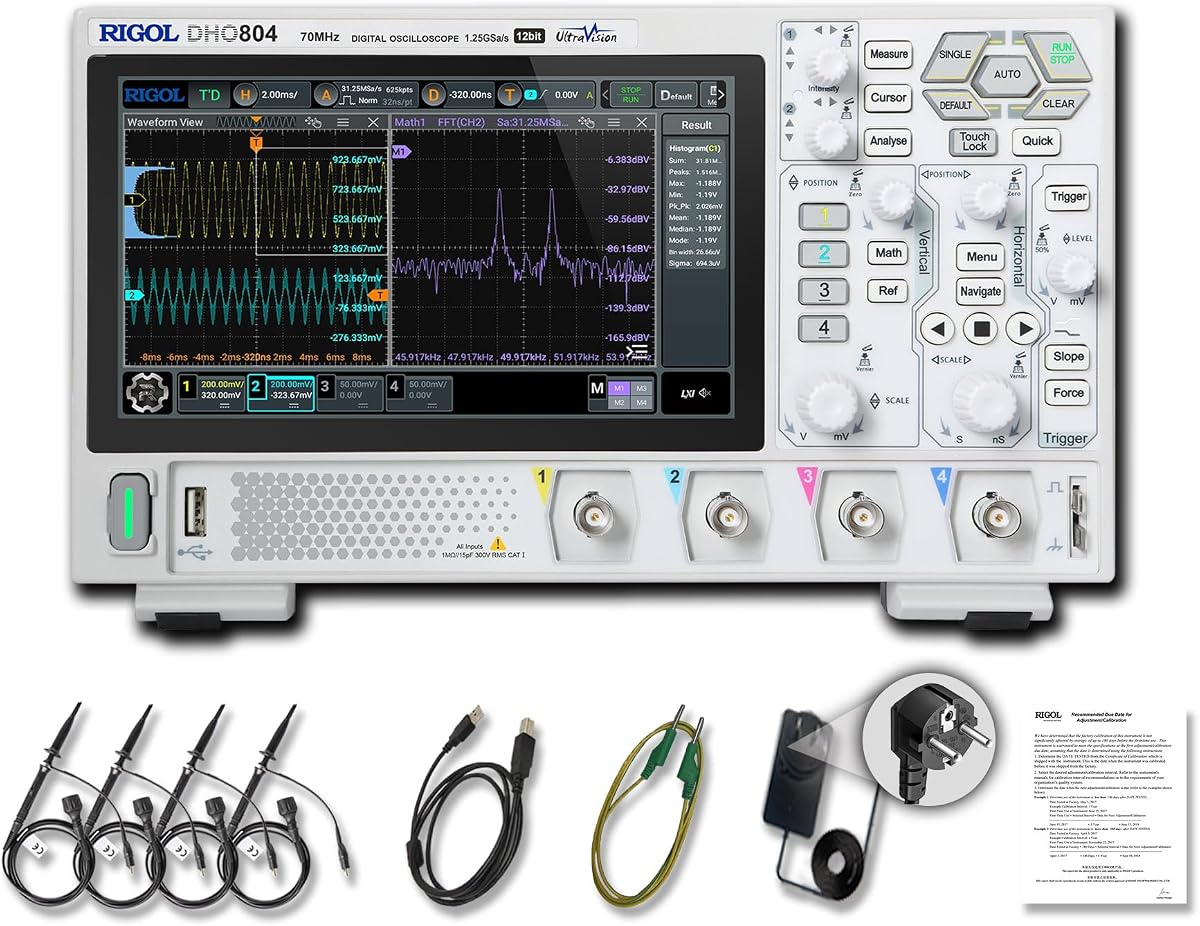
RIGOL DHO804
4.3Editor score
70 MHz bandwidth
Four analog channels
12-bit vertical resolution
A digital oscilloscope reveals how electrical signals behave over time, making it essential for electronics repair, embedded development, power-system analysis, education, and field troubleshooting. A useful model balances bandwidth, sampling rate, vertical resolution, record depth, display clarity, triggering, connectivity, and portability rather than focusing on a single headline specification.
We compared the listed scopes using their supplied specifications, including analog channels, bandwidth, sampling rate, memory depth, waveform capture performance, decoding tools, signal-generation options, displays, power sources, and remote-control interfaces. The list covers portable and bench instruments from entry-level troubleshooting tools to higher-bandwidth laboratory models with advanced acquisition and analysis features.
Each review highlights the strongest use case, notable capabilities, and practical limitations so the right scope can be matched to the work at hand. Product availability, configurations, and pricing can change, and the two listings without descriptive information remain limited-data entries rather than fully evaluated recommendations.
4.3Editor score

4.9Editor score

4.5Editor score
As an Amazon Associate we earn from qualifying purchases.
This side-by-side comparison organizes the ten listings by the factors that most directly affect signal capture and usability, including bandwidth, channels, sampling rate, memory, analysis features, portability, and connectivity.


The RIGOL DHO804 is a portable four-channel digital oscilloscope rated 4.3, offering 70 MHz bandwidth, 1.25 GSa/s sampling, and 12-bit vertical resolution. Its standout combination is channel count and resolution: engineers can compare several rails at once while retaining finer vertical detail than a conventional lower-resolution entry scope.
We may earn a commission when you buy through this link, at no additional cost to you.
The acquisition system supports up to 1,000,000 waveforms per second with 256-level intensity grading. Waveform search and event, time, and frame navigation help isolate rare faults, while peak detection can identify glitches down to 1.6 ns. The 25 Mpts memory depth gives users room to examine long captures without immediately discarding the wider context.
Analysis features are unusually broad for the class. FFT processing supports up to 1 Mpts, and the scope provides filters, math, 41 automatic measurements, and standard decoding for CAN, RS232/UART, I2C, SPI, and four-bit parallel buses. USB Host/Device, HDMI, and LXI-C LAN connectivity support data transfer, external displays, browser-based Web Control, and SCPI automation.
This is a compelling choice for switching-power ripple and noise checks, embedded bring-up, sensor-interface validation, protocol troubleshooting, teaching, and general bench work. The 7-inch 1024×600 touch screen and Flex Knob help keep routine adjustments efficient, while portable construction makes it more adaptable than a fixed bench-only instrument. The main limitation is that 70 MHz is not the right choice for much faster edges or high-frequency systems.
Four analog channels make the DHO804 particularly useful when a design contains several supply rails, sensor outputs, clocks, or control lines. Users can compare timing relationships without repeatedly changing probes or relying on a separate reference channel.
Standard trigger and decode support for common embedded buses helps turn a changing waveform into readable data. The 41 automatic measurements, filters, math functions, and FFT analysis further reduce the need to rely on visual estimation alone.
We may earn a commission when you buy through this link, at no additional cost to you.
The RIGOL DHO924S is a 4.5-rated advanced oscilloscope that combines 250 MHz bandwidth, four analog channels, 1.25 GSa/s sampling, 12-bit resolution, and up to 50 Mpts of memory. It is designed for users who need to capture faster edges, retain longer records, and move beyond basic signal inspection.
We may earn a commission when you buy through this link, at no additional cost to you.
UltraAcquire can capture up to 1,000,000 waveforms per second, and 256-level intensity grading helps reveal signal density, jitter, noise, and intermittent behavior. Search, navigation, and an event table support efficient review of long acquisitions. The larger memory depth is particularly helpful when a user needs to move from a quick trigger-level view to a detailed record of a fault.
The S model's defining feature is its single-channel AFG output, which works with built-in Bode plot analysis over 10 Hz to 25 MHz. That combination supports loop-response and frequency-response testing without treating the oscilloscope as only a measuring instrument. Sixteen digital channels are also available, although the required PLA2216 probe is sold separately.
Connectivity is a major strength. USB Host/Device, LXI-C LAN, HDMI, browser Web Control, and standard SCPI commands support remote operation, laboratory automation, documentation, and external-display workflows. CAN, LIN, UART, I2C, and SPI decoding extend its usefulness for embedded development. The lack of slow sweep or roll is the clearest restriction, while the separate digital probe adds another consideration for mixed-signal work.
The integrated AFG output lets an engineer inject a controlled source and observe the result without arranging a separate generator for every test. Bode plot analysis from 10 Hz to 25 MHz adds a convenient way to examine gain and phase response.
A waveform acquisition rate of up to 1,000,000 per second, combined with intensity grading, makes the DHO924S well suited to intermittent faults. Search and event-table navigation help shorten the path from a suspected anomaly to the captured instance that deserves closer inspection.
We may earn a commission when you buy through this link, at no additional cost to you.
The FNIRSI DPOS350P is a 4.1-rated handheld scope that combines four functions in one enclosure: a 350 MHz digital oscilloscope, spectrum analyzer, frequency-response analyzer, and DDS signal generator. Its two-channel configuration and 1 GSa/s sampling rate make it a versatile field instrument for engineers who need more than a basic waveform display.
We may earn a commission when you buy through this link, at no additional cost to you.
The oscilloscope section provides 8- to 16-bit resolution, 47 Kpts of record depth, a 50,000-waveform-per-second refresh rate, digital phosphor, X-Y mode, zoom, cursors, and 12 automatic measurements. A 2 mV/div setting offers sensitivity for low-level signals, while a seven-inch touchscreen provides a larger control surface than a typical pocket model.
Its analysis suite is the major attraction. FFT analysis spans 200 kHz to 350 MHz with selectable FFT lengths, harmonic markers, cursor readouts, and a real-time 2D/3D waterfall. The frequency-response analyzer covers 10 Hz to 50 MHz and measures gain, phase, and frequency, making the unit useful for Bode-style plots, loop-stability checks, and analog filter tuning.
The DDS generator outputs 14 standard waveforms plus clipped waveforms, with a 0 to 50 MHz range, 1 Hz resolution, adjustable amplitude and offset, variable duty cycle, and support for custom clipping waveforms. An 8,000 mAh battery supports extended field use, and the unit can store 500 waveforms and 90 screenshots. The comparatively shallow 47 Kpts memory and two-channel limit are important when a task demands long records or many simultaneous analog signals.
FFT analysis, harmonic markers, and a 2D/3D waterfall help users inspect the frequency content surrounding a transient or interference source. These tools are useful when the time-domain trace shows a problem but does not reveal its spectral character.
The 8,000 mAh battery and integrated generator make the DPOS350P practical for maintenance work where carrying several separate instruments would be inconvenient. Storage for waveforms and screenshots also helps preserve observations during site visits.
We may earn a commission when you buy through this link, at no additional cost to you.
The RIGOL DS1102Z-E is a 4.9-rated two-channel scope with 100 MHz bandwidth, a real-time sampling rate of up to 1 GSa/s, and deep memory of up to 24 Mpts. It is a strong general-purpose bench choice for electronics debugging, education labs, power work, and embedded bring-up.
We may earn a commission when you buy through this link, at no additional cost to you.
Its waveform capture rate of up to 30,000 frames per second improves the chance of revealing intermittent glitches. The 7-inch WVGA TFT display uses intensity-graded color to create a digital-phosphor-style view, making jitter, noise, and brief events easier to distinguish. The relatively large screen also provides a practical balance for prolonged bench use.
Memory and recording are major strengths. Up to 24 Mpts is available in the stated configuration, with 12 Mpts in dual-channel mode. Hardware real-time recording and playback can store and review as many as 60,000 frames, helping users investigate a fault after it has disappeared instead of relying on a single live display.
Serial bus trigger and decoding support for RS232/UART, I2C, and SPI makes it useful for embedded troubleshooting. USB Host, USB Device, LAN with LXI, and AUX output for trigger or pass/fail support bench integration and documentation workflows. Its two-channel layout and modest display resolution are the main limitations, but the combination of deep memory, capture performance, decoding, and remote control makes it an especially balanced choice for routine engineering work.
A long acquisition can show how a fault developed instead of presenting only a narrow trigger window. The stated memory of up to 24 Mpts, with 12 Mpts in dual-channel operation, is generous for a two-channel model and supports more considered post-capture analysis.
Recording up to 60,000 frames gives users a way to revisit intermittent behavior. This is particularly valuable when a glitch is too brief to recognize reliably on a live screen or when the trigger is not perfectly tuned.
We may earn a commission when you buy through this link, at no additional cost to you.
The FNIRSI 2C53T is a 4.3-rated 3-in-1 instrument that combines a two-channel 50 MHz oscilloscope, a 4.5-digit 19,999-count multimeter, and a DDS signal generator. It is positioned as a portable tool for professionals, schools, and hobbyists who want to diagnose, measure, and inject signals without carrying multiple devices.
We may earn a commission when you buy through this link, at no additional cost to you.
The oscilloscope offers 250 MSa/s sampling, 1 Kpts of record depth, automatic measurements, persistence, X-Y mode, cursor measurement, and math operation. Vertical sensitivity runs from 10 mV/div to 10 V/div, and waveform images can be saved and exported. A built-in high-voltage protection module and a stated maximum voltage of 400 V add practical emphasis on protection, although users must still observe correct probe and measurement procedures.
The multimeter section supports AC and DC voltage, AC and DC current, resistance, capacitance, and continuity. Its 19,999-count display provides more precision than a basic meter, while the DDS generator outputs 13 waveforms up to 50 kHz with 1 Hz steps. A one-click save function, screenshot capability, and reference-waveform comparison help document and compare observations.
The 2.8-inch LCD, 3,000 mAh battery, and stated standby time of up to six hours make this a practical portable kit. Language switching and adjustable grid brightness improve usability in different environments. The 1 Kpts record depth is the decisive compromise, so the 2C53T is best suited to quick signal checks rather than long captures or detailed post-processing.
Voltage, current, resistance, capacitance, and continuity measurements are integrated into the same enclosure. This makes the unit convenient for preliminary troubleshooting where the first question is whether a circuit, supply, or component is behaving as expected.
The ability to display a saved reference waveform and the measured waveform together supports direct comparison between states. Image saving and Type-C export also help preserve evidence for notes, reports, or later review.
We may earn a commission when you buy through this link, at no additional cost to you.
The FNIRSI DSO152 is a 4.4-rated handheld oscilloscope built around portability and rapid basic measurements. It provides 200 kHz bandwidth, a 2.5 MS/s real-time sampling rate, and a compact 2.8-inch HD LCD with 320×240 resolution. It is aimed at automotive maintenance, field service, R&D education, and quick signal checks.
We may earn a commission when you buy through this link, at no additional cost to you.
Automatic, normal, and single trigger modes support both periodic analog signals and aperiodic digital behavior. A one-key AUTO function sets the operating parameters and displays the measured waveform without a lengthy adjustment process. Holding the AUTO button calibrates the baseline, which helps users begin troubleshooting with less setup and more attention on the signal itself.
The supplied 10× probe is stated to measure up to 800 VPP, equivalent to 280 V AC, and the scope is described as handling voltages up to 400 V. These figures make it relevant to automotive and mains-related inspection, but correct probe ratings, grounding, and safe measurement procedures remain the user's responsibility. The product should not be treated as a substitute for a properly rated high-voltage measurement system.
A built-in 1,000 mAh lithium battery provides approximately four hours of continuous use after charging, while the Type-C interface supports data transmission, charging, and firmware upgrades. The unit arrives assembled, avoiding the setup problems associated with kit-form pocket scopes. Its limitations are fundamental: 200 kHz bandwidth, modest sampling, and a basic display restrict it to slower or relatively simple waveforms.
The one-key AUTO mode reduces the number of adjustments required before viewing a signal. Baseline calibration adds another shortcut for users who need a quick indication rather than a fully configured laboratory acquisition.
The lightweight, assembled design is easy to carry and immediate to deploy. Battery operation and Type-C charging make it especially useful for automotive and maintenance tasks where a bench instrument is not practical.
We may earn a commission when you buy through this link, at no additional cost to you.
The Hantek DSO2D15 is a 4.6-rated two-channel digital storage oscilloscope with 150 MHz bandwidth. Its supplied information is concise, but it identifies a useful combination of signal capture, triggering, decoding, and waveform generation for commissioning and educational work.
We may earn a commission when you buy through this link, at no additional cost to you.
Arbitrary waveform output broadens the instrument beyond passive observation. Engineers can use the generator to inject test signals and examine a circuit's response, which is useful during board bring-up, classroom exercises, and signal-path commissioning. The product therefore functions more like a compact development bench than a single-purpose display.
Fourteen trigger modes offer flexible control over how the scope stabilizes a display. The stated support for five serial protocol triggers and decodes assists users working with communication, aerospace, national defense, embedded systems, computers, research, and education. Those fields span both slow control signals and communication-oriented testing, although the supplied listing does not identify each supported protocol or provide detailed decode performance.
The 6.33-pound package weight makes this more of a portable lab instrument than an ultra-pocket diagnostic tool. Compared with lighter handheld scopes, it is better suited to a workbench, classroom, or temporary field station where a larger instrument is acceptable. The main drawback in this review is incomplete supplied data: memory depth, sampling rate, display details, and exact protocol support are not stated, so buyers should verify those specifications before committing to a demanding application.
Arbitrary waveform output lets users move beyond checking a circuit passively. Signal injection can help validate amplifier stages, timing behavior, control loops, and teaching exercises where a repeatable stimulus is required.
A broad selection of trigger modes helps stabilize different signal patterns, while serial trigger and decode functions support embedded troubleshooting. The variety of listed application fields reflects the DSO2D15's general-purpose positioning.
We may earn a commission when you buy through this link, at no additional cost to you.
The FNIRSI 1013D Plus is a 4.4-rated portable two-channel oscilloscope with 100 MHz bandwidth, 1 GSa/s sampling, and a seven-inch 800×480 color touchscreen. It combines the screen size of a bench scope with an ultra-thin enclosure, making it suitable for field diagnostics, education, and mobile measurement work.
We may earn a commission when you buy through this link, at no additional cost to you.
Automatic, normal, and single trigger modes cover periodic analog and aperiodic digital signals. Capacitive touch and gesture operation provide direct control of the display, while cursor measurements offer peak-to-peak and frequency values without requiring every result to be inferred from grid divisions. The built-in high-voltage protection module is stated to tolerate continuous voltages up to 400 V, adding a useful safety-oriented feature for higher-voltage inspection.
The waveform image manager includes one gigabyte of storage and can hold up to 1,000 screenshots and 1,000 sets of waveform data. Users can browse thumbnails, open detailed views, page through results, and zoom or move waveforms. A 6,000 mAh lithium battery provides a stated four hours of use, balancing portability with a screen large enough for waveform inspection.
Lissajous graphics are useful for comparing amplitude, frequency, and phase between two signals, while FFT viewing provides a rough estimate of harmonic content. That rough-estimate distinction matters: the feature is convenient for orientation but should not be treated as equivalent to a dedicated high-resolution spectrum analyzer. The 1013D Plus is best suited to users who prioritize screen size, touch navigation, and portability over deep acquisition memory or broad protocol decoding.
Direct manipulation through the capacitive screen makes waveform control, zooming, and measurement convenient. Gesture-based operation can be especially effective for users who do not want to navigate a dense collection of physical controls.
Storing screenshots and waveform data gives field users a way to organize observations without relying on a separate workstation. Thumbnail browsing and detailed review make the capture library more useful after returning from a service call.
We may earn a commission when you buy through this link, at no additional cost to you.
This entry has an associated Amazon product page but no usable product name, rating, image, or descriptive specifications in the supplied source data. It therefore cannot be evaluated on bandwidth, sampling rate, channel count, display, connectivity, or practical features from the available information.
We may earn a commission when you buy through this link, at no additional cost to you.
That absence matters because a digital oscilloscope's headline bandwidth alone does not define its usefulness. Trigger behavior, record depth, vertical resolution, waveform update performance, serial decoding, and accessories can materially change the experience. Without those details, it would be speculative to position this listing as suitable for education, repair, power analysis, or embedded development.
The appropriate approach is to treat this listing as requiring direct verification before purchase. Review the current product page for the exact model, included probes, dimensions, input ranges, display size, supported protocols, and manufacturer documentation. Also confirm whether the item is new, bundled, renewed, or temporarily unavailable.
This entry is included because the roundup covers all ten supplied product records, not because the available evidence supports a recommendation. It may be a viable option after its specifications are established, but choosing it over any documented model would be an informed buying decision rather than a comparison supported by this guide.
Start by confirming the model name and what is included in the box. An oscilloscope listing can change over time, so the current title, images, and package contents should be treated as the controlling details.
Check bandwidth, sampling, channels, memory, triggering, and decoding against the intended task. Without those specifications, the listing cannot responsibly be matched to a specific use case.
We may earn a commission when you buy through this link, at no additional cost to you.
This final entry also has a product URL but no title, rating, image, or feature description in the supplied source. There is consequently no factual basis here for describing its bandwidth, sampling performance, channel arrangement, measurement capabilities, or intended applications.
We may earn a commission when you buy through this link, at no additional cost to you.
A scope can appear inexpensive while still being a poor match if it lacks the required input range, trigger modes, record depth, isolation, or decoder support. Conversely, a technically capable model may be inconvenient if it is physically large or lacks a suitable display. Those trade-offs cannot be evaluated for this entry from the available record.
Users should open the associated page and confirm whether it has become unavailable, redirected, or been replaced by a different product. If the listing remains active, look for a precise model designation and the manufacturer's datasheet. Verification should include probes, input limits, sample rate, memory depth, display resolution, supported serial protocols, and remote-control options.
It is retained to provide one review for every supplied product, as required by the roundup structure. It is not an award recipient and should not be selected based on this guide alone. The eight documented models offer a much stronger basis for comparison, while this listing is best treated as a research task rather than a ready recommendation.
A valid URL does not guarantee that the original product is currently available under the same conditions. Review the page status, model identity, package contents, and seller information before drawing conclusions.
Once the model is identified, consult its documentation for electrical ratings and supported measurements. A documented specification set is essential for making a safe and technically appropriate oscilloscope choice.
We may earn a commission when you buy through this link, at no additional cost to you.
The right oscilloscope depends on the signals you need to observe, the required measurement accuracy, the work environment, and the analysis tools you use. Review the following factors together rather than selecting on bandwidth alone.
Bandwidth indicates the scope's intended frequency range and strongly influences how faithfully it can display fast edges. A higher-bandwidth model is generally more appropriate for high-speed digital circuits, clock signals, switching converters, and communications links, while lower-bandwidth instruments can be sufficient for slow analog controls, automotive circuits, and basic power checks. The listed range extends from 200 kHz in the DSO152 to 350 MHz in the DPOS350P, demonstrating that suitable bandwidth depends entirely on the signal class.
Choose bandwidth that comfortably exceeds the fastest content you expect to measure, while also considering rise times and transient behavior rather than only fundamental frequency.
Sampling rate determines how densely the scope samples a waveform in time, while vertical resolution controls how finely small amplitude changes can be distinguished. The models offer sampling rates from 2.5 MS/s to 1.25 GSa/s, and several products use 12-bit or higher vertical resolution. Higher values can improve the visibility of noise, ripple, and small transitions, provided the bandwidth and memory are sufficient for the application.
Treat sampling rate and resolution as complementary specifications, and check whether a listed maximum applies continuously or under particular channel configurations.
Analog channels determine how many independent signals can be observed simultaneously. Two-channel scopes are common for comparing a circuit input with its output, while four-channel models make it easier to watch several power rails, sensor lines, or control signals at once. The DHO804 and DHO924S provide four analog channels, and the DHO924S also lists 16 digital channels when the required probe is available.
Choose enough channels for realistic test setups, but avoid paying for unnecessary capacity if a two-channel comparison covers the work consistently.
Record depth determines how much history a single acquisition can preserve, which matters when a rare fault must be viewed within a longer operating period. The documented models range from 1 Kpts in the 2C53T to 50 Mpts in the DHO924S. Waveform capture rate, intensity grading, recording, playback, and search functions also affect the ability to reveal brief or irregular events. A long memory value is useful only if the display and analysis tools make the captured data easy to navigate.
Prioritize models that combine adequate memory with search, event tables, zoom, recording, and fast waveform acquisition for intermittent-fault work.
A stable trigger determines where the scope begins displaying a waveform, and different trigger modes suit repetitive, aperiodic, or single-event signals. Protocol decoders add value by converting supported serial traffic into readable data. Common standards represented in the list include CAN, LIN, RS232/UART, I2C, and SPI, while the DHO924S also lists 16 digital channels. Confirm both the exact protocol and the associated trigger and decode features rather than assuming every bus type is supported.
For embedded work, prioritize the exact serial buses used in the project and verify decoding quality, channel requirements, and included accessories.
FFT, waterfall, Bode plot, frequency-response analysis, and automatic measurements can turn a scope into a broader diagnostic platform. Built-in signal generation adds another dimension by allowing controlled stimulus to be applied during testing. The DPOS350P combines spectrum analysis, frequency-response analysis, and a DDS generator, while the DHO924S includes an AFG output and Bode plot analysis. These integrated tools can reduce the number of separate instruments required for a complete test.
Select integrated analysis when it directly supports your workflow, and verify the frequency limits, resolution, and output flexibility rather than relying on the feature name alone.
A scope may live permanently on a bench, move between laboratories, or be carried into the field. The DHO804 has a seven-inch 1024×600 touch screen, the DS1102Z-E has a seven-inch WVGA display, and the DPOS350P pairs a seven-inch screen with an 8,000 mAh battery. Smaller handheld designs prioritize weight and battery life, while bench models generally offer larger displays and richer controls. The stated package weight of the Hantek DSO2D15 is 6.33 pounds, illustrating the difference between a portable field tool and a portable lab instrument.
Balance screen size, battery capacity, physical size, and data access according to where and how often the oscilloscope will be used.
USB, LAN, HDMI, browser control, and SCPI command support can improve documentation, remote operation, and automated testing. The RIGOL models provide combinations of USB Host/Device, LXI-C LAN, HDMI, Web Control, and standard SCPI commands. USB data transfer and firmware upgrades on the DSO152 extend its utility as a portable tool, while the DSO2D15's Type-C connection supports image export. Remote features are most valuable when measurements must be reproduced, archived, or incorporated into a larger test process.
Choose connectivity based on where captured waveforms will go and whether remote control is needed, rather than assuming more ports automatically improves daily use.
Begin with a planned connection and appropriate probe attenuation. Confirm the probe rating, select the correct voltage range, connect ground correctly, and keep the input within the instrument's stated limits. Before energizing a circuit, check the probe compensation, channel scaling, trigger level, time base, and vertical offset so the display is not misleading.
Choose the trigger mode that matches the event. Automatic mode is convenient for repetitive activity, normal mode waits for a defined event, and single mode captures one occurrence. Increase record depth or use recording and search features when investigating intermittent faults, and use protocol decoding only when the signal integrity is sufficient for a valid interpretation.
Protect and maintain the instrument by using its carrying case, avoiding exposed connectors and displays, charging portable models as recommended, and keeping firmware current where updates are supported. Save meaningful waveforms and images, document probe settings, and review stored data before resetting the device. For measurements involving elevated voltages or automotive systems, follow the manufacturer's safety instructions and use only suitably rated accessories.
Choose a bandwidth comfortably above the highest frequency or fastest edge you need to measure. Lower bandwidth can be sufficient for slow control signals and basic troubleshooting, while fast digital, switching-power, and communications work generally calls for more bandwidth. Consider transient behavior as well as the nominal clock frequency when making a decision.
No, sample rate is only one part of capture quality. Memory depth, vertical resolution, bandwidth, trigger performance, display update rate, and the model's behavior in multi-channel modes also affect what you can see. A very high theoretical sampling rate may be less useful if record depth is shallow or the associated analysis tools are limited.
Two channels let you compare two related signals, such as an input and output. Four channels can show more rails, sensors, clocks, or control lines simultaneously, which simplifies system debugging and timing comparisons. The RIGOL DHO804 and DHO924S are the four-channel options in this list.
Portability does not automatically mean lower measurement quality, but portable models often trade memory, screen size, channel count, or analysis depth for battery operation. The FNIRSI DPOS350P includes substantial analysis features, while simpler handheld units are more focused on quick field checks. Compare specifications against the task rather than judging by form factor alone.
A deeper record preserves a longer history of the signal, making it easier to see how a fault developed or to examine a full operating interval. It also allows more points to be represented at a given sampling rate. The models range from 1 Kpts to 50 Mpts, so this is a major distinction for intermittent and long-duration measurements.
Yes, if the model supports the exact protocol and the signal is clean enough for reliable decoding. CAN, LIN, RS232/UART, I2C, and SPI appear among the listed capabilities, but the exact model and required probe or accessory should be confirmed. Waveform viewing remains essential when the bus signal is too noisy for a trustworthy decode.
Check the output frequency range, waveform types, amplitude, offset, duty-cycle control, and whether the scope can automatically measure a loop or frequency response with that output. The RIGOL DHO924S pairs a single-channel AFG with Bode plot analysis, while the DPOS350P offers a broader DDS and frequency-response toolset.
Store the unit in a protective case, keep connectors and screens free from dust and impact, and use only suitable probes and accessories. Charge portable models as directed, update firmware when supported, and periodically verify probe compensation. Save important captures and document settings so maintenance does not erase useful troubleshooting evidence.
The RIGOL DS1102Z-E stands out as the strongest general-purpose bench pick because its 4.9 rating accompanies 100 MHz bandwidth, deep memory, 60,000-frame recording, serial decoding, and LAN connectivity. The DHO804 offers the most balanced budget-oriented feature set with four channels and 12-bit resolution, while the DHO924S is the premium choice for 250 MHz bandwidth, 50 Mpts memory, Bode analysis, and built-in signal generation.
Prioritize the specifications that directly affect the task: bandwidth for fast signals, channels for simultaneous comparisons, memory and capture performance for intermittent faults, and decoding for embedded work. If a generator, spectrum analyzer, frequency-response tool, or touchscreen is important to daily use, integrated features can make a portable model more efficient than a collection of separate instruments.
Product configurations, availability, and pricing can change, so check the current listing and manufacturer specifications before ordering. Confirm the included probes, required accessories, measurement limits, and current model details, and use the documented products in this guide as the starting point for a more reliable purchase.
