
JLab JBuds Mini Tones
4.2Editor score
Compact 3.3-gram earbuds
Bluetooth Multipoint support
IP55 sweat and dust resistance
Custom EQ and hearing limiter
Explore the best low profile earbuds for helmets, comparing comfort, fit, battery life, sound, durability, and features for riding and everyday outdoor use.
Low profile earbuds for helmets should fit inside the ear without pressing against helmet padding, protruding toward the shell, or shifting every time you put your protective gear on. A comfortable, stable fit matters as much as sound, calls, battery life, and resistance to sweat, dust, and light rain.
We compared ten compact and semi-in-ear models using the supplied specifications, including physical dimensions or weight where stated, fit design, wireless version, battery endurance, water-resistance rating, controls, and helmet-specific features. The list includes motorcycle-focused models, general-purpose mini earbuds, and sport-oriented options for cyclists.
Each review identifies the strongest use case and relevant trade-offs, while the comparison table makes the main differences easier to scan. Product ratings and features can change as listings evolve, and current prices should be checked at the linked retailer before making a purchase.
4.2Editor score

5.0Editor score

3.9Editor score
The comparison below highlights each model's most relevant helmet-wearing characteristics, including form factor, stated weight, wireless standard, endurance, and key features. Ratings reflect the supplied product data rather than an independent laboratory assessment.



The Artevive Motorcycle Earbuds are among the most purpose-specific products in this guide. Their 2.7 rating is the lowest among the ten listed models, but the supplied description makes a strong case for riders who prioritize a flush fit over a full communications feature set. The silicone body is designed to sit fully inside the ear rather than rest against the helmet liner.
We may earn a commission when you buy through this link, at no additional cost to you.
The principal benefit is reduced pressure. Regular earbuds with stems or larger external housings can conflict with the padded area around the ear, particularly in full-face helmets. Artevive says its low-profile silicone design avoids pressure points, while a flexible shell is intended to hold the earbuds in place as the rider puts on a helmet. Two tip sizes are included to help riders accommodate different ear shapes.
Bluetooth connection is designed for direct pairing with a phone, without an app or cable. Music, podcasts, and turn-by-turn navigation are the intended uses. The battery specification is up to six hours of playback, and the supplied listing says the compact case can provide two or three additional full recharges. There is no microphone or rider-to-rider communication, so this is not a substitute for a helmet intercom system.
This model makes the most sense for a solo motorcycle rider who wants navigation and audio without wearing a bulky communications unit. Its low supplied rating warrants caution, so buyers should review recent customer feedback, verify the return terms, and confirm that the fit works with their specific helmet. Within the specialist motorcycle options, it remains one of the clearest matches for the low-profile requirement.
The key design choice is the fully internal silicone form. That shape should reduce interference with helmet padding, while the adaptive shell and two tip sizes target stability during the repeated movements associated with putting on and removing a helmet.
Direct phone pairing supports music, podcasts, and GPS audio for solo riders. The absence of a microphone and intercom is an important limitation, so communication-focused riders should consider a full helmet communication system instead.
We may earn a commission when you buy through this link, at no additional cost to you.
The Artevives Bluetooth Moto Earbuds combine a motorcycle-specific low-profile design with a 5.0 rating, the highest supplied score in this roundup. Their defining feature is an ultra-slim silicone body intended to sit flush within the ear, avoiding pressure against the padded ear area of a helmet. That makes them a particularly coherent choice for riders searching this category.
We may earn a commission when you buy through this link, at no additional cost to you.
The supplied information emphasizes all-day comfort without specifying a universal fit. A flexible silicone shell adapts to the wearer's ear, and two tip sizes are supplied to reduce the chance of the earbuds shifting. Once the helmet is on, the low external profile should leave more room around the ear than conventional stem-style earbuds.
Pairing is handled directly through the phone's Bluetooth settings, with no app or cable required. The earbuds support music, podcasts, and GPS navigation, with up to six hours of playback per charge. Their charging case adds two to three full recharges according to the description. There is no microphone, so these are designed for personal audio rather than calls or rider conversations.
For a solo motorcyclist, this is a focused and straightforward recommendation. It combines the strongest listed rating with explicit helmet-comfort engineering. As with any helmet accessory, riders should test the earbud position before a long trip, confirm that helmet removal and replacement do not dislodge them, and use legal, properly installed helmet speakers or an approved communications system when group communication is required.
The earbud housing is intended to remain fully inside the ear rather than project outward. This reduces contact with helmet padding and addresses one of the most common practical problems faced by riders using ordinary true wireless earbuds.
Fast phone pairing, six hours of playback, and a rechargeable case cover the core needs of commuting and recreational riders. GPS prompts are especially useful when a phone is mounted out of direct view, although there is no communication hardware.
We may earn a commission when you buy through this link, at no additional cost to you.
The Ear Buds Invisible Mini Earbuds are general-purpose earbuds with several traits that translate well to helmet use. Their 3.9 rating reflects a middling but broadly positive result, while the stated 0.1-ounce weight and tiny housing emphasize comfort and reduced visual bulk. The listing positions them for small ear canals and side sleeping.
We may earn a commission when you buy through this link, at no additional cost to you.
The supplied specifications include Bluetooth 5.3, physical noise reduction, acoustic noise cancellation for the microphones, and four hours of playback from the earbuds. The case supplies up to another 20 hours, and the case itself can be recharged in about an hour. The audio section describes a hollow stereo effect intended to create an immersive presentation.
This is not marketed specifically as a helmet product, and no water-resistance certification is listed. That makes it a more speculative option for riding than the Artevive models or the explicitly sport-rated Z1. Its advantages are instead centered on tiny dimensions, low weight, and a discreet profile. The fitting guidance suggests checking ear-canal size carefully, especially for riders with smaller ears.
It is a sensible compact option for riders who want music or podcasts under a helmet without a bulky exterior. The four-hour runtime may suit shorter commutes better than all-day touring. Buyers should also check the manufacturer's latest pairing instructions and ensure that their phone supports the stated Bluetooth version before ordering.
At only 0.1 ounce per earbud, the housing should sit comfortably inside the ear and leave the surrounding helmet area unobstructed. The fit still depends on ear shape, so riders should avoid assuming that every mini design will remain secure.
Four hours of playback covers many commutes and rides. The additional case capacity extends listening across several sessions, but earbuds that need regular recharging may be less convenient for long-distance travel.
We may earn a commission when you buy through this link, at no additional cost to you.
The Small Mini Invisible Earbuds offer a similar ultra-compact proposition to several other products in this list. Their 4.0 rating is slightly stronger than that of the comparable SK19 model, and their 0.1-ounce weight keeps the physical burden low. The earbuds are designed to be nearly invisible from the front and comfortable for smaller ear canals.
We may earn a commission when you buy through this link, at no additional cost to you.
Bluetooth 5.3 is supported, and the one-step process asks users to remove both earbuds from the case and select the device name from the phone's Bluetooth menu. The supplied description says the earbuds are compatible with smartphones, tablets, laptops, smartwatches, and major operating systems. Four hours of playback is available per charge, with the case adding up to 20 hours.
Physical noise reduction and acoustic noise cancellation are specified for microphone performance in noisy surroundings. These features may help with call clarity, but they do not guarantee safe awareness of traffic, engines, or other environmental sounds. The product also lacks a stated water-resistance rating, an important consideration for cycling, commuting, and motorcycle use.
This option suits a rider seeking a tiny, inexpensive-feeling general-purpose earbud that can move between several devices. Its low profile should help with helmet clearance, although it does not include helmet-specific engineering. Confirming fit, weather resistance, and recent buyer feedback is especially important before using it outdoors.
Support for phones, tablets, computers, smartwatches, iOS, Android, and Windows makes the earbuds useful beyond a single riding setup. That flexibility is useful for riders who also use the same set for work or exercise.
The tiny form supports the low-profile goal, yet the product provides no explicit helmet certification or water-resistance rating. Riders should treat it as a compact general option rather than a purpose-built motorcycle accessory.
We may earn a commission when you buy through this link, at no additional cost to you.
The JLab JBuds Mini Tones are the most feature-rich compact earbuds in the comparison. They carry a 4.2 rating and weigh 3.3 grams per earbud, making them larger than the 0.08- to 0.1-ounce mini models but still small enough for many helmets. Their standout advantage is an extensive software and connectivity feature set.
We may earn a commission when you buy through this link, at no additional cost to you.
Bluetooth Multipoint allows two devices to remain connected simultaneously, which is useful when a rider moves between phone-based navigation and a computer or another connected device. The JLab App provides EQ customization, Be Aware Audio adjustment, touch-control remapping, a safe hearing volume limiter, and firmware updates. Four EQ presets include JLab Signature, Balanced, Bass Boost, and Custom.
Battery life reaches 5.5 hours per earbud, and the compact case raises total listening time to 20 hours. IP55 protection supplies a stated degree of sweat and dust resistance, which is a meaningful advantage for outdoor riding. Be Aware Audio lets some outside sound enter without removing the earbuds, supporting situational awareness while music continues.
This is the premium recommendation for buyers who want customization and device switching rather than a dedicated motorcycle-only feature. The trade-off is that 3.3 grams and the app-focused design may not be as inconspicuous under tight helmet padding as the ultra-small alternatives. Still, the combination of IP55 protection, low weight, and multipoint connectivity makes it one of the strongest all-around choices.
Four EQ modes, a custom profile, adjustable ambient awareness, and remappable touch controls give this model more control than the simpler mini earbuds. That makes it easier to tune music and navigation prompts to personal preferences.
IP55 sweat and dust protection provides more practical confidence during active use. Combined with multipoint connectivity and a safe listening limiter, the model feels particularly well suited to riders who use earbuds across commuting, exercise, and work.
We may earn a commission when you buy through this link, at no additional cost to you.
The Extra-Small Wireless Earbuds Z1 are explicitly positioned for helmet use, especially cycling helmets, making them one of the most relevant options for the keyword. Their 3.8 rating is moderate, but the product description directly addresses the pressure and protrusion problems associated with ordinary earbuds under headgear.
We may earn a commission when you buy through this link, at no additional cost to you.
Each earbud weighs 2.3 grams and uses a semi-in-ear, stemless form. It rests more gently in the outer ear than a deeply inserted design and should leave the helmet liner relatively undisturbed. The semi-open structure also allows ambient sound to pass through, helping cyclists remain aware of traffic and nearby activity.
Audio is described as natural and balanced, emphasizing vocals and midrange detail rather than heavy bass. Touch controls manage music and calls, while IPX5 sweat resistance provides a stated level of protection for workouts and light rain. The product is advertised for cycling, skating, and other activities involving helmets.
This is a compelling choice for cyclists who prioritize environmental awareness and comfort. It is less directly aimed at motorcyclists who need sealed audio for engine noise, and no specific battery-runtime figure appears in the supplied data. Riders should verify fit with their helmet liner, check the current rating and warranty terms, and confirm the controls are usable while wearing gloves.
The stemless housing and shallow semi-in-ear fit are intended to avoid poking into helmet padding. That direct helmet focus makes the Z1 easier to justify for cycling than models that merely happen to be small.
The semi-open design permits some outside sound to reach the ear. That can help cyclists detect surrounding activity, although the same feature may reduce audio isolation in a noisy motorcycle environment.
We may earn a commission when you buy through this link, at no additional cost to you.
The Wireless Bluetooth Headset Set stands apart because it includes two pairs of earbuds: ultra-slim sleep earbuds and short-handle sports earphones. Its 4.1 rating is among the stronger results here, and the dual-format package offers more choice than a conventional single set.
We may earn a commission when you buy through this link, at no additional cost to you.
The sleep pair weighs 0.1 ounce and is designed to sit almost unnoticeably in the ear, making it the more relevant option for tight helmet padding. The sport pair has a short handle, which may be easier to handle during activities but less discreet beneath a close-fitting helmet. Bluetooth 5.4 supports quick, stable connections and improved signal transmission.
Playback lasts four to six hours per pair. The two earbuds can be alternated, and the supplied description states that combined use with the charging case can reach 36 hours. Intelligent touch controls support playback, calls, voice assistance, and other functions, with the T08 chip described as improving control accuracy.
The set is versatile but requires a little more thought than a single-pair purchase. Riders can compare the two shapes before riding and keep the more comfortable one under the helmet. Because no water-resistance rating or helmet-specific certification is provided, it is best considered a flexible multi-use package rather than a dedicated all-weather riding solution.
The ultra-slim sleep pair offers less external bulk, while the short-handle sport pair may be easier to manipulate. Trying both styles against the helmet liner can reveal which one stays comfortable and stable.
The ability to alternate between two pairs helps extend listening time. The stated combined 36-hour endurance is especially useful for travel, although actual results depend on which pair and how they are used.
We may earn a commission when you buy through this link, at no additional cost to you.
The Mini Earbuds for Work and Sleep are a straightforward compact option with a 4.2 rating. They weigh 0.1 ounce each and are described as a snug, low-profile fit designed to minimize the sensation of an object resting in the ear. That shape can translate well when the ear is surrounded by helmet padding.
We may earn a commission when you buy through this link, at no additional cost to you.
The supplied listing emphasizes comfort for listening during rest, including side sleeping, and directs buyers to check the size-dimension image before ordering. Bluetooth 5.3 and physical noise isolation support connection and clearer microphone calls. The earbuds provide up to four hours of listening, while the charging case adds approximately 20 hours for 24 hours total.
A useful troubleshooting feature is the automatic reset procedure. If only one earbud works or a connection fails, placing both earbuds in the case and closing the lid for five seconds can reset them. This simplifies recovery from common pairing problems, though it does not guarantee that every hardware issue will be resolved.
This model is a good choice for riders who prioritize an established rating, tiny weight, and simple controls over specialized waterproofing or multipoint connectivity. It is not marketed for helmets specifically, so the fit should be tested with the intended headgear. Its four-hour playback also makes it best suited to shorter routes unless the case is carried.
The 0.1-ounce body and snug profile reduce bulk around the ear. Checking the provided dimensions before purchase can prevent frustration when the earbuds are used with a close-fitting helmet.
The five-second case reset is a simple troubleshooting method for disconnected or single-earbud problems. It may save time after switching between devices or when one bud fails to reconnect.
We may earn a commission when you buy through this link, at no additional cost to you.
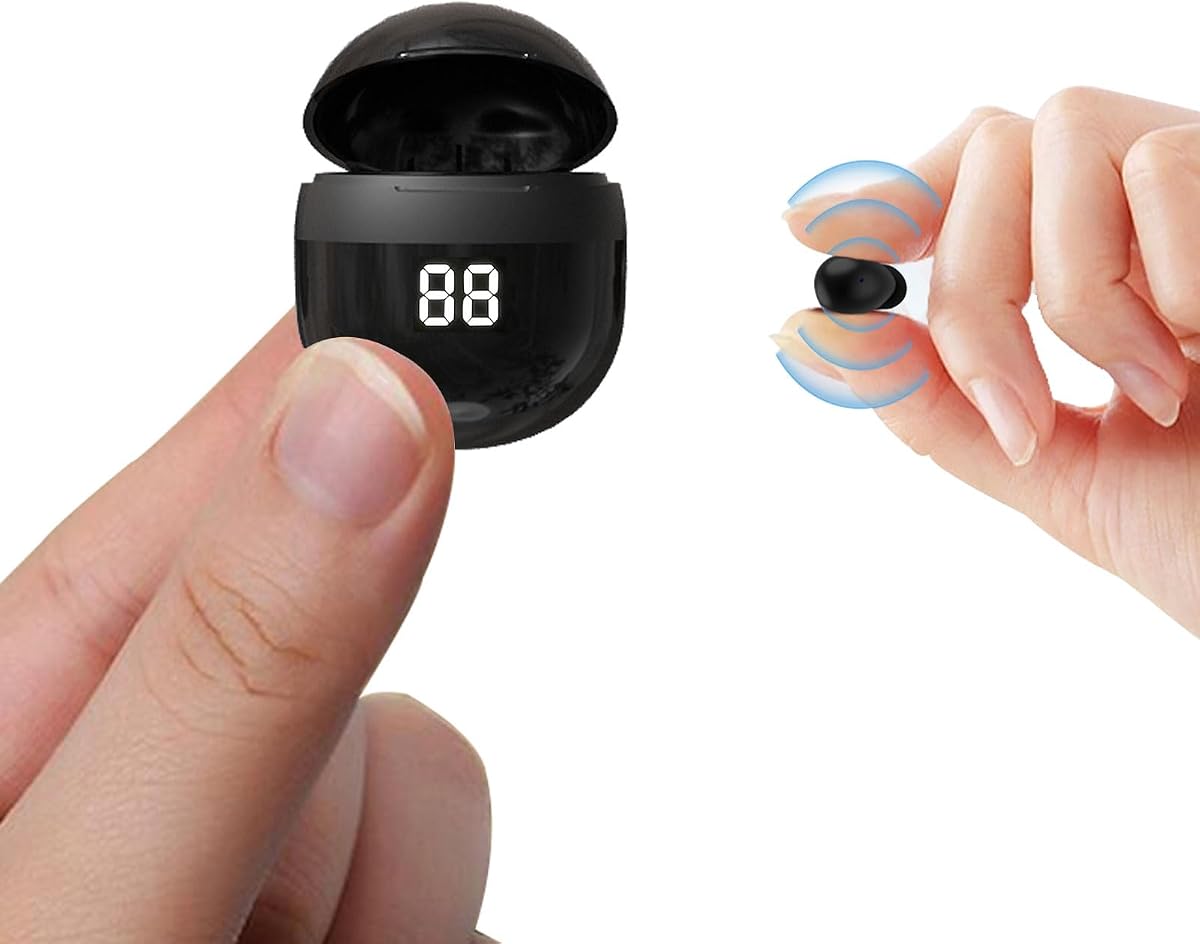
The Invisible Small Mini Sleep Earbuds weigh just 0.08 ounce per earbud, making them among the lightest products in the guide. Their 4.1 rating is solid, and the peanut-sized, nearly invisible housing offers a strong low-profile proposition. The product is designed for discreet wear during work, rest, and other activities.
We may earn a commission when you buy through this link, at no additional cost to you.
Bluetooth 5.3 is used for stable transmission and low-latency operation. The earbuds last four hours on a charge, while the compact case extends total usage to 20 hours. A useful LED display on the tumbler-shaped case shows remaining case power, reducing uncertainty when preparing for a long ride or trip.
Touch controls support playback, volume, calls, muting, and voice-assistant access. The listing mentions microphone support and Siri voice-assistant compatibility. These functions broaden the product beyond simple music listening, though no dedicated helmet microphone or rider communication system is described.
The main attraction is minimal weight and visual bulk. That makes the earbuds appealing for helmets with tight ear pockets, but buyers should not mistake the absence of bulk for a guaranteed secure fit under vigorous movement. No water rating is given, so careful use in wet conditions is advisable.
At 0.08 ounce, the housing places very little physical load on the ear. The tiny shape can also avoid interfering with the outer edge of a helmet liner, provided the earbud is seated correctly.
The charging case's LED power display helps riders check available charge before a trip. The case can extend listening beyond a single four-hour earbud session, which is useful for multi-stop journeys.
We may earn a commission when you buy through this link, at no additional cost to you.
The Invisible Mini Wireless Earbuds finish the roundup with a 4.2 rating and a combination of a tiny profile, multiple tip sizes, and IPX5 water resistance. Their smooth ergonomic shape is intended to remain nearly invisible and avoid pressure, which makes them relevant to riders with very small earbud pockets.
We may earn a commission when you buy through this link, at no additional cost to you.
Several sizes of soft ear tips are included to accommodate different ear-canal shapes. A stable and snug fit is important for cycling and motorcycle use, but the correct size must be selected to achieve that result. The listing also describes clear treble, balanced bass, and compatibility with Bluetooth-enabled smartphones, tablets, and laptops.
Fast automatic pairing and low-latency transmission are useful for starting a ride without delay. The product does not provide a specific earbud or case runtime in the supplied data, making endurance harder to compare with models that publish clear hour figures. IPX5 is a positive detail for outdoor use, although it is not the same as full waterproofing.
The final model is best for a rider who struggles with larger earbuds and values a weather-resistance rating over app-based controls. Its language-change procedure is unusual and requires pressing the Bluetooth button in a specific pattern. Review current instructions before pairing, and verify the exact included accessories and current customer feedback.
Multiple soft tips give the earbuds a better chance of staying secure without sitting deeply. Trying each size under the helmet is important because a stable everyday fit does not always translate perfectly to a moving, padded environment.
The stated IPX5 rating supports use around sweat and light rain. It adds outdoor confidence, although the earbuds should not be submerged and are not presented as fully waterproof.
We may earn a commission when you buy through this link, at no additional cost to you.
The right helmet-compatible earbud balances physical size, fit, sound behavior, connectivity, endurance, and outdoor durability. Because helmet construction varies, comfort should be evaluated with the exact model of headgear you intend to use rather than from appearance alone.
Low profile means the entire earbud should sit inside the ear without creating a hard point against the helmet liner. Stem-style models, large touch panels, and protruding charging-case designs are less desirable because they can conflict with padded ear pockets. Full-face helmets usually have more space around the ears than open-face helmets, while tight sport helmets can expose even modest protrusions. Motorcycle helmets may also include thicker removable liners that change the available clearance.
Look for descriptions emphasizing a flush, invisible, mini, semi-in-ear, or fully internal design. The Artevive models are explicitly engineered for helmet use, while the Z1 is positioned for cycling helmets. General mini earbuds may work well, but their helmet suitability depends more heavily on individual anatomy.
A compact body is only useful if it remains secure without being inserted painfully deeply. Look for flexible silicone shells, multiple ear-tip sizes, and descriptions that address small ear canals. Semi-in-ear designs rest more gently near the entrance of the ear, which can reduce pressure but may also transmit more outside sound. Fully internal designs may offer better isolation while requiring more accurate tip selection.
Choose a model that allows you to wear the earbud for an extended period without soreness. Before riding far, put the helmet on and off several times, walk around, and make minor head movements. If the earbud shifts or presses against padding, try another tip size or a different design.
Individual earbud runtime determines whether a model can last through a full ride without an interruption. Four hours may be adequate for a short commute, while five-and-a-half or six hours is more convenient for longer tours. The case adds useful reserve, but riders should consider whether the compact case is easy to carry and whether the earbuds support enough cycles for repeated use.
Prioritize stated earbud runtime first, then look at total case endurance. Published figures can vary with volume and use, so treat them as comparisons rather than guarantees. The Artevive and JLab models list roughly five to six hours per charge, while several ultra-mini alternatives specify about four hours.
Sweat, dust, and light rain are common during cycling and motorcycle travel. An IP rating provides more objective protection than a generic claim of being water resistant. IP55, as listed for the JLab model, indicates dust protection and resistance to water spray. IPX5, listed for the Z1 and the tenth product, focuses on water protection without a dust rating.
Neither an IPX5 nor an IP55 rating means the earbuds can be submerged or washed under a tap. Keep charging contacts dry, avoid leaving earbuds in a wet case, and let them dry fully before charging. Products with no stated rating should receive extra care in wet weather.
Helmet use creates a distinctive acoustic environment because the ear may sit close to a speaker or inside an insulated shell. Motorcycle riders may prefer stronger isolation to reduce engine and wind noise, while cyclists often value awareness of traffic and surroundings. Semi-open designs such as the Z1 intentionally allow some outside sound through, which can be helpful outdoors but may reduce music clarity.
Read descriptions carefully for balanced sound, bass emphasis, ambient awareness, and microphone noise reduction. Noise-reducing microphones do not automatically make the earbuds safe or effective for hearing environmental hazards. Always follow local traffic laws and remain attentive while riding.
Bluetooth 5.3 and 5.4 appear across the list, while Bluetooth Multipoint offers a more specialized convenience. Multipoint can keep two devices connected, allowing a rider to move between phone navigation and a computer without repeatedly repairing. Simpler models connect to one source at a time and may require disconnecting the previous device before pairing another.
Consider how you use audio during a ride. A single phone is usually sufficient for GPS prompts and music. If you regularly switch between devices, multipoint can save friction. Confirm compatibility with the rider's phone, navigation app, and preferred voice assistant before purchasing.
Touch controls, physical buttons, voice assistants, and microphones affect everyday usability. Gloves, wind, and helmet padding can make small touch targets difficult to operate. Voice control can help, but its reliability depends on the connected phone and ambient noise. Product descriptions do not provide consistent details about button position or waterproof operation, so check current manuals and customer feedback.
Most compact options are intended for personal music, calls, and navigation rather than motorcycle group communication. The two Artevive products explicitly exclude rider-to-rider communication. Riders needing helmet-to-helmet conversation should use a dedicated, legally compliant helmet communication system designed for that purpose.
Ratings can provide a useful signal but should not be treated as a complete measure of helmet compatibility. The supplied ratings range from 2.7 to 5.0, and review totals are not provided. Product generations and listing content can also change. Check recent reviews for comments about fit, connection stability, battery, controls, and water resistance rather than relying only on the overall score.
Before ordering, verify the seller's return policy, warranty terms, included ear-tip sizes, charging accessories, and compatibility with your devices. If possible, keep the helmet nearby after delivery and test the earbuds under realistic riding conditions while retaining the packaging and receipt for a straightforward return if needed.
Start by fully charging both earbuds and the case, then check the included tip sizes. Place each earbud in the position recommended by the manufacturer, but do not force it deeper than feels comfortable. Put on and remove the helmet several times to identify any contact points. If an earbud shifts, try another tip or switch to the shallower fit of a semi-in-ear design.
Pair the earbuds before riding and complete a short test with your usual navigation prompt, music source, calls, and controls. Store the paired device name in the Bluetooth menu if the model allows easy reconnection. For models with multipoint, connect the phone and second device before departure, then confirm that switching does not interrupt navigation unexpectedly.
After riding, remove the earbuds before taking off the helmet if they tend to fall out. Wipe the earbuds and case with a dry, soft cloth, keep the charging contacts free of dust, and avoid moisture around the USB-C port. Let wet earbuds dry completely before charging or storing them, and use the case for storage when possible.
A low profile design can improve comfort because it reduces contact between the earbud and helmet padding. The Artevive models are specifically designed to sit fully inside the ear, while other compact options may work depending on ear anatomy and helmet construction. Test the fit before a long ride and confirm that the earbuds do not shift when the helmet is removed.
They may, especially if they use a stemless or semi-in-ear shape, but there is no universal fit. Full-face helmets vary in liner thickness, speaker placement, and ear-pocket depth. Bring the helmet to the fitting test or inspect its dimensions before ordering, and avoid choosing a model whose body presses against padding.
The Extra-Small Wireless Earbuds Z1 are the most explicitly helmet-focused cycling option in this guide. Their 2.3-gram stemless design, IPX5 sweat resistance, and semi-open ambient awareness are relevant to cyclists. The JLab JBuds Mini Tones are another strong all-around choice because of their compact size, IP55 rating, and multipoint connectivity.
Not according to the supplied specifications for the two Artevive models, which explicitly have no microphone or rider-to-rider communication. Most of the remaining products provide personal audio, calls, or voice-assistant functions, but that is different from a helmet intercom. Riders who need group communication should choose a purpose-built helmet communication system.
Four hours may cover shorter commutes, while five-and-a-half to six hours offers more flexibility for touring. The charging case matters too, particularly on long trips where outlets are unavailable. Consider both earbud runtime and total case endurance, and remember that published playback figures can vary with volume and use.
IPX5 indicates resistance to water spray, making the earbuds more suitable for sweat and light rain than models without a rating. It does not mean they can be submerged, soaked, or washed under running water. Keep the case dry, wipe the earbuds after wet rides, and allow them to dry fully before charging.
Choose the correct ear-tip size and confirm that the earbud is seated without pressure. Semi-in-ear designs may be easier to position but less secure, while fully internal silicone designs are intended to stay locked in place. Test repeated helmet removal and replacement, as well as quick head movements, before relying on the fit during a ride.
A microphone is useful for phone calls and voice-assistant commands, but it is not automatically suitable for reliable helmet-to-helmet conversation. The Artevive options offer music and GPS without a microphone. For group riding or frequent verbal communication, a dedicated helmet communication system is the more appropriate category.
The Artevives Bluetooth Moto Earbuds stand out as the strongest overall choice because they combine a motorcycle-specific flush silicone design with a 5.0 supplied rating, six hours of playback, and simple phone pairing. The related Artevive Motorcycle Earbuds offer the same specialist focus, while the JLab JBuds Mini Tones win the premium slot for multipoint connectivity, customization, and IP55 protection.
For riders on a tighter budget, the ultra-small Ear Buds Invisible Mini Earbuds provide a discreet 0.1-ounce design and useful noise-reducing microphone features. Cyclists should examine the explicitly helmet-oriented Z1, while riders needing multiple earbud styles can consider the two-pair Wireless Bluetooth Headset Set. The key priority should always be a stable fit without pressure against the helmet liner.
Ratings, features, accessories, and current prices can change, so check the latest listing and recent customer feedback before buying. Verify fit with your specific helmet, confirm the necessary connection features, and review the return policy. With those checks completed, a compact earbud can provide a more comfortable and convenient way to enjoy music, podcasts, calls, and GPS guidance under protective headgear.