
Aquarium Clean Light 3W Mini
4.2Editor score
Compact 3W mini design
UV test card included
Freshwater and pond applications
This Aquarium UV Light guide compares 10 options by wattage, tank capacity, timer controls, shielding, installation, and water clarification.
Aquarium UV lights use ultraviolet energy to help control green water, algae, microorganisms, and odors, but they are not interchangeable with the UV lamps found in most aquarium hoods. A useful unit should match the tank volume, circulate water past the lamp, and provide a protected installation that keeps ultraviolet light away from fish, people, and plants.
The products in this guide are compared by wattage, supported aquarium size, timer functions, protective shielding, filtration compatibility, freshwater and saltwater applicability, and the installation guidance supplied by each manufacturer. The list covers compact aquarium lamps as well as pond, pool, spa, and cold-plunge models, so the right choice depends heavily on water volume and circulation.
Each review identifies the product's strongest feature, practical trade-offs, and most suitable setup. The first three selections receive the guide's featured awards, while the remaining products offer alternatives for particular tank sizes or installation needs. Product ratings and availability can change, and current prices should be checked before purchasing.
4.2Editor score

4.4Editor score

4.1Editor score
This side-by-side overview compares each aquarium UV light by power, intended water volume, control features, and installation style. It is designed to make tank-size matching and safe placement easier before you choose a model.

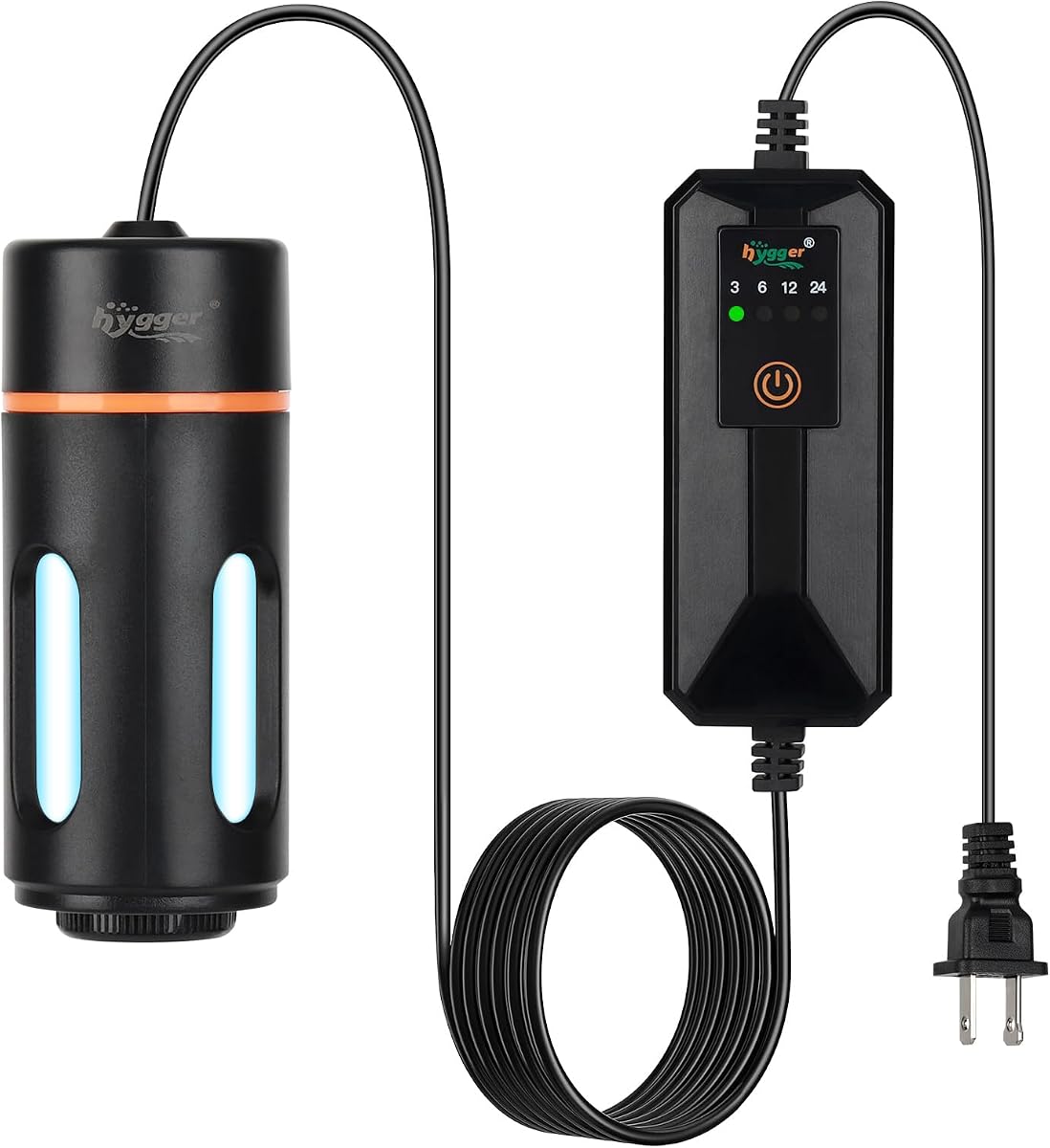
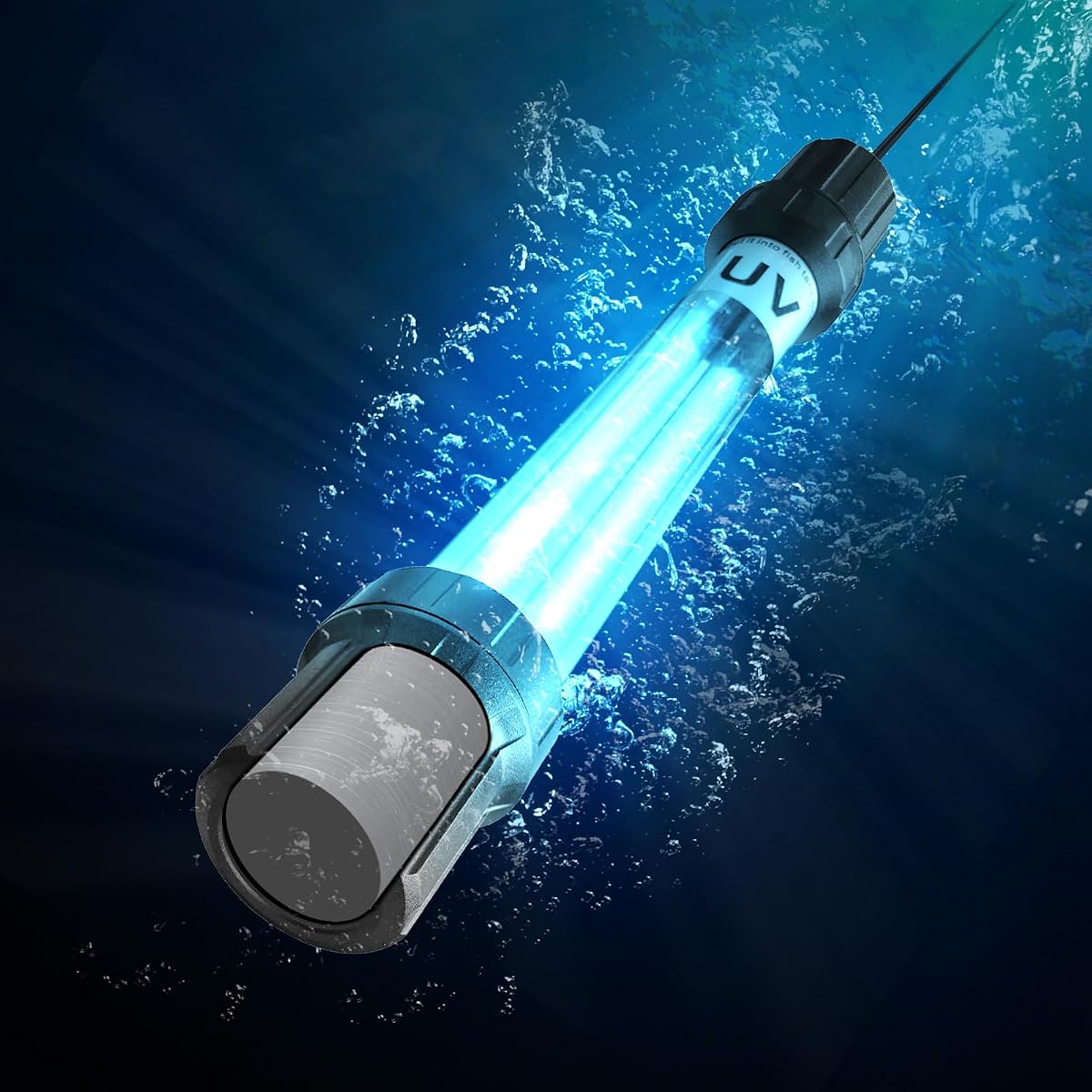


The hygger 3W Aquarium U-V Light is a compact clarification lamp for tanks between 2 and 15 gallons. Its 4.4 rating is the highest among the products in this guide, while its 254nm output, four timer modes, and memory function make it especially practical for fish and turtle tanks that need a repeatable maintenance routine.
We may earn a commission when you buy through this link, at no additional cost to you.
The most useful feature is the built-in controller. Settings of 4, 8, 12, and 24 hours allow the lamp to suit a severe green-water outbreak or a shorter daily maintenance cycle, and the unit remembers the selection after a power interruption. Its protective cover directs most light toward the rear, helping reduce direct exposure when the unit is positioned close to the tank wall or bottom.
The product is not a self-contained filter, so performance depends on adequate water movement. Manufacturer guidance recommends placing it near filter flow or using a wave pump, and the strongest results will come when water passes directly through the illuminated area. Its small supported capacity also means that it is better suited to betta tanks, nano aquariums, and turtle habitats than larger planted systems.
This is a strong choice for anyone who wants timer-driven UV clarification in a small aquarium and understands that placement matters more than simply leaving the lamp submerged. Buy it if your tank is within the 2–15 gallon range, your circulation can expose the lamp to moving water, and you can install it without shining directly into fish or viewers.
The four daily timer settings make it easy to move from intensive clarification to routine maintenance without handling the lamp every day. Memory retention also prevents unexpected changes to the cycle after a brief power interruption.
Because the lamp works best in moving water, filter placement or a nearby circulation pump can materially improve its usefulness. Keeping water moving past the light also helps it process more of the tank volume than a stagnant installation would.
We may earn a commission when you buy through this link, at no additional cost to you.
The Aquarium Clean Light 3W Mini is a budget-oriented UV lamp intended to help remove green coloration and improve the appearance of small aquarium, pond, pool, and indoor water systems. It carries a 4.2 rating and stands out for its very small format, simple button control, and included UV test card.
We may earn a commission when you buy through this link, at no additional cost to you.
The test card is a useful addition because it gives buyers a way to check that the lamp is producing ultraviolet light. The stated 254nm wavelength is intended to break down chemical bonds and disrupt the DNA, RNA, and proteins of microorganisms, helping reduce the green coloration associated with algae and other suspended growth.
Its limitations are equally clear. The product does not include a timer, and its guidance calls for approximately three to four hours of use every two to four days. It is intended to clarify green water rather than remove black deposits attached to rocks or the aquarium, so it should not be treated as a substitute for physical algae removal or routine tank maintenance.
Choose this model for a small setup where simplicity and a low footprint matter more than automated scheduling. It is best placed in a filter or behind an opaque divider, with the electrical plug and controller kept dry. Users should also measure their tank and compare dimensions before ordering to avoid a cramped installation.
The included card can help verify ultraviolet output and give users a quick visual check after installation. That is especially helpful for a compact lamp that may be difficult to inspect closely once it is concealed in a filter compartment.
Manual operation is straightforward, but there is no automatic cycle. For a small aquarium, consistent three-to-four-hour sessions every few days can be easier to manage than configuring a more complex controller.
We may earn a commission when you buy through this link, at no additional cost to you.
The Internal Green Water Killer is an aquarium filter and UV pump combination designed to turn green water clear in approximately three to seven days. It supports freshwater and saltwater tanks up to 75 gallons and includes a built-in 5W pump, reducing the need to arrange a separate circulation device for the lamp.
We may earn a commission when you buy through this link, at no additional cost to you.
The integrated pump is the product's defining feature. Instead of relying on a nearby filter outlet, pump, or wave maker to move water through the UV area, the unit is designed to circulate water internally. This makes it especially convenient for hobbyists who want a straightforward internal green-water solution with fewer separate components.
The comparatively basic feature set is the main trade-off. The supplied information does not mention a timer, memory function, external controller, or configurable shield, so users gain simplicity but lose the flexible automation offered by several newer hygger models. Its rated capacity also remains modest compared with the 11W, 18W, and 20W options in this guide.
This is a practical pick for a tank up to 75 gallons where an integrated pump and uncomplicated operation matter most. Choose it for green-water cleanup in either freshwater or saltwater, but check the physical dimensions of the internal unit and confirm that your filter compartment has enough clearance.
The built-in pump supplies the water movement the UV treatment needs. That self-contained approach can make installation cleaner and reduce the number of separate devices required for a small green-water correction.
Compatibility with both water types broadens the potential audience for the product. As always, the lamp should be positioned so fish are not exposed directly to the ultraviolet output.
We may earn a commission when you buy through this link, at no additional cost to you.
The hygger 11W Aquarium U-V Light is a feature-rich clarifier for freshwater and saltwater tanks from 60 to 180 gallons. Its 4.1 rating reflects a capable package built around a 254nm lamp, four timer settings, memory retention, and a 360-degree protective shield that makes direct aquarium placement more approachable.
We may earn a commission when you buy through this link, at no additional cost to you.
The shield can operate in two configurations. Healthy Mode closes the shield for use inside a fish tank, while High Efficiency Mode opens it for placement in a filter chamber where broader light exposure can assist with algae cleanup. The included suction cups and manual support either installation style, making this one of the more adaptable products in the roundup.
During an active green-algae outbreak, the 24-hour setting can be used continuously for three to seven days, followed by roughly three hours per day for maintenance. Continuous long-term operation can shorten bulb lifespan, however, so the timer should be used deliberately rather than treated as a permanent setting. The 11W output also requires a tank and filter arrangement capable of handling the intended volume.
This is the best premium-oriented choice for larger home aquariums that need both protected direct placement and filter-based operation. It suits owners who want meaningful wattage, adjustable scheduling, and a two-mode housing in one unit, particularly those dealing with recurring green water or algae.
Closing the shield reduces direct leakage when the lamp sits inside a tank, while opening it in a filter chamber can improve treatment efficiency. This dual approach is more flexible than a fixed open tube.
The controller remembers the selected three-, six-, 12-, or 24-hour cycle after interruptions. This makes the lamp convenient for repeated maintenance schedules without daily manual changes.
We may earn a commission when you buy through this link, at no additional cost to you.
The hygger 5W Aquarium U-V Light is a middle-sized option for tanks between 13 and 40 gallons. It earns a 4.1 rating and combines a 254nm ultraviolet lamp, programmable timer, memory function, and a 360-degree safety shield for both in-tank and filter-chamber installation.
We may earn a commission when you buy through this link, at no additional cost to you.
Its two modes closely resemble those found on the larger hygger 11W model. The shield stays closed for direct aquarium use and opens for filter placement, where more of the water can pass through the illuminated zone. The controller offers three-, six-, 12-, and 24-hour periods, allowing a more intensive initial correction followed by shorter routine use.
The product includes the lamp, two suction cups, and a manual, but compatible HG245 replacement bulbs are sold separately. That is worth considering for long-term ownership. The manufacturer also warns that continuous 24-hour operation shortens bulb lifespan, so 24-hour mode is better reserved for temporary three-to-seven-day outbreaks.
Choose this lamp for aquariums that fall between the very small models and the larger 60-to-180-gallon option. It is a balanced choice for freshwater or saltwater tanks that need automated control and a shielded housing without the higher output of the 11W model.
The 13-to-40-gallon range covers many common planted tanks and smaller display aquariums. It offers more treatment power than a nano unit while avoiding the size and circulation demands associated with a high-output model.
The closed shield is intended to limit exposure in a fish tank, while the open configuration is better suited to a filter. Matching the mode to the installation is central to using the lamp responsibly.
We may earn a commission when you buy through this link, at no additional cost to you.
The 18W Aquarium UV Light is designed for much larger water systems than a typical home aquarium lamp. It supports volumes from 100 to 1,000 gallons and can be used in koi ponds, pools, spas, cold plunges, bathtubs, and large fish tanks, giving it a 4.1 rating within this diverse list.
We may earn a commission when you buy through this link, at no additional cost to you.
Dual-tube technology is the main construction feature, while the weighted block helps the unit stand securely underwater and provides broad treatment coverage. Thickened, multi-level end seals support underwater reliability, and the high-transparency quartz glass is intended to permit stronger UV penetration. A 17-foot cable provides considerable placement flexibility.
The product's broad capabilities come with strict safety considerations. For an aquarium, the manufacturer recommends using the lamp in a filter or isolating it with an opaque barrier so fish are not irradiated directly. For ponds, filter or pond-screen placement is advised. The product should also be handled carefully around electricity, and the included installation guidance should be followed closely.
This is a strong choice for pond owners, pool or spa users, and very large aquariums. It is less appropriate for a standard home aquarium because the filter shielding, space, and water volume required to use it effectively would exceed the needs of a compact planted tank.
The dual-tube arrangement is intended to provide more stable ultraviolet output than a single-tube design. Its wider intended capacity makes it better aligned with substantial circulating water systems.
A gravity block allows the lamp to stand underwater without relying on a dedicated mounting bracket. Double seals at the ends add reassurance, although correct submersion and electrical separation remain essential.
We may earn a commission when you buy through this link, at no additional cost to you.
The FishTankLight 11W is a straightforward UV clarification lamp for aquariums between 55 and 150 gallons. It has a 4.0 rating, an 11W ultraviolet tube operating at 254nm, and support for both freshwater and saltwater environments.
We may earn a commission when you buy through this link, at no additional cost to you.
Its primary strength is uncomplicated operation. The product does not list an automatic timer, so the owner controls the operating schedule manually, with the supplied guidance recommending roughly three to four hours every two to five days. This is adequate for a regular maintenance routine but less convenient than models with programmable daily cycles.
The important installation consideration is separation from animals. The instructions specifically recommend placing the light in a filter or behind an opaque plate so that it does not shine directly on fish. Because performance also depends on adequate flow, a unit hidden in a poorly circulated filter may not clarify water as effectively as expected.
Choose this lamp if you want substantial power for a medium-to-large aquarium and prefer manual scheduling over digital controls. It is best for owners with a suitable filter chamber, enough clearance for the unit, and a clear plan for shielding it from fish.
The 11W power level and 55-to-150-gallon guidance place this unit between compact nano lamps and higher-output pond clarifiers. It can suit established freshwater or saltwater systems without requiring the larger footprint of a dual-tube unit.
Installing the tube in a filter or hiding it behind an opaque plate helps prevent direct ultraviolet exposure. Users should measure the filter area before purchase because the product's physical size must still fit the intended location.
We may earn a commission when you buy through this link, at no additional cost to you.
The Qualirey 11W UVC Light is a submersible ultraviolet lamp for aquariums, ponds, sumps, and swimming pools. Its 4.2 rating reflects a focused design built around a 254nm lamp, a timer function, a protective hood, and high-transmission explosion-resistant quartz glass.
We may earn a commission when you buy through this link, at no additional cost to you.
The included hood distinguishes it from several open-tube alternatives by giving users a physical means of limiting direct ultraviolet exposure. The unit is still intended for placement in a filter tank rather than the same water space as fish. Installation requires full immersion before connecting power, while the plug and power supply must remain dry.
The timer provides scheduled operation, and the guidance recommends approximately two-hour sessions, with continuous use beyond six hours discouraged. During a serious algae or water-quality problem, the manufacturer suggests up to three days of more continuous use. Those instructions are more restrictive than the longer 24-hour cycles supported by some competing products.
Choose this model for a user who values the supplied hood and quartz-tube construction. It works well for filter compartments and secondary water systems, but it should be avoided for direct exposure of animals, and the absence of a stated tank-volume range means users should judge suitability from lamp power and actual filter capacity.
The hood helps redirect or limit light around the tube. It is a useful layer of protection, though the manufacturer's stronger recommendation is still to install the unit in a filter tank rather than alongside fish.
The high-transmission quartz tube is designed to let ultraviolet light pass through the water-facing surface. Because the material is vulnerable to damage, careful handling and inspection after transport are important.
We may earn a commission when you buy through this link, at no additional cost to you.
The Compact 3W U-V Light is designed for freshwater and saltwater tanks between 3 and 20 gallons. It has a 4.0 rating and offers a more granular timer than most competing compact models, with adjustable one-hour intervals from 1 to 24 hours and automatic daily cycling.
We may earn a commission when you buy through this link, at no additional cost to you.
Its protective housing supports two operating modes. Health Mode closes the shield for placement inside a tank, while Efficient Mode opens it to broaden the treated area. The manufacturer also includes controller indicators and a lamp window, allowing the operating status to be checked without dismantling the installation.
The product does not include a pump, so it needs an existing source of water movement. Installing it near a filter outlet is the simplest option, and consistent flow will produce better results than leaving the lamp in still water. Its listed dimensions are compact, which helps when fitting it into a small aquarium or turtle habitat.
Choose this model for a small tank when fine control over daily run time is important. Its timer granularity, memory function, status monitoring, and protective housing make it a well-rounded alternative to the simpler 3W models, although the absence of an included pump means existing circulation is a prerequisite.
Settings from one to 24 hours in one-hour increments allow short maintenance runs or extended treatment as conditions change. The controller repeats the selected cycle daily and retains it after a power outage.
Controller displays, indicator lights, and a visible lamp window make it easier to confirm operation. These details are particularly helpful when the lamp is concealed in a filter or behind aquarium décor.
We may earn a commission when you buy through this link, at no additional cost to you.
The 20W UV Submersible Aquarium and Pond Light is the highest-output option in this roundup, with a 4.2 rating and a stated capacity of 200 to 2,000 gallons. It is intended for ponds, pools, cold plunge tubs, spas, hot tubs, and large aquariums rather than ordinary household tanks.
We may earn a commission when you buy through this link, at no additional cost to you.
Its dual-tube UV-C system is designed to provide stable output, while the weighted gravity block keeps the unit upright underwater and supports treatment in multiple directions. Thick, double-sealed end covers improve submerged protection, and the 17-foot power cable gives owners flexibility when the lamp must be placed near a filter, pool edge, or pond equipment.
The specification is impressive but inappropriate for small aquariums. At 20W with a minimum stated range of 200 gallons, installing it in a modest fish tank would be excessive and could create unnecessary safety concerns. Fish tanks also require the lamp to be placed behind the filter or otherwise shielded from direct exposure.
Choose this product for large ponds, pools, and commercial-scale water systems that can support the stated volume. It is best for users seeking broad treatment from a durable dual-tube arrangement and who can provide safe, dry electrical connections.
The 200-to-2,000-gallon range places this lamp at the opposite end of the guide from the 3W compact units. It is intended to clarify substantial circulating water volumes rather than treat a small desktop aquarium.
A weighted base and dual end seals create a stable underwater installation with less reliance on external brackets. The long cable supports many positioning options, provided the power connection remains safely outside the water.
We may earn a commission when you buy through this link, at no additional cost to you.
Choosing an aquarium UV light requires balancing tank volume, water circulation, electrical safety, and control features. The most important principle is to match the unit to the water it will actually treat and install it where animals cannot receive direct ultraviolet exposure.
Begin with the tank's actual water volume rather than its nominal gallon marking. Compact 3W lamps are intended for nano tanks and small aquariums, 5W models cover a moderate range, and 11W products support medium-to-large systems. The 18W and 20W dual-tube units are built for large ponds, pools, and aquariums. A higher wattage in an undersized system does not automatically produce better clarification, while an undersized lamp in a large volume may not keep pace with recurring green water.
UV clarification depends on water passing through or near the illuminated tube. Filter placement, proximity to a filter outlet, or use of a circulation pump can increase the effective treated volume. Stagnant water leaves much of the aquarium untreated even when the lamp is switched on. For integrated pump designs, check that the unit can draw and move enough water without overwhelming fish, livestock, or delicate filter media.
A protective shield, opaque divider, or dedicated filter chamber helps prevent direct exposure to fish, reptiles, plants, and people. Some units use a closable shield for in-tank use and an open configuration for filter placement. Others are designed only for installation behind an opaque plate. Look for physical separation, not merely a warning in the listing, and make sure the chosen installation method actually matches the product design.
A timer makes it easier to maintain a consistent treatment schedule without manual intervention. Some controllers offer broad choices such as 1–24 hours in one-hour increments, while others use fewer presets. Memory is especially helpful because it restores the last schedule after a power interruption. For severe green water, continuous short-term use may be appropriate; for maintenance, a shorter daily cycle is generally more practical and can reduce unnecessary bulb wear.
Most compact aquarium lamps are described for both freshwater and saltwater tanks, while larger dual-tube products are also aimed at ponds, pools, spas, bathtubs, and cold plunges. Water chemistry and organism density vary widely, so treat a product's application claims as guidance rather than a guarantee. Confirm that the unit's housing, cable length, mounting method, and power supply suit the intended environment.
Quartz glass and silica glass are common in these products because they transmit ultraviolet light while isolating the lamp from the surrounding water. Submersible models need dependable end seals, protected electrical connections, and a stable base. A weighted gravity block is useful in ponds and pools, while suction cups can help position aquarium models. Inspect the tube and seals before use, particularly after transport, because a cracked or damaged tube should not be submerged.
UV lights can help clarify green water and reduce algae, microorganisms, and odors, but they do not remove every kind of debris or deposit. Some products explicitly cannot remove black material attached to rocks. Physical cleaning, appropriate nutrient management, filtration, water changes, and responsible stocking remain necessary. Results also depend on the severity of the problem, how much water passes through the unit, and whether the lamp is serviced as directed.
Before installation, measure the aquarium, filter chamber, and available electrical clearance. Compare those measurements with the product dimensions, read the manual, and inspect the lamp tube, seals, cable, controller, and power supply. Do not install a damaged unit. For an aquarium, the safest general approach is to place the UV lamp inside a suitable filter chamber or behind an opaque barrier that keeps the emitted light away from fish and other living organisms.
Submerge the lamp fully before switching it on when the manufacturer requires it, and keep the plug, controller, transformer, and any electrical connection dry. Position the unit in moving water, near a filter outlet or within an appropriate filter path. Never look directly into an operating UV lamp, and avoid skin exposure. For a severe green-water or algae outbreak, follow the stated treatment schedule; for ongoing maintenance, use a shorter cycle rather than leaving the lamp operating continuously without a reason.
Clean the housing and flow path according to the manufacturer's instructions, inspect the tube and seals regularly, and confirm that the timer and indicators operate as expected. Do not use abrasive tools or unapproved chemicals on quartz or silica glass. If the tube is cracked, clouded, discolored, or leaking, disconnect the power and replace or service the unit before submerging it again. Maintain normal aquarium hygiene alongside UV treatment, including appropriate filtration, stocking levels, plant care, and water changes.
Direct ultraviolet exposure can harm fish, reptiles, plants, and people. Choose a unit with a protective shield or install it in a filter chamber or behind an opaque plate so fish are not exposed directly. The lamp should operate only after proper submersion, with all electrical connections kept dry.
Several products describe visible improvement within approximately three to seven days, depending on tank size, water conditions, and circulation. The lamp must see enough moving water to be effective, and severe algae may also require cleaning, nutrient management, and other corrective steps. Results can be slower in oversized systems or when the unit is poorly placed.
Many of the aquarium-focused models in this guide are explicitly suitable for both freshwater and saltwater. Larger pond and pool clarifiers may also support these systems, but the listing should be checked for the exact application. In every case, the lamp still needs shielding from aquatic life and safe electrical placement.
Continuous operation can be appropriate for a limited initial correction, but several manufacturers warn that prolonged 24-hour use shortens bulb lifespan. After an outbreak, switching to a shorter daily maintenance schedule is generally more practical. Follow the product's recommended cycle and avoid leaving the lamp on when it is not needed.
It depends on the model. Integrated-pump products provide their own circulation, while most compact and shielded lamps require existing filter flow or a separate wave pump. A consistent flow past the UV tube is essential for useful clarification, so verify the setup before installation.
Not reliably. UV clarification is most useful for suspended algae contributing to green water, not for attached deposits or black material on rocks and décor. The first product in the list specifically states that it cannot clean such black precipitate. Physical removal and prevention remain necessary.
Match the lamp to the tank's actual water volume and the manufacturer's supported capacity. In this guide, 3W models cover the smallest tanks, 5W and 11W options cover medium to large aquariums, and 18W and 20W products target large ponds, pools, and fish tanks. Higher wattage is not automatically better for a small aquarium.
The lamp will stop operating whenever its power supply is disconnected. Models with timer memory will restore the selected cycle once power returns, while manual or less advanced controllers may require the owner to reset them. Unplug the unit before any inspection or maintenance and keep all connections away from water.
The hygger 3W Aquarium U-V Light is the strongest compact overall pick because it combines a 4.4 rating with four timer settings, memory, and a protective housing for tanks up to 15 gallons. The Aquarium Clean Light 3W Mini is the budget option for simple, small-tank clarification, while the hygger 11W model is the premium choice for larger aquariums and flexible shielded operation.
Prioritize tank volume, effective circulation, and safe separation from living organisms before considering convenience features. A timer, memory function, adjustable shield, and status indicators make routine use easier, but none of them can compensate for an undersized lamp or poor placement. For large ponds and pools, the 18W and 20W dual-tube models offer much greater capacity, while ordinary home aquariums are better served by a compact or mid-size unit.
Ratings, product availability, and prices can change over time, so check the current listing and manufacturer instructions before ordering. Compare the stated capacity with the tank's real water volume, confirm that the physical unit fits the intended filter or protected location, and keep the electrical supply dry.