
KODAK Luma 150 Mini Projector
4.2Editor score
60 ANSI-lumen brightness
Up to 150-inch image
2.5-hour battery runtime
Portable pocket sized pico projectors turn almost any blank wall, bedroom, campsite, or meeting room into an instant entertainment screen. The strongest choices balance compact dimensions, usable brightness, simple connections, built-in audio, and enough battery life for genuinely mobile viewing.
This guide compares ten portable mini projectors using the specifications and features listed in their product information. It examines DLP or LED technology, native resolution, image size, wireless mirroring, wired ports, speakers, battery runtime, focus controls, and the practical differences between conventional and folding designs.
Each entry reveals the experience the projector is best suited for, from quick presentations and travel entertainment to tracing crafts and compact movie nights. Ratings and specifications can change with updates, and current prices and availability should always be confirmed before purchase.
4.2Editor score

5.0Editor score

3.8Editor score
As an Amazon Associate we earn from qualifying purchases.
The comparison below highlights the major differences in size, playback capability, connectivity, battery use, and special features, making it easier to identify the right portable projector for your space and priorities.




The KODAK Luma 150 Mini Projector combines a 60-ANSI-lumen DLP-style pocket design with a rechargeable battery and built-in speaker, making it a practical all-around option for travel, presentations, and casual movie viewing. Its 4.2 rating reflects a generally positive feature set, particularly its connectivity, battery capability, and maximum image size.
We may earn a commission when you buy through this link, at no additional cost to you.
Its standout benefit is flexibility. The projector can display images up to 150 inches, accepts HDMI and micro USB-C connections, and supports wireless mirroring through AirPlay and Miracast. A 1000:1 contrast ratio and 16:9 projection help it produce a recognizable widescreen image, while the integrated speaker removes the need for additional equipment during short sessions.
The important limitation is native resolution. At 854 x 480, it is better suited to casual streaming, slideshows, and simple games than to finely detailed professional content, even though the listed specifications support higher input and 4K sources. The 60-ANSI-lumen rating also means a controlled room will provide a more convincing result than a bright living room.
This is a strong choice for buyers who want meaningful battery life, flexible screen sizes, and straightforward phone or laptop connectivity without paying for the most advanced automatic projection features. It is especially practical for presentations, hotel-room entertainment, and informal family viewing, making it our top budget selection.
AirPlay and Miracast reduce cable clutter, while HDMI and micro USB-C provide dependable wired routes for compatible phones, computers, storage devices, and streaming hardware. Copyrighted streaming apps generally require an external streaming device because wireless mirroring may not display protected content.
The listed battery runtime of up to 2.5 hours makes this model more useful away from an outlet than many compact alternatives. It remains a short-session projector, but that is enough for a movie, presentation, or an evening of casual entertainment when charged beforehand.
We may earn a commission when you buy through this link, at no additional cost to you.
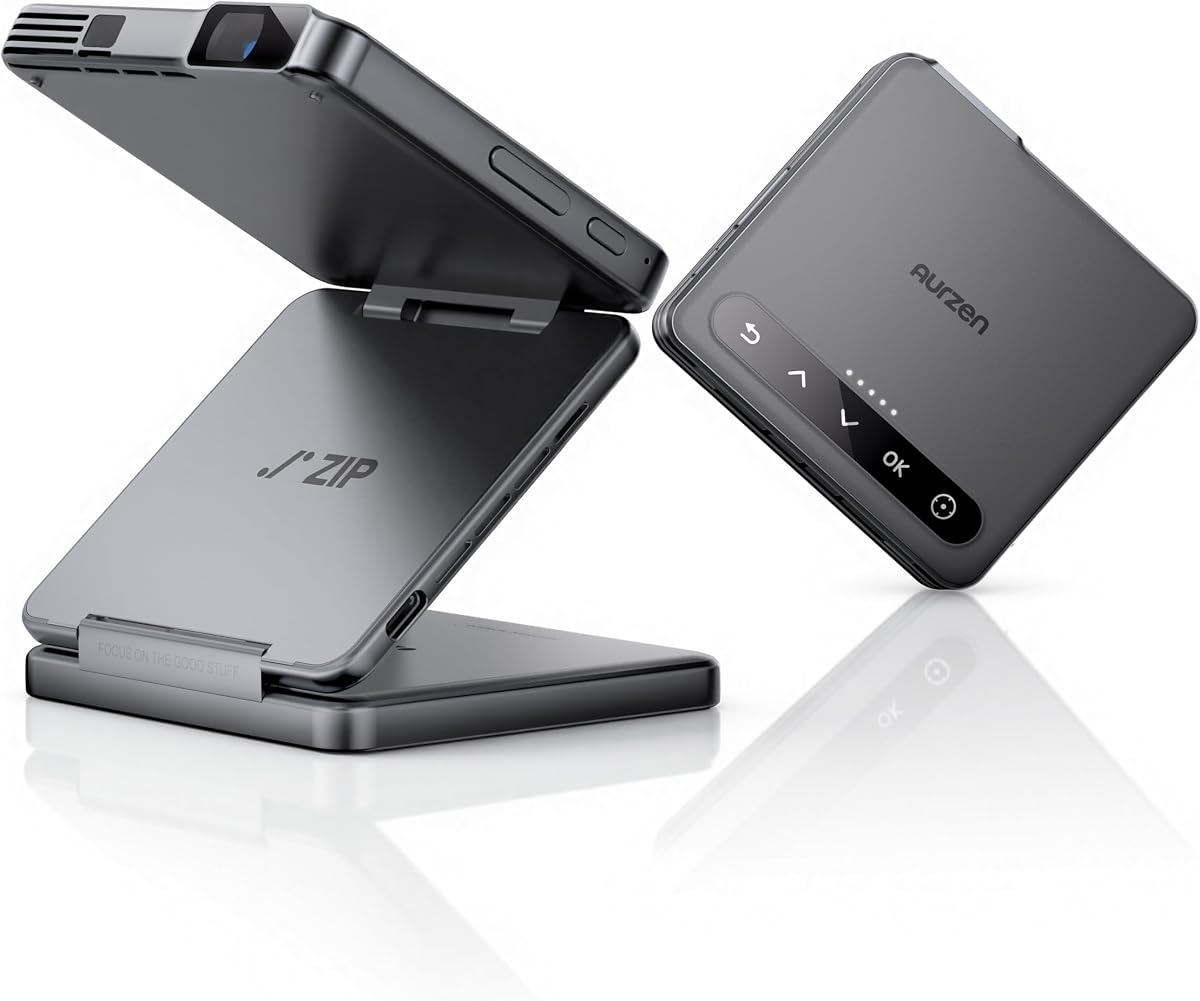
The Aurzen ZIP Tri-Fold DLP Pocket Mini Projector distinguishes itself through a folding, wallet-size body and an unusually broad set of functions for such a small device. At 0.62 pounds, it weighs 100 ANSI lumens, native 720p resolution, USB-C connectivity, Bluetooth 5.4, automatic focus, and vertical-screen support into one portable package.
We may earn a commission when you buy through this link, at no additional cost to you.
Its most impressive feature is the ToF autofocus system, which the product information says measures distance 30 times per second. This is especially valuable for tracing artwork, sewing, decorating cookies, and other tasks where a stable, sharp outline matters. The built-in Z-shaped stand and tri-fold structure also make it easy to orient the projector on different surfaces.
There are a few trade-offs. The built-in 5000mAh battery is listed for up to 1.5 hours in eco mode, which is shorter than the KODAK Luma 150's stated runtime. Protected streaming content is not supported directly by the built-in mirroring system, and a compatible CastPlay Pro dongle is sold separately for supported applications.
This projector makes the most sense for creative users and travelers who value intelligent focusing and exceptional packability over a long unplugged runtime. Its lower 3.8 rating may give cautious buyers pause, but the specialized feature set justifies considering it for tracing, short travel sessions, and vertical social content.
Automatic focus and keystone correction give the ZIP an edge when the projection surface or angle changes. These features are more useful for tracing and decorating than they are for a permanently aligned entertainment setup, where manual adjustments would be inconsequential.
The tri-fold body and integrated stand reduce the space required for storage and setup. At the same time, the 1.5-hour battery and 100-ANSI-lumen output establish clear limits, so it works best for focused activities and short viewing sessions.
We may earn a commission when you buy through this link, at no additional cost to you.
The black KODAK Luma 150 Portable Mini Projector offers a balanced mix of cordless operation, wireless sharing, and familiar media connections. Its 4.2 rating places it among the stronger-rated entries, while the 3800mAh battery and built-in speaker make it especially convenient for presentations and casual media sessions.
We may earn a commission when you buy through this link, at no additional cost to you.
The device supports AirPlay and Miracast for compatible iPhone and Android devices, and its HDMI, USB-A, and microSD inputs cover phones, tablets, laptops, and locally stored media. A maximum projection size of 100 inches provides a suitably cinematic scale for movies, gaming, or presentations without requiring a large permanent screen.
Compared with the larger-image version of the Luma 150, this model specifies a more compact maximum display and does not list the same detailed brightness, resolution, and contrast information. That makes it slightly harder to compare on paper, and buyers seeking a very large image or advanced setup features may prefer the more fully specified alternative.
It is a good fit for buyers who prioritize simple cordless use, broad connection options, and a speaker in a compact body. It can serve as a travel projector, bedside entertainment system, or quick presentation tool, provided the room is controlled and the source material does not demand native high-definition detail.
The rechargeable battery removes the need for a nearby outlet, and the integrated speaker supplies basic audio for short sessions. This makes the projector easier to move between a table, a campsite, or a temporary presentation area.
HDMI, USB-A, microSD, AirPlay, and Miracast create a useful mix of wired and wireless routes. The variety is valuable for travelers who may switch between a phone, laptop, and locally stored content.
We may earn a commission when you buy through this link, at no additional cost to you.
The Kodak Ultra Mini Portable Projector uses a palm-sized DLP optical engine, integrated speakers, and rechargeable power to offer a straightforward pocket-projecting solution. Its 4.1 rating reflects a well-regarded mix of portability, color capability, and easy connectivity for compatible phones, tablets, computers, and media players.
We may earn a commission when you buy through this link, at no additional cost to you.
The product information highlights 16.7 million displayed colors, an advanced LED light source, and support for 1080p input. HDMI, USB, microSD, and a 3.5mm input broaden the ways content can be played, while the built-in speakers make it possible to begin viewing without immediately connecting a separate sound system.
The stated performance condition is important: the picture is best in a dark to dimly lit room. A tiny projector cannot match the brightness of a larger entertainment display, and supported 1080p input does not mean the unit itself renders every source at native 1080p. Fine detail and large ambient light remain the main constraints.
Buyers who prioritize minimum size, plug-and-play operation, and a DLP image engine will appreciate this model. It is well suited to bedroom movies, tabletop viewing, and personal travel entertainment when the space can be darkened and the source is connected by a supported route.
The DLP optical engine is designed to deliver strong color from a very small chassis. Its palm-sized form is easy to place in a handbag or briefcase, although a protective case remains sensible for regular transport.
HDMI, USB, microSD, and the integrated media player make the projector approachable for users who do not want to navigate a complicated setup. The built-in speakers add convenience, although external audio can improve longer viewing sessions.
We may earn a commission when you buy through this link, at no additional cost to you.
The grey Aurzen ZIP Tri-Fold shares the ZIP's highly compact, feature-rich design, including 100 ANSI lumens, native 720p resolution, a 0.62-pound weight, and a built-in folding stand. Its 3.8 rating is lower than several alternatives, but its automatic adjustment features and tracing-oriented tools give it a clear specialized purpose.
We may earn a commission when you buy through this link, at no additional cost to you.
One-click mirroring works with iOS, Android, and Windows without requiring a Wi-Fi network, while Bluetooth 5.4 handles audio. The vertical full-screen mode suits social video, and automatic focus and keystone correction reduce setup time when projecting onto imperfect surfaces or changing the projector's angle.
Its limits are equally defined. Battery life reaches up to 1.5 hours in eco mode, Google Cast is unsupported, and protected content requires the separately sold CastPlay Pro dongle when using a compatible source. The native 720p specification also positions it as a compact casual projector rather than a detailed professional display.
This model is most compelling for people who want to trace, decorate, sew, doodle, or travel with the smallest possible projection system. Those who need a longer battery runtime or broader streaming compatibility should consider a conventional rectangular portable projector instead.
The combination of auto focus, keystone correction, and one-click mirroring gives the ZIP a practical role in cake decorating, artwork tracing, sewing, and tufting. It helps reduce the repeated manual adjustments that can make a tiny projector frustrating for detailed work.
The ability to mirror supported devices without a Wi-Fi network is useful in locations where connectivity is unreliable. Google Cast remains unsupported, and DRM-protected applications may need an optional compatible dongle.
We may earn a commission when you buy through this link, at no additional cost to you.
The KODAK Luma 350 Portable Smart Projector stands apart from the simpler media players in this list because it includes onboard Android 6.0, Wi-Fi, Bluetooth, touch controls, and built-in speakers. Its 4.1 rating reflects a versatile smart-projector approach designed for movies, games, presentations, and app-based viewing.
We may earn a commission when you buy through this link, at no additional cost to you.
The operating system allows users to browse, download, and potentially stream applications directly on the projector, reducing dependence on a phone or laptop once apps are set up. A phone can also function as a remote, while Bluetooth and Wi-Fi provide convenient ways to link compatible devices.
Its age is a meaningful consideration. Android 6.0 is an older platform, and app availability or compatibility may be restricted compared with current systems. The product information also cautions that content mirroring has limitations. Buyers should confirm that their preferred applications support the projector's current operating system before relying on it as a streaming hub.
The Luma 350 is worth considering for buyers who want a self-contained smart projector rather than a simple display for external media. It is particularly suitable for users comfortable managing an older Android interface, keeping firmware updated, and checking app compatibility before travel or an important presentation.
Onboard Android turns the projector into a more independent entertainment device. The touch interface and app-download capability can simplify couch-side viewing, although users should verify support for the services they intend to use.
Wi-Fi and Bluetooth support flexible device connections, and a phone can serve as a remote. These features complement the rechargeable design and help reduce the number of cables required for a casual home-theater setup.
We may earn a commission when you buy through this link, at no additional cost to you.
This white KODAK Luma 150 Mini Projector has a 4.8 rating, making it the highest-rated conventional Luma listing in the group. It combines a pocket-friendly body, wireless AirPlay and Miracast mirroring, a 120-inch maximum image, and an integrated speaker system in a package aimed at travel and spontaneous viewing.
We may earn a commission when you buy through this link, at no additional cost to you.
Its connectivity is one of the strongest aspects. Compatible phones can mirror wirelessly, while HDMI, USB, and microSD inputs provide alternatives for laptops, tablets, and stored media. A 3.5mm audio jack allows private listening or connection to amplified equipment, and the tripod-mountable design helps keep the image stable.
The main drawback is limited published detail. This listing does not state the brightness, native resolution, or exact battery runtime, making it harder to compare directly with more fully specified models. The 120-inch maximum is also an image-size capability rather than a guarantee that every source will look equally clear at that scale.
This is a compelling choice for buyers who want a highly rated, compact projector with generous connectivity and simple placement. It is well suited to presentations, bedroom entertainment, and travel, particularly when wireless mirroring and the included mounting flexibility matter more than knowing every technical specification in advance.
AirPlay and Miracast make it easy to share compatible screens without a physical connection. For protected streaming applications, an external compatible streaming device remains the more dependable route.
The tripod mount improves stability on tables and other surfaces. Integrated audio provides immediate sound, while the 3.5mm jack gives private-listening or amplified-sound options when needed.
We may earn a commission when you buy through this link, at no additional cost to you.
The KODAK Luma 150 Type 4 Pocket DLP Pico Projector Kit earns a 5.0 rating and stands out as the most complete package in the guide. It combines the compact projector with a carrying case, tripod, and 60-inch screen, allowing buyers to set up a viewing area without sourcing every accessory separately.
We may earn a commission when you buy through this link, at no additional cost to you.
The projector itself weighs just 7.75 ounces, which is exceptionally light for a device that includes a battery, speaker, DLP projection system, and multiple connections. Its automatic image alignment feature adjusts the picture for setup, while wireless mirroring supports compatible Android, iOS, and Windows devices. HDMI, USB, and microSD inputs cover the most common source types.
Brightness and native resolution are not stated in the supplied listing, so the package should be judged partly on its convenience rather than a complete technical specification sheet. The included 60-inch screen is also a starter screen rather than a solution for a very large room, and image quality in bright ambient light will depend on the projector's actual output.
This kit is ideal for first-time projector buyers, travelers, and anyone who values an immediate setup. The case improves transport, the tripod helps position the unit, and the screen provides a defined surface. That combination makes it our editor's choice for a ready-to-go portable entertainment package.
The carrying case, tripod, and 60-inch screen create a ready-to-use package for travel, dorm rooms, patios, and indoor movie nights. It reduces the most common source of extra purchases for a first projector.
At 7.75 ounces, the projector is easy to carry, while automatic alignment reduces setup adjustments. These qualities make it convenient for spontaneous presentations and viewing sessions where carrying a full entertainment setup would be inconvenient.
We may earn a commission when you buy through this link, at no additional cost to you.
The KODAK Luma 75 Mini Projector is a compact DLP model designed for personal viewing, travel, and presentations, with a 4.1 rating. It supports up to a 100-inch image, includes an integrated media player, and offers HDMI, USB, microSD, and 3.5mm connections in a small package.
We may earn a commission when you buy through this link, at no additional cost to you.
Standalone playback is a useful feature because users are not limited to content streamed from a connected phone or laptop. The 1080p HD support makes the projector suitable for common HD source material, while the DLP system provides the core imaging technology for movies, games, and photo slideshows.
Its rechargeable battery lasts for up to 1.5 hours, which supports a short film, a presentation, or a casual gaming session but not an entire evening without charging. The 100-inch maximum is also smaller than the largest image available from some Luma models. A dark or dim room remains important for a clear result.
This projector is best for buyers who want uncomplicated pocket-scale viewing without requiring advanced wireless features. It works particularly well for personal media, small-room entertainment, and travel, and the broad selection of ports gives users more source options than a minimalist screen-only device.
The integrated media player allows compatible locally stored content to be viewed without a phone or laptop. That independence is helpful for travel, although file formats and media-player support should be checked before relying on it.
The rechargeable design and stated 1.5-hour runtime make the Luma 75 convenient for locations without an outlet. It is better for a planned short session than for continuous entertainment, and the smaller screen ceiling reinforces that positioning.
We may earn a commission when you buy through this link, at no additional cost to you.
The white KODAK Luma 150 Mini Portable Projector has a 5.0 rating and a travel-focused design that measures 3.94 inches on each side and is only 0.91 inch thick. It includes a tripod and travel case, offering a practical combination for users who want to carry a projector without adding much bulk.
We may earn a commission when you buy through this link, at no additional cost to you.
Wireless freedom comes through AirPlay and Miracast support for compatible Android, iOS, and Windows devices. For wired sources, HDMI, USB, and microSD provide several practical options. The included tripod simplifies positioning, and the case helps protect the compact body during transport.
The listing does not provide exact brightness, native resolution, image size, or battery runtime, which limits direct technical comparisons with other Luma products. A 30,000-hour LED rating indicates a long-rated light source, but that figure should not be confused with overall projector longevity or continuous battery capacity.
This projector is a strong travel option for users who prioritize wireless sharing, compact dimensions, and included travel accessories. It is suitable for presentations, hotel-room viewing, and casual gatherings, particularly when a phone is the primary source and a nearby outlet is available for longer use.
Its square footprint and slim depth make the projector easy to slip into a bag, while the included travel case adds protection. The tripod also prevents the need to find a separate stable stand immediately after arrival.
AirPlay and Miracast suit quick phone-based sharing, while HDMI, USB, and microSD cover laptops, tablets, and stored media. This range gives the compact projector practical flexibility for both temporary and semi-permanent setups.
We may earn a commission when you buy through this link, at no additional cost to you.
The right pocket projector depends on where it will be used, how it will receive content, and how long it must run away from an outlet. Brightness, native resolution, battery life, focus controls, and connection options should be weighed together rather than judged from size alone.
ANSI lumens provide a more useful brightness reference than an unspecified lamp wattage because they account for the projector's light output and efficiency. The models with published figures range from 60 ANSI lumens for the KODAK Luma 150 to 100 ANSI lumens for the Aurzen ZIP. A brighter specification can help when some ambient light is present, although none of these compact projectors is designed to replace a large-screen television in a brightly lit room.
For the clearest image, use a dark room, close curtains, and place the projection surface where light falls evenly. A controlled environment matters even with a higher ANSI rating. Choose the highest clearly stated brightness figure when your main location is dim but not completely dark.
Native resolution determines the detail the projector can render without relying on input downscaling. The Aurzen ZIP lists 720p native resolution with 1080p support, while the KODAK Luma 150 lists 854 x 480 native resolution and supports 4K input. The Kodak Ultra Mini likewise lists 1080p input support, but that should not be interpreted as a native 1080p panel.
Text-heavy presentations benefit from higher native detail, while movies and casual gaming can look acceptable at lower resolutions when the image size is controlled. Match the projector to the content. Check the source format, avoid assuming supported input equals native output, and use the largest practical image without stretching clarity beyond the resolution can support.
Battery runtime determines whether a projector is useful for a full movie, a short presentation, or only a brief escape from an outlet. Published runtimes range from 1.5 hours for the KODAK Luma 75 and Aurzen ZIP to 2.5 hours for the standard KODAK Luma 150. These figures may depend on brightness mode and operating conditions, so the battery should be charged before leaving home.
For longer use, look for a projector that can operate while connected to power. The Aurzen ZIP explicitly supports simultaneous charging and playback with a 24W-or-higher adapter, while several KODAK listings describe rechargeable operation without providing the same detailed charging guidance. Plan around the shortest expected session and treat battery specifications as practical limits, not guarantees.
True pocket portability depends on body dimensions, weight, stand design, and included accessories. The Aurzen ZIP is unusual because its tri-fold body and built-in Z-shaped stand collapse into a wallet-like form and weigh 0.62 pounds. The KODAK Luma 150 Type 4 Kit weighs just 7.75 ounces and includes a case and tripod, while the latest white Luma 150 measures 3.94 by 3.94 by 0.91 inches.
Choose a design that fits your normal bag and can be positioned without assembly. A folding model is valuable for frequent transit, while a rectangular model may be steadier and easier to align. Always consider carrying a case, especially for a device that will be stored in a backpack or suitcase between uses.
AirPlay and Miracast are common among the KODAK models and make it easy to share compatible phone or computer screens without a cable. The Aurzen ZIP offers one-click mirroring for iOS, Android, and Windows without requiring a Wi-Fi network, but it does not support Google Cast. These distinctions matter if a particular device or application is part of your normal routine.
Wireless mirroring is not the same as native streaming. Protected content from services such as Netflix or similar platforms generally cannot be mirrored directly. Connecting a compatible external streaming device through HDMI is the more dependable method for those applications. The Luma 350's onboard Android 6.0 also allows app management, but buyers should confirm that the required apps remain compatible.
HDMI is the essential wired connection for computers, phones, streaming devices, and game consoles. USB and microSD add value when local files or a media player are more convenient. A 3.5mm audio jack gives the projector more flexibility, and the built-in speakers included across most of these models provide immediate sound without another device.
Do not assume a USB port accepts every drive format, and check whether local media files are supported before relying on standalone playback. The KODAK Luma 75 and Ultra Mini explicitly emphasize integrated media-player functionality. For stronger sound, connect an external speaker or soundbar using the available audio connection or Bluetooth where supported.
Automatic focus and keystone correction are especially useful for projectors that move frequently or operate on imperfect surfaces. The Aurzen ZIP uses ToF technology to measure distance repeatedly and claims zero-lag automatic focus. The Luma 150 Type 4 Kit includes automatic image alignment, which can save time when the screen angle or projector position changes.
A tripod can still matter even with automatic features because it prevents accidental movement. Place the projector directly opposite the screen when possible, and use a stable surface. For tracing, cookie decorating, sewing, or other precision tasks, a sharp focused outline is more important than maximum image size, making the ZIP's automatic tools particularly relevant.
A presenter, traveler, parent, artist, and casual viewer will prioritize different qualities. Presentations benefit from readable text, flexible inputs, and quick alignment. Travel favors low weight, battery life, and wireless sharing. Craft work benefits from stable focus, while home entertainment benefits most from speaker quality and a screen large enough for the room.
The most versatile model in this list balances size, connectivity, and battery capability, but specialized options can be more convincing for a specific task. The Aurzen ZIP is purpose-built for tracing and vertical content, the Luma 350 is oriented toward app-based viewing, and the Luma 150 Type 4 Kit provides the most complete starter package. Decide which use will occur most often before choosing.
Begin by charging the projector fully and locating a stable surface with a clear projection area. Turn it on, select the appropriate source, and connect a streaming device through HDMI or mirror a compatible phone or computer. For the first use, keep the room dim, place the projector directly facing the wall or screen, and adjust focus before making fine changes to image size.
AirPlay and Miracast work best when the sending device and projector are close and the display is mirrored rather than trying to play DRM-protected applications directly. Protected streaming services are more reliably viewed with a compatible HDMI streaming device. When using automatic focus or alignment, give the projector a moment to complete its adjustment and avoid moving it repeatedly afterward.
To care for the projector, keep the lens away from dust, fingerprints, and direct contact. Clean the exterior with a soft dry cloth, and do not pour liquid into vents or ports. Store it in its case, avoid leaving it in extreme heat, and allow the device to cool before packing it after extended use. Check firmware updates for smart models and confirm media formats before relying on USB or microSD playback.
A pocket projector is best for travel, presentations, casual gaming, and smaller viewing areas rather than serving as a direct replacement for a television. Its compact light source generally produces a lower image brightness than a larger home display, and a dark room makes a substantial difference. For frequent large-screen use, a dedicated home theater or larger portable projector may be more suitable.
The two models with clear ANSI-lumen figures list 60 and 100 lumens, and even these compact projectors work best in controlled lighting. More ambient light reduces contrast and makes smaller text harder to read. If a wall cannot be darkened, prioritize a higher stated ANSI figure and plan to use a dedicated screen rather than a textured wall.
Wireless mirroring generally cannot display DRM-protected content from major streaming services. A more reliable method is to connect a compatible streaming device such as a Fire TV Stick or Roku device through HDMI. The external device handles the protected application while the projector displays its output.
No. Input support means the projector can accept a signal at that resolution, while the native panel determines how much detail it can display. The Aurzen ZIP lists 720p native resolution with 1080p support, and the KODAK Luma 150 lists 854 x 480 native resolution with higher input support, so those distinctions matter when comparing image detail.
The Aurzen ZIP is the most compact structurally because its tri-fold body and built-in stand reduce its packed size, and it weighs 0.62 pounds. The KODAK Luma 150 Type 4 Kit is exceptionally light at 7.75 ounces and includes a carrying case and tripod. The best choice depends on whether packed dimensions, weight, accessories, or battery runtime matter most.
The Aurzen ZIP includes Bluetooth 5.4 for audio, allowing compatible sound sources or speakers to be used without a cable. Other projectors offer wired 3.5mm audio output, and the KODAK Luma 350 supports Bluetooth and Wi-Fi. Confirm that a particular Bluetooth device is intended for audio output rather than video transmission.
A pico projector can be useful for tracing, cookie decorating, sewing, and similar precision work when its image is sharp and stable. The Aurzen ZIP is especially relevant because automatic focus and keystone correction help maintain alignment. Use a matte, light-colored surface, secure the projector, and avoid placing dark outlines where shadows could distort the projected shape.
Compare the listed runtime in the same brightness mode where possible and consider whether the projector can operate while charging. Published figures range from 1.5 hours in eco mode for the Aurzen ZIP to 2.5 hours for the KODAK Luma 150. Actual results can vary with brightness, wireless activity, and battery condition, so fully charge the device before an important session.
The KODAK Luma 150 Mini Projector offers the strongest budget-oriented balance of battery life, wired and wireless connectivity, built-in audio, and a large possible image. The KODAK Luma 150 Type 4 Kit is the most convenient complete package, while the Aurzen ZIP Tri-Fold stands out for automatic focusing, creative-project support, and exceptional compactness.
Your priorities should determine the winner. Choose the standard Luma 150 for longer unplugged use and flexible media connections, the Type 4 Kit for included travel and viewing accessories, or the Aurzen ZIP for the smallest folded design and specialized tracing features. The Luma 350 is worth considering for its onboard Android interface, while the Luma 75 focuses on simple standalone playback.
Before ordering, verify the room, source devices, content format, and protected-streaming requirements against the latest product details. Current prices, promotions, availability, ratings, and specifications can change, so confirm the current listing for the model you prefer and check whether any accessories or compatible external devices are sold separately.