
DOKIO 400W 31V Monocrystalline Solar Panel
4.1Editor score
400-watt monocrystalline capacity
Long 9.84-foot MC4 leads
Weather-resistant outdoor construction
Compare the best 400 Watt Solar Panels for Rvs, including portable, rigid, bifacial, and complete kit options for reliable mobile off-grid power systems.
A 400 watt solar panel can give an RV a substantial source of renewable energy, but the best choice depends on whether you want a permanent rooftop installation, a portable charging solution, or a complete battery-charging kit. Capacity alone does not determine performance; compatibility, mounting needs, and electrical design matter just as much.
We compared all ten options by examining their rated capacity, construction, efficiency claims, connector and controller support, weather resistance, portability, and suitability for RV travel. The list covers rigid panels, foldable models, bifacial panels, multi-panel sets, and a full kit with a 40A MPPT charge controller.
Each review identifies the strongest reasons to consider the panel while noting important trade-offs. The selections reveal three broad approaches: convenient portable charging, space-conscious permanent installation, and higher-output systems for more demanding energy needs. Product listings and prices can change, so confirm current specifications before buying.
4.1Editor score

4.8Editor score

4.5Editor score
This side-by-side comparison highlights the different roles served by the ten panels, including portable power-station chargers, permanent rooftop modules, bifacial sets, and a complete charge-controller kit. Capacity labels do not tell the whole story, so connector type, physical design, and intended installation method deserve equal attention.


The DOKIO 400W 31V Monocrystalline Solar Panel offers a straightforward way to add meaningful solar capacity to an RV without assembling several smaller modules. It has a 4.1 customer rating and stands out for its 400-watt standard-test rating, 31V configuration, and unusually long built-in MC4 leads. Those leads can simplify connections when the panel is mounted farther from the charge controller.
We may earn a commission when you buy through this link, at no additional cost to you.
Its monocrystalline construction targets efficient conversion, while the tempered-glass surface and aluminum frame are designed for outdoor exposure. A sealed junction box adds protection against rain and splashes. The 3-meter, or 9.84-foot, leads are especially useful in RV installations because they may reduce the need for extension cables and additional connector pairs, which also reduces opportunities for a poor connection.
The main trade-off is that this is a panel rather than a complete charging system. RV owners must have a suitably rated MPPT charge controller and must verify the entire electrical configuration before connecting it. DOKIO specifically recommends parallel wiring for a 12V system and advises using series configurations only with controllers designed for a high input voltage. Real output will vary with sunlight, heat, shade, cable resistance, and controller performance.
This panel is best for travelers who want a relatively simple, permanent 400-watt installation without buying four separate 100-watt modules. It is also a sensible option when mounting space is limited but a rigid panel and long leads suit the installation better than a foldable design. Buyers should confirm roof clearance, controller compatibility, and required connector orientation before ordering.
The included 3-meter MC4 leads can make it easier to place the controller beneath the vehicle while keeping the panel on the roof. Reducing extension connections also helps limit avoidable installation complexity.
For a typical 12V installation, DOKIO recommends parallel wiring for smoother charging. That approach should be implemented only with a controller appropriate for the panel's electrical characteristics and the RV's battery configuration.
We may earn a commission when you buy through this link, at no additional cost to you.
The Renogy 400Watt Premium Solar Kit is the most straightforward all-in-one option in this group. It combines a 400-watt solar offering with a 40A MPPT charge controller, reducing the need to source those major components separately. Its 4.5 rating reflects a well-regarded package for travelers who want a coordinated starting point for a battery-charging system.
We may earn a commission when you buy through this link, at no additional cost to you.
MPPT technology is useful in an RV because it can optimize charging performance when panel operating voltage and battery voltage do not align perfectly. The included controller is rated for a maximum battery voltage of 32V, a critical detail for people operating a 24V system or considering lithium batteries with higher charging voltages. Installation should be planned around that limit rather than treating it as a universal specification.
A complete kit does not make the installation entirely automatic. The RV owner still needs to select appropriate cables, fuses, disconnects, battery connections, mounting hardware, and roof-safe attachment components. The charge controller must also be mounted in a protected, ventilated location away from moisture and excessive heat. Adding components outside the original package can increase both installation time and cost.
This kit is best for first-time RV solar builders who prefer a recognized bundle over assembling a panel and controller individually. It is also convenient for anyone who values the compatibility of a matched set. Buyers should still confirm the panel's physical dimensions, the controller's supported battery chemistries, and the complete wiring plan before installation.
A 40A MPPT controller is included with the kit, providing a clearer path to a matched charging setup. Buyers still need to confirm that the controller's battery-voltage and chemistry settings correspond to their installed batteries.
The stated maximum battery voltage of 32V is essential for anyone using a 24V system. It should be checked against the battery bank and charging plan before any components are connected.
We may earn a commission when you buy through this link, at no additional cost to you.
The JJN 400W Bifacial Solar Panel 2 Pack combines two 200-watt modules into a 400-watt-class setup, with a 4.6 customer rating. Its most interesting feature is the bifacial design, which can collect light from the front and rear of each module. That makes the set particularly relevant for RV installations where the panels can be mounted above a light-colored surface with some space below.
We may earn a commission when you buy through this link, at no additional cost to you.
The listed rear-side gain varies substantially by surface. JJN describes approximately 5–10% on grass, 15–25% on sand or gravel, and up to 30% on a highly reflective white surface. Those figures are conditional rather than universal, so installers should consider airflow, mounting height, and the material beneath the panels. A frame that leaves a wide, unobstructed gap can make bifacial operation more useful.
The modules measure 970 by 576 by 30 millimeters, or 38.19 by 22.68 by 1.18 inches, and use a black corrosion-resistant aluminum frame. The junction box is rated IP65, while the connectors are listed as IP67. Rated wind and snow loads are 2400Pa and 5400Pa respectively. These specifications indicate outdoor-focused construction, but proper mounting and sealing remain the installer's responsibility.
This set is a good match for RV owners who want more placement flexibility than one large rigid panel offers. Two smaller modules can be positioned around roof obstacles, although each requires secure mounting. It is less compelling for travelers who need one compact folding unit. Confirm the desired controller arrangement and parallel or series configuration before installation.
Rear-side production improves when reflected light can reach the back of the module. Avoid tightly sandwiching the panels, and consider how the surface beneath them affects the possible gain.
The pair can be arranged separately on a roof, although available area and shade patterns should be mapped first. Separation does not guarantee equal production if one location receives substantially less sunlight.
We may earn a commission when you buy through this link, at no additional cost to you.
The CTOLITY 400W foldable solar panel is aimed at RV travelers who want a large portable charging surface rather than a permanently mounted rooftop array. It has a 4.4 customer rating, a 400-watt nominal output, and a stated conversion rate of up to 23%. The folding construction makes it practical to store beneath a seat, in a storage bay, or in an exterior compartment.
We may earn a commission when you buy through this link, at no additional cost to you.
Compatibility is a central selling point. The description specifically identifies Jackery and EcoFlow power stations and describes the panel as suitable for RV trips, camping, hiking, boating, and emergency use. A 40V portable-panel design may not work with every power station, so buyers should verify the input voltage, connector type, and whether the station accepts a solar input of this class.
The panel includes an adjustable kickstand and is constructed with waterproof Oxford cloth and PET lamination. Its intelligent electronics are described as protecting against over-current, over-voltage, and short-circuit conditions, while an auto-reboot feature adjusts operation as light changes. The stated IP65 protection applies to the panel's construction, but the complete charging system should still be protected from standing water and deep immersion.
This is a strong candidate for travelers who often move between campsites and do not want to drill into the RV roof. It is less suitable for owners seeking a permanent, unattended array. A folding panel generally needs to be placed in direct sun, monitored, and repositioned as conditions change, so real-world energy yield may vary with how and where it is used.
The folding format allows the panel to be packed away when the RV is moving or stored. It also makes it easier to move between a sunny campsite, an awning, or another suitable surface.
A nominal 400-watt rating alone does not guarantee operation. Check the power station's solar input voltage, current limit, and connector, because an incorrect interface can prevent charging or limit performance.
We may earn a commission when you buy through this link, at no additional cost to you.
The Greenmagic Portable 400 Watt Solar Panel is one of the strongest portable options for RV travel, combining a 4.6 rating with broad compatibility claims. It uses monocrystalline silicon cells and lists a conversion efficiency between 21.5% and 23.5%. The built-in MC4 cable is designed to work with many 40V portable power stations, including models from Jackery, Goal-Zero, EcoFlow, Bluetti, and Anker.
We may earn a commission when you buy through this link, at no additional cost to you.
Four adjustable kickstands provide more positioning options than a single central support. Three hanging loops around the edge also offer mounting possibilities, including attachment to the side of an RV. The folded size is listed as 32.09 by 31.30 by 1.97 inches, and the weight is 21.5 pounds, making it more substantial than a lightweight leisure panel but still portable for many travel setups.
Weather protection requires careful interpretation. The surface uses laminated technology and an 840D Oxford-cloth outer layer, and the panel is described as IP65 waterproof. The same information specifically states that the junction box is not waterproof and instructs users not to place the panel under rain or soak it in water. That limitation is important for travelers who expect the panel to remain deployed through wet weather.
This panel is well suited to owners who already own a compatible 40V power station and want broad brand flexibility. It also works for campsite charging when a panel can be moved to follow the sun. Those planning a permanent roof installation should look instead toward a rigid model, because a foldable unit generally cannot be left unattended in the same position without adequate support and weather management.
The built-in MC4 cable makes the panel useful with many power stations, but the station's input voltage and current limits still govern compatibility. Always compare those specifications with the panel's 39V nominal output before use.
Although the panel has IP65 protection, its junction box is explicitly not waterproof. Protect that connection and avoid exposing the deployed unit to rain or standing water.
We may earn a commission when you buy through this link, at no additional cost to you.
The E-POWO 400W foldable solar panel combines a 400-watt rating with a stated conversion efficiency of up to 23.5%. Its 4.3 customer rating reflects a capable portable product, particularly for travelers who own a power station with an uncommon connector. The included seven-in-one cable supports Anderson, XT60, DC7909, DC5521, DC8020, DC5525, and DC35135 connections.
We may earn a commission when you buy through this link, at no additional cost to you.
ETFE lamination gives the photovoltaic surface dust resistance and weatherproofing, while the product data assigns the module IP67 protection. Its fiberglass structure is described as resistant to corrosion and thermal instability. Those attributes are valuable in an RV environment where portable electronics may encounter temperature changes, dust, and occasional splashing.
The panel weighs 15.57 kilograms, or 34.3 pounds, so it is not one of the lightest options despite its folding design. The folded dimensions are listed as 37.76 by 24.96 by 1.3 inches. Three built-in kickstands permit 40-, 50-, and 60-degree positioning, while reinforced grommets allow RV or tent mounting. These details make it adaptable, but setup planning is still essential.
The E-POWO is a good choice for owners who value a broad connector cable and a high stated efficiency in a portable form. It may be less appealing to travelers who need the lightest possible panel. The product includes a 18-month warranty and an accessory pouch, and the manufacturer asks users to contact support for issues. Cloud cover and obstacles can reduce output, so location and angle remain critical.
The supplied multi-connector cable is a practical advantage for a varied collection of power stations. It does not replace an electrical compatibility check, but it can make common setups more convenient.
The ETFE-coated photovoltaic surface is designed to resist dust and weather exposure. The folding fabric enclosure and fiberglass structure should still be kept away from prolonged immersion and standing water.
We may earn a commission when you buy through this link, at no additional cost to you.
The 400 Watt Solar Panels, 12V 18BB N-Type product is positioned as a high-efficiency 12V option with a 4.4 customer rating. Its Grade A+ N-Type cells are described as reaching 25% efficiency under EL testing, and the 18BB silver-containing busbars use full-welding technology intended to improve electrical performance and long-term stability.
We may earn a commission when you buy through this link, at no additional cost to you.
A reverse-current blocking diode is included to prevent nighttime current flow and improve operating safety. The junction box is filled with polyurethane polymer and rated IP68, while the anti-corrosion aluminum-alloy frame is listed for 2400Pa wind pressure and 5400Pa snow loads. These features point toward permanent outdoor use on an RV roof or another exposed structure.
The wiring uses 11 AWG oxygen-free copper, with conductivity listed as 99.99% and a current-handling capacity of up to 25 amps. A UV-resistant outer sheath is intended to withstand sunlight, elevated temperatures, and moisture. Enhanced MC4 connectors use galvanized copper with PPO engineering plastic. Together, these details could reduce resistive losses in a properly sized installation.
One point requires verification before purchase: the title identifies a 400-watt product, while portions of the description repeatedly refer to a 200-watt panel. Buyers should confirm the actual number of modules, their individual ratings, and the final series or parallel arrangement in the listing. A suitable charge controller remains necessary, and the physical dimensions should be checked against the available RV roof area.
The built-in reverse-current blocking diode helps prevent power from flowing backward into the panel when there is little or no sunlight. It remains important to use compatible fusing and a correctly configured charge controller.
Because the product description alternates between 400-watt and 200-want references, check the package contents and electrical labeling. Confirm whether the order contains one large module or multiple smaller modules before planning the wiring.
We may earn a commission when you buy through this link, at no additional cost to you.
The Callsun N-Type 16BB 400W Bifacial Solar Panel set earns the highest customer rating in this comparison at 4.8. It pairs two 200-watt modules, each using N-type monocrystalline cells and 16BB busbars, with a stated conversion efficiency of up to 25.6%. The combination of high efficiency, bifacial construction, and shade-mitigation features makes it a particularly strong contender for permanent RV use.
We may earn a commission when you buy through this link, at no additional cost to you.
Each panel has a transparent backsheet that can collect direct sunlight and reflected light from behind. Callsun states that the bifacial design may increase total output by as much as 30% over an opaque-back panel, particularly over reflective gravel or snow. The amount of extra production depends on reflectivity, mounting height, and the amount of unobstructed space beneath the module.
TwinCell Anti-Shade Technology divides each panel into two independently operating halves. According to the product data, this parallel-module arrangement can improve output by as much as 50% under partial shade because an unshaded section can continue generating. That feature is highly relevant to RVs parked near trees, buildings, vents, or roof-mounted accessories that cast shadows during the day.
The 51.3 by 30.3 by 1.4-inch modules are described as suitable for Class B vans and other constrained roofs, and pre-drilled holes support common Z-brackets and universal rails. The trade-offs are that two panels require two secure mounting locations and a properly designed wiring arrangement. This is the most balanced recommendation for owners who value long-term efficiency, compact dimensions, and better behavior in partially shaded locations.
The greatest rear-side benefit occurs when reflected light can reach the panel's back surface. A gap beneath the modules and a reflective roof or ground surface can make the bifacial design more effective.
The TwinCell layout is intended to limit the output loss that a single shaded section can cause. It does not make shade irrelevant, so mounting should still avoid obstructions that cover large portions of both panels.
We may earn a commission when you buy through this link, at no additional cost to you.
The Callsun N-Type 16BB 400W four-pack is built around four separate 100-watt panels rather than one or two large modules. It has a 4.5 customer rating and uses N-type monocrystalline cells with 16BB technology to achieve a stated efficiency of up to 25%. The smaller format can make it easier to distribute panels around a roof's existing contours and obstructions.
We may earn a commission when you buy through this link, at no additional cost to you.
Each module measures 31.1 by 22.7 by 1.1 inches and weighs 11.4 pounds. The listing describes the dimensions as 15% smaller than traditional panels. Pre-drilled holes simplify attachment, while the 12V monocrystalline design is intended for RV, boat, cabin, off-grid, and backup applications. Four modules also allow an installer to choose among different series and parallel arrangements.
Callsun lists a temperature coefficient of -0.3% per degree Celsius, which is intended to limit power loss in hot conditions. Construction includes 3.2-millimeter low-iron tempered glass, corrosion-resistant aluminum-alloy frames, reinforced corner guards, and IP68 waterproof protection. The stated wind and snow ratings are 2400Pa and 5400Pa. The product also carries a 25-year performance guarantee and ten-year materials-and-workmanship coverage.
This four-pack is best for RV owners who want a 400-watt permanent array made from manageable modules. It allows more placement choices than a single rigid panel, but the four units require more mounting points, cable routing, and branch connections. A charge controller sized for the chosen arrangement is still required. Buyers should also map roof shadows before committing to the four-panel layout.
Four compact panels can be arranged around vents, racks, or other roof features more easily than one large rectangle. Each placement must still receive useful sunlight and have a secure structural attachment.
The four modules can provide flexible configuration options, but their final value depends on correct series or parallel wiring, suitable cable sizing, branch protection, and a controller matched to the resulting voltage and current.
We may earn a commission when you buy through this link, at no additional cost to you.
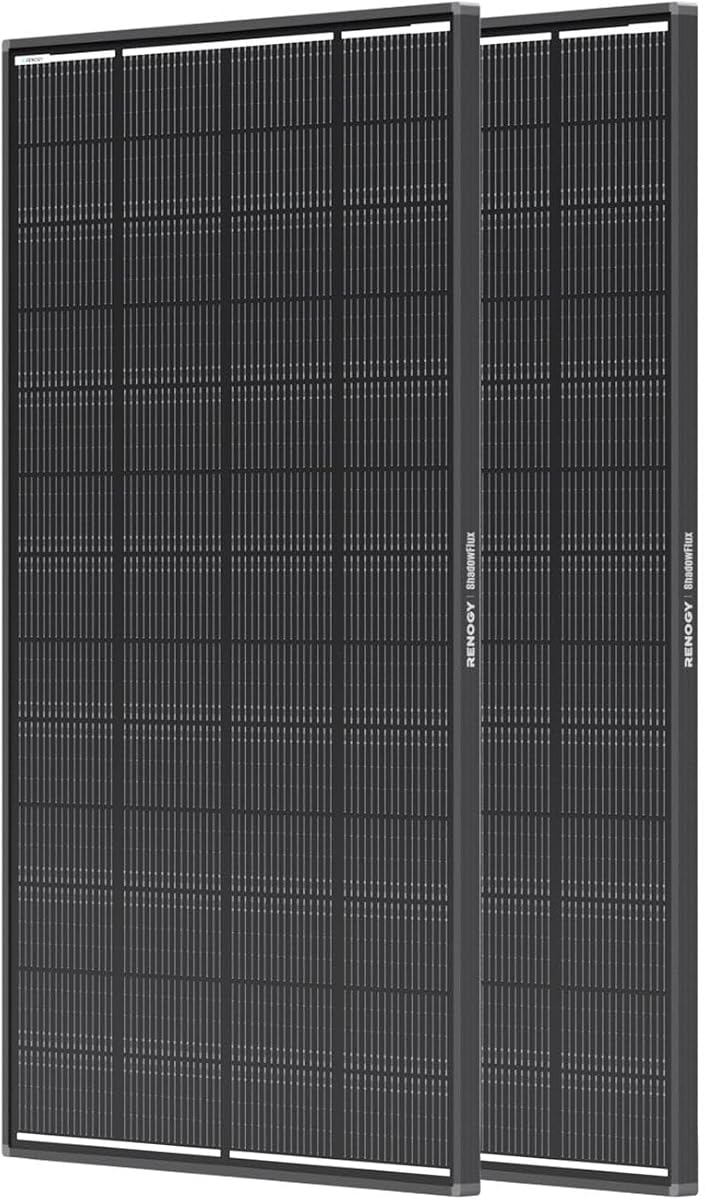
The Renogy ShadowFlux Solar Panel 400 Watt combines N-Type cells, 16BB construction, and anti-shading technology in a premium-oriented package. Its 4.5 customer rating places it among the strongest products in the comparison. The stated 25% efficiency and ShadowFlux design target two common RV challenges: improving conversion from each cell and reducing the effect of localized shade.
We may earn a commission when you buy through this link, at no additional cost to you.
ShadowFlux technology is intended to reduce hot-spot risks when buildings, plants, stains, or other objects partially shade the panel. N-Type cells and 16BB busbars also support stable output and reduced micro-crack risk. Renogy describes the panel as 7% smaller and 10% more compact than PERC designs, making it worth checking for RV roofs where every inch affects the installation.
The environmental rating is at least IP67, and the encapsulation material is designed to resist water vapor. Renogy backs the panels with five-year materials-and-craftsmanship coverage and a 25-year output warranty guaranteeing 80% power output. Those long-term assurances are meaningful for a permanent rooftop system exposed to sun, rain, snow, and temperature changes throughout the year.
This panel is best for owners willing to pay for a more advanced permanent installation and for those who expect partial roof shading. The main limitation is that a suitable MPPT charge controller, wiring, disconnects, mounting hardware, and battery protection are not represented in the listing information. Confirm the exact dimensions, electrical ratings, and battery configuration before ordering.
ShadowFlux is designed to preserve useful output when a portion of the panel is shaded by common rooftop surroundings. Proper placement remains the best way to avoid production losses.
The stated five-year materials warranty and 25-year output coverage support the panel's role as a permanent energy asset. Keep purchase documentation and follow the listed installation and maintenance requirements.
We may earn a commission when you buy through this link, at no additional cost to you.
The right 400-watt solar panel for an RV balances output, portability, electrical compatibility, physical dimensions, and the way you travel. Use the following factors to narrow the field before comparing controllers, battery banks, and installation hardware.
A 400-watt rating normally represents laboratory output under standard test conditions, not a guarantee of continuous real-world production. Sun angle, cloud cover, temperature, shade, dust, cable losses, and charge-controller performance can all change the result. A panel with a high stated efficiency may perform better in limited roof space, but placement and system losses still matter more than a headline figure when the RV spends time away from ideal sunlight.
Compare rated capacity, cell technology, and efficiency together, then assess realistic daily energy production for the RV's location and travel pattern.
Foldable panels prioritize storage flexibility, transportability, and the ability to move the collection surface toward direct sun. Rigid panels are generally better for permanent rooftop installations because they can be secured in a favorable position and wired directly to the charging system. Consider how often you camp in shade, whether roof drilling is acceptable, and how much interior storage you can devote to a portable panel.
Choose a foldable model for flexibility or a rigid model for a consistent permanent array, based on your travel style.
Panel wattage alone does not determine charging compatibility. Check the panel's voltage and current at the relevant operating conditions, then compare those figures with the charge controller's input range and the RV's battery bank. MPPT controllers are highlighted by several products in this guide because they can optimize charging when panel and battery voltages differ. The Renogy kit's 32V maximum battery-voltage specification is a clear example of why controller limits deserve close attention.
Make a written wiring plan and verify battery chemistry, nominal voltage, controller range, fuse ratings, and disconnect requirements before connecting any panel.
The nominal wattage says little about physical fit. Rigid systems may use one large module, two medium modules, or several small ones, and each format affects roof layout. Measure the usable area after accounting for vents, antennas, air conditioners, roof racks, walkways, and safe cable routes. Also consider whether a panel can be tilted or whether it must remain flat to avoid wind loading and water pooling.
Measure the available roof area and leave installation clearance around every module, especially when shade from nearby equipment may develop later.
MC4 connectors appear on many rigid panels and on some portable products, but the connector alone does not guarantee compatibility. A power station may require a proprietary cable or may limit solar input voltage or current. For permanent systems, cable length, conductor gauge, resistance, insulation quality, UV resistance, and the number of connections all influence efficiency and reliability. A long built-in lead can reduce extension complexity, but it should not be allowed to create a tight bend or strain point.
Match every connector to the controller, use outdoor-rated cable where appropriate, secure strain relief, and verify the controller's accepted input before purchasing accessories.
RV panels face sun, rain, dust, vibration, wind, and temperature changes. Look for tempered glass, corrosion-resistant aluminum frames, sealed junction boxes, and meaningful environmental ratings. IP ratings apply to specific components and test conditions, so a panel's overall rating should not be assumed to cover every exposed connector. Bifacial modules need clearance behind them, while portable fabrics and junction boxes may have stricter limits than the photovoltaic surface.
Read the product's exclusions carefully, protect non-waterproof junction boxes, and use mounting methods that do not trap water against the frame.
Partial shade can cause disproportionate losses in an inadequately designed panel, especially when modules are connected in series without appropriate protections. Products using separate parallel sections, multiple busbars, or dedicated anti-shading layouts may continue producing under localized obstructions. This matters on RV roofs where a small antenna, roof vent, tree branch, or accumulating stain may shade one portion of a module. Shade performance helps, but it does not replace thoughtful placement.
Map the roof's seasonal shadow patterns and prioritize positions that remain clear throughout the day whenever possible.
Portable solar panels must balance folded size against panel area, weight, fabric strength, and connector protection. A larger surface may offer more nominal power but become cumbersome for one person to carry. A folding design may also be less suitable for permanent exterior exposure. Rigid panels generally use stronger glass-and-frame construction, but they add weight and require secure roof mounting. If the panel will be handled frequently, consider the included handle, folded thickness, carry weight, and storage space.
Choose the lightest design that comfortably meets your charging needs, and avoid buying a heavy portable panel that will remain unused in the vehicle.
Before installation, inventory the panel, charge controller, cables, connectors, mounting hardware, disconnects, fuses, and battery connections. Confirm that the voltage, current, connector, and polarity specifications are compatible. Create a plan showing panel placement, cable routing, controller location, and the position of every protection device before drilling or connecting anything.
Mount rigid panels using the specified pre-drilled holes and appropriate RV-rated brackets or rails. Keep electrical connections dry, provide strain relief, and avoid sharp bends in cables. For portable panels, unfold the fabric fully, set the kickstands on stable ground, select an angle that minimizes shade, and orient the surface toward the strongest available sunlight. Never assume a listed output will occur while the panel is partially folded or obstructed.
Clean the photovoltaic surface periodically with a soft cloth and suitable water, following the manufacturer's instructions. Remove accumulated dust, leaves, bird residue, and snow because dirty or covered cells can lose meaningful output. Check connectors for looseness, corrosion, damaged insulation, and water intrusion. Disconnect energy sources before inspecting wiring, and have an electrical professional address damaged conductors, uncertain grounding, or unfamiliar high-voltage configurations.
Yes, a 400-watt panel can contribute meaningful charging power to a compatible RV battery bank. The controller must match the panel's electrical output and the battery bank's nominal voltage and chemistry. Actual charging speed varies with sunlight, temperature, shading, system losses, and how much power the connected loads consume.
They can provide the same total nominal capacity when configured correctly, but they are not identical in installation or behavior. Two panels offer more placement flexibility and may be easier to fit around roof obstacles. Electrical voltage, current, shading exposure, wiring, and controller sizing determine how the pair performs in practice.
A bifacial panel can be advantageous when the rear side receives reflected light, but it is not automatically better in every installation. The benefit depends on the surface below the panel, mounting clearance, and the amount of unobstructed rear-side exposure. A conventional monofacial panel with a better location can sometimes outperform a bifacial panel placed under restrictive conditions.
No. Compatibility depends on input voltage, current, connector type, and the power station's solar-input limits. MC4-equipped panels may still require an appropriate adapter or cable, and some power stations limit the accepted solar input. Check both devices' specifications before ordering or connecting a portable panel.
An RV battery should be charged through a controller that regulates voltage and current, and an MPPT controller is often well suited to solar charging. Its exact suitability depends on panel configuration and battery-bank voltage. The controller's input range, battery chemistry settings, current capacity, and any temperature-related limitations must all be verified.
Only if the mounting method is designed for that roof and the attachment does not create leaks or leave unsupported areas. Many installations use Z-brackets or rail systems with an appropriate sealant beneath the penetration points. Check the panel dimensions, roof curvature, wind exposure, walkway access, and cable routing before drilling.
The theoretical energy at 400 watts for five peak-sun hours would be 2,000 watt-hours, but actual results vary. Some product descriptions cite approximately 2,000Wh per day under favorable conditions, while real RV installations may produce less because of heat, shade, orientation, and electrical losses. A portable panel's output also depends on how accurately it is positioned.
It depends on the specific model's instructions. Some portable panels have IP65 or IP67 protection, but product listings may still exclude the junction box, connectors, or fabric seams. Read the stated exclusions and protect vulnerable connections. When conditions are uncertain, bring the panel into a dry, ventilated location and allow it to dry before folding.
The DOKIO panel stands out as a value-focused rigid option for owners who want a single 400-watt module and long MC4 leads, while the Callsun bifacial set is the most complete all-around recommendation for permanent RV use. The Renogy ShadowFlux panel is a premium alternative for travelers who prioritize anti-shading technology, high efficiency, and a compact installation.
Before choosing, prioritize the power architecture over the wattage label. Verify voltage, current, connector type, charge-controller limits, and battery configuration. Then select rigid or portable construction based on whether the panel will remain on the roof or move with you, and map shade before deciding where it will go.
Product listings, technical details, and prices can change, so review the current seller information and specifications before purchasing. If the package content is unclear, as with some multi-module listings, contact the seller or manufacturer and obtain a written configuration description. That final check can prevent incompatible wiring and make the installation much smoother.


