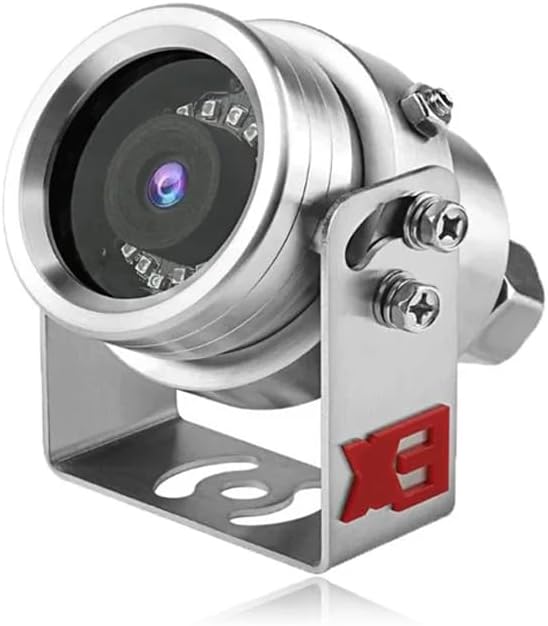
HJT 5MP POE Explosion Proof Camera
5.0Editor score
304 stainless steel housing
CT6 explosion-proof level
IP66 weatherproof protection
5MP ultra HD resolution
98-foot infrared night vision
Explosion proof cameras are built for demanding environments where ordinary surveillance equipment can fail, including chemical plants, fuel facilities, industrial worksites, and other hazardous locations. The right camera must combine appropriate protection, reliable imaging, useful networking, and an installation method suited to the location rather than merely carrying the term in its name.
We compared the ten products in this guide by examining their stated explosion protection, housing and environmental resistance, resolution, night or underwater capability, power options, recording features, controls, and intended applications. The list covers fixed surveillance cameras, industrial digital cameras, an explosion-protected bullet camera, and a rugged industrial documentation camera.
Each review explains what makes the product distinctive while also identifying important limitations, particularly where certification details are incomplete. The top selections represent the strongest balance of budget value, specialized capability, and premium construction, while individual reviews help buyers match a camera to a specific hazardous-area workflow. Listings and configurations can change over time.
5.0Editor score


As an Amazon Associate we earn from qualifying purchases.
The table below compares every camera by product type, stated protective capability, core imaging specification, and primary deployment advantage, making it easier to identify the option that best matches your site and documentation requirements.


The HJT 5MP POE Explosion Proof Camera is the most complete budget-oriented fixed camera in this group, combining a 5MP sensor, 304 stainless steel housing, stated CT6 explosion-proof level, IP66 protection, and a generous 98-foot infrared range. Its 5.0 customer rating is also the highest confirmed rating among the listed surveillance models, although the small sample and limited details should be considered when evaluating that score.
We may earn a commission when you buy through this link, at no additional cost to you.
The camera's main strength is its balanced construction. A stainless steel shell and tempered flat glass are appropriate for industrial exteriors, while the 85-degree field of view and 3.6mm lens provide a broad, fixed perspective for monitoring doors, machinery, tank areas, or perimeter approaches. PoE simplifies deployment because power and data can travel through one Ethernet cable, while dual H.265 and H.264 compression gives operators more choice when managing storage and bandwidth.
Night performance is another convincing feature. Eighteen infrared LEDs are specified to illuminate subjects as far as 98 feet, and the automatic motion detection can trigger real-time alerts when suspicious activity occurs. These are useful functions in locations with changing light conditions, although buyers should verify the available field of view, storage platform, and alarm integration before commissioning a multi-camera system.
The principal trade-off is the fixed 3.6mm lens, which cannot be manually adjusted to isolate distant subjects after installation. The supplied information also does not identify a recognized explosion-protection certificate, so facility engineers must confirm compliance with local rules rather than relying on the product's terminology alone. For installers seeking a capable, economical fixed camera with PoE, strong night vision, and rugged housing, this remains a strong recommendation.
The 304 stainless steel shell, CT6 construction claim, IP66 rating, and tempered flat glass form a practical foundation for exposed industrial monitoring. Verify all certification and installation requirements with qualified site personnel before using the camera in a classified hazardous area.
A 5MP sensor and 85-degree field of view support broad scene coverage, while H.265 compression can reduce storage requirements. The combination of PoE and infrared night illumination makes installation and 24-hour monitoring more practical.
We may earn a commission when you buy through this link, at no additional cost to you.
The DORLAND Industrial Intrinsically Safe EX Card Camera 02 is designed for mobile documentation rather than permanent wall-mounted surveillance. It combines a 48MP autofocus still camera with 5K video at 30 frames per second, a 3.5-inch IPS display, WiFi, 16X digital zoom, and a stated Zone 1 explosion-proof design. No confirmed customer rating is available, so its evaluated value depends on the supplied feature set.
We may earn a commission when you buy through this link, at no additional cost to you.
Its imaging specifications are especially useful for inspections. The 48MP mode can record fine equipment details, while 5K video provides a sharper moving-image option. A six-axis gyroscope and electronic image stabilization help reduce visible shake, and the automatic focus system is intended to keep operation straightforward for users who may not be experienced with industrial cameras.
Storage and field logistics are handled well. The camera supports SD cards up to 256GB, although a card is not included with the stated package, and it can transfer files to a computer for sharing or documentation. Two explosion-proof batteries, charging cables, a charger head, a charging dock, a lanyard, a lens cap, a filter lens, and a 128GB memory card are listed among the accessories.
The important limitation concerns optional external components. The description says an external fill light and microphone can support recording but must be purchased separately, and replacing a hot-shoe device is prohibited in a hazardous or explosive environment. Buyers must match every accessory to the appropriate certified configuration. This camera is best suited to mobile technicians who need high-resolution evidence in a genuinely portable intrinsically safe package.
The 48MP still mode is well suited to photographing valves, seals, gauges, and machinery, while 5K recording supports detailed process documentation. Autofocus and electronic stabilization reduce the need for manual adjustments during active inspections.
Two explosion-proof batteries, a charging dock, WiFi transfer, and computer file transfer give field users several practical ways to manage a full documentation shift. The included 128GB card also reduces the immediate need for additional storage.
We may earn a commission when you buy through this link, at no additional cost to you.
The LINOVISION 4K Explosion Proof PoE Camera targets installations that need long cable runs and centralized surveillance management. It records 8MP 4K video, uses a 304 stainless steel housing, supports PoE and 12V DC power, and can be paired with the included waterproof PoE extender to add up to 330 feet of transmission at 1000Mbps bandwidth. No confirmed customer rating is listed.
We may earn a commission when you buy through this link, at no additional cost to you.
Its strongest feature is installation flexibility. A single Ethernet cable can carry both power and data under IEEE 802.3af, while the extender makes the camera more practical for aquaculture farms, dams, chemical plants, refineries, offshore oil facilities, and gas stations where pulling additional cable is difficult. The camera also supports separate 12V DC power when that better suits the site's infrastructure.
Software access is unusually comprehensive for a fixed camera. Users can operate an intuitive web interface through major browsers without requiring a plug-in or ActiveX, use the mobile app with cloud access, or manage tens of cameras across sites with the included PC-based VMS software. An API is also offered for third-party integration, which can make the camera more adaptable to an existing control environment.
The most important caveat appears in the product data: the explosion-proof design is described as having no certificate yet. The 4K sensor is strong, and the stainless enclosure is promising, but facility safety teams should require appropriate documentation before approving deployment in a regulated hazardous location. Night vision reaches 100 feet through two LEDs, although the output is black and white. For long-run fixed monitoring with excellent network options, this camera is a compelling choice once certification is resolved.
The extra 330-foot PoE transmission capability can reduce the need for intermediate power or network points. It is especially useful around water, outdoor industrial structures, and large properties where conventional Ethernet reach is limited.
The web interface, mobile application, cloud access, VMS software, and API support different monitoring styles. This makes the camera attractive to operators who need both local access and centralized oversight across multiple locations.
We may earn a commission when you buy through this link, at no additional cost to you.
The DORLAND Camera EX05 is the most feature-dense mobile camera in the list, combining a stated ATEX explosion-proof design, IP68 underwater protection, 8K capture, 70MP still photography, 18X zoom, autofocus, a dual-screen selfie arrangement, and a 2500mAh battery. No customer rating is available, but the breadth of its environmental and imaging specifications makes it an attractive specialist tool.
We may earn a commission when you buy through this link, at no additional cost to you.
The EX05 can address situations that exceed ordinary surveillance requirements. Its IP68 rating supports submerged use, while the explosion-proof designation makes it more relevant to industrial documentation. At the same time, 70MP photographs and 8K recording give technicians options for close inspection, wide environmental views, and evidence-quality stills without carrying a separate camera system.
Autofocus and 18X zoom are valuable when the subject is difficult to approach or must be observed without disturbing the surrounding environment. The dual-screen setup can aid self-recording and content framing, and the rechargeable battery supports mobile work. An SOS light adds another visible utility in low-light or emergency conditions, although the supplied summary does not detail its runtime or activation behavior.
This is a specialized purchase rather than a straightforward fixed-security camera. Buyers should verify the exact ATEX documentation, operating limits, and whether the stated waterproof and explosion-proof configurations are approved for their intended environment. The EX05 is recommended for industrial inspectors, field engineers, and specialist teams that need a rugged, high-resolution camera capable of working across difficult surfaces and conditions.
The choice between 8K video and 70MP stills allows users to prioritize either detailed motion or maximum static resolution. Autofocus and 18X zoom further reduce the need to physically approach sensitive equipment.
An IP68 enclosure and stated ATEX explosion-proof design broaden the potential operating environment. Confirm the precise certification and immersion conditions before field deployment because the compact summary does not provide all technical limits.
We may earn a commission when you buy through this link, at no additional cost to you.
This HJT 5MP POE Explosion Proof Camera offers a similar core proposition to the first-ranked model: rugged fixed surveillance with a stainless steel housing, IP66 protection, 5MP imaging, PoE networking, and 98-foot infrared night vision. The stated CT6 explosion-proof level, 3.6mm lens, and 85-degree view angle make it appropriate for broad outdoor coverage. No confirmed rating is supplied.
We may earn a commission when you buy through this link, at no additional cost to you.
The camera is particularly straightforward for monitoring fixed areas such as entrances, loading zones, production equipment, or outdoor approaches. Eighteen infrared LEDs support clear low-light monitoring to 98 feet, while H.265 and H.264 compression let an installer select an efficient storage profile. Motion detection can also generate alerts when unexpected activity occurs in the monitored area.
The 304 stainless steel construction and tempered flat glass are appropriate for exposed industrial service, and PoE means the installer can reduce cable requirements by carrying power and network data over one connection. The wide viewing angle is useful where the objective is to cover a large scene rather than identify a small, distant target through a telephoto lens.
Limitations include the lack of a confirmed customer rating and the inability to zoom or refine the field of view after installation. Certification documentation is also absent from the supplied information, so it should be requested before installation in a formally classified area. This model is a sensible choice for buyers who want a simple, high-resolution outdoor security camera with night vision and no extensive configuration requirements.
The 85-degree field of view and 5MP resolution provide a practical balance between scene breadth and detail. PoE simplifies wiring, while the 3.6mm lens keeps the unit aimed toward a broad industrial area.
Eighteen infrared LEDs provide illumination up to 98 feet, reducing dependence on visible lighting. H.265 compression can be especially useful when a site records continuously and storage capacity is limited.
We may earn a commission when you buy through this link, at no additional cost to you.
The DORLAND Industrial Intrinsically Safe 5K 64MP Digital Camera emphasizes usable controls alongside high-resolution capture. It offers a 3.6-inch IPS touchscreen, autofocus, anti-shake, WiFi, 8X optical zoom, a dual-camera selfie arrangement, 5K video, and 64MP photographs. The stated Zone 1 explosion-proof design and IP54 rating make it a specialist field camera, although no customer rating is listed.
We may earn a commission when you buy through this link, at no additional cost to you.
Compared with a digital zoom, the 8X optical zoom should help preserve more usable detail when framing a subject at a distance. That advantage matters in industrial inspections where approaching a hot surface, moving mechanism, or restricted area may be impractical. Autofocus further supports quick operation, while anti-shake can improve handheld footage and still-image clarity.
The touchscreen is a meaningful convenience for users who regularly configure capture settings or review material directly in the field. WiFi provides another route for transferring or sharing files, and the dual-camera selfie design broadens the camera's application for demonstrations and documentation. Together, these features make it more approachable than a basic fixed surveillance unit.
IP54 protection is less extensive than the IP68 rating offered by the EX05, so this model is not the right choice for routine underwater use. Certification details should also be verified for the intended hazardous zone. It is recommended for technicians who prioritize a touch interface, optical reach, and detailed still images over a permanent surveillance installation.
EightX optical zoom allows operators to isolate distant details without relying entirely on digital cropping. The dual-camera setup adds framing flexibility for demonstrations, self-recorded procedures, and site updates.
A 3.6-inch IPS touchscreen makes menus and playback easier to navigate than on a minimal handheld camera. Autofocus, anti-shake, and WiFi support a streamlined workflow from capture through file transfer.
We may earn a commission when you buy through this link, at no additional cost to you.
The DORLAND Ex HDV 100i is built for operators who need to record industrial processes, procedures, and inspections as video. Its listed features include a 48MP 5K/30FPS mode, an 8MP CMOS sensor, 16X anti-shake zoom, a three-inch flip touchscreen, WiFi, and IR LED fill-light support. The industrial intrinsically safe and explosion-proof description positions it as a specialized camcorder rather than a fixed security camera.
We may earn a commission when you buy through this link, at no additional cost to you.
The 5K recording mode provides a high level of visible detail, which is valuable when reviewing machinery operation or documenting procedural work. Sixteen-times zoom gives the camera substantial framing flexibility, while anti-shake helps produce steadier handheld results. The flip touchscreen allows the operator to position the screen conveniently for different shooting angles, including high or low viewpoints.
This is a practical tool for training, maintenance records, incident documentation, and remote collaboration. WiFi can support convenient file handling, while the fill light assists in dark areas. The product is clearly aimed at workers who need a versatile recorder that can be carried between tasks instead of permanently mounted over a single scene.
As with other intrinsically safe products in this roundup, the concise listing does not provide enough certification detail for a site engineer to make a final compliance decision. Buyers should verify the exact approved configuration and whether the fill light is permitted in the target atmosphere. The HDV 100i is a strong choice for mobile industrial video documentation where detail, stabilization, and flexible framing matter most.
Five-key 30FPS recording captures enough detail to review equipment behavior and technician actions. The 48MP specification and 8MP CMOS sensor also support high-quality still extraction when documentation requires photographs.
Anti-shake combined with 16X zoom helps users document subjects that cannot be approached closely. The flip touchscreen supports flexible framing, and the integrated fill light can improve visibility in low-light work areas.
We may earn a commission when you buy through this link, at no additional cost to you.
The P1468-XLE Explosion-Protected Bullet Camera is the premium fixed-surveillance choice in this guide, with a concise specification centered on hazardous-location use. Its stated advantages are durable construction, advanced protection features, reliable operation in challenging environments, and high-quality video capture in extreme conditions. No customer rating is available, so the available information is necessarily narrower than for the more fully specified models.
We may earn a commission when you buy through this link, at no additional cost to you.
The product's strongest selling point is its specialization. Rather than relying only on broad weather and corrosion ratings, the listing emphasizes an explosion-protected design specifically intended for industrial and hazardous-location surveillance. That focus makes the camera a candidate for permanent monitoring where environmental severity, housing integrity, and dependable operation are the primary requirements.
Its bullet form also has practical installation advantages. The elongated enclosure can be aligned with a specific sightline, making it suitable for entrances, process areas, access corridors, and other locations where a narrow, directed view is preferred. Its construction is presented as reliable under challenging conditions, supporting round-the-clock observation in facilities where ordinary cameras may be vulnerable to impacts, debris, or severe exposure.
The lack of published resolution, lens, connectivity, power, and ingress details requires buyers to request complete technical documentation. The absence of a confirmed rating also means there is no customer feedback in the supplied data to support or challenge the stated construction advantages. Subject to verification of specifications and certification, the P1468-XLE is recommended for buyers who prioritize purpose-built hazardous-location surveillance over consumer-style features.
The explosion-protected enclosure is the defining feature, positioning the camera for fixed monitoring in hazardous industrial environments. This is more appropriate for a permanent access-control or process-security role than a portable documentation workflow.
The bullet format can be aimed at a specific entry, aisle, or process point without the visual bulk of a larger enclosure. Request lens, low-light, and mounting information before comparing it with the more fully specified models.
We may earn a commission when you buy through this link, at no additional cost to you.
The NightKing Stainless Steel Corrosion Explosion Proof Camera is a fixed PoE surveillance model with a 304 stainless steel, CT6 housing, bullet-proof glass, motorized autofocus, and a 2.8–12mm HD lens. It can record at 5MP and 20 frames per second, 4MP and 25 frames per second, or 2MP and 30 frames per second. No confirmed customer rating is provided.
We may earn a commission when you buy through this link, at no additional cost to you.
Its most attractive feature is the motorized 2.8–12mm lens. Unlike a fixed wide-angle camera, the four-times zoom can be adjusted after installation to frame a distant entrance, inspect a process area, or produce a more useful close view. Motorized autofocus further helps maintain clarity when the scene changes, while ONVIF and Hik protocol support broadens its compatibility with network systems.
PoE carries both data and power through one cable, reducing installation complexity in facilities where adding separate power runs is difficult. The stainless steel enclosure, corrosion resistance, and bullet-proof glass are particularly relevant to airports, banks, police stations, warehouses, gas stations, vessels, vehicles, streets, and industrial areas. The bullet form can also be directed toward a precise line of sight.
The listing explicitly states that the camera does not supply ATEX verification. That limitation is critical: buyers who require formal explosion certification should not order based solely on the explosion-proof description. The product also provides little information about infrared illumination or low-light performance. It remains a capable, adjustable fixed camera for harsh environments where corrosion resistance and motorized framing are priorities, but certification must be resolved before hazardous-area use.
The motorized 2.8–12mm lens provides a useful four-times optical adjustment range. Installers can optimize the scene after mounting, and motorized autofocus supports clarity as distances and lighting conditions change.
A 304 stainless steel shell, corrosion protection, bullet-proof glass, ONVIF support, and Hik protocol compatibility make this camera appealing for demanding sites with existing network infrastructure. PoE keeps the power arrangement simple.
We may earn a commission when you buy through this link, at no additional cost to you.
The Ricoh G900 is a rugged industrial documentation camera rather than a certified explosion-proof surveillance model, but it offers an exceptional combination of physical durability, image quality, location tagging, and data security. It produces effective 20MP images, has a 4.0 customer rating, and includes a webcam function, built-in GPS, and extensive password controls for the camera, internal memory, and SD cards.
We may earn a commission when you buy through this link, at no additional cost to you.
Its environmental specifications are unusually strong. The body passes a 2.1-meter drop test, provides IPX8 water resistance to 20 meters for up to two hours, resists sodium hypochlorite, ethanol, and liquid chlorine dioxide disinfectants, and is rated to remain functional down to minus 10°C. These properties make it useful for utilities, field service teams, construction, inspection, and environments where moisture, impacts, and cleaning chemicals are common concerns.
The software features support organized visual reporting. Barcodes can assist with memos and password entry, memo data can be stamped on pictures, related images can be grouped, and temporary voice memos can be added. The webcam function allows the camera to serve as a live communication device, while built-in GPS helps users associate field images with location data. Password protection for both SDHC and SDXC memory cards adds an important security layer.
The decisive trade-off is that the supplied data does not identify this model as explosion-proof or ATEX certified. It should not be treated as a substitute for an approved camera in a classified hazardous area. Buyers who need chemical resistance, deep waterproofing, impact protection, and detailed inspection records will find it highly capable, while hazardous-area surveillance buyers should look to one of the specifically explosion-protected models.
A 2.1-meter drop rating, 20-meter waterproof capability, chemical resistance, and freeze protection support use in harsh working environments. The 20MP sensor preserves fine detail in low light and other difficult conditions.
Built-in GPS, barcodes, image memos, voice notes, and grouped clips help create organized field reports. Layered password controls protect the camera, internal memory, USB access, settings, and compatible memory cards.
We may earn a commission when you buy through this link, at no additional cost to you.
Choosing a camera for a hazardous or industrial environment requires matching the protection level, optical needs, power method, and documentation workflow to the site. Certification and installation requirements should take priority over headline resolution, and every accessory must also be approved for the intended operating area.
A product described as explosion-proof, explosion-protected, or intrinsically safe may not carry the certification required by your facility. The products in this guide variously state CT6 construction, ATEX protection, Zone 1 suitability, or explosion-protected design, while the LINOVISION listing explicitly notes that no certificate is yet supplied and the NightKing listing states that ATEX verification is not included. Ask the manufacturer for the exact certificate, certified model designation, applicable zone, gas group, temperature class, and documentation before making a safety-critical purchase.
Fixed PoE cameras are suited to continuous surveillance of a defined area, while handheld industrial cameras support inspections, maintenance records, and incident documentation. The P1468-XLE and LINOVISION models fit permanent monitoring roles; the DORLAND portable cameras and Ricoh G900 fit mobile evidence collection. Choosing by workflow prevents buyers from paying for mobile features they will not use or overlooking remote access needed by a control room.
Resolution figures alone do not reveal whether a camera will identify distant activity. The list includes 2MP, 4K 8MP, 5MP, 20MP, 48MP, 64MP, and 70MP options across still and video modes. Consider the required subject size, viewing distance, available storage, and output workflow. A high-resolution mobile image may be more useful for equipment evidence than a fixed wide-angle scene, while continuous surveillance may benefit more from effective compression and frame rate than a very large still-image specification.
The two HJT cameras use a fixed 3.6mm lens with an 85-degree view, which suits broad scenes but offers little post-installation adjustment. The NightKing camera has a motorized 2.8–12mm lens, while portable DORLAND models offer optical or digital zoom for inspecting distant subjects. For darkness, verify the stated night range and lighting technology: the HJT cameras specify 18 infrared LEDs and 98-foot visibility, whereas the LINOVISION camera offers 100-foot black-and-white night vision.
IP ratings describe resistance to solids and liquids, while explosion protection addresses a different hazard. The HJT models state IP66, the LINOVISION camera describes waterproof construction, the DORLAND EX Card Camera 02 and touch camera state IP54, the EX05 states IP68, and the Ricoh G900 supports immersion to 20 meters. Salt spray, chemicals, impact, temperature extremes, and ultraviolet exposure may also matter. Request independent enclosure and material specifications rather than assuming a high IP number solves every environmental concern.
PoE is convenient for fixed cameras because one Ethernet cable can carry data and power, but distance, grounding, switching capacity, and environmental protection must be considered. The LINOVISION model includes a waterproof extender that can add 330 feet at 1000Mbps bandwidth and also supports 12V DC. Mobile cameras instead rely on rechargeable batteries, docks, SD cards, and sometimes WiFi. Plan the complete data path and backup method before installing remote equipment in a difficult-to-reach location.
Fixed camera users should compare ONVIF compatibility, web-interface access, mobile applications, cloud services, VMS support, APIs, and H.265 or H.264 compression. The NightKing supports ONVIF and a Hik protocol, while the LINOVISION model offers browser access, a mobile app, cloud access, PC-based VMS, and an API. Portable cameras often rely on SD cards and direct file transfer. The DORLAND EX Card Camera 02 supports cards up to 256GB, while its package includes a 128GB card.
An approved camera can still become unsafe if paired with an incompatible battery, charger, microphone, fill light, or mounting accessory. The EX Card Camera 02 states that its fill light and external microphone are sold separately and warns against replacing the hot-shoe device in a hazardous or explosive environment. Confirm approved accessories, battery compatibility, charging arrangements, and cable accessories with the manufacturer or responsible safety authority.
Begin with a documented site assessment rather than installing a camera based only on its product description. Identify the hazardous zone, gas or dust classification, temperature limits, corrosion exposure, required viewing angles, power location, and network path. Compare the exact camera and every accessory with the site's approved equipment list, and involve qualified electrical, safety, and instrumentation personnel wherever the manufacturer or local rules require it.
Install the mounting hardware and housing according to the supplied instructions, paying particular attention to seals, cable entries, grounding, conduit, and the orientation of connectors. Preserve the protective window from scratches and impact. For fixed PoE models, test Ethernet and power at the intended operating distance before finalizing the route. For portable cameras, use only approved batteries, chargers, and storage media, and confirm that a user can complete the task without introducing an unapproved accessory into the hazardous area.
For routine care, clean the viewing window with a nonabrasive method approved by the manufacturer, inspect seals and connectors, and check that the enclosure remains intact after impacts or maintenance. Keep firmware, applications, and recording software updated on a controlled network, back up important footage, and rotate passwords where supported. Never open or modify a certified enclosure in the field, and retire the camera if its protection is damaged or its certification can no longer be confirmed.
An explosion-proof camera uses an enclosure designed to contain an internal ignition and prevent it from igniting the surrounding atmosphere. An intrinsically safe camera limits the energy available in its electronics so it cannot create a hazardous condition under normal operation. The terms describe different protection concepts, and a site should determine which one its code and risk assessment require.
No. A marketing description is not the same as formal certification. The LINOVISION listing says no certificate is yet supplied, and the NightKing listing explicitly says ATEX verification is not provided. Buyers should request current, model-specific documentation and confirm that it covers the exact camera, accessories, installation method, and destination jurisdiction.
The DORLAND EX Card Camera 02, EX05, 64MP touch camera, and HDV 100i are designed as portable industrial cameras rather than fixed surveillance units. The EX05 stands out for 70MP still images, 8K capture, 18X zoom, and stated ATEX and IP68 protection. The right choice still depends on the site's approved certification and required environmental limits.
The necessary resolution depends on how much detail the operator must see at the farthest relevant distance. The 5MP HJT cameras suit broad fixed coverage, while the 8MP LINOVISION model offers 4K output. A 4K image can help with wide scenes, but lens choice, lighting, compression, frame rate, and network bandwidth remain just as important as the pixel count.
PoE can simplify fixed installations by carrying data and power through one Ethernet cable, but cable length and network design still matter. The LINOVISION model includes a waterproof PoE extender stated to add 330 feet at 1000Mbps bandwidth. Installers should verify compatibility, grounding, surge protection, and environmental requirements rather than assuming any distance is automatically safe.
IP66 indicates protection against dust ingress and powerful water jets, while IP68 indicates a higher level of dust protection and resistance to continuous immersion under specified conditions. Neither rating by itself establishes explosion protection. Buyers should also verify the enclosure's certification, temperature range, chemical resistance, and impact performance.
The supplied product information does not identify the Ricoh G900 as explosion-proof or ATEX certified, so it should not be assumed suitable for a classified hazardous area. It is well suited to rugged visual documentation because of its 20MP sensor, 20-meter waterproof capability, chemical resistance, impact testing, GPS, and password controls. Confirm any intended hazardous-area use with the manufacturer and site safety professionals.
Use strong device and account passwords, restrict shared access, enable automatic updates, and use encrypted or protected storage where the system supports it. The Ricoh G900 specifically provides password protection for the camera, internal memory, USB access, settings, and compatible SD cards. Fixed installations should also use secure network access, role-based accounts, and tested backup procedures.
The HJT 5MP POE camera is the strongest all-around value in the group, combining 5MP recording, a stainless steel enclosure, IP66 protection, PoE, and 98-foot infrared night vision. The DORLAND EX05 stands out for specialized field work with stated ATEX protection, 8K and 70MP capture, 18X zoom, and IP68 underwater protection, while the P1468-XLE offers the most purpose-built premium fixed-surveillance option.
Prioritize certification, environmental suitability, and workflow before choosing among headline specifications. A portable inspection camera and a permanently mounted network camera solve different problems, and neither should be evaluated solely by resolution. Verify the approved model, power method, accessories, mounting, temperature limits, and integration requirements with qualified site personnel.
Listings, bundles, configurations, and product details can change over time, so confirm the current specifications and certification documents before purchasing. The most reliable choice is not automatically the model with the largest resolution; it is the one that is approved for the exact location, equipped for the task, supported by the intended power and network system, and documented for long-term use.