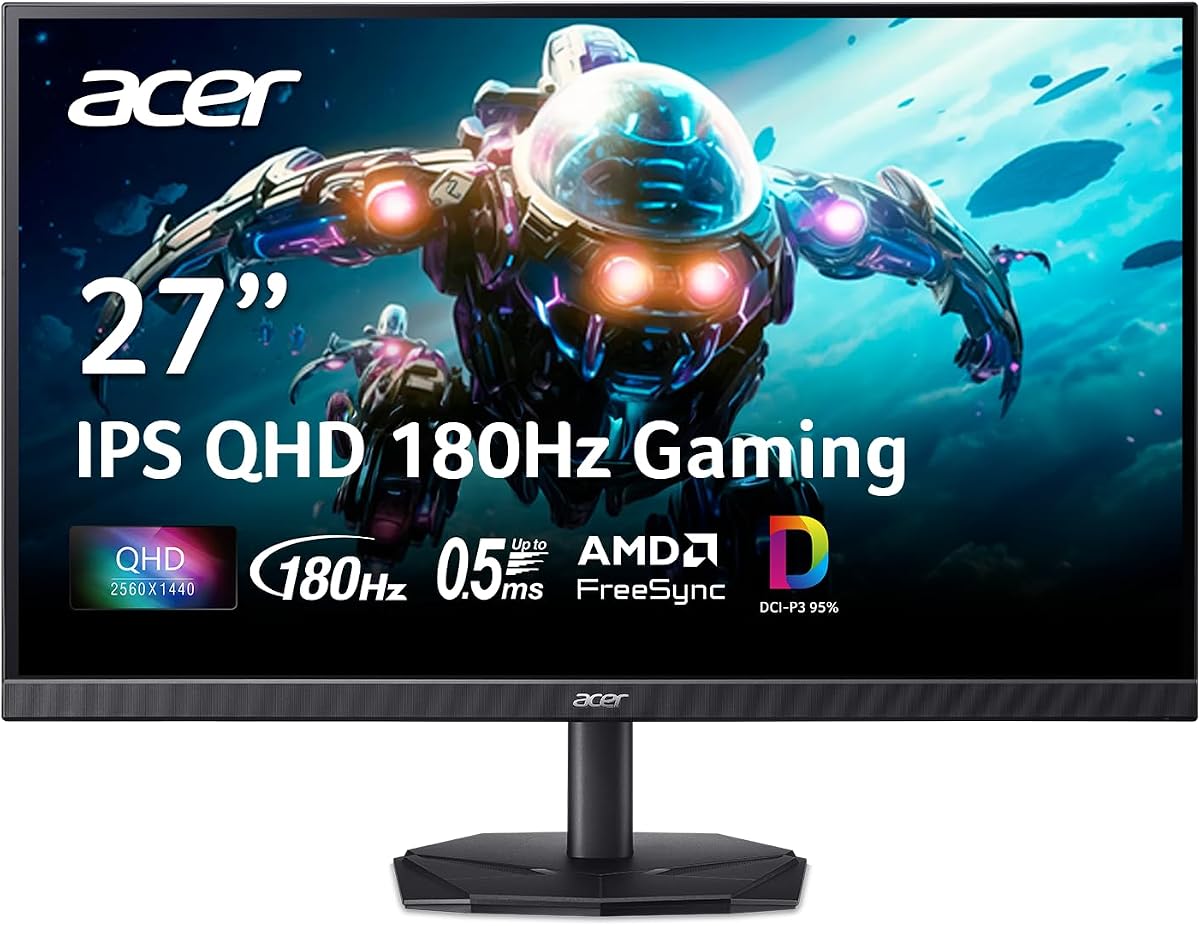
Acer Nitro KG271U
4.5Editor score
2560 x 1440 IPS panel
Up to 180Hz refresh
Up to 0.5ms GTG
DCI-P3 95% coverage
A 1440p IPS monitor gives console players a sharper image than standard 1080p while preserving the wide viewing angles and accurate color associated with In-Plane Switching panels. The right model should also deliver responsive motion, useful synchronization, flexible positioning, and the connection options needed for modern consoles and accessories.
This guide compares ten 27-inch gaming monitors using the supplied specifications, including panel type, resolution, refresh rate, response time, variable-refresh-rate support, HDR capability, color coverage, ports, and stand adjustment. It highlights practical differences for console gaming rather than treating every high-refresh display as equally suited to living-room play.
Each review identifies the monitor's strongest qualities, relevant compromises, and likely audience. The top three selections represent the best overall, budget-oriented, and premium choices in this group. Pricing, promotional terms, and availability can change, so readers should confirm current details and console compatibility before purchasing.
4.5Editor score
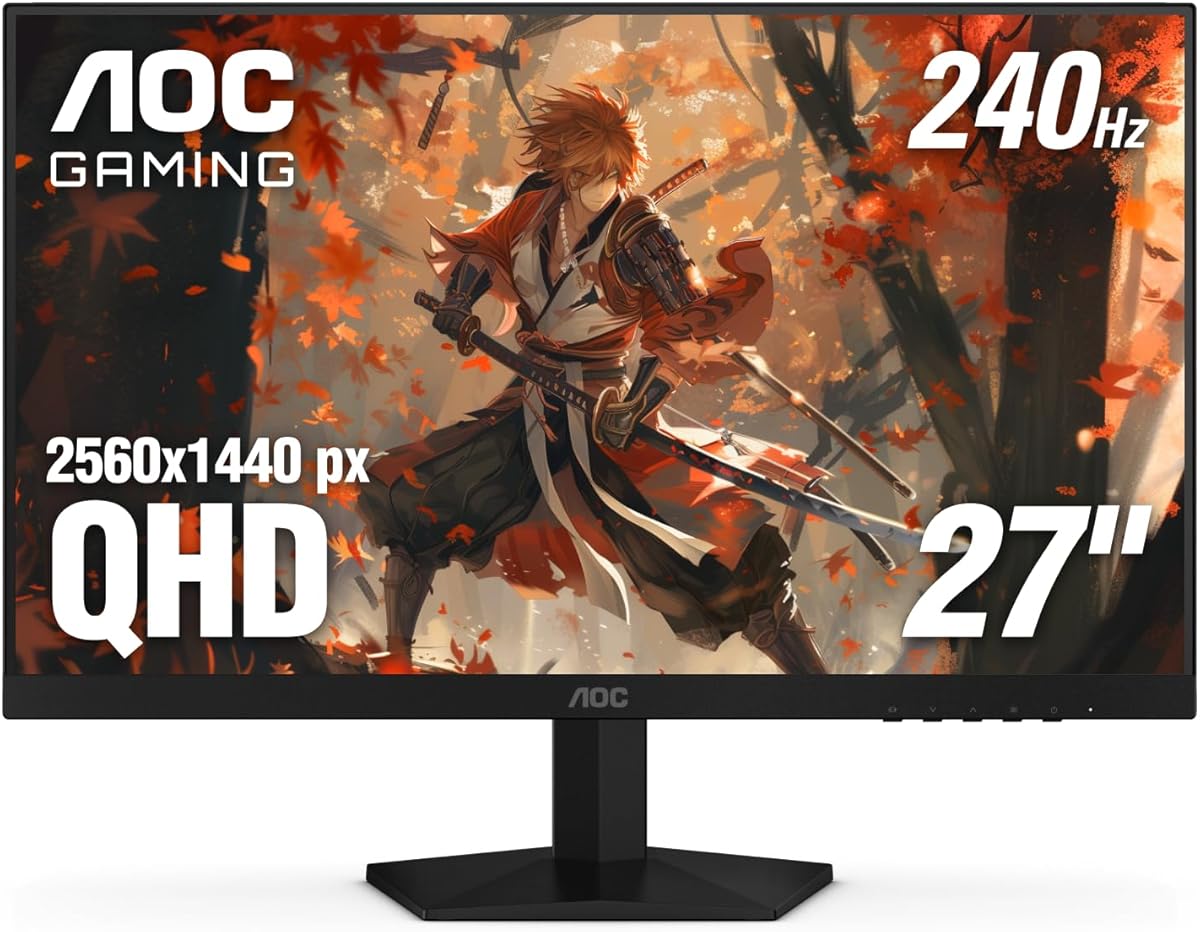
4.6Editor score

4.4Editor score
As an Amazon Associate we earn from qualifying purchases.
The comparison below places the ten displays by their stated resolution, refresh rate, response time, gaming features, and connectivity. These specifications reveal which models target competitive PC play, broader color-sensitive work, or console setups requiring modern HDMI and convenient peripherals.



The AOC Q27G41ZE stands out as the most versatile overall choice in this guide, combining a 2560 x 1440 IPS panel with a 240Hz refresh rate over DisplayPort and an advertised 0.3ms MPRT. Its 4.6 rating reflects a strong balance of speed, visual clarity, and practical gaming features. For console players, the two HDMI 2.0 inputs make it straightforward to connect a console while retaining a PC or streaming device.
We may earn a commission when you buy through this link, at no additional cost to you.
Motion performance is the model's defining advantage. The supplied specifications state that the native refresh rate is 240Hz through DisplayPort, while the product title identifies the display as supporting a 260Hz overclocked mode. Its near-instant advertised MPRT and adaptive synchronization make it a natural fit for fast action, while Shadow Control and Game Mode presets give players quick ways to tune visibility and the overall picture.
The trade-offs come mainly in physical setup and real-world console limits. Its tilt adjustment spans -3° to +21°, but the specification does not list height, swivel, or pivot adjustment, so positioning may be less flexible than on several competitors. Console output is also generally constrained by the console and selected display mode, meaning the headline 240Hz figure does not imply that a current console will drive the monitor at that rate.
This is the strongest recommendation for someone who wants one capable monitor for console gaming, competitive PC titles, and everyday use. The 300-nit brightness, 1000:1 contrast ratio, IPS viewing angles, and frameless styling reinforce its all-purpose appeal. It is particularly suitable when high refresh performance and useful gaming controls matter more than extensive ergonomic adjustment.
For buyers comparing this model with lower-refresh 180Hz options, the AOC justifies its place with higher peak performance, a strong rating, and broad synchronization support. It does not need to match the premium stand adjustment or connectivity of costlier gaming monitors to deliver an excellent mixed-console experience. It remains the most complete pick for performance-focused console and PC gaming.
Two HDMI 2.0 ports allow a console and another source to remain connected at the same time, while DisplayPort 1.4 serves fast PC gaming. The included audio output can also carry sound to compatible external speakers or a headset receiver without requiring the console's weaker built-in speakers.
The 240Hz DisplayPort refresh rate and 0.3ms advertised MPRT target quick movement, while Adaptive-Sync support helps maintain fluid presentation when the source and display are compatible. Actual console frame rates remain limited by the console and game, but the headroom makes this monitor effective across different console generations and PC gaming.
We may earn a commission when you buy through this link, at no additional cost to you.
The Acer Nitro KG271U is the budget-focused selection for gamers moving beyond 1080p without paying for the highest possible refresh rate. Its 2560 x 1440 IPS panel, up-to-180Hz refresh rate, and up-to-0.5ms GTG response offer a modern feature set, while its 4.5 rating places it among the stronger-reviewed choices here. The zero-frame design also gives the display a clean appearance.
We may earn a commission when you buy through this link, at no additional cost to you.
Color capability is a notable strength beyond raw gaming speed. Supporting DCI-P3 at 95% makes the KG271U more compelling for mixed use, including console games, movies, photo viewing, and color-sensitive creative projects. AMD FreeSync can reduce tearing and stuttering when the connected graphics source supports the feature, helping deliver a more stable presentation during intense scenes.
Its specification list is less complete than that of several rivals. The supplied data does not identify the exact HDMI version or port quantity, nor does it describe height, swivel, pivot, or tilt adjustments. That means console users should confirm that their preferred connection and stand movement are available. The screen's fast response and refresh rate also do not guarantee native 1440p or high-refresh output from every console.
The KG271U makes the most sense for value-conscious console players who want a sharp IPS image, high refresh capability, and stronger color coverage without chasing extreme refresh figures. It is also a credible choice for PC gamers who can benefit from 180Hz and FreeSync. The main advantage is a balanced specification package rather than a single headline feature.
Among the less expensive entries, this monitor is especially convincing because it combines QHD resolution, up to 180Hz, fast GTG performance, and DCI-P3 95% in one package. Buyers should verify ports and ergonomic support, but those unresolved details do not undermine the core appeal: a capable, sharp IPS display with enough speed for modern console and PC gaming.
The 2560 x 1440 panel provides more spatial detail than a 1080p display, making character models, environments, and interface elements appear cleaner. This is particularly useful on larger screens or when sitting close to a television-sized gaming display.
DCI-P3 95% coverage gives the monitor broader color capability than a basic sRGB-focused screen. The result is useful for games with rich art direction and for users who also watch HDR-oriented content or perform color-aware desktop work.
We may earn a commission when you buy through this link, at no additional cost to you.
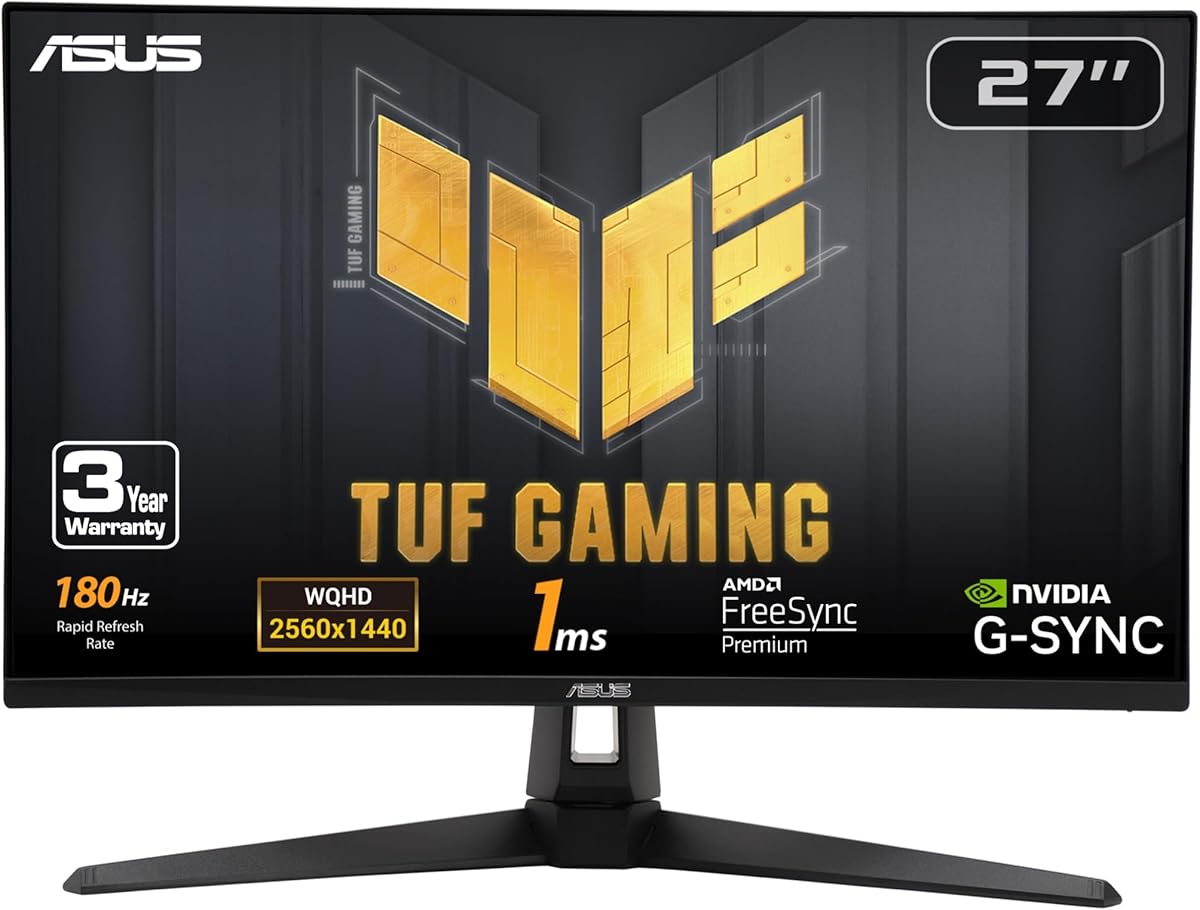
The ASUS TUF VG27AQ3A earns a premium recommendation because it combines a 4.6 rating with a well-rounded collection of motion, synchronization, color, and convenience features. Its 27-inch Fast IPS panel operates at 2560 x 1440 and 180Hz with a stated 1ms response time. That balance makes it suitable for console gaming, competitive PC titles, and media use.
We may earn a commission when you buy through this link, at no additional cost to you.
Its synchronization support is particularly comprehensive. FreeSync Premium, G-SYNC compatibility, and AdaptiveSync are listed, while ELMB Sync enables ELMB and variable-refresh-rate technologies to work together to reduce ghosting and tearing. HDR-10 support adds brighter highlights and deeper shadows, and the panel covers 130% of the sRGB gamut with wide viewing angles.
Console buyers should still verify the supplied connection details before purchase, because the product information emphasizes PC gaming and does not list a complete port inventory. HDR-10 support likewise does not reveal peak brightness, measured contrast, or whether a console's HDR output will provide a dramatic visual improvement. Built-in speakers are convenient for everyday use, though dedicated gaming audio will usually provide a clearer result.
This TUF model is a strong fit for gamers who want multiple synchronization choices rather than a display focused on a single platform. The included DisplayPort cable, power accessories, quick-start guide, warranty card, and built-in speakers make it convenient to set up in a mixed gaming space. Its fast IPS panel and 180Hz rate also provide ample headroom for high-frame-rate PC play.
The VG27AQ3A is not the fastest choice in this comparison, but speed is only one part of the equation. Broad VRR support, ELMB Sync, HDR-10, accurate color, built-in audio, and a strong rating create a more versatile package. It is a particularly convincing premium choice for buyers who may switch regularly between a console and PC.
FreeSync Premium, G-SYNC compatibility, and AdaptiveSync give the display broad support for variable-refresh systems. ELMB Sync adds motion clarity by allowing the blur-reduction technology to operate with variable refresh, which is useful for fast competitive games.
HDR-10 support is intended to reveal brighter highlights and more nuanced shadows, while the Fast IPS panel's 130% sRGB coverage supports vivid color. The benefit depends on game support, source capability, lighting, and the user's chosen settings.
We may earn a commission when you buy through this link, at no additional cost to you.
The Gigabyte GS27QA SA is a fast IPS gaming monitor with a 4.5 rating, an 180Hz refresh rate, and an advertised 1ms MPRT. Its performance-oriented specifications are appealing for action games, but there is an important resolution ambiguity: the supplied product title explicitly identifies the screen as FHD. It should therefore be verified as a 1440p model before purchase if native 1440p is essential.
We may earn a commission when you buy through this link, at no additional cost to you.
The GS27QA SA's core strengths are speed and a broadly capable color specification. Its 1000:1 contrast ratio, 100% sRGB gamut, and 8-bit color depth should produce clear, familiar color for games and desktop use. AMD FreeSync can reduce tearing and stuttering with compatible source hardware, while HDR10 certification is intended to add richer color and deeper contrast.
Its main weakness is that the available product information does not clearly establish a 2560 x 1440 panel. The title calls it FHD, and the supplied feature list discusses the panel size, refresh rate, response time, color, HDR, and FreeSync without explicitly resolving the resolution conflict. Console gamers should also confirm HDMI version and port arrangement before buying.
The monitor is still worth considering for anyone who values smooth motion more than exact 1440p resolution, or who finds the GS27QA SA in a listing that clearly verifies a different panel configuration than the title. It may also serve well as a secondary high-refresh display for a PC, while its FreeSync support and HDR10 capability suit compatible gaming systems.
As a result, this is a conditional rather than universal recommendation. The 180Hz refresh rate, 1ms MPRT, and 4.5 rating make the GS27QA SA compelling on paper, but accurate QHD resolution is the deciding specification for this particular buying guide. Clear resolution information at the point of purchase should take priority over any assumption based on the model family.
The 180Hz refresh rate provides ample headroom for fast-moving games, while the advertised 1ms MPRT targets minimal trailing blur. These figures are most useful when the source can produce sufficiently high frame rates to take advantage of the display.
The supplied title describes the GS27QA SA as FHD even though it appears in a 1440p roundup. A buyer should confirm the exact panel resolution, supported modes, and inputs in the final listing before considering this model for a console setup.
We may earn a commission when you buy through this link, at no additional cost to you.
The Acer Nitro XV271U M3 stands out for physical flexibility. Its 2560 x 1440 IPS panel runs at up to 180Hz through DisplayPort and up to 144Hz through HDMI, with response time listed as 1ms GtG and as low as 0.5ms GtG. For console-first buyers, the 144Hz HDMI ceiling remains comfortably high and may suit high-refresh modes on compatible consoles.
We may earn a commission when you buy through this link, at no additional cost to you.
The stand is the model's defining feature. It offers 4.7 inches of height adjustment, a -5° to 25° tilt range, 360-degree swivel, and plus-or-minus 90-degree pivot. That flexibility makes the monitor easier to align with a desk, entertainment center, or secondary seating position. It also complies with 100 x 100mm VESA mounting for users who prefer an articulated arm.
Connectivity is practical for a mixed setup: one DisplayPort 1.2 port, two HDMI 2.0 ports, and one audio output port. DisplayPort and HDMI cables are included, reducing setup friction. The drawback is that DisplayPort 1.2 is not the newest interface, although it is sufficient for the model's listed 2560 x 1440 at 180Hz. AMD FreeSync Premium is also listed.
This monitor is an excellent choice for console players who expect to alternate between a console and a PC and who value stand flexibility. Its two HDMI ports support convenient source switching, and the audio output can feed external speakers or a receiver. The 144Hz HDMI refresh ceiling may be irrelevant for many console games but still exceeds the common 120Hz console mode.
Compared with the KG271U, the XV271U M3 provides much more physical adjustment and clearer port information. It is therefore easier to recommend for a flexible desk or console installation. Its main limitation is that the highest stated refresh rate depends on DisplayPort rather than HDMI, but for its intended console role, the monitor remains highly capable and adaptable.
Height, tilt, swivel, and pivot adjustments make it easier to find a comfortable viewing position across different furniture and room layouts. The 360-degree swivel also helps when placing the display between a console and a desk-oriented PC.
Two HDMI 2.0 ports permit simultaneous hookup of a console and another source, while DisplayPort 1.2 supports the listed 180Hz PC mode. Included cables and an audio-out connection help simplify a first setup.
We may earn a commission when you buy through this link, at no additional cost to you.
The Samsung Odyssey G5 G50F combines a 2560 x 1440 IPS panel, 180Hz refresh rate, and 1ms GtG response with a 4.5 rating. Its most console-relevant feature is Auto Source Switch+, which is designed to move instantaneously between connected devices. That convenience is especially useful for players who regularly alternate between a console, PC, and streaming device.
We may earn a commission when you buy through this link, at no additional cost to you.
Samsung's gaming tools also distinguish the G50F from a basic high-refresh IPS display. Black Equalizer can improve visibility in the deepest shadows, while Virtual Aim Point adds a central aiming reference for competitive shooters. HDR10 support creates brighter highlights and more nuanced shadows. The listed 178-degree viewing angle also makes the IPS panel practical for off-axis console viewing.
The supplied information does not provide a complete port inventory, so buyers should verify HDMI version and quantity before purchase. Automatic source switching may also depend on how the console and other devices are connected and how source priorities are configured. G-SYNC compatibility is listed, which is useful for PC gaming, but the supplied details do not describe a comparable console-specific synchronization protocol.
The height-adjustable stand is another meaningful advantage. It can pivot, tilt, and swivel to fit different viewing arrangements, making the monitor suitable for both a dedicated gaming desk and a multi-device entertainment area. Although built-in audio is not mentioned in the supplied features, the inclusion of gaming utilities and ergonomic controls is enough to distinguish this model from a basic office-oriented IPS panel.
The Odyssey G5 G50F is most attractive to console players who value quick source changes and game-specific visibility tools. Its 180Hz panel and 1ms response also make it a capable PC display. For a buyer who wants QHD sharpness, broad viewing angles, ergonomic adjustment, and convenient switching in one screen, it is a particularly balanced recommendation.
Auto Source Switch+ is designed to change connected inputs without the manual selection process that can interrupt a gaming session. It is most convenient when a console and PC are both powered and connected through compatible cables.
Black Equalizer can reveal detail in very dark scenes, while Virtual Aim Point provides a central reference for games where an on-screen reticle is useful. These tools may be less relevant in cinematic single-player experiences but are valuable for competitive shooters.
We may earn a commission when you buy through this link, at no additional cost to you.
The ASUS ROG XG27ACS is a 27-inch Fast IPS monitor with 2560 x 1440 resolution, a 180Hz refresh rate, and a 1ms GTG response time. Its 4.4 rating makes it a credible all-around choice, but its most distinctive feature is the USB Type-C hub. The port can transmit a DisplayPort signal while also serving as a hub for wired peripherals.
We may earn a commission when you buy through this link, at no additional cost to you.
That USB-C arrangement can streamline a modern desk, especially when a laptop or compact PC is the primary computer and a console occupies one of the display's other inputs. The hub reduces the need for separate adapters or an additional desktop switch for keyboards, mice, storage devices, and other accessories. DisplayWidget Center adds a practical layer by allowing OSD changes through a mouse.
Gaming performance is handled by Fast IPS technology, ELMB Sync, and variable-refresh-rate support. ELMB Sync enables ELMB to operate alongside variable refresh, helping reduce ghosting and tearing in fast scenes. The monitor also supports HDR, though the supplied information does not give detailed brightness or contrast figures. Console users should verify the precise HDMI ports and supported input modes before ordering.
The premium ROG positioning is reinforced more by flexibility than by an extreme refresh number. A console can serve as a dedicated gaming source while USB-C handles the computer and accessories, creating a tidy hybrid setup. The monitor's 180Hz rate and 1ms GTG response still provide plenty of capability for competitive PC gaming and quick console action.
This is the top recommendation here for buyers who want a single display to combine console gaming with a laptop-driven desktop setup. The USB-C hub is more than a novelty because it can reduce cable complexity and centralize peripherals. Those who do not need USB-C may find similar core gaming features elsewhere, but the XG27ACS remains an appealing premium hybrid-workstation option.
USB-C video input and hub functionality allow compatible peripherals to connect through one upstream cable. In a console-and-laptop arrangement, the monitor can serve as a central hub rather than requiring a separate dock or several direct connections.
The 180Hz refresh rate and 1ms GTG response target crisp movement, while ELMB Sync combines blur reduction with variable refresh. These features are particularly valuable in competitive PC titles and remain useful for any console game with rapid camera movement.
We may earn a commission when you buy through this link, at no additional cost to you.
The LG UltraGear 27GR83Q-B combines 2560 x 1440 IPS output, up to 240Hz, and 1ms GtG response with a comprehensive connection and gaming-feature set. Its 4.4 rating reflects a capable overall package. Modern HDMI 2.1 and DisplayPort 1.4 connectivity make it particularly interesting for console players because the display supports the full 240Hz refresh rate through either specified interface.
We may earn a commission when you buy through this link, at no additional cost to you.
Synchronization is broad, with NVIDIA G-SYNC compatibility and AMD FreeSync Premium both listed. HDR support extends through VESA DisplayHDR 400 and up to 95% typical DCI-P3 gamut coverage. The screen also includes Gamer, FPS, and RTS modes, Dynamic Action Sync, Black Stabilizer, an FPS counter, and a crosshair. These controls make it easier to tailor the image to different genres.
Audio is another area of differentiation. DTS Headphone:X support is provided for compatible headphones, and the four-pole headphone jack carries a stereo headphone signal plus a mono microphone signal with a common ground. That can be more convenient for console players using a gaming headset than connecting separate devices, although the source and headset must support the required connection format.
The supplied stand specification lists tilt, height, and pivot adjustment but does not mention swivel, so users should confirm that omission if 360-degree movement is important. The advertised 240Hz mode should also not be mistaken for the frame rate supplied by every console. Even so, the monitor supports high-refresh console modes where the hardware and content permit, and its IPS panel offers a sharp, responsive base for everyday play.
The 27GR83Q-B is best suited to console gamers who also play competitive PC games and want detailed on-screen tools, modern high-bandwidth connections, and flexible synchronization. It is not the simplest option, but it offers more than a standard high-refresh monitor. The combination of DisplayHDR 400, strong color coverage, gaming utilities, and headphone support makes it a feature-rich hybrid display.
HDMI 2.1 and DisplayPort 1.4 are both listed as capable of driving the monitor at up to 240Hz. That makes the 27GR83Q-B well prepared for high-refresh PC play and compatible high-refresh console modes, subject to source-device support.
Black Stabilizer, Dynamic Action Sync, an FPS counter, a crosshair, and genre-specific display modes support competitive play. DTS Headphone:X and a four-pole headset jack add value for console users who want spatial audio and headset communication through a wired connection.
We may earn a commission when you buy through this link, at no additional cost to you.
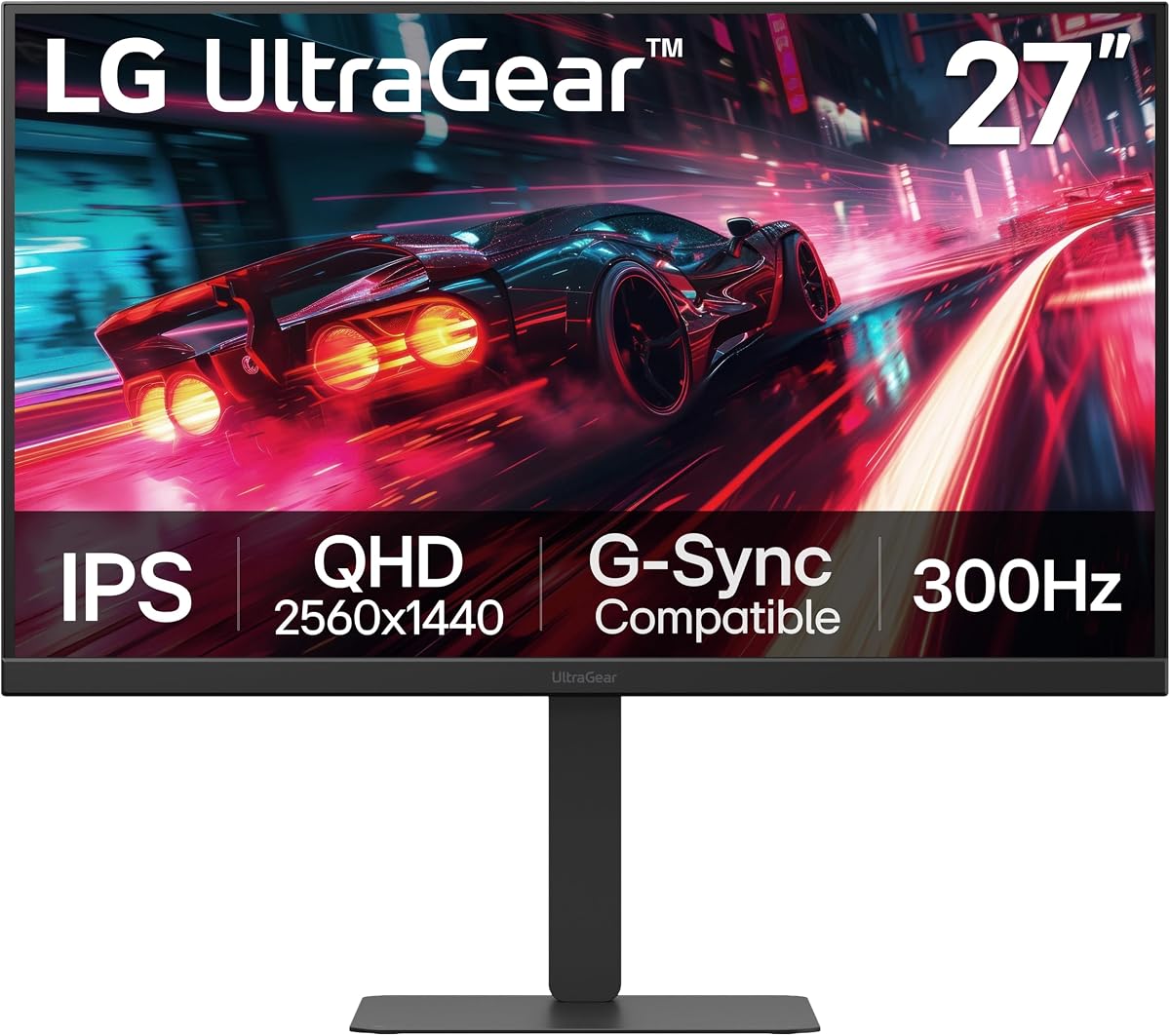
The LG UltraGear 27G640A-B is the performance leader in this roundup, combining 2560 x 1440 IPS resolution with a 300Hz refresh rate and 1ms GtG response. Its 4.4 rating and extensive gaming features make it a strong premium choice for competitive PC players. Console users gain from the high-refresh capability and broad connectivity, although their actual frame rate remains tied to the console and game.
We may earn a commission when you buy through this link, at no additional cost to you.
Both AMD FreeSync Premium and NVIDIA G-SYNC compatibility are listed, allowing the monitor to adapt its refresh behavior to different graphics hardware. VESA DisplayHDR 400 and up to 95% DCI-P3 coverage support rich, high-fidelity visuals. Dynamic Action Sync, Black Stabilizer, an FPS counter, and a crosshair round out a competitive toolkit that can be useful in console shooters as well.
Connectivity is a major strength. Dual HDMI 2.1 ports, DisplayPort 1.4, and USB Type-C with 15W power delivery support several source types and reduce the need for some adapters. The USB-C connection is not described as a full docking hub, so buyers should not assume it will operate multiple peripherals in the same way as the ASUS ROG XG27ACS's explicitly stated hub.
Physical adjustment is comprehensive. The stand provides tilt, height, swivel, and pivot controls, allowing the display to suit both a conventional desk and an entertainment-center position. That versatility makes the 300Hz specification more practical for mixed use, rather than limiting the monitor to a tightly optimized competitive rig.
The 27G640A-B is best for buyers who want maximum performance headroom, excellent motion response, modern ports, and a flexible stand. A console-only buyer may not use the 300Hz mode regularly, but the 1440p IPS panel, HDR support, color coverage, and useful gaming utilities still make it a capable display. It is most compelling when the same screen serves high-end PC gaming and console play.
The 300Hz panel provides substantial room for very fast competitive PC games and high-refresh console modes. Even when a source cannot reach that rate, the monitor's low-latency design and 1ms GtG response help preserve a crisp presentation during fast movement.
Dual HDMI 2.1, DisplayPort 1.4, and USB Type-C with 15W power delivery cover a wide range of source devices. Tilt, height, swivel, and pivot adjustments provide more placement flexibility than most other monitors in this group.
We may earn a commission when you buy through this link, at no additional cost to you.
The MSI G272QPF is a capable 27-inch QHD gaming monitor built around a Rapid IPS panel, 170Hz refresh rate, and stated 1ms response time. Its 4.2 rating is the lowest among the ten products in this guide, but the underlying specifications remain competitive. The display also supports G-SYNC compatibility, HDR readiness, adaptive synchronization, and extensive stand adjustment.
We may earn a commission when you buy through this link, at no additional cost to you.
Its 2560 x 1440 resolution is the core console-gaming advantage. The panel delivers more visible detail than 1080p while its 178-degree viewing angle helps preserve clarity when the player is not directly centered. A 170Hz refresh rate offers useful headroom for high-frame-rate PC gaming and can accommodate compatible high-refresh console modes.
The supplied information is less detailed than several competitors' entries. Specific HDMI and DisplayPort versions are not stated, and the exact HDR format, brightness, color-gamut measurements, and port quantities are also absent. Buyers should confirm these details, particularly HDMI capabilities, before choosing it for a console-first setup. The listed 1ms figure should also be understood within the context of the manufacturer's response-time specification.
MSI's stand adjustment is a major strength. Tilt, swivel, height adjustment, and pivot make it easier to adapt the screen to different furniture, viewing angles, and multi-device arrangements. This flexibility helps offset its lower overall rating, particularly for buyers who place a 27-inch monitor on a shared desk or entertainment unit.
The G272QPF is worth considering when 1440p clarity, fast motion, flexible positioning, and broad synchronization support matter more than having the highest refresh rate. It is a practical alternative to the 180Hz models in this list. Confirming the final port specifications and supported console modes before purchase would make it easier to integrate into an existing setup.
The 2560 x 1440 panel offers a substantial step up in detail from 1080p, which can make text, interface elements, and distant scenery look cleaner. Its 178-degree viewing angle also gives console players more freedom to sit slightly off-center.
Tilt, swivel, height adjustment, and pivot support make this monitor adaptable to desks, stands, and entertainment furniture. These physical controls are useful when the display must serve both a console and a regularly used PC workstation.
We may earn a commission when you buy through this link, at no additional cost to you.
The best 1440p IPS monitor for console gaming balances image clarity, motion performance, source compatibility, and physical setup. Because console capabilities and monitor specifications vary, buyers should evaluate each display as part of a complete gaming system rather than focusing on refresh rate alone.
A native 2560 x 1440 panel provides enough horizontal and vertical detail to make games, menus, and on-screen text look noticeably cleaner than 1080p. This is especially visible on a 27-inch display and when the player sits close to the screen. Some consoles can output at higher resolutions when paired with compatible displays, but the game, system settings, and connection must all support the desired mode.
Choose a monitor whose official specifications explicitly state 2560 x 1440 as its native resolution. Do not assume that every 27-inch IPS gaming monitor qualifies, because screen size and panel technology alone do not establish resolution. The Gigabyte GS27QA SA requires particularly careful verification because its supplied title identifies it as FHD.
Refresh rate determines how many times the display updates each second, while response time influences how quickly pixels change from one color or brightness to another. A 180Hz or 240Hz panel can present fast motion more smoothly than a standard 60Hz screen, although actual benefits depend on the source producing enough frames. Console frame rates are often lower than the monitor's maximum, but a higher ceiling still provides a more capable display for mixed PC and console use.
For most console-focused buyers, 180Hz is a strong target, while 240Hz or 300Hz matters more to competitive PC gamers. Treat advertised response times carefully: MPRT and GtG are different measurements, and real-world clarity also depends on panel behavior, settings, lighting, and frame rate.
The connection interface determines which resolution and refresh combinations a console can deliver. HDMI 2.0 is common on many 1440p gaming monitors and can support high-refresh console modes, while HDMI 2.1 provides more bandwidth for the latest consoles and compatible PC sources. DisplayPort is valuable for PC gaming and variable-refresh support but is not the normal way to connect a home console.
Check port versions, quantities, and supported input modes before purchasing. G-SYNC compatibility and AMD FreeSync primarily benefit PC graphics cards, so they should not be treated as the deciding factors for a console-only setup. The most important console-related question is whether the desired 1440p picture and available high-refresh mode work over the included or required cable.
HDR support can add brighter highlights, richer color, and better separation in dark scenes when the game, console, and display settings all support it. However, the HDR label alone does not indicate how strong the effect will be. Peak brightness, contrast behavior, local-dimming capability, and room conditions all influence the result. A monitor rated for HDR may still look best in SDR for fast competitive play.
IPS panels generally provide consistent color and wide viewing angles. The Acer Nitro KG271U lists DCI-P3 95% coverage, while the LG 27GR83Q-B and 27G640A-B also list up to 95% typical DCI-P3 coverage. The ASUS TUF VG27AQ3A lists 130% sRGB. These values are useful for judging broad color capability, but direct comparisons remain approximate unless measurements use the same methodology.
Display utilities can improve visibility or make competitive games easier to navigate. Black Equalizer, Black Stabilizer, Shadow Control, and Game Mode presets help tune brightness for different scenes. Crosshairs, Virtual Aim Point, an FPS counter, and genre-specific modes may be useful for shooters and competitive titles, though they can be distracting in cinematic games.
Choose a monitor whose tools match the player's habits rather than assuming every extra feature is beneficial. Console users may also value Auto Source Switch+, which is designed to move between connected sources, and gaming presets that can be adjusted directly through the on-screen display. Always confirm that the features work with the console's signal and remain accessible through the included controls.
A monitor that looks good on paper can still be frustrating if it cannot be positioned comfortably. Height adjustment is important for aligning the screen with a desk or entertainment center, while tilt, swivel, and pivot make it easier to change viewing direction. VESA compatibility offers an additional route to positioning through a compatible arm or wall mount.
The Acer Nitro XV271U M3, Samsung Odyssey G5 G50F, LG 27GR83Q-B, LG 27G640A-B, and MSI G272QPF list substantial adjustment support, although their exact combinations differ. The AOC Q27G41ZE is more limited, with tilt adjustment only. Consider monitor depth, desk clearance, viewing distance, and whether the stand base conflicts with a console or soundbar.
A useful console setup often needs more than one video input. Two HDMI ports allow a console and a PC or streaming device to remain connected simultaneously, while DisplayPort can serve a computer and audio-out can feed external speakers or a receiver. USB Type-C may add power delivery, peripheral connectivity, or both, but these functions differ between models.
The ASUS ROG XG27ACS explicitly provides a USB-C hub, and the LG 27G640A-B supports USB Type-C with 15W power delivery. By contrast, the Acer Nitro XV271U M3 includes both DisplayPort and HDMI cables. Consider which cables are supplied, whether your console requires a specific cable, and how you plan to route power, audio, and peripherals before choosing the final model.
The monitor's finish, bezel design, and stand should complement the rest of the gaming setup, particularly if it will be visible from a sofa. The AOC Q27G41ZE uses a three-sided frameless design and a textured black-and-red finish, while the Acer KG271U emphasizes a zero-frame appearance. These visual traits do not affect performance, but they influence how comfortably the display fits a room.
Look for a design that does not overpower a compact entertainment center and a stand that suits your furniture. Also consider cable routing, because a narrow bezel is less useful if multiple thick cables must remain exposed. Appearance should be considered alongside measured features and compatibility rather than as a substitute for them.
Begin by connecting the console to the preferred HDMI input and select that source through the monitor's controls. If using the display with a PC as well, connect the computer through DisplayPort or the alternate HDMI port where applicable. Use the resolution and refresh-rate menu to select the highest mode supported by the console, game, and cable, then enable the console's matching output setting. Allowing the system to negotiate a compatible mode is often more dependable than forcing an unsupported combination.
After choosing the correct input, adjust brightness and contrast while viewing ordinary gameplay rather than a bright desktop menu. IPS panels are often most accurate at standard or lower brightness, so reducing excessive backlight can improve visible detail without sacrificing punch. If the monitor includes game-specific modes, test them one at a time and retain the most neutral mode for single-player games. Competitive players can then add a shadow-enhancement tool, crosshair, or FPS counter if those aids suit their preferences.
For daily care, clean the screen with a soft, lint-free microfiber cloth and avoid household cleaners, ammonia, or moisture around the bezel. Do not press on the panel or use abrasive pads. Keep vents unobstructed, route cables so they do not pull against the connectors, and adjust the stand within its supported range. Periodically check the console's display settings and the monitor's on-screen display after a system update, since firmware or software changes can affect supported modes and behavior.
Yes, a native 1440p IPS monitor is an excellent console-gaming choice because it combines sharper detail than 1080p with consistent color and wide viewing angles. A compatible console may also offer high-refresh output over suitable HDMI connections. The available refresh rate depends on the console model, game, selected mode, and monitor, so owners should verify supported resolutions before purchasing.
Usually not, because most current console games do not consistently generate enough frames to use the highest monitor refresh rates. A 144Hz-capable model is often more practical for console-only use, while 180Hz to 300Hz becomes more valuable when the same monitor is also used for competitive PC gaming. The additional refresh capability does not improve games that render at lower frame rates.
FreeSync and G-SYNC are primarily PC graphics technologies and should not be treated as universal console synchronization features. Their value depends on the connected graphics hardware and the monitor's compatibility implementation. Console users should instead focus on HDMI version, supported input modes, resolution, refresh rate, and whether the game or console offers its own high-refresh or variable-refresh behavior.
HDR can improve highlights, shadow detail, and perceived image depth in compatible games, but the effect depends on display quality, source support, and room lighting. A monitor carrying an HDR label may not deliver dramatic results if its brightness and contrast performance are modest. Competitive players may also prefer a brighter SDR image for clearer visibility in bright rooms.
IPS is often preferred for shared or off-center viewing because it generally provides consistent colors and wide viewing angles. VA can offer deeper contrast and less light leakage, but its slower pixel transitions may appear as smearing in fast motion. The best choice still depends on refresh rate, response behavior, room placement, and personal preferences rather than panel technology alone.
A 27-inch 1440p monitor offers a strong balance of detail and physical size for desk gaming and many living-room setups. Larger screens can make console games more cinematic, but they require more viewing distance and may reduce pixel density at the same resolution. Choose a size that fits the room and remains comfortable to view rather than relying on screen size alone.
It is wise to check the console's display output menu after connection. Select 1440p if the console and game support it, then choose a compatible high-refresh mode when available. If the image looks soft, appears cropped, or runs at an unexpected refresh rate, cycling the console output mode or reconnecting the cable can help the system establish the correct display configuration.
Stand adjustment is especially important if the monitor will alternate between a desk and an entertainment center, or if it must align with a console positioned below or beside the screen. Height, tilt, swivel, and pivot can reduce neck strain and improve the viewing angle. Models such as the Acer Nitro XV271U M3, LG 27G640A-B, and MSI G272QPF provide especially broad adjustment.
The AOC Q27G41ZE is the strongest all-around recommendation because it combines a sharp 2560 x 1440 IPS panel, 240Hz DisplayPort performance, adaptive synchronization, useful gaming controls, and convenient HDMI connectivity. The Acer Nitro KG271U is the budget-oriented selection for players seeking QHD detail, up to 180Hz, fast GTG response, and DCI-P3 95% without prioritizing every premium feature. The ASUS TUF VG27AQ3A stands out as a feature-rich premium option with broad synchronization, ELMB Sync, HDR-10, and built-in audio.
Prioritize the features your console can actually use. Native 1440p support, suitable HDMI connectivity, and a high-refresh mode that the console and game can deliver come before extreme PC-focused specifications. For a mixed setup, also consider USB-C hubbing, audio output, wide stand adjustment, and G-SYNC or FreeSync support. For competitive console shooters, consider shadow-enhancement tools and crosshairs, while cinematic players may place more value on HDR, color accuracy, and viewing angle.
Before ordering, verify the exact resolution, port versions, supported refresh modes, stand features, and HDR details in the current listing. Models such as the Gigabyte GS27QA SA need particular attention because the supplied title does not clearly identify a 1440p panel. Promotional terms and availability can change, so checking the latest manufacturer information and seller listing will help ensure that the chosen monitor integrates cleanly with the console and the rest of the setup.