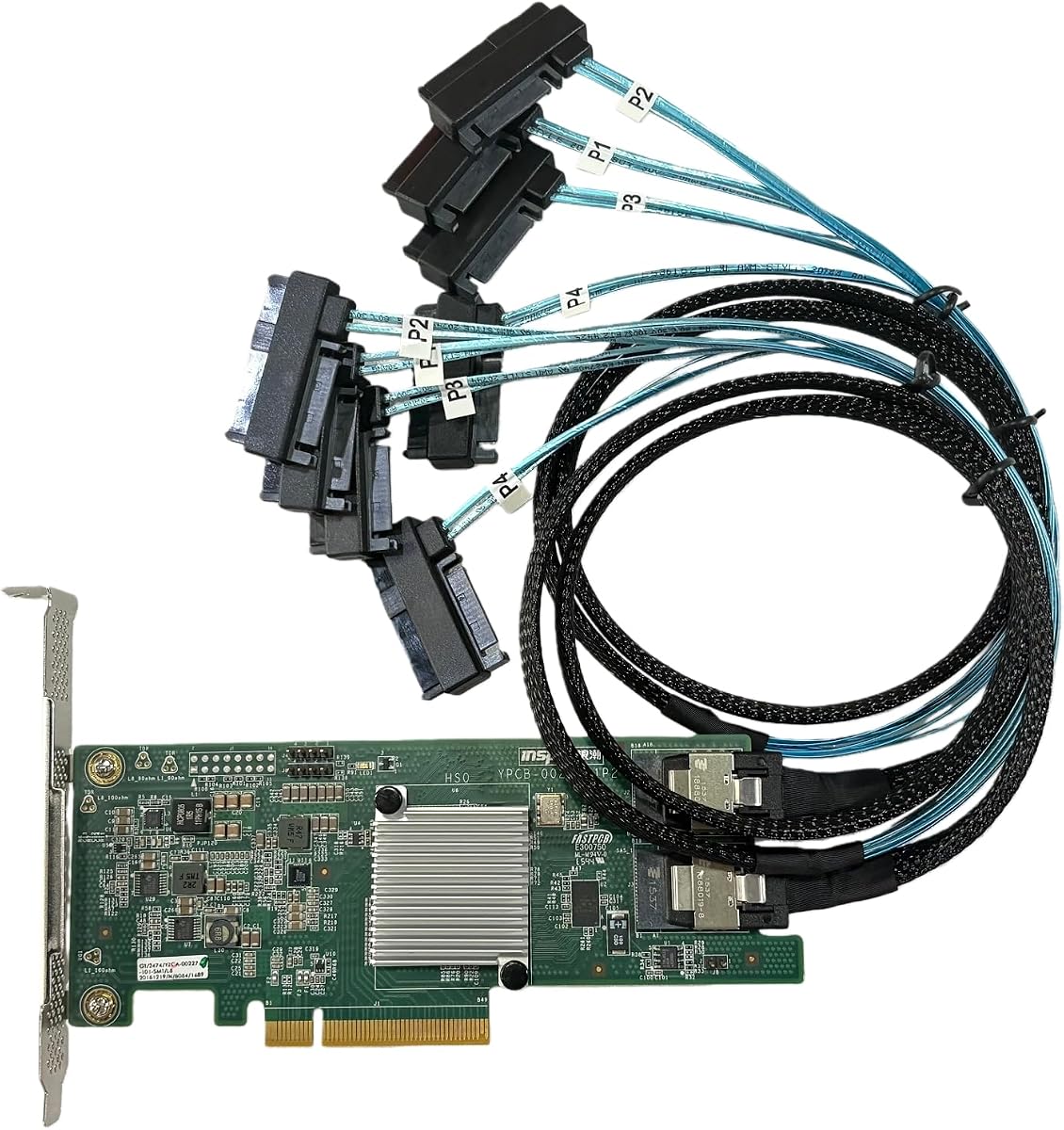
SAS2308 9207-8i IT HBA
4.7Editor score
Six-Gbps SAS transfer rate
Eight-port SAS2308 controller
Includes two SAS cables
Includes low-profile bracket
This guide compares the best SAS card for PC options, covering controller compatibility, IT mode, drive connections, expansion potential, and included cables.
A SAS card for PC adds a dedicated path for connecting compatible hard drives or SSDs, making it useful for NAS builds, ZFS storage, home labs, and expanded workstation storage. The right choice depends on controller support, IT-mode firmware, connector layout, PCIe compatibility, and whether your chosen drives use SATA or SAS cabling.
We compared all ten listed products by examining their stated controllers, transfer rates, host interfaces, internal connectors, drive capacity, included accessories, and intended operating systems. The list covers SAS3008-based eight-port cards, a SAS3224 sixteen-port card, an older SAS2308 model, a SATA expansion controller, and one unrelated Thunderbolt product included for transparency.
Each review explains where the product fits, along with its practical strengths and limitations. Ratings reflect the supplied listing information, while products without a published rating are shown without one. Availability, bundle contents, firmware details, and pricing can change, so verify the current listing before purchasing.
4.7Editor score

5.0Editor score
This side-by-side comparison organizes every listed option by controller, interface, connectivity, and practical bundle value, including one product that is not actually a SAS expansion card.


This SAS HBA is listed for systems using the LSI 9300-8i and SAS3008 controller, with IT-mode firmware for non-RAID, pass-through-style storage work. It carries a 4.5 rating, and its most useful combination is a modern 12Gb/s SAS interface with support for SATA devices, making it relevant to home labs, NAS projects, and ZFS or TrueNAS environments.
We may earn a commission when you buy through this link, at no additional cost to you.
The card uses a PCIe 3.0 x8 host interface and provides two Mini-SAS HD SFF-8643 connectors. Up to eight drives can be attached directly, and a compatible external SAS expander can extend the storage arrangement further. The package includes two SFF-8643-to-four-SATA cables, each with four SATA ends, so a SATA-only system can begin with useful connectivity out of the box.
The important limitation is that those supplied cables are only for SATA drives. SAS drives require SFF-8643-to-SFF-8482 SAS cables, which are not included. This distinction matters because the drive-facing connector on a SAS drive is different from the SATA power and data interface, even though the controller can operate with both types of equipment when correctly cabled.
This is a strong choice for a builder who specifically needs SAS3008 or 9300-8i compatibility, values 12Gb/s SAS capability, and wants a ready-made SATA bundle. It is less suitable for someone seeking only SATA expansion with no SAS controller requirement, or for a system whose motherboard or chassis lacks an available PCIe slot and physical room for the card.
Two internal SFF-8643 connectors create a useful eight-drive foundation. That capacity can be expanded through a compatible SAS expander, making the card suitable for projects that begin modestly but may grow.
The included breakout cables connect the internal Mini-SAS connectors to eight SATA endpoints. They reduce the need to source matching SATA cables immediately, although they do not support SAS drives.
We may earn a commission when you buy through this link, at no additional cost to you.
This option is listed for both the LSI 9211-8i and 9300-8i, using a Broadcom or LSI SAS3008 eight-port controller. Its 4.2 rating is lower than several alternatives, but the broader stated model compatibility may make it appealing to builders who already know which legacy HBA their motherboard, chassis, or planned system requires.
We may earn a commission when you buy through this link, at no additional cost to you.
The controller runs in IT mode for non-RAID operation and supports data rates up to 12Gbps for SAS and 6Gbps for SATA. A PCIe 3.0 x8 interface and two SFF-8643 internal connectors support as many as eight directly attached drives, with additional capacity possible through a compatible SAS expander.
Two SFF-8643-to-four-SATA cables are included, providing eight SATA ends. As with the first-ranked product, these are exclusively SATA breakout cables and cannot be used with SAS drives. A build incorporating enterprise SAS disks must budget for the correct SFF-8643-to-SFF-8482 wiring or use a suitable matched card-and-cable bundle.
Choose this card when compatibility with either named 9211-8i or 9300-8i platform is more important than having a cable bundle for SAS drives. It offers the same core 12Gb/s SAS3008 platform as the leader, but the lower rating and narrower stated compatibility make it less compelling as a general recommendation.
Explicit support for both 9211-8i and 9300-8i platforms is the defining benefit. This gives builders with either controller family a clearer fit than a generic expansion card.
The included breakout cables provide eight SATA endpoints across two internal connectors. They are useful for immediate SATA-only installations but require replacement for SAS equipment.
We may earn a commission when you buy through this link, at no additional cost to you.
The SAS2308 9207-8i provides an eight-port HBA based on the older SAS2308 controller generation. Its listed 4.7 rating is among the strongest in the group, while the 6Gb/s transfer rate and included SFF-8087-to-SFF-8482 cables distinguish it as a value-oriented option for compatible legacy systems.
We may earn a commission when you buy through this link, at no additional cost to you.
LSI P20 IT-mode firmware is listed alongside support for ZFS, FreeNAS, and unRAID. The card uses PCIe 3.0 x8 and includes a high and low-profile bracket, which adds installation flexibility for desktop, server, and compact NAS chassis where bracket clearance may matter.
Its main drawback is generational. Six-Gbps SAS is slower on paper than the 12Gbps offered by SAS3008-based cards, and the older controller may not be the correct match for a system designed around a 9300-8i. Buyers should therefore treat compatibility as more important than headline transfer speed.
This is a compelling budget choice when the target system uses a 9207-8i or compatible SAS2308 platform, particularly if the included SAS cables and low-profile bracket reduce extra purchases. It is less appropriate for a new build specifically seeking 12Gb/s SAS3008 performance or a 9300-8i-based design.
Unlike the SATA bundles in several SAS3008 listings, the two included SFF-8087-to-SFF-8482 cables are intended for compatible SAS drives. That makes the package more relevant to mixed or SAS-focused storage installations.
Both standard and low-profile brackets are included. This broadens the range of cases and systems in which the HBA can be installed without sourcing another bracket.
We may earn a commission when you buy through this link, at no additional cost to you.
This SAS3008-based card is listed for compatibility with the 9300-8i, 9211-8i, and 9207-8i, covering three commonly referenced eight-port HBA platforms. It operates in IT mode for pass-through storage use and supports 12Gb/s SAS or 6Gb/s SATA through a PCIe 3.0 x8 interface.
We may earn a commission when you buy through this link, at no additional cost to you.
Two SFF-8643 internal connectors allow up to eight drives to be connected directly, with further expansion possible through a compatible SAS expander. The supplied SFF-8643-to-SFF-8482 cables are described as supporting compatible SAS and SATA drives, reducing uncertainty about which cable type is needed for a new installation.
The listing does not provide a current rating, so the product cannot be compared numerically with the rated alternatives. Buyers should give extra attention to the exact stated compatibility, physical dimensions, and operating-system support of the complete system before ordering.
The product is an excellent fit for a SAS-focused build that wants a 12Gb/s SAS3008 card, broad support for three named controller models, and applicable SAS cabling in the box. It is particularly attractive when the included cable type matches the planned drives and otherwise would need to be purchased separately.
Support for the 9300-8i, 9211-8i, and 9207-8i gives the card broad relevance across related eight-port LSI platforms. Buyers should still verify physical and firmware requirements rather than relying on the model name alone.
The two SFF-8643-to-SFF-8482 cables are designed for compatible SAS and SATA equipment. They offer a more direct starting point for installations using the appropriate drive connections.
We may earn a commission when you buy through this link, at no additional cost to you.
This card is listed for the D3307 and LSI 9300-8i, using an LSI or Broadcom SAS3008 controller in the 9300-8i class. It has a 5.0 listing rating and presents a clean, technically focused option for builders who already understand the exact cabling and expander requirements of their storage design.
We may earn a commission when you buy through this link, at no additional cost to you.
The HBA provides IT-mode non-RAID firmware, up to 12Gbps SAS throughput, backward compatibility with 6Gbps SATA, and a PCIe 3.0 x8 host interface. Its two Mini-SAS HD SFF-8643 connectors support up to eight directly connected drives, while an external SAS expander can extend the design to larger arrays.
Only the card is listed in the packing list, which is the principal tradeoff. The absence of breakout cables means buyers must obtain the correct SFF-8643-to-SATA or SFF-8643-to-SFF-8482 leads for their drives. It also offers no bracket information, so chassis requirements deserve careful attention.
Despite the missing accessories, it is the strongest overall recommendation for a builder centered on the 9300-8i platform because it combines a perfect rating, modern SAS speed, broad drive support, and a straightforward eight-port foundation. It is ideal for experienced users or systems that already have the correct cabling.
The SAS3008 platform supports up to 12Gbps SAS while remaining compatible with 6Gbps SATA devices. This makes it a practical bridge between enterprise-style SAS storage and ordinary SATA media.
Shipping with only the card gives experienced builders control over the exact cable set and topology. It is less convenient for newcomers who want a complete plug-and-play bundle.
We may earn a commission when you buy through this link, at no additional cost to you.
This 9300-8i and 9211-8i-compatible SAS3008 card combines a 5.0 listing rating with a useful selection of included accessories. It also states support for the 9207-8i, giving the product broader relevance across the same family of eight-port adapters represented elsewhere in the list.
We may earn a commission when you buy through this link, at no additional cost to you.
IT-mode firmware and a pass-through storage design suit ZFS, FreeNAS, TrueNAS, unRAID, Proxmox, and ESXi-oriented home labs. The PCIe 3.0 x8 host interface and two SFF-8643 internal connectors support eight direct drive connections at rates up to 12Gbps for SAS and 6Gbps for SATA.
Two SFF-8643-to-SFF-8482 SAS cables are included and are described as supporting compatible SAS and SATA drives. That makes the package more practical for a SAS-oriented build than a card supplied only with SATA breakouts, although the connector standard still needs to match the chosen equipment.
This card is a well-balanced choice for a builder who wants a high-rated SAS3008 adapter, modern transfer capability, and applicable cables in the package. It is especially attractive for systems known to use the 9211-8i or 9300-8i, provided the installer confirms physical fit and platform support.
The perfect listing rating is encouraging, although it should not replace compatibility checks. The technical foundation is appropriate for common NAS and home-lab storage roles.
The two included SFF-8643-to-SFF-8482 cables eliminate the need to find that exact cable type at the outset. They remain appropriate only for equipment that matches the stated standards.
We may earn a commission when you buy through this link, at no additional cost to you.
The ASUS ThunderboltEX 4 is an expansion card for Thunderbolt and display connectivity, not an SAS HBA or internal storage controller. It uses an Intel Thunderbolt 4 JHL 8540 controller, includes two USB Type-C ports, and carries a listed rating of 3.9, but it does not satisfy the core function of connecting SAS hard drives.
We may earn a commission when you buy through this link, at no additional cost to you.
Its notable capabilities are up to 40Gb/s bidirectional bandwidth per port, support for daisy-chaining as many as five Thunderbolt-enabled devices, DisplayPort 1.4 output supporting up to 8K resolution, and charging up to 100W. These features serve docks, displays, and Thunderbolt peripherals rather than direct-attached storage arrays.
The card contains no stated SAS controller, SFF-8643 connectors, IT-mode firmware, or SATA breakout support. It therefore cannot substitute for one of the SAS3008, SAS2308, or SAS3224 adapters in this comparison, and it should not be included in a shortlist based solely on its PCIe expansion-card form factor.
This product is relevant only to a buyer who needs Thunderbolt 4 expansion in a desktop and has independently determined that a SAS card is not required. For a NAS, ZFS storage array, or multi-drive SAS project, choose one of the purpose-built HBAs instead and verify the required drive cables and controller compatibility.
The two Type-C ports provide high-bandwidth connectivity for compatible Thunderbolt devices. That is valuable for docks and display workflows, but it does not create a SAS storage path.
DisplayPort 1.4 support and charging up to 100W broaden the card's appeal as a workstation connectivity accessory. Neither feature is relevant to direct drive management.
We may earn a commission when you buy through this link, at no additional cost to you.
This card combines a SAS3008 controller, a 5.0 listing rating, and a bundle of SATA breakout cables. It is stated as compatible with the 9300-8i, 9211-8i, and 9207-8i, making it a relevant choice for systems that use one of those common eight-port platforms.
We may earn a commission when you buy through this link, at no additional cost to you.
The HBA uses IT-mode non-RAID firmware and a PCIe 3.0 x8 interface. Two SFF-8643 internal connectors support up to eight direct drive connections, while compatible SAS expanders allow larger arrays. The controller supports data rates up to 12Gbps for SAS and 6Gbps for SATA.
The included SFF-8643-to-SATA cables are expressly for SATA drives and cannot be used with SAS drives. A buyer planning enterprise SAS equipment must obtain SFF-8643-to-SFF-8482 cables separately, while a SATA-only build can use the supplied leads directly.
This option is well suited to a new NAS or home-lab build that primarily uses SATA hard drives and SSDs. Its perfect rating, modern controller capability, and included SATA cables simplify the first stage of assembly, provided the installer understands that the cable set changes for SAS media.
Two included breakout cables create eight SATA endpoints for immediate storage expansion. This makes the card convenient for assembling a SATA-based array without ordering those leads separately.
Although the initial bundle targets eight SATA drives, compatible expander support provides a path to larger arrays. The final topology must use appropriate cabling and power planning.
We may earn a commission when you buy through this link, at no additional cost to you.
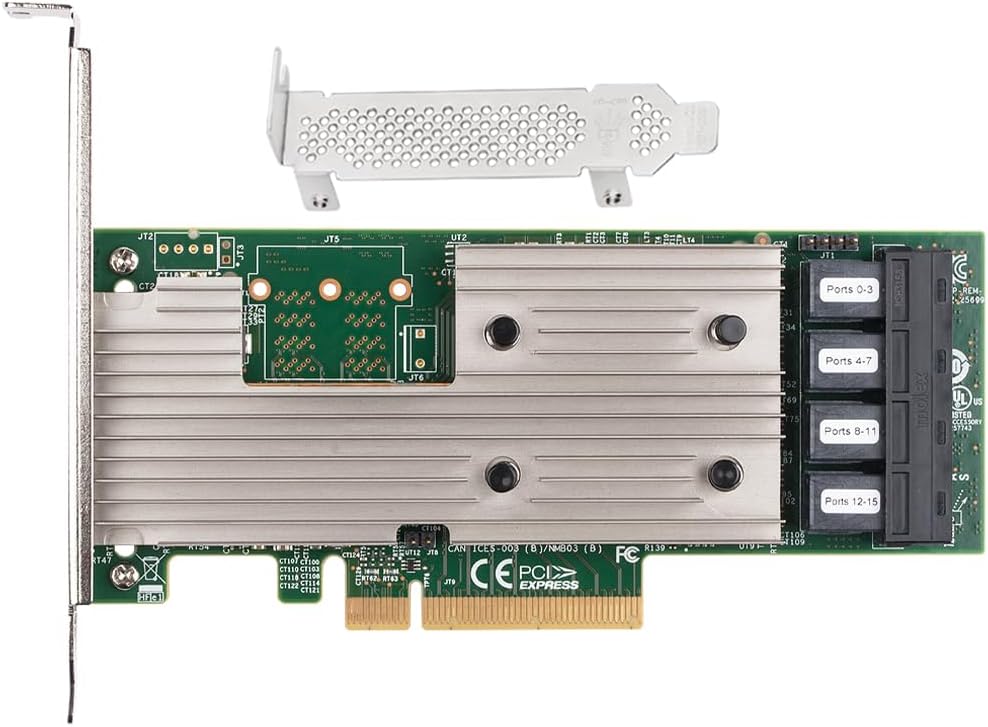
The SAS3224 9305-16i stands apart from the eight-port cards in the list by providing four Mini-SAS HD SFF-8643 connectors and support for as many as sixteen directly attached drives. It is listed for the LSI 9305-16i platform and uses the Broadcom or LSI SAS3224 controller.
We may earn a commission when you buy through this link, at no additional cost to you.
The card runs in IT mode for non-RAID storage use and supports up to 12Gbps SAS and 6Gbps SATA through a PCIe 3.0 x8 host interface. A compatible SAS expander can extend the design beyond the sixteen direct connections, making this the strongest listed option for storage systems expected to grow substantially.
Only the HBA card is included, and no current rating is provided. Buyers must therefore source the correct breakout or SAS cables separately and should carefully confirm chassis clearance, available power, and operating-system support. The greater connector count also requires more disciplined cable routing and airflow planning.
This is the top choice for a high-drive-count NAS, storage server, or lab where sixteen direct connections are important. It is overkill for a compact workstation or small two- or four-drive expansion, but it provides the greatest stated direct-attachment capacity in this comparison.
Four SFF-8643 connectors and sixteen direct drive positions distinguish this card from the eight-port alternatives. That density is valuable for storage enclosures and larger home-lab arrays.
Compatible expander support means the initial sixteen-drive design does not have to be the final limit. It remains essential to budget for suitable internal and external cabling.
We may earn a commission when you buy through this link, at no additional cost to you.
The RIITOP card is a SATA expansion solution rather than a SAS HBA. It converts one available PCIe connection into two internal SFF-8643 ports, with each port capable of connecting to four SATA drives through suitable breakout cables for a stated maximum of eight HDDs or SSDs.
We may earn a commission when you buy through this link, at no additional cost to you.
Its upstream link uses a PCIe Gen3 x2 configuration and is described as providing up to 16Gbps of bandwidth. The drive side operates at SATA 6Gbps, which is the standard SATA III rate, but it does not provide the 12Gb/s SAS capability of the genuine SAS controllers in this guide.
The card includes a low-profile bracket but does not include SFF-8643-to-SATA breakout cables. It is described as compatible with desktop PCs, servers, NAS systems, NVR or DVR systems, and industrial computers, with stated support for Windows 10, Windows 8, Linux, and Mac OS.
Choose it when the objective is straightforward SATA capacity and an SFF-8643 backplane rather than enterprise SAS connectivity. It should not be selected for a build requiring IT-mode SAS firmware, SFF-8482 SAS drive support, or 12Gb/s SAS operation.
Two internal SFF-8643 ports can support up to eight SATA devices when paired with appropriate breakout cables. This is a useful capacity increase for compatible NAS and server layouts.
Each SATA connection has an independent activity LED, while an aluminum heatsink supports heat dissipation. The gold-plated PCIe edge connector is also designed to improve conductivity.
We may earn a commission when you buy through this link, at no additional cost to you.
A reliable SAS card for PC selection begins with the controller and drives already in the build. Interface speed, connector standards, firmware mode, physical fit, and operating-system support then determine whether the card will work as intended.
Start with the exact controller generation that your motherboard, chassis, backplane, or planned storage design expects. The list includes SAS3008-based cards associated with the 9300-8i, 9211-8i, and 9207-8i, an older SAS2308 controller, and a SAS3224 card associated with the 9305-16i. These are not automatically interchangeable even when they use similar PCI Express interfaces, Mini-SAS connectors, or the word IT mode.
Model numbers in a product title are useful clues, but they are not a substitute for checking the complete system specification. Consider the card's firmware, platform layout, physical bracket, slot width, and the requirements of the operating system that will load the driver. A card can advertise an impressive transfer rate and still be unsuitable if its controller family does not match the intended platform.
Verify controller compatibility before considering cost, accessories, or ratings.
Most of the genuine SAS options in this guide are specified in IT mode, which is described as non-RAID or pass-through operation. This is the usual preference for ZFS, FreeNAS, TrueNAS, unRAID, Proxmox, and ESXi-oriented home labs because the storage software can manage the individual drives and pooling rather than relying on a hardware RAID layer.
IT mode does not eliminate the need for sound configuration. Drive formatting, controller drivers, operating-system recognition, and storage-software settings still matter. It also does not make every drive type interchangeable: the drive's power and data connectors, the cable standard, and the HBA's supported protocols must all align.
Choose IT mode for software-managed arrays, then match every cable to the drive type.
A SAS controller can support SATA devices when the proper breakout cables are used, but SAS and SATA drives do not use the same physical connection. The listed SFF-8643-to-SATA cables terminate in SATA connectors, while SFF-8643-to-SFF-8482 or SFF-8087-to-SFF-8482 leads are intended for compatible SAS drives.
Several bundles look complete at first glance but include only SATA cables. Others include SAS-oriented leads. Check the packing list carefully, count the drive endpoints you need, and determine whether your system uses backplanes with fixed connectors. It is also important to recognize that an ordinary SATA power lead is separate from the data cable and must still be available for each drive.
Match the cable connector to the drive, and count every required data endpoint.
The genuine SAS HBAs in this list use a PCIe 3.0 x8 host interface, while the RIITOP SATA expansion card uses a PCIe x4 form factor with a PCIe Gen3 x2 interface. The slot must have the appropriate physical length, provide a compatible lane configuration, and leave room for the card in the chassis.
Bandwidth is rarely the only limiting factor in a multi-drive array, since actual throughput depends on the drives, workload, controller, and system architecture. However, using a reduced-width slot or a heavily shared platform may prevent the card from operating at its stated interface rate. Server motherboards may also have slot-sharing arrangements that require special attention.
Confirm physical fit, available lanes, and slot-sharing rules before ordering.
The most common genuine SAS options in this comparison provide two Mini-SAS HD SFF-8643 connectors and support up to eight directly attached drives. The SAS3224 card provides four SFF-8643 connectors and up to sixteen direct connections. The RIITOP SATA card also uses two SFF-8643 connectors, but its purpose and protocol support differ.
Direct attachment capacity is not the same as total possible capacity. A compatible SAS expander can extend many genuine HBA designs, but it introduces another device that needs compatible cabling, adequate power, and careful topology. Compare both the immediate and expanded layouts rather than selecting solely on the number printed in a title.
Balance connector count against expansion complexity and available backplane options.
The SAS3008 and SAS3224 options are specified for up to 12Gb/s SAS and 6Gbps SATA, while the older SAS2308 card is listed at 6Gb/s SAS. The RIITOP controller also operates SATA drives at 6Gbps. These figures describe link capability, not guaranteed real-world file transfer speed.
Mechanical hard drives, consumer SSDs, workloads, queue depth, and the rest of the storage path can all limit results. A faster link remains useful for certain professional or multi-device workloads, but many home-lab and NAS builds prioritize compatibility, reliability, and correct drive handling over headline bandwidth.
Prioritize the protocol you need, not just the largest advertised rate.
The value of an accessory bundle depends on the exact installation. The SAS2308 option includes two SAS cables and both standard and low-profile brackets. The RIITOP SATA card includes a low-profile bracket but requires breakout cables. Several SAS3008 cards include SATA breakouts, some include SAS-oriented cables, and the card-only listings include no drive leads.
A complete bundle can reduce extra purchases, but only if its connectors match the planned drives and backplane. The list does not consistently specify bracket inclusion for every genuine HBA, so the chassis should be checked for height, slot clearance, airflow, and mounting requirements. Cables also need room to route without obstructing fans.
Treat included cables as useful only when their standards match the build.
The genuine SAS cards are positioned for ZFS, FreeNAS, TrueNAS, unRAID, Proxmox, and ESXi-related use, while the RIITOP card states support for several desktop, server, and Linux environments. These intended uses are a strong starting point, but the selected operating system must have appropriate driver and controller support.
For a home lab, check whether the system relies on PCIe passthrough, boot-device support, or automatic disk detection. For a NAS, verify the exact management interface and the expectations of the selected operating system. Hardware detection alone does not guarantee that every disk, enclosure, or feature will work as intended.
Confirm operating-system, driver, boot, and passthrough requirements before finalizing the purchase.
Before installing the card, power down the PC, disconnect the power supply, and follow the chassis manufacturer's instructions for opening the case. Confirm that an appropriate PCIe slot is available, that the card fits physically, and that any required low-profile or full-height bracket is installed. Connect the correct data cables only after the card is seated securely.
For a SATA-based arrangement, use the listed SFF-8643-to-SATA breakout leads and attach each drive with its own SATA data connection. For SAS drives, use the appropriate SFF-8643-to-SFF-8482 or SFF-8087-to-SFF-8482 cable. Route cables away from hot areas and fans, secure each connection, and ensure every hard drive has adequate SATA power.
After booting, install the appropriate controller driver and confirm that the HBA appears in the operating system or virtualization platform. Check drive detection before creating pools or assigning storage. Keep the system powered off before changing cabling, and avoid disconnecting devices while the operating system is actively using the array or while data is being written.
Yes, when the controller supports SATA and the correct SFF-8643-to-SATA breakout cable is used. A SATA data connector and SATA power connection are still required for each drive. Do not connect a SAS drive using a cable intended only for SATA drives, because the physical connector standards are different.
An HBA in IT mode generally passes individual drives through to the operating system or storage software. A hardware RAID card may combine drives into a RAID array and present the result as a virtual device. The cards in this guide are chiefly described as IT-mode, non-RAID HBAs for software-managed storage.
No. Controller generation, firmware, physical layout, connector type, and platform support all matter. The guide includes SAS3008-based options associated with several common eight-port models, an older SAS2308 card, and a SAS3224 sixteen-port card, but the complete system specification should be checked before selecting one.
Most of the genuine eight-port SAS3008 and SAS2308 options support up to eight direct drive connections across two SFF-8643 connectors. The SAS3224 9305-16i option supports up to sixteen direct connections through four connectors. Compatible expanders may allow larger arrays, but the required expander and cabling must be supported.
It depends on the selected listing. Some include SFF-8643-to-SFF-8482 SAS cables, some include SFF-8643-to-SATA breakout cables, the SAS2308 option includes SFF-8087-to-SFF-8482 cables, and the card-only options include no drive cables. Check the packing list and connector type before ordering.
No. It is a SATA expansion card that provides two internal SFF-8643 ports for connecting SATA drives through separate breakout cables. It lists SATA 6Gbps performance rather than 12Gb/s SAS capability and should be chosen only when SATA expansion is the actual requirement.
The genuine SAS products are specifically described for use with ZFS, FreeNAS, TrueNAS, unRAID, Proxmox, and ESXi-oriented storage applications. The operating system must support the controller and firmware, and the project may also require appropriate passthrough, driver, boot, or disk-identification configuration.
Confirm that the card is fully seated, the correct bracket is fitted, data cables match the drive connectors, every drive has power, and no cables obstruct airflow. After boot, install the appropriate driver and verify controller and disk detection before creating storage pools or moving important data.
The editor's choice is the SAS3008 9300-8i card for its 5.0 rating, 12Gb/s SAS capability, IT-mode operation, and suitability for modern eight-port storage systems. The SAS2308 9207-8i stands out as the budget pick when a six-Gbps legacy platform, included SAS cables, and a low-profile bracket align with the build. The SAS3224 9305-16i is the premium selection for projects that need sixteen direct drive connections.
Prioritize exact controller compatibility, IT-mode support, and the correct cable standard before considering accessories or transfer speed. A 12Gb/s card is not automatically better than a six-Gbps model if the former is incompatible with the target platform. For straightforward SATA-only expansion without enterprise SAS requirements, the RIITOP dual SFF-8643 controller serves a different and more modest role.
Review the current listing before purchasing because ratings, bundle contents, availability, and pricing can change. Confirm the included cables, chassis clearance, PCIe slot, expander requirements, operating-system support, and the exact drives you plan to connect. With those checks complete, the right SAS card for PC becomes much easier to select with confidence.